
Ezekiel 12:2

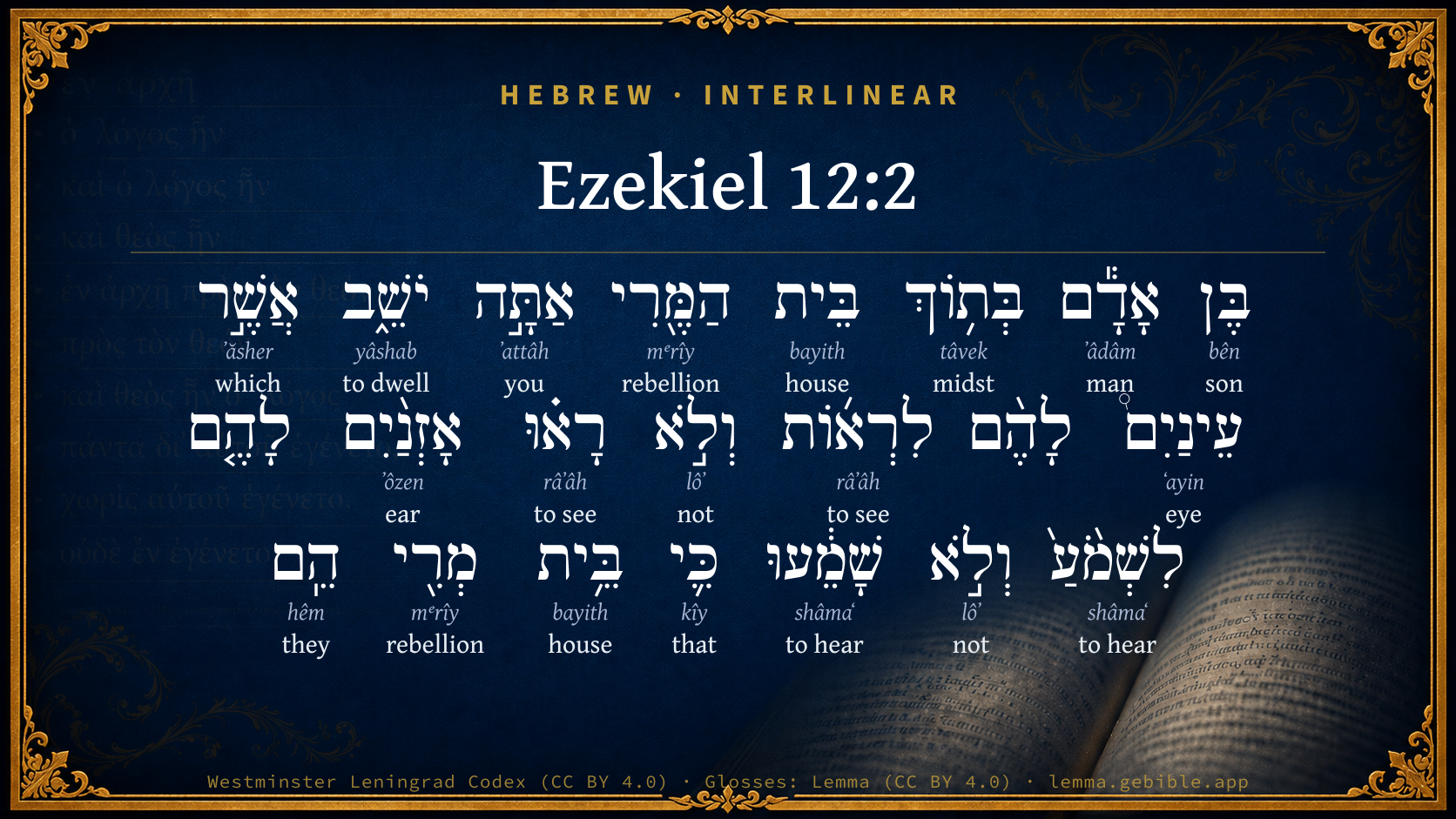
Hebrew (Westminster Leningrad Codex) Ezekiel 12:2 appears in the Hebrew Old Testament. The text above is from the Westminster Leningrad Codex. Each word links to its Strong’s number, a concise gloss, and parsing drawn from the Open Scriptures Hebrew Bible morphology. Click any word for its full Brown-Driver-Briggs (BDB) entry.
Download image
Cite this verse

Ezekiel 12:2 (World English Bible). Public Domain. Lemma interlinear Bible study tool, https://lemma.gebible.app/v/ezekiel/12/2.

Show BibTeX & RIS
BibTeX
RIS
English Translation
Son of man, you dwell in the midst of the rebellious house, who have eyes to see, and don't see, who have ears to hear, and don't hear; for they are a rebellious house.
World English Bible · Public Domain
Download a study sheet

One document with this verse’s original text, its word-by-word gloss line, the meaning frame, cross-references with their text, attributed commentary, and full source and license credits — printable, and it pastes into notes with its structure intact.

This verse Autodidact and up

Study sheet (.html) Plain text (.txt)

A passage Seminary Student

Up to 50 verses in one chapter. A passage sheet keeps up to 6 commentary sources and 12 cross-references per verse, in the order this page ranks them, and says so on the sheet whenever that leaves anything out. Ask for a single verse and you get the Autodidact verse sheet above.

Everything on this page stays free to read, with no account — the sheet is a download of what is already on screen, not access to it.

Want to remove ads? Support Godless Engineer
Compare translations 3

The same verse in 3 English versions, stacked beneath the original-language interlinear above. Click any original word for its lexicon entry.

Each is an independent rendering of the whole verse — the interlinear is not word-aligned to these translations.

Highlighted words mark where these versions differ — a whole-verse word diff, not a word-by-word alignment.

  • World English Bible Public Domain
    Son of man, you dwell in the midst of the rebellious house, who have eyes to see, and don't see, who have ears to hear, and don't hear; for they are a rebellious house.
  • King James Version Public Domain
    Son of man, thou dwellest in the midst of a rebellious house, which have eyes to see, and see not; they have ears to hear, and hear not: for they are a rebellious house.
  • unfoldingWord Literal Text CC BY-SA 4.0
    “Son of man, you live in the midst of a rebellious house, where they have eyes to see but they do not see; and where they have ears to hear but do not listen, because they are a rebellious house.

unfoldingWord Literal Text — © unfoldingWord, licensed CC BY-SA 4.0. Word-aligned USFM3 via Door43 (git.door43.org/unfoldingWord/en_ult).

Versions to compare (up to 4)

3 of 4 selected

Show all 18 translations

Every available English version of this verse, each an independent rendering of the whole verse.

  • World English Bible Public Domain
    Son of man, you dwell in the midst of the rebellious house, who have eyes to see, and don't see, who have ears to hear, and don't hear; for they are a rebellious house.
  • Berean Standard Bible Public Domain
    “Son of man, you are living in a rebellious house. They have eyes to see but do not see, and ears to hear but do not hear, for they are a rebellious house.
  • Majority Standard Bible Public Domain
    “Son of man, you are living in a rebellious house. They have eyes to see but do not see, and ears to hear but do not hear, for they are a rebellious house.
  • King James Version Public Domain
    Son of man, thou dwellest in the midst of a rebellious house, which have eyes to see, and see not; they have ears to hear, and hear not: for they are a rebellious house.
  • American Standard Version (1901) Public Domain
    Son of man, thou dwellest in the midst of the rebellious house, that have eyes to see, and see not, that have ears to hear, and hear not; for they are a rebellious house.
  • Revised Version (1885) Public Domain
    Son of man, thou dwellest in the midst of the rebellious house, which have eyes to see, and see not, which have ears to hear, and hear not; for they are a rebellious house.
  • Geneva Bible (1599) Public Domain
    Sonne of man, thou dwellest in the middes of a rebellious house, which haue eyes to see, and see not: they haue eares to heare, and heare not: for they are a rebellious house.
  • Douay-Rheims (1899) Public Domain
    Son of man, thou dwellest in the midst of a provoking house: who have eyes to see, and see not: and ears to hear, and hear not: for they are a provoking house.
  • Young's Literal Translation Public Domain
    `Son of man, in the midst of the rebellious house thou art dwelling, that have eyes to see, and they have not seen; ears they have to hear, and they have not heard; for a rebellious house `are' they.
  • Literal Standard Version CC BY-SA 4.0
    “Son of man, you are dwelling in the midst of the house of rebellion, that have eyes to see, and they have not seen; they have ears to hear, and they have not heard; for they [are] a house of rebellion.
  • Unlocked Literal Bible CC BY-SA 4.0
    “Son of man, you live in the midst of a rebellious house, where they have eyes to see but they do not see; and where they have ears to hear but do not listen, because they are a rebellious house.
  • unfoldingWord Literal Text CC BY-SA 4.0
    “Son of man, you live in the midst of a rebellious house, where they have eyes to see but they do not see; and where they have ears to hear but do not listen, because they are a rebellious house.
  • Darby Bible Public Domain
    Son of man, thou dwellest in the midst of a rebellious house, which have eyes to see, and see not, which have ears to hear, and hear not; for they are a rebellious house.
  • World Messianic Bible Public Domain
    “Son of man, you dwell in the middle of the rebellious house, who have eyes to see, and don’t see, who have ears to hear, and don’t hear; for they are a rebellious house.
  • Webster's Bible Public Domain
    Son of man, thou dwellest in the midst of a rebellious house, who have eyes to see, and see not; they have ears to hear, and hear not: for they are a rebellious house.
  • Free Bible Version CC BY-SA 4.0
    “Son of man, you are living among rebellious people. They have eyes to see but they don't see, and ears to hear but they don't hear, because they are rebellious people.
  • Bible in Basic English Public Domain
    Son of man, you are living among an uncontrolled people, who have eyes to see but see not, and ears for hearing but they do not give ear; for they are an uncontrolled people.
  • JPS Tanakh (1917) Public Domain
    'Son of man, thou dwellest in the midst of the rebellious house, that have eyes to see, and see not, that have ears to hear, and hear not; for they are a rebellious house.

Literal Standard Version (2020), Covenant Press — licensed CC BY-SA 4.0. Text via the HelloAO Bible API (eBible.org). Unlocked Literal Bible (unfoldingWord) — licensed CC BY-SA 4.0. Text via the HelloAO Bible API (eBible.org). unfoldingWord Literal Text — © unfoldingWord, licensed CC BY-SA 4.0. Word-aligned USFM3 via Door43 (git.door43.org/unfoldingWord/en_ult). Free Bible Version, Dr. Jonathan Gallagher — licensed CC BY-SA 4.0. Text via the HelloAO Bible API (eBible.org).

Word by word

More ways to search: Search by grammar → Find every occurrence → Compare this word →

Practice this passage: Drill this verse → Learn its vocabulary →

הַמֶּ֖רִי
mᵉrîy
H4805
“the · rebellion”
Particle, Definite Article + Noun, Common, Masculine, Singular, Absolute
Part of Speech
Particle + Noun
Type
Common
Gender
Masculine
Number
Singular
State
Absolute
Full BDB Definition

Origin: from H4784

TWOT: 1242a

rebellion - rebellion - rebellious (in construct)
  1. בֶּן bên H1121 “son of” Noun, Common, Masculine, Singular, Construct
  2. אָדָ֕ם ʼâdâm H120 “man” Noun, Common, Masculine, Singular, Absolute
  3. בְּת֥וֹךְ tâvek H8432 “in/at · midst of” Preposition + Noun, Common, Masculine, Singular, Construct
  4. בֵּית bayith H1004 “house of” Noun, Common, Masculine, Singular, Construct
  5. אַתָּ֣ה ʼattâh H859 “you” Pronoun, Personal, 2nd Person, Masculine, Singular
  6. יֹשֵׁ֑ב yâshab H3427 “dwelling” Verb, Qal, Participle Active, Masculine, Singular, Absolute
  7. אֲשֶׁ֣ר ʼăsher H834 “which” Particle, Relative
  8. עֵינַיִם֩ ʻayin H5869 “eyes” Noun, Common, Both, Dual, Absolute
  9. לִרְא֜וֹת râʼâh H7200 “to see” Preposition + Verb, Qal, Infinitive Construct
  10. וְלֹ֣א lôʼ H3808 “and · not” Conjunction + Particle, Negative
  11. רָא֗וּ râʼâh H7200 “to see” Verb, Qal, Perfect, 3rd Person, Common, Plural
  12. אָזְנַ֨יִם ʼôzen H241 “ears” Noun, Common, Feminine, Dual, Absolute
  13. לִשְׁמֹ֨עַ֙ shâmaʻ H8085 “to hear” Preposition + Verb, Qal, Infinitive Construct
  14. וְלֹ֣א lôʼ H3808 “and · not” Conjunction + Particle, Negative
  15. שָׁמֵ֔עוּ shâmaʻ H8085 “to hear” Verb, Qal, Perfect, 3rd Person, Common, Plural
  16. כִּ֛י kîy H3588 “that” Conjunction
  17. בֵּ֥ית bayith H1004 “house of” Noun, Common, Masculine, Singular, Construct
  18. מְרִ֖י mᵉrîy H4805 “rebellion” Noun, Common, Masculine, Singular, Absolute
  19. הֵֽם hêm H1992 “they” Pronoun, Personal, 3rd Person, Masculine, Plural

About this verse

These counts appear in no published source. They are computed here, from the morphology-tagged text and Lemma’s own curated glosses. What Lemma adds →

22
words
15
distinct lemmas
Prophets
section

Notable vocabulary

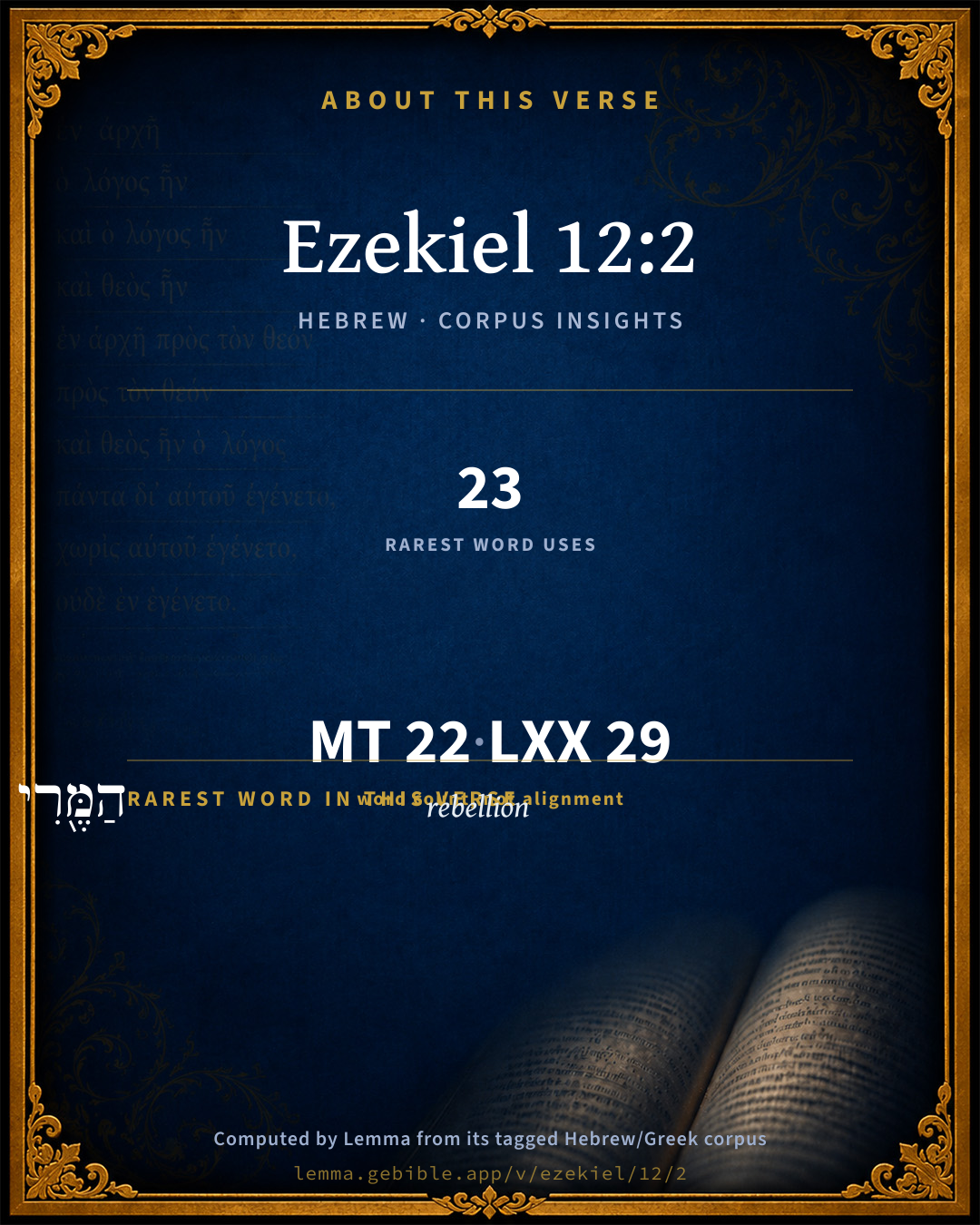
The rarest word here is הַמֶּ֖רִי rebellion H4805 — appearing just 23 times in the whole Hebrew Bible.

Shared distinctive vocabulary

הַמֶּ֖רִי rebellion H4805 occurs in 21 verses of the Hebrew Bible. Also found in:

Grammatical profile

  • 5 verbs
  • 9 nouns
  • 2 pronouns
  • 2 prepositions
  • 1 conjunction
  • 3 particles

Verb forms

  • יֹשֵׁ֑ב Qal · Participle Active
  • לִרְא֜וֹת Qal · Infinitive Construct
  • רָא֗וּ Qal · Perfect
  • לִשְׁמֹ֨עַ֙ Qal · Infinitive Construct
  • שָׁמֵ֔עוּ Qal · Perfect

Repetition

Words recur within this verse — often emphatic in Hebrew:

  • בֵּית house H1004 ×2
  • הַמֶּ֖רִי rebellion H4805 ×2
  • לִרְא֜וֹת to see H7200 ×2
  • לִשְׁמֹ֨עַ֙ to hear H8085 ×2
  • וְלֹ֣א not H3808 ×2

Hebrew & Septuagint length

In English translation the verse runs 34 words from the Hebrew and 35 from the Septuagint (LXX English) — closely comparable.

A rough comparison of the two English renderings, which tokenize alike — not a word-level alignment.

Word counts can differ between the Hebrew and the Greek without any difference in meaning — e.g. the Hebrew direct-object marker אֵת has no separate Greek word, and Greek often adds the article ὁ.

In the original languages it is 22 Hebrew tokens and 29 Greek tokens — but the two are counted differently (Hebrew bundles its prefixes and suffixes into one token; the Greek is in lemma form), so that isn’t a like-for-like length.

Cross-references

37

Topical passages linked to Ezekiel 12:2 in the Treasury of Scripture Knowledge — connected by theme and wording, ordered by reader-vote popularity; previews shown in the World English Bible.

  • Jeremiah 5:21 Hear now this, foolish people, and without understanding; who have eyes, and don't see; who have ears, and don't hear:
  • Mark 4:12 that 'seeing they may see, and not perceive; and hearing they may hear, and not understand; lest perhaps they should turn again, and their sins should be forgiven them.'"
  • Psalms 78:40 How often they rebelled against him in the wilderness, And grieved him in the desert!
  • John 9:39–41 Jesus said, "I came into this world for judgment, that those who don't see may see; and that those who see may become blind."
  • Isaiah 1:23 Your princes are rebellious, and companions of thieves. Everyone loves bribes, and follows after rewards. They don't judge the fatherless, Neither does the cause of the widow come to them.
  • Jeremiah 9:1–6 Oh that my head were waters, and my eyes a spring of tears, that I might weep day and night for the slain of the daughter of my people!
  • Ephesians 4:18 being darkened in their understanding, alienated from the life of God, because of the ignorance that is in them, because of the hardening of their hearts;
  • Isaiah 6:9–10 He said, "Go, and tell this people, 'You hear indeed, But don't understand; And you see indeed, But don't perceive.'
  • Isaiah 30:1 Woe to the rebellious children, says Yahweh, who take counsel, but not of me; and who make a league, but not of my Spirit, that they may add sin to sin,
  • Isaiah 30:9 For it is a rebellious people, lying children, children who will not hear the law of Yahweh;
  • Isaiah 42:19–20 Who is blind, but my servant? or deaf, as my messenger whom I send? Who is blind as he who is at peace, and blind as Yahweh's servant?
  • Isaiah 65:2 I have spread out my hands all the day to a rebellious people, who walk in a way that is not good, after their own thoughts;
  • Jeremiah 5:23 But this people has a revolting and a rebellious heart; they are revolted and gone.
  • Ezekiel 2:5–8 They, whether they will hear, or whether they will forbear, (for they are a rebellious house), yet shall know that there has been a prophet among them.
  • Matthew 13:13–14 Therefore I speak to them in parables, because seeing they don't see, and hearing, they don't hear, neither do they understand.
  • John 12:40 "He has blinded their eyes and he hardened their heart, Lest they should see with their eyes, And perceive with their heart, And would turn, And I would heal them."
  • Acts 7:51–52 "You stiff-necked and uncircumcised in heart and ears, you always resist the Holy Spirit! As your fathers did, so you do.
  • 2 Corinthians 3:14 But their minds were hardened, for until this very day at the reading of the old covenant the same veil remains, because in Christ it passes away.
  • Deuteronomy 9:7 Remember, don't forget, how you provoked Yahweh your God to wrath in the wilderness: from the day that you went forth out of the land of Egypt, until you came to this place, you have been rebellious against Yahweh.
  • Deuteronomy 9:24 You have been rebellious against Yahweh from the day that I knew you.
  • Deuteronomy 31:27 For I know your rebellion, and your stiff neck: behold, while I am yet alive with you this day, you have been rebellious against Yahweh; and how much more after my death?
  • Ezekiel 2:3 He said to me, Son of man, I send you to the children of Israel, to nations that are rebellious, which have rebelled against me: they and their fathers have transgressed against me even to this very day.
  • Ezekiel 3:26–27 and I will make your tongue cleave to the roof of your mouth, that you shall be mute, and shall not be to them a reprover; for they are a rebellious house.
  • Luke 8:10 He said, "To you it is given to know the mysteries of the Kingdom of God, but to the rest in parables; that 'seeing they may not see, and hearing they may not understand.'
  • Deuteronomy 29:4 but Yahweh has not given you a heart to know, and eyes to see, and ears to hear, to this day.
  • Isaiah 29:9–12 Stay you and wonder; take your pleasure and be blind: they are drunken, but not with wine; they stagger, but not with strong drink.
  • Ezekiel 3:9 As an adamant harder than flint have I made your forehead: don't be afraid of them, neither be dismayed at their looks, though they are a rebellious house.
  • Ezekiel 17:12 Say now to the rebellious house, Don't you know what these things mean? tell them, Behold, the king of Babylon came to Jerusalem, and took the king of it, and the princes of it, and brought them to him to Babylon:
  • Ezekiel 24:3 Utter a parable to the rebellious house, and tell them, Thus says the Lord Yahweh, Set on the caldron, set it on, and also pour water into it:
  • Ezekiel 44:6 You shall tell the rebellious, even to the house of Israel, Thus says the Lord Yahweh: you house of Israel, let it suffice you of all your abominations,
  • Daniel 9:5–9 we have sinned, and have dealt perversely, and have done wickedly, and have rebelled, even turning aside from your precepts and from your ordinances;
  • Mark 8:17–18 Jesus, perceiving it, said to them, "Why do you reason that it's because you have no bread? Don't you perceive yet, neither understand? Is your heart still hardened?
  • Romans 11:7–8 What then? That which Israel seeks for, that he didn't obtain, but the chosen ones obtained it, and the rest were hardened.
  • 2 Corinthians 4:3–4 Even if our Gospel is veiled, it is veiled in those who perish;
  • 2 Thessalonians 2:10–11 and with all deception of wickedness for those who are being lost, because they didn't receive the love of the truth, that they might be saved.
  • Jeremiah 4:17 As keepers of a field are they against her round about, because she has been rebellious against me, says Yahweh.
  • Acts 28:26–27 saying, 'Go to this people, and say, In hearing, you will hear, But will in no way understand. In seeing, you will see, But will in no way perceive.

Cross-references courtesy of OpenBible.info (CC BY 4.0).

Hebrew and Greek witnesses Masoretic Hebrew ↔ Greek Septuagint

The same verse in the two great witnesses to the Old Testament, shown verse-for-verse.

These are two independent witnesses, not word-aligned to each other, and the Septuagint is shown in lemma (dictionary) form.

Hebrew Ezekiel 12:2 Masoretic · Westminster Leningrad Codex

בֶּן אָדָ֕ם בְּת֥וֹךְ בֵּית הַמֶּ֖רִי אַתָּ֣ה יֹשֵׁ֑ב אֲשֶׁ֣ר עֵינַיִם֩ לָהֶ֨ם לִרְא֜וֹת וְלֹ֣א רָא֗וּ אָזְנַ֨יִם לָהֶ֤ם לִשְׁמֹ֨עַ֙ וְלֹ֣א שָׁמֵ֔עוּ כִּ֛י בֵּ֥ית מְרִ֖י הֵֽם

Son of man, you dwell in the midst of the rebellious house, who have eyes to see, and don't see, who have ears to hear, and don't hear; for they are a rebellious house.

World English Bible · Public Domain

Greek LXX Ezekiel 12:2 Septuagint · lemma form

υἱός ἄνθρωπος ἐν μέσος ὁ ἀδικία αὐτός σύ καταοἰκέω ὅς ἔχω ὀφθαλμός ὁ βλέπω καί οὐ βλέπω καί οὖς ἔχω ὁ ἀκούω καί οὐ ἀκούω διότι οἶκος παραπικραίνω εἰμί

Son of man, you dwell in the midst of the iniquities of those, who have eyes to see, and see not; and have ears to hear, and hear not: because it is a provoking house.

LXX2012 (modern English Septuagint) · Public Domain

Hebrew: Westminster Leningrad Codex (CC BY 4.0). Greek: Septuagint (public domain); English from LXX2012 (modern English Septuagint) (Public Domain). How the Septuagint differs from the Hebrew →

Targum (Aramaic paraphrase)

1

The Targum is the ancient Jewish Aramaic paraphrase of the Hebrew Scriptures — an interpretive translation, not the Hebrew text itself. Onkelos (literal) and Pseudo-Jonathan (expansive) render the Torah, and Jonathan the Prophets. Coverage is partial: where no permissively-licensed English translation exists for a verse, only the Aramaic is shown. This is verse-level text, not a word-by-word alignment to the Hebrew.

  1. Targum Jonathan Prophets (Joshua–Malachi)
    בַּר אָדָם בְּגוֹ עַמָא סַרְבָנָא אַתְּ יָתֵיב דִי עַיְנִין לְהוֹן לְמֶחֱזֵי וְלָא חָזָן וְאוּדְנִין לְהוֹן לְמִשְׁמַע וְלָא שָׁמְעִין אֲרֵי עַם סַרְבָן אִינוּן:

    (no public-domain English translation for this verse)

    Targum Jonathan — Aramaic: “Mikraot Gedolot” (public domain). English: “Sefaria Community Translation” (CC0 1.0 (public-domain dedication)); “London "Chaldee Paraphrase," 1871” (public domain). Text via Sefaria.

Commentary

Notes on Ezekiel 12:2 from classic Christian and Jewish commentators (each source and its license shown beneath its notes). The classic Christian expositions comment on the surrounding passage and are grouped to its opening verse, so a note may address several verses; the Jewish commentaries on the Tanakh (Rashi and others) are per-verse, so they appear only where the commentator wrote on this verse.

Lemma curates 59 commentaries, every one of them public domain or Creative Commons licensed, each selected and text-cleaned for this edition rather than reprinted as found. About our sources →

Trapp's Complete Commentary

John Trapp

Eze 12:2 Son of man, thou dwellest in the midst of a rebellious house, which have eyes to see, and see not; they have ears to hear, and hear not: for they [are] a rebellious house.

Ver. 2. A rebellious house.] Heb., A house of rebellion, domus perduellis, that hath cast down the gauntlet of defiance against me.

Which have eyes to see, and see not,] sc., To any good purpose. They will not see, {Isa 26:11} and who so blind as such? They wink wilfully, which is no small aggravation of their sin. {Joh 9:4 Eph 4:18}

Which have ears to hear, and hear not,] i.e., Castigatiores non evadunt. They are not a button the better for what they hear. They draw not up the ears of their minds to the ears of their bodies, that one sound might pierce both.

John Trapp, A Commentary or Exposition upon All the Books of the Old and New Testament (1647–1656) — public domain. Text from a community e-Sword module.

The Biblical Illustrator

Joseph S. Exell

Eze_12:2

Son of man, thou dwellest in the midst of a rebellious house, which have eyes to see and see not.

The disuse of spiritual faculties

Eyes and ears are for many reasons the most important and valuable organs of the human body, the chief gates--to use the language of Bunyan--to the famous town of Mansoul. The one brings us into contact with form, the other with sound; the one has relation to space, the other to time. No part in the human frame is so wonderful in their execution as these. The eye, says one, by its admirable combination of coats and humours and lenses, produces on the retina, or expansion of nerve at the back of the socket or bony cavity, in which it is so securely lodged, a distinct picture of the minutest or largest object; so that, on a space that is less than an inch in diameter, a landscape of miles in extent, with all its variety of scenery, is depicted with perfect exactness of relative proportion in all its parts. Nor is the ear less wonderful. It is a complicated mechanism lying wholly within the body, showing only the wide outer porch through which the sound enters. It conveys the sound through various chambers to the inmost extremities of those nerves which bear the messages to the brain. So delicate is this organ, that it catches the softest whispers, and conveys them to the soul, and so strong that it hears the roll of the loudest thunder in the chamber of its mistress. Now, the text--as well as other parts of Scripture--teaches that mans spiritual nature has organs answering to those organs of the body. The text calls us to notice the spiritual disuse of these faculties.

I. It involves the greatest deprivation.

1. The disuse shuts out the grandest realities of existence. What are the immutable principles of rectitude, what is the great spiritual universe, what is God Himself, to the man who is morally blind and deaf?

2. The disuse shuts out the sublimest joys of existence. What are the charms of physical to moral beauty, the beauty of holiness and God? What are the charms of physical harmony to those of that great moral anthem that fills the spiritual universe with rapture and delights the ear of God Himself? How great then the deprivation of the spiritually blind and deaf! God is with them, His pure, happy heavens lie about them, and they know it not.

3. The disuse deteriorates the faculties themselves. Unused organs often die out.

II. It involves the greatest wickedness.

1. It is an abuse of talent. All the powers we possess, we possess as trustees, not as proprietors; they are entrusted to us for a specific purpose.

2. It is an abuse of the greatest talents. These spiritual faculties are the highest we have--higher than bodily power, higher than intellectual ability, higher than natural genius.

Conclusion--

1. The sad condition of the unregenerate world.

2. The deeply needed mission of Christ. (Homilist.)

Rebelliousness means loss of faculty

You cannot commit sin and be as clear-minded as you were before you committed it. The obscurity of mind may not be immediately evident; but let a man allow one bad thought to pass through his brain, and the brain has lost quality, a tremendous injury has been inflicted on that sensitive organ; by and by, after a succession of such passages, there will be no brain to injure. Sin tears down whatever it touches. Your habit is bringing you to imbecility, if it is a bad habit. You must name it; preachers may not speak distinctly and definitely, but they create a standard by which men may judge themselves, and by which preachers may also judge their own aspirations and purposes. You are losing your eyesight by your sin; you are becoming deaf because you are becoming worse in thought and desire and purpose; you are not the business man you were a quarter of a century ago, when you were a disciplinarian, a Spartan, a self-critic, when you held yourself in a leash, and would not allow yourself to go an inch faster than your judgment approved; since then you have loosened the reins, you have allowed the steeds to go at their own will, and the consequence is that you miss one-half of what is spoken to you, and you fail to see Gods morning and Gods sunset; they are but commonplaces to you, mayhap but broad vulgarities. Men should be good if they wish to keep their genius. The bad man goes down. His descent may not be palpable today or tomorrow, but the process is not the less certain and tremendous because it is sometimes imperceptible. (J. Parker, D. D.)

The Biblical Illustrator, edited by Joseph S. Exell (c. 1880s–1900s) — public domain. Text from a community e-Sword module.

Geneva Bible (1599)

Geneva Bible translators

That is, they receive not the fruit of that which they see and hear.

Geneva Bible (1599) marginal notes — public domain. Text via Bolls.life.

Adam Clarke's Commentary

Verse 2. Which have eyes to see, and see not] It is not want of grace that brings them to destruction. They have eyes to see, but they will not use them. No man is lost because he had not sufficient grace to save him, but because he abused that grace.

Adam Clarke's Commentary on the Bible (1810–1826) — public domain. Text from a community e-Sword/MySword module.

Ellicott's Commentary for English Readers

(2) A rebellious house.—Comp. Deu_1:26; Rom_10:21. The seeing not and hearing not is that perverse refusing to see and to hear so often spoken of in Scripture. (See Deu_29:4; Isa_6:9; Jer_5:21; Mat_13:14-15.) It was because of this disposition that the prophet was to give them a sign to which they could not shut their eyes.

A Bible Commentary for English Readers, edited by Charles John Ellicott (1878–1897) — public domain. Text from a community e-Sword module.

The Cambridge Bible for Schools and Colleges

gen. ed. J. J. S. Perowne

2. The people of Israel among whom the prophet dwells is a rebellious house (ch. Eze_2:3; Eze_2:6-8, Eze_3:26-27). His former signs meet with no belief from them. They have eyes but see not: they behold events and history with their bodily eyes, but fail to discern the moral meaning in them. Events are just events to them, the nature of the God who animates the events remains undiscovered by them (Isa_6:9; Isa_42:20; Jer_5:21; Mar_8:18). And the signs and words of the prophet make no impression on them; they say, “Doth he not speak parables?” (ch. Eze_20:49). Therefore new signs must be given them (Eze_12:4).

The Cambridge Bible for Schools and Colleges (gen. ed. J. J. S. Perowne; Cambridge University Press, 1878–1918) — public domain. Text from a community e-Sword module.

John Gill's Exposition

Therefore, thou son of man, prepare thee stuff for removing,.... Or, "vessels of captivity" (s), such as persons take along with them when they go a journey, or into a far country; such as a staff, scrip, purse, shoes, &c. or household goods; such as tables, chairs, and the like, which are removed when a person goes from one house to another; by which sign they of the captivity were to be taught that Zedekiah and the people of the Jews should in like manner be carried captive into Babylon; which they were not willing to believe, and the false prophets had told them the contrary:

and remove by day in their sight; be carrying the stuff out, day by day, several days running, as Jarchi from Menachem interprets it; that they may see and take notice of it, and ask the reason of it; which, when known, they might send to their correspondents at Jerusalem, and acquaint them with it:

and thou shall remove from thy place to another place in their sight; from the house in which he dwelt, to another house at some distance; yet so as to be seen by them, both from whence and whither he moved:

it may be they will consider; or "see" (t); make use of their eyes, and of their understandings, and think better of things. The Targum is,

"perhaps they will fear;''

the Lord, and regard his prophets, and be afraid of his judgments:

though they be a rebellious house; such who are the most obstinate may be reclaimed.

(s) "vasa transmigrationis", Pagninus, Montanus, Starckius; "instrumenta migrationis", Junius & Tremellius, Piscator, Polanus. (t) "fortasse visuri sunt", Junius & Tremellius, Polanus; "fortasse videbunt", Piscator, Starckius.

John Gill's Exposition of the Whole Bible (1746–1763) — public domain (CC PDM 1.0). Text via the HelloAO Bible API.

Albert Barnes' Notes on the Bible

Compare Deu 1:26; margin reference; Rom 10:21. The repetition of such words from age to age, shows that the prophet’s words are intended to reach beyond the generation in which he lived.

Albert Barnes' Notes on the Bible (1834–1885) — public domain. Text from a community e-Sword/MySword module.

Matthew Poole's English Annotations

Thou dwellest; the prophet knowing the captivity would be long, had settled his habitation, and probably found some favour with the enemy, that he might be accommodated for his abode. The Jews who gave up to the Chaldeans found that kindness mentioned Jer 29:4-7, with Eze 24:5,6, and so were indifferently well placed together, and the prophet dwells among them, in the land of Chaldea.

A rebellious house; in their captivity too many of them retained their stubborn murmuring and rebellious humour, and blamed, quarrelled, and condemned them who gave them counsel to yield, and themselves for yielding, and it is likely stirred up them at Jerusalem to hold out, and save themselves, and rescue their brethren. These will ridicule thy words, yet speak them; for they are mine, and shall be accomplished.

Eyes to see; they have wit enough, they are of a capacity well enough fitted, if they would, to understand and consider what thou speakest; expressed by a double phrase, which signifies one and the same thing; eyes and ears.

See not; they contemptuously refuse to see and hear, they will not consider, lay to heart, repent, and reform. They are a rebellious house; they have conspired together, and all they will resolve or design is to do whatever is good in their own eyes, and whatever their wild imaginations, raised by false prophets, suggest.

Matthew Poole's English Annotations on the Holy Bible (1683–1685) — public domain. Text from a community e-Sword/MySword module.

Whedon's Commentary on the Bible

Daniel D. Whedon

2. Which have eyes to see, and see not — This rebellious nation (Eze_2:3; Eze_2:8; Eze_3:26-27) have had their eyes blinded and their ears deafened by their rebellion (Isa_6:9; Isa_42:20; Jer_5:21; Mat_13:14-15). They have seared their consciences and deadened their moral perception until even the prophecies just uttered have not moved them to faith and reformation. This is true not only of the hopeless Israelites in Jerusalem now, forsaken by Jehovah, but of many even of the true Israel who are in exile. (See notes Eze_11:16-21.) They need simpler and more impressive picture-sermons to bring them to a conscious recognition of their spiritual condition and the fate which awaits impenitence — even the destruction of the holy city.

Daniel D. Whedon (gen. ed.), Commentary on the Old and New Testaments (1874–1909) — public domain. Text from a community e-Sword module.

The Pulpit Commentary

Which have eyes to see, etc. We note the words in their relation both to like utterances in the past, (Isa_6:9 Isa_42:20) and byEzekiel"s contemporary, (Jer_5:21) and in the future by our Lord, (Mat_13:13) by St. John, (Joh_12:40) and lastly by St. Paul. (Act_28:27) The thought and phrase were naturally as ever-recurring as the fact.

Ver. 2. Blind eyes and deaf ears.

I ALL MEN HAVE ORGANS FOR PERCEIVING SPIRITUAL TRUTH. These blind Jews have eyes and the deaf have ears. Neither class is deformed or mutilated in respect of their organs of sense. Here is the paradox, the surprising situation. It is men with eyes and ears who are blind and deaf. It is no wonder that the lower animals should live without man"s religion in a life of brutish appetite. But it is surprising that beings endowed with higher faculties should degrade themselves to such a life. That this is the case with the most hardened and ignorant may be proved by the experience of life.

1. The most brutalized sinner was once a child. Then he had the child"swondering, open-eyed vision of truth.

2. The most degraded have been restored. Then the faculty of spiritualperception has been reawakened. This proves that it was only dormant, not absent.

3. Even in a condition of indifference a degraded, deadened soul may bearoused. The bow drawn at a venture may send an arrow into a joint of the armour of worldly thought and find the natural sensitiveness beneath.

II SOME MEN HAVE LOST THE POWER. OF PERCEIVING SPIRITUAL TRUTH. Their eyes are blind and their ears deaf. This does not mean merely that they have not the gifts Joel referred to. (Joe_2:28) It means that they do not perceive the truth which is declared to them by the messengers of God.

1. The words spoken are not heeded. They are mere sound. Immediatelythey are spoken in the ear a rush of unsympathetic thoughts sweeps them away. It is like sowing by the wayside. The seed is trampled underfoot.

2. If the words are attended to, the personal significance of them is notgrasped. They are mere ideas unrealized. They are not felt to have any relation to life. Thus a biblical scholar may be blind to the truth of God.

III THIS STATE OF SPIRITUAL BLINDNESS AND DEAFNESS IS CAUSED BY SIN. The people are "a rebellious house," and therefore they cannot perceive the Divine message. We have come upon one of the worst consequences of sin. It deadens the soul against its own guilt and against the messages from God to the sinner. This is very different from intellectual dulness. The will of God is so revealed that "the wayfaring man, though a fool, may not err therein." Indeed, mere intellectual acumen does very little in helping us to perceive spiritual and moral truth. God has hidden from the "wise and prudent" what he has revealed to "babes and sucklings." The preaching of the cross of Christ is foolishness to many of the world"s wise, (1Co_1:18, 1Co_1:19) because they have not spiritual sympathy with it. (1Co_2:14) Note the blinding and deafening which are sometimes ascribed to God (e.g. Isa_6:9, Isa_6:10) because it is the abuse of God"s action that leads to such a condition, and because it is a condition of Divine judgment are here brought back to man"s guilt.

IV GOD DOES NOT NEGLECT THE BLIND AND DEAF. Their state is one of guilt for they brought it on themselves and also one of danger. But they are not left alone in it. Ezekiel is to proceed to more simple and striking action, in order to extort attention from the indifferent. We must shake the sleeper when his house is on fire. We want more rousing preaching. God has pity on the blind and deaf, and it is according to his mercy that every effort should be made to reach them. Christ gives new sight and hearing. (Luk_4:18)

The Pulpit Commentary (1880–1919), ed. H.D.M. Spence-Jones & Joseph S. Exell — public domain. Text from a community e-Sword module.

John Wesley's Explanatory Notes

Eyes to see - They have capacity, if they would, to understand, but they will not understand, what thou speakest.

John Wesley, Explanatory Notes Upon the Whole Bible (1754–1765) — public domain. Text via the GEBible commentary corpus.

Lesson kit

Teaching starters — assembled from the data on this page, not authored interpretation. Every prompt links to the verse data it draws on. Edit before teaching.

Ezekiel, in the Prophets, opens this verse with 22 words (15 distinct Hebrew lemmas). Its most distinctive word is mᵉrîy (“rebellion”). A historical commentator’s framing appears above. Read the whole chapter for the surrounding context.

Discussion questions

  1. The word mᵉrîy carries the sense “rebellion.” How does it shape the verse?
  2. Numbers 17:10 shares the word «rebellion» with this verse. How do the two illuminate each other?
  3. “house” occurs 2× in this one verse. What is the effect of the repetition?
  4. The translations on this page render this verse differently — a whole-verse word diff, not a word-by-word alignment. What might account for the different wordings?
  5. The verb «יֹשֵׁ֑ב» is Qal Participle Active. How does its form color the action?
  6. Reading how Trapp's Complete Commentary and The Biblical Illustrator read this verse, where do the two commentators agree and where do they part?

Things to notice

Reading settings

Reading text

Shown beneath each verse's original-language words.

Old Testament
Old Testament edition

Read the OT as the Masoretic Hebrew (MT) or the Greek Septuagint (LXX).

English shown for the Greek Septuagint (in the Hebrew ↔ Greek comparison).

Comparing translations? Open the Compare panel on any verse page to stack up to four side by side.