Exodus 32:3

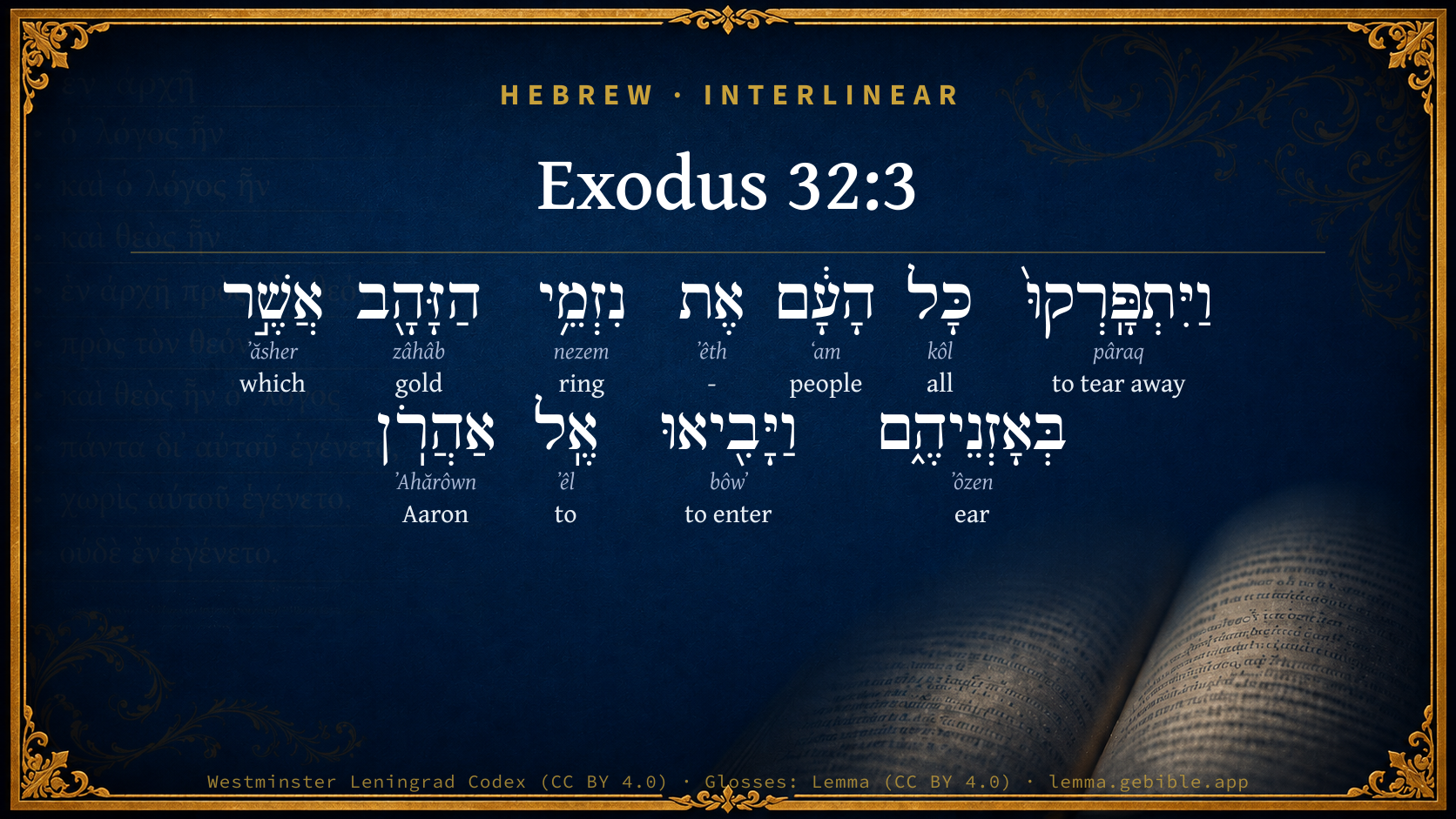
Hebrew (Westminster Leningrad Codex) Exodus 32:3 appears in the Hebrew Old Testament. The text above is from the Westminster Leningrad Codex. Each word links to its Strong’s number, a concise gloss, and parsing drawn from the Open Scriptures Hebrew Bible morphology. Click any word for its full Brown-Driver-Briggs (BDB) entry.
Download image
Cite this verse

Exodus 32:3 (World English Bible). Public Domain. Lemma interlinear Bible study tool, https://lemma.gebible.app/v/exodus/32/3.

Show BibTeX & RIS
BibTeX
RIS
English Translation
All the people took off the golden rings which were in their ears, and brought them to Aaron.
World English Bible · Public Domain
Download a study sheet

One document with this verse’s original text, its word-by-word gloss line, the meaning frame, cross-references with their text, attributed commentary, and full source and license credits — printable, and it pastes into notes with its structure intact.

This verse Autodidact and up

Study sheet (.html) Plain text (.txt)

A passage Seminary Student

Up to 50 verses in one chapter. A passage sheet keeps up to 6 commentary sources and 12 cross-references per verse, in the order this page ranks them, and says so on the sheet whenever that leaves anything out. Ask for a single verse and you get the Autodidact verse sheet above.

Everything on this page stays free to read, with no account — the sheet is a download of what is already on screen, not access to it.

Want to remove ads? Support Godless Engineer
Compare translations 3

The same verse in 3 English versions, stacked beneath the original-language interlinear above. Click any original word for its lexicon entry.

Each is an independent rendering of the whole verse — the interlinear is not word-aligned to these translations.

Highlighted words mark where these versions differ — a whole-verse word diff, not a word-by-word alignment.

  • World English Bible Public Domain
    All the people took off the golden rings which were in their ears, and brought them to Aaron.
  • King James Version Public Domain
    And all the people brake off the golden earrings which were in their ears, and brought them unto Aaron.
  • unfoldingWord Literal Text CC BY-SA 4.0
    And all the people tore the rings of gold off themselves that were on their ears and brought them to Aaron.

unfoldingWord Literal Text — © unfoldingWord, licensed CC BY-SA 4.0. Word-aligned USFM3 via Door43 (git.door43.org/unfoldingWord/en_ult).

Versions to compare (up to 4)

3 of 4 selected

Show all 18 translations

Every available English version of this verse, each an independent rendering of the whole verse.

  • World English Bible Public Domain
    All the people took off the golden rings which were in their ears, and brought them to Aaron.
  • Berean Standard Bible Public Domain
    Then all the people took off their gold earrings and brought them to Aaron.
  • Majority Standard Bible Public Domain
    Then all the people took off their gold earrings and brought them to Aaron.
  • King James Version Public Domain
    And all the people brake off the golden earrings which were in their ears, and brought them unto Aaron.
  • American Standard Version (1901) Public Domain
    And all the people brake off the golden rings which were in their ears, and brought them unto Aaron.
  • Revised Version (1885) Public Domain
    And all the people brake off the golden rings which were in their ears, and brought them unto Aaron.
  • Geneva Bible (1599) Public Domain
    Then all ye people pluckt from them selues the golden earings, which were in their eares, and they brought them vnto Aaron.
  • Douay-Rheims (1899) Public Domain
    And the people did what he had commanded, bringing the earrings to Aaron.
  • Young's Literal Translation Public Domain
    and all the people themselves break off the rings of gold which `are' in their ears, and bring in unto Aaron,
  • Literal Standard Version CC BY-SA 4.0
    and all the people break off the rings of gold which [are] in their ears, and bring [them] to Aaron,
  • Unlocked Literal Bible CC BY-SA 4.0
    All the people took off the golden rings that were on their ears and brought them to Aaron.
  • unfoldingWord Literal Text CC BY-SA 4.0
    And all the people tore the rings of gold off themselves that were on their ears and brought them to Aaron.
  • Darby Bible Public Domain
    Then all the people broke off the golden rings that were in their ears, and brought [them] to Aaron.
  • World Messianic Bible Public Domain
    All the people took off the golden rings which were in their ears, and brought them to Aaron.
  • Webster's Bible Public Domain
    And all the people broke off the golden ear-rings which were in their ears, and brought them to Aaron.
  • Free Bible Version CC BY-SA 4.0
    So everyone took off the gold earrings they were wearing and brought them to Aaron.
  • Bible in Basic English Public Domain
    And all the people took the gold rings from their ears and gave them to Aaron.
  • JPS Tanakh (1917) Public Domain
    And all the people broke off the golden rings which were in their ears, and brought them unto Aaron.

Literal Standard Version (2020), Covenant Press — licensed CC BY-SA 4.0. Text via the HelloAO Bible API (eBible.org). Unlocked Literal Bible (unfoldingWord) — licensed CC BY-SA 4.0. Text via the HelloAO Bible API (eBible.org). unfoldingWord Literal Text — © unfoldingWord, licensed CC BY-SA 4.0. Word-aligned USFM3 via Door43 (git.door43.org/unfoldingWord/en_ult). Free Bible Version, Dr. Jonathan Gallagher — licensed CC BY-SA 4.0. Text via the HelloAO Bible API (eBible.org).

Word by word

More ways to search: Search by grammar → Find every occurrence → Compare this word →

Practice this passage: Drill this verse → Learn its vocabulary →

וַיִּתְפָּֽרְקוּ֙
pâraq
H6561
“and · to tear away”
Conjunction + Verb, Hithpael, Sequential Imperfect, 3rd Person, Masculine, Plural
Part of Speech
Conjunction + Verb
Stem
Hithpael
Form
Sequential Imperfect
Person
3rd Person
Gender
Masculine
Number
Plural
Full BDB Definition

Origin: a primitive root

TWOT: 1828

to tear apart or away, tear off, break away - (Qal) to tear away, snatch, rescue - (Piel) to tear off - (Hithpael) to tear off from oneself, be broken off, be broken in pieces
  1. כָּל kôl H3605 “all of” Noun, Common, Masculine, Singular, Construct
  2. הָעָ֔ם ʻam H5971 “the · people” Particle, Definite Article + Noun, Common, Masculine, Singular, Absolute
  3. אֶת ʼêth H853 “-” Particle, Direct Object
  4. נִזְמֵ֥י nezem H5141 “rings of” Noun, Common, Masculine, Plural, Construct
  5. הַזָּהָ֖ב zâhâb H2091 “the · gold” Particle, Definite Article + Noun, Common, Masculine, Singular, Absolute
  6. אֲשֶׁ֣ר ʼăsher H834 “which” Particle, Relative
  7. בְּאָזְנֵיהֶ֑ם ʼôzen H241 “in/at · ears · their” Preposition + Noun, Common, Feminine, Dual, Construct + Suffix, Personal, 3rd Person, Masculine, Plural
  8. וַיָּבִ֖יאוּ bôwʼ H935 “and · to enter” Conjunction + Verb, Hiphil, Sequential Imperfect, 3rd Person, Masculine, Plural
  9. אֶֽל ʼêl H413 “to” Preposition
  10. אַהֲרֹֽן ʼAhărôwn H175 “Aaron” Noun, Proper

About this verse

These counts appear in no published source. They are computed here, from the morphology-tagged text and Lemma’s own curated glosses. What Lemma adds →

11
words
11
distinct lemmas
Pentateuch
section

Notable vocabulary

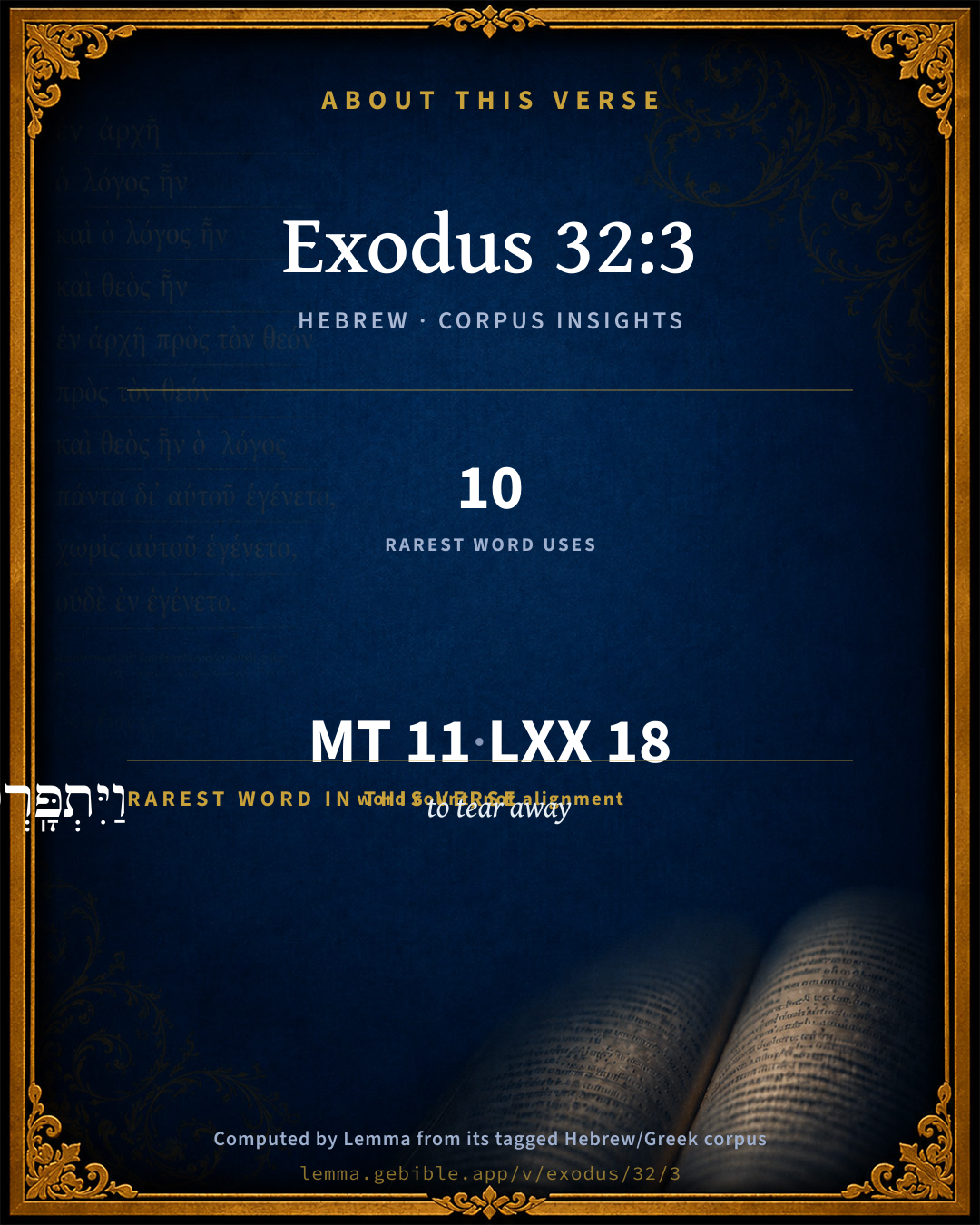
The rarest word here is וַיִּתְפָּֽרְקוּ֙ to tear away H6561 — appearing just 10 times in the whole Hebrew Bible.

Shared distinctive vocabulary

וַיִּתְפָּֽרְקוּ֙ to tear away H6561 occurs in 10 verses of the Hebrew Bible. Also found in:

Grammatical profile

  • 2 verbs
  • 6 nouns
  • 1 preposition
  • 2 particles

Verb forms

  • וַיִּתְפָּֽרְקוּ֙ Hithpael · Sequential Imperfect
  • וַיָּבִ֖יאוּ Hiphil · Sequential Imperfect

Hebrew & Septuagint length

In English translation the verse runs 18 words from the Hebrew and 19 from the Septuagint (LXX English) — closely comparable.

A rough comparison of the two English renderings, which tokenize alike — not a word-level alignment.

Word counts can differ between the Hebrew and the Greek without any difference in meaning — e.g. the Hebrew direct-object marker אֵת has no separate Greek word, and Greek often adds the article ὁ.

In the original languages it is 11 Hebrew tokens and 18 Greek tokens — but the two are counted differently (Hebrew bundles its prefixes and suffixes into one token; the Greek is in lemma form), so that isn’t a like-for-like length.

Cross-references

4

Topical passages linked to Exodus 32:3 in the Treasury of Scripture Knowledge — connected by theme and wording, ordered by reader-vote popularity; previews shown in the World English Bible.

  • Judges 17:3–4 He restored the eleven hundred [pieces] of silver to his mother; and his mother said, I most assuredly dedicate the silver to Yahweh from my hand for my son, to make an engraved image and a molten image: now therefore I will restore it to you.
  • Isaiah 40:19–20 The image, a workman has cast [it], and the goldsmith overlays it with gold, and casts [for it] silver chains.
  • Isaiah 46:6 Some pour out gold from the bag, and weigh silver in the balance. They hire a goldsmith, and he makes it a god. They fall down--yes, they worship.
  • Jeremiah 10:9 There is silver beaten into plates, which is brought from Tarshish, and gold from Uphaz, the work of the artificer and of the hands of the goldsmith; blue and purple for their clothing; they are all the work of skillful men.

Cross-references courtesy of OpenBible.info (CC BY 4.0).

Hebrew and Greek witnesses Masoretic Hebrew ↔ Greek Septuagint

The same verse in the two great witnesses to the Old Testament, shown verse-for-verse.

These are two independent witnesses, not word-aligned to each other, and the Septuagint is shown in lemma (dictionary) form.

Hebrew Exodus 32:3 Masoretic · Westminster Leningrad Codex

וַיִּתְפָּֽרְקוּ֙ כָּל הָעָ֔ם אֶת נִזְמֵ֥י הַזָּהָ֖ב אֲשֶׁ֣ר בְּאָזְנֵיהֶ֑ם וַיָּבִ֖יאוּ אֶֽל אַהֲרֹֽן

All the people took off the golden rings which were in their ears, and brought them to Aaron.

World English Bible · Public Domain

Greek LXX Exodus 32:3 Septuagint · lemma form

καί περιαἱρέω πᾶς ὁ λαός ὁ ἐνώτιον ὁ χρυσοῦς ὁ ἐν ὁ οὖς αὐτός καί φέρω πρός ααρων

And all the people took off the golden ear-rings that were in their ears, and brought them to Aaron.

LXX2012 (modern English Septuagint) · Public Domain

Hebrew: Westminster Leningrad Codex (CC BY 4.0). Greek: Septuagint (public domain); English from LXX2012 (modern English Septuagint) (Public Domain). How the Septuagint differs from the Hebrew →

Targum (Aramaic paraphrase)

2

The Targum is the ancient Jewish Aramaic paraphrase of the Hebrew Scriptures — an interpretive translation, not the Hebrew text itself. Onkelos (literal) and Pseudo-Jonathan (expansive) render the Torah, and Jonathan the Prophets. Coverage is partial: where no permissively-licensed English translation exists for a verse, only the Aramaic is shown. This is verse-level text, not a word-by-word alignment to the Hebrew.

  1. Targum Onkelos Torah (Genesis–Deuteronomy)
    וְאִתְפְּרִיקוּ כָּל עַמָא יָת קָדָשֵׁי דְדַהֲבָא דִי בְאוּדְנֵיהוֹן וְאַיְתִיוּ לְאַהֲרֹן:

    (no public-domain English translation for this verse)

    Targum Onkelos — Aramaic: “Onkelos Genesis” (public domain); “Onkelos Exodus” (public domain); “Onkelos Leviticus” (public domain); “Onkelos Numbers” (public domain); “Onkelos Deuteronomy” (public domain). English: “Sefaria Community Translation” (CC0 1.0 (public-domain dedication)); “J.W. Etheridge. The Targums of Onkelos and Jonathan Ben Uzziel on the Pentateuch. London: Longmans, Green, 1862” (public domain). Text via Sefaria.

  2. Targum Pseudo-Jonathan Torah (Genesis–Deuteronomy)
    וְסָרִיבוּ נְשַׁיָא לְמִיתַּן תַּכְשִׁיטֵיהוֹן לְגַבְרֵיהוֹן וּמִן יַד פְּרִיקוּ כָּל עַמָּא יַת קָדָשֵׁי דְדַהֲבָא דִי בְאוּדְנֵיהוֹן וְאַיְיתִיוּ לְאַהֲרן

    And their wives denied themselves to give their ornaments to their husbands; and all the people at once delivered up the golden rings which were in their ears, and brought them to Aharon.

    Targum Pseudo-Jonathan — Aramaic: “Targum Jonathan on Genesis” (public domain); “Targum Jonathan on Exodus” (public domain); “Targum Jonathan on Leviticus” (public domain); “Targum Jonathan on Numbers” (public domain); “Targum Jonathan on Deuteronomy” (public domain). English: “The Targum of Jonathan ben Uzziel, trans. J. W. Etheridge, London, 1862” (public domain). Text via Sefaria.

Commentary

Notes on Exodus 32:3 from classic Christian and Jewish commentators (each source and its license shown beneath its notes). The classic Christian expositions comment on the surrounding passage and are grouped to its opening verse, so a note may address several verses; the Jewish commentaries on the Tanakh (Rashi and others) are per-verse, so they appear only where the commentator wrote on this verse.

Lemma curates 59 commentaries, every one of them public domain or Creative Commons licensed, each selected and text-cleaned for this edition rather than reprinted as found. About our sources →

Trapp's Complete Commentary

John Trapp

Exo 32:3 And all the people brake off the golden earrings which [were] in their ears, and brought [them] unto Aaron.

Ver. 3. Brake off the golden ear-rings.] Which they had got of the Egyptians. {Exo 12:35} To make use of heathen authors for ostentation, is to make a calf of the treasure gotten out of Egypt.

John Trapp, A Commentary or Exposition upon All the Books of the Old and New Testament (1647–1656) — public domain. Text from a community e-Sword module.

Joseph Benson's Commentary

Exo 32:3. The people brake off their ear-rings — Whereby they showed both their madness upon their idols, and their base ingratitude to God, who had transferred these jewels from the Egyptians to them.

Joseph Benson's Commentary on the Old and New Testaments (1811–1818) — public domain. Text from a community e-Sword module.

Geneva Bible (1599)

Geneva Bible translators

Such is the rage of idolaters, that they spare no cost to satisfy their wicked desires.

Geneva Bible (1599) marginal notes — public domain. Text via Bolls.life.

Jamieson, Fausset & Brown

Robert Jamieson, A. R. Fausset & David Brown

all the people brake off the golden earrings--The Egyptian rings, as seen on the monuments, were round massy plates of metal; and as they were rings of this sort the Israelites wore, their size and number must, in the general collection, have produced a large store of the precious metal.

Jamieson, Fausset & Brown — Commentary Critical and Explanatory on the Whole Bible (1871) — public domain (CC PDM 1.0). Text via the HelloAO Bible API.

Adam Clarke's Commentary

Verse 3. And all the people brake off the golden ear-rings] The human being is naturally fond of dress, though this has been improperly attributed to the female sex alone, and those are most fond of it who have the shallowest capacities; but on this occasion the bent of the people to idolatry was greater than even their love of dress, so that they readily stripped themselves of their ornaments in order to get a molten god. They made some compensation for this afterwards; see Ex 35:22, and See Clarke on Ex 38:9.

Adam Clarke's Commentary on the Bible (1810–1826) — public domain. Text from a community e-Sword/MySword module.

Ellicott's Commentary for English Readers

(3) All the people brake off the golden earrings.—Aaron had miscalculated the strength of the people’s fanaticism. Not the slightest resistance was offered to his requirement, not the slightest objection made. “All the people,” with one accord, surrendered their earrings. Some measure is hereby afforded of the intensity of the feeling which was moving the people and urging them to substitute an idolatrous worship for the abstract and purely spiritual religion which had reigned supreme since their departure from Egypt.

A Bible Commentary for English Readers, edited by Charles John Ellicott (1878–1897) — public domain. Text from a community e-Sword module.

John Gill's Exposition

And he received them at their hand,.... For the use they delivered them to him:

and fashioned it with a graving tool, after he had made it a molten calf; that is, after he had melted the gold, and cast it into a mould, which gave it the figure of a calf, and with his tool wrought it into a more agreeable form, he took off the roughness of it, and polished it; or if it was in imitation of the Egyptian Apis or Osiris, he might with his graving tool engrave such marks and figures as were upon that; to cause the greater resemblance, so Selden (y) thinks; see Gill on Jer 46:20 or else the sense may be, that he drew the figure of a calf with his tool, or made it in "a mould" (z), into which he poured in the melted gold:

and made it a molten calf; the Targum of Jonathan gives another sense of the former clause, "he bound it up in a napkin"; in a linen cloth or bag, i.e. the gold of the ear rings, and then put it into the melting pot, and so cast it into a mould, and made a calf of it. Jarchi takes notice of this sense, and it is espoused by Bochart (a), who produces two passages of Scripture for the confirmation of it, Jdg 8:24 and illustrates it by Isa 46:6. What inclined Aaron to make it in the form of a calf, is not easy to say; whether in imitation of the cherubim, one of the faces of which was that of an ox, as Moncaeus thought; or whether in imitation of the Osiris of the Egyptians, who was worshipped in a living ox, and sometimes in the image of one, even a golden one. Plutarch is express for it, and says (b), that the ox was an image of Osiris, and that it was a golden one; and so says Philo the Jew (c), the Israelites, emulous of Egyptian figments, made a golden ox; or whether he did this to make them ashamed of their idolatry, thinking they would never be guilty of worshipping the form of an ox eating grass, or because an ox was an emblem of power and majesty:

and they said, these be thy gods, O Israel, which brought thee up out of the land of Egypt; they own they were, brought up out of that land by the divine Being; and they could not be so stupid as to believe, that this calf, which was only a mass of gold, figured and decorated, was inanimate, had no life nor breath, and was just made, after their coming out of Egypt, was what brought them from hence; but that this was a representation of God, who had done this for them; yet some Jewish writers are so foolish as to suppose, that through art it had the breath of life in it, and came out of the mould a living calf, Satan, or Samael, entering into it, and lowed in it (d).

(y) De Diis Syris Syntagm. 1. c. 4. p. 138. (z) "formavit illud modulo", Piscator; so some in Ben Melech, and in Vatablus; and so the Vulgate Latin, "formant opere fusorio"; see Fagius in loc. (a) Hierozoic. p. 1. l. 2. c. 39. col. 334, 335. (b) De Isid. & Osir. (c) De Vita Mosis, l. 3. p. 677. (d) Pirke Eliezer, c. 45.

John Gill's Exposition of the Whole Bible (1746–1763) — public domain (CC PDM 1.0). Text via the HelloAO Bible API.

Matthew Poole's English Annotations

Whereby they show both their madness upon their idols, and their base ingratitude to their God, who had transferred these jewels from the Egyptians to them, Exo 12:35,36, which therefore God upbraids them with, Eze 16:11, &c.

In their ears, i.e. the men’s ears, for the affix is of the masculine gender; whereby it seems the men were more set upon idolatry than the women, parting with their earrings for it, which the women would not do.

Matthew Poole's English Annotations on the Holy Bible (1683–1685) — public domain. Text from a community e-Sword/MySword module.

Whedon's Commentary on the Bible

Daniel D. Whedon

3. All the people brake off — Kurtz observes that Aaron had “counted upon the vanity of the women and youth, and their love for golden ornaments, and he hoped that in this way he would excite such opposition in the community itself as would suffice to save him from having to offer a resistance which appeared to be dangerous. But he had entirely miscalculated. He knew but the surface of the human heart; the depths of its natural disposition were beyond his reach. All the people cheerfully broke off the golden ornaments from their ears, for they were about to accomplish an act of pure self-will; and in that case there is no sacrifice which the human heart is not ready to make.”

Daniel D. Whedon (gen. ed.), Commentary on the Old and New Testaments (1874–1909) — public domain. Text from a community e-Sword module.

The Pulpit Commentary

All the people broke off the golden ear-rings. Thus, as is supposed, disappointing Aaron, who had counted on the refusal of the women to part with their finery, and the reluctance of the men to compel them. Had ear-rings been still regarded as amulets it is not likely that they would have been so readily given up.

The Pulpit Commentary (1880–1919), ed. H.D.M. Spence-Jones & Joseph S. Exell — public domain. Text from a community e-Sword module.

John Wesley's Explanatory Notes

And all the people brake off their ear-rings - Which Aaron melted down, and, having a mold prepared, poured the melted gold into it, and then produced it in the shape of an ox or calf, giving it some finishing strokes with a graving tool.

John Wesley, Explanatory Notes Upon the Whole Bible (1754–1765) — public domain. Text via the GEBible commentary corpus.

unfoldingWord translationNotes

Door43 World Missions Community

All the people

This refers to all the people who rejected Moses as their leader and Moses' God as their God.

fashioned it in a mold, and made it into a molded calf

Aaron melted the gold and poured it into a mold that had the shape of a calf. When the gold became hard, he removed the mold, and the hardened gold had the shape of a calf.

translationWords

people group

gold

Aaron

receive

mold

cow

Israel

false god

Egypt

unfoldingWord translationNotes — © Distant Shores Media and the Door43 World Missions Community, licensed CC BY-SA 4.0. Source: git.door43.org/Door43/en_tn.

Rashi

Rabbi Shlomo Yitzchaki (Rashi)

ויתפרקו AND [ALL THE PEOPLE] BRAKE OFF — פרק is a term denoting “unloading a burden”. Being a transitive verb one would expect ויפרקו instead of the reflexive form ויפרקו but when they took them (the pendants) off their ears they themselves became unloaded from their pendants and therefore ויתפרקו “they unloaded themselves”, is the appropriate word to use; décharger in old French, English discharge.

את נזמי is the same as מנזמי, (they unloaded themselves from their pendants), (את having the same meaning as מן), similar to (Exodus 9:29) “As soon as I am gone out את העיר”, which means מן העיר, from the city.

Rashi on the Tanakh — English translations: “The Judaica Press complete Tanach with Rashi, translated by A. J. Rosenberg” (CC BY 4.0); “Pentateuch with Rashi's commentary by M. Rosenbaum and A.M. Silbermann, 1929-1934” (public domain); “The Metsudah Tanach series, Lakewood, N.J” (CC BY 4.0); and “The Book of Joshua, Metsudah Publications, 1997” (CC BY 4.0). Text via Sefaria.

Lesson kit

Teaching starters — assembled from the data on this page, not authored interpretation. Every prompt links to the verse data it draws on. Edit before teaching.

Exodus, in the Pentateuch, opens this verse with 11 words (11 distinct Hebrew lemmas). Its most distinctive word is pâraq (“to tear away”). A historical commentator’s framing appears above. Read the whole chapter for the surrounding context.

Discussion questions

  1. The word pâraq carries the sense “to tear away.” How does it shape the verse?
  2. Genesis 27:40 shares the word «to tear away» with this verse. How do the two illuminate each other?
  3. These translations render this verse differently. What is at stake in choosing one wording over another?
  4. The verb «וַיִּתְפָּֽרְקוּ֙» is Hithpael Sequential Imperfect. How does its form color the action?
  5. Reading how Trapp's Complete Commentary and Joseph Benson's Commentary read this verse, where do the two commentators agree and where do they part?

Things to notice

Reading settings

Reading text

Shown beneath each verse's original-language words.

Old Testament
Old Testament edition

Read the OT as the Masoretic Hebrew (MT) or the Greek Septuagint (LXX).

English shown for the Greek Septuagint (in the Hebrew ↔ Greek comparison).

Comparing translations? Open the Compare panel on any verse page to stack up to four side by side.