Isaiah 30:21

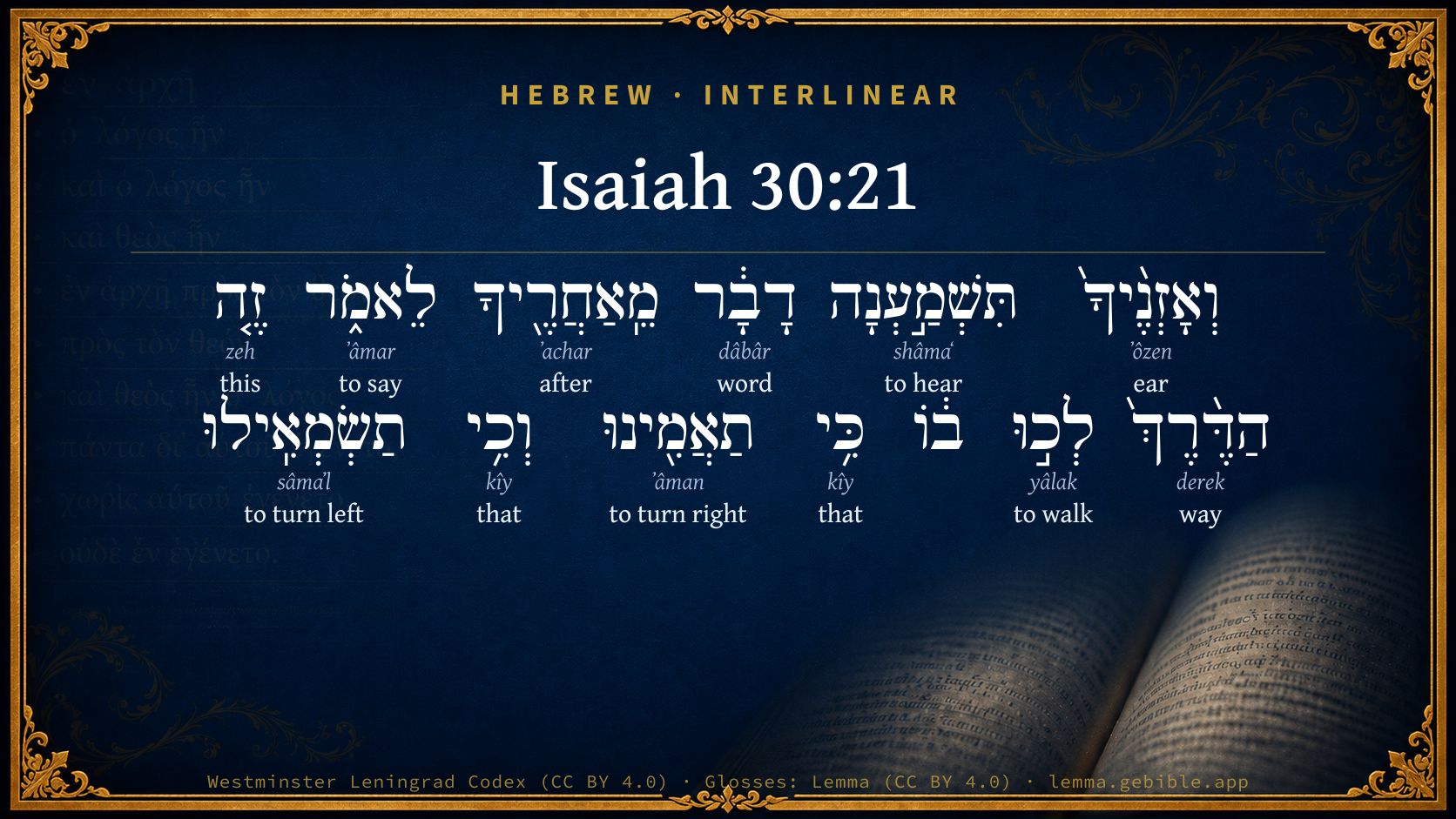
Hebrew (Westminster Leningrad Codex) Isaiah 30:21 appears in the Hebrew Old Testament. The text above is from the Westminster Leningrad Codex. Each word links to its Strong’s number, a concise gloss, and parsing drawn from the Open Scriptures Hebrew Bible morphology. Click any word for its full Brown-Driver-Briggs (BDB) entry.
Download image
Cite this verse

Isaiah 30:21 (World English Bible). Public Domain. Lemma interlinear Bible study tool, https://lemma.gebible.app/v/isaiah/30/21.

Show BibTeX & RIS
BibTeX
RIS
English Translation
and your ears shall hear a word behind you, saying, This is the way, walk you in it; when you turn to the right hand, and when you turn to the left.
World English Bible · Public Domain
Highlights
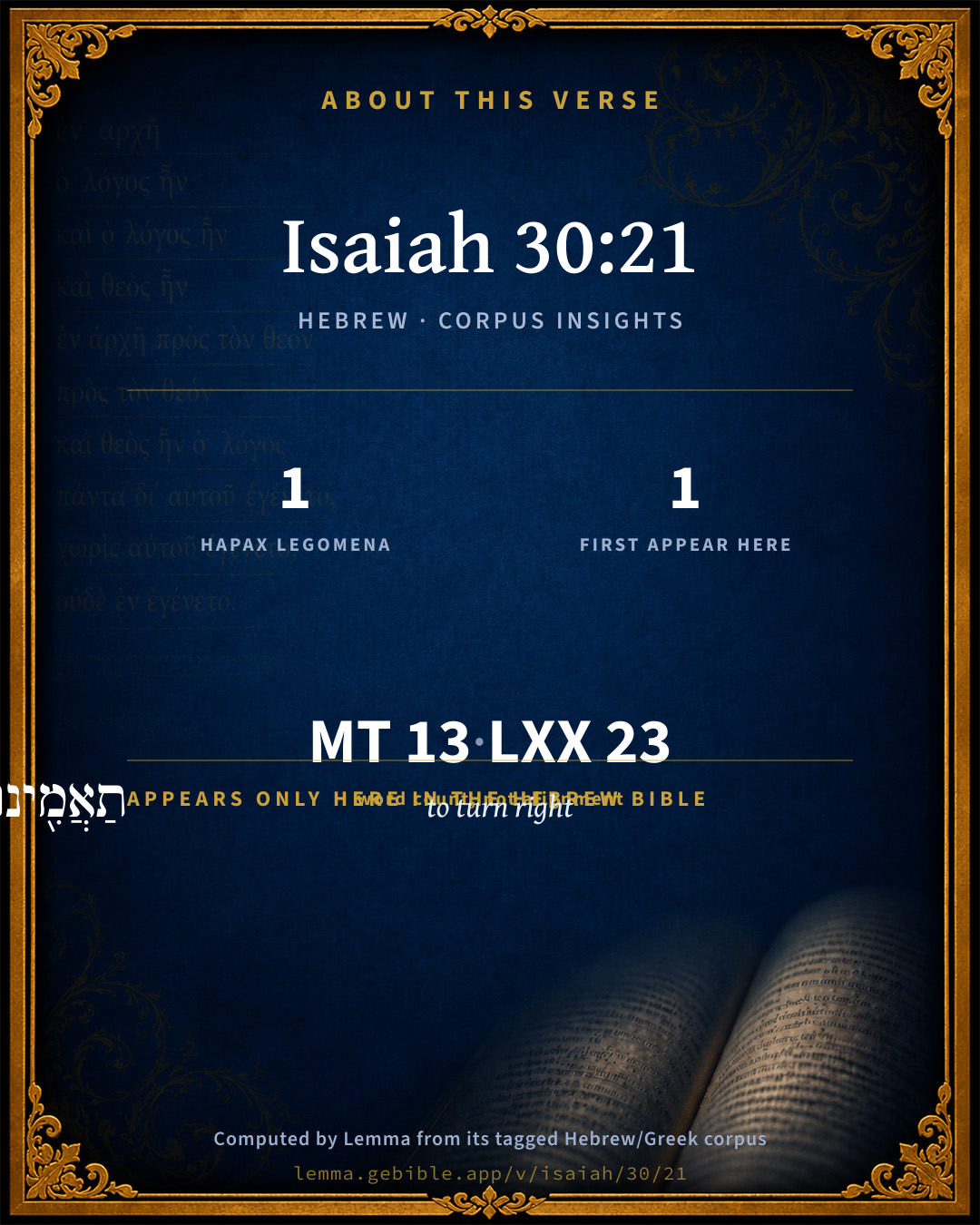
  • 1 hapax legomenon — only here in the Hebrew Bible
  • 1 first appearance in the Hebrew Bible
Full analysis ↓
Download a study sheet

One document with this verse’s original text, its word-by-word gloss line, the meaning frame, cross-references with their text, attributed commentary, and full source and license credits — printable, and it pastes into notes with its structure intact.

This verse Autodidact and up

Study sheet (.html) Plain text (.txt)

A passage Seminary Student

Up to 50 verses in one chapter. A passage sheet keeps up to 6 commentary sources and 12 cross-references per verse, in the order this page ranks them, and says so on the sheet whenever that leaves anything out. Ask for a single verse and you get the Autodidact verse sheet above.

Everything on this page stays free to read, with no account — the sheet is a download of what is already on screen, not access to it.

Want to remove ads? Support Godless Engineer
Compare translations 3

The same verse in 3 English versions, stacked beneath the original-language interlinear above. Click any original word for its lexicon entry.

Each is an independent rendering of the whole verse — the interlinear is not word-aligned to these translations.

Highlighted words mark where these versions differ — a whole-verse word diff, not a word-by-word alignment.

  • World English Bible Public Domain
    and your ears shall hear a word behind you, saying, This is the way, walk you in it; when you turn to the right hand, and when you turn to the left.
  • King James Version Public Domain
    And thine ears shall hear a word behind thee, saying, This is the way, walk ye in it, when ye turn to the right hand, and when ye turn to the left.
  • unfoldingWord Literal Text CC BY-SA 4.0
    And your ears will hear a word from behind you, saying, “This the way; walk in it,” when you turn to the right or when you turn to the left.

unfoldingWord Literal Text — © unfoldingWord, licensed CC BY-SA 4.0. Word-aligned USFM3 via Door43 (git.door43.org/unfoldingWord/en_ult).

Versions to compare (up to 4)

3 of 4 selected

Show all 18 translations

Every available English version of this verse, each an independent rendering of the whole verse.

  • World English Bible Public Domain
    and your ears shall hear a word behind you, saying, This is the way, walk you in it; when you turn to the right hand, and when you turn to the left.
  • Berean Standard Bible Public Domain
    And whether you turn to the right or to the left, your ears will hear this command behind you: “This is the way. Walk in it.”
  • Majority Standard Bible Public Domain
    And whether you turn to the right or to the left, your ears will hear this command behind you: “This is the way. Walk in it.”
  • King James Version Public Domain
    And thine ears shall hear a word behind thee, saying, This is the way, walk ye in it, when ye turn to the right hand, and when ye turn to the left.
  • American Standard Version (1901) Public Domain
    and thine ears shall hear a word behind thee, saying, This is the way, walk ye in it; when ye turn to the right hand, and when ye turn to the left.
  • Revised Version (1885) Public Domain
    and thine ears shall hear a word behind thee, saying, This is the way, walk ye in it; when ye turn to the right hand and when e turn to the left.
  • Geneva Bible (1599) Public Domain
    And thine eares shall heare a worde behind thee, saying, This is the way, walke ye in it, when thou turnest to the right hand, and when thou turnest to the left.
  • Douay-Rheims (1899) Public Domain
    And thy ears shall hear the word of one admonishing thee behind thy back: This is the way, walk ye in it: and go not aside neither to the right hand, nor to the left.
  • Young's Literal Translation Public Domain
    And thine ear heareth a word behind thee, Saying, `This `is' the way, go ye in it,' When ye turn to the right, And when ye turn to the left.
  • Literal Standard Version CC BY-SA 4.0
    And your ear hears a word behind you, saying, “This [is] the way, go in it,” || When you turn to the right, || And when you turn to the left.
  • Unlocked Literal Bible CC BY-SA 4.0
    Your ears will hear a word behind you saying, “This is the way, walk in it,” when you turn to the right or when you turn to the left.
  • unfoldingWord Literal Text CC BY-SA 4.0
    And your ears will hear a word from behind you, saying, “This the way; walk in it,” when you turn to the right or when you turn to the left.
  • Darby Bible Public Domain
    And when ye turn to the right hand or when ye turn to the left, thine ears shall hear a word behind thee, saying, This is the way, walk ye in it.
  • World Messianic Bible Public Domain
    and when you turn to the right hand, and when you turn to the left, your ears will hear a voice behind you, saying, “This is the way. Walk in it.”
  • Webster's Bible Public Domain
    And thy ears shall hear a word behind thee, saying, This is the way, walk ye in it, when ye turn to the right hand, and when ye turn to the left.
  • Free Bible Version CC BY-SA 4.0
    When you walk to the right or to the left, you will hear this command coming from behind you: “This is the way to follow.”
  • Bible in Basic English Public Domain
    And at your back, when you are turning to the right hand or to the left, a voice will be sounding in your ears, saying, This is the way in which you are to go.
  • JPS Tanakh (1917) Public Domain
    And thine ears shall hear a word behind thee, saying: 'This is the way, walk ye in it, when ye turn to the right hand, and when ye turn to the left.'

Literal Standard Version (2020), Covenant Press — licensed CC BY-SA 4.0. Text via the HelloAO Bible API (eBible.org). Unlocked Literal Bible (unfoldingWord) — licensed CC BY-SA 4.0. Text via the HelloAO Bible API (eBible.org). unfoldingWord Literal Text — © unfoldingWord, licensed CC BY-SA 4.0. Word-aligned USFM3 via Door43 (git.door43.org/unfoldingWord/en_ult). Free Bible Version, Dr. Jonathan Gallagher — licensed CC BY-SA 4.0. Text via the HelloAO Bible API (eBible.org).

Word by word

More ways to search: Search by grammar → Find every occurrence → Compare this word →

Practice this passage: Drill this verse → Learn its vocabulary →

תַאֲמִ֖ינוּ
ʼâman
H541
“to turn right”
Verb, Hiphil, Imperfect, 2nd Person, Masculine, Plural
Part of Speech
Verb
Stem
Hiphil
Form
Imperfect
Person
2nd Person
Gender
Masculine
Number
Plural
Full BDB Definition

Origin: denominative from H3225

TWOT: 872

(Hiphil) to take the right hand, to turn right, choose to the right, go to the right, use the right hand
  1. וְאָזְנֶ֨יךָ֙ ʼôzen H241 “and · ears · your” Conjunction + Noun, Common, Feminine, Dual, Construct + Suffix, Personal, 2nd Person, Masculine, Singular
  2. תִּשְׁמַ֣עְנָה shâmaʻ H8085 “to hear” Verb, Qal, Imperfect, 3rd Person, Feminine, Plural
  3. דָבָ֔ר dâbâr H1697 “word” Noun, Common, Masculine, Singular, Absolute
  4. מֵֽאַחֲרֶ֖יךָ ʼachar H310 “from · after · you” Preposition + Preposition + Suffix, Personal, 2nd Person, Masculine, Singular
  5. לֵאמֹ֑ר ʼâmar H559 “to say” Preposition + Verb, Qal, Infinitive Construct
  6. זֶ֤ה zeh H2088 “this” Pronoun, Demonstrative, Masculine, Singular
  7. הַדֶּ֨רֶךְ֙ derek H1870 “the · way” Particle, Definite Article + Noun, Common, Both, Singular, Absolute
  8. לְכ֣וּ yâlak H3212 “walk” Verb, Qal, Imperative, 2nd Person, Masculine, Plural
  9. כִּ֥י kîy H3588 “that” Conjunction
  10. וְכִ֥י kîy H3588 “and · that” Conjunction + Conjunction
  11. תַשְׂמְאִֽילוּ sâmaʼl H8041 “to turn left” Verb, Hiphil, Imperfect, 2nd Person, Masculine, Plural

About this verse

These counts appear in no published source. They are computed here, from the morphology-tagged text and Lemma’s own curated glosses. What Lemma adds →

13
words
11
distinct lemmas
Prophets
section

Notable vocabulary

1 hapax legomenon — a word that appears only here in the entire Hebrew Bible:

  • תַאֲמִ֖ינוּ to turn right H541

First appearance in Scripture

This word makes its first canonical appearance in the Hebrew Bible here:

  • תַאֲמִ֖ינוּ to turn right H541

Shared distinctive vocabulary

תַשְׂמְאִֽילוּ to turn left H8041 occurs in 5 verses of the Hebrew Bible. Also found in:

Grammatical profile

  • 5 verbs
  • 3 nouns
  • 1 pronoun
  • 2 prepositions
  • 2 conjunctions

Verb forms

  • תִּשְׁמַ֣עְנָה Qal · Imperfect
  • לֵאמֹ֑ר Qal · Infinitive Construct
  • לְכ֣וּ Qal · Imperative
  • תַאֲמִ֖ינוּ Hiphil · Imperfect
  • תַשְׂמְאִֽילוּ Hiphil · Imperfect

Repetition

A word recurs within this verse — often emphatic in Hebrew:

  • כִּ֥י that H3588 ×2

Hebrew & Septuagint length

In English translation the verse runs 32 words from the Hebrew and 36 from the Septuagint (LXX English) — closely comparable.

A rough comparison of the two English renderings, which tokenize alike — not a word-level alignment.

Word counts can differ between the Hebrew and the Greek without any difference in meaning — e.g. the Hebrew direct-object marker אֵת has no separate Greek word, and Greek often adds the article ὁ.

In the original languages it is 13 Hebrew tokens and 23 Greek tokens — but the two are counted differently (Hebrew bundles its prefixes and suffixes into one token; the Greek is in lemma form), so that isn’t a like-for-like length.

Cross-references

17

Topical passages linked to Isaiah 30:21 in the Treasury of Scripture Knowledge — connected by theme and wording, ordered by reader-vote popularity; previews shown in the World English Bible.

  • Psalms 32:8 I will instruct you and teach you in the way which you shall go. I will counsel you with my eye on you.
  • Proverbs 3:5–6 Trust in Yahweh with all your heart, And don't lean on your own understanding.
  • Isaiah 58:11 and Yahweh will guide you continually, and satisfy your soul in dry places, and make strong your bones; and you shall be like a watered garden, and like a spring of water, whose waters don't fail.
  • Isaiah 42:16 I will bring the blind by a way that they don't know; in paths that they don't know will I lead them; I will make darkness light before them, and crooked places straight. These things will I do, and I will not forsake them.
  • Deuteronomy 5:32 You shall observe to do therefore as Yahweh your God has commanded you: you shall not turn aside to the right hand or to the left.
  • Isaiah 35:8–9 A highway shall be there, and a way, and it shall be called The way of holiness. The unclean shall not pass over it, but is shall be for for him who walks in the Way. Wicked fools will not go there.
  • Psalms 143:8–10 Cause me to hear your loving kindness in the morning, For I trust in you. Cause me to know the way in which I should walk, For I lift up my soul to you.
  • Jeremiah 6:16 Thus says Yahweh, Stand you in the ways and see, and ask for the old paths, where is the good way; and walk therein, and you shall find rest for your souls: but they said, We will not walk [therein].
  • Isaiah 48:17 Thus says Yahweh, your Redeemer, the Holy One of Israel: I am Yahweh your God, who teaches you to profit, who leads you by the way that you should go.
  • Joshua 1:7 Only be strong and very courageous, to observe to do according to all the law, which Moses my servant commanded you: don't turn from it to the right hand or to the left, that you may have good success wherever you go.
  • Psalms 25:8–9 Good and upright is Yahweh, Therefore he will instruct sinners in the way.
  • Proverbs 4:27 Don't turn to the right hand nor to the left. Remove your foot from evil.
  • Isaiah 29:24 They also who err in spirit shall come to understanding, and those who murmur shall receive instruction.
  • 2 Kings 22:2 He did that which was right in the eyes of Yahweh, and walked in all the way of David his father, and didn't turn aside to the right hand or to the left.
  • Joshua 23:6 Therefore be you very courageous to keep and to do all that is written in the book of the law of Moses, that you not turn aside from it to the right hand or to the left;
  • 1 John 2:27 As for you, the anointing which you received from him remains in you, and you don't need for anyone to teach you. But as his anointing teaches you concerning all things, and is true, and is no lie, and even as it taught you, you will remain in him.
  • 1 John 2:20 You have an anointing from the Holy One, and you know the truth.

Cross-references courtesy of OpenBible.info (CC BY 4.0).

Hebrew and Greek witnesses Masoretic Hebrew ↔ Greek Septuagint

The same verse in the two great witnesses to the Old Testament, shown verse-for-verse.

These are two independent witnesses, not word-aligned to each other, and the Septuagint is shown in lemma (dictionary) form.

Hebrew Isaiah 30:21 Masoretic · Westminster Leningrad Codex

וְאָזְנֶ֨יךָ֙ תִּשְׁמַ֣עְנָה דָבָ֔ר מֵֽאַחֲרֶ֖יךָ לֵאמֹ֑ר זֶ֤ה הַדֶּ֨רֶךְ֙ לְכ֣וּ ב֔וֹ כִּ֥י תַאֲמִ֖ינוּ וְכִ֥י תַשְׂמְאִֽילוּ

and your ears shall hear a word behind you, saying, This is the way, walk you in it; when you turn to the right hand, and when you turn to the left.

World English Bible · Public Domain

Greek LXX Isaiah 30:21 Septuagint · lemma form

καί ὁ οὖς σύ ἀκούω ὁ λόγος ὁ ὀπίσω σύ πλανάω ὁ λέγω οὗτος ὁ ὁδός πορεύομαι ἐν αὐτός εἰμί δεξιός εἰμί ἀριστερός

and your ears shall hear the words of them that went after you to lead you astray, who say, This is the way, let us walk in it, whether to the right or to the left.

LXX2012 (modern English Septuagint) · Public Domain

On this verse, John Gill's Exposition discusses the Septuagint’s reading. Read the note in Commentary ↓

Hebrew: Westminster Leningrad Codex (CC BY 4.0). Greek: Septuagint (public domain); English from LXX2012 (modern English Septuagint) (Public Domain). How the Septuagint differs from the Hebrew →

Targum (Aramaic paraphrase)

1

The Targum is the ancient Jewish Aramaic paraphrase of the Hebrew Scriptures — an interpretive translation, not the Hebrew text itself. Onkelos (literal) and Pseudo-Jonathan (expansive) render the Torah, and Jonathan the Prophets. Coverage is partial: where no permissively-licensed English translation exists for a verse, only the Aramaic is shown. This is verse-level text, not a word-by-word alignment to the Hebrew.

  1. Targum Jonathan Prophets (Joshua–Malachi)
    וְאוֹדְנָךְ יִשְׁמְעוּן פִּתְגָמָא מִבִּתְרָךְ לְמֵימָר הֲדָא אוֹרְחָא דְתַקְנָא הֲלִיכוּ בָהּ לָא תִסְטוּן מִנֵיהּ לְיַמִינָא וְלִסְמָאלָא:

    And thine ears shall hear a word behind thee, saying, This is the right way, walk ye in it, and turn ye not from it to the right, or to the left.

    Targum Jonathan — Aramaic: “Mikraot Gedolot” (public domain). English: “Sefaria Community Translation” (CC0 1.0 (public-domain dedication)); “London "Chaldee Paraphrase," 1871” (public domain). Text via Sefaria.

Commentary

Notes on Isaiah 30:21 from classic Christian and Jewish commentators (each source and its license shown beneath its notes). The classic Christian expositions comment on the surrounding passage and are grouped to its opening verse, so a note may address several verses; the Jewish commentaries on the Tanakh (Rashi and others) are per-verse, so they appear only where the commentator wrote on this verse.

Lemma curates 59 commentaries, every one of them public domain or Creative Commons licensed, each selected and text-cleaned for this edition rather than reprinted as found. About our sources →

Trapp's Complete Commentary

John Trapp

Isa 30:21 And thine ears shall hear a word behind thee, saying, This [is] the way, walk ye in it, when ye turn to the right hand, and when ye turn to the left.

Ver. 21. And thine ears shall hear a word behind thee.] Quum a tergo tuo dicent, when they shall say behind thee - viz., thy teachers: a metaphor, say some, from shepherds driving their sheep, and whistling them in when ready to stray. {a}

When ye turn to the right hand, or to the left.] Heb., When ye right hand it, and when ye left hand it. It is hard to hold the king’s highway chalked out in the word, without swerving - to walk accurately, and as it were in a frame; yet this must be done, and all exorbitancies carefully shunned. Hereunto the word preached is a singular help: God by his Spirit also sends for us in our strayings, and sets us right again. There will be upon any miscarriage, singultus cordis, sobbing of heart, an upbraiding or rising of heart, as it is termed by Abigail; {1Sa 25:31} the Spirit will come in with his secret and sweet voice, both correcting and directing pro re nata for unfolding affairs.

{a} Subest comparatio a pastore sumpta, qui oves sequitur, et aberrantes in viam revocat.

John Trapp, A Commentary or Exposition upon All the Books of the Old and New Testament (1647–1656) — public domain. Text from a community e-Sword module.

The Biblical Illustrator

Joseph S. Exell

Isa_30:21

And thine ears shall hear a word behind thee

The Bath kol

The voice is evidently that of a faithful guide and monitor; according to the Rabbins the Bath kol or mysterious echo which conducts and warns the righteous.

(J. A. Alexander.)

A voice behind thee

The direction of the voice from behind is commonly explained by saying that the image is borrowed from the practice of shepherds going behind their flocks, or nurses behind children, to observe their motions. A much more natural solution is the one proposed by Henderson, to wit, that their guides were to be before them, but that when they declined from the right way their backs would be turned to them, consequently the warning voice would be heard behind them. (J. A. Alexander.)

The way of life and the ways of death

This world is full of ways, as it is of men; and one way only is right. One only is the straight way of Gods commandments, that leadeth to eternal life. The rest are the ways of men, that lead to destruction; and the most deceitful of them all are those which branch off from this one, going, some of them more, some of them less in its direction, and then by a sudden turn forsaking it. So that amid the multitude of ways many travellers through life never find the right one at all. And too many, after they have been graciously set upon it, forsake it for the many byways of sin. But the promises of God are found on His one way only; there alone their light guides amid darkness, on that alone will men meet their Saviour. (R. W. Evans, B. D.)

Care needed in going through the world

We should never forget our true position in this mortal life. We have to pick our way in it. The best known road in the world may be missed by such want of proper attention. (R. W.Evans, B. D.)

Good company in the right road

What words do we hear behind us? what company is following us? If it be not good company, can we be on the right road? If a person going (as he thought) towards London, heard persons behind him talking as if they were going towards Manchester, would he not be alarmed, suspecting that he had missed his way? How then can he be on the right road to Heaven, who hears the company that treads on his steps, talk of very different places, of very different ends of their journey? (R. W. Evans, B. D.)

The guiding word

I. THE SINNERS ATTITUDE BEFORE GOD IS UNSEEMLY AND DANGEROUS. A word behind thee. A man who hears a word behind him has his back to the speaker. He is, for some reason, not in a friendly attitude.

1. The fact is implied, in the context, that the sinner has not only his back turned to God, but is actually going away from Him. And that the going away is not an inadvertency or oversight, but the result of a set purpose.

2. That he is self-willed, stubborn, and persistent in his efforts; he continues his course of separation, in spite of the constant overtures and entreaties of love.

II. GODS WARNINGS AND OVERTURES ARE SIMPLE AND EASILY UNDERSTOOD. A word behind thee. Not a confusing, rapidly uttered discourse--not a cold philosophical, or logical treatise; not a metaphysical disquisition, couched in scientific phrase--bewildering and vague, but, a word. Not a mysterious echo from the hilltops, or an unknown voice speaking from afar, but, a word behind thee. Thine ears shall hear. God is not unreason able in His demands. When He calls, man possesses the God-given capacity to hear and obey.

III. A KNOWLEDGE OF HIS DUTY IS NOT OPTIONAL WITH THE SINNER. Thine ears shall hear. A mans knowledge of his duty is not conditioned by his conduct, as are the blessings of religion. God never gives any man up until he becomes so wedded to his sins that he indignantly spurns all efforts for his salvation, both human and Divine.

IV. GODS WARNINGS AND INSTRUCTIONS ARE ADEQUATE AND AMPLE, THEREFORE THE SINNER IS WITHOUT EXCUSE. This is the way, walk ye in it. In His teachings, Jesus Christ always presents duties as well as doctrines,--practice as well as principles.

1. Here we have doctrine. This is the way. Not one of a number of ways, or an improvement on the old. No; it has neither duplicate nor substitute.

2. We have also the practical. Walk ye in it.

V. THE LIFE OF THE SINNER IS NOT NECESSARILY FIXED AND MONOTONOUS. When ye turn to the right hand, or to the left The tremendous prerogative of free agency leaves it with every man to formulate and determine his own activities.

1. Notice the broad sphere open to the sinner, and from which he is to select the pathway of his activities.

(1) He may go straight ahead. This may involve very little that is specially good or bad.

(2) He may turn to the right hand. There is such a thing as right-hand sins. Popular, paying iniquities, which evoke but little human condemnation.

(3) He may also turn to the left. There is such a thing as left-hand sins, awkward, unseemly, embarrassing. Conduct that destroys reputation, health, character, destiny. The forger, the liar, the thief, the drunkard, the sensualist, all come in here. Everything sacred, noble, manly, valuable, is sacrificed to the absorbing demand of the present.

2. Notice the grandest possibility within reach of the sinner. Right about face. This grand movement at once brings to an end both his conduct and character as a sinner. (Thomas Kelly.)

The guiding word

Man is a traveller. He has lost his way. He needs a guide, both to bring him back to, and keep him in, the right path to the end of the journey. Where is that guide to be found? It is referred to in the text. A word behind thee. The following remarks are suggested concerning this guiding word.

I. It comes to man from WITHOUT. There are inner guides placed there by our Maker in our constitution. Reason. Conscience. But both these have failed us. They themselves are lost in the haze of depravity. Hence the need of a guide from without; such a guide as the word. It comes from God to man--

1. Through nature.

2. Through Christ.

II. It comes to man in EXPLICITNESS. This is the way, walk ye in it, when ye turn to the right hand, and when ye turn to the left. There is no indefiniteness here, no vagueness, and no uncertainty; no suggesting a choice between different ways. The word reveals the right and only way, and that way is Christ. I am the way--Follow Me.

III. It comes to man from MYSTERY. Behind thee. Thou dost not see the speaker. The voice breaks out from the dark past. It comes from behind. Behind all that is seen and heard, behind all the phenomena of nature, behind the universe, from God Himself, the Mysterious One.

IV. It comes to man, BUT HE MUST LISTEN. Thou shalt hear. This hearing is the want. Mens spiritual ears are deaf. The guiding word is everywhere.

There is no speech nor language where His voice is not heard. Open thine ear: listen and thou shalt catch the guiding directions. (Homilist.)

Diving guidance and admonition

The text may be applied to the abundant means of grace, and the plentiful effusion of the Holy Spirit, under the Gospel dispensation--to the privileges which we enjoy, and the assistance promised to us.

I. THE WAY, referred to in the text, may be applied--

1. To Gods method of saving sinful men, through faith in the Lord Jesus Christ. It was said of the apostles, These men are the servants of the Most High God, who show unto us the way of salvation. We must walk in it, actually choosing Him to be our Redeemer and Advocate, committing ourselves entirely to Him, and earnestly seeking the continual supplies of His Spirit, that we may be saved from sin.

2. The text may be applied to the way in which the sanctification of the believer is, through Divine grace, effected. We are not only to receive Christ Jesus the Lord, but also to walk in Him; and to prove that we live in the Spirit, by walking in the Spirit. It is by daily prayer, and the daily improvement of Scripture, of Divine ordinances, and providential occurrences, and a steadfast adherence to the will of God, that we must expect to grow in grace, and go from strength to strength.

3. It may be applied to that particular course of service to which each Christian is called, by the circumstances in which he b placed, the talents committed to him, or the relations he bears to others. Knowing that the way of man is not in himself, that it is not in man that walketh to direct his steps--how liable he is to mistake the path of duty on various occasions, he will pray, Teach me Thy way, O God (Psa_27:11; Psa_119:33-37).

II. THE PROMISE meets all the cases which have been mentioned.

1. It is a promise of the direction which God will afford to all who really seek it.

2. It is a promise of Divine grace to incline us to walk in Gods way. Thine ears shall hear a word behind thee, etc.

3. It is a promise that He will quicken us in the path of duty.

4. It is a promise that the Lord will preserve His people, and enable them to endure unto the end. (Essex Congregational Remembrancer.)

The teachings of the past

I. THE VALUE OF EVERY EXPERIENCE THAT BEFALLS US.

II. THE SOLE ROAD TO BLESSEDNESS, TO PEACE, TO JOY, TO TRUE PROSPERITY OF LIFE, IS RIGHTEOUSNESS.

III. GODS GUIDANCE OF THE FAITHFUL SOUL. (H. Varley, B. A.)

The word behind thee

I. THE MONITOR in these words. Thine ears shall hear a word, etc.

II. THE ADMONITION ITSELF. This is the way, etc.

III. THE OCCASION. When ye turn to the right hand, etc. (T. Horton.)

The Divine monitor

It is a promise--

1. Of ministerial opportunities.

2. Of the continuance of spiritual suggestions. (T. Horton.)

The voice behind

1. It is a pursuing and overtaking word; a word that follows us and comes at our heels.

2. A revoking and recalling word. A word of restraint.

3. An impulsive and provoking word. A word that puts thee forward, that furthers thee and promotes thee in thy way. (T. Horton.)

The admonition

This is the way, walk ye in it.

1. A word of correction and reformation in case of miscarriage. It is very fitly said to those who wander and are out of the way, to bring them again into it.

2. A word of direction and instruction in case of ignorance.

3. A word of strengthening and confirmation in case of unsettledness. It is very suitably said to those who are doubtful and wavering and uncertain in themselves whether they be right in the way or no, to encourage them to persevere and go on in those good ways which they have made entrance upon. (T. Horton.)

Turning to the right hand or to the left

The expression plainly intimates that there are dangerous bypaths on both hands, into which the people of God are apt to turn aside.

I. ON THE RIGHT HAND, there are erroneous principles and practices which are mistaken for that truth and holiness whereof they are really destitute. Such are--

1. Professed confidence in Gods pardoning mercy, disjoined from the acknowledged necessity of His sanctifying grace.

2. High pretensions to faith which are not verified by solicitude to maintain good works.

3. Flaming profession of piety toward God, unaccompanied with the exercises of justice, mercy, and charity toward men.

4. Great pretended zeal against public vices, attended with indifference as to secret personal transgressions.

5. Loud approbation of discourses that expose infidelity, hypocrisy, and iniquity, whilst these sins are indulged in heart and life.

II. ON THE LEFT HAND there are also pernicious principles and dangerous practices into which men are prone to deviate. Such are--

1. The confession that holiness is indispensably requisite to the enjoyment of God, whilst the necessity of atonement for sin is denied or overlooked.

2. Strenuous assertions of the importance of good works, separate from a proper regard to faith, the active principle from which they proceed.

3. High respect for the duties of justice, mercy, and charity, joined with criminal indifference and neglect of the exercises of piety and devotion.

4. Partiality to their own favourite sins and unaffectedness with the transgressions of other people, whereby God is offended, His law transgressed, and His truth dishonoured. (R. Macculloch.)

Virtue

Virtue lies in the middle, between two extremes, which are equally to be avoided. (R. Macculloch.)

The voice behind thee

I. THE POSITION OF THE WANDERER to whom this special blessing comes. How does God find men when He declares that they shall hear a word behind them?

1. With their backs turned to Him. The wanderer seeks not God, but God seeks him. Man turns from the God of love, but the love of God turns not away from him.

2. They were going further and further away from Him. Of course, when you have once turned your back upon the right, the further you travel the more wrong you become.

3. They were pursuing their course in spite of warning. Read the twentieth verse: Thine eyes shall see thy teachers: there they stood, good men, right in the way, entreating their hearers to cease from provoking their God and destroying their own souls.

4. They had many ways in which to wander. Sometimes they roamed to the right hand, at other times they wandered to the left, but they never turned face about. Some men have right-hand sins, respectable iniquities which challenge little censure from their fellows. Others have left-hand sins; they plunge into the sins of the flesh; no vice is too black for them.

II. THE CALL OF MERCY.

1. It is a call that is altogether undesired, and comes unsought to the man who has gone astray.

2. A word behind thee: it is the voice of an unseen Caller whose existence has been almost forgotten. It is not the teachers that speak in this powerful way. The teachers you have seen with your eyes, and they have done you no good; but some One calls whom you never saw, and never will see, till He sits on the throne of judgment at the last great day; but still He utters a word which cannot be kept out of your ears. It will come to you mysteriously at all sorts of hours crying, Return, return, return.

3. This voice pursues and overtakes the sinner.

4. That voice when it comes to sinners is generally most opportune, for they are to hear this voice behind them when they turn to the right hand or to the left.

5. It is absolutely necessary that the potent word should be spoken, and should be heard. For the man had seen his teachers, but they had not wrought him any good.

III. WHAT WAS THE WORD OF THAT CALL? It is stated at full length. This is the way, walk ye in it.

1. It contains within itself specific instruction. This is the way. There is a kind of preaching which has nothing specific, definite, and positive in it: it is a bit of cloud land, and you may make what you like out of it.

2. This definite instruction may also be said to be a special correction. It as good as says the opposite path is not the way.

3. It is also a word of sure confirmation. This is the way.

4. This is followed up by a word of personal direction. Do not merely hear about it, but walk ye in it.

5. This takes the form of encouraging permission. This is the way. Do not sit looking at it: walk ye in it. But I am so big a sinner. Christ is the way; walk ye in it. There is room enough for big sinners in Jesus. But I have been so long coming. Never mind: this is the way, walk ye in it. But I am afraid my feet are so polluted that I shall stare the way. This is the way, walk ye in it.

IV. THE SUCCESS OF THE WORD. Thine ears shall hear. God not only gives us something to hear, but He gives us ears to hear with. This is effectual grace.

1. This means that the message of Divine love shall come to the mans mind so as to create uneasiness in it.

2. After awhile there gets to be a desire in his heart.

3. As that voice continues to sound, it pulls him up and leads to resolve. (C. H.Spurgeon.)

This is the way, walk ye in it

The right way

The right way is possessed of every qualification and advantage that you can possibly desire.

1. It is a highway, open to persons of every description.

2. It is the way of holiness, wherein the unclean shall not walk.

3. It is a patent way, wherein the wayfaring man, though a fool, shall not err.

4. It is a safe way, wherein you shall be protected from the hostile attacks of your enemies.

5. It is a pleasant way, wherein you shall enjoy sacred peace.

6. It is an infallible way to arrive at fulness of joys, and rivers of pleasures for evermore. (R. Macculloch.)

The Biblical Illustrator, edited by Joseph S. Exell (c. 1880s–1900s) — public domain. Text from a community e-Sword module.

Tyndale Open Study Notes

Tyndale Open Resources

30:21 The people’s own ears will hear and follow God’s instructions (see 6:9-10; 29:18; 35:5).

Tyndale Open Study Notes — © Tyndale Open Resources, licensed CC BY-SA 4.0. Text via the HelloAO Bible API.

Geneva Bible (1599)

Geneva Bible translators

God shall direct all thy ways, and appoint thee how to go either hither or thither.

Geneva Bible (1599) marginal notes — public domain. Text via Bolls.life.

Jamieson, Fausset & Brown

Robert Jamieson, A. R. Fausset & David Brown

word--conscience, guided by the Holy Spirit (Joh 16:13).

Jamieson, Fausset & Brown — Commentary Critical and Explanatory on the Whole Bible (1871) — public domain (CC PDM 1.0). Text via the HelloAO Bible API.

Adam Clarke's Commentary

Verse 21. When ye turn to the right hand, and when ye turn to the left - "Turn not aside, to the right or to the left."] The Syriac, Chaldee, and Vulgate, translate as if, instead of כי־וכי ki-vechi, they read לא־ולא lo-velo.

Adam Clarke's Commentary on the Bible (1810–1826) — public domain. Text from a community e-Sword/MySword module.

Ellicott's Commentary for English Readers

(21) Thine ears shall hear a word behind thee.—The voice of the human teacher on whom the people looked as they listened would find an echo in that inner voice telling them which was the true way, when they were tempted to turn to the right hand or the left.

A Bible Commentary for English Readers, edited by Charles John Ellicott (1878–1897) — public domain. Text from a community e-Sword module.

The Cambridge Bible for Schools and Colleges

gen. ed. J. J. S. Perowne

21. thine ears shall hear a word behind thee] that of Jehovah, walking like a Father behind His children. Cf. Isa_29:18.

The Cambridge Bible for Schools and Colleges (gen. ed. J. J. S. Perowne; Cambridge University Press, 1878–1918) — public domain. Text from a community e-Sword module.

John Gill's Exposition

And thine ears shall hear a word behind thee,.... Which may be said in reference to the backsliding and declining state of the people, Isa 30:11 and is thought by some to be an allusion to schoolmasters, who stand behind their scholars, or at their backs, to guide, teach, and instruct them; and by others to shepherds following their flocks, who, when they observe any of the sheep going out of the way, call them back; or to travellers, who, coming to a place where are several ways, and being at a loss which way to take, and inclining to turn to the right or left, are called to by persons behind them, and directed in the right way. This "voice behind" is by the Jews (e) interpreted of Bath Kol; and by others of the voice of conscience; but it rather intends the Spirit of God, and his grace; though it seems best to understand it of the Scriptures of truth, the word of God, the only rule of faith and practice; the language of which is,

saying, This is the way, walk ye in it; it directs to Christ the way, and who is the only way of life and salvation to be walked in by faith, and to all the lesser paths of duty and doctrine, which to walk in is both pleasant and profitable, and which is the right way; so the Targum paraphrases it,

"this is the right way;''

to which agree the comments of Aben Ezra, Jarchi, and Kimchi; though the Arabic and Syriac versions, following the Septuagint, represent them as the words of seducers, directing to a wrong way: but the words are a promise of being led right, and not a threatening of being led wrong:

when ye turn to the right hand, and when ye turn to the left; through ignorance or inadvertency, through the prevalence of corruption, or force of temptation; and as it is promised there should be such a voice, so they should have ears to hear, their ears erect to attend to what is said, to observe it, and act according to it.

(e) T. Bab. Megilla, fol. 32. 1.

John Gill's Exposition of the Whole Bible (1746–1763) — public domain (CC PDM 1.0). Text via the HelloAO Bible API.

Albert Barnes' Notes on the Bible

And thine ears shall hear a word - A command or admonition. You shall not be left without spiritual guides and directors.

Behind thee - That is, says Vitringa, the voice of conscience, as an “invisible” guide, shall admonish you. The idea, however, seems to be that if they were ignorant of the way, or if they were inclined to err, they should be admonished of the true path which they ought to pursue. The idea is taken either from the practice of teachers who are represented as “following” their pupils and admonishing them if they were in danger of going astray (Grotius; or from shepherds, who are represented as following their flocks, and directing them when they wandered. The Jews understand this voice ‘from behind’ to be the כל בת bath kol - ‘the daughter of the voice;’ a divine admonition which they suppose attends the pious. The essential thought is, that they would not be left without a guide and instructor; that, if they were inclined to go astray, they would be recalled to the path of truth and duty. Perhaps there is the idea, also, that the admonition would come from some “invisible” influence, or from some unexpected quarter, as it is often the case that those who are inquiring on the subject of religion receive light from quarters where they least expected, and from sources to which they were not looking. It is also true that the admonitions of Providence, of conscience, and of the Holy Spirit, seem often to come from “behind” us. that is, they “recall” us from the path in which we were going, and restrain us from a course that would be fraught with danger.

When ye turn to the right hand ... - When you shall be in danger of wandering from the direct and straight path. The voice shall recall you, and direct you in the way in which you ought to go.

Albert Barnes' Notes on the Bible (1834–1885) — public domain. Text from a community e-Sword/MySword module.

Matthew Poole's English Annotations

Thine ears shall hear a word; as oft as need requires thou shalt hear the voice of God’s word and Spirit directing thee in thy course.

Hear a word behind thee; a metaphor borrowed either,

1. From the custom of shepherds, who use to follow their sheep, and to recall them when they go out of the way. Or,

2. From travellers, who when they are gone out of the right way, are ofttimes recalled and admonished of their error by some other passenger or person who is behind them, and therefore discerns their mistake; which he could not so easily discover if he were before them.

Matthew Poole's English Annotations on the Holy Bible (1683–1685) — public domain. Text from a community e-Sword/MySword module.

The Pulpit Commentary

Thine ears shall hear a word behind thee. Kay says, "The teacher will go before his flock, marking out the way before them." But in that case, the flock would hear the word before them. Delitzsch explains better, "They (the teachers), as the shepherds of the flock, would follow the people with friendly words of admonition." Even in the East, shepherds sometimes follow their flocks. (see Gen_32:17) When ye turn, i.e. when ye are about to turn.

Sins of will and sins of frailty.

"When ye turn to the right hand, and when ye turn to the left." This is an evident recognition of the infirmities and wanderings of those who do, of set purpose of heart, mean to serve God. The verse is a gracious assurance that, in such times of frailty, God"s people shall have due warning and correction. We may take as types of the two kinds of sin sins of will and sins of frailty the two persons who were present to the mind of Christ when he spoke as in Joh_12:10; and these two persons will illustrate the classes who were in the mind of Isaiah when he gave the warning of the text the boldly willful who persisted in the policy of seeking aid from Egypt, and the frail" ones whose faith faltered under the pressure of the anxiety of the times and the delay of the Divine intervention. They were swayed to this side or to that, but, nevertheless, tried hard to keep steadily, Piglet on.

I JUDAS, TYPE OF THOSE WHO ARE HEART-WRONG, INSINCERE, RULED BY CONSIDERATIONS OF SELF-INTEREST. There are no minute details given of the process of Judas"s apostasy. There was, indeed, nothing unusual about it. The covetous spirit made him connect himself with Christ chiefly for personal ends. The essential thing in any one who unites with Christ is surrender of self and self-will, and this surrender Judas never made. The point, however, to be specially dwelt on here is that his great sin was a matter of will, plan, resolve, determination. He did not drift into it; he was not enticed into it; he was not taken at unawares: he schemed it; he willed it; the guilt of it fully rested on him. Whenever men sin with their wills and openly, they must come under the crushings of Divine judgment. Sins of will are rebellions that must be mastered. The distinction between sins of will and. sins of frailty may be further shown in King Saul and King David.

II PETER, TYPE OF THE SINCERE BUT FAULTY AND FRAIL. Compare David. Peter was hasty, impulsive, uncertain, sometimes even weak. "The spirit was willing, but the flesh was weak." lie swayed now to this side, and now to that, and needed just such warnings as are provided in the above text. The Apostle John urges on those who are sincere Christians, that if they "say they have no sin, they deceive themselves, and the truth is not in them." And these, which at first are "goings aside," "frailties," will soon grow to become" willfulnesses, "if they are not checked and corrected. Therefore may we rejoice in God, and assure our hearts in his promise that the voice shall call us back when our feet incline to wander to the right or the left. R.T.

The Pulpit Commentary (1880–1919), ed. H.D.M. Spence-Jones & Joseph S. Exell — public domain. Text from a community e-Sword module.

John Wesley's Explanatory Notes

Shall hear - Thou shalt hear the voice of God's word and spirit. Behind thee - A metaphor borrowed from shepherds, who use to follow their sheep, and recall them when they go out of the way.

John Wesley, Explanatory Notes Upon the Whole Bible (1754–1765) — public domain. Text via the GEBible commentary corpus.

J. A. Alexander on Isaiah

Joseph Addison Alexander

“And thine ears shall hear a word from behind thee, saying, This is the way, walk ye in it, when ye turn to the right and when ye turn to the left.” Word is an idiomatic expression used where we should say ‘one speaking’. The direction of the voice from behind is commonly explained by saying, that the image is borrowed from the practice of shepherds going behind their flocks, or nurses behind children, to observe their motions. A much more natural solution is that their guides were to be before them, but that when they declined from the right way their backs would be turned to them, and consequently the warning voice would be heard behind them. The meaning of the call is, ‘this is the way which you have left, come back to it.’ As if he had said, this warning will be necessary, for you will certainly depart at times from the path of safety. This idea may, however, be considered as included or implied in the usual translation ‘when’.

Joseph Addison Alexander, The Prophecies of Isaiah (1846–1847; New York: Scribner, 1870–1878) — public domain. Text from a community e-Sword module.

Rashi

Rabbi Shlomo Yitzchaki (Rashi)

And your ears shall hear from behind you Not as you do now, that you despise My words and say, “You shall not prophesy for us true things” (verse 10), but your ears shall be bent also behind you to hear from Me, perhaps a prophet will come and instruct you the way to go, whether right or left.

Rashi on the Tanakh — English translations: “The Judaica Press complete Tanach with Rashi, translated by A. J. Rosenberg” (CC BY 4.0); “Pentateuch with Rashi's commentary by M. Rosenbaum and A.M. Silbermann, 1929-1934” (public domain); “The Metsudah Tanach series, Lakewood, N.J” (CC BY 4.0); and “The Book of Joshua, Metsudah Publications, 1997” (CC BY 4.0). Text via Sefaria.

Ibn Ezra

Rabbi Abraham ibn Ezra

And thine ears, etc. Thou wilt see thy teachers before thee, and hear the words of thy prophets and instructers, that call after thee from behind. Some explain the words thine eyes shall see and thine ears shall hear to express figuratively the seeing and understanding of the heart. תאמינו ═ חימינו; א is substituted for י as is frequently done.

When you turn to the right hand, etc.: When you are about to depart from the right way, either to the right or to the left, you will hear distinctly the words of them that show the right way.

Ibn Ezra on the Tanakh — English translations: “Sefaria Community Translation” (CC0 1.0 (public-domain dedication)); “Yalkut, Sifsei Chachomim Chumash, Metsudah Publications, 2009” (CC BY 4.0); and “Commentary of Ibn Ezra on Isaiah - trans. by M. Friedlander, 1873” (public domain). Text via Sefaria.

Lesson kit

Teaching starters — assembled from the data on this page, not authored interpretation. Every prompt links to the verse data it draws on. Edit before teaching.

Isaiah, in the Prophets, opens this verse with 13 words (11 distinct Hebrew lemmas). Its most distinctive word is ʼâman (“to turn right”). A historical commentator’s framing appears above. Read the whole chapter for the surrounding context.

Discussion questions

  1. How does “to turn right” (ʼâman) shape what this verse is saying?
  2. 1 word here appears nowhere else in the Hebrew Bible. Why might the author reach for such rare wording?
  3. This is the first place “to turn right” appears in Scripture (first appears here). What does its debut here establish?
  4. How does Genesis 13:9, which shares the word «to turn left», read alongside this verse?
  5. What does the repetition of “that” (2× in this one verse) do in this verse?
  6. These translations render this verse differently. What is at stake in choosing one wording over another?
  7. «תִּשְׁמַ֣עְנָה» is a Qal Imperfect verb. How does that grammatical form shape the action described?
  8. Compare how Trapp's Complete Commentary and The Biblical Illustrator read this verse. Where do they agree or differ?

Things to notice

  • 1 word in this verse appears nowhere else in the Hebrew Bible.
  • 1 word makes its first canonical appearance in Scripture here.
  • This verse counts 13 Hebrew ↔ 23 Greek words.
  • These translations choose different wording for 4 words in this verse.
  • “that” occurs 2× in this single verse.

Reading settings

Reading text

Shown beneath each verse's original-language words.

Old Testament
Old Testament edition

Read the OT as the Masoretic Hebrew (MT) or the Greek Septuagint (LXX).

English shown for the Greek Septuagint (in the Hebrew ↔ Greek comparison).

Comparing translations? Open the Compare panel on any verse page to stack up to four side by side.