

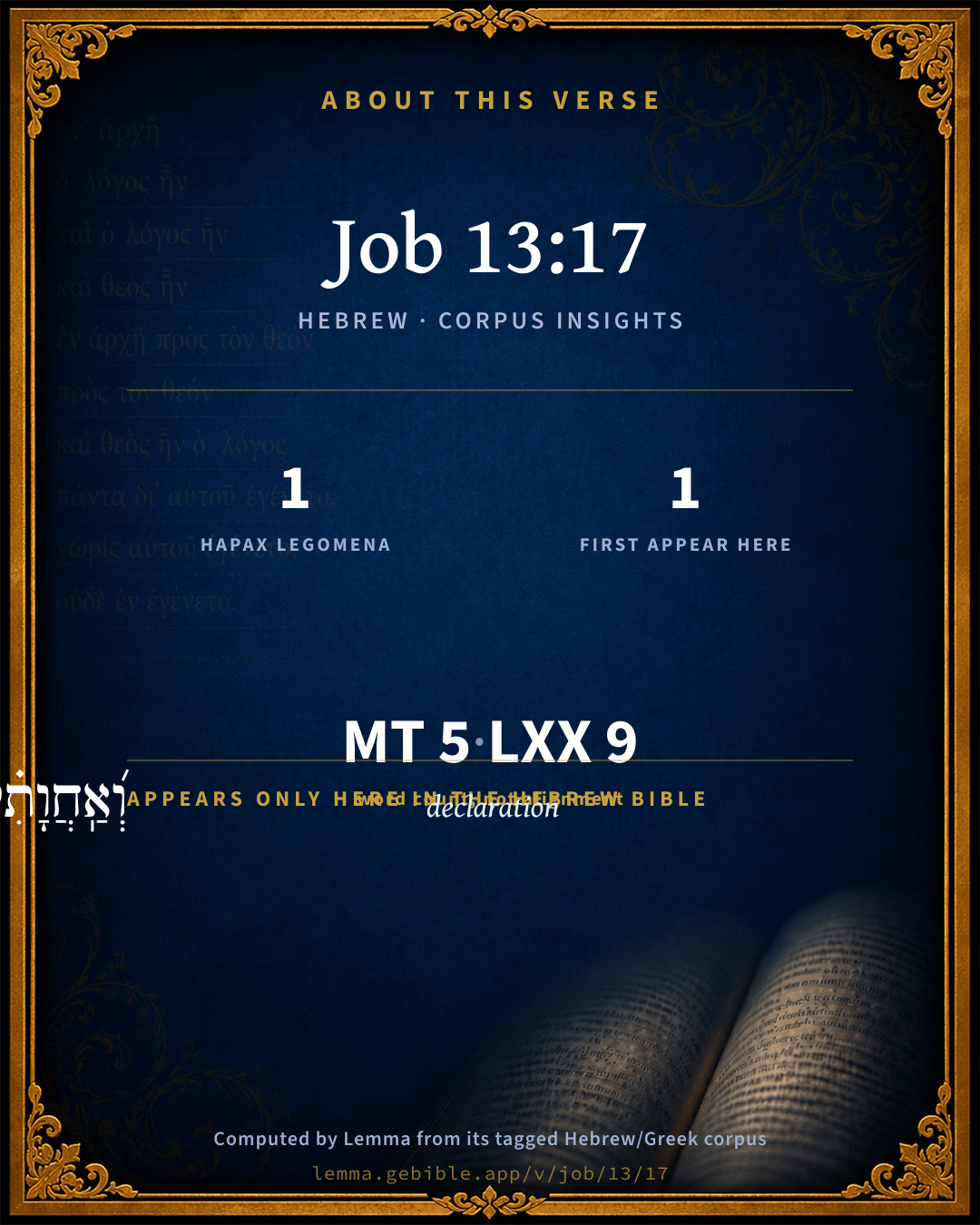
Job 13:17

Hebrew (Westminster Leningrad Codex) Job 13:17 appears in the Hebrew Old Testament. The text above is from the Westminster Leningrad Codex. Each word links to its Strong’s number, a concise gloss, and parsing drawn from the Open Scriptures Hebrew Bible morphology. Click any word for its full Brown-Driver-Briggs (BDB) entry.
Download image
Cite this verse

Job 13:17 (World English Bible). Public Domain. Lemma interlinear Bible study tool, https://lemma.gebible.app/v/job/13/17.

Show BibTeX & RIS
BibTeX
RIS
English Translation
Hear diligently my speech. Let my declaration be in your ears.
World English Bible · Public Domain
Highlights
  • 1 hapax legomenon — only here in the Hebrew Bible
  • 1 first appearance in the Hebrew Bible
Full analysis ↓
Download a study sheet

One document with this verse’s original text, its word-by-word gloss line, the meaning frame, cross-references with their text, attributed commentary, and full source and license credits — printable, and it pastes into notes with its structure intact.

This verse Autodidact and up

Study sheet (.html) Plain text (.txt)

A passage Seminary Student

Up to 50 verses in one chapter. A passage sheet keeps up to 6 commentary sources and 12 cross-references per verse, in the order this page ranks them, and says so on the sheet whenever that leaves anything out. Ask for a single verse and you get the Autodidact verse sheet above.

Everything on this page stays free to read, with no account — the sheet is a download of what is already on screen, not access to it.

Want to remove ads? Support Godless Engineer
Compare translations 3

The same verse in 3 English versions, stacked beneath the original-language interlinear above. Click any original word for its lexicon entry.

Each is an independent rendering of the whole verse — the interlinear is not word-aligned to these translations.

Highlighted words mark where these versions differ — a whole-verse word diff, not a word-by-word alignment.

  • World English Bible Public Domain
    Hear diligently my speech. Let my declaration be in your ears.
  • King James Version Public Domain
    Hear diligently my speech, and my declaration with your ears.
  • unfoldingWord Literal Text CC BY-SA 4.0
    Hearing, hear my word, and my declaration in your ears.

unfoldingWord Literal Text — © unfoldingWord, licensed CC BY-SA 4.0. Word-aligned USFM3 via Door43 (git.door43.org/unfoldingWord/en_ult).

Versions to compare (up to 4)

3 of 4 selected

Show all 18 translations

Every available English version of this verse, each an independent rendering of the whole verse.

  • World English Bible Public Domain
    Hear diligently my speech. Let my declaration be in your ears.
  • Berean Standard Bible Public Domain
    Listen carefully to my words; let my declaration ring in your ears.
  • Majority Standard Bible Public Domain
    Listen carefully to my words; let my declaration ring in your ears.
  • King James Version Public Domain
    Hear diligently my speech, and my declaration with your ears.
  • American Standard Version (1901) Public Domain
    Hear diligently my speech, And let my declaration be in your ears.
  • Revised Version (1885) Public Domain
    Hear diligently my speech, and let my declaration be in your ears.
  • Geneva Bible (1599) Public Domain
    Heare diligently my wordes, and marke my talke.
  • Douay-Rheims (1899) Public Domain
    Hear ye my speech, and receive with Sour ears hidden truths.
  • Young's Literal Translation Public Domain
    Hear ye diligently my word, And my declaration with your ears.
  • Literal Standard Version CC BY-SA 4.0
    Hear my word diligently, || And my declaration with your ears.
  • Unlocked Literal Bible CC BY-SA 4.0
    God, listen carefully to my speech; let my declaration come to your ears.
  • unfoldingWord Literal Text CC BY-SA 4.0
    Hearing, hear my word, and my declaration in your ears.
  • Darby Bible Public Domain
    Hear attentively my speech and my declaration with your ears.
  • World Messianic Bible Public Domain
    Listen carefully to my speech. Let my declaration be in your ears.
  • Webster's Bible Public Domain
    Hear diligently my speech, and my declaration with your ears.
  • Free Bible Version CC BY-SA 4.0
    Listen carefully to what I say, pay attention to my explanation.
  • Bible in Basic English Public Domain
    Give ear with care to my words, and keep what I say in your minds.
  • JPS Tanakh (1917) Public Domain
    Hear diligently my speech, and let my declaration be in your ears.

Literal Standard Version (2020), Covenant Press — licensed CC BY-SA 4.0. Text via the HelloAO Bible API (eBible.org). Unlocked Literal Bible (unfoldingWord) — licensed CC BY-SA 4.0. Text via the HelloAO Bible API (eBible.org). unfoldingWord Literal Text — © unfoldingWord, licensed CC BY-SA 4.0. Word-aligned USFM3 via Door43 (git.door43.org/unfoldingWord/en_ult). Free Bible Version, Dr. Jonathan Gallagher — licensed CC BY-SA 4.0. Text via the HelloAO Bible API (eBible.org).

Word by word

More ways to search: Search by grammar → Find every occurrence → Compare this word →

Practice this passage: Drill this verse → Learn its vocabulary →

About this verse

These counts appear in no published source. They are computed here, from the morphology-tagged text and Lemma’s own curated glosses. What Lemma adds →

5
words
4
distinct lemmas
Wisdom
section

Notable vocabulary

1 hapax legomenon — a word that appears only here in the entire Hebrew Bible:

  • וְ֝אַֽחֲוָתִ֗י declaration H262

First appearance in Scripture

This word makes its first canonical appearance in the Hebrew Bible here:

  • וְ֝אַֽחֲוָתִ֗י declaration H262

Shared distinctive vocabulary

מִלָּתִ֑י word H4405 occurs in 38 verses of the Hebrew Bible. Also found in:

Grammatical profile

  • 2 verbs
  • 3 nouns

Verb forms

  • שִׁמְע֣וּ Qal · Imperative
  • שָׁ֭מוֹעַ Qal · Infinitive Absolute

Repetition

A word recurs within this verse — often emphatic in Hebrew:

  • שִׁמְע֣וּ to hear H8085 ×2

Hebrew & Septuagint length

In English translation the verse runs 11 words from the Hebrew and 12 from the Septuagint (LXX English) — closely comparable.

A rough comparison of the two English renderings, which tokenize alike — not a word-level alignment.

Word counts can differ between the Hebrew and the Greek without any difference in meaning — e.g. the Hebrew direct-object marker אֵת has no separate Greek word, and Greek often adds the article ὁ.

In the original languages it is 5 Hebrew tokens and 9 Greek tokens — but the two are counted differently (Hebrew bundles its prefixes and suffixes into one token; the Greek is in lemma form), so that isn’t a like-for-like length.

Cross-references

3

Topical passages linked to Job 13:17 in the Treasury of Scripture Knowledge — connected by theme and wording, ordered by reader-vote popularity; previews shown in the World English Bible.

  • Job 13:6 Hear now my reasoning. Listen to the pleadings of my lips.
  • Job 21:2 "Listen diligently to my speech. Let this be your consolation.
  • Job 33:1 "However, Job, Please hear my speech, And listen to all my words.

Cross-references courtesy of OpenBible.info (CC BY 4.0).

Hebrew and Greek witnesses Masoretic Hebrew ↔ Greek Septuagint

The same verse in the two great witnesses to the Old Testament, shown verse-for-verse.

These are two independent witnesses, not word-aligned to each other, and the Septuagint is shown in lemma (dictionary) form.

Hebrew Job 13:17 Masoretic · Westminster Leningrad Codex

שִׁמְע֣וּ שָׁ֭מוֹעַ מִלָּתִ֑י וְ֝אַֽחֲוָתִ֗י בְּאָזְנֵיכֶֽם

Hear diligently my speech. Let my declaration be in your ears.

World English Bible · Public Domain

Greek LXX Job 13:17 Septuagint · lemma form

ἀκούω ἀκούω ὁ ῥῆμα ἐγώ ἀναἀγγέλλω γάρ σύ ἀκούω

Hear, hear you⌃ my words, for I will declare in your hearing.

LXX2012 (modern English Septuagint) · Public Domain

Hebrew: Westminster Leningrad Codex (CC BY 4.0). Greek: Septuagint (public domain); English from LXX2012 (modern English Septuagint) (Public Domain). How the Septuagint differs from the Hebrew →

Commentary

Notes on Job 13:17 from classic Christian and Jewish commentators (each source and its license shown beneath its notes). The classic Christian expositions comment on the surrounding passage and are grouped to its opening verse, so a note may address several verses; the Jewish commentaries on the Tanakh (Rashi and others) are per-verse, so they appear only where the commentator wrote on this verse.

Lemma curates 59 commentaries, every one of them public domain or Creative Commons licensed, each selected and text-cleaned for this edition rather than reprinted as found. About our sources →

Trapp's Complete Commentary

John Trapp

Job 13:17 Hear diligently my speech, and my declaration with your ears.

Ver. 17. Hear diligently my speech] Heb. Hearing hear, that is, incline your ears and hear, as Isa 55:3. Mark and attend; hear me not only, but heed me too; interrupt me not, neither give me the slip, as it may seem they were ready to do, when they heard him profess such a deal of faith and hope under so many and heavy afflictions; wherein they thought that either he was beside himself, or, at least, beside the cushion, as we say, and utterly out. See Job 13:6, and observe, that it is but needful often to stir up our auditors to attention. Job makes more prefaces than one to be heard; so do the prophets often. Hear the word of the Lord, hear and give ear, be not proud, for the Lord hath spoken it. So doth the arch prophet more than once, Rev 2:7; Rev 2:11; Rev 2:17; Rev 2:29; Rev 3:6; Rev 3:13; Rev 3:22 Mat 13:9, "Who hath ears to hear, let him hear." All Christ’s hearers had not ears; or if they had, yet they were stopped; or if open, yet the bore was not large enough. Oh pray that God would say unto us, Ephphatha, be opened, for a heavy ear is a singular judgment.

John Trapp, A Commentary or Exposition upon All the Books of the Old and New Testament (1647–1656) — public domain. Text from a community e-Sword module.

Joseph Benson's Commentary

Job 13:17. Hear diligently my speech — This he desired before, (Job 13:6,) and now repeats, either, because they manifested some dislike of his speech, and some desire to interrupt him; or, because he now comes more closely to the question; the foregoing verses being mostly in the way of preface to it. And my declaration — That is, the words whereby I declare my mind.

Joseph Benson's Commentary on the Old and New Testaments (1811–1818) — public domain. Text from a community e-Sword module.

Keil & Delitzsch

C. F. Keil & F. Delitzsch

17 Hear, O hear my confession,

And let my declaration echo in your ears.

18 Behold now! I have arranged the cause,

I know that I shall maintain the right.

19 Who then can contend with me?

Then, indeed, I would be silent and expire.

Eager for the accomplishment of his wish that he might himself take his cause before God, and as though in imagination it were so, he invites the friends to be present to hear his defence of himself. מלּה (in Arabic directly used for confession = religion) is the confession which he will lay down, and אחוה the declaration that he will make in evidence, i.e., the proof of his innocence. The latter substantive, which signifies brotherly conduct in post-biblical Hebrew, is here an ἅπ. λεγ. from חוה, not however with Aleph prostheticum from Kal, but after the form אזכּרה = הזכּרה, from the Aphl = Hiphil of this verb, which, except Psa 19:3, occurs only in the book of Job as Hebrew (comp. the n. actionis, אחויה, Dan 5:12), Ewald, 156, c. It is unnecessary to carry the שׁמעוּ on to Job 13:17 (hear now ... with your own ears, as e.g., Jer 26:11); Job 13:17 is an independent substantival clause like Job 15:11; Isa 5:9, which carries in itself the verbal idea of תּהי or תּבא (Psa 18:7). They shall hear, for on his part he has arranged, i.e., prepared (משׁפּט ערך, causam instruere, as Job 23:4, comp. Job 33:5) the cause, so that the action can begin forthwith; and he knows that he, he and no one else, will be found in the right. With the conviction of this superiority, he exclaims, Who in all the world could contend with him, i.e., advance valid arguments against his defence of himself? Then, indeed, if this impossibility should happen, he would be dumb, and willingly die as one completely overpowered not merely in outward appearance, but in reality vanquished. יריב עמדי following הוא מי (comp. Job 4:7) may be taken as an elliptical relative clause: qui litigare possit mecum (comp. Isa 50:9 with Rom 8:34, τίς ὁ καταδρίνων); but since זה הוא מי is also used in the sense of quis tandem or ecquisnam, this syntactic connection which certainly did exist (Ewald, 325, a) is obliterated, and הוא serves like זה only to give intensity and vividness to the מי. On עתּה כּי (in meaning not different to אז כּי), vid., Job 3:13; Job 8:6. In Job 13:19 that is granted as possible which, according to the declaration of his conscience, Job must consider as absolutely impossible. Therefore he clings to the desire of being able to bring his cause before God, and becomes more and more absorbed in the thought.

Keil & Delitzsch — Biblical Commentary on the Old Testament (1861–1891) — public domain (CC PDM 1.0). Text via the HelloAO Bible API. (Old Testament only.)

Jamieson, Fausset & Brown

Robert Jamieson, A. R. Fausset & David Brown

my declaration--namely, that I wish to be permitted to justify myself immediately before God.

with your ears--that is, attentively.

Jamieson, Fausset & Brown — Commentary Critical and Explanatory on the Whole Bible (1871) — public domain (CC PDM 1.0). Text via the HelloAO Bible API.

The Cambridge Bible for Schools and Colleges

gen. ed. J. J. S. Perowne

17–22. Assured of victory, he commands his friends to mark his pleading of his cause.

The Cambridge Bible for Schools and Colleges (gen. ed. J. J. S. Perowne; Cambridge University Press, 1878–1918) — public domain. Text from a community e-Sword module.

John Gill's Exposition

Hear diligently my speech,.... Or, "in hearing hear" (s); meaning, not only that his friends would attentively hear him, but continue to hear him; that they would hear him out what he had to say further: upon his expressing himself with so much faith and confidence in God, they might rise up from their seats and be preparing to be gone, as not having patience to hear a man talk so confidently, who they thought was a bad man and an hypocrite; or they might attempt to interrupt him while speaking, and therefore he desires they would be still, and patiently and diligently hear what he had more to say:

and my declaration with your ears; that is, that they would listen to it attentively, when he doubted not but he should make his case as clear as the sun, and set it in such a point of view, as that it would appear most plainly to be right, and he to be a just man.

(s) "audite audiendo", Pagninus, Montanus, Beza, &c.

John Gill's Exposition of the Whole Bible (1746–1763) — public domain (CC PDM 1.0). Text via the HelloAO Bible API.

Albert Barnes' Notes on the Bible

Hear diligently my speech - That which I have made; that is, the declaration which I have made of my innocence. He refers to his solemn declaration, Job 13:15-16 that he had unwavering confidence in God, and that even should God slay him he would put confidence in him. This solemn appeal he wished them to attend to as one of the utmost importance.

Albert Barnes' Notes on the Bible (1834–1885) — public domain. Text from a community e-Sword/MySword module.

Haydock's Catholic Bible Commentary

Truths. Literally, "riddles" to you. Hebrew achavathi, (Haydock) means "instructions," &c. (Calmet)

George Leo Haydock (1774–1849), Haydock's Catholic Family Bible and Commentary, 1859 edition — public domain. Excludes Psalms (Douay-Rheims chapter numbering differs from Protestant) and Deuterocanonical books (Catholic canon only).

Matthew Poole's English Annotations

This he desired before, Job 13:6, and now repeateth, either because they manifested some neglect or dislike of his speech, and some desire to interrupt him; or because he now comes more closely to his business, the foregoing verses being mostly in way of preface to it.

My declaration, i.e. the words whereby I declare my mind.

Matthew Poole's English Annotations on the Holy Bible (1683–1685) — public domain. Text from a community e-Sword/MySword module.

The Pulpit Commentary

Hear diligently my speech, and my declaration with your ears. A last appeal to his opponents to give him their full attention (comp. ver. 6).

Vers. 17-28. Job to God: resumption of the third controversy: The pleading of a saint with Heaven.

I PRELIMINARIES TO THE PLEADING.

1. Public audience invited. Job requests his discomfited friends to be silent spectators of the ensuing trial, and to attentively consider the defence he was about to offer (ver. 17). Intended chiefly for the ear of God, it should yet contain nothing unfit for publication in the hearing of men. Conscious of sincerity, Job had nothing to conceal. Guilelessness is ever a mark of true saintship. "A man with a clear conscience can stand fearlessly before the whole world." Undaunted courage is also characteristic of the godly, (Psa_27:1 Pro_28:1 1Jn_3:21) who, however, unlike Job, are emboldened, not by a sense of their own integrity, but by a calm reliance on the righteousness of Christ. (Isa_45:24, 25 50:7-9 Rom_8:32-34)

2. Perfect readiness expressed. Job asserts (ver. 18) that he had carefully arranged the several pleas he should urge in vindication of his outraged integrity. And in this Job"s example may be followed with advantage. Neither saint nor sinner should irreverently and presumptuously intrude into God"s presence without having first composed his heart and, as far as possible, arranged his thoughts. (Ecc_5:2) No man is ready for reasoning with God in prayer until he knows both what he wants and how to plead for it.

3. Hopeful confidence entertained. "I know that I shall be justified" (ver. 18). This was no presumption on the part of Job, who probably based his justification before God, in the strictly forensic sense of absolution and acceptance, not upon his own righteousness, but upon the free favour of God, through the merit of his Redeemer; (Job_19:25) but merely that inward consciousness of personal integrity which a good man may justly rely on as evidence of a gracious state, and by which he may encourage his fainting spirit when about to appear before God, like Hezekiah, (Isa_38:3) David, (Psa_26:1) St. Peter, (Joh_21:17) St. Paul, (Rom_9:1) and St. John. (1Jn_3:21) Of course, it would be presumption were a sinful man, standing on his own righteousness, to expect that he would be justified before God. (Psa_143:2 Rom_3:20) But, trusting in the great propitiatory sacrifice of him who is "the Lord our Righteousness," the guiltiest and most unworthy sinner may draw near to God with holy boldness, (Heb_4:16 Heb_10:22) and with absolute assurance of acceptance and salvation, (Heb_7:25 Rom_8:1) saying, "I know that I shall be justified.

4. Sinful impeachment challenged. "Who is he that will plead with me?" i.e. against me, contradicting and disproving what I now so fearlessly assert, viz. my personal integrity. If there is any, let him stand forth and establish his indictment. If be succeed in tarnishing my fair name, "I shall be silent, I shall give up the ghost," feeling that, honour gone, life itself can have no further charm for me. Many a one besides Job has felt that "good name in man and woman is the immediate jewel of their souls" ("Othello," act 3. sc. 3), "the immortal part" of themselves (ibid., act 2. sc. 3), and that, that being lost, nothing worthy of possessing can remain (cf. "Richard II," Ac 1. sc. 1). Job"s language reminds us of St. Paul"s address to his accusers before Felix; (Act_24:16-21) and afterwards before Festus; (Act_25:11) also of the loftier challenge addressed by Christ to his countrymen. (Isa_50:8 Joh_8:46) And though certainly believers cannot use the question as did Christ, and may sometimes have a difficulty in employing it in the sense of either Job or St. Paul, it is always open to them, as they keep their eyes on the cross, to exclaim, "Who shall lay anything to the charge of God"s elect?". (Rom_8:33)

II CONDITIONS OF THE PLEADING.

1. A cessation of his troubles. (Ver. 21) The hand of God a frequent biblical expression for affliction, (1Sa_5:6, 7 Psa_32:4 Psa_38:2 Isa_1:25) which is sent, (Deu_8:5 2Sa_7:14 Job_5:17 Psa_94:12 Heb_12:6, Heb_12:7) guided, (Job_33:17-19 Pro_3:11, 12 Isa_48:10 Eze_20:37) and removed (Psa_50:15 Psa_66:12 Zec_13:9 Joh_16:20 Mat_5:4) by Divine wisdom and power. The fatherly chastisements of God are directly designed to refine and purify the saintly soul, (Job_36:8, 10 Isa_48:10 Heb_12:11) and to draw it near his footstool in penitence and faith, humility and love. (Hos_5:15 Heb_12:9) Yet, not unfrequently, one of the first effects of bodily affliction upon a good man, especially if it be severe, is to discompose his mind, disturb his heart, and generally unfit him for converse with God. Notwithstanding the spiritual benefits folded up in tribulation, there can be no greater blessing, even with a view to the exercises of religion, than mens sans in sano corpore. Much of the spiritual depression experienced by Christians is traceable to extreme bodily infirmity, though sometimes happy invalids can say with St. Paul," When I am weak, then am I strong;" "Most gladly will I glory in infirmities, that the power of God may rest upon me." Then, if pious souls, groaning beneath the pressure of physical maladies and mental anxieties, find it hard to concentrate their thoughts upon Divine things, what must be the madness of those who delay the work of repenting and pleading with God for forgiveness and salvation till they are lying on a sick-bed, racked with pain, and perhaps trembling in the grasp of death?

2. A removal of his fear. (Ver. 21) The Divine character has a terrifying, as well as an attractive, side to sinful man. The glory of the Divine purity is so effulgent, (Job_4:18) of the Divine justice so incorruptible, (Job_9:2) of the Divine wisdom so ineffable, (Job_9:4) of the Divine strength so overwhelming, (Job_9:19) that the human spirit instinctively shrinks back in alarm. Burdened with guilt, tainted with pollution, lying under condemnation, it cannot hold up its head in the presence of such awful majesty, but, falling prostrate before the footstool of heaven"s glorious King, exclaims, like Isaiah, "Woe is me; for I am undone!"; (Isa_6:5) and like David, "In judgment enter not with me, thy servant poor; For why, this well I wet, no sinner can endure The sight of thee, O God. (Psa_143:2, metrical version.) And like St. Peter, "Depart from me; for I am a sinful man, O Lord". (Luk_5:8) Job felt that, unless his mind were relieved from such paralyzing views of the overwhelming grandeur of his invisible Judge, it would be utterly hopeless to expect he could even state his case aright, much less win his cause. Hence already he had craved the interposition of a daysman, who should both take away God"s rod and remove God"s fear (Job_9:34) in order to enable him to speak; and to this he apparently again recurs. Happily such a daysman has been provided for us in Christ, in whom the anxious sinner may now behold, not only the rod of Divine punishment removed, but the greatness of the Divine glory veiled, so that one who desires to speak with God may do so without a fear, "whether God himself opens the cause, or permits him to have the first word.

III CONTENTS OF THE PLEADING.

1. A bold interrogation. (Ver. 23)

(1) A valuable definition. Sin is avon"or perverse acting, a bending, twisting, or turning aside from the Divine Law; chattah, a false step, hence a failing, an error, a sin of weakness or infirmity; and pesha" a breaking away, hence deliberate and malignant wickedness. The first epithet describes the nature of sin is any want of conformity unto or transgression of the Law of God;" the second points to the source of sin human weakness; (Jer_10:23) while the third indicates the heinousness of sin it is essentially rebellion against God. (Rom_8:7) Or the three expressions may allude to different kinds of sin, palpable offences, venial imperfections, notorious crimes, of all which Job was supposed to be guilty.

(2) A candid confession. Whatever iniquities, sins, or transgressions Job had committed, God perfectly knew them, could reckon up their number and estimate their heinousness. Men often are unconscious of their faults, frequently forget their shortcomings, and can seldom realize the enormity of their wickednesses. But all these are patent to God"s omniscient mind. (Psa_69:5 Psa_73:23 Luk_16:15 Heb_4:13)

(3) A passionate supplication. That God would enable Job to understand the nature and enormity of those offences of which he had been guilty, and for which his friends alleged he was suffering. The prayer is admirably suited to and urgently needed by all, though not in the sense in which it was employed by Job. No man can attain to a clear discovery, of his own sinfulness, to an adequate estimate of the number of his misdeeds, to a just appreciation of their essential wickedness, except through Divine teaching. Such teaching God imparts through his Word (Psa_94:12 Rom_7:9) and Spirit. (Joh_16:8)

(4) An obvious implication. Job designed it to be understood that he himself was unconscious of any such offences, though of course he did not claim to be entirely innocent.

2. An inexplicable problem. (Ver. 24) Here is

(1) a painful experience, the sense of having lost the Divine favour, to a gracious soul the highest blessing attainable or even conceivable on earth; (Psa_30:5 Psa_63:3)

a. a common experience, realized by David, (Isa_13:1 Isa_22:1) by, (Psa_88:14) and by Christ, (Mat_27:46) as well as by many of Christ"s followers since;

b. a mysterious experience, not that God should hide his face and seem to withdraw his favour from a sinful soul, but that, having once admitted a repenting and believing sinner to his love, he should to all appearance cast him off a course of conduct for which Job was perfectly at a loss to account; yet

c. a needful experience, in the case of Christ to make him perfect as a Saviour, in that of Job, David, Heman, and others to make them perfect as saints.

3. A pathetic expostulation.

(1) The unworthiness of the Divine conduct in afflicting Job. Absolutely powerless and insignificant had Job become through his long-continued trouble, like a fallen leaf upon the way, agitated and tossed by every passing wind, or like the withered stubble of a corn-field, and yet the Almighty assailed him with the full force of his Divine artillery, as if he were some formidable opponent whom it required the battalions of omnipotence to crush (ver. 25). To Job"s mind it seemed wholly incongruous, entirely preposterous, completely unbecoming the Divine Majesty. So God"s procedure in providence oftentimes appears to sense and reason unworthy of his greatness and glory; but faith, coming to the rescue, reminds the doubting heart that doeth all things well.

(2) The seeming injustice of God"s conduct in afflicting Job. Conscious of innocence in his riper years, Job could only offer, as the solution of that perplexing enigma by which he was confronted, that God was going back upon the sins of his youthful days, although these had long since been repented of and forgiven (ver. 26). But sin once forgiven is for ever forgotten. (Isa_43:25 Mic_7:18, Mic_7:19) God never reproduces for punishment the transgression he has freely pardoned. Yet the iniquities of youth which have not been cancelled by Divine mercy have a strange power of self-resuscitation in riper years; and God often makes wicked men (e.g. the drunkard, the profligate), in accordance with the established and righteous laws of retribution, to inherit, or possess, or reap the hitter fruits in old age of the excesses and indulgences of youth. Hence the necessity of cultivating moral purity in youth, and the propriety in after-years of praying, "Remember not the sins of my youth". (Psa_25:7)

(3) The extreme severity of God"s conduct in afflicting Job, who was treated like a prisoner; whose feet were thrust into the stocks, as were those of Jer_20:2 Jer_29:6, and of Paul and Silas; (Act_16:24) whose steps were narrowly watched, lest he should either enjoy too much freedom or attempt to escape, (cf. Job_10:14; and see homiletics on Job_7:12-21) and whose liberty was (according to one interpretation), restrained within narrow limits, by a boundary or circle drawn around the soles of his feet (ver. 27), and that though he, the chained, inspected, and immured prisoner, was a poor miserable creature, lying rotting on an ash-heap like a garment that the moth gnaweth (ver. 28).

Learn:

1. The gratitude which saints and sinners both owe to God for the throne of grace.

2. The sublime fearlessness with which the guiltiest no less than the godliest may approach that throne.

3. The liberty which all enjoy to pour out their hearts before God.

4. The propriety of seeking a more intimate acquaintance with the reality and power of indwelling sin.

5. The sinfulness of supposing that God ever treats any of his creatures as enemies.

The Pulpit Commentary (1880–1919), ed. H.D.M. Spence-Jones & Joseph S. Exell — public domain. Text from a community e-Sword module.

John Wesley's Explanatory Notes

Hear - He now comes more closely to his business, the foregoing verses being mostly in way of preface.

John Wesley, Explanatory Notes Upon the Whole Bible (1754–1765) — public domain. Text via the GEBible commentary corpus.

Lesson kit

Teaching starters — assembled from the data on this page, not authored interpretation. Every prompt links to the verse data it draws on. Edit before teaching.

Job, in the Wisdom, opens this verse with 5 words (4 distinct Hebrew lemmas). Its most distinctive word is ʼachvâh (“declaration”). A historical commentator’s framing appears above. Read the whole chapter for the surrounding context.

Discussion questions

  1. How does “declaration” (ʼachvâh) shape what this verse is saying?
  2. 1 word here appears nowhere else in the Hebrew Bible. Why might the author reach for such rare wording?
  3. This is the first place “declaration” appears in Scripture (first appears here). What does its debut here establish?
  4. How does 2 Samuel 23:2, which shares the word «word», read alongside this verse?
  5. What does the repetition of “to hear” (2× in this one verse) do in this verse?
  6. These translations render this verse differently. What is at stake in choosing one wording over another?
  7. «שִׁמְע֣וּ» is a Qal Imperative verb. How does that grammatical form shape the action described?
  8. Compare how Trapp's Complete Commentary and Joseph Benson's Commentary read this verse. Where do they agree or differ?

Things to notice

  • 1 word in this verse appears nowhere else in the Hebrew Bible.
  • 1 word makes its first canonical appearance in Scripture here.
  • This verse counts 5 Hebrew ↔ 9 Greek words.
  • These translations choose different wording for 5 words in this verse.
  • “to hear” occurs 2× in this single verse.

Reading settings

Reading text

Shown beneath each verse's original-language words.

Old Testament
Old Testament edition

Read the OT as the Masoretic Hebrew (MT) or the Greek Septuagint (LXX).

English shown for the Greek Septuagint (in the Hebrew ↔ Greek comparison).

Comparing translations? Open the Compare panel on any verse page to stack up to four side by side.