

Proverbs 25:12

Hebrew (Westminster Leningrad Codex) Proverbs 25:12 appears in the Hebrew Old Testament. The text above is from the Westminster Leningrad Codex. Each word links to its Strong’s number, a concise gloss, and parsing drawn from the Open Scriptures Hebrew Bible morphology. Click any word for its full Brown-Driver-Briggs (BDB) entry.
Download image
Cite this verse

Proverbs 25:12 (World English Bible). Public Domain. Lemma interlinear Bible study tool, https://lemma.gebible.app/v/proverbs/25/12.

Show BibTeX & RIS
BibTeX
RIS
English Translation
As an ear-ring of gold, and an ornament of fine gold, So is a wise reprover to an obedient ear.
World English Bible · Public Domain
Highlights
  • 1 first appearance in the Hebrew Bible
Full analysis ↓
Download a study sheet

One document with this verse’s original text, its word-by-word gloss line, the meaning frame, cross-references with their text, attributed commentary, and full source and license credits — printable, and it pastes into notes with its structure intact.

This verse Autodidact and up

Study sheet (.html) Plain text (.txt)

A passage Seminary Student

Up to 50 verses in one chapter. A passage sheet keeps up to 6 commentary sources and 12 cross-references per verse, in the order this page ranks them, and says so on the sheet whenever that leaves anything out. Ask for a single verse and you get the Autodidact verse sheet above.

Everything on this page stays free to read, with no account — the sheet is a download of what is already on screen, not access to it.

Want to remove ads? Support Godless Engineer
Compare translations 3

The same verse in 3 English versions, stacked beneath the original-language interlinear above. Click any original word for its lexicon entry.

Each is an independent rendering of the whole verse — the interlinear is not word-aligned to these translations.

Highlighted words mark where these versions differ — a whole-verse word diff, not a word-by-word alignment.

  • World English Bible Public Domain
    As an ear-ring of gold, and an ornament of fine gold, So is a wise reprover to an obedient ear.
  • King James Version Public Domain
    As an earring of gold, and an ornament of fine gold, so is a wise reprover upon an obedient ear.
  • unfoldingWord Literal Text CC BY-SA 4.0
    A ring of gold and jewelry of fine gold a wise rebuke to a listening ear.

unfoldingWord Literal Text — © unfoldingWord, licensed CC BY-SA 4.0. Word-aligned USFM3 via Door43 (git.door43.org/unfoldingWord/en_ult).

Versions to compare (up to 4)

3 of 4 selected

Show all 18 translations

Every available English version of this verse, each an independent rendering of the whole verse.

  • World English Bible Public Domain
    As an ear-ring of gold, and an ornament of fine gold, So is a wise reprover to an obedient ear.
  • Berean Standard Bible Public Domain
    Like an earring of gold or an ornament of fine gold is a wise man’s rebuke to a listening ear.
  • Majority Standard Bible Public Domain
    Like an earring of gold or an ornament of fine gold is a wise man’s rebuke to a listening ear.
  • King James Version Public Domain
    As an earring of gold, and an ornament of fine gold, so is a wise reprover upon an obedient ear.
  • American Standard Version (1901) Public Domain
    `As' an ear-ring of gold, and an ornament of fine gold, `So is' a wise reprover upon an obedient ear.
  • Revised Version (1885) Public Domain
    As an earring of gold, and an ornament of fine gold, so is a wise reprover upon an obedient ear.
  • Geneva Bible (1599) Public Domain
    He that reprooueth the wise, and the obedient eare, is as a golden earering and an ornament of fine golde.
  • Douay-Rheims (1899) Public Domain
    As an earring of gold and a bright pearl, so is he that reproveth the wise, and the obedient ear.
  • Young's Literal Translation Public Domain
    A ring of gold, and an ornament of pure gold, `Is' the wise reprover to an attentive ear.
  • Literal Standard Version CC BY-SA 4.0
    A ring of gold, and an ornament of pure gold, || [Is] the wise reprover to an attentive ear.
  • Unlocked Literal Bible CC BY-SA 4.0
    A gold ring or jewelry made of fine gold is a wise rebuke to a listening ear.
  • unfoldingWord Literal Text CC BY-SA 4.0
    A ring of gold and jewelry of fine gold a wise rebuke to a listening ear.
  • Darby Bible Public Domain
    An ear-ring of gold, and an ornament of fine gold, is a wise reprover upon an attentive ear.
  • World Messianic Bible Public Domain
    As an earring of gold, and an ornament of fine gold, so is a wise reprover to an obedient ear.
  • Webster's Bible Public Domain
    As an ear-ring of gold, and an ornament of fine gold, so is a wise reprover upon an obedient ear.
  • Free Bible Version CC BY-SA 4.0
    Constructive criticism from the wise to someone who listens is like a gold ring and a necklace of fine gold.
  • Bible in Basic English Public Domain
    Like a nose-ring of gold and an ornament of the best gold, is a wise man who says sharp words to an ear ready to give attention.
  • JPS Tanakh (1917) Public Domain
    As an ear-ring of gold, and an ornament of fine gold, so is a wise reprover upon an obedient ear.

Literal Standard Version (2020), Covenant Press — licensed CC BY-SA 4.0. Text via the HelloAO Bible API (eBible.org). Unlocked Literal Bible (unfoldingWord) — licensed CC BY-SA 4.0. Text via the HelloAO Bible API (eBible.org). unfoldingWord Literal Text — © unfoldingWord, licensed CC BY-SA 4.0. Word-aligned USFM3 via Door43 (git.door43.org/unfoldingWord/en_ult). Free Bible Version, Dr. Jonathan Gallagher — licensed CC BY-SA 4.0. Text via the HelloAO Bible API (eBible.org).

Word by word

More ways to search: Search by grammar → Find every occurrence → Compare this word →

Practice this passage: Drill this verse → Learn its vocabulary →

About this verse

These counts appear in no published source. They are computed here, from the morphology-tagged text and Lemma’s own curated glosses. What Lemma adds →

9
words
9
distinct lemmas
Wisdom
section

Notable vocabulary

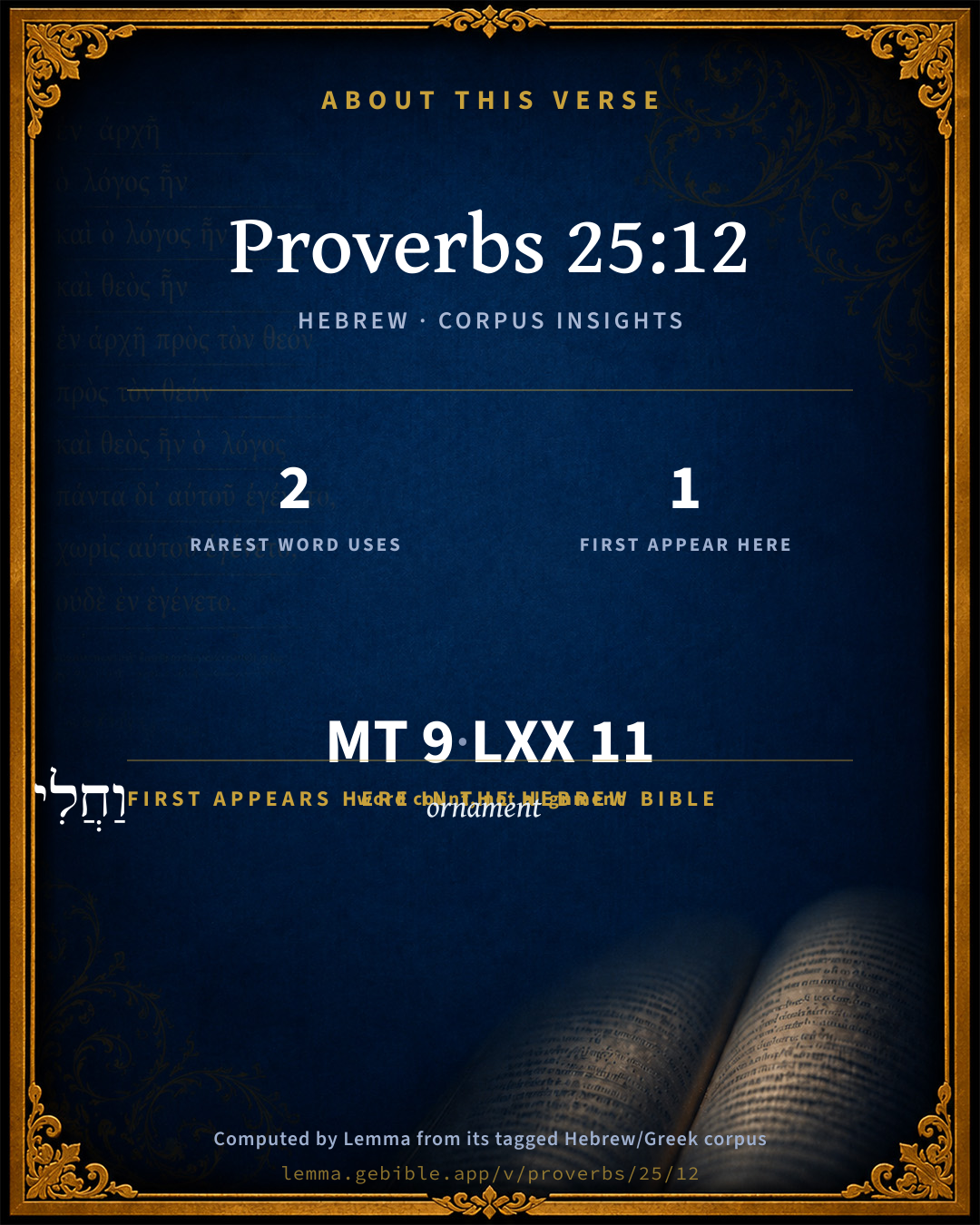
The rarest word here is וַחֲלִי ornament H2481 — appearing just 2 times in the whole Hebrew Bible.

First appearance in Scripture

This word makes its first canonical appearance in the Hebrew Bible here:

  • וַחֲלִי ornament H2481

Shared distinctive vocabulary

וַחֲלִי ornament H2481 occurs in 2 verses of the Hebrew Bible. Also found in:

Grammatical profile

  • 2 verbs
  • 5 nouns
  • 1 adjective
  • 1 preposition

Verb forms

  • מוֹכִ֥יחַ Hiphil · Participle Active
  • שֹׁמָֽעַת Qal · Participle Active

Hebrew & Septuagint length

In English translation the verse runs 20 words from the Hebrew and 20 from the Septuagint (LXX English) — the same length.

A rough comparison of the two English renderings, which tokenize alike — not a word-level alignment.

Word counts can differ between the Hebrew and the Greek without any difference in meaning — e.g. the Hebrew direct-object marker אֵת has no separate Greek word, and Greek often adds the article ὁ.

In the original languages it is 9 Hebrew tokens and 11 Greek tokens — but the two are counted differently (Hebrew bundles its prefixes and suffixes into one token; the Greek is in lemma form), so that isn’t a like-for-like length.

Cross-references

9

Topical passages linked to Proverbs 25:12 in the Treasury of Scripture Knowledge — connected by theme and wording, ordered by reader-vote popularity; previews shown in the World English Bible.

  • Psalms 141:5 Let the righteous strike me, it is kindness; Let him reprove me, it is like oil on the head; Don't let my head refuse it; Yet my prayer is always against evil deeds.
  • Proverbs 15:31–32 The ear that listens to reproof lives, And will be at home among the wise.
  • Proverbs 9:8 Don't reprove a scoffer, lest he hate you. Reprove a wise man, and he will love you.
  • Proverbs 15:5 A fool despises his father's correction, But he who heeds reproof shows prudence.
  • Proverbs 27:5–6 Better is open rebuke Than hidden love.
  • 1 Samuel 25:31–34 that this shall be no grief to you, nor offense of heart to my lord, either that you have shed blood without cause, or that my lord has avenged himself. When Yahweh shall have dealt well with my lord, then remember your handmaid.
  • Job 42:11 Then came there to him all his brothers, and all his sisters, and all those who had been of his acquaintance before, and ate bread with him in his house. They comforted him, and consoled him concerning all the evil that Yahweh had brought on him. Everyone also gave him a piece of money, and everyone a ring of gold.
  • Proverbs 1:8–9 My son, listen to your father's instruction, And don't forsake your mother's teaching:
  • Proverbs 20:12 The hearing ear, and the seeing eye, Yahweh has made even both of them.

Cross-references courtesy of OpenBible.info (CC BY 4.0).

Hebrew and Greek witnesses Masoretic Hebrew ↔ Greek Septuagint

The same verse in the two great witnesses to the Old Testament, shown verse-for-verse.

These are two independent witnesses, not word-aligned to each other, and the Septuagint is shown in lemma (dictionary) form.

Hebrew Proverbs 25:12 Masoretic · Westminster Leningrad Codex

נֶ֣זֶם זָ֭הָב וַחֲלִי כָ֑תֶם מוֹכִ֥יחַ חָ֝כָ֗ם עַל אֹ֥זֶן שֹׁמָֽעַת

As an ear-ring of gold, and an ornament of fine gold, So is a wise reprover to an obedient ear.

World English Bible · Public Domain

Greek LXX Proverbs 25:12 Septuagint · lemma form

εἰς ἐνώτιον χρυσοῦς σάρδιον πολυτελής δέω λόγος σοφός εἰς εὐήκοος οὖς

In an ear-ring of gold a precious sardius is also set; so is a wise word to an obedient ear.

LXX2012 (modern English Septuagint) · Public Domain

On this verse, The Pulpit Commentary discusses the Septuagint’s reading. Read the note in Commentary ↓

Hebrew: Westminster Leningrad Codex (CC BY 4.0). Greek: Septuagint (public domain); English from LXX2012 (modern English Septuagint) (Public Domain). How the Septuagint differs from the Hebrew →

Commentary

Notes on Proverbs 25:12 from classic Christian and Jewish commentators (each source and its license shown beneath its notes). The classic Christian expositions comment on the surrounding passage and are grouped to its opening verse, so a note may address several verses; the Jewish commentaries on the Tanakh (Rashi and others) are per-verse, so they appear only where the commentator wrote on this verse.

Lemma curates 59 commentaries, every one of them public domain or Creative Commons licensed, each selected and text-cleaned for this edition rather than reprinted as found. About our sources →

Trapp's Complete Commentary

John Trapp

Pro 25:12 [As] an earring of gold, and an ornament of fine gold, [so is] a wise reprover upon an obedient ear.

Ver. 12. As an earring of gold, &c.] Ut in auris aurea, &c. A seasonable word falling upon a tractable ear hath a redoubled grace with it, as an earring of gold, and as an ornament of fine gold, or as a diamond in a diadem. It is a hard and happy thing to "suffer the words of exhortation," to digest a reproof; to say with David, "Let the righteous smite me," &c.; to be of Gerson’s disposition, of whom it is recorded that he rejoiced in nothing more, quam si ab aliquo fraterne et charitative redargueretur, {a} than if he were friendly and freely reproved by anyone. Every vice doth now go armed; touch it never so gently, yet like the nettle it will sting you. If you deal with it roughly and roundly it swaggereth, as the Hebrew did with Moses, "Who made thee a man of authority?" &c. {Exo 2:14} Earrings and ornaments are ill bestowed upon such uncircumcised ears.

{a} In vita Jo. Gers.

John Trapp, A Commentary or Exposition upon All the Books of the Old and New Testament (1647–1656) — public domain. Text from a community e-Sword module.

Joseph Benson's Commentary

Pro 25:12. As an ear-ring of gold, &c. — That is, highly acceptable, and a great ornament, and not an offence and dishonour, as fools think it; is a wise reprover — One who reproves an offender faithfully, and yet prudently, in the fittest manner and season; upon an obedient ear — To the man that hearkens to the reproof, and is instructed and reformed by it.

Joseph Benson's Commentary on the Old and New Testaments (1811–1818) — public domain. Text from a community e-Sword module.

The Preacher's Complete Homiletical Commentary

Joseph S. Exell (gen. ed.)

CRITICAL NOTES.—

Pro_25:12. An obedient ear. Literally “an ear that heareth.”

Pro_25:13. The cold of snow, etc. “The coolness of snow is not that of a fall of snow, which in the time of harvest would be a calamity, but of drink cooled with snow, which was brought from Lebanon, or elsewhere, from the clefts of the rocks; the peasants of Damascus store up the winter’s snow in a cleft of the mountain, and convey it in the warm months to Damascus and the coast towns.” (Delitzsch.)

MAIN HOMILETICS OF Pro_25:12

GIVING AND TAKING

I. To give reproof effectually needs—

1. A character which deserves respect. An iron pin when cold may by the exercise of much strength and the expenditure of much time be driven through a plate of iron, but if it be red hot, it goes through it with speed and ease. A blunt axe may fell a tree, but if it has a good edge the work is done far more quickly and effectually. So a very faulty man may obtain a hearing when he reproves, and his reproofs may do good, but the same reproof from the lips of one who possesses a high moral character will be far more likely to reach the conscience of the listener and lead him to repentance.

2. A knowledge of the character and disposition of him whom he reproves. It is indispensable that the physician who ministers a powerful drug to a patient, or who subjects him to a critical operation, should first know something about his bodily constitution, should ascertain if there is tendency to disease which his treatment might strengthen, or exceptional weakness of any organ which would make it unable to bear the strain he is about to put upon it. If he do not make some preliminary investigation on these matters he may be developing an evil as great as the one he seeks to eradicate. A reprover should remember that all men are not alike in their temperament and moral development, and that consequently what would do real good to one transgressor would only harden another, and that, therefore, there must be acquaintance with the patient before the medicine is administered.

3. A sincere desire to benefit the offender. He who reproves without a real feeling of pity and a wish to help him whom he reproves will find that his words will do about as much good as water does to a rock when it falls upon it. It may drop day and night for years, but the rock is rock still—no moisture penetrates it and no verdure clothes it. So reproof that is not dictated by love will never reach the heart, and no fruits of repentance will result from fault-finding for its own sake.

4. A due regard to a fitting time and place. He must not rebuke his child when he is suffering pain, or charge home a fault upon the father of a family before his children. We are not likely to reform a drunkard by upbraiding him when he is under the influence of drink, or to convince a proud man that he is wrong by putting him to shame before others. A wise reprover will not only see to it that his medicine is suited to his patient, but will consider when it is most fitting to administer it.

II. To take reproof meekly—

1. Reveals a man under the control of reason. It is only the delirious patient or the child who angrily resists the surgeon’s knife, and looks no further than the present pain. A reasonable man may cry out under the operation, but he knows that his future health depends upon it, and he therefore submits patiently, although he suffers acutely. If a man looks at reproof in the same light, he will receive it in the same spirit, and give a convincing proof that he is not ruled by passion but by reason.

2. Reveals a man governed by true self-love. Love for our own true interests prompts us to welcome every hand stretched out to help us, and every means afforded us of becoming better and wiser. A wise reprover is a true friend, and he who does not recognise him as such shows that his own advancement is not the aim of his life and the object of his desire. But no greater proof of a sincere regard for our own moral and spiritual growth can be given than that of lending an obedient ear to a wise reproof.

OUTLINES AND SUGGESTIVE COMMENTS

The wise reprover or instructor, who lovingly and seasonably telleth his neighbour of his fault or duty, may fitly be likened unto a jewel of pearl; for he lighteneth and enricheth him that is instructed with knowledge and the gifts of God’s Holy Spirit. The attentive and obedient hearer who desires to increase in learning, and who receiveth the word of God with meekness, may also be aptly resembled to a golden earring; for he is transformed from glory to glory, by the ministry and instruction of the prudent and learned teacher.—Muffett.

When a reproof is both administered in wisdom and received in humility and in good part,—then there is a union of two equal rarities. A reproof well-administered is rare; and not less so is a reproof well taken. We may remark, however, that the rareness of the latter arises, to no small extent, out of the rareness of the former. It is because reproof is so seldom wellgiven, that it is so seldon well-taken.—Wardlaw.

An earring is fastened to the ear, and that it may be fastened, it pierceth the ear, and being so fastened, it is an ornament to the whole face; so like-wise is a reproof upon an obedient ear. First, it pierceth it, and is received willingly into it; secondly, it is fastened upon it, so that it stays with it; thirdly, it is an ornament to his whole life, which is thereby reformed.—Jermin.

For Homiletics on the subject of Pro_25:13, see on chap. Pro_13:17, page 321.

The Preacher's Complete Homiletical Commentary (gen. ed. Joseph S. Exell; Funk & Wagnalls, c. 1892) — public domain (pre-1929). A full-Bible homiletical/sermon-outline anthology covering 65 of 66 books (2 John is absent from the source module). Text from a community e-Sword module.

Jamieson, Fausset & Brown

Robert Jamieson, A. R. Fausset & David Brown

Those who desire to know and do rightly, most highly esteem good counsel (Pro 9:9; Pro 15:31). The listening ear is better than one hung with gold.

Jamieson, Fausset & Brown — Commentary Critical and Explanatory on the Whole Bible (1871) — public domain (CC PDM 1.0). Text via the HelloAO Bible API.

Adam Clarke's Commentary

Verse 12. As an ear-ring of gold] I believe נזם nezem to mean the nose-ring with its pendants; the left nostril is pierced, and a ring put through it, as in the ear. This is very common in almost every part of the East, among women of condition. This is a farther illustration of the above metaphor.

Adam Clarke's Commentary on the Bible (1810–1826) — public domain. Text from a community e-Sword/MySword module.

The Cambridge Bible for Schools and Colleges

gen. ed. J. J. S. Perowne

12. earring] Or, nose-ring, R.V. marg. See Pro_11:22, note.

The Cambridge Bible for Schools and Colleges (gen. ed. J. J. S. Perowne; Cambridge University Press, 1878–1918) — public domain. Text from a community e-Sword module.

John Gill's Exposition

As an earring of gold, and an ornament of fine gold,.... As a golden earring, when first put on, gives pain and uneasiness; but, being well hung and fixed, is very ornamental, being of fine gold, and especially when any jewels are upon it; which may be meant by the ornament, as the word is rendered, Sol 7:1;

so is a wise reprover upon an obedient ear; such is the reproof of a wise man, which is seasonably given, in a fit and proper manner; and which appears to proceed from love, and is designed for good, and done in great affection and faithfulness: this, though it may be a little grating to the ear at first, yet, when well considered and received, instead of leaving any infamy or reproach on the person reproved, it is an ornament to him, as well as reflects honour upon the reprover. It may be rendered, "so is he that reproveth a wise man, upon" or "with an obedient ear" (g); a wise man that has an obedient or hearing ear, who is so wise as to altered to reproofs given him, and which he takes kindly, and receives profit and advantage from them; see Pro 9:8.

(g) "qui arguit sapientem", V. L. Pagninus, Mercerus, Gejerus.

John Gill's Exposition of the Whole Bible (1746–1763) — public domain (CC PDM 1.0). Text via the HelloAO Bible API.

Albert Barnes' Notes on the Bible

The theme of this proverb being the same as that of Pro 25:11, its occurrence suggests the thought that rings used as ornaments for ears, or nose, or forehead, and other trinkets formed part of the works of art spoken of in the foregoing note, and that the king had something at once pointed and wise to say of each of them.

Albert Barnes' Notes on the Bible (1834–1885) — public domain. Text from a community e-Sword/MySword module.

Haydock's Catholic Bible Commentary

Bright. Hebrew chali cathem, "an ornament of fine gold," (Montanus; Protestants; Haydock) may probably denote a collar or ring. The eastern nations wore rings fixed at the top of the ears, and under the nose. Some were so large that they put their meat through them. The Scripture often alludes to these customs, which are so different from ours. (Canticle of Canticles vii. 1.)

George Leo Haydock (1774–1849), Haydock's Catholic Family Bible and Commentary, 1859 edition — public domain. Excludes Psalms (Douay-Rheims chapter numbering differs from Protestant) and Deuterocanonical books (Catholic canon only).

Matthew Poole's English Annotations

As an earring of gold, and an ornament of fine gold; highly acceptable, and a great ornament, and not an offence and dishonour, as fools esteem it;

so is a wise reprover, that reproves an offender faithfully; yet prudently, in the fittest manner and season.

Upon an obedient ear; to a man that hearkens to it, and is instructed and reformed by it.

Matthew Poole's English Annotations on the Holy Bible (1683–1685) — public domain. Text from a community e-Sword/MySword module.

Whedon's Commentary on the Bible

Daniel D. Whedon

12. As an earring — The original means either an earring or a nose-ring. The Orientals are as fond of rings in their nostrils as our modern ladies of rings in their ears.

An ornament of fine gold — A necklace or collar “of fine gold.” An ear attentive to instruction is better than one ornamented with gold rings.

Daniel D. Whedon (gen. ed.), Commentary on the Old and New Testaments (1874–1909) — public domain. Text from a community e-Sword module.

The Pulpit Commentary

Another distich concerning the seasonable word, of the same character as the last. As an earring of gold, and an ornament of fine gold. In this, as in many of the proverbs, the comparison is not expressed, but is merely implied by juxtaposition. Nezem, in Pro_11:22, was a nose ring, here probably an earring is meant; chali, "ornament," is a trinket or jewel worn suspended on neck or breast. The two, whether worn by one person or more, form a lovely combination, and set off the wearer"s grace and beauty. Vulgate, Inauris aurea et margaritum fulgens, "A golden earring and a brilliant pearl." Septuagint, "A golden earring a precious sardius also is set." So is a wise reprover upon an obedient ear. The obedient ear receives the precepts of the wise reprover, and wears them as a valued ornament. In Pro_1:9 the instruction of parents is compared to a chaplet on the head and a fair chain on the neck. Septuagint, "A wise word on an obedient ear."

The Pulpit Commentary (1880–1919), ed. H.D.M. Spence-Jones & Joseph S. Exell — public domain. Text from a community e-Sword module.

Keil & Delitzsch

C. F. Keil & F. Delitzsch

Another proverb continues the commendation of the effective word; for it represents, in emblem, the interchangeable relation of speaker and hearer:

A golden earring and an ornament of fine gold -

A wise preacher to an ear that heareth;

i.e., as the former two ornaments form a beautiful ensemble, so the latter two, the wise preacher of morality and an attentive ear, form a harmonious whole: על, down upon, is explained by Deu 32:2. נזם, at Pro 11:12, standing along with באף, meant a ring for the nose; but here, as elsewhere, it means an earring (lxx, Jerome, Venet.), translated by the Syr. and Targ. by קדשׁא, because it serves as a talisman. A ring for the nose

(Note: Vid., Gieger's Zeitschrift, 1872, pp. 45-48, where it is endeavoured to be shown that נזם, as an earring, is rejected from the later biblical literature, because it had become "an object used in the worship of idols," and that the word was used only of a ring for the nose as a permissible ornament, while עגיל was used for the earring. But that does not apply to the Solomonic era; for that, in the passage under review, נזם signifies a ring for the nose, is only a supposition of Geiger's, because it accords with his construction of history.)

cannot also be here thought of, because this ornament is an emblem of the attentive ear: willingly accepted chastisement or instruction is an ear-ornament to him who hears (Stier). But the gift of the wise preacher, which consists in rightly dividing the word of truth, Ti2 2:15, is as an ornament for the neck or the breast חלי (= Arab. khaly, fem. חליה = ḥilyt), of fine gold (כּתם, jewel, then particularly precious gold, from כּתם, Arab. katam, recondere).

(Note: Hitzig compares Arab. kumêt; but this means bayard, as Lagarde remarks, the Greek κόμαιθος; and if by כתם gold foxes (gold money) are to be thought of, yet they have nothing whatever to do with bayards (red-brown horses); cf. Beohmer, de colorum nominibus equinorum, in his Roman. Stud. Heft 2, 1872, p. 285.)

The Venet. well: κόσμος ἀπυροχρύσου (fine gold); on the contrary (perhaps in want of another name for gold), כתם is translated, by the lxx and Syr., by sardine; by the Targ., by emerald; and by Jerome, by margaritum.

(Note: Another Greek translates πίνωσις χρυσῆ. This πίνωσις is a philological mystery, the solution of which has been attempted by Bochart, Letronne, and Field.)

It looks well when two stand together, the one of whom has golden earrings, and the other wears a yet more precious golden necklace - such a beautiful mutual relationship is formed by a wise speaker and a hearer who listens to his admonitions.

Keil & Delitzsch — Biblical Commentary on the Old Testament (1861–1891) — public domain (CC PDM 1.0). Text via the HelloAO Bible API. (Old Testament only.)

Rashi

Rabbi Shlomo Yitzchaki (Rashi)

Like a golden earring and jewelry of finest gold A collection of golden jewelry, as in (Hos. 2: 15): “and adorned herself with her earrings and her jewelry (וחליתה),” and like (Song 7:3): “jewels (חלאים).”

finest gold Heb. כתם an expression of a golden ornament, and likewise (Song 5:11): “His head is as a jewel (כתם) of the finest gold.”

Rashi on the Tanakh — English translations: “The Judaica Press complete Tanach with Rashi, translated by A. J. Rosenberg” (CC BY 4.0); “Pentateuch with Rashi's commentary by M. Rosenbaum and A.M. Silbermann, 1929-1934” (public domain); “The Metsudah Tanach series, Lakewood, N.J” (CC BY 4.0); and “The Book of Joshua, Metsudah Publications, 1997” (CC BY 4.0). Text via Sefaria.

Lesson kit

Teaching starters — assembled from the data on this page, not authored interpretation. Every prompt links to the verse data it draws on. Edit before teaching.

Proverbs, in the Wisdom, opens this verse with 9 words (9 distinct Hebrew lemmas). Its most distinctive word is chălîy (“ornament”). A historical commentator’s framing appears above. Read the whole chapter for the surrounding context.

Discussion questions

  1. What does “ornament” (chălîy) contribute to the verse as a whole?
  2. This is the first place “ornament” appears in Scripture (first appears here). What does its debut here establish?
  3. How does Song of Solomon 7:1, which shares the word «ornament», read alongside this verse?
  4. These translations render this verse differently. What is at stake in choosing one wording over another?
  5. «מוֹכִ֥יחַ» is a Hiphil Participle Active verb. How does that grammatical form shape the action described?
  6. Compare how Trapp's Complete Commentary and Joseph Benson's Commentary read this verse. Where do they agree or differ?

Things to notice

Reading settings

Reading text

Shown beneath each verse's original-language words.

Old Testament
Old Testament edition

Read the OT as the Masoretic Hebrew (MT) or the Greek Septuagint (LXX).

English shown for the Greek Septuagint (in the Hebrew ↔ Greek comparison).

Comparing translations? Open the Compare panel on any verse page to stack up to four side by side.