
Proverbs 23:9

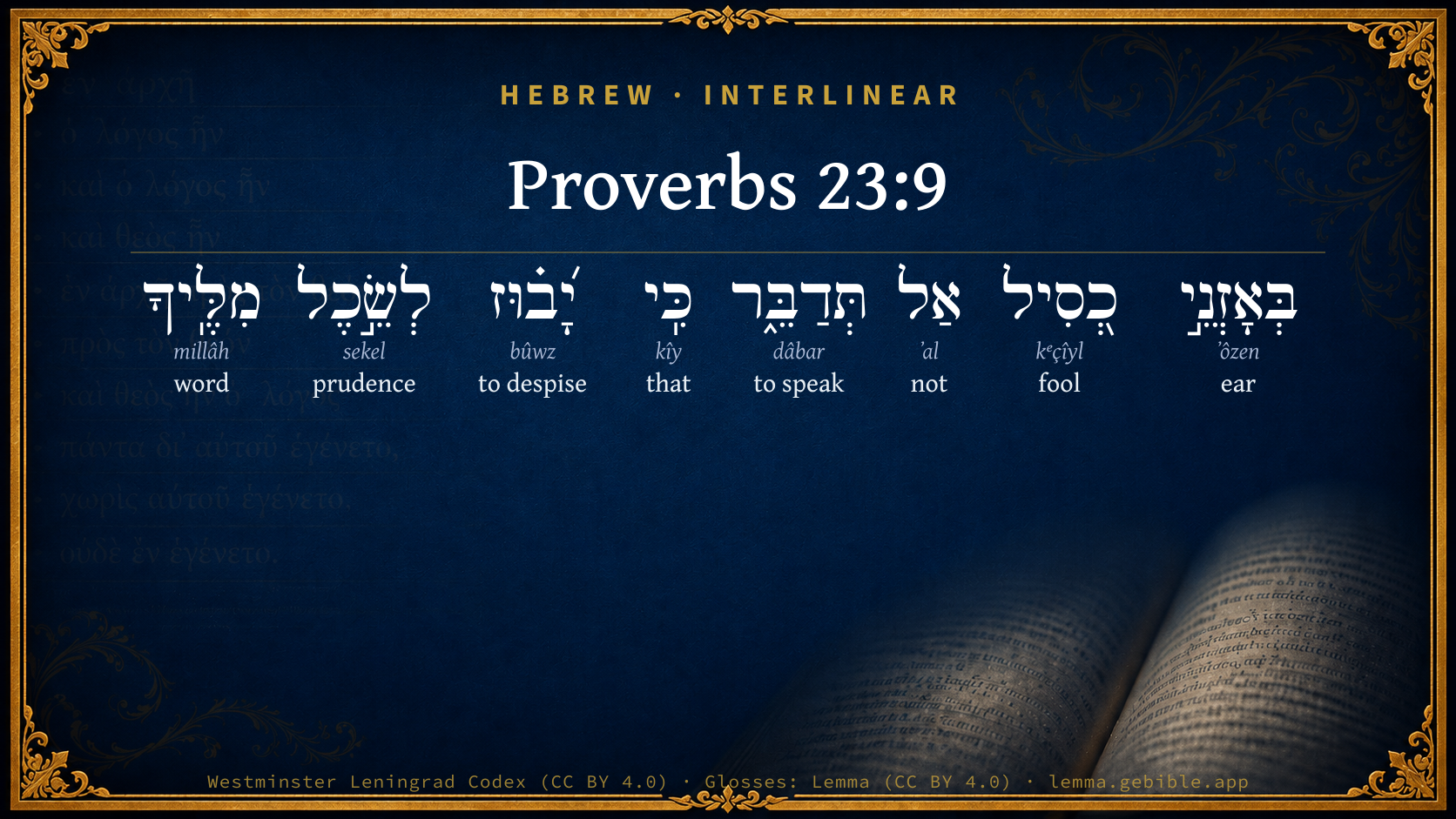
Hebrew (Westminster Leningrad Codex) Proverbs 23:9 appears in the Hebrew Old Testament. The text above is from the Westminster Leningrad Codex. Each word links to its Strong’s number, a concise gloss, and parsing drawn from the Open Scriptures Hebrew Bible morphology. Click any word for its full Brown-Driver-Briggs (BDB) entry.
Download image
Cite this verse

Proverbs 23:9 (World English Bible). Public Domain. Lemma interlinear Bible study tool, https://lemma.gebible.app/v/proverbs/23/9.

Show BibTeX & RIS
BibTeX
RIS
English Translation
Don't speak in the ears of a fool, For he will despise the wisdom of your words.
World English Bible · Public Domain
Download a study sheet

One document with this verse’s original text, its word-by-word gloss line, the meaning frame, cross-references with their text, attributed commentary, and full source and license credits — printable, and it pastes into notes with its structure intact.

This verse Autodidact and up

Study sheet (.html) Plain text (.txt)

A passage Seminary Student

Up to 50 verses in one chapter. A passage sheet keeps up to 6 commentary sources and 12 cross-references per verse, in the order this page ranks them, and says so on the sheet whenever that leaves anything out. Ask for a single verse and you get the Autodidact verse sheet above.

Everything on this page stays free to read, with no account — the sheet is a download of what is already on screen, not access to it.

Want to remove ads? Support Godless Engineer
Compare translations 3

The same verse in 3 English versions, stacked beneath the original-language interlinear above. Click any original word for its lexicon entry.

Each is an independent rendering of the whole verse — the interlinear is not word-aligned to these translations.

Highlighted words mark where these versions differ — a whole-verse word diff, not a word-by-word alignment.

  • World English Bible Public Domain
    Don't speak in the ears of a fool, For he will despise the wisdom of your words.
  • King James Version Public Domain
    Speak not in the ears of a fool: for he will despise the wisdom of thy words.
  • unfoldingWord Literal Text CC BY-SA 4.0
    Do not speak in the ears of a stupid, for he will show contempt for the insight of your words.

unfoldingWord Literal Text — © unfoldingWord, licensed CC BY-SA 4.0. Word-aligned USFM3 via Door43 (git.door43.org/unfoldingWord/en_ult).

Versions to compare (up to 4)

3 of 4 selected

Show all 18 translations

Every available English version of this verse, each an independent rendering of the whole verse.

  • World English Bible Public Domain
    Don't speak in the ears of a fool, For he will despise the wisdom of your words.
  • Berean Standard Bible Public Domain
    Do not speak to a fool, for he will despise the wisdom of your words.
  • Majority Standard Bible Public Domain
    Do not speak to a fool, for he will despise the wisdom of your words.
  • King James Version Public Domain
    Speak not in the ears of a fool: for he will despise the wisdom of thy words.
  • American Standard Version (1901) Public Domain
    Speak not in the hearing of a fool; For he will despise the wisdom of thy words.
  • Revised Version (1885) Public Domain
    Speak not in the hearing of a fool; for he will despise the wisdom of thy words.
  • Geneva Bible (1599) Public Domain
    Speake not in the eares of a foole: for hee will despise the wisdome of thy wordes.
  • Douay-Rheims (1899) Public Domain
    Speak not in the ears of fools: because they will despise the instruction of thy speech.
  • Young's Literal Translation Public Domain
    In the ears of a fool speak not, For he treadeth on the wisdom of thy words.
  • Literal Standard Version CC BY-SA 4.0
    Do not speak in the ears of a fool, || For he treads on the wisdom of your words.
  • Unlocked Literal Bible CC BY-SA 4.0
    Do not speak in the hearing of a fool, for he will despise the wisdom of your words.
  • unfoldingWord Literal Text CC BY-SA 4.0
    Do not speak in the ears of a stupid, for he will show contempt for the insight of your words.
  • Darby Bible Public Domain
    Speak not in the ears of a foolish [man], for he will despise the wisdom of thy words.
  • World Messianic Bible Public Domain
    Don’t speak in the ears of a fool, for he will despise the wisdom of your words.
  • Webster's Bible Public Domain
    Speak not in the ears of a fool: for he will despise the wisdom of thy words.
  • Free Bible Version CC BY-SA 4.0
    Don't talk to stupid people because they'll ridicule your wise words.
  • Bible in Basic English Public Domain
    Say nothing in the hearing of a foolish man, for he will put no value on the wisdom of your words.
  • JPS Tanakh (1917) Public Domain
    Speak not in the ears of a fool; for he will despise the wisdom of thy words.

Literal Standard Version (2020), Covenant Press — licensed CC BY-SA 4.0. Text via the HelloAO Bible API (eBible.org). Unlocked Literal Bible (unfoldingWord) — licensed CC BY-SA 4.0. Text via the HelloAO Bible API (eBible.org). unfoldingWord Literal Text — © unfoldingWord, licensed CC BY-SA 4.0. Word-aligned USFM3 via Door43 (git.door43.org/unfoldingWord/en_ult). Free Bible Version, Dr. Jonathan Gallagher — licensed CC BY-SA 4.0. Text via the HelloAO Bible API (eBible.org).

Word by word

More ways to search: Search by grammar → Find every occurrence → Compare this word →

Practice this passage: Drill this verse → Learn its vocabulary →

About this verse

These counts appear in no published source. They are computed here, from the morphology-tagged text and Lemma’s own curated glosses. What Lemma adds →

8
words
8
distinct lemmas
Wisdom
section

Notable vocabulary

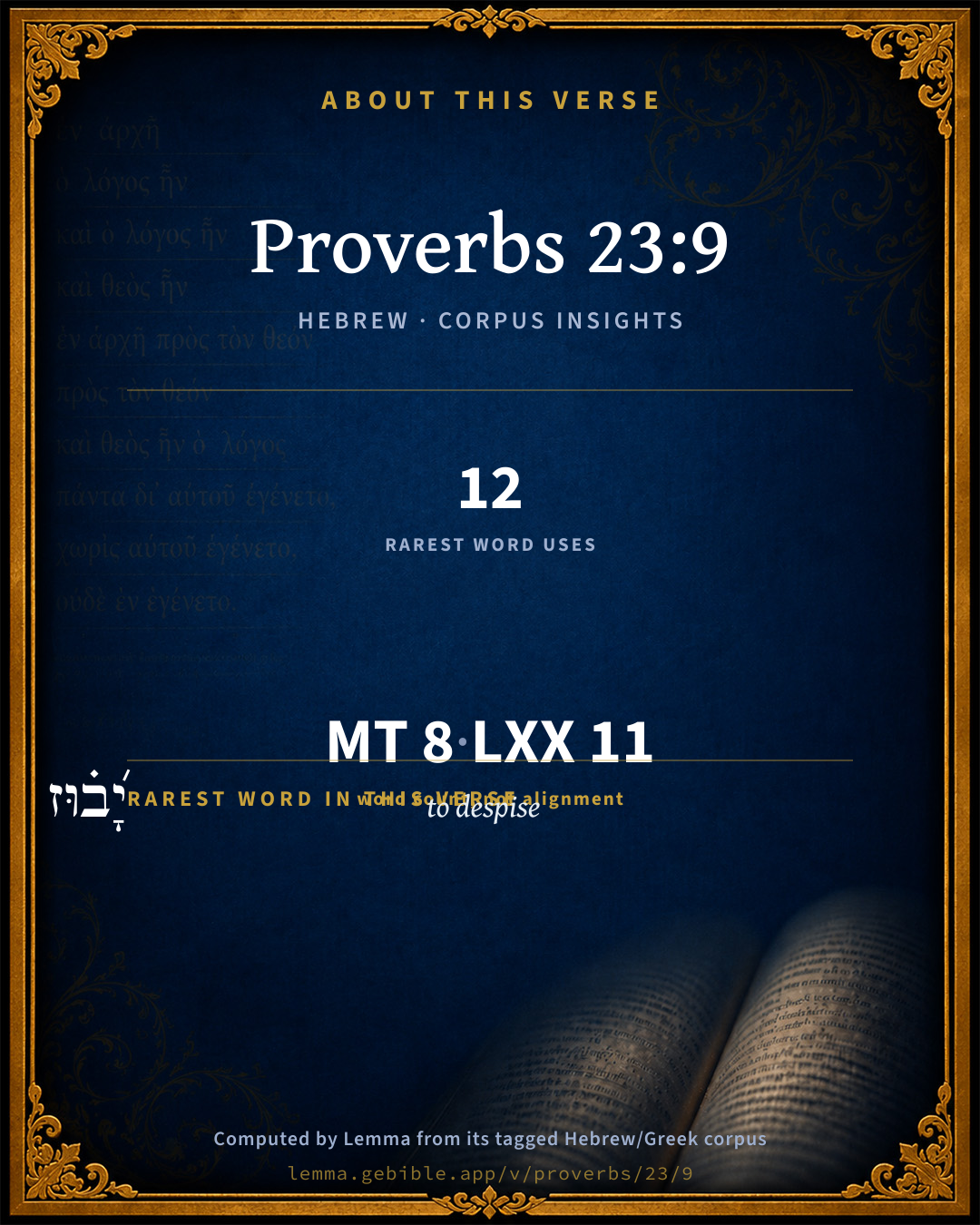
The rarest word here is יָ֝ב֗וּז to despise H936 — appearing just 12 times in the whole Hebrew Bible.

Shared distinctive vocabulary

יָ֝ב֗וּז to despise H936 occurs in 11 verses of the Hebrew Bible. Also found in:

Grammatical profile

  • 2 verbs
  • 3 nouns
  • 1 adjective
  • 1 conjunction
  • 1 particle

Verb forms

  • תְּדַבֵּ֑ר Piel · Jussive
  • יָ֝ב֗וּז Qal · Imperfect

Hebrew & Septuagint length

In English translation the verse runs 17 words from the Hebrew and 18 from the Septuagint (LXX English) — closely comparable.

A rough comparison of the two English renderings, which tokenize alike — not a word-level alignment.

Word counts can differ between the Hebrew and the Greek without any difference in meaning — e.g. the Hebrew direct-object marker אֵת has no separate Greek word, and Greek often adds the article ὁ.

In the original languages it is 8 Hebrew tokens and 11 Greek tokens — but the two are counted differently (Hebrew bundles its prefixes and suffixes into one token; the Greek is in lemma form), so that isn’t a like-for-like length.

Cross-references

15

Topical passages linked to Proverbs 23:9 in the Treasury of Scripture Knowledge — connected by theme and wording, ordered by reader-vote popularity; previews shown in the World English Bible.

  • Proverbs 9:7–8 He who corrects a mocker invites insult. He who reproves a wicked man invites abuse.
  • Matthew 7:6 "Don't give that which is holy to the dogs, neither throw your pearls before the pigs, lest perhaps they trample them under their feet, and turn and tear you to pieces.
  • Proverbs 26:4–5 Don't answer a fool according to his folly, Lest you also be like him.
  • Proverbs 1:7 The fear of Yahweh is the beginning of knowledge; But the foolish despise wisdom and instruction.
  • Isaiah 36:21 But they held their peace, and answered him not a word; for the king's commandment was, saying, Don't answer him.
  • John 8:52 Then the Jews said to him, "Now we know that you have a demon. Abraham died, and the prophets; and you say, 'If a man keeps my word, he will never taste of death.'
  • John 10:20 Many of them said, "He has a demon, and is insane! Why do you listen to him?"
  • Acts 13:45–46 But when the Jews saw the multitudes, they were filled with jealousy, and contradicted the things which were spoken by Paul, and blasphemed.
  • Acts 28:25–28 When they didn't agree among themselves, they departed after Paul had spoken one word, "The Holy Spirit spoke rightly through Isaiah, the prophet, to our fathers,
  • 1 Corinthians 1:21–24 For seeing that in the wisdom of God, the world through its wisdom didn't know God, it was God's good pleasure through the foolishness of the preaching to save those who believe.
  • Luke 16:14 The Pharisees, who were lovers of money, also heard all these things, and they scoffed at him.
  • John 9:30–34 The man answered them, "How amazing! You don't know where he comes from, yet he opened my eyes.
  • Acts 17:18 Some of the Epicurean and Stoic philosophers also were conversing with him. Some said, "What does this babbler want to say?" Others said, "He seems to be advocating foreign deities," because he preached Jesus and the resurrection.
  • Acts 17:32 Now when they heard of the resurrection of the dead, some mocked; but others said, "We want to hear you again concerning this."
  • John 9:40 Those of the Pharisees who were with him heard these things, and said to him, "Are we also blind?"

Cross-references courtesy of OpenBible.info (CC BY 4.0).

Hebrew and Greek witnesses Masoretic Hebrew ↔ Greek Septuagint

The same verse in the two great witnesses to the Old Testament, shown verse-for-verse.

These are two independent witnesses, not word-aligned to each other, and the Septuagint is shown in lemma (dictionary) form.

Hebrew Proverbs 23:9 Masoretic · Westminster Leningrad Codex

בְּאָזְנֵ֣י כְ֭סִיל אַל תְּדַבֵּ֑ר כִּֽי יָ֝ב֗וּז לְשֵׂ֣כֶל מִלֶּֽיךָ

Don't speak in the ears of a fool, For he will despise the wisdom of your words.

World English Bible · Public Domain

Greek LXX Proverbs 23:9 Septuagint · lemma form

εἰς οὖς ἄφρων μηδείς λέγω μήποτε μυκτηρίζω ὁ συνετός λόγος σύ

Say nothing in the ears of a fool, lest at any time he sneer at your wise words.

LXX2012 (modern English Septuagint) · Public Domain

Hebrew: Westminster Leningrad Codex (CC BY 4.0). Greek: Septuagint (public domain); English from LXX2012 (modern English Septuagint) (Public Domain). How the Septuagint differs from the Hebrew →

Commentary

Notes on Proverbs 23:9 from classic Christian and Jewish commentators (each source and its license shown beneath its notes). The classic Christian expositions comment on the surrounding passage and are grouped to its opening verse, so a note may address several verses; the Jewish commentaries on the Tanakh (Rashi and others) are per-verse, so they appear only where the commentator wrote on this verse.

Lemma curates 59 commentaries, every one of them public domain or Creative Commons licensed, each selected and text-cleaned for this edition rather than reprinted as found. About our sources →

Trapp's Complete Commentary

John Trapp

Pro 23:9 Speak not in the ears of a fool: for he will despise the wisdom of thy words.

Ver. 9. Speak not in the ears of a fool.] That is, of a wilful fool, that seldom asketh council, but never followeth any, as it is said of James, King of Scotland. {a} {See Trapp on "Pro 9:7"} {See Trapp on "Pro 9:8"} {See Trapp on "Mat 7:6"}

{a} Daniel’s History.

John Trapp, A Commentary or Exposition upon All the Books of the Old and New Testament (1647–1656) — public domain. Text from a community e-Sword module.

Joseph Benson's Commentary

Pro 23:9. Speak not in the ears of a fool — Cast not away good counsels upon obstinate and incorrigible sinners: see Mat 7:6. For he will despise the wisdom of thy words — He will scornfully reject thy wise and good admonitions.

Joseph Benson's Commentary on the Old and New Testaments (1811–1818) — public domain. Text from a community e-Sword module.

The Preacher's Complete Homiletical Commentary

Joseph S. Exell (gen. ed.)

MAIN HOMILETICS OF Pro_23:9

THE MORALLY INCURABLE

I. A man may become morally incurable by human instructors. There are cases of bodily disease which it would be quite useless for the most skilful physician to attempt to cure; such an attempt would only be a throwing away of time and energy on his part which might be usefully employed upon another patient. And so there is at least one form of moral disease which is beyond the reach of human effort. It is that of the man who scoffs at everything, and upon whom, therefore, the most affectionate entreaties and the most solemn warnings are thrown away.

II. To offer to such an incurable fool the wisdom of God is to break a Divine commandment. The Redeemer Himself, under the Gospel dispensation, issued such a prohibition. Even among the beneficent utterances of the Sermon on the Mount comes the command, “Give not that which is holy unto the dogs, neither cast ye your pearls before swine, lest they trample them under their feet, and turn again and rend you.” (Mat_7:6.) Although Christ and His disciples were sent forth to proclaim the Gospel message among men who, on account of their bitter animosity to Him and to His teachings were compared to “wolves” (Luk_10:3.), there were others in a far more hopeless condition before whom they were forbidden to place the great truths of the kingdom of God, and they were such characters as the fool of this proverb, who would have “despised the wisdom of their words.” The deep import of the words of Solomon are fully seen when we consider the even more startling utterance of Him who loved and died for all men.

III. There is Divine compassion for the sinner in this commandment. To offer to such a man what he would scoff at, would be to give him an occasion of increasing his own guilt by a new refusal of Divine truth. Mercy, therefore, is mingled with the stern judgment of the prohibition.

OUTLINES AND SUGGESTIVE COMMENTS

We often speak of retribution as if it always lay beyond the grave, and the day of grace as extending through the whole life of man; but such is not the fact. Retribution begins with many men here. The day of grace terminates with many men before the day of death. There are those who reach an unconvertible state, their characters are stereotyped and fixed as eternity. The things that belong to their peace are hid from their eyes. They are incorrigible. Such is the character referred to in the text.—Dr. David Thomas.

Those that are reproved by ministers, and Christian friends may learn from this verse that they have no reason to take it amiss, or to think that they are treated with contempt. They are considered as offenders, but at the same time as offending brethren, who are not incurably perverse. They would be treated in a very different way, and might reckon themselves with more justice to be considered in the light of scorners, and dogs, and swine if there were no means used to recover them to repentance.—Lawson.

The Preacher's Complete Homiletical Commentary (gen. ed. Joseph S. Exell; Funk & Wagnalls, c. 1892) — public domain (pre-1929). A full-Bible homiletical/sermon-outline anthology covering 65 of 66 books (2 John is absent from the source module). Text from a community e-Sword module.

Bridges on Proverbs

Charles Bridges

Our Lord’s rule is to the same purport — "Give not that which is holy unto the dogs; neither cast ye your pearls before swine, lest they trample them under foot, and turn again and rend you." (Mat 7:6 .) Cast not away your good counsels upon incorrigible sinners. So long as there is any hope of reclaiming the fool, make every effort for his precious soul. In the true spirit of our Master, bring the Gospel to the worst and the most unwilling; and never make the rule of prudence the excuse for indolence. Yet "there is a time to keep silence, as well as a time to speak."†1 Such a time we shall understand by the trial to our own spirit. We long to speak in compassion. But self-denial, not self-indulgence, restrains.†2 We have before been warned against untimely rebuke. (Pro 9:8 .) This caution extends further — Speak not in the ears of a fool. Such was our Master’s silence before Herod. (Luk 23:9 .) If he would hear, there would be hope. But instead of being thankful for instruction, he will despise the wisdom of thy words (Pro 1:7 ), and take occasion from them only to scoff and blaspheme the more. Many doubtful cases, however, require much wisdom. And the safe rule will be, never to speak without prayer for divine guidance, and simplicity, and love.

Footnotes:

†1 Ecc 3:7. Pro 26:4-5 .

†2 Psa 39:1-2.

Charles Bridges, An Exposition of the Book of Proverbs (1846) — public domain. Text from a community e-Sword module.

Tyndale Open Study Notes

Tyndale Open Resources

23:9 Saying 9: Fools ignore advice (cp. 9:7-12; 10:18), so the wise do not waste their breath (see Matt 7:6).

Tyndale Open Study Notes — © Tyndale Open Resources, licensed CC BY-SA 4.0. Text via the HelloAO Bible API.

Matthew Henry's Commentary

We are here directed not to cast pearls before swine (Mat 7:6) and not to expose things sacred to the contempt and ridicule of profane scoffers. It is our duty to take all fit occasions to speak of divine things; but, 1. There are some that will make a jest of every thing, though it be ever so prudently and pertinently spoken, that will not only despise a wise man's words, but despise even the wisdom of them, that in them which is most improvable for their own edification; they will particularly reproach that, as if it had an ill design upon them, which they must guard against. 2. Those that do so forfeit the benefit of good advice and instruction, and a wise man is not only allowed, but advised, not to speak in the ears of such fools; let them be foolish still, and let not precious breath be thrown away upon them. If what a wise man says in his wisdom will not be heard, let him hold his peace, and try whether the wisdom of that will be regarded.

Matthew Henry's Commentary on the Whole Bible (1708–1710) — public domain (CC PDM 1.0). Text via the HelloAO Bible API.

Jamieson, Fausset & Brown

Robert Jamieson, A. R. Fausset & David Brown

(Compare Pro 9:8). "Cast not your pearls before swine" (Mat 7:6).

Jamieson, Fausset & Brown — Commentary Critical and Explanatory on the Whole Bible (1871) — public domain (CC PDM 1.0). Text via the HelloAO Bible API.

Ellicott's Commentary for English Readers

(9) Speak not in the ears of a fool.—Do not waste thy time in explaining matters to him.

A fool.—A dull, stupid person. (Comp. Pro_1:22.)

A Bible Commentary for English Readers, edited by Charles John Ellicott (1878–1897) — public domain. Text from a community e-Sword module.

John Gill's Exposition

Speak not in the ears of a fool,.... For it is only beating the air, and speaking to the wind; it is casting pearls before swine, and that which is holy to dogs. By the "fool" is meant a wicked man, one abandoned to sin, and hardened in it; that scoffs at all admonitions and reproofs, that derides the word, and the preachers of it, and makes a mock at all good men, and everything they say; and therefore what is serious and sacred should not be said to them, since it only becomes the object of their banter and ridicule;

for he will despise the wisdom of thy words; not only the words of doctrine, reproof, and correction, but the "wisdom" of them; or let them be ever so wisely spoken; for if the wisdom of God and his words, the truths of the Gospel, are foolishness with such, and despised by them, then much more the wisdom even of the best of men, and the wisest things they say; yea, when they deliver the wisdom of God in a mystery, the hidden wisdom, the Gospel of Christ, which therefore should be spoken among them that are perfect, Co1 1:24.

John Gill's Exposition of the Whole Bible (1746–1763) — public domain (CC PDM 1.0). Text via the HelloAO Bible API.

Albert Barnes' Notes on the Bible

The “fool” here is one willfully and persistently deaf to it, almost identical with the scorner.

Albert Barnes' Notes on the Bible (1834–1885) — public domain. Text from a community e-Sword/MySword module.

Matthew Poole's English Annotations

Speak not in the ears of a fool; cast not away good counsels upon obstinate and incorrigible sinners. We have the same advice given Mat 7:6.

He will despise the wisdom of thy words; he will scornfully reject thy wise and good admonitions.

Matthew Poole's English Annotations on the Holy Bible (1683–1685) — public domain. Text from a community e-Sword/MySword module.

Whedon's Commentary on the Bible

Daniel D. Whedon

9. Speak not in the ears of a fool — Compare Mat_7:6 : “Cast [not] ye your pearls before swine.” Waste not your time in talking to him who despises all you say. Compare Pro_9:8.

Daniel D. Whedon (gen. ed.), Commentary on the Old and New Testaments (1874–1909) — public domain. Text from a community e-Sword module.

The Pulpit Commentary

Here is another case in which "sweet words" are lost. Speak not in the ears of a fool. This does not mean, as it would in our English phrase whisper not to a fool; but do not take the trouble to try to make him understand, impart nothing to him. The "fool" here (kesil) is the dull, stolid, stupid man. who cannot be moved from his own narrow groove. (see Pro_1:22) It is a mere casting of pearls before swine (Mat_7:6) to speak to such a man of high aims, righteous motives, self-sacrifice. (comp. Pro_9:8) He will despise the wisdom of thy words. He cannot enter into the meaning of words of wisdom; he has no appetite for them, he cannot assimilate them; and in his self-satisfied dulness he feels for them nothing but contempt (on Ecc 22:7, etc., "Whoso teacheth a fool is as one that glueth a potsherd together, and as he that waketh one from a sound sleep. He that telleth a tale to a fool speaketh to one in a slumber: whey he hath told his tale, he will say, What is the matter?")

Vers. 9-11. Holding aloof from evil.

I THE FOOL. (Ver. 9) There is "a time to keep silence." Truth may be desecrated in certain company by speech and honoured by silence. Pearls are not to be cast before swine. The silence of Christ was equally eloquent with his words. How much does the sentence convey, "He answered hint never a word"! Beyond a certain point explanations are worse than useless; the caviller only takes them as food for his folly and encouragement to his perversity.

II THE OPPRESSOR. (Ver. 10) The property of the widow and the fatherless is in the protection of the Almighty. He is the Eternal Vindicator of down-trodden right. In the bright evangelical picture of conduct it is the very opposite of violence and oppression to the weak that is held up for our emulation: "To visit the fatherless and the widow in their affliction." And the negative side is, in one word, "to keep one"s self unspotted from the world. J.

The Pulpit Commentary (1880–1919), ed. H.D.M. Spence-Jones & Joseph S. Exell — public domain. Text from a community e-Sword module.

John Wesley's Explanatory Notes

Of a fool - Cast not away good counsels upon incorrigible sinners.

John Wesley, Explanatory Notes Upon the Whole Bible (1754–1765) — public domain. Text via the GEBible commentary corpus.

Keil & Delitzsch

C. F. Keil & F. Delitzsch

Another case in which good words are lost:

Speak not to the ears of a fool,

For he will despise the wisdom of thy words.

To speak in the ears of any one, does not mean to whisper to him, to so to speak that it is distinctly perceived. כּסיל, as we have no often explained, is the intellectually heavy and dull, like pinguis and tardus; Arab. balyd, clumsy, intellectually immoveable (cf. bld, the place where one places himself firmly down, which one makes his point of gravity). The heart of such an one is covered over (Psa 119:70), as with grease, against all impressions of better knowledge; he has for the knowledge which the words spoken design to impart to him, no susceptibility, no mind, but only contempt. The construction בּוּז ל has been frequently met with from Pro 6:30.

Keil & Delitzsch — Biblical Commentary on the Old Testament (1861–1891) — public domain (CC PDM 1.0). Text via the HelloAO Bible API. (Old Testament only.)

Kretzmann's Popular Commentary

Paul E. Kretzmann

v. 9. Speak not in the ears of a fool; for he will despise the wisdom of thy words.

Paul E. Kretzmann, Popular Commentary of the Bible (1921–1924) — public domain. Text from a community e-Sword module.

unfoldingWord translationNotes

Door43 World Missions Community

General Information:

These verses continue the "thirty sayings" (Proverbs 22:20).

in the hearing of a fool

The abstract noun "hearing" can be translated as a verb. AT: "where a fool can hear you" (See: Abstract Nouns)

ancient

very old. See how you translated this in Proverbs 22:28.

boundary stone

This is a large stone to show where one person's land ends and another person's land begins. See how you translated this in Proverbs 22:28.

encroach

This means to slowly take or begin to use land (or some thing) that belongs to someone else.

orphans

children whose parents are dead

their Redeemer

Yahweh

he will plead their case against you

The metaphor is of a lawyer defending the needy in front of a judge. AT: "he will defend the orphans against you" or "he will see that the orphans receive justice and punish you" (See: Metaphor)

translationWords

fool

wise

word

redeem

unfoldingWord translationNotes — © Distant Shores Media and the Door43 World Missions Community, licensed CC BY-SA 4.0. Source: git.door43.org/Door43/en_tn.

Lesson kit

Teaching starters — assembled from the data on this page, not authored interpretation. Every prompt links to the verse data it draws on. Edit before teaching.

Proverbs, in the Wisdom, opens this verse with 8 words (8 distinct Hebrew lemmas). Its most distinctive word is bûwz (“to despise”). A historical commentator’s framing appears above. Read the whole chapter for the surrounding context.

Discussion questions

  1. How does “to despise” (bûwz) shape what this verse is saying?
  2. How does Proverbs 1:7, which shares the word «to despise», read alongside this verse?
  3. These translations render this verse differently. What is at stake in choosing one wording over another?
  4. «תְּדַבֵּ֑ר» is a Piel Jussive verb. How does that grammatical form shape the action described?
  5. Compare how Trapp's Complete Commentary and Joseph Benson's Commentary read this verse. Where do they agree or differ?

Things to notice

Reading settings

Reading text

Shown beneath each verse's original-language words.

Old Testament
Old Testament edition

Read the OT as the Masoretic Hebrew (MT) or the Greek Septuagint (LXX).

English shown for the Greek Septuagint (in the Hebrew ↔ Greek comparison).

Comparing translations? Open the Compare panel on any verse page to stack up to four side by side.