Jeremiah 28:7

Hebrew (Westminster Leningrad Codex) Jeremiah 28:7 appears in the Hebrew Old Testament. The text above is from the Westminster Leningrad Codex. Each word links to its Strong’s number, a concise gloss, and parsing drawn from the Open Scriptures Hebrew Bible morphology. Click any word for its full Brown-Driver-Briggs (BDB) entry.
Download image
Cite this verse

Jeremiah 28:7 (World English Bible). Public Domain. Lemma interlinear Bible study tool, https://lemma.gebible.app/v/jeremiah/28/7.

Show BibTeX & RIS
BibTeX
RIS
English Translation
Nevertheless hear you now this word that I speak in your ears, and in the ears of all the people:
World English Bible · Public Domain
Download a study sheet

One document with this verse’s original text, its word-by-word gloss line, the meaning frame, cross-references with their text, attributed commentary, and full source and license credits — printable, and it pastes into notes with its structure intact.

This verse Autodidact and up

Study sheet (.html) Plain text (.txt)

A passage Seminary Student

Up to 50 verses in one chapter. A passage sheet keeps up to 6 commentary sources and 12 cross-references per verse, in the order this page ranks them, and says so on the sheet whenever that leaves anything out. Ask for a single verse and you get the Autodidact verse sheet above.

Everything on this page stays free to read, with no account — the sheet is a download of what is already on screen, not access to it.

Want to remove ads? Support Godless Engineer
Compare translations 3

The same verse in 3 English versions, stacked beneath the original-language interlinear above. Click any original word for its lexicon entry.

Each is an independent rendering of the whole verse — the interlinear is not word-aligned to these translations.

Highlighted words mark where these versions differ — a whole-verse word diff, not a word-by-word alignment.

  • World English Bible Public Domain
    Nevertheless hear you now this word that I speak in your ears, and in the ears of all the people:
  • King James Version Public Domain
    Nevertheless hear thou now this word that I speak in thine ears, and in the ears of all the people;
  • unfoldingWord Literal Text CC BY-SA 4.0
    But please hear this word that I am speaking in your ears and in the ears of all the people:

unfoldingWord Literal Text — © unfoldingWord, licensed CC BY-SA 4.0. Word-aligned USFM3 via Door43 (git.door43.org/unfoldingWord/en_ult).

Versions to compare (up to 4)

3 of 4 selected

Show all 18 translations

Every available English version of this verse, each an independent rendering of the whole verse.

  • World English Bible Public Domain
    Nevertheless hear you now this word that I speak in your ears, and in the ears of all the people:
  • Berean Standard Bible Public Domain
    Nevertheless, listen now to this message I am speaking in your hearing and in the hearing of all the people.
  • Majority Standard Bible Public Domain
    Nevertheless, listen now to this message I am speaking in your hearing and in the hearing of all the people.
  • King James Version Public Domain
    Nevertheless hear thou now this word that I speak in thine ears, and in the ears of all the people;
  • American Standard Version (1901) Public Domain
    Nevertheless hear thou now this word that I speak in thine ears, and in the ears of all the people:
  • Revised Version (1885) Public Domain
    Nevertheless hear thou now this word that I speak in thine ears, and in the ears of all the people:
  • Geneva Bible (1599) Public Domain
    But heare thou now this worde that I will speake in thine eares and in the eares of all the people.
  • Douay-Rheims (1899) Public Domain
    Nevertheless hear this word that I speak in thy ears, and in the ears of all the people:
  • Young's Literal Translation Public Domain
    `Only, hear, I pray thee, this word that I am speaking in thine ears, and in the ears of all the people.
  • Literal Standard Version CC BY-SA 4.0
    Only, please hear this word that I am speaking in your ears, and in the ears of all the people.
  • Unlocked Literal Bible CC BY-SA 4.0
    However, listen to the word that I am proclaiming in your hearing and in the hearing of all the people.
  • unfoldingWord Literal Text CC BY-SA 4.0
    But please hear this word that I am speaking in your ears and in the ears of all the people:
  • Darby Bible Public Domain
    Nevertheless, hear, I pray thee, this word which I speak in thine ears, and in the ears of all the people:
  • World Messianic Bible Public Domain
    Nevertheless listen now to this word that I speak in your ears, and in the ears of all the people:
  • Webster's Bible Public Domain
    Nevertheless, now hear thou this word that I speak in thy ears, and in the ears of all the people:
  • Free Bible Version CC BY-SA 4.0
    But even so, pay attention to this message I'm going to tell you and everyone here.
  • Bible in Basic English Public Domain
    But still, give ear to this word which I am saying to you and to all the people:
  • JPS Tanakh (1917) Public Domain
    Nevertheless hear thou now this word that I speak in thine ears, and in the ears of all the people:

Literal Standard Version (2020), Covenant Press — licensed CC BY-SA 4.0. Text via the HelloAO Bible API (eBible.org). Unlocked Literal Bible (unfoldingWord) — licensed CC BY-SA 4.0. Text via the HelloAO Bible API (eBible.org). unfoldingWord Literal Text — © unfoldingWord, licensed CC BY-SA 4.0. Word-aligned USFM3 via Door43 (git.door43.org/unfoldingWord/en_ult). Free Bible Version, Dr. Jonathan Gallagher — licensed CC BY-SA 4.0. Text via the HelloAO Bible API (eBible.org).

Word by word

More ways to search: Search by grammar → Find every occurrence → Compare this word →

Practice this passage: Drill this verse → Learn its vocabulary →

אַךְ
ʼak
H389
“surely”
Particle, Accusative
Part of Speech
Particle
Type
Accusative
Full BDB Definition

Origin: akin to H403

TWOT: 84

indeed, surely (emphatic) - howbeit, only, but, yet (restrictive)
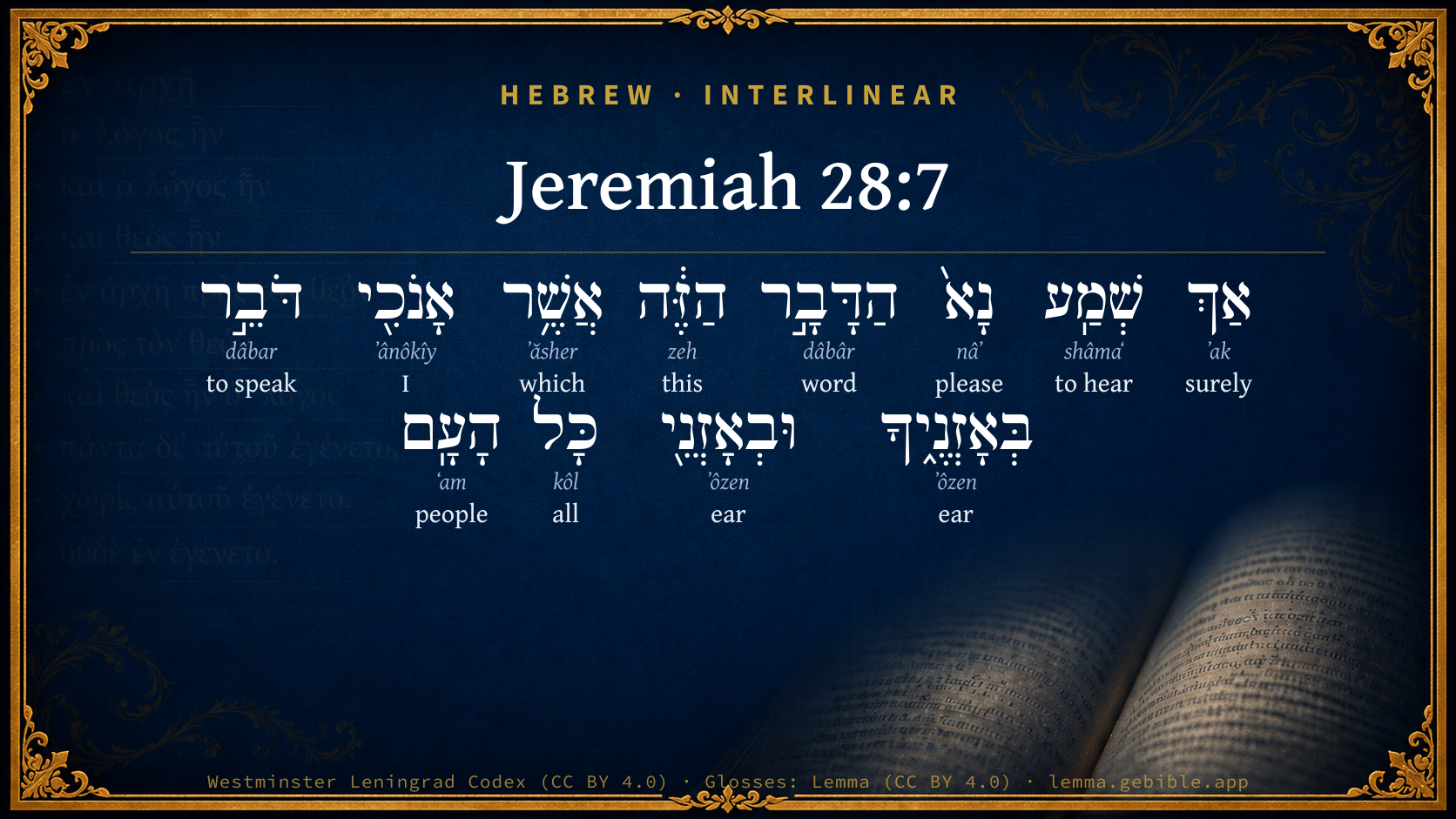
  1. שְׁמַֽע shâmaʻ H8085 “hear” Verb, Qal, Imperative, 2nd Person, Masculine, Singular
  2. נָא֙ nâʼ H4994 “please” Particle, Exhortation
  3. הַדָּבָ֣ר dâbâr H1697 “the · word” Particle, Definite Article + Noun, Common, Masculine, Singular, Absolute
  4. הַזֶּ֔ה zeh H2088 “the · this” Particle, Definite Article + Pronoun, Demonstrative, Masculine, Singular
  5. אֲשֶׁ֥ר ʼăsher H834 “which” Particle, Relative
  6. אָנֹכִ֖י ʼânôkîy H595 “I” Pronoun, Personal, 1st Person, Common, Singular
  7. דֹּבֵ֣ר dâbar H1696 “speaking” Verb, Qal, Participle Active, Masculine, Singular, Absolute
  8. בְּאָזְנֶ֑יךָ ʼôzen H241 “in/at · ears · your” Preposition + Noun, Common, Feminine, Dual, Construct + Suffix, Personal, 2nd Person, Masculine, Singular
  9. וּבְאָזְנֵ֖י ʼôzen H241 “and · in/at · ears of” Conjunction + Preposition + Noun, Common, Feminine, Dual, Construct
  10. כָּל kôl H3605 “all of” Noun, Common, Masculine, Singular, Construct
  11. הָעָֽם ʻam H5971 “the · people” Particle, Definite Article + Noun, Common, Masculine, Singular, Absolute

About this verse

These counts appear in no published source. They are computed here, from the morphology-tagged text and Lemma’s own curated glosses. What Lemma adds →

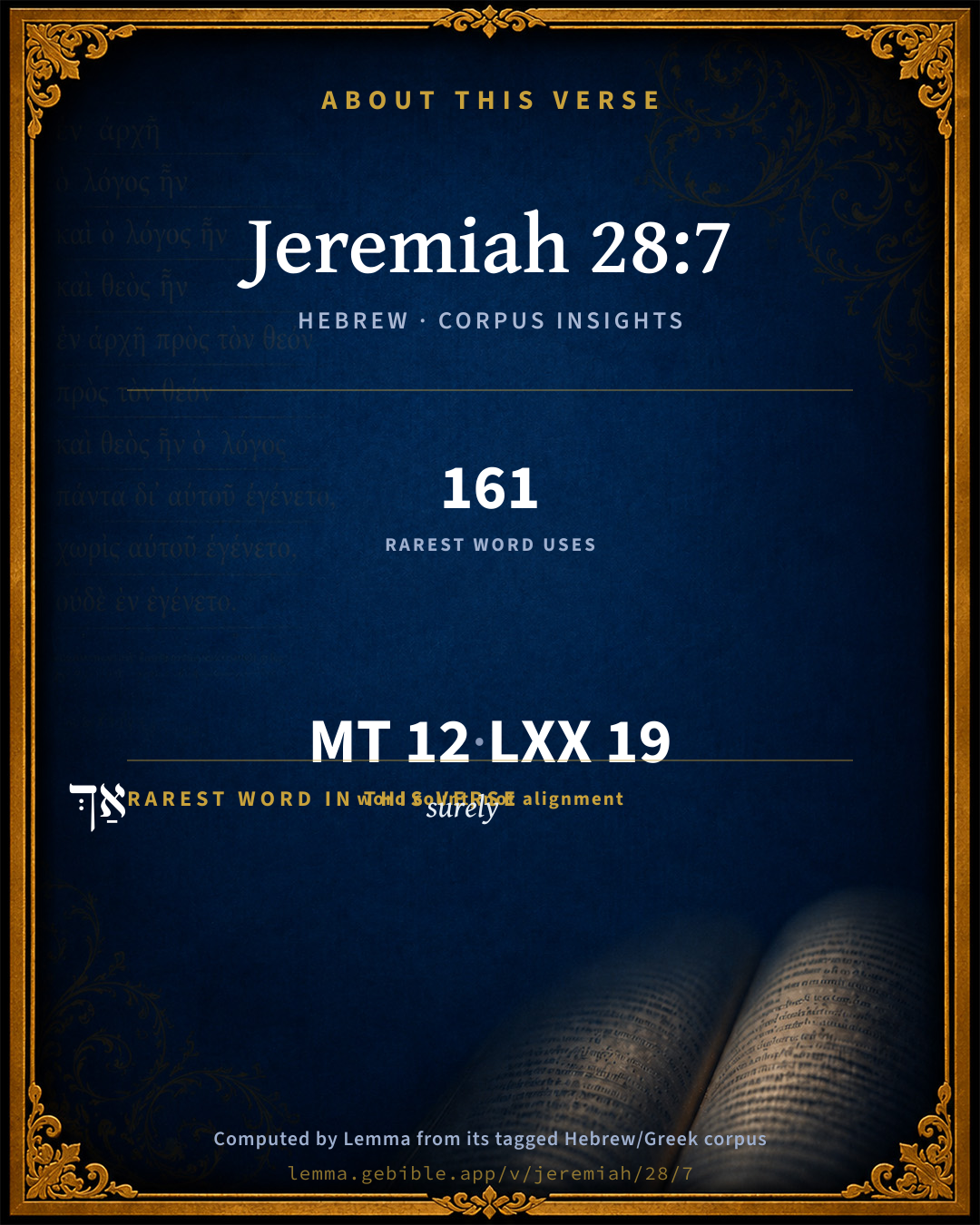
12
words
11
distinct lemmas
Prophets
section

Grammatical profile

  • 2 verbs
  • 5 nouns
  • 2 pronouns
  • 3 particles

Verb forms

  • שְׁמַֽע Qal · Imperative
  • דֹּבֵ֣ר Qal · Participle Active

Repetition

A word recurs within this verse — often emphatic in Hebrew:

  • בְּאָזְנֶ֑יךָ ear H241 ×2

Hebrew & Septuagint length

In the original languages it is 12 Hebrew tokens and 19 Greek tokens — but the two are counted differently (Hebrew bundles its prefixes and suffixes into one token; the Greek is in lemma form), so that isn’t a like-for-like length.

Cross-references

1

Topical passages linked to Jeremiah 28:7 in the Treasury of Scripture Knowledge — connected by theme and wording, ordered by reader-vote popularity; previews shown in the World English Bible.

  • 1 Kings 22:28 Micaiah said, If you return at all in peace, Yahweh has not spoken by me. He said, Hear, you peoples, all of you.

Cross-references courtesy of OpenBible.info (CC BY 4.0).

Hebrew and Greek witnesses Masoretic Hebrew ↔ Greek Septuagint

The same verse in the two great witnesses to the Old Testament, shown verse-for-verse.

These are two independent witnesses, not word-aligned to each other, and the Septuagint is shown in lemma (dictionary) form.

Hebrew Jeremiah 28:7 Masoretic · Westminster Leningrad Codex

אַךְ שְׁמַֽע נָא֙ הַדָּבָ֣ר הַזֶּ֔ה אֲשֶׁ֥ר אָנֹכִ֖י דֹּבֵ֣ר בְּאָזְנֶ֑יךָ וּבְאָזְנֵ֖י כָּל הָעָֽם

Nevertheless hear you now this word that I speak in your ears, and in the ears of all the people:

World English Bible · Public Domain

Greek LXX Structure differs

In the Septuagint, Jeremiah is about an eighth shorter than the Hebrew and arranges its material differently — the Oracles Against the Nations (Hebrew chapters 46–51) appear in the middle of the Greek book, after 25:13. Because the chapter and verse boundaries do not line up, a verse-for-verse comparison with the Hebrew is not shown.

A verse-for-verse comparison isn’t shown here because the chapters and verses don’t line up. Switch to the LXX edition with the MT / LXX toggle above to read the Greek directly.

Hebrew: Westminster Leningrad Codex (CC BY 4.0). Greek: Septuagint (public domain); English from a public-domain English Septuagint. How the Septuagint differs from the Hebrew →

Targum (Aramaic paraphrase)

1

The Targum is the ancient Jewish Aramaic paraphrase of the Hebrew Scriptures — an interpretive translation, not the Hebrew text itself. Onkelos (literal) and Pseudo-Jonathan (expansive) render the Torah, and Jonathan the Prophets. Coverage is partial: where no permissively-licensed English translation exists for a verse, only the Aramaic is shown. This is verse-level text, not a word-by-word alignment to the Hebrew.

  1. Targum Jonathan Prophets (Joshua–Malachi)
    בְּרַם שְׁמַע כְּעַן פִּתְגָמָא הָדֵין דִי אֲנָא מְמַלֵיל קֳדָמָךְ וּקְדָם כָּל עַמָא:

    (no public-domain English translation for this verse)

    Targum Jonathan — Aramaic: “Mikraot Gedolot” (public domain). English: “Sefaria Community Translation” (CC0 1.0 (public-domain dedication)); “London "Chaldee Paraphrase," 1871” (public domain). Text via Sefaria.

Commentary

Notes on Jeremiah 28:7 from classic Christian and Jewish commentators (each source and its license shown beneath its notes). The classic Christian expositions comment on the surrounding passage and are grouped to its opening verse, so a note may address several verses; the Jewish commentaries on the Tanakh (Rashi and others) are per-verse, so they appear only where the commentator wrote on this verse.

Lemma curates 59 commentaries, every one of them public domain or Creative Commons licensed, each selected and text-cleaned for this edition rather than reprinted as found. About our sources →

Trapp's Complete Commentary

John Trapp

Jer 28:7 Nevertheless hear thou now this word that I speak in thine ears, and in the ears of all the people;

Ver. 7. Nevertheless, hear thou now.] Audi quaeso. Hear, I pray thee; soft words, but hard arguments. See on Isa 5:3.

And in the ears of all the people.] Whom I desire not to deceive, and to advise for the best, whatever they think of me. Let them think what they will, mode impii silentii non arguar, as Luther once said, so that I be not found guilty of a sinful silence.

John Trapp, A Commentary or Exposition upon All the Books of the Old and New Testament (1647–1656) — public domain. Text from a community e-Sword module.

Tyndale Open Study Notes

Tyndale Open Resources

28:7-9 Only when a prophet’s predictions come true can people be certain that he has spoken the Lord’s word (Deut 18:20-22).

Tyndale Open Study Notes — © Tyndale Open Resources, licensed CC BY-SA 4.0. Text via the HelloAO Bible API.

John Calvin's Commentaries

Jeremiah, having testified that he did not wish for anything adverse to his own people, but had a good will towards them, now adds that what he had predicted was yet most true. Here is seen more fully what I have said of his twofold feeling; for though the Prophet wished to consult the welfare of the people, he did not yet cease to render full obedience to God, and to announce those messages which were at the same time very grievous: thus Jeremiah did not keep silence, but became an herald of God’s vengeance against the people. On the one hand, then, he showed that he desired nothing more than the welfare and the safety of his people, and that yet it was not in his power nor in that of any mortal to change the celestial decree which he had pronounced. We hence see that God so influenced the minds and hearts of his servants, that they were not cruel or barbarous; and yet they were not made soft and pliable through the influence of humanity, but boldly declared what God had commanded them.

For this reason he said, Nevertheless, hear thou this word which I pronounce in thine ears, and in the ears of all the people By these words Jeremiah indirectly condemned the vanity of Hananiah, who sought to flatter the people, and by his adulations hunted for favor and applause, as it is usual with such impostors, he then said that it availed him nothing to give the people the hope of a near deliverance, for God had not changed his purpose. And Jeremiah now boldly and openly opposed him, as he had sufficiently rebutted that ill-will with which he was unjustly loaded; for impostors ever find out calumnies by which they assail the faithful servants of God. He might at the beginning have objected to Jeremiah and said, “Thou art alienated from thine own nation, thou art not touched by the many miseries by which we have been hitherto distressed, nor carest thou for what may happen to us in future.” Thus he might have kindled hatred against Jeremiah, had he not cleared himself. But after he had testified that he felt kindly and was well affected towards his own nation, he assailed the impostor himself, and hesitated not to assert what seemed very grievous, that the people would become captives.

Yet Jeremiah seems here to have been smitten in some measure with fear; for he did not confirm his own prophecy, but left that as it were in suspense; and yet he doubtless exposed the false declaration of Hananiah. But we know that the whole of what the Prophet said is not recited; for he only in a brief way records the heads or the chief things; and further, as we shall presently see, Jeremiah could not act as he wished in the midst of such a tumult, for he would have spoken to the deaf; and as Hananiah had prejudiced the minds of almost all, the holy Prophet would not have been listened to while there was such a confusion. He was therefore satisfied with the brief assertion, that God would soon shew that Hananiah was a false witness in promising so quick a return to the captives and exiles.

John Calvin's Commentaries (1540-1563) — public domain. Text from the Calvin Translation Society English edition (1840s-50s) via the Christian Classics Ethereal Library (ccel.org). Calvin's coverage is partial (roughly two-thirds of the Bible); uncommented books and verses are honest gaps, never fabricated. The 19th-century editor's footnotes and remarks are omitted so the notes are faithfully Calvin's own voice.

The Cambridge Bible for Schools and Colleges

gen. ed. J. J. S. Perowne

7–9. The passage forms an important aid to our grasping of the real nature of O.T. prophecy. True prophets did not flatter with promises of good fortune, seeing that their aim was to preach repentance and reformation to a sinful world. Any future prosperity which they contemplated could only be subsequent to the purging away of evil by the Divine judgements. For such an attitude on the part of the prophet courage and self-denial were needed; hence the presumption was a safe one that one who spoke thus was sent by God, and so refused to pander from selfish motives to the wishes of his hearers. Nothing could avail against this argument in proof of the trustworthiness of the true prophet, except the actual fulfilment of his opponent’s prediction to the contrary. It was probably as realising this that Hananiah, in spite of the risk of exposure involved, fixed an early date for the fulfilment of his pleasing forecast (Jer_28:3), and thereupon had his own weapon turned against him (Jer_28:16 f.). For this passage cp. Deu_18:22, also Jer_13:1-3.

The Cambridge Bible for Schools and Colleges (gen. ed. J. J. S. Perowne; Cambridge University Press, 1878–1918) — public domain. Text from a community e-Sword module.

John Gill's Exposition

Nevertheless, hear thou now this word that I speak in thine ears,.... Though this would be very acceptable to me, and I should be glad to have it fulfilled; yet carefully attend to what I am about to say, it being what greatly concerns thee to observe, as well as all present to listen to: and therefore it is added,

and in the ears of all the people; that stood round to hear the conversation that passed between the two prophets.

John Gill's Exposition of the Whole Bible (1746–1763) — public domain (CC PDM 1.0). Text via the HelloAO Bible API.

Matthew Poole's English Annotations

The word which I am now about to speak concerneth, thee, and not thee alone, but all the people; therefore do thou mark it well, and let them mark it also.

Matthew Poole's English Annotations on the Holy Bible (1683–1685) — public domain. Text from a community e-Sword/MySword module.

Rashi

Rabbi Shlomo Yitzchaki (Rashi)

But, hearken now... The prophet who would prophesy for peace. He said: I prophesy retribution. If it does not come, I am not a liar, for the Holy One, blessed be He, renounces the evil, but the prophet who prophesies for peace, etc., when the word of the prophet comes, etc., but if his word does not come, he is a liar, as it is said, “God is not a man that He should lie, etc.” (Num. 23:19). In this manner Rabbi Tanhuma (Vayera 13) expounded.

Rashi on the Tanakh — English translations: “The Judaica Press complete Tanach with Rashi, translated by A. J. Rosenberg” (CC BY 4.0); “Pentateuch with Rashi's commentary by M. Rosenbaum and A.M. Silbermann, 1929-1934” (public domain); “The Metsudah Tanach series, Lakewood, N.J” (CC BY 4.0); and “The Book of Joshua, Metsudah Publications, 1997” (CC BY 4.0). Text via Sefaria.

Lesson kit

Teaching starters — assembled from the data on this page, not authored interpretation. Every prompt links to the verse data it draws on. Edit before teaching.

Jeremiah, in the Prophets, opens this verse with 12 words (11 distinct Hebrew lemmas). Its most distinctive word is ʼak (“surely”). A historical commentator’s framing appears above. Read the whole chapter for the surrounding context.

Discussion questions

  1. How does “surely” (ʼak) shape what this verse is saying?
  2. 1 Kings 22:28 shares this passage’s theme. How do the two illuminate each other?
  3. “ear” occurs 2× in this one verse. What is the effect of the repetition?
  4. These translations render this verse differently. What is at stake in choosing one wording over another?
  5. The verb «שְׁמַֽע» is Qal Imperative. How does its form color the action?
  6. Reading how Trapp's Complete Commentary and Tyndale Open Study Notes read this verse, where do the two commentators agree and where do they part?

Things to notice

Reading settings

Reading text

Shown beneath each verse's original-language words.

Old Testament
Old Testament edition

Read the OT as the Masoretic Hebrew (MT) or the Greek Septuagint (LXX).

English shown for the Greek Septuagint (in the Hebrew ↔ Greek comparison).

Comparing translations? Open the Compare panel on any verse page to stack up to four side by side.