

Job 33:16

Hebrew (Westminster Leningrad Codex) Job 33:16 appears in the Hebrew Old Testament. The text above is from the Westminster Leningrad Codex. Each word links to its Strong’s number, a concise gloss, and parsing drawn from the Open Scriptures Hebrew Bible morphology. Click any word for its full Brown-Driver-Briggs (BDB) entry.
Download image
Cite this verse

Job 33:16 (World English Bible). Public Domain. Lemma interlinear Bible study tool, https://lemma.gebible.app/v/job/33/16.

Show BibTeX & RIS
BibTeX
RIS
English Translation
Then he opens the ears of men, And seals their instruction,
World English Bible · Public Domain
Highlights
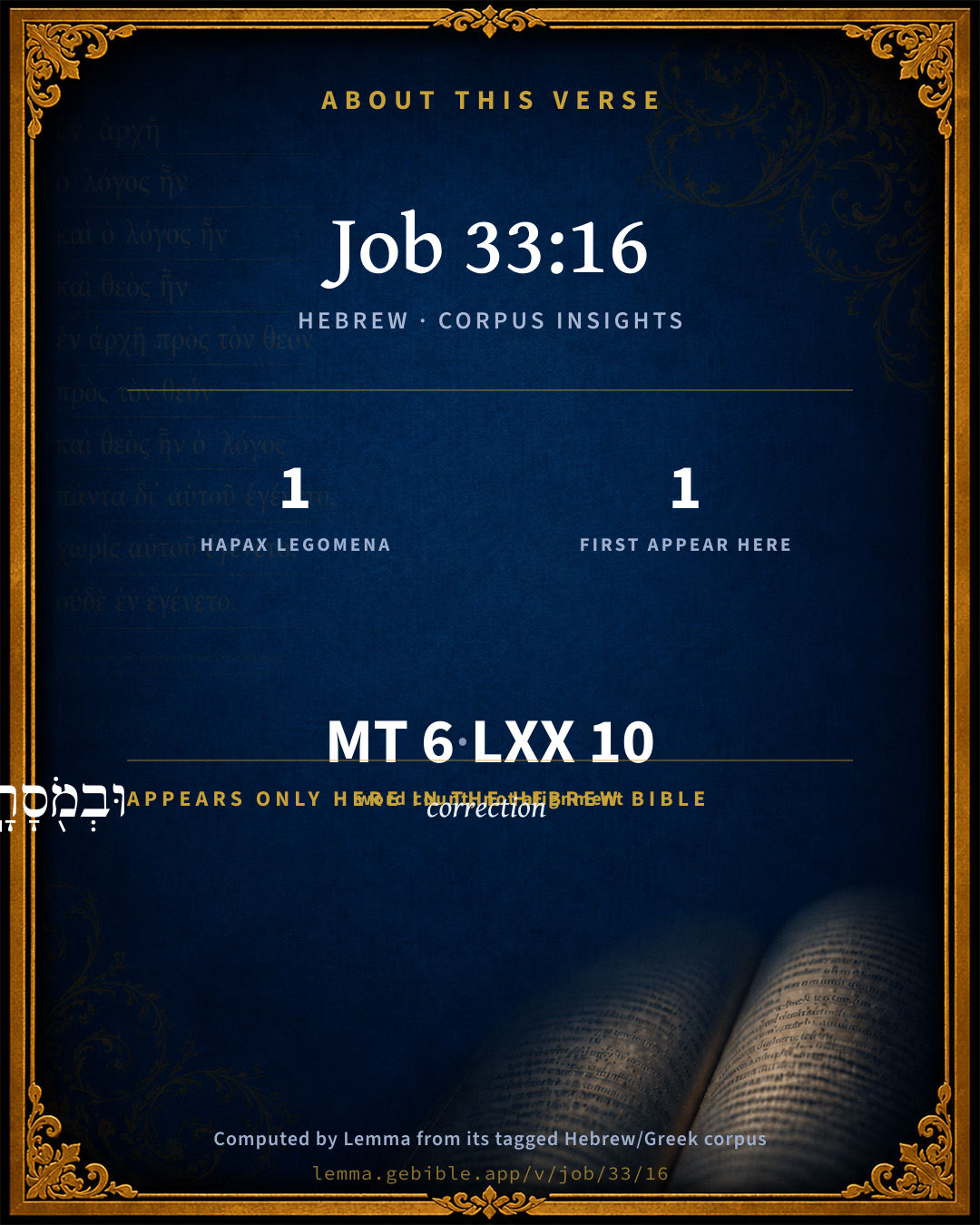
  • 1 hapax legomenon — only here in the Hebrew Bible
  • 1 first appearance in the Hebrew Bible
Full analysis ↓
Download a study sheet

One document with this verse’s original text, its word-by-word gloss line, the meaning frame, cross-references with their text, attributed commentary, and full source and license credits — printable, and it pastes into notes with its structure intact.

This verse Autodidact and up

Study sheet (.html) Plain text (.txt)

A passage Seminary Student

Up to 50 verses in one chapter. A passage sheet keeps up to 6 commentary sources and 12 cross-references per verse, in the order this page ranks them, and says so on the sheet whenever that leaves anything out. Ask for a single verse and you get the Autodidact verse sheet above.

Everything on this page stays free to read, with no account — the sheet is a download of what is already on screen, not access to it.

Want to remove ads? Support Godless Engineer
Compare translations 3

The same verse in 3 English versions, stacked beneath the original-language interlinear above. Click any original word for its lexicon entry.

Each is an independent rendering of the whole verse — the interlinear is not word-aligned to these translations.

Highlighted words mark where these versions differ — a whole-verse word diff, not a word-by-word alignment.

  • World English Bible Public Domain
    Then he opens the ears of men, And seals their instruction,
  • King James Version Public Domain
    Then he openeth the ears of men, and sealeth their instruction,
  • unfoldingWord Literal Text CC BY-SA 4.0
    then he opens the ear of men and seals their correction

unfoldingWord Literal Text — © unfoldingWord, licensed CC BY-SA 4.0. Word-aligned USFM3 via Door43 (git.door43.org/unfoldingWord/en_ult).

Versions to compare (up to 4)

3 of 4 selected

Show all 18 translations

Every available English version of this verse, each an independent rendering of the whole verse.

  • World English Bible Public Domain
    Then he opens the ears of men, And seals their instruction,
  • Berean Standard Bible Public Domain
    He opens their ears and terrifies them with warnings
  • Majority Standard Bible Public Domain
    He opens their ears and terrifies them with warnings
  • King James Version Public Domain
    Then he openeth the ears of men, and sealeth their instruction,
  • American Standard Version (1901) Public Domain
    Then he openeth the ears of men, And sealeth their instruction,
  • Revised Version (1885) Public Domain
    Then he openeth the ears of men, and sealeth their instruction,
  • Geneva Bible (1599) Public Domain
    Then he openeth the eares of men, euen by their corrections, which he had sealed,
  • Douay-Rheims (1899) Public Domain
    Then he openeth the ears of men, and teaching instructeth them in what they are to learn.
  • Young's Literal Translation Public Domain
    Then He uncovereth the ear of men, And for their instruction sealeth:
  • Literal Standard Version CC BY-SA 4.0
    Then He uncovers the ear of men, || And seals for their instruction,
  • Unlocked Literal Bible CC BY-SA 4.0
    then God opens the ears of men, and frightens them with threats,
  • unfoldingWord Literal Text CC BY-SA 4.0
    then he opens the ear of men and seals their correction
  • Darby Bible Public Domain
    Then he openeth men's ears, and sealeth their instruction,
  • World Messianic Bible Public Domain
    then he opens the ears of men, and seals their instruction,
  • Webster's Bible Public Domain
    Then he openeth the ears of men, and sealeth their instruction,
  • Free Bible Version CC BY-SA 4.0
    God speaks to them with solemn warnings
  • Bible in Basic English Public Domain
    Then he makes his secrets clear to men, so that they are full of fear at what they see;
  • JPS Tanakh (1917) Public Domain
    Then He openeth the ears of men, and by their chastisement sealeth the decree,

Literal Standard Version (2020), Covenant Press — licensed CC BY-SA 4.0. Text via the HelloAO Bible API (eBible.org). Unlocked Literal Bible (unfoldingWord) — licensed CC BY-SA 4.0. Text via the HelloAO Bible API (eBible.org). unfoldingWord Literal Text — © unfoldingWord, licensed CC BY-SA 4.0. Word-aligned USFM3 via Door43 (git.door43.org/unfoldingWord/en_ult). Free Bible Version, Dr. Jonathan Gallagher — licensed CC BY-SA 4.0. Text via the HelloAO Bible API (eBible.org).

Word by word

More ways to search: Search by grammar → Find every occurrence → Compare this word →

Practice this passage: Drill this verse → Learn its vocabulary →

About this verse

These counts appear in no published source. They are computed here, from the morphology-tagged text and Lemma’s own curated glosses. What Lemma adds →

6
words
6
distinct lemmas
Wisdom
section

Notable vocabulary

1 hapax legomenon — a word that appears only here in the entire Hebrew Bible:

  • וּבְמֹ֖סָרָ֣ם correction H4561

First appearance in Scripture

This word makes its first canonical appearance in the Hebrew Bible here:

  • וּבְמֹ֖סָרָ֣ם correction H4561

Shared distinctive vocabulary

יַחְתֹּֽם to seal H2856 occurs in 24 verses of the Hebrew Bible. Also found in:

Grammatical profile

  • 2 verbs
  • 3 nouns
  • 1 adverb

Verb forms

  • יִ֭גְלֶה Qal · Imperfect
  • יַחְתֹּֽם Qal · Imperfect

Hebrew & Septuagint length

In English translation the verse runs 11 words from the Hebrew and 14 from the Septuagint (LXX English) — closely comparable.

A rough comparison of the two English renderings, which tokenize alike — not a word-level alignment.

Word counts can differ between the Hebrew and the Greek without any difference in meaning — e.g. the Hebrew direct-object marker אֵת has no separate Greek word, and Greek often adds the article ὁ.

In the original languages it is 6 Hebrew tokens and 10 Greek tokens — but the two are counted differently (Hebrew bundles its prefixes and suffixes into one token; the Greek is in lemma form), so that isn’t a like-for-like length.

Cross-references

11

Topical passages linked to Job 33:16 in the Treasury of Scripture Knowledge — connected by theme and wording, ordered by reader-vote popularity; previews shown in the World English Bible.

  • Job 36:10 He also opens their ears to instruction, And commands that they return from iniquity.
  • Job 36:15 He delivers the afflicted by their affliction, And opens their ear in oppression.
  • Psalms 40:6 Sacrifice and offering you didn't desire. You have opened my ears: Burnt offering and sin offering you have not required.
  • Isaiah 50:5 The Lord Yahweh has opened my ear, and I was not rebellious, neither turned away backward.
  • Isaiah 6:10 Make the heart of this people fat; Make their ears heavy, and shut their eyes; Lest they see with their eyes, And hear with their ears, And understand with their heart, And turn again, and be healed."
  • Luke 24:45 Then he opened their minds, that they might understand the Scriptures.
  • Acts 16:14 A certain woman named Lydia, a seller of purple, of the city of Thyatira, one who worshiped God, heard us; whose heart the Lord opened to listen to the things which were spoken by Paul.
  • 2 Samuel 7:27 For you, Yahweh of Hosts, the God of Israel, have revealed to your servant, saying, I will build you a house: therefore has your servant found in his heart to pray this prayer to you.
  • Nehemiah 9:38 Yet for all this we make a sure covenant, and write it; and our princes, our Levites, [and] our priests, seal to it.
  • Isaiah 48:8 Yes, you didn't hear; yes, you didn't know; yes, from of old your ear was not opened: for I knew that you did deal very treacherously, and was called a transgressor from the womb.
  • Romans 15:28 When therefore I have accomplished this, and have sealed to them this fruit, I will go on by way of you to Spain.

Cross-references courtesy of OpenBible.info (CC BY 4.0).

Hebrew and Greek witnesses Masoretic Hebrew ↔ Greek Septuagint

The same verse in the two great witnesses to the Old Testament, shown verse-for-verse.

These are two independent witnesses, not word-aligned to each other, and the Septuagint is shown in lemma (dictionary) form.

Hebrew Job 33:16 Masoretic · Westminster Leningrad Codex

אָ֣ז יִ֭גְלֶה אֹ֣זֶן אֲנָשִׁ֑ים וּבְמֹ֖סָרָ֣ם יַחְתֹּֽם

Then he opens the ears of men, And seals their instruction,

World English Bible · Public Domain

Greek LXX Job 33:16 Septuagint · lemma form

τότε ἀνακαλύπτω νοῦς ἄνθρωπος ἐν εἶδος φόβος τοιοῦτος αὐτός ἐκφοβέω

then opens he the understanding of men: he scares them with such fearful visions:

LXX2012 (modern English Septuagint) · Public Domain

On this verse, Joseph Benson's Commentary discusses the Septuagint’s reading. Read the note in Commentary ↓

Hebrew: Westminster Leningrad Codex (CC BY 4.0). Greek: Septuagint (public domain); English from LXX2012 (modern English Septuagint) (Public Domain). How the Septuagint differs from the Hebrew →

Commentary

Notes on Job 33:16 from classic Christian and Jewish commentators (each source and its license shown beneath its notes). The classic Christian expositions comment on the surrounding passage and are grouped to its opening verse, so a note may address several verses; the Jewish commentaries on the Tanakh (Rashi and others) are per-verse, so they appear only where the commentator wrote on this verse.

Lemma curates 59 commentaries, every one of them public domain or Creative Commons licensed, each selected and text-cleaned for this edition rather than reprinted as found. About our sources →

Trapp's Complete Commentary

John Trapp

Job 33:16 Then he openeth the ears of men, and sealeth their instruction,

Ver. 16. Then he openeth the ears of men] He maketh the bore bigger, as it were, that good counsel may enter; he calleth up the ears of the soul to the ears of the body, that one sound may pierce both; he saith, as to him in the Gospel Ephphatha; and together with his word there goeth forth a power, as Luk 4:32. See Job 36:10; Job 36:15.

And sealeth their instruction] Or, their correction, for they go together, Psa 94:12 Pro 3:12-13; Pro 6:14, and God sealeth, or setteth on, the one by the other; as when a schoolmaster would have a lesson learned indeed, he set it on with a whipping. Luther saith, that many of St Paul’s Epistles could not be understood but by the cross, Vexatio dat intellectum. Another grave divine giveth this good advice to find out the sin that God afflicteth for, consider what truths have been pressed upon your hearts before the affliction; for afflictions used to come as seals to instruction; before they did not come with power to your hearts, now God seals them: thus he. Bernard saith concerning his brother, when he gave him many good instructions, and he, being a soldier, minded them not; he put his finger to his sides, and said, One day a spear shall make way to this heart of thine for instructions and admonitions to enter. The Tigurine translation is full and elegant, Tunc aurem hominibus vellit, et disciplinam eorum velut impresso sigillo consignat: Then he pulleth men by the ear, and consigneth their instruction, as with a seal set unto it.

John Trapp, A Commentary or Exposition upon All the Books of the Old and New Testament (1647–1656) — public domain. Text from a community e-Sword module.

Joseph Benson's Commentary

Job 33:16-17. Then he openeth the ears of men — When their minds are free from the business and cares of the day, he secretly whispers instruction upon their ears, and imprints it upon their minds, and that in such a manner that they do not let it slip, (as men usually do most things which they hear, either from God or men,) but retain and hold it fast, being fully assured of the truth and importance of it. That he may withdraw man from his purpose — That is, from the execution of his purpose. Hebrew, מעשׂה, magnaseh, his work, that is, his evil work, as the Chaldee and LXX. understand it; from sin, which is truly and properly called man’s work, because it hath its rise in and from him, and is very agreeable to his nature, in his present corrupt state; as, on the contrary, all the good that is in man is generally and properly ascribed to God in Scripture. And hide pride from man — Pride is here mentioned as the root of those evil purposes or works last spoken of, which, for the most part, proceed from haughtiness of spirit, whereby men scorn to submit themselves and their wills and actions to God’s authority, but resolve to follow their own wills and corrupt passions, in spite of God, and with contempt of him. By God’s hiding pride from man may be meant his taking it away, as he is said to hide sin when he removes the guilt and power of it. Or, pride may be here put for the occasion of it. And God by this means is said to hide pride from man, because, by these glorious representations of his divine majesty to man, he takes him off from the admiration of his own excellency, and brings him to a sight of his own weakness, and to an humble and ready submission to God’s will.

Joseph Benson's Commentary on the Old and New Testaments (1811–1818) — public domain. Text from a community e-Sword module.

Geneva Bible (1599)

Geneva Bible translators

That is, determined to send upon them.

Geneva Bible (1599) marginal notes — public domain. Text via Bolls.life.

Jamieson, Fausset & Brown

Robert Jamieson, A. R. Fausset & David Brown

Literally, "sealeth (their ears) to Himself by warnings," that is, with the sureness and secrecy of a seal He reveals His warnings [UMBREIT]. To seal up securely (Job 37:7).

Jamieson, Fausset & Brown — Commentary Critical and Explanatory on the Whole Bible (1871) — public domain (CC PDM 1.0). Text via the HelloAO Bible API.

Adam Clarke's Commentary

Verse 16. Then he openeth the ears of men, and sealeth, c.]

III. By secret INSPIRATIONS. A dream or a vision simply considered is likely to do no good it is the opening of the understanding, and the pouring in of the light, that make men wise to salvation. Serious alarms, holy purposes, penitential pangs for past sins, apprehension of death and judgment, discoveries of God's justice, of Christ's love, of the world's vanity, of heaven's excellence, c., &c., &c., are often used by the Divine Spirit to withdraw men from their evil purpose, and to hide pride from man, Job 33:17 and of all these openings of the ear of the heart, and sealing instructions upon the conscience, we have numerous examples in the history of the Church, in the experience of good men, and even in the civil and providential history of all nations.

Adam Clarke's Commentary on the Bible (1810–1826) — public domain. Text from a community e-Sword/MySword module.

Ellicott's Commentary for English Readers

(16) Then he openeth the ears of men and sealeth.—Comp. Job_14:17 : “My transgression is sealed in a bag.” “He openeth their ear,” that is, He showeth them that He will decree, confirm, and seal up their chastisement, the sentence that is to be executed upon them, if they will not repent. If taken in the sense of instruction, it must mean that He will complete and confirm it.

A Bible Commentary for English Readers, edited by Charles John Ellicott (1878–1897) — public domain. Text from a community e-Sword module.

The Cambridge Bible for Schools and Colleges

gen. ed. J. J. S. Perowne

16. sealeth their instruction] The instruction is that communicated when the ear is opened, and a revelation given (comp. ch. Job_36:10; Job_36:15; 1Sa_9:15; Psa_40:6); and “to seal’ it is to confirm it and give it abiding efficacy. This is done partly by the impressive circumstances and manner of the dream; compare the impression produced on Eliphaz, after the model of whose vision the passage seems moulded. Perhaps the figure of “sealing” the instruction arises from the idea of closing up again the opened ear over the divine communication.

Others understand by “instruction” here the chastisement of affliction, assuming that the person to whom the vision was sent was one under trouble. “Instruction” is possibly used in this sense by Elihu, ch. Job_36:10; but in this chap. the case of affliction seems introduced first in Job_33:19.

The Cambridge Bible for Schools and Colleges (gen. ed. J. J. S. Perowne; Cambridge University Press, 1878–1918) — public domain. Text from a community e-Sword module.

John Gill's Exposition

Then he openeth the ears of men,.... Not the ears of his body, which remaining shut while things are presented to his mind in a dream or vision, but his internal ears; it is the same with opening the heart or understanding to attend to and receive the things delivered in this visionary way:

and sealeth their instruction; sends home the instruction given in this manner, and imprints it upon the mind, so that it is well remembered when awake, not only the dreams themselves, but the lessons taught and learnt there, as may be observed in the cases of Abimelech and Laban, Gen 20:3; the word signifies "chastisement" (l) as well as instruction, that being one way in which God teaches and instructs men, Psa 94:12; and so the sense may be, that God in a dream or vision makes it known to men, that if they regard not what he says to them, and repent not of their evils, and turn from them, he will correct and chastise them, and this he assures them of; and they may look for the certain performance of it, that he will visit their transgressions with a rod, and their iniquities with stripes; things that are sealed being sure and firm. Mr. Broughton renders the words, "and imprints why they are chastised."

(l) "disciplinam eorum", Tigurine version; "castigationem eorum", Beza, Vatablus, Drusius, Mercerus, Piscator, Michaelis, Schultens.

John Gill's Exposition of the Whole Bible (1746–1763) — public domain (CC PDM 1.0). Text via the HelloAO Bible API.

Albert Barnes' Notes on the Bible

Then he openeth the ears of men - Margin, as in Hebrew “revealeth,” or “uncovereth.” The idea is, that he then reveals to the ear of man important admonitions or counsels. He communicates valuable truth. We are not to understand this as saying that the sleeper actually hears God speak, but as the ear is the organ of hearing, it is employed here to denote that God then communicates His will to human beinigs. In what way he had access to the souls of people by dreams, it is impossible to explain.

And sealeth their instruction - literally, “In their admonition he seals;” or he affixes a seal. The idea is, that he makes the admonition or instruction as secure as if a seal were affixed to it. A seal ratified or confirmed a contract, a will, or a deed, and the sense here is, that the communications of God to the soul were as firm as if they had been ratified in like manner. Or possibly it may mean, that the warnings of God were communicated to the soul like a sealed letter or message unknown to any other; that is, were made privately to the individual himself in the slumbers of the night. Others have understood the word rendered instruction, as denoting castigation, or punishment, and according to that explanation the meaning would be, that he announces to them certain punishment if they continued in sin; he made it as certain to them as if it were ratified by a seal. So Rosenmuller and Mercer. Schultens supposes it to be equivalent to inspires them, or communicates instruction by inspiration as if it were confirmed and ratified by a seal. He observes that the Arabic word hhatham is often used in the Koran, meaning to inspire. The Septuagint renders it, ἀυτοὺς ἐξεφόβησεν autous exephobēsen - “he terrifies them” - where they evidently read יחתם yechathēm instead of יחתם yachthom. The sense is, that God communicates warnings to people on their beds, in a manner as solemn and impressive as if it were ratified with a seal, and made as secure as possible.

Albert Barnes' Notes on the Bible (1834–1885) — public domain. Text from a community e-Sword/MySword module.

Haydock's Catholic Bible Commentary

Instructeth. Hebrew, "sealing," that they may not mistake such a favour for a common dream. (Calmet)

George Leo Haydock (1774–1849), Haydock's Catholic Family Bible and Commentary, 1859 edition — public domain. Excludes Psalms (Douay-Rheims chapter numbering differs from Protestant) and Deuterocanonical books (Catholic canon only).

Matthew Poole's English Annotations

i.e. He revealeth his will to the ears and hearts of men, as this phrase is used, Job 36:10; Psa 40:6; Isa 1:4; and he imprinteth those instructions which he hath revealed to their ears upon their minds, that after they have heard and received them they do not let them slip, as men commonly do most things which they hear, whether from God or men, but do retain and hold them fast, and are fully satisfied and assured of the truth and importance of them. Or, he sealeth their chastening, or correction, for so this word signifies as well as instruction, i.e. he gives them assurance of his purpose of correcting them for their sins, if they do not prevent it by a speedy repentance. Or, he sealeth it (i.e. his word conveyed to their ears and minds) with chastening them, i.e. he gives them assurance of the truth and reality of his revelation by striking them with a sacred dread and horror, as was usual in such dreams or night visions, as we see Job 4:13,15; which he did that they might remember it the better, and distinguish this from such vain dreams as are only the productions of man’s fancy.

Matthew Poole's English Annotations on the Holy Bible (1683–1685) — public domain. Text from a community e-Sword/MySword module.

Whedon's Commentary on the Bible

Daniel D. Whedon

16. Sealeth their instruction — “Seals it (the ear) with warning for them.” — Hitzig. God opens the ear that man may comprehend the instruction (chastisement) which he seals upon the soul represented by the ear. Every human being thus assumes new interest if, with Elihu, we look upon him as the end of divine thoughts, purposes, and discipline; God stamping his seal on the soul even, that the impressions may be deepened and perpetuated. Matters of moment are sealed against loss or harm. See note Job_14:17; Deu_32:34; Isa_8:16.

Daniel D. Whedon (gen. ed.), Commentary on the Old and New Testaments (1874–1909) — public domain. Text from a community e-Sword module.

The Pulpit Commentary

Then he openeth the ears of men, and sealeth their instruction. At such times, Elihu holds, God gives men spiritual wisdom, instructs them, makes them understand his dealings with them and his purposes with respect to them. If Job is perplexed concerning the Almighty"s ways with himself, and desires explanations, let him have his ear open to the Divine teaching on such occasions, and seriously lay it to heart. He will thus, it may be, find his perplexity diminished.

The Pulpit Commentary (1880–1919), ed. H.D.M. Spence-Jones & Joseph S. Exell — public domain. Text from a community e-Sword module.

John Wesley's Explanatory Notes

Sealeth - He imprints those instructions upon their minds.

John Wesley, Explanatory Notes Upon the Whole Bible (1754–1765) — public domain. Text via the GEBible commentary corpus.

unfoldingWord translationNotes

Door43 World Missions Community

General Information:

Elihu continues speaking to Job.

then God opens the ears of men

This speaks of God making people aware of things as if he were opening their ears so that they could hear. AT: "then God reveals things to people" (See: Metaphor)

in order to pull man back from

This speaks of God keeping someone from doing something as if he were physically pulling him away from harm. AT: "in order to keep him from" (See: Metaphor)

God keeps man's life back from the pit ... his life from crossing over to death

Both of these statements mean the same thing. AT: "God saves people from the grave and from death" (See: Parallelism)

the pit

The place where people go when they die is referred to here as "the pit." AT: "the place where dead people are" (See: Metaphor)

man's life back ... his life

This is an idiom. AT: "man from dying and ... he keeps him" (See: Idiom)

from crossing over to death

Here "death" represents the place where people go when they die, that is, sheol. AT: "from going to sheol" (See: Metonymy)

translationWords

sin

proud

life

pit

die

unfoldingWord translationNotes — © Distant Shores Media and the Door43 World Missions Community, licensed CC BY-SA 4.0. Source: git.door43.org/Door43/en_tn.

Rashi

Rabbi Shlomo Yitzchaki (Rashi)

Then He opens the ear of men as He did to Abimelech in the dream of the night.

and with their chastisement He seals [them] He seals them and binds them with suffering because of their iniquity.

Rashi on the Tanakh — English translations: “The Judaica Press complete Tanach with Rashi, translated by A. J. Rosenberg” (CC BY 4.0); “Pentateuch with Rashi's commentary by M. Rosenbaum and A.M. Silbermann, 1929-1934” (public domain); “The Metsudah Tanach series, Lakewood, N.J” (CC BY 4.0); and “The Book of Joshua, Metsudah Publications, 1997” (CC BY 4.0). Text via Sefaria.

Lesson kit

Teaching starters — assembled from the data on this page, not authored interpretation. Every prompt links to the verse data it draws on. Edit before teaching.

Job, in the Wisdom, opens this verse with 6 words (6 distinct Hebrew lemmas). Its most distinctive word is môçâr (“correction”). A historical commentator’s framing appears above. Read the whole chapter for the surrounding context.

Discussion questions

  1. The word môçâr carries the sense “correction.” How does it shape the verse?
  2. This verse holds 1 word here found nowhere else in the Hebrew Bible. What might the rare word draw attention to?
  3. The word “correction” first appears here in Scripture. What is being introduced at this debut?
  4. Leviticus 15:3 shares the word «to seal» with this verse. How do the two illuminate each other?
  5. These translations render this verse differently. What is at stake in choosing one wording over another?
  6. The verb «יִ֭גְלֶה» is Qal Imperfect. How does its form color the action?
  7. Reading how Trapp's Complete Commentary and Joseph Benson's Commentary read this verse, where do the two commentators agree and where do they part?

Things to notice

Reading settings

Reading text

Shown beneath each verse's original-language words.

Old Testament
Old Testament edition

Read the OT as the Masoretic Hebrew (MT) or the Greek Septuagint (LXX).

English shown for the Greek Septuagint (in the Hebrew ↔ Greek comparison).

Comparing translations? Open the Compare panel on any verse page to stack up to four side by side.