Deuteronomy 15:17

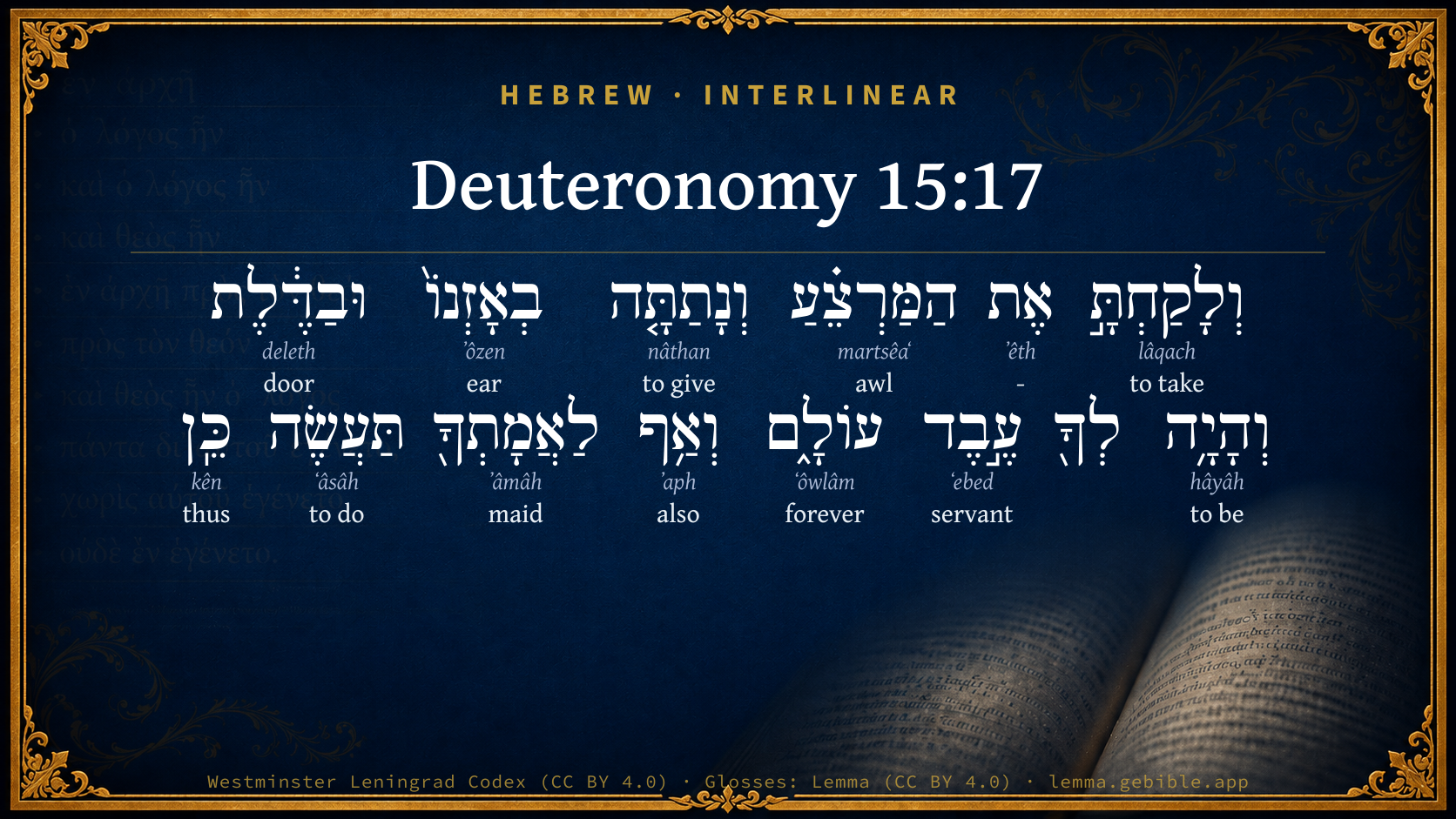
Hebrew (Westminster Leningrad Codex) Deuteronomy 15:17 appears in the Hebrew Old Testament. The text above is from the Westminster Leningrad Codex. Each word links to its Strong’s number, a concise gloss, and parsing drawn from the Open Scriptures Hebrew Bible morphology. Click any word for its full Brown-Driver-Briggs (BDB) entry.
Download image
Cite this verse

Deuteronomy 15:17 (World English Bible). Public Domain. Lemma interlinear Bible study tool, https://lemma.gebible.app/v/deuteronomy/15/17.

Show BibTeX & RIS
BibTeX
RIS
English Translation
then you shall take an awl, and thrust it through his ear to the door, and he shall be your servant forever. Also to your maid-servant you shall do likewise.
World English Bible · Public Domain
Download a study sheet

One document with this verse’s original text, its word-by-word gloss line, the meaning frame, cross-references with their text, attributed commentary, and full source and license credits — printable, and it pastes into notes with its structure intact.

This verse Autodidact and up

Study sheet (.html) Plain text (.txt)

A passage Seminary Student

Up to 50 verses in one chapter. A passage sheet keeps up to 6 commentary sources and 12 cross-references per verse, in the order this page ranks them, and says so on the sheet whenever that leaves anything out. Ask for a single verse and you get the Autodidact verse sheet above.

Everything on this page stays free to read, with no account — the sheet is a download of what is already on screen, not access to it.

Want to remove ads? Support Godless Engineer
Compare translations 3

The same verse in 3 English versions, stacked beneath the original-language interlinear above. Click any original word for its lexicon entry.

Each is an independent rendering of the whole verse — the interlinear is not word-aligned to these translations.

Highlighted words mark where these versions differ — a whole-verse word diff, not a word-by-word alignment.

  • World English Bible Public Domain
    then you shall take an awl, and thrust it through his ear to the door, and he shall be your servant forever. Also to your maid-servant you shall do likewise.
  • King James Version Public Domain
    Then thou shalt take an awl, and thrust it through his ear unto the door, and he shall be thy servant for ever. And also unto thy maidservant thou shalt do likewise.
  • unfoldingWord Literal Text CC BY-SA 4.0
    then you shall take an awl and put through his ear and to the door, and he shall be your slave forever. And also you shall do thus to your female slave.

unfoldingWord Literal Text — © unfoldingWord, licensed CC BY-SA 4.0. Word-aligned USFM3 via Door43 (git.door43.org/unfoldingWord/en_ult).

Versions to compare (up to 4)

3 of 4 selected

Show all 18 translations

Every available English version of this verse, each an independent rendering of the whole verse.

  • World English Bible Public Domain
    then you shall take an awl, and thrust it through his ear to the door, and he shall be your servant forever. Also to your maid-servant you shall do likewise.
  • Berean Standard Bible Public Domain
    then take an awl and pierce it through his ear into the door, and he will become your servant for life. And treat your maidservant the same way.
  • Majority Standard Bible Public Domain
    then take an awl and pierce it through his ear into the door, and he will become your servant for life. And treat your maidservant the same way.
  • King James Version Public Domain
    Then thou shalt take an awl, and thrust it through his ear unto the door, and he shall be thy servant for ever. And also unto thy maidservant thou shalt do likewise.
  • American Standard Version (1901) Public Domain
    then thou shalt take an awl, and thrust it through his ear unto the door, and he shall be thy servant for ever. And also unto thy maid-servant thou shalt do likewise.
  • Revised Version (1885) Public Domain
    then thou shalt take an awl, and thrust it through his ear unto the door, and he shall be thy servant for ever. And also unto thy maidservant thou shalt do likewise.
  • Geneva Bible (1599) Public Domain
    Then shalt thou take a naule, and perce his eare through against the doore, and he shall be thy seruant for euer: and vnto thy maid seruant thou shall doe likewise.
  • Douay-Rheims (1899) Public Domain
    Thou shalt take an awl, and bore through his ear in the door of thy house, and he shall serve thee for ever: thou shalt do in like manner to thy womanservant also.
  • Young's Literal Translation Public Domain
    then thou hast taken the awl, and hast put `it' through his ear, and through the door, and he hath been to thee a servant age-during; and also to thy handmaid thou dost do so.
  • Literal Standard Version CC BY-SA 4.0
    then you have taken the awl, and have put [it] through his ear, and through the door, and he has been a perpetual servant to you; and you also do so to your handmaid.
  • Unlocked Literal Bible CC BY-SA 4.0
    then you must take an awl and thrust it through his ear to a door, and he will be your servant for life. You must do the same with your female servant.
  • unfoldingWord Literal Text CC BY-SA 4.0
    then you shall take an awl and put through his ear and to the door, and he shall be your slave forever. And also you shall do thus to your female slave.
  • Darby Bible Public Domain
    then thou shalt take an awl, and thrust it through his ear and into the door; and he shall be thy bondman for ever. And also unto thy handmaid thou shalt do likewise.
  • World Messianic Bible Public Domain
    then you shall take an awl, and thrust it through his ear to the door, and he shall be your servant forever. Also to your female servant you shall do likewise.
  • Webster's Bible Public Domain
    Then thou shalt take an awl, and thrust it through his ear into the door, and he shall be thy servant for ever. And also to thy maid-servant thou shalt do likewise.
  • Free Bible Version CC BY-SA 4.0
    then use a metal tool to pierce his ear against the door, and he will be your slave for life. Do the same for your female slave.
  • Bible in Basic English Public Domain
    Then take a sharp-pointed instrument, driving it through his ear into the door, and he will be your servant for ever. And you may do the same for your servant-girl.
  • JPS Tanakh (1917) Public Domain
    then thou shalt take an awl, and thrust it through his ear and into the door, and he shall be thy bondman for ever. And also unto thy bondwoman thou shalt do likewise.

Literal Standard Version (2020), Covenant Press — licensed CC BY-SA 4.0. Text via the HelloAO Bible API (eBible.org). Unlocked Literal Bible (unfoldingWord) — licensed CC BY-SA 4.0. Text via the HelloAO Bible API (eBible.org). unfoldingWord Literal Text — © unfoldingWord, licensed CC BY-SA 4.0. Word-aligned USFM3 via Door43 (git.door43.org/unfoldingWord/en_ult). Free Bible Version, Dr. Jonathan Gallagher — licensed CC BY-SA 4.0. Text via the HelloAO Bible API (eBible.org).

Word by word

More ways to search: Search by grammar → Find every occurrence → Compare this word →

Practice this passage: Drill this verse → Learn its vocabulary →

הַמַּרְצֵ֗עַ
martsêaʻ
H4836
“the · awl”
Particle, Definite Article + Noun, Common, Masculine, Singular, Absolute
Part of Speech
Particle + Noun
Type
Common
Gender
Masculine
Number
Singular
State
Absolute
Full BDB Definition

Origin: from H7527

TWOT: 2209a

awl, boring-instrument
  1. וְלָקַחְתָּ֣ lâqach H3947 “and · to take” Conjunction + Verb, Qal, Sequential Perfect, 2nd Person, Masculine, Singular
  2. אֶת ʼêth H853 “-” Particle, Direct Object
  3. וְנָתַתָּ֤ה nâthan H5414 “and · to give” Conjunction + Verb, Qal, Sequential Perfect, 2nd Person, Masculine, Singular
  4. בְאָזְנוֹ֙ ʼôzen H241 “in/at · ear · his” Preposition + Noun, Common, Feminine, Singular, Construct + Suffix, Personal, 3rd Person, Masculine, Singular
  5. וּבַדֶּ֔לֶת deleth H1817 “and · in/at the · door” Conjunction + Preposition, Determined + Noun, Common, Feminine, Singular, Absolute
  6. וְהָיָ֥ה hâyâh H1961 “and · to be” Conjunction + Verb, Qal, Sequential Perfect, 3rd Person, Masculine, Singular
  7. עֶ֣בֶד ʻebed H5650 “servant of” Noun, Common, Masculine, Singular, Construct
  8. עוֹלָ֑ם ʻôwlâm H5769 “forever” Noun, Common, Masculine, Singular, Absolute
  9. וְאַ֥ף ʼaph H637 “and · also” Conjunction + Adverb
  10. לַאֲמָתְךָ֖ ʼâmâh H519 “to/for · maid · your” Preposition + Noun, Common, Feminine, Singular, Construct + Suffix, Personal, 2nd Person, Masculine, Singular
  11. תַּעֲשֶׂה ʻâsâh H6213 “to do” Verb, Qal, Imperfect, 2nd Person, Masculine, Singular
  12. כֵּֽן kên H3651 “thus” Particle, Demonstrative

About this verse

These counts appear in no published source. They are computed here, from the morphology-tagged text and Lemma’s own curated glosses. What Lemma adds →

14
words
13
distinct lemmas
Pentateuch
section

Notable vocabulary

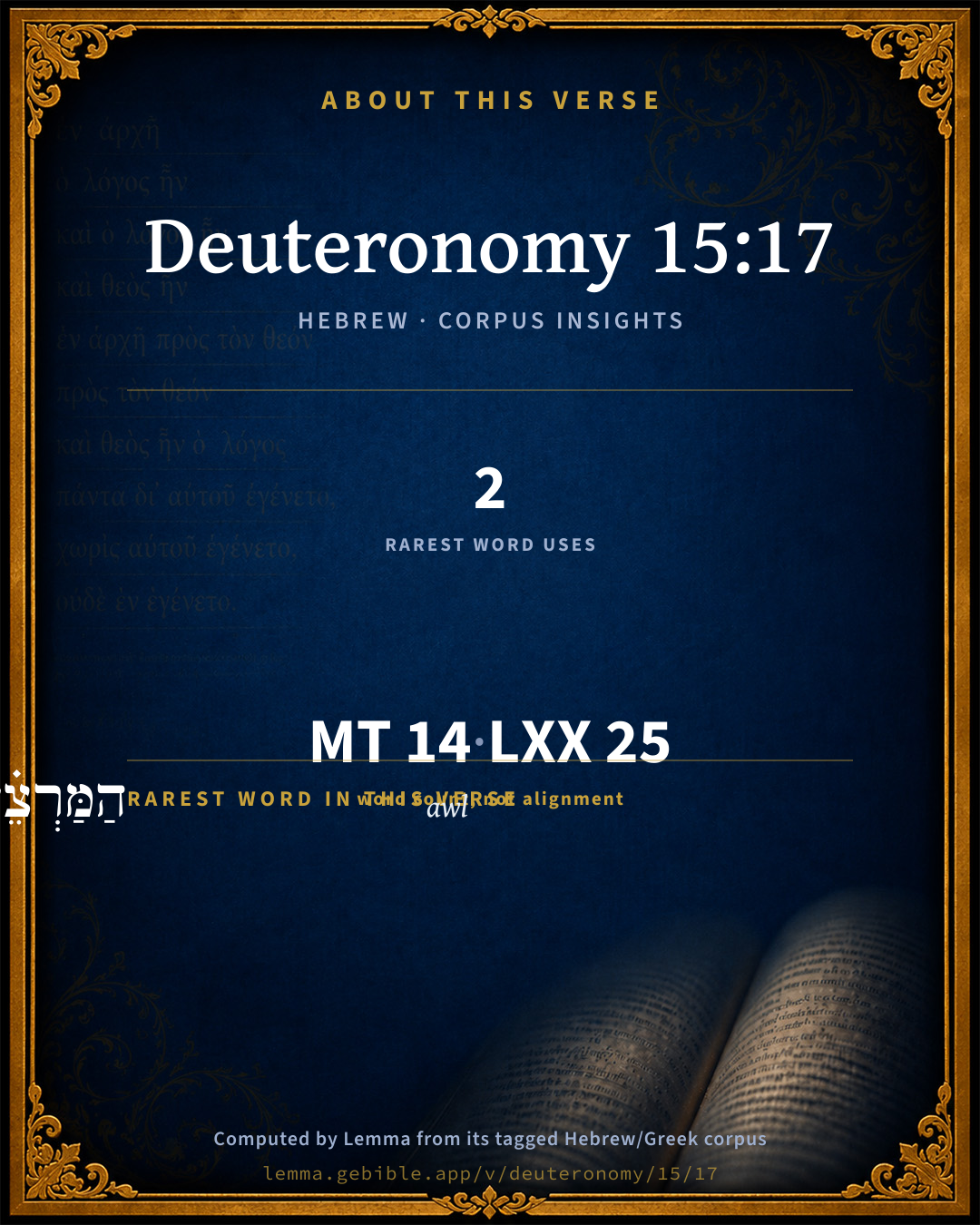
The rarest word here is הַמַּרְצֵ֗עַ awl H4836 — appearing just 2 times in the whole Hebrew Bible.

Shared distinctive vocabulary

הַמַּרְצֵ֗עַ awl H4836 occurs in 2 verses of the Hebrew Bible. Also found in:

Grammatical profile

  • 4 verbs
  • 6 nouns
  • 1 preposition
  • 1 adverb
  • 2 particles

Verb forms

  • וְלָקַחְתָּ֣ Qal · Sequential Perfect
  • וְנָתַתָּ֤ה Qal · Sequential Perfect
  • וְהָיָ֥ה Qal · Sequential Perfect
  • תַּעֲשֶׂה Qal · Imperfect

Hebrew & Septuagint length

In English translation the verse runs 30 words from the Hebrew and 32 from the Septuagint (LXX English) — closely comparable.

A rough comparison of the two English renderings, which tokenize alike — not a word-level alignment.

Word counts can differ between the Hebrew and the Greek without any difference in meaning — e.g. the Hebrew direct-object marker אֵת has no separate Greek word, and Greek often adds the article ὁ.

In the original languages it is 14 Hebrew tokens and 25 Greek tokens — but the two are counted differently (Hebrew bundles its prefixes and suffixes into one token; the Greek is in lemma form), so that isn’t a like-for-like length.

Cross-references

2

Topical passages linked to Deuteronomy 15:17 in the Treasury of Scripture Knowledge — connected by theme and wording, ordered by reader-vote popularity; previews shown in the World English Bible.

  • Leviticus 25:39–42 "'If your brother has grown poor among you, and sells himself to you; you shall not make him to serve as a slave.
  • 1 Samuel 1:22 But Hannah didn't go up; for she said to her husband, [I will not go up] until the child be weaned; and then I will bring him, that he may appear before Yahweh, and there abide forever.

Cross-references courtesy of OpenBible.info (CC BY 4.0).

Hebrew and Greek witnesses Masoretic Hebrew ↔ Greek Septuagint

The same verse in the two great witnesses to the Old Testament, shown verse-for-verse.

These are two independent witnesses, not word-aligned to each other, and the Septuagint is shown in lemma (dictionary) form.

Hebrew Deuteronomy 15:17 Masoretic · Westminster Leningrad Codex

וְלָקַחְתָּ֣ אֶת הַמַּרְצֵ֗עַ וְנָתַתָּ֤ה בְאָזְנוֹ֙ וּבַדֶּ֔לֶת וְהָיָ֥ה לְךָ֖ עֶ֣בֶד עוֹלָ֑ם וְאַ֥ף לַאֲמָתְךָ֖ תַּעֲשֶׂה כֵּֽן

then you shall take an awl, and thrust it through his ear to the door, and he shall be your servant forever. Also to your maid-servant you shall do likewise.

World English Bible · Public Domain

Greek LXX Deuteronomy 15:17 Septuagint · lemma form

καί λαμβάνω ὁ ὀπήτιον καί τρυπάω ὁ ὠτίον αὐτός πρός ὁ θύρα καί εἰμί σύ οἰκέτης εἰς ὁ αἰών καί ὁ παιδίσκη σύ ποιέω ὡσαύτως

then you shall take an awl, and bore his ear through to the door, and he shall be your servant for ever; and in like manner shall you do to your maidservant.

LXX2012 (modern English Septuagint) · Public Domain

Hebrew: Westminster Leningrad Codex (CC BY 4.0). Greek: Septuagint (public domain); English from LXX2012 (modern English Septuagint) (Public Domain). How the Septuagint differs from the Hebrew →

Targum (Aramaic paraphrase)

2

The Targum is the ancient Jewish Aramaic paraphrase of the Hebrew Scriptures — an interpretive translation, not the Hebrew text itself. Onkelos (literal) and Pseudo-Jonathan (expansive) render the Torah, and Jonathan the Prophets. Coverage is partial: where no permissively-licensed English translation exists for a verse, only the Aramaic is shown. This is verse-level text, not a word-by-word alignment to the Hebrew.

  1. Targum Onkelos Torah (Genesis–Deuteronomy)
    וְתִסַב יָת מַרְצְעָא וְתִתֵּן בְּאֻדְנֵהּ וּבְדָשָׁא וִיהֵי לָךְ עִבֵד פָּלַח לְעָלָם וְאַף לְאַמְתָךְ תַּעְבֶּד כֵּן

    (no public-domain English translation for this verse)

    Targum Onkelos — Aramaic: “Onkelos Genesis” (public domain); “Onkelos Exodus” (public domain); “Onkelos Leviticus” (public domain); “Onkelos Numbers” (public domain); “Onkelos Deuteronomy” (public domain). English: “Sefaria Community Translation” (CC0 1.0 (public-domain dedication)); “J.W. Etheridge. The Targums of Onkelos and Jonathan Ben Uzziel on the Pentateuch. London: Longmans, Green, 1862” (public domain). Text via Sefaria.

  2. Targum Pseudo-Jonathan Torah (Genesis–Deuteronomy)
    וְתִסַּב יַת מַחְטָא וְתִנְעוֹץ בְּאוּדְנֵיהּ וּבִתְרַע בֵּית דִינָא וִיהֵי לָךְ עֶבֶד פְּלַח עַד יוֹבְלָא וְאוּף לְאַמְתָךְ תִּכְתּוֹב גֵט חֵירַר וְתִתֵּן לָהּ

    then thou shalt take an awl, and bore (or apply) it through his ear, and that to the door of the house of judgment, and he shall be thy serving servant until the Jubilee. And for thy handmaid also thou shalt write a certificate of release, and give it to her.

    Targum Pseudo-Jonathan — Aramaic: “Targum Jonathan on Genesis” (public domain); “Targum Jonathan on Exodus” (public domain); “Targum Jonathan on Leviticus” (public domain); “Targum Jonathan on Numbers” (public domain); “Targum Jonathan on Deuteronomy” (public domain). English: “The Targum of Jonathan ben Uzziel, trans. J. W. Etheridge, London, 1862” (public domain). Text via Sefaria.

Commentary

Notes on Deuteronomy 15:17 from classic Christian and Jewish commentators (each source and its license shown beneath its notes). The classic Christian expositions comment on the surrounding passage and are grouped to its opening verse, so a note may address several verses; the Jewish commentaries on the Tanakh (Rashi and others) are per-verse, so they appear only where the commentator wrote on this verse.

Lemma curates 59 commentaries, every one of them public domain or Creative Commons licensed, each selected and text-cleaned for this edition rather than reprinted as found. About our sources →

Tyndale Open Study Notes

Tyndale Open Resources

15:17 push it through his earlobe: This disfigurement publicly indicated that a bondservant had voluntarily indentured himself to his master for life. This might be what Paul meant when he said “I bear on my body the scars that show I belong to Jesus” (Gal 6:17).

Tyndale Open Study Notes — © Tyndale Open Resources, licensed CC BY-SA 4.0. Text via the HelloAO Bible API.

Geneva Bible (1599)

Geneva Bible translators

To the year of Jubilee, Lev. 25:40.

Geneva Bible (1599) marginal notes — public domain. Text via Bolls.life.

Adam Clarke's Commentary

Verse 17. Thou shalt take an awl] See Clarke on Ex 21:6.

Adam Clarke's Commentary on the Bible (1810–1826) — public domain. Text from a community e-Sword/MySword module.

Ellicott's Commentary for English Readers

(17) And unto thy maidservant thou shalt do likewise—i.e., “in furnishing her liberally” (Rashi), and “possibly also in retaining her if she will.”

It must not be supposed that this contradicts Exo_21:7, “She shall not go out as the menservants do.” She shall not go out according to the going of the men-servants (i.e., on the same principle). It is not said, She shall not go out at all. The exceptions are given in Exo_21:8-11, which see. The general right of release is stated here. One difference (as stated by Rashi) is that women were not liable to be sold for theft like men, but might be sold by their parents in infancy. If the girl were not marriageable when the first Sabbatical year arrived, she would obtain her freedom absolutely, because the case contemplated in Exo_21:8-10 could not possibly arise. And, generally, we may suppose that the rights of an unmarried female slave would be the same as those of a man, to go out free in the seventh year. (See Jer_34:9.)

A Bible Commentary for English Readers, edited by Charles John Ellicott (1878–1897) — public domain. Text from a community e-Sword module.

The Cambridge Bible for Schools and Colleges

gen. ed. J. J. S. Perowne

17. thou shalt take an awl] Lit. a borer, only here and in Exo_21:6.

and thrust it through his ear] Lit. set, or give, it; E, bore or pierce his ear. His ear because it is the organ of obedience. Cp. Psa_40:6, mine ears thou hast opened; Isa_50:4 f., morning by morning he wakeneth mine ear to hear as the taught … The Lord Jehovah hath opened mine ear. In the Code of Ḫammurabi (§ 282) the slave who denies his master has his ear cut off.

unto the door] E, to the door or doorpost, i.e. of his master’s house. See Driver on Exo_21:6, and the meaning of the other phrase there, to the Elohim, which D omits, whether because it means the local sanctuary, abolished by D’s law, or some domestic image of deity, still more repugnant to D. See Clay Trumbull, The Threshold Covenant, 210.

thy bondman for ever] i.e. for life; ‘again a good example of the relative force of the Heb. phrase for ever’ (Berth.).

And also unto thy bondwoman, etc.] See introd. note.

The Cambridge Bible for Schools and Colleges (gen. ed. J. J. S. Perowne; Cambridge University Press, 1878–1918) — public domain. Text from a community e-Sword module.

John Gill's Exposition

Then thou shall take an awl, and thrust it through his ear unto the door,.... Not of his master's house, but of the sanhedrim, or court of judicature, according to the Targum of Jonathan, before whom he was to be brought, and declare his desire to continue with his master; See Gill on Exo 21:6,

and he shall be thy servant for ever; that is, unto the jubilee, as the same Targum; for then all servants were released, and so Jarchi calls it the ever of jubilee:

and also unto thy maidservant thou shall do likewise; not bore her ear, for, as both Jarchi and Aben Ezra, and others say, she was not to be bored; though some are of opinion that a maidservant who was willing to continue with her master was to be bored as a manservant; but this respects the manner of dismissing her, or letting her go free, when she was not to go empty, but to be liberally furnished and supplied, as a manservant was.

John Gill's Exposition of the Whole Bible (1746–1763) — public domain (CC PDM 1.0). Text via the HelloAO Bible API.

Haydock's Catholic Bible Commentary

House, before a judge. It is supposed that this law regarded only those who had sold themselves, or had been condemned to be slaves. (Fagius) --- For ever; that is, till the year of jubilee. --- Also, not by piercing her ear, as some have thought, but by setting her at liberty, and giving her something, ver. 14.

George Leo Haydock (1774–1849), Haydock's Catholic Family Bible and Commentary, 1859 edition — public domain. Excludes Psalms (Douay-Rheims chapter numbering differs from Protestant) and Deuterocanonical books (Catholic canon only).

Matthew Poole's English Annotations

For ever, i.e. all the time of his life, or, at least, till the year of jubilee. See on Exo 21:6.

Unto thy maid-servant thou shalt do likewise, i.e. either dismiss her honourably, and with plenty of provisions; or engage her to perpetual servitude in the same manner, and by the same rites; whence it appears that this case differs from that Exo 21:7, and that the maid-servant there was taken in upon other and better terms than this here.

Matthew Poole's English Annotations on the Holy Bible (1683–1685) — public domain. Text from a community e-Sword/MySword module.

Whedon's Commentary on the Bible

Daniel D. Whedon

17. Take an awl, and thrust it through his ear — The bored ears constituted a badge of slavery.

Daniel D. Whedon (gen. ed.), Commentary on the Old and New Testaments (1874–1909) — public domain. Text from a community e-Sword module.

John Wesley's Explanatory Notes

For ever - All the time of his life, or, at least, 'till the year of jubilee. Likewise - That is, either dismiss her with plenty, or engage her to perpetual servitude, in the same manner and by the same rites.

John Wesley, Explanatory Notes Upon the Whole Bible (1754–1765) — public domain. Text via the GEBible commentary corpus.

Rashi

Rabbi Shlomo Yitzchaki (Rashi)

עבד עולם [AND HE SHALL BE THY] SERVANT עולם — One might think that עולם has here its usual meaning: for ever! Scripture, however, states, (Leviticus 25:10) “[And ye shall sanctify the fiftieth year and proclaim liberty throughout all the land unto all the inhabitants thereof] and ye shall return every man unto his family”. Consequently, you learn that it (what Scripture terms here עולם), can only mean the period until the termination of that Jubilee cycle (Mekhilta; cf. Rashi on that verse),

ואף לאמתך תעשה כן AND ALSO UNTO THY MAID SERVANT THOU SHALT DO LIKEWISE — i.e. furnish her out of thy property. One might think, however, that Scripture puts her on the same level with the man-servant concerning the piercing of the ear too! It however, states, (Exodus 21:5) “And if the man-servant (העבד) shall plainly say, [I love my lord … then … his lord shall bore his ear through with an awl]” — so you see that a man-servant must have his ear pierced, but a maid-servant does not have it pierced (Sifrei Devarim 122:6).

Rashi on the Tanakh — English translations: “The Judaica Press complete Tanach with Rashi, translated by A. J. Rosenberg” (CC BY 4.0); “Pentateuch with Rashi's commentary by M. Rosenbaum and A.M. Silbermann, 1929-1934” (public domain); “The Metsudah Tanach series, Lakewood, N.J” (CC BY 4.0); and “The Book of Joshua, Metsudah Publications, 1997” (CC BY 4.0). Text via Sefaria.

Lesson kit

Teaching starters — assembled from the data on this page, not authored interpretation. Every prompt links to the verse data it draws on. Edit before teaching.

Deuteronomy, in the Pentateuch, opens this verse with 14 words (13 distinct Hebrew lemmas). Its most distinctive word is martsêaʻ (“awl”). A historical commentator’s framing appears above. Read the whole chapter for the surrounding context.

Discussion questions

  1. The word martsêaʻ carries the sense “awl.” How does it shape the verse?
  2. How does Exodus 21:6, which shares the word «awl», read alongside this verse?
  3. These translations render this verse differently. What is at stake in choosing one wording over another?
  4. «וְלָקַחְתָּ֣» is a Qal Sequential Perfect verb. How does that grammatical form shape the action described?
  5. Compare how Tyndale Open Study Notes and Geneva Bible (1599) read this verse. Where do they agree or differ?

Things to notice

Reading settings

Reading text

Shown beneath each verse's original-language words.

Old Testament
Old Testament edition

Read the OT as the Masoretic Hebrew (MT) or the Greek Septuagint (LXX).

English shown for the Greek Septuagint (in the Hebrew ↔ Greek comparison).

Comparing translations? Open the Compare panel on any verse page to stack up to four side by side.