Deuteronomy 29:4

Hebrew (Westminster Leningrad Codex) Deuteronomy 29:4 appears in the Hebrew Old Testament. The text above is from the Westminster Leningrad Codex. Each word links to its Strong’s number, a concise gloss, and parsing drawn from the Open Scriptures Hebrew Bible morphology. Click any word for its full Brown-Driver-Briggs (BDB) entry.
Download image
Cite this verse

Deuteronomy 29:4 (World English Bible). Public Domain. Lemma interlinear Bible study tool, https://lemma.gebible.app/v/deuteronomy/29/4.

Show BibTeX & RIS
BibTeX
RIS
English Translation
but Yahweh has not given you a heart to know, and eyes to see, and ears to hear, to this day.
World English Bible · Public Domain
Download a study sheet

One document with this verse’s original text, its word-by-word gloss line, the meaning frame, cross-references with their text, attributed commentary, and full source and license credits — printable, and it pastes into notes with its structure intact.

This verse Autodidact and up

Study sheet (.html) Plain text (.txt)

A passage Seminary Student

Up to 50 verses in one chapter. A passage sheet keeps up to 6 commentary sources and 12 cross-references per verse, in the order this page ranks them, and says so on the sheet whenever that leaves anything out. Ask for a single verse and you get the Autodidact verse sheet above.

Everything on this page stays free to read, with no account — the sheet is a download of what is already on screen, not access to it.

Want to remove ads? Support Godless Engineer
Compare translations 3

The same verse in 3 English versions, stacked beneath the original-language interlinear above. Click any original word for its lexicon entry.

Each is an independent rendering of the whole verse — the interlinear is not word-aligned to these translations.

Highlighted words mark where these versions differ — a whole-verse word diff, not a word-by-word alignment.

  • World English Bible Public Domain
    but Yahweh has not given you a heart to know, and eyes to see, and ears to hear, to this day.
  • King James Version Public Domain
    Yet the LORD hath not given you an heart to perceive, and eyes to see, and ears to hear, unto this day.
  • unfoldingWord Literal Text CC BY-SA 4.0
    But until this day, Yahweh has not given to you a heart to know or eyes to see or ears to hear.

unfoldingWord Literal Text — © unfoldingWord, licensed CC BY-SA 4.0. Word-aligned USFM3 via Door43 (git.door43.org/unfoldingWord/en_ult).

Versions to compare (up to 4)

3 of 4 selected

Show all 18 translations

Every available English version of this verse, each an independent rendering of the whole verse.

  • World English Bible Public Domain
    but Yahweh has not given you a heart to know, and eyes to see, and ears to hear, to this day.
  • Berean Standard Bible Public Domain
    Yet to this day the LORD has not given you a mind to understand, eyes to see, or ears to hear.
  • Majority Standard Bible Public Domain
    Yet to this day the LORD has not given you a mind to understand, eyes to see, or ears to hear.
  • King James Version Public Domain
    Yet the LORD hath not given you an heart to perceive, and eyes to see, and ears to hear, unto this day.
  • American Standard Version (1901) Public Domain
    but Jehovah hath not given you a heart to know, and eyes to see, and ears to hear, unto this day.
  • Revised Version (1885) Public Domain
    but the LORD hath not given you an heart to know, and eyes to see, and ears to hear, unto this day.
  • Geneva Bible (1599) Public Domain
    Yet the Lord hath not giuen you an heart to perceiue, and eyes to see, and eares to heare, vnto this day.
  • Douay-Rheims (1899) Public Domain
    And the Lord hath not given you al heart to understand, and eyes to see, and ears that may hear, unto this present day.
  • Young's Literal Translation Public Domain
    and Jehovah hath not given to you a heart to know, and eyes to see, and ears to hear, till this day,
  • Literal Standard Version CC BY-SA 4.0
    And YHWH has not given to you a heart to know, and eyes to see, and ears to hear, until this day.
  • Unlocked Literal Bible CC BY-SA 4.0
    But until today Yahweh has not given you a heart to know, eyes to see, or ears to hear.
  • unfoldingWord Literal Text CC BY-SA 4.0
    But until this day, Yahweh has not given to you a heart to know or eyes to see or ears to hear.
  • Darby Bible Public Domain
    But Jehovah hath not given you a heart to perceive, and eyes to see, and ears to hear, to this day.
  • World Messianic Bible Public Domain
    But the LORD has not given you a heart to know, eyes to see, and ears to hear, to this day.
  • Webster's Bible Public Domain
    Yet the LORD hath not given you a heart to perceive, and eyes to see, and ears to hear, to this day.
  • Free Bible Version CC BY-SA 4.0
    But up to now the Lord has not given you minds that understand, or eyes that see, or ears that hear, saying,
  • Bible in Basic English Public Domain
    But even to this day the Lord has not given you a mind open to knowledge, or seeing eyes or hearing ears.
  • JPS Tanakh (1917) Public Domain
    (29-3) but the LORD hath not given you a heart to know, and eyes to see, and ears to hear, unto this day.

Literal Standard Version (2020), Covenant Press — licensed CC BY-SA 4.0. Text via the HelloAO Bible API (eBible.org). Unlocked Literal Bible (unfoldingWord) — licensed CC BY-SA 4.0. Text via the HelloAO Bible API (eBible.org). unfoldingWord Literal Text — © unfoldingWord, licensed CC BY-SA 4.0. Word-aligned USFM3 via Door43 (git.door43.org/unfoldingWord/en_ult). Free Bible Version, Dr. Jonathan Gallagher — licensed CC BY-SA 4.0. Text via the HelloAO Bible API (eBible.org).

Word by word

More ways to search: Search by grammar → Find every occurrence → Compare this word →

Practice this passage: Drill this verse → Learn its vocabulary →

וְאָזְנַ֣יִם
ʼôzen
H241
“and · ears”
Conjunction + Noun, Common, Feminine, Dual, Absolute
Part of Speech
Conjunction + Noun
Type
Common
Gender
Feminine
Number
Dual
State
Absolute
Full BDB Definition

Origin: from H238

TWOT: 57a

ear, as part of the body - ear, as organ of hearing - (subjective) to uncover the ear to reveal; the receiver of divine revelation
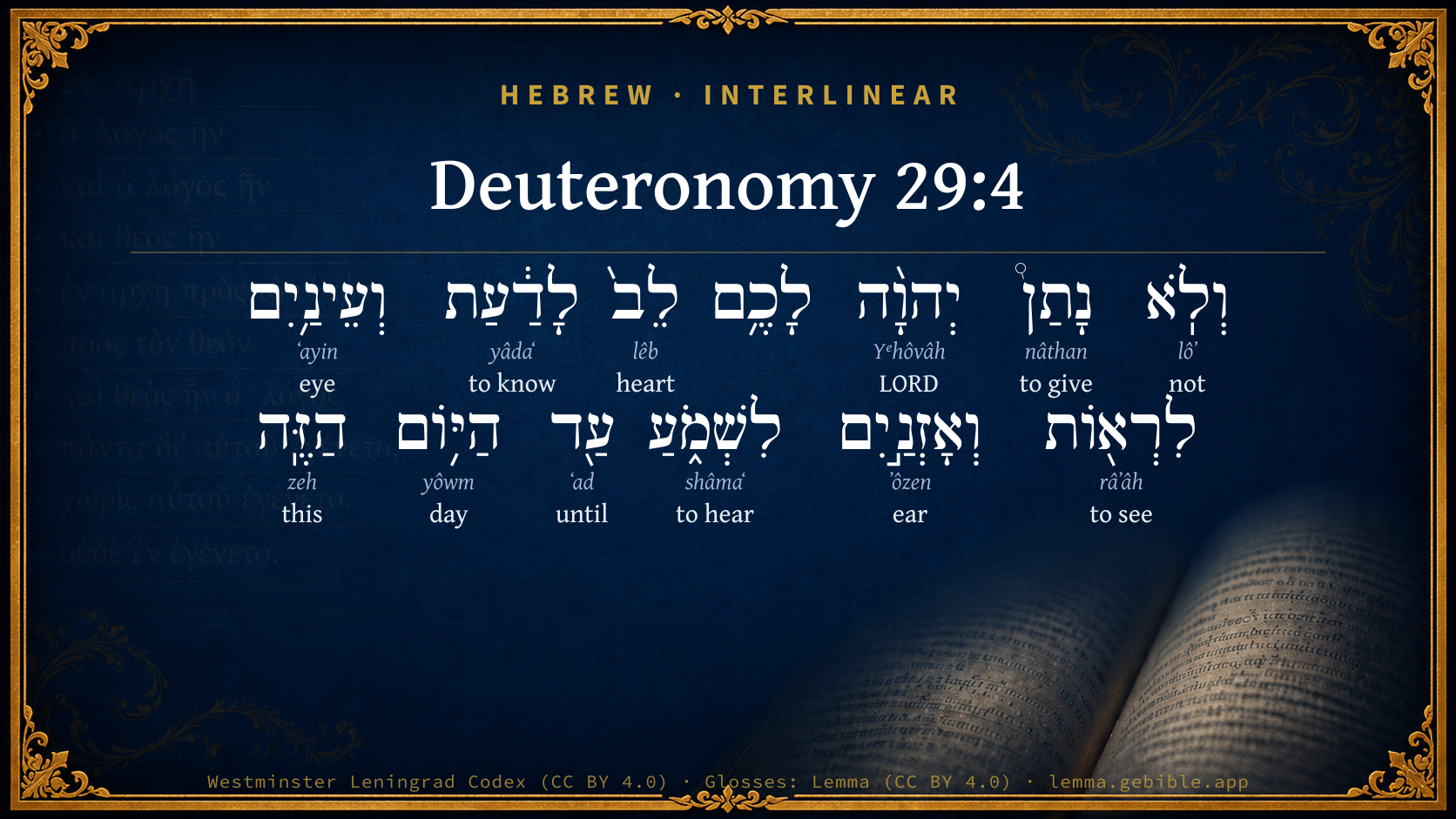
  1. וְלֹֽא lôʼ H3808 “and · not” Conjunction + Particle, Negative
  2. נָתַן֩ nâthan H5414 “to give” Verb, Qal, Perfect, 3rd Person, Masculine, Singular
  3. יְהוָ֨ה Yᵉhôvâh H3068 “LORD” Noun, Proper
  4. לֵב֙ lêb H3820 “heart” Noun, Common, Masculine, Singular, Absolute
  5. לָדַ֔עַת yâdaʻ H3045 “to know” Preposition + Verb, Qal, Infinitive Construct
  6. וְעֵינַ֥יִם ʻayin H5869 “and · eyes” Conjunction + Noun, Common, Both, Dual, Absolute
  7. לִרְא֖וֹת râʼâh H7200 “to see” Preposition + Verb, Qal, Infinitive Construct
  8. לִשְׁמֹ֑עַ shâmaʻ H8085 “to hear” Preposition + Verb, Qal, Infinitive Construct
  9. עַ֖ד ʻad H5704 “until” Preposition
  10. הַיּ֥וֹם yôwm H3117 “the · day” Particle, Definite Article + Noun, Common, Masculine, Singular, Absolute
  11. הַזֶּֽה zeh H2088 “the · this” Particle, Definite Article + Pronoun, Demonstrative, Masculine, Singular

About this verse

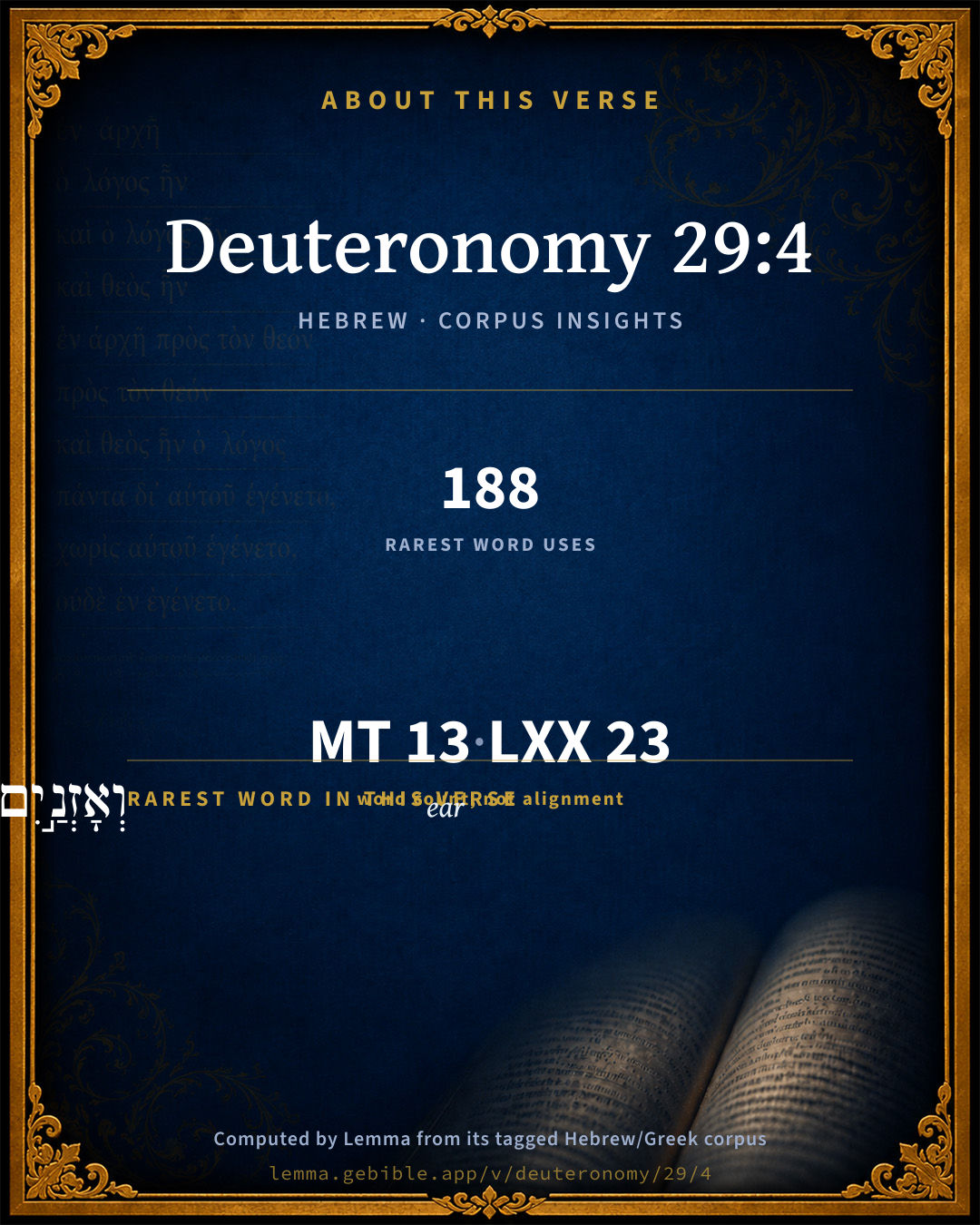
These counts appear in no published source. They are computed here, from the morphology-tagged text and Lemma’s own curated glosses. What Lemma adds →

13
words
12
distinct lemmas
Pentateuch
section

Grammatical profile

  • 4 verbs
  • 5 nouns
  • 1 pronoun
  • 2 prepositions
  • 1 particle

Verb forms

  • נָתַן֩ Qal · Perfect
  • לָדַ֔עַת Qal · Infinitive Construct
  • לִרְא֖וֹת Qal · Infinitive Construct
  • לִשְׁמֹ֑עַ Qal · Infinitive Construct

Hebrew & Septuagint length

In English translation the verse runs 21 words from the Hebrew and 23 from the Septuagint (LXX English) — closely comparable.

A rough comparison of the two English renderings, which tokenize alike — not a word-level alignment.

Word counts can differ between the Hebrew and the Greek without any difference in meaning — e.g. the Hebrew direct-object marker אֵת has no separate Greek word, and Greek often adds the article ὁ.

In the original languages it is 13 Hebrew tokens and 23 Greek tokens — but the two are counted differently (Hebrew bundles its prefixes and suffixes into one token; the Greek is in lemma form), so that isn’t a like-for-like length.

Cross-references

15

Topical passages linked to Deuteronomy 29:4 in the Treasury of Scripture Knowledge — connected by theme and wording, ordered by reader-vote popularity; previews shown in the World English Bible.

  • Isaiah 6:9–10 He said, "Go, and tell this people, 'You hear indeed, But don't understand; And you see indeed, But don't perceive.'
  • Ephesians 4:18 being darkened in their understanding, alienated from the life of God, because of the ignorance that is in them, because of the hardening of their hearts;
  • Proverbs 20:12 The hearing ear, and the seeing eye, Yahweh has made even both of them.
  • John 8:43 Why don't you understand my speech? Because you can't hear my word.
  • Isaiah 63:17 O Yahweh, why do you make us to err from your ways, and harden our heart from your fear? Return for your servants' sake, the tribes of your inheritance.
  • Matthew 13:11–15 He answered them, "To you it is given to know the mysteries of the Kingdom of Heaven, but it is not given to them.
  • Ezekiel 36:26 A new heart also will I give you, and a new spirit will I put within you; and I will take away the stony heart out of your flesh, and I will give you a heart of flesh.
  • Romans 11:7–10 What then? That which Israel seeks for, that he didn't obtain, but the chosen ones obtained it, and the rest were hardened.
  • 2 Corinthians 3:15 But to this day, when Moses is read, a veil lies on their heart.
  • John 12:38–40 that the word of Isaiah the prophet might be fulfilled, which he spoke, "Lord, who has believed our report? To whom has the arm of the Lord been revealed?"
  • Acts 28:26–27 saying, 'Go to this people, and say, In hearing, you will hear, But will in no way understand. In seeing, you will see, But will in no way perceive.
  • 2 Thessalonians 2:10–12 and with all deception of wickedness for those who are being lost, because they didn't receive the love of the truth, that they might be saved.
  • James 1:13–17 Let no man say when he is tempted, "I am tempted by God," for God can't be tempted by evil, and he himself tempts no one.
  • Deuteronomy 2:30 But Sihon king of Heshbon would not let us pass by him; for Yahweh your God hardened his spirit, and made his heart obstinate, that he might deliver him into your hand, as at this day.
  • 2 Timothy 2:25 in gentleness correcting those who oppose him: perhaps God may give them repentance leading to a full knowledge of the truth,

Cross-references courtesy of OpenBible.info (CC BY 4.0).

Hebrew and Greek witnesses Masoretic Hebrew ↔ Greek Septuagint

The same verse in the two great witnesses to the Old Testament, shown verse-for-verse.

These are two independent witnesses, not word-aligned to each other, and the Septuagint is shown in lemma (dictionary) form.

Hebrew Deuteronomy 29:4 Masoretic · Westminster Leningrad Codex

וְלֹֽא נָתַן֩ יְהוָ֨ה לָכֶ֥ם לֵב֙ לָדַ֔עַת וְעֵינַ֥יִם לִרְא֖וֹת וְאָזְנַ֣יִם לִשְׁמֹ֑עַ עַ֖ד הַיּ֥וֹם הַזֶּֽה

but Yahweh has not given you a heart to know, and eyes to see, and ears to hear, to this day.

World English Bible · Public Domain

Greek LXX Deuteronomy 29:4 Septuagint · lemma form

καί ἄγω σύ τεσσαράκοντα ἔτος ἐν ὁ ἔρημος οὐ παλαιόω ὁ ἱμάτιον σύ καί ὁ ὑπόδημα σύ οὐ κατατρίβω ἀπό ὁ πούς σύ

Yet the Lord God has not given you a heart to know, and eyes to see, and ears to hear, until this day.

LXX2012 (modern English Septuagint) · Public Domain

Hebrew: Westminster Leningrad Codex (CC BY 4.0). Greek: Septuagint (public domain); English from LXX2012 (modern English Septuagint) (Public Domain). How the Septuagint differs from the Hebrew →

Targum (Aramaic paraphrase)

2

The Targum is the ancient Jewish Aramaic paraphrase of the Hebrew Scriptures — an interpretive translation, not the Hebrew text itself. Onkelos (literal) and Pseudo-Jonathan (expansive) render the Torah, and Jonathan the Prophets. Coverage is partial: where no permissively-licensed English translation exists for a verse, only the Aramaic is shown. This is verse-level text, not a word-by-word alignment to the Hebrew.

  1. Targum Onkelos Torah (Genesis–Deuteronomy)
    וְדַבָּרִית יָתְכוֹן אַרְבְּעִין שְׁנִין בְּמַדְבְּרָא לָא בְלִיאַת כְּסוּתְכוֹן מִנְכוֹן וּמְסָנָךְ לָא עַדוֹ מֵעַל רַגְלָךְ

    (no public-domain English translation for this verse)

    Targum Onkelos — Aramaic: “Onkelos Genesis” (public domain); “Onkelos Exodus” (public domain); “Onkelos Leviticus” (public domain); “Onkelos Numbers” (public domain); “Onkelos Deuteronomy” (public domain). English: “Sefaria Community Translation” (CC0 1.0 (public-domain dedication)); “J.W. Etheridge. The Targums of Onkelos and Jonathan Ben Uzziel on the Pentateuch. London: Longmans, Green, 1862” (public domain). Text via Sefaria.

  2. Targum Pseudo-Jonathan Torah (Genesis–Deuteronomy)
    וַהֲלִיכִית יַתְכוֹן אַרְבְּעִין שְׁנִין בְּמַדְבְּרָא לָא בָלְמוּ כְסוּתְכוֹן מֵעִילַוֵי גוּשְׁמֵיכוֹן וְסַנְדְלֵיכוֹן לָא אִיטָלְעוּ מֵעִילַוֵי רִיגְלֵיכוֹן

    And I have led you forty years in the wilderness; your garments have not become old upon your bodies, nor your shoes worn away from your feet.

    Targum Pseudo-Jonathan — Aramaic: “Targum Jonathan on Genesis” (public domain); “Targum Jonathan on Exodus” (public domain); “Targum Jonathan on Leviticus” (public domain); “Targum Jonathan on Numbers” (public domain); “Targum Jonathan on Deuteronomy” (public domain). English: “The Targum of Jonathan ben Uzziel, trans. J. W. Etheridge, London, 1862” (public domain). Text via Sefaria.

Commentary

Notes on Deuteronomy 29:4 from classic Christian and Jewish commentators (each source and its license shown beneath its notes). The classic Christian expositions comment on the surrounding passage and are grouped to its opening verse, so a note may address several verses; the Jewish commentaries on the Tanakh (Rashi and others) are per-verse, so they appear only where the commentator wrote on this verse.

Lemma curates 59 commentaries, every one of them public domain or Creative Commons licensed, each selected and text-cleaned for this edition rather than reprinted as found. About our sources →

Trapp's Complete Commentary

John Trapp

Deu 29:4 Yet the LORD hath not given you an heart to perceive, and eyes to see, and ears to hear, unto this day.

Ver. 4. Yet the Lord hath not given you.] Nor is he bound to do, "but on whom he will he showeth mercy, and whom he will he hardeneth," i.e., he softeneth not. Till when, a man stands in the midst of means, as a stake in the midst of streams, unmoveable: yea, the more God forbids a sin, the more he bids for it. {Rom 7:8} {See Trapp on "Mat 13:11"} {See Trapp on "Mat 13:13"} {See Trapp on "Mat 13:14"}

John Trapp, A Commentary or Exposition upon All the Books of the Old and New Testament (1647–1656) — public domain. Text from a community e-Sword module.

The Biblical Illustrator

Joseph S. Exell

Deu_29:4

The Lord hath not given you an heart to perceive.

Men without heart, sight, or hearing

Feeling, sight, hearing! What wonderful things these are! If we could exist without them, what a wretched condition ours would be! The outer world would be unknown to us if the gates of the senses were shut, and the soul would be famished, like Samaria when it was straitly shut up, and there was no going in nor coming out. When any one of the senses is gone it involves great deprivation, and subjects the person enduring it to the pity of his fellows, but if all were absent what wretchedness must ensue! Transfer your thoughts now from these external senses by which we become conscious of the external world to those spiritual senses by which we perceive the spiritual world, the kingdom of heaven, the Lord of that kingdom, and all the powers of the world to come. There is a heart which should be tender, by which we perceive the presence of God and feel His operations, and even behold the Lord Himself, as it is written, Blessed are the pure in heart, for they shall see God. There is a spiritual eye by which the things invisible are discerned; blessed are they to whom the Lord has given to see the things of His kingdom, which to the unrenewed remain hidden in parables. There is a spiritual ear by which we hear the gentle whispers of the Spirit, which frequently come to us internally, without the medium of sounds that can affect the ear. Blessed are those who have the ear which the Lord has purged, and cleansed, and opened, so that it listens to the Divine call But there is no blessedness in the case of men devoid of spiritual feeling, sight, and hearing. Theirs is a miserable plight.

I. We shall think upon a mournful fact. Here was a whole nation, with but very few exceptions, of whom their leader, who knew and loved them best, was obliged to say, The Lord hath not given you a heart to perceive, unto this day.

1. The mournful part of it was, that this was the nation that had been specially favoured of God above all others.

2. Note again, that not only were they a highly favoured people, but they had seen very wonderful acts performed by the Lord Himself.

3. In addition to this, these people had passed through a very remarkable experience.

4. In addition to all this sight and experience, the Israelites had received remarkable instruction.

5. One thing else is worth notice, that these people had been associated with remarkable characters. They were not all blinded, there were a few among them who were gracious, and so were made to perceive. Caleb and Joshua were there, and Aaron and Miriam; but chiefly there was Moses, grandest of men, true father of the nation

II. Let us note the mournful reasons for all this.

1. The reasons for their incapacity to see and perceive lay, first, in the tact that these people never believed in their own blindness. They had no heart to perceive, and they did not perceive their absence of perception; they had no eyes wherewith to detect their own dimness of vision. They were such fools as to dote on their own wisdom, so poor as to think themselves rich, so hypocritical as to profess to be sincere. Pride is the great creator of darkness; like Nahash, the Ammonite, it puts out the right eye. Men seek not the light, because they boast that they are the children of the day and need no light from above.

2. More than this, these men never asked for a heart to perceive, and eyes to see, and ears to hear. No man hath ever asked for these things and been refused; no soul has cried in its blindness and darkness, Open Thou mine eyes, but what a gracious answer has always come. It is the prerogative of the Lord Jesus to open the blind eyes; but this He is ever ready to do whenever men call upon His name. Then, moreover, what little light they did have they resisted. When they were forced to see, it was only for a moment that they would be instructed, and then they shut their eyes again.

III. What was the mournful result of these people being so highly favoured, and yet not seeing their God?

1. The result was, first, that they missed a happy portion, I can hardly imagine how happy the children of Israel might have been. They left Egypt with a high hand and an outstretched arm, their ears were hung with jewels, and their purses were filled with riches, while around them manna dropped from heaven, and cool streams flowed at their side. They might have made a quick march to the promised land, and at once entered their rest, for their God who had sent the hornet before them would soon have driven out their adversaries. They would have known no invading enemy, and felt neither blast, nor blight, nor mildew; in fact, they would have been the happiest nation under heaven: He should have fed them also with the finest of the wheat: and with honey out of the rock should I have satisfied thee. They flung all this on one side: they would not have God, and so they could not have prosperity. They walked contrary to Him, and He walked contrary to them; they would not obey Him, and therefore His anger smoked against them.

2. Think, moreover, what a glorious destiny they threw aside. Had they been equal to the occasion, by Gods grace they might have been a nation of kings and priests, they might have been the Lords missionaries to all lands, the light-bearers to all peoples.

3. Another result was that while they missed so high a position, they went on sinning. As they did not learn the lesson God was teaching them, namely, that He was God, and that to serve Him was their joy and their prosperity, they went from one evil to another, provoking the Lord to jealousy.

4. Hence they frequently suffered. A plague broke out at one time, and a burning at another; at one time they were visited with fever, and anon the earth opened beneath them; one day the Amalekites smote them, another day fiery serpents leaped up from the sand, and they died by thousands, being poisoned by their bites. They suffered much and often, and in all their trials they did but reap what they had sown.

5. At last this evil ended terribly. The Lord lifted His hand to heaven, and swore that the rebellious generation should not enter into His rest, and they began to die by wholesale till Moses cried, We are consumed by Thine anger, and by Thy wrath are we troubled. Not one of the men that came out of Egypt, save only Joshua and Caleb, reached the promised land. (C. H. Spurgeon.)

A perceiving heart the gift of God

To complete the sense of the words, we must have recourse to the two precedent verses; which, being compared to the text, present us with a description of such a brutish temper as is not to be found in any people mentioned throughout the whole Book of God, or any history whatsoever.

I. What is meant by Gods giving to the soul a perceiving heart? We have grace here set out by such acts as are properly acts of knowledge; as understanding, seeing, hearing; not because, as some imagine, grace is placed only in the understanding, which, being informed with such a principle, is able to govern, and practically to determine the will, without the help of any new principle infused into that. For grace is a habit equally placed in both these faculties, but it is expressed by the acts of the understanding:--

1. Because the understanding has the precedency and first stroke in holy actions, as well as in others; it is the head and fountain from whence they derive their goodness, the leading faculty: and therefore the works of all the rest may, by way of eminence, be ascribed to this, as the conquest of an army is ascribed to the leader only, or general.

2. Because the means of grace are chiefly and most frequently expressed by the word truth; 1Ti_1:15, This is a faithful (or a true) saying, that Christ came into the world to save sinners. And in Joh_3:33, He that believeth hath set to his seal that God is true. And in Joh_17:17, Thy Word is truth. From hence, therefore, I collect--

(1) That to understand and receive the Word, according to the letter and notion, by a bare assent to the truth of it, is not to have a heart to perceive nor an ear to hear: because it is evident, both from Scripture and ordinary observation, that such a reception of the means of grace is not always attended with these spiritual effects: as, for instance, the Jews heard Christ and admired Him, but afterwards they rejected His doctrine and crucified His person. To hear the Word of God, and to hear God speaking in His Word, are things vastly different.

(2) Therefore, in the second place, to have a perceiving heart and a hearing ear is to have a spiritual light begot in the mind by an immediate overpowering work of the Spirit, whereby alone the soul is enabled to apprehend the things of God spiritually, and to practise them effectually: and without this we may see and see, and never perceive, and hear again and again and never understand.

II. Whence it is that, without this gift of a perceiving heart, the soul cannot make any improvement of the means of grace. It arises from these two reasons--

1. From its exceeding impotence and inability to apprehend these things.

2. From its contrariety to them. And there are two things in the soul in which this contrariety chiefly consists.

(1) Carnal corruptions.

(2) Carnal wisdom.

III. Although upon Gods denial of a perceiving heart the soul does inevitably remain unprofitable under the means of grace, so as not to hear nor perceive; yet this hardness, or unprofitableness, cannot at all be ascribed to God as the author of it. In order to the clearing of this we know that Gods not giving a heart to perceive may admit of a double acceptation.

1. As it implies only a bare denial of grace.

2. As it does also include a positive act of induration.

IV. How God can justly reprehend men for not hearing nor perceiving, when, upon His denial of a heart, there is a necessity lying upon them to do neither. Now, there can be no just reprehension but for sin, and nothing can be sin but that which is voluntary and free, and how can that be flee for a man to do or not to do which from necessity he cannot do? Application--

1. This doctrine speaks refutation to that opinion that states a sufficiency of grace in the bare proposal of things to be believed and practised, without a new powerful work of the Spirit upon the heart, that may determine and enable it to believe and accept of these things.

2. Is of exhortation; that in the enjoyment of the means of grace we should not terminate in the means, but look up to God, who alone is able to give a heart to improve them. (R. South, D. D.)

Mens blindness in spiritual things

Consider this complaint--

I. As uttered by Moses against the people of his charge. They had seen with their bodily eyes all the wonders that had been wrought for them. They understood not.

1. The true character of that dispensation.

2. The obligations which it entailed upon them.

II. As applicable to ourselves at this day.

1. By the great mass of nominal Christians the nature of the Gospel is very indistinctly seen.

2. The effects of it are very partially experienced. Address--

(1) Those who are altogether blind.

(2) Those who think they see.

(3) Those whose eyes God has opened. (C. Simeon, M. A.)

The Biblical Illustrator, edited by Joseph S. Exell (c. 1880s–1900s) — public domain. Text from a community e-Sword module.

Joseph Benson's Commentary

Deu 29:4. The Lord hath not given you a heart to perceive — Which he would have done had you sincerely and earnestly desired and asked it of him; and you are inexcusable that you have not, considering his signal mercies on the one hand, and awful judgments on the other, of which you have had such great experience, and which called loudly upon you to humble yourselves before him in true repentance, and seek his grace to enable you to understand and improve by such extraordinary dispensations and wonderful works. For he does not speak thus to excuse their wickedness, but to direct them to whom they must have recourse for a good understanding of God’s works; and to intimate that although the hearing ear, and the seeing eye, be the workmanship of God, yet their want of these was their own fault, and the just punishment of their former sins; their present case being like theirs in Isaiah’s time, who first shut their own eyes and ears that they might not see and hear, and would not understand, and then, by the righteous judgment of God, had their eyes and ears closed that they should not see, and hear, and understand. God’s readiness to do us good in other things, is a plain evidence, that if we have not grace, that best of gifts, it is our own fault and not his: he would have gathered us, and we would not.

Joseph Benson's Commentary on the Old and New Testaments (1811–1818) — public domain. Text from a community e-Sword module.

Geneva Bible (1599)

Geneva Bible translators

He showeth that it is not in man’s power to understand the mysteries of God, if it be not given him from above.

Geneva Bible (1599) marginal notes — public domain. Text via Bolls.life.

Adam Clarke's Commentary

Verse 4. The Lord hath not given you a heart, c.] Some critics read this verse interrogatively: And hath not God given you a heart, c.? because they suppose that God could not reprehend them for the non-performance of a duty, when he had neither given them a mind to perceive the obligation of it, nor strength to perform it, had that obligation been known. Though this is strictly just, yet there is no need for the interrogation, as the words only imply that they had not such a heart, &c., not because God had not given them all the means of knowledge, and helps of his grace and Spirit, which were necessary but they had not made a faithful use of their advantages, and therefore they had not that wise, loving, and obedient heart which they otherwise might have had. If they had had such a heart, it would have been God's gift, for he is the author of all good and that they had not such a heart was a proof that they had grieved his Spirit, and abused the grace which he had afforded them to produce that gracious change, the want of which is here deplored. Hence God himself is represented as grieved because they were unchanged and disobedient: "O that there were such a heart in them, that they would fear me, and keep all my commandments always, that it might be well with them and with their children for ever!" See De 5:29, and the note there.

Adam Clarke's Commentary on the Bible (1810–1826) — public domain. Text from a community e-Sword/MySword module.

Ellicott's Commentary for English Readers

(4) Yet the Lord hath not given you an heart to perceive.—“To mark the mercies of the Holy One, blessed be He! and to cleave unto Him” (Rashi). And so in Psa_106:7, “Our fathers understood not Thy wonders in Egypt; they remembered not the multitude of Thy mercies.” (See also on Deu_31:16, &c.)

A Bible Commentary for English Readers, edited by Charles John Ellicott (1878–1897) — public domain. Text from a community e-Sword module.

The Cambridge Bible for Schools and Colleges

gen. ed. J. J. S. Perowne

4. an heart to know] The heart the seat of the practical understanding; ‘not the seat of the affections, but the mind itself, the intellectual faculty of the soul’ (Calvin), yet always in a moral aspect; see on Deu_4:39, Deu_6:6. Eyes and ears, figures here of the spiritual senses, cp. Jer_5:21.

In form the connection with the preceding v. is difficult to trace, but the substance is clear. The deeds in which the Divine revelation consists are of no avail without the inward power to recognise and appreciate them, which is also, equally with them, of the gift of God; ‘Men are ever blind even in the brightest light, until they have been enlightened of God’ (Calvin). The speaker is made to express the truth in this negative way in order to emphasise to the people the urgent need of their at last, after so much neglect, awakening to the meaning of Jehovah’s Providence. The awkwardness of the construction is due to the effort to express both the grace of God and the responsibility of man.

The Cambridge Bible for Schools and Colleges (gen. ed. J. J. S. Perowne; Cambridge University Press, 1878–1918) — public domain. Text from a community e-Sword module.

John Gill's Exposition

Yet the Lord hath not given you an heart to perceive,.... They had some of them seen the above miracles with their bodily eyes, but had not discerned with the eyes of their understanding the power of God displayed in them, the goodness of God to them on whose behalf they were wrought, in order to obtain their deliverance, and the vengeance of God on the Egyptians for detaining them; so Jarchi interprets it of an heart to know the mercies of the Lord, and to cleave unto him:

and eyes to see, and ears to hear, unto this day; to see and observe the gracious dealings of God with them, and to hearken to his voice and obey it: so the understanding heart, the seeing eye, and hearing ear, in things spiritual, are from the Lord, are special gifts of his grace, which he bestows on some, and not on others; see Pro 20:12. The Targum of Jonathan is,"the Word of the Lord did not give you an heart, &c.''

John Gill's Exposition of the Whole Bible (1746–1763) — public domain (CC PDM 1.0). Text via the HelloAO Bible API.

Albert Barnes' Notes on the Bible

Ability to understand the things of God is the gift of God (compare 1Co 2:13-14); yet man is not guiltless if he lacks that ability. The people had it not because they had not felt their want of it, nor asked for it. Compare 2Co 3:14-15.

Albert Barnes' Notes on the Bible (1834–1885) — public domain. Text from a community e-Sword/MySword module.

Haydock's Catholic Bible Commentary

Hath not given you, &c. Through your own fault, and because you resisted his grace. (Challoner) --- If they had not been guilty, Moses would never have made them this reproach. "But he shews that they could not understand or obey without God’s assistance,....and yet if....it be wanting, si adjutorium Dei desit, the vice of man is not on that account, deserving of excuse, since the judgments of God are just, though they be hidden." (St. Augustine, q. 50.) --- Others explain it thus: Hitherto you have not been able to discern the designs of God in your regard: but now, being on the point of crossing the Jordan, to take possession of the land which God had promised to your fathers, you ought to place an unbounded confidence in him. Others read with an interrogation, which entirely removes the evil interpretation of the wicked, who pretend that God requires impossibilities. "Hath not the Lord?" &c. (Calmet) --- God sometimes delivers over to a reprobate sense, and to their own will. (Theodoret, q. 37.) (Worthington)

George Leo Haydock (1774–1849), Haydock's Catholic Family Bible and Commentary, 1859 edition — public domain. Excludes Psalms (Douay-Rheims chapter numbering differs from Protestant) and Deuterocanonical books (Catholic canon only).

Matthew Poole's English Annotations

This verse comes in by way of correction or exception to the foregoing clause in this manner, I said indeed, Ye have seen, &c., Deu 29:2, and thine eyes have seen, &c., but I must recall my words, for in truth you have not seen them; in seeing you have not seen, and perceiving you have not perceived them: you have perceived and seen them with the eyes of your body, but not with your minds and hearts; you have not seen them to any purpose; you have not yet learned rightly to understand the word and works of God, so as to know them for your good, and to make a right use of them, and to comply with them; which he expresseth thus,

the Lord hath not given you, & c., not to excuse their wickedness, but partly to direct them what course to take, and to whom they must have recourse for the amending of their former errors, and for a good understanding and improvement of God’s works; and partly to aggravate their sin, and to intimate that although the hearing ear, and the seeing eye, and the understanding heart, be the workmanship of God, Pro 20:12, and the effects of his special grace, Deu 30:6; Jer 31:33; 32:39, &c., yet their want of this grace was their own fault, and the just punishment of their former sins; their present case being like theirs in Isaiah’s time, who first shut their eyes and ears that they might not see and hear, and would not understand, and then by the tremendous, but righteous judgment of God, had their hearts made fat, and their eyes and ears closed, that they should not be able to see, and hear, and understand, as is manifest from the history of their carriage in the wilderness.

Matthew Poole's English Annotations on the Holy Bible (1683–1685) — public domain. Text from a community e-Sword/MySword module.

Whedon's Commentary on the Bible

Daniel D. Whedon

4. A heart to perceive — Their disobedience had rendered them incapable of perceiving their true relations to Jehovah their God. Comp. Isa_6:9; Mat_13:15, and Joh_12:37-40.

Daniel D. Whedon (gen. ed.), Commentary on the Old and New Testaments (1874–1909) — public domain. Text from a community e-Sword module.

The Pulpit Commentary

The Lord hath not given you a heart to perceive, etc. Moses says this "not to excuse their wickedness, but partly to direct them what course to take, and to whom they must have recourse for the amending of their former errors, and for a good understanding and improvement of God"s works; and partly to aggravate their sin, and to intimate that, although the hearing ear and the seeing eye and the understanding heart are the workmanship of God, (Pro_20:12) and the effects of his special grace (Deu_30:6; Jer_31:33 Jer_32:39, etc.) yet their want of this grace was their own fault and the just punishment of their former sins" (Poole). As they would not attend to God"s word, as they had shut their eyes and their ears, that they might not see, or hear, or learn what God was teaching them by his conduct towards them, they had been left to themselves; and, as a necessary consequence, they had become as persons who had no eyes to see, or ears to hear, or heart to perceive what was set before them for their learning.

The Pulpit Commentary (1880–1919), ed. H.D.M. Spence-Jones & Joseph S. Exell — public domain. Text from a community e-Sword module.

John Wesley's Explanatory Notes

Yet the Lord - That is, you have perceived and seen them with the eyes of your body, but not with your minds and hearts; you have not yet learned rightly to understand the word and works of God, so as to know them for your good, and to make a right use of them, and to comply with them: which he expresseth thus, the Lord hath not given you, &c. not to excuse their wickedness, but to direct them to whom they must have recourse for a good understanding of God's works; and to intimate that although the hearing ear, and the seeing eye, be the workmanship of God, yet their want of his grace was their own fault, and the just punishment of their former sins; their present case being like theirs in Isaiah's time, who first shut their own eyes and ears that they might not see and hear, and would not understand, and then by the righteous judgment of God, had their eyes and ears closed that they should not see and hear, and understand. God's readiness to do us good in other things, is a plain evidence, that if we have not grace, that best of gifts, 'tis our own fault and not his: he would have gathered us, and we would not.

John Wesley, Explanatory Notes Upon the Whole Bible (1754–1765) — public domain. Text via the GEBible commentary corpus.

Lesson kit

Teaching starters — assembled from the data on this page, not authored interpretation. Every prompt links to the verse data it draws on. Edit before teaching.

Deuteronomy, in the Pentateuch, opens this verse with 13 words (12 distinct Hebrew lemmas). Its most distinctive word is ʼôzen (“ear”). A historical commentator’s framing appears above. Read the whole chapter for the surrounding context.

Discussion questions

  1. How does “ear” (ʼôzen) shape what this verse is saying?
  2. Isaiah 6:9–10 shares this passage’s theme. How do the two illuminate each other?
  3. These translations render this verse differently; the difference is in the English rendering, not the original. What questions does that raise?
  4. The verb «נָתַן֩» is Qal Perfect. How does its form color the action?
  5. Reading how Trapp's Complete Commentary and The Biblical Illustrator read this verse, where do the two commentators agree and where do they part?

Things to notice

Reading settings

Reading text

Shown beneath each verse's original-language words.

Old Testament
Old Testament edition

Read the OT as the Masoretic Hebrew (MT) or the Greek Septuagint (LXX).

English shown for the Greek Septuagint (in the Hebrew ↔ Greek comparison).

Comparing translations? Open the Compare panel on any verse page to stack up to four side by side.