
Deuteronomy 31:28

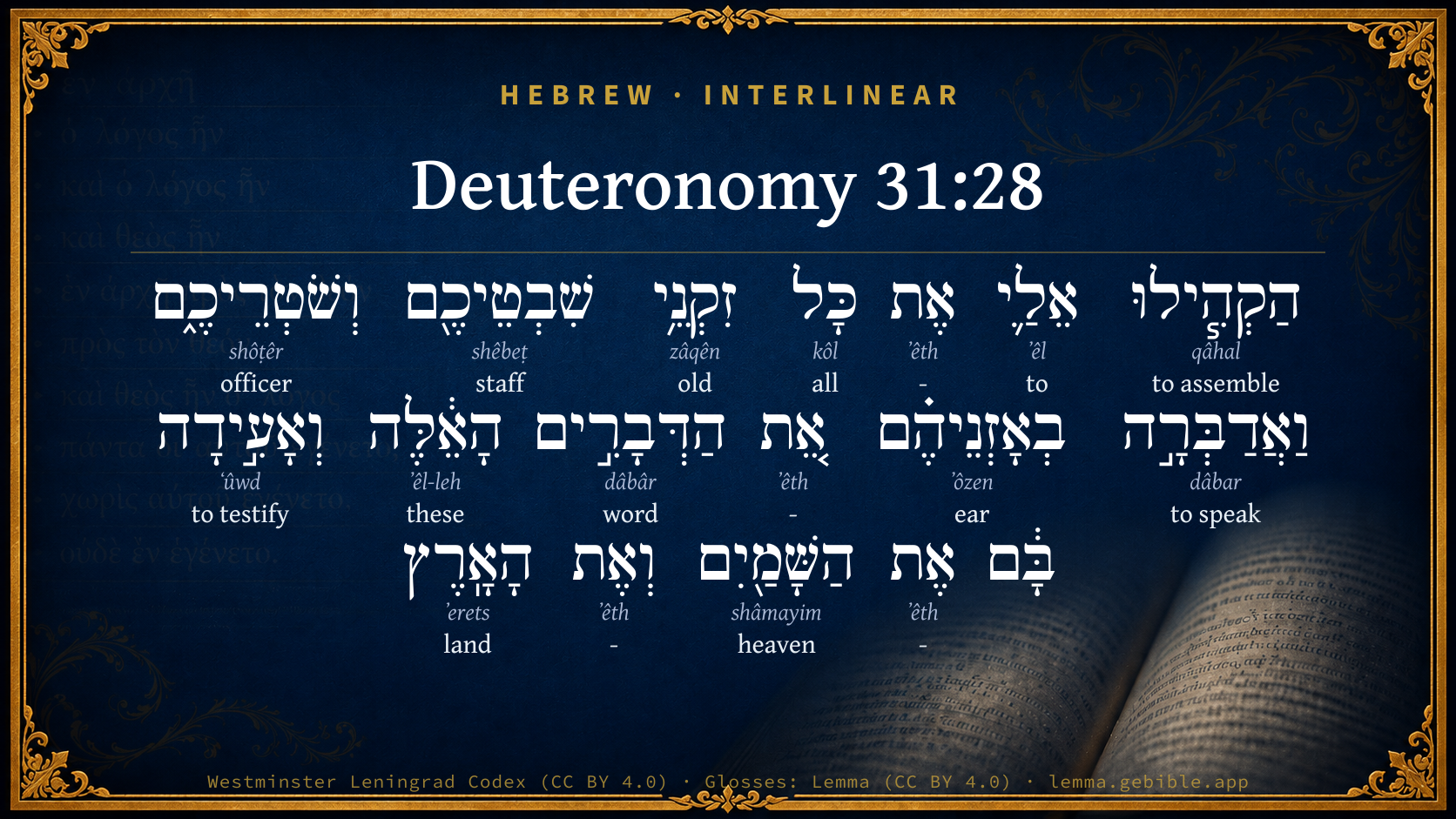
Hebrew (Westminster Leningrad Codex) Deuteronomy 31:28 appears in the Hebrew Old Testament. The text above is from the Westminster Leningrad Codex. Each word links to its Strong’s number, a concise gloss, and parsing drawn from the Open Scriptures Hebrew Bible morphology. Click any word for its full Brown-Driver-Briggs (BDB) entry.
Download image
Cite this verse

Deuteronomy 31:28 (World English Bible). Public Domain. Lemma interlinear Bible study tool, https://lemma.gebible.app/v/deuteronomy/31/28.

Show BibTeX & RIS
BibTeX
RIS
English Translation
Assemble to me all the elders of your tribes, and your officers, that I may speak these words in their ears, and call heaven and earth to witness against them.
World English Bible · Public Domain
Download a study sheet

One document with this verse’s original text, its word-by-word gloss line, the meaning frame, cross-references with their text, attributed commentary, and full source and license credits — printable, and it pastes into notes with its structure intact.

This verse Autodidact and up

Study sheet (.html) Plain text (.txt)

A passage Seminary Student

Up to 50 verses in one chapter. A passage sheet keeps up to 6 commentary sources and 12 cross-references per verse, in the order this page ranks them, and says so on the sheet whenever that leaves anything out. Ask for a single verse and you get the Autodidact verse sheet above.

Everything on this page stays free to read, with no account — the sheet is a download of what is already on screen, not access to it.

Want to remove ads? Support Godless Engineer
Compare translations 3

The same verse in 3 English versions, stacked beneath the original-language interlinear above. Click any original word for its lexicon entry.

Each is an independent rendering of the whole verse — the interlinear is not word-aligned to these translations.

Highlighted words mark where these versions differ — a whole-verse word diff, not a word-by-word alignment.

  • World English Bible Public Domain
    Assemble to me all the elders of your tribes, and your officers, that I may speak these words in their ears, and call heaven and earth to witness against them.
  • King James Version Public Domain
    Gather unto me all the elders of your tribes, and your officers, that I may speak these words in their ears, and call heaven and earth to record against them.
  • unfoldingWord Literal Text CC BY-SA 4.0
    Assemble to me all the elders of your tribes and your officers and let me speak these words in their ears and call the heavens and the earth to witness against them.

unfoldingWord Literal Text — © unfoldingWord, licensed CC BY-SA 4.0. Word-aligned USFM3 via Door43 (git.door43.org/unfoldingWord/en_ult).

Versions to compare (up to 4)

3 of 4 selected

Show all 18 translations

Every available English version of this verse, each an independent rendering of the whole verse.

  • World English Bible Public Domain
    Assemble to me all the elders of your tribes, and your officers, that I may speak these words in their ears, and call heaven and earth to witness against them.
  • Berean Standard Bible Public Domain
    Assemble before me all the elders of your tribes and all your officers so that I may speak these words in their hearing and call heaven and earth to witness against them.
  • Majority Standard Bible Public Domain
    Assemble before me all the elders of your tribes and all your officers so that I may speak these words in their hearing and call heaven and earth to witness against them.
  • King James Version Public Domain
    Gather unto me all the elders of your tribes, and your officers, that I may speak these words in their ears, and call heaven and earth to record against them.
  • American Standard Version (1901) Public Domain
    Assemble unto me all the elders of your tribes, and your officers, that I may speak these words in their ears, and call heaven and earth to witness against them.
  • Revised Version (1885) Public Domain
    Assemble unto me all the elders of your tribes, and your officers, that I may speak these words in their ears, and call heaven and earth to witness against them.
  • Geneva Bible (1599) Public Domain
    Gather vnto me all the Elders of your tribes, and your officers, that I may speake these wordes in their audience, and call heauen and earth to recorde against them.
  • Douay-Rheims (1899) Public Domain
    Gather unto me all the ancients of your tribes, and your doctors, and I will speak these words in their hearing, and will call heaven and earth to witness against them.
  • Young's Literal Translation Public Domain
    `Assemble unto me all the elders of your tribes, and your authorities, and I speak in their ears these words, and cause to testify against them the heavens and the earth,
  • Literal Standard Version CC BY-SA 4.0
    Assemble to me all the elderly of your tribes, and your authorities, and I speak these words in their ears, and cause the heavens and the earth to testify against them,
  • Unlocked Literal Bible CC BY-SA 4.0
    Assemble to me all the elders of your tribes, and your officers, so that I may speak these words in their ears and call heaven and earth to witness against them.
  • unfoldingWord Literal Text CC BY-SA 4.0
    Assemble to me all the elders of your tribes and your officers and let me speak these words in their ears and call the heavens and the earth to witness against them.
  • Darby Bible Public Domain
    Gather to me all the elders of your tribes, and your officers, that I may speak these words in their ears, and take heaven and earth to witness against them.
  • World Messianic Bible Public Domain
    Assemble to me all the elders of your tribes and your officers, that I may speak these words in their ears, and call heaven and earth to witness against them.
  • Webster's Bible Public Domain
    Assemble to me all the elders of your tribes, and your officers, that I may speak these words in their ears, and call heaven and earth to record against them.
  • Free Bible Version CC BY-SA 4.0
    Summon all the elders of your tribes and all your officers to gather here before me so that I can tell them this directly and call on heaven and earth as witnesses against them.
  • Bible in Basic English Public Domain
    Get together before me all those who are in authority in your tribes, and your overseers, so that I may say these things in their hearing, and make heaven and earth my witnesses against them.
  • JPS Tanakh (1917) Public Domain
    Assemble unto me all the elders of your tribes, and your officers, that I may speak these words in their ears, and call heaven and earth to witness against them.

Literal Standard Version (2020), Covenant Press — licensed CC BY-SA 4.0. Text via the HelloAO Bible API (eBible.org). Unlocked Literal Bible (unfoldingWord) — licensed CC BY-SA 4.0. Text via the HelloAO Bible API (eBible.org). unfoldingWord Literal Text — © unfoldingWord, licensed CC BY-SA 4.0. Word-aligned USFM3 via Door43 (git.door43.org/unfoldingWord/en_ult). Free Bible Version, Dr. Jonathan Gallagher — licensed CC BY-SA 4.0. Text via the HelloAO Bible API (eBible.org).

Word by word

More ways to search: Search by grammar → Find every occurrence → Compare this word →

Practice this passage: Drill this verse → Learn its vocabulary →

וְשֹׁטְרֵיכֶ֑ם
shôṭêr
H7860
“and · officer · you”
Conjunction + Verb, Qal, Participle Active, Masculine, Plural, Construct + Suffix, Personal, 2nd Person, Masculine, Plural
Part of Speech
Conjunction + Verb
Stem
Qal
Form
Participle Active
Gender
Masculine
Number
Plural
State
Construct
Full BDB Definition

Origin: act part of an otherwise unused root probably meaning to write

TWOT: TWOT - 2374a

(Qal) official, officer
  1. הַקְהִ֧ילוּ qâhal H6950 “assemble” Verb, Hiphil, Imperative, 2nd Person, Masculine, Plural
  2. אֵלַ֛י ʼêl H413 “to · me” Preposition + Suffix, Personal, 1st Person, Common, Singular
  3. אֶת ʼêth H853 “-” Particle, Direct Object
  4. כָּל kôl H3605 “all of” Noun, Common, Masculine, Singular, Construct
  5. זִקְנֵ֥י zâqên H2205 “old of” Adjective, Adjective, Masculine, Plural, Construct
  6. שִׁבְטֵיכֶ֖ם shêbeṭ H7626 “staffs · your” Noun, Common, Masculine, Plural, Construct + Suffix, Personal, 2nd Person, Masculine, Plural
  7. וַאֲדַבְּרָ֣ה dâbar H1696 “and · to speak” Conjunction + Verb, Piel, Cohortative, 1st Person, Common, Singular
  8. בְאָזְנֵיהֶ֗ם ʼôzen H241 “in/at · ears · their” Preposition + Noun, Common, Feminine, Dual, Construct + Suffix, Personal, 3rd Person, Masculine, Plural
  9. אֵ֚ת ʼêth H853 “-” Particle, Direct Object
  10. הַדְּבָרִ֣ים dâbâr H1697 “the · words” Particle, Definite Article + Noun, Common, Masculine, Plural, Absolute
  11. הָאֵ֔לֶּה ʼêl-leh H428 “the · these” Particle, Definite Article + Pronoun, Demonstrative, Common, Plural
  12. וְאָעִ֣ידָה ʻûwd H5749 “and · to testify” Conjunction + Verb, Hiphil, Cohortative, 1st Person, Common, Singular
  13. אֶת ʼêth H853 “-” Particle, Direct Object
  14. הַשָּׁמַ֖יִם shâmayim H8064 “the · heaven(s)” Particle, Definite Article + Noun, Common, Masculine, Plural, Absolute
  15. וְאֶת ʼêth H853 “and · -” Conjunction + Particle, Direct Object
  16. הָאָֽרֶץ ʼerets H776 “the · land” Particle, Definite Article + Noun, Common, Both, Singular, Absolute

About this verse

These counts appear in no published source. They are computed here, from the morphology-tagged text and Lemma’s own curated glosses. What Lemma adds →

18
words
14
distinct lemmas
Pentateuch
section

Notable vocabulary

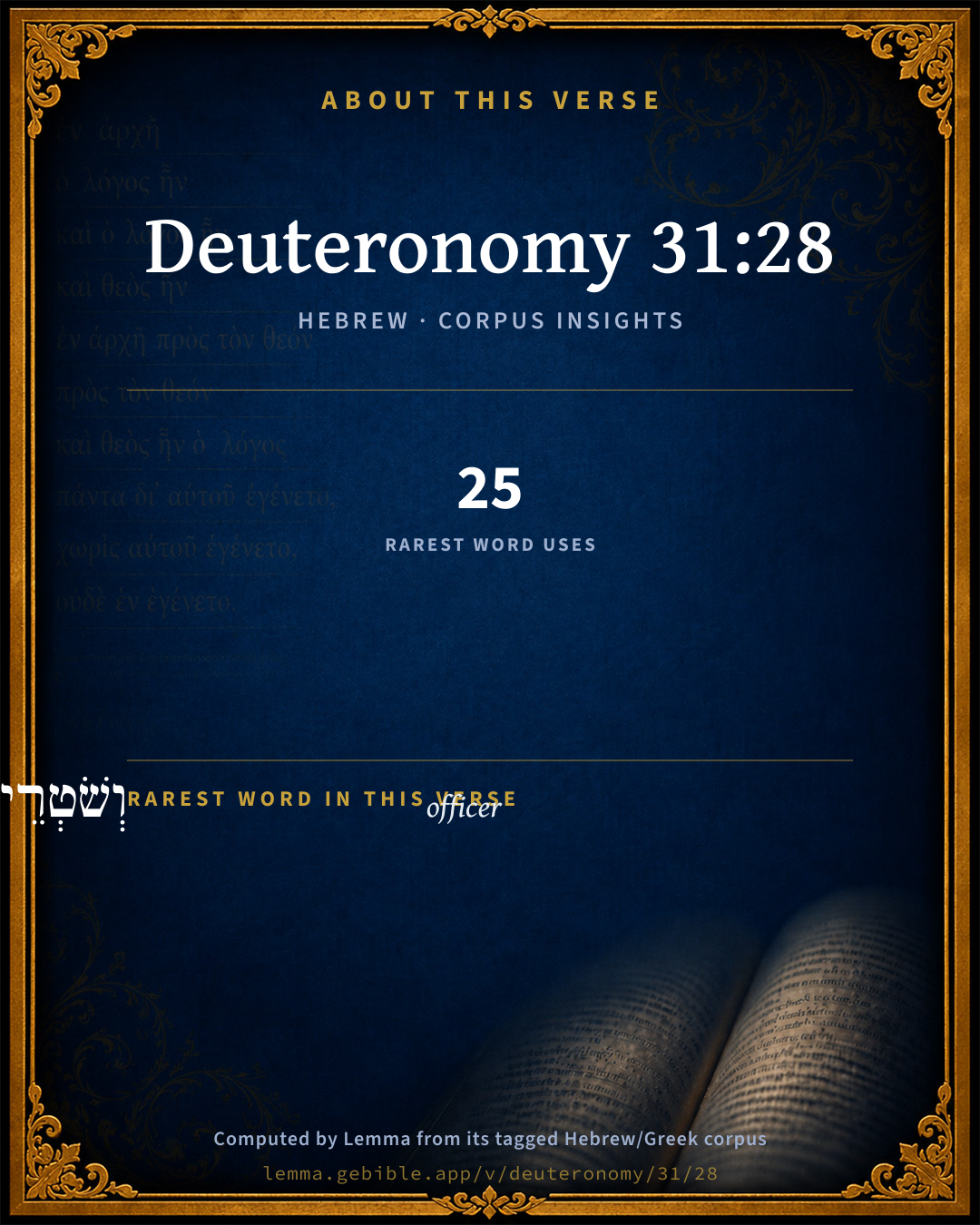
The rarest word here is וְשֹׁטְרֵיכֶ֑ם officer H7860 — appearing just 25 times in the whole Hebrew Bible.

Shared distinctive vocabulary

וְשֹׁטְרֵיכֶ֑ם officer H7860 occurs in 25 verses of the Hebrew Bible. Also found in:

Grammatical profile

  • 4 verbs
  • 6 nouns
  • 1 adjective
  • 1 pronoun
  • 2 prepositions
  • 4 particles

Verb forms

  • הַקְהִ֧ילוּ Hiphil · Imperative
  • וְשֹׁטְרֵיכֶ֑ם Qal · Participle Active
  • וַאֲדַבְּרָ֣ה Piel · Cohortative
  • וְאָעִ֣ידָה Hiphil · Cohortative

Hebrew & Septuagint length

In English translation the verse runs 30 words from the Hebrew and 39 from the Septuagint (LXX English) — closely comparable.

A rough comparison of the two English renderings, which tokenize alike — not a word-level alignment.

Word counts can differ between the Hebrew and the Greek without any difference in meaning — e.g. the Hebrew direct-object marker אֵת has no separate Greek word, and Greek often adds the article ὁ.

Cross-references

10

Topical passages linked to Deuteronomy 31:28 in the Treasury of Scripture Knowledge — connected by theme and wording, ordered by reader-vote popularity; previews shown in the World English Bible.

  • Deuteronomy 4:26 I call heaven and earth to witness against you this day, that you shall soon utterly perish from off the land whereunto you go over the Jordan to possess it; you shall not prolong your days on it, but shall utterly be destroyed.
  • Deuteronomy 32:1 Give ear, you heavens, and I will speak; Let the earth hear the words of my mouth.
  • Deuteronomy 30:19 I call heaven and earth to witness against you this day, that I have set before you life and death, the blessing and the curse: therefore choose life, that you may live, you and your seed;
  • Luke 19:40 He answered them, "I tell you that if these were silent, the stones would cry out."
  • Genesis 49:1–2 Jacob called to his sons, and said: "Gather yourselves together, that I may tell you that which will happen to you in the days to come.
  • Numbers 11:16–17 Yahweh said to Moses, Gather to me seventy men of the elders of Israel, whom you know to be the elders of the people, and officers over them; and bring them to the tent of meeting, that they may stand there with you.
  • Deuteronomy 29:10 You stand this day all of you before Yahweh your God; your heads, your tribes, your elders, and your officers, even all the men of Israel,
  • Deuteronomy 31:12 Assemble the people, the men and the women and the little ones, and your foreigner who is within your gates, that they may hear, and that they may learn, and fear Yahweh your God, and observe to do all the words of this law;
  • Isaiah 1:2 Hear, heavens, And listen, earth; for Yahweh has spoken: I have nourished and brought up children, And they have rebelled against me.
  • Exodus 18:25 Moses chose able men out of all Israel, and made them heads over the people, rulers of thousands, rulers of hundreds, rulers of fifties, and rulers of tens.

Cross-references courtesy of OpenBible.info (CC BY 4.0).

Hebrew and Greek witnesses Masoretic Hebrew ↔ Greek Septuagint

The same verse in the two great witnesses to the Old Testament, shown verse-for-verse.

These are two independent witnesses, not word-aligned to each other, and the Septuagint is shown in lemma (dictionary) form.

Hebrew Deuteronomy 31:28 Masoretic · Westminster Leningrad Codex

הַקְהִ֧ילוּ אֵלַ֛י אֶת כָּל זִקְנֵ֥י שִׁבְטֵיכֶ֖ם וְשֹׁטְרֵיכֶ֑ם וַאֲדַבְּרָ֣ה בְאָזְנֵיהֶ֗ם אֵ֚ת הַדְּבָרִ֣ים הָאֵ֔לֶּה וְאָעִ֣ידָה בָּ֔ם אֶת הַשָּׁמַ֖יִם וְאֶת הָאָֽרֶץ

Assemble to me all the elders of your tribes, and your officers, that I may speak these words in their ears, and call heaven and earth to witness against them.

World English Bible · Public Domain

Greek LXX Deuteronomy 31:28 Septuagint · lemma form

ἐκκλησιάζω πρός ἐγώ ὁ φύλαρχος σύ καί ὁ πρεσβύτερος σύ καί ὁ κριτής σύ καί ὁ σύ ἵνα λαλέω εἰς ὁ οὖς αὐτός πᾶς ὁ λόγος οὗτος καί διαμαρτύρομαι αὐτός ὁ τε οὐρανός καί ὁ γῆ

Gather together to me the heads of your tribes, and your elders, and your judges, and your officers, that I may speak in their ears all these words; and I call both heaven and earth to witness against them.

LXX2012 (modern English Septuagint) · Public Domain

On this verse, The Cambridge Bible for Schools and Colleges discusses the Septuagint’s reading. Read the note in Commentary ↓

Hebrew: Westminster Leningrad Codex (CC BY 4.0). Greek: Septuagint (public domain); English from LXX2012 (modern English Septuagint) (Public Domain). How the Septuagint differs from the Hebrew →

Targum (Aramaic paraphrase)

2

The Targum is the ancient Jewish Aramaic paraphrase of the Hebrew Scriptures — an interpretive translation, not the Hebrew text itself. Onkelos (literal) and Pseudo-Jonathan (expansive) render the Torah, and Jonathan the Prophets. Coverage is partial: where no permissively-licensed English translation exists for a verse, only the Aramaic is shown. This is verse-level text, not a word-by-word alignment to the Hebrew.

  1. Targum Onkelos Torah (Genesis–Deuteronomy)
    כְּנִישׁוּ לְוָתִי יָת כָּל סָבֵי שִׁבְטֵיכוֹן וְסָרְכֵיכוֹן וֶאֱמַלֵל קֳדָמֵיהוֹן יָת פִּתְגָמַיָא הָאִלֵין וְאַסְהֵד בְּהוֹן יָת שְׁמַיָא וְיָת אַרְעָא

    (no public-domain English translation for this verse)

    Targum Onkelos — Aramaic: “Onkelos Genesis” (public domain); “Onkelos Exodus” (public domain); “Onkelos Leviticus” (public domain); “Onkelos Numbers” (public domain); “Onkelos Deuteronomy” (public domain). English: “Sefaria Community Translation” (CC0 1.0 (public-domain dedication)); “J.W. Etheridge. The Targums of Onkelos and Jonathan Ben Uzziel on the Pentateuch. London: Longmans, Green, 1862” (public domain). Text via Sefaria.

  2. Targum Pseudo-Jonathan Torah (Genesis–Deuteronomy)
    כְּנוּשׁוּ לְוָותִי יַת כָּל חַכִּימֵי שִׁבְטֵיכוֹן וְסַרְכֵיכוֹן וַאֲמַלֵיל בְּמִשְׁמְעֵהוֹן יַת כָּל פִּתְגָמַיָא הָאִילֵין וְאַסְהִיד בְּהוֹן יַת שְׁמַיָא וְיַת אַרְעָא

    Gather together to me all the sages of your tribes and your officers, and I will speak all these words in their hearing, and will call heaven and earth to bear witness against them.

    Targum Pseudo-Jonathan — Aramaic: “Targum Jonathan on Genesis” (public domain); “Targum Jonathan on Exodus” (public domain); “Targum Jonathan on Leviticus” (public domain); “Targum Jonathan on Numbers” (public domain); “Targum Jonathan on Deuteronomy” (public domain). English: “The Targum of Jonathan ben Uzziel, trans. J. W. Etheridge, London, 1862” (public domain). Text via Sefaria.

Commentary

Notes on Deuteronomy 31:28 from classic Christian and Jewish commentators (each source and its license shown beneath its notes). The classic Christian expositions comment on the surrounding passage and are grouped to its opening verse, so a note may address several verses; the Jewish commentaries on the Tanakh (Rashi and others) are per-verse, so they appear only where the commentator wrote on this verse.

Lemma curates 59 commentaries, every one of them public domain or Creative Commons licensed, each selected and text-cleaned for this edition rather than reprinted as found. About our sources →

Joseph Benson's Commentary

Deu 31:28-30. Gather unto me all the elders — It is probable that Moses, having spoken to the people what he was commanded, dismissed them again till he should write the following song; which having done, he summoned the elders (and people, Deu 31:30) to deliver to them from his own mouth what he had written. Moses spake in the ears of all the congregation — Pronounced himself, with an audible voice, to the representatives of the congregation, and afterward ordered to be repeated to the people of every tribe, the following song or hymn.

Joseph Benson's Commentary on the Old and New Testaments (1811–1818) — public domain. Text from a community e-Sword module.

Geneva Bible (1599)

Geneva Bible translators

As governors, judges and magistrates.

Geneva Bible (1599) marginal notes — public domain. Text via Bolls.life.

The Cambridge Bible for Schools and Colleges

gen. ed. J. J. S. Perowne

28. Assemble] Imperative Pl. See on Deu_31:12, and Deu_5:22.

elders of your tribes, etc.] LXX heads of your tribes, adding and your judges, and some LXX codd. also add elders. Cp. Deu_5:23, Deu_29:10 (9).

these words] Though this phrase usually refers to what precedes, it is more probable that here what follows, i.e. the Song, is meant, as indubitably is the case in Exo_20:1.

The Cambridge Bible for Schools and Colleges (gen. ed. J. J. S. Perowne; Cambridge University Press, 1878–1918) — public domain. Text from a community e-Sword module.

John Gill's Exposition

For I know that after my death,.... Which was just at hand, some time after that, not immediately; this he knew by a spirit of prophecy, namely, what follows:

ye will utterly corrupt yourselves; their ways, works, and manners, and so themselves; corrupt the worship of God by making idols, and serving them, which is the corruption chiefly intended:

and turn aside from the way which I have commanded you: from the way of the commandments of God, which Moses had given them in his name, and in which they were directed to walk; but, as here foretold, would wander and swerve from them as they did:

and evil will befall you in the latter days; not only in the times of the judges, and in the time of the Babylonish captivity, but in their present captivity, as they call it; which shows that the following song has things in it which respect times at a great distance, and even the present ones, and yet to come:

because ye will do evil in the sight of the Lord, to provoke him to anger through the work of your hands; their idols, idolatry being the evil chiefly designed, which is of all things the most provoking of the Lord.

John Gill's Exposition of the Whole Bible (1746–1763) — public domain (CC PDM 1.0). Text via the HelloAO Bible API.

Whedon's Commentary on the Bible

Daniel D. Whedon

28. Gather unto me all the elders — Moses now, after handing over the book of the law, directs that the elders of the tribes and all in official position be gathered around him. A general assembly representing the entire nation now come together to listen to the unequalled ode which bears the name of the Song of Moses.

Daniel D. Whedon (gen. ed.), Commentary on the Old and New Testaments (1874–1909) — public domain. Text from a community e-Sword module.

The Pulpit Commentary

Call heaven and earth to record against them. (cf. Deu_32:1) These words; the words of his charge, and especially the song he had composed, and which it would be the business of these officers to teach to the congregation.

The Pulpit Commentary (1880–1919), ed. H.D.M. Spence-Jones & Joseph S. Exell — public domain. Text from a community e-Sword module.

Keil & Delitzsch

C. F. Keil & F. Delitzsch

Directly after handing over the book of the law, Moses directed the elders of all the tribes, together with the official persons, to gather round him, that he might rehearse to them the ode which he had written fore the people. The summons, "gather unto me," was addressed to the persons to whom he had given the book of the law. The elders and officers, as the civil authorities of the congregation, were collected together by him to hear the ode, because they were to put it in the mouth of the people, i.e., to take care that all the nation should learn it. The words, "I will call heaven and earth as witnesses against you," refer to the substance of the ode about to be rehearsed, which begins with an appeal to the heaven and the earth (Deu 32:1). The reason assigned for this in Deu 31:29 is a brief summary of what the Lord had said to Moses in Deu 31:16-21, and Moses thought it necessary to communicate to the representatives of the nation. "The work of your hands" refers to the idols (vid., Deu 4:28).

Keil & Delitzsch — Biblical Commentary on the Old Testament (1861–1891) — public domain (CC PDM 1.0). Text via the HelloAO Bible API. (Old Testament only.)

Rashi

Rabbi Shlomo Yitzchaki (Rashi)

הקהילו אלי ASSEMBLE UNTO ME [ALL THE ELDERS OF YOUR TRIBE] — They did not, however, blow the trumpets that day to call the congregation together (as is prescribed in Numbers 10:3), because it states (Numbers 10:2) “Make for thee [two trumpets of silver]” (which Rashi explains to mean that no one should use them except himself), and he had not empowered Joshua to use them. Indeed they were hidden away even during his (Moses) lifetime — on the day of his death, thus fulfilling the words of the text, (Ecclesiastes 8:8) “There is no authority on the day of death” (cf. Midrash Tanchuma, Vayechi 2 on ויחי and ‎Midrash Tanchuma, Beha'alotcha 10 on בהעלתך).‎

ואעידה בם את השמים ואת הארץ I WILL CALL THE HEAVEN AND THE EARTH AS WITNESSES AGAINST THEM — But if you ask, “Behold he has already above (Deuteronomy 30:19) called heaven and earth as witnesses: “I call [the heaven and the earth] as witnesses this day against you etc.”?! Then I reply: There he said this to the Israelites (he told them that He would do this), but now he intends to say (Deuteronomy 32:1) “Give ear, O ye heavens, [and I will speak; and hear earth] etc.”, thus calling them as witnesses.

Rashi on the Tanakh — English translations: “The Judaica Press complete Tanach with Rashi, translated by A. J. Rosenberg” (CC BY 4.0); “Pentateuch with Rashi's commentary by M. Rosenbaum and A.M. Silbermann, 1929-1934” (public domain); “The Metsudah Tanach series, Lakewood, N.J” (CC BY 4.0); and “The Book of Joshua, Metsudah Publications, 1997” (CC BY 4.0). Text via Sefaria.

Lesson kit

Teaching starters — assembled from the data on this page, not authored interpretation. Every prompt links to the verse data it draws on. Edit before teaching.

Deuteronomy, in the Pentateuch, opens this verse with 18 words (14 distinct Hebrew lemmas). Its most distinctive word is shôṭêr (“officer”). A historical commentator’s framing appears above. Read the whole chapter for the surrounding context.

Discussion questions

  1. The word shôṭêr carries the sense “officer.” How does it shape the verse?
  2. How does Exodus 5:6, which shares the word «officer», read alongside this verse?
  3. The translations on this page render this verse differently — a whole-verse word diff, not a word-by-word alignment. What might account for the different wordings?
  4. «הַקְהִ֧ילוּ» is a Hiphil Imperative verb. How does that grammatical form shape the action described?
  5. Compare how Joseph Benson's Commentary and Geneva Bible (1599) read this verse. Where do they agree or differ?

Things to notice

Reading settings

Reading text

Shown beneath each verse's original-language words.

Old Testament
Old Testament edition

Read the OT as the Masoretic Hebrew (MT) or the Greek Septuagint (LXX).

English shown for the Greek Septuagint (in the Hebrew ↔ Greek comparison).

Comparing translations? Open the Compare panel on any verse page to stack up to four side by side.