1 Chronicles 17:20

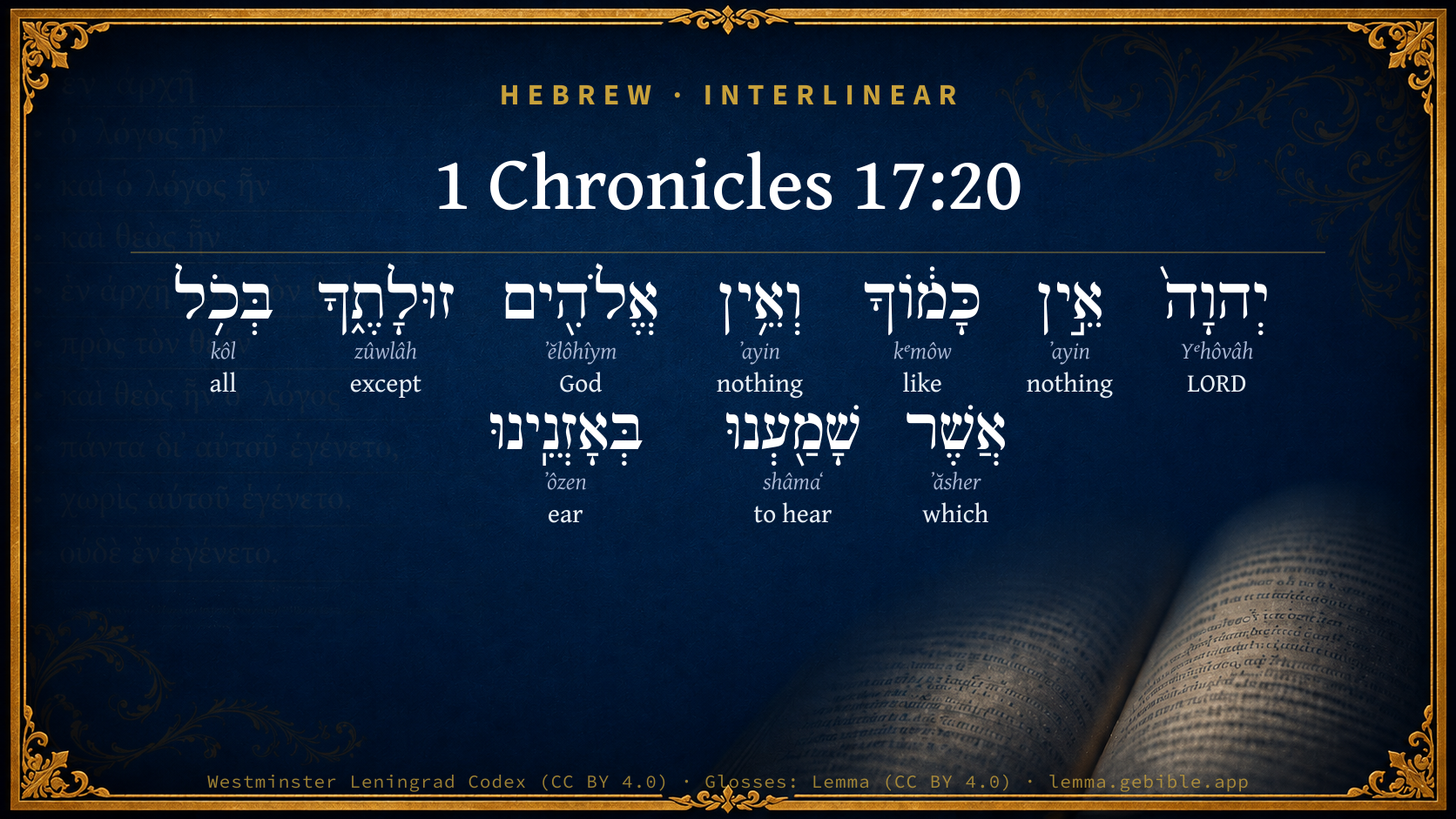
Hebrew (Westminster Leningrad Codex) 1 Chronicles 17:20 appears in the Hebrew Old Testament. The text above is from the Westminster Leningrad Codex. Each word links to its Strong’s number, a concise gloss, and parsing drawn from the Open Scriptures Hebrew Bible morphology. Click any word for its full Brown-Driver-Briggs (BDB) entry.
Download image
Cite this verse

1 Chronicles 17:20 (World English Bible). Public Domain. Lemma interlinear Bible study tool, https://lemma.gebible.app/v/1-chronicles/17/20.

Show BibTeX & RIS
BibTeX
RIS
English Translation
Yahweh, there is none like you, neither is there any God besides you, according to all that we have heard with our ears.
World English Bible · Public Domain
Download a study sheet

One document with this verse’s original text, its word-by-word gloss line, the meaning frame, cross-references with their text, attributed commentary, and full source and license credits — printable, and it pastes into notes with its structure intact.

This verse Autodidact and up

Study sheet (.html) Plain text (.txt)

A passage Seminary Student

Up to 50 verses in one chapter. A passage sheet keeps up to 6 commentary sources and 12 cross-references per verse, in the order this page ranks them, and says so on the sheet whenever that leaves anything out. Ask for a single verse and you get the Autodidact verse sheet above.

Everything on this page stays free to read, with no account — the sheet is a download of what is already on screen, not access to it.

Want to remove ads? Support Godless Engineer
Compare translations 3

The same verse in 3 English versions, stacked beneath the original-language interlinear above. Click any original word for its lexicon entry.

Each is an independent rendering of the whole verse — the interlinear is not word-aligned to these translations.

Highlighted words mark where these versions differ — a whole-verse word diff, not a word-by-word alignment.

  • World English Bible Public Domain
    Yahweh, there is none like you, neither is there any God besides you, according to all that we have heard with our ears.
  • King James Version Public Domain
    O LORD, there is none like thee, neither is there any God beside thee, according to all that we have heard with our ears.
  • unfoldingWord Literal Text CC BY-SA 4.0
    Yahweh, none like you and no God except you, in all that we have heard with our ears.

unfoldingWord Literal Text — © unfoldingWord, licensed CC BY-SA 4.0. Word-aligned USFM3 via Door43 (git.door43.org/unfoldingWord/en_ult).

Versions to compare (up to 4)

3 of 4 selected

Show all 18 translations

Every available English version of this verse, each an independent rendering of the whole verse.

  • World English Bible Public Domain
    Yahweh, there is none like you, neither is there any God besides you, according to all that we have heard with our ears.
  • Berean Standard Bible Public Domain
    O LORD, there is none like You, and there is no God but You, according to everything we have heard with our own ears.
  • Majority Standard Bible Public Domain
    O LORD, there is none like You, and there is no God but You, according to everything we have heard with our own ears.
  • King James Version Public Domain
    O LORD, there is none like thee, neither is there any God beside thee, according to all that we have heard with our ears.
  • American Standard Version (1901) Public Domain
    O Jehovah, there is none like thee, neither is there any God besides thee, according to all that we have heard with our ears.
  • Revised Version (1885) Public Domain
    O LORD, there is none like thee, neither is there any God beside thee, according to all that we have heard with our ears.
  • Geneva Bible (1599) Public Domain
    Lord, there is none like thee, neither is there any God besides thee, according to all that we haue heard with our eares.
  • Douay-Rheims (1899) Public Domain
    O Lord there is none like thee: and there is no other God beside thee, of all whom we have heard of with our ears.
  • Young's Literal Translation Public Domain
    O Jehovah, there is none like Thee, and there is no god save Thee, according to all that we have heard with our ears.
  • Literal Standard Version CC BY-SA 4.0
    O YHWH, there is none like You, and there is no god except You, according to all that we have heard with our ears.
  • Unlocked Literal Bible CC BY-SA 4.0
    Yahweh, there is none like you, and there is no God besides you, just as we have always heard.
  • unfoldingWord Literal Text CC BY-SA 4.0
    Yahweh, none like you and no God except you, in all that we have heard with our ears.
  • Darby Bible Public Domain
    Jehovah, there is none like thee, neither is there any God beside thee, according to all that we have heard with our ears.
  • World Messianic Bible Public Domain
    LORD, there is no one like you, neither is there any God besides you, according to all that we have heard with our ears.
  • Webster's Bible Public Domain
    O LORD, there is none like thee, neither is there any God besides thee, according to all that we have heard with our ears.
  • Free Bible Version CC BY-SA 4.0
    Lord, there really is no one like you; there is no other God, only you. We have never heard about anyone else.
  • Bible in Basic English Public Domain
    O Lord, there is no one like you, and no other God but you, as is clear from everything which has come to our ears.
  • JPS Tanakh (1917) Public Domain
    O LORD, there is none like Thee, neither is there any God beside Thee, according to all that we have heard with our ears.

Literal Standard Version (2020), Covenant Press — licensed CC BY-SA 4.0. Text via the HelloAO Bible API (eBible.org). Unlocked Literal Bible (unfoldingWord) — licensed CC BY-SA 4.0. Text via the HelloAO Bible API (eBible.org). unfoldingWord Literal Text — © unfoldingWord, licensed CC BY-SA 4.0. Word-aligned USFM3 via Door43 (git.door43.org/unfoldingWord/en_ult). Free Bible Version, Dr. Jonathan Gallagher — licensed CC BY-SA 4.0. Text via the HelloAO Bible API (eBible.org).

Word by word

More ways to search: Search by grammar → Find every occurrence → Compare this word →

Practice this passage: Drill this verse → Learn its vocabulary →

זוּלָתֶ֑ךָ
zûwlâh
H2108
“except · you”
Preposition + Suffix, Personal, 2nd Person, Masculine, Singular
Part of Speech
Preposition
Full BDB Definition

Origin: from H2107

TWOT: 537a

a removal, a putting away (noun feminine) - except, besides, with the exception of, with removal of (preposition) - except that (conjunction)
  1. יְהוָה֙ Yᵉhôvâh H3068 “LORD” Noun, Proper
  2. אֵ֣ין ʼayin H369 “nothing” Particle, Negative
  3. כָּמ֔וֹךָ kᵉmôw H3644 “like · you” Preposition + Suffix, Personal, 2nd Person, Masculine, Singular
  4. וְאֵ֥ין ʼayin H369 “and · nothing” Conjunction + Particle, Negative
  5. אֱלֹהִ֖ים ʼĕlôhîym H430 “God(s)” Noun, Common, Masculine, Plural, Absolute
  6. בְּכֹ֥ל kôl H3605 “in/at · all” Preposition + Noun, Common, Masculine, Singular, Absolute
  7. אֲשֶׁר ʼăsher H834 “which” Particle, Relative
  8. שָׁמַ֖עְנוּ shâmaʻ H8085 “to hear” Verb, Qal, Perfect, 1st Person, Common, Plural
  9. בְּאָזְנֵֽינוּ ʼôzen H241 “in/at · ears · our” Preposition + Noun, Common, Feminine, Dual, Construct + Suffix, Personal, 1st Person, Common, Plural

About this verse

These counts appear in no published source. They are computed here, from the morphology-tagged text and Lemma’s own curated glosses. What Lemma adds →

10
words
9
distinct lemmas
Historical
section

Notable vocabulary

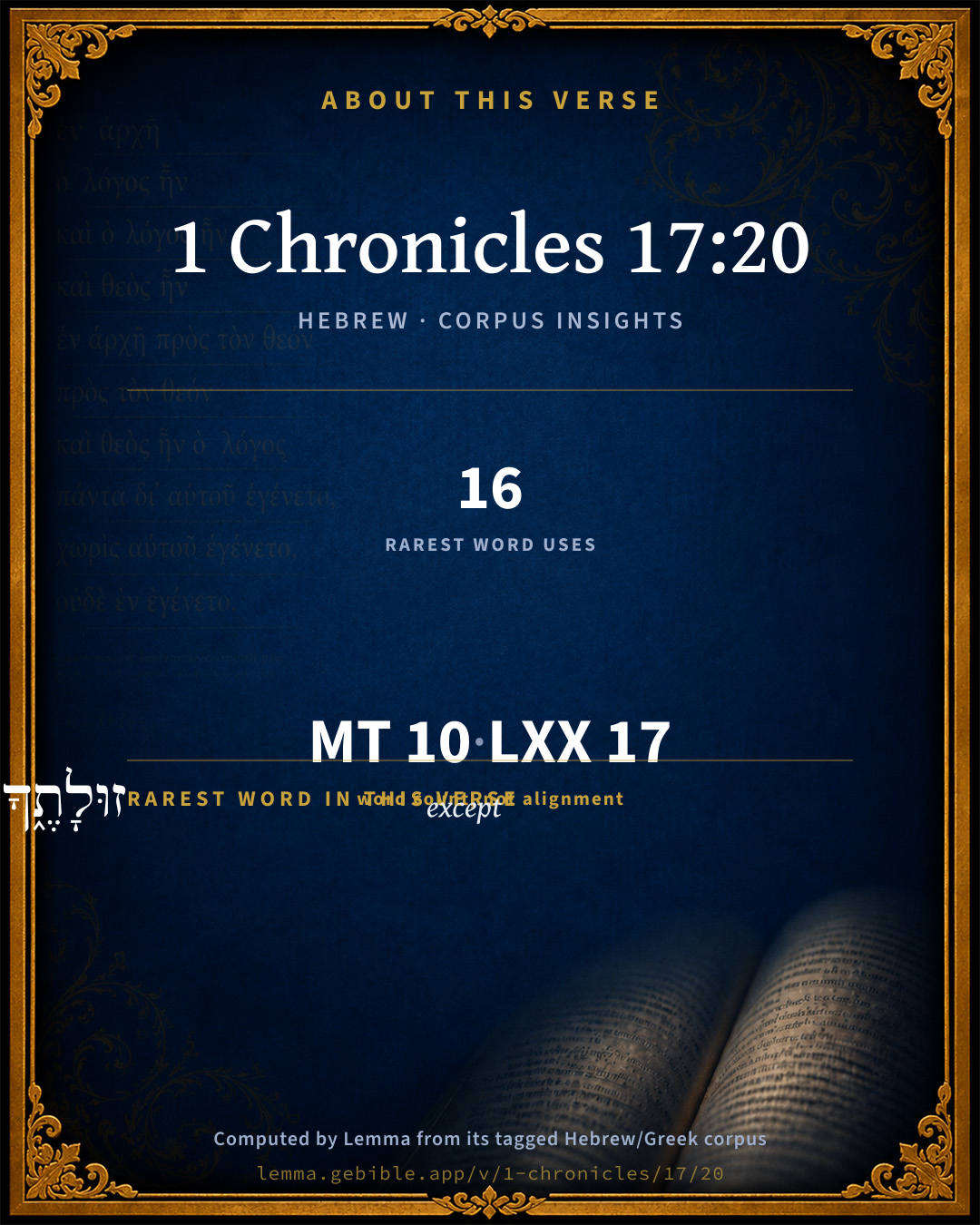
The rarest word here is זוּלָתֶ֑ךָ except H2108 — appearing just 16 times in the whole Hebrew Bible.

Shared distinctive vocabulary

זוּלָתֶ֑ךָ except H2108 occurs in 16 verses of the Hebrew Bible. Also found in:

Grammatical profile

  • 1 verb
  • 4 nouns
  • 2 prepositions
  • 3 particles

Verb forms

  • שָׁמַ֖עְנוּ Qal · Perfect

Repetition

A word recurs within this verse — often emphatic in Hebrew:

  • אֵ֣ין nothing H369 ×2

Hebrew & Septuagint length

In English translation the verse runs 23 words from the Hebrew and 25 from the Septuagint (LXX English) — closely comparable.

A rough comparison of the two English renderings, which tokenize alike — not a word-level alignment.

Word counts can differ between the Hebrew and the Greek without any difference in meaning — e.g. the Hebrew direct-object marker אֵת has no separate Greek word, and Greek often adds the article ὁ.

In the original languages it is 10 Hebrew tokens and 17 Greek tokens — but the two are counted differently (Hebrew bundles its prefixes and suffixes into one token; the Greek is in lemma form), so that isn’t a like-for-like length.

Cross-references

21

Topical passages linked to 1 Chronicles 17:20 in the Treasury of Scripture Knowledge — connected by theme and wording, ordered by reader-vote popularity; previews shown in the World English Bible.

  • Isaiah 44:6 Thus says Yahweh, the King of Israel, and his Redeemer, Yahweh of Hosts: I am the first, and I am the last; and besides me there is no God.
  • Exodus 15:11 Who is like you, Yahweh, among the gods? Who is like you, glorious in holiness, Fearful in praises, doing wonders?
  • Jeremiah 10:6–7 There is none like you, Yahweh; you are great, and your name is great in might.
  • Ephesians 3:20 Now to him who is able to do exceedingly abundantly above all that we ask or think, according to the power that works in us,
  • Deuteronomy 3:24 Lord Yahweh, you have begun to show your servant your greatness, and your strong hand: for what god is there in heaven or in earth, that can do according to your works, and according to your mighty acts?
  • Deuteronomy 4:39 Know therefore this day, and lay it to your heart, that Yahweh he is God in heaven above and on the earth beneath; there is none else.
  • Deuteronomy 33:26 There is none like God, Jeshurun, Who rides on the heavens for your help, In his excellency on the skies.
  • 1 Samuel 2:2 There is none holy as Yahweh; For there is none besides you, Neither is there any rock like our God.
  • Psalms 78:3–4 Which we have heard and known, And our fathers have told us.
  • Psalms 86:8 There is no one like you among the gods, Lord, Nor any deeds like your deeds.
  • Psalms 89:6 For who in the skies can be compared to Yahweh? Who among the sons of the heavenly beings is like Yahweh,
  • Psalms 89:8 Yahweh, God of hosts, who is a mighty one, like you? Yah, your faithfulness is around you.
  • Isaiah 43:10 You are my witnesses, says Yahweh, and my servant whom I have chosen; that you may know and believe me, and understand that I am he: before me there was no God formed, neither shall there be after me.
  • Isaiah 45:5 I am Yahweh, and there is none else; besides me there is no God. I will gird you, though you have not known me;
  • Isaiah 45:22 Look to me, and be you saved, all the ends of the earth; for I am God, and there is none else.
  • Isaiah 63:12 who caused his glorious arm to go at the right hand of Moses? who divided the waters before them, to make himself an everlasting name?
  • Exodus 18:11 Now I know that Yahweh is greater than all gods because of the thing in which they dealt arrogantly against them."
  • Deuteronomy 4:35 To you it was shown, that you might know that Yahweh he is God; there is none else besides him.
  • Psalms 44:1 We have heard with our ears, God; Our fathers have told us, What work you did in their days, In the days of old.
  • Isaiah 40:18 To whom then will you liken God? or what likeness will you compare to him?
  • Isaiah 40:25 To whom then will you liken me, that I should be equal [to him]? says the Holy One.

Cross-references courtesy of OpenBible.info (CC BY 4.0).

Hebrew and Greek witnesses Masoretic Hebrew ↔ Greek Septuagint

The same verse in the two great witnesses to the Old Testament, shown verse-for-verse.

These are two independent witnesses, not word-aligned to each other, and the Septuagint is shown in lemma (dictionary) form.

Hebrew 1 Chronicles 17:20 Masoretic · Westminster Leningrad Codex

יְהוָה֙ אֵ֣ין כָּמ֔וֹךָ וְאֵ֥ין אֱלֹהִ֖ים זוּלָתֶ֑ךָ בְּכֹ֥ל אֲשֶׁר שָׁמַ֖עְנוּ בְּאָזְנֵֽינוּ

Yahweh, there is none like you, neither is there any God besides you, according to all that we have heard with our ears.

World English Bible · Public Domain

Greek LXX 1 Chronicles 17:20 Septuagint · lemma form

κύριος οὐ εἰμί ὅμοιος σύ καί οὐ εἰμί πλήν σύ κατά πᾶς ὅσος ἀκούω ἐν οὖς ἐγώ

O Lord, there is none like you, and there is no God beside you, according to all things which we have heard with our ears.

LXX2012 (modern English Septuagint) · Public Domain

Hebrew: Westminster Leningrad Codex (CC BY 4.0). Greek: Septuagint (public domain); English from LXX2012 (modern English Septuagint) (Public Domain). How the Septuagint differs from the Hebrew →

Commentary

Notes on 1 Chronicles 17:20 from classic Christian and Jewish commentators (each source and its license shown beneath its notes). The classic Christian expositions comment on the surrounding passage and are grouped to its opening verse, so a note may address several verses; the Jewish commentaries on the Tanakh (Rashi and others) are per-verse, so they appear only where the commentator wrote on this verse.

Lemma curates 59 commentaries, every one of them public domain or Creative Commons licensed, each selected and text-cleaned for this edition rather than reprinted as found. About our sources →

Ellicott's Commentary for English Readers

(20) One or two words are omitted. (See 2Sa_7:22 : “Wherefore thou art great, O Lord God, for there is none,” &c. Comp. Isa_46:9; Isa_45:18; Isa_45:5-6, &c.; Deu_33:26; and for the end of the verse, Psa_44:1; Exo_10:2; Deu_4:9.)

A Bible Commentary for English Readers, edited by Charles John Ellicott (1878–1897) — public domain. Text from a community e-Sword module.

The Pulpit Commentary

Vers. 20-22.

God incomparable.

Surrounded as they were by idolatrous nations, it was natural that the Israelites should often draw comparisons between their own God, and the God of the whole earth, on the one hand, and the so-called gods of the heathen on the other. The most important contrast would be in character; for, whilst the idolatrous peoples worshipped gods who were the impersonation of cruelty, caprice, and lust, Jehovah was worshipped as a holy, a righteous, a merciful Lord and Ruler. Yet there was another contrast that between the powerlessness of the idols of the nations, and the might and wisdom of the true and living God. In Psalm 115. this contrast is wrought out with vigour and irony.

I THERE IS NONE LIKE GOD IN HIS BEING. All creatures, as their name implies, are fashioned by a superior power, and upheld in life by him in whom they "live and move and have their being." The Lord is the self-existing Being, who is from eternity to eternity.

II THERE IS NONE LIKE GOD IN HIS ATTRIBUTES. All our qualities of mind are derived from him, and, so far as they are excellent, they are gleams of his brightness. Human virtues are the growth of a Divine seed. But in Jehovah all perfections meet and harmonize.

III THERE IS NONE LIKE GOD IN HIS PROVIDENCE. This seems especially to have impressed the mind of the king, when he poured forth his adoring thanksgiving before the Lord. The recollection of God"s goodness and faithfulness, not only to himself and his household, but also to the nation of Israel, awakened his grateful and admiring praises. And we too have these reasons in abundance to prompt our thanksgivings and confidence.

II THERE IS NONE LIKE GOD IN MERCY AND LOVINGKINDNESS. These are attributes of God; but they are attributes called into exercise by our state and position as sinners in the sight of the Searcher of hearts, the righteous Judge and King. In this passage David acknowledges that God redeemed his people Israel, made them his own, became their God. How gloriously are these expressions justified in the dispensation of the gospel, of God"s infinite love towards our race in the gift. and the effective mediation of his dear Son! Let these reflections

(1) awaken our gratitude to him who has made himself known to us, and who, though incomparable and alone, deigns to communicate in grace and compassion with us; and

(2) prompt us to testify to his adorable excellence, and to summon our brethren, the children of men, to put their trust under the shadow of his wings. T.

Vers. 20, 21.

The uniqueness of the Divine dealings.

David saw plainly a troth which seems equally plain to us from the records given in the Scriptures, that God"s ways of dealing with the nation of Israel had been throughout singular, unique, and surprisingly gracious. A few illustrative instances from the history may be given. But this is precisely the impression which each one of us receives upon a review of our own lives. The Divine dealings with us seem, in the preciseness of their adaptations, and the tenderness of their grace, quite unique; and it seems, to the sincere heart, that nobody can sing just such a thankful, happy song as he can. Now on earth, and much more yonder, we shall adore that special grace which is so manifest in our individual lives.

I DIVINE DEALINGS ARE ALWAYS THE SAME. "Very much is made in these days of the uniformity and absolute working of law in the physical spheres. But we can more than match the truth by our teachings respecting the uniformity and the absolute working of law in the moral and spiritual spheres. Sin always carries its consequences. Personal influences on others can be as strictly assured as laws of nature. St. Paul boldly affirms that "whatsoever a man soweth, that shall he also reap." The forces God brings to bear on men are always the same. There is but one gospel for man"s redemption. Nobody can come to God save by the way of penitence and faith and prayer. The truth may be applied to the minutest conditions and circumstances of life. There is nothing new in the circumstances, and God will deal with us in them exactly as he dealt with our fathers. Because of this uniformity of Divine dealings in the moral spheres, we can use the experiences of the fathers, and be warned, encouraged, or taught by the records left of their life-histories and the Divine dealings with them. No right-minded man would ever wish any deviation from either the eternal principles or practices for his sake. He would rather just be in the Divine order, within the conditions and provision of the infinitely wise and infinitely good Divine law. We require to press this point, because fanaticism has often assumed that God steps aside of his laws to deal in special ways with favoured individuals. There is a sense in which Divine dealings are special, but it is of the utmost importance that we gain first hold, and firm hold, of the truth that God"s ways are orderly and regular, fixed and unalterable, because settled in the infinite Divine wisdom. It may be necessary here to deal with the idea of a miracle. It may be said, "Does not God work miracles? And has he not worked them for individuals?" We are coming more clearly to see that a miracle is not a contravention of law, but only a modification of the workings together of law, made apprehensible by man. Thus God"s law of the vintage is that vines bear grapes, Man"s apprehension of the law is that vines bear grapes in so many months. Christ"s miracle shows us that man"s time-law is no essential part of the law; the vintage may come in what man calls a moment. Christ"s miracles contravened no laws, if the laws be relieved of man"s additions to them.

II DIVINE DEALINGS BECOME UNIQUE BY ADAPTATION TO THE INDIVIDUAL. We must never conceive of law as if it were working distinct from the Lawgiver. It is not like an "act of parliament," which is passed, and then set free to its work. Law, in its proper sense, is the condition on which the Lawgiver acts. And God acts as a Father, with special knowledge and care of each individual, and due adjustment of law to each case I am individual to myself; individual and unique. And I may hold the confidence that God will deal with me just as if no other being lived. The uniformity of moral law has this sublime qualification, "The Lord knoweth them that are his. R.T.

The Pulpit Commentary (1880–1919), ed. H.D.M. Spence-Jones & Joseph S. Exell — public domain. Text from a community e-Sword module.

Rashi

Rabbi Shlomo Yitzchaki (Rashi)

O Lord, there is none like You Perhaps you will say that there is none as great as He, but there is one slightly smaller than He. Therefore. it says: “... and there is no god besides You.”

there is none like You, and there is no god besides You even among the nations.

according to all that we have heard with our ears all our days.

Rashi on the Tanakh — English translations: “The Judaica Press complete Tanach with Rashi, translated by A. J. Rosenberg” (CC BY 4.0); “Pentateuch with Rashi's commentary by M. Rosenbaum and A.M. Silbermann, 1929-1934” (public domain); “The Metsudah Tanach series, Lakewood, N.J” (CC BY 4.0); and “The Book of Joshua, Metsudah Publications, 1997” (CC BY 4.0). Text via Sefaria.

Lesson kit

Teaching starters — assembled from the data on this page, not authored interpretation. Every prompt links to the verse data it draws on. Edit before teaching.

1 Chronicles, in the Historical, opens this verse with 10 words (9 distinct Hebrew lemmas). Its most distinctive word is zûwlâh (“except”). A historical commentator’s framing appears above. Read the whole chapter for the surrounding context.

Discussion questions

  1. How does “except” (zûwlâh) shape what this verse is saying?
  2. How does Deuteronomy 1:36, which shares the word «except», read alongside this verse?
  3. What does the repetition of “nothing” (2× in this one verse) do in this verse?
  4. These translations render this verse differently; the difference is in the English rendering, not the original. What questions does that raise?
  5. «שָׁמַ֖עְנוּ» is a Qal Perfect verb. How does that grammatical form shape the action described?
  6. Compare how Ellicott's Commentary for English Readers and The Pulpit Commentary read this verse. Where do they agree or differ?

Things to notice

Reading settings

Reading text

Shown beneath each verse's original-language words.

Old Testament
Old Testament edition

Read the OT as the Masoretic Hebrew (MT) or the Greek Septuagint (LXX).

English shown for the Greek Septuagint (in the Hebrew ↔ Greek comparison).

Comparing translations? Open the Compare panel on any verse page to stack up to four side by side.