
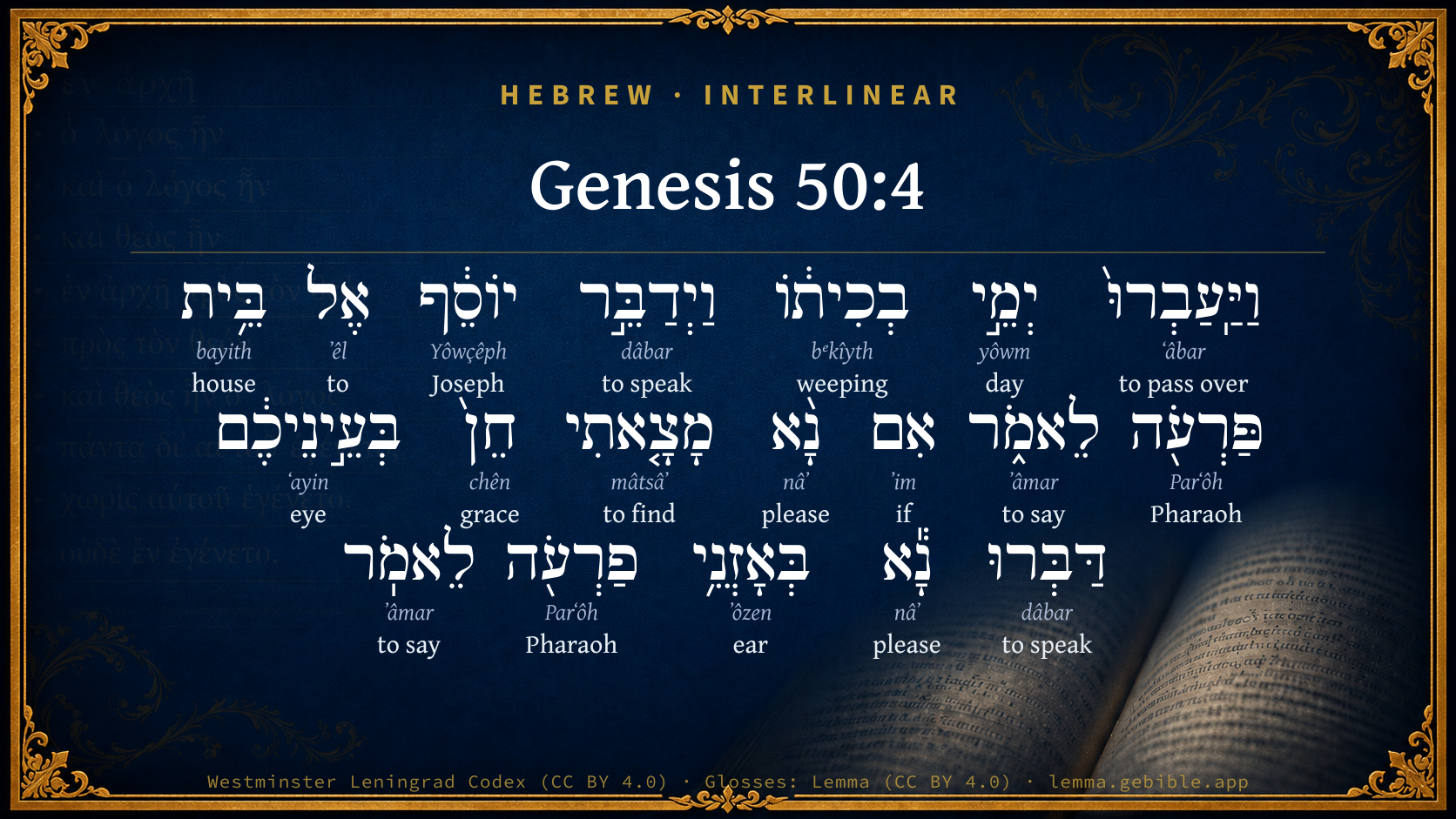
Genesis 50:4

Hebrew (Westminster Leningrad Codex) Genesis 50:4 appears in the Hebrew Old Testament. The text above is from the Westminster Leningrad Codex. Each word links to its Strong’s number, a concise gloss, and parsing drawn from the Open Scriptures Hebrew Bible morphology. Click any word for its full Brown-Driver-Briggs (BDB) entry.
Download image
Cite this verse

Genesis 50:4 (World English Bible). Public Domain. Lemma interlinear Bible study tool, https://lemma.gebible.app/v/genesis/50/4.

Show BibTeX & RIS
BibTeX
RIS
English Translation
When the days of weeping for him were past, Joseph spoke to the house of Pharaoh, saying, "If now I have found favor in your eyes, please speak in the ears of Pharaoh, saying,
World English Bible · Public Domain
Highlights
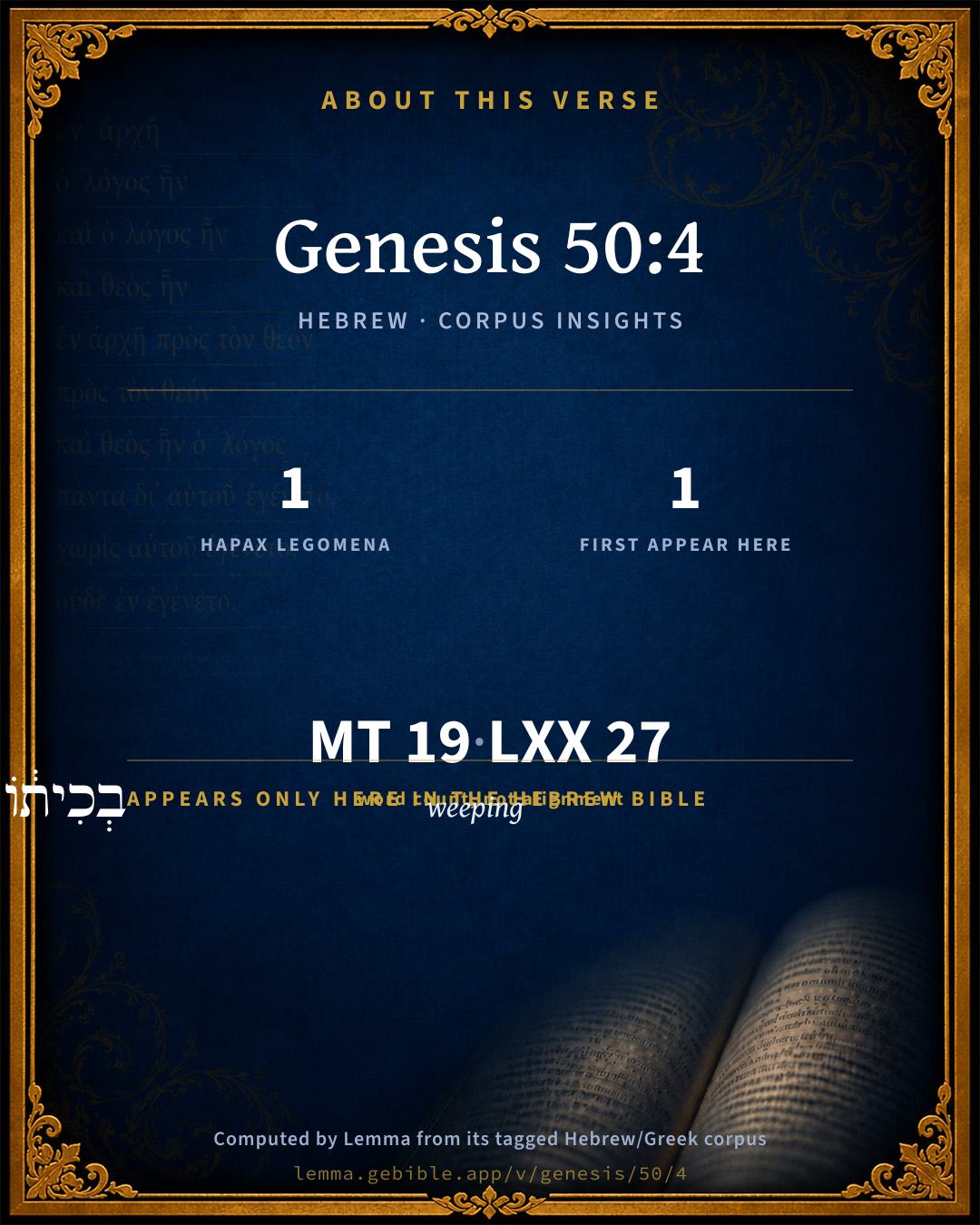
  • 1 hapax legomenon — only here in the Hebrew Bible
  • 1 first appearance in the Hebrew Bible
Full analysis ↓
Download a study sheet

One document with this verse’s original text, its word-by-word gloss line, the meaning frame, cross-references with their text, attributed commentary, and full source and license credits — printable, and it pastes into notes with its structure intact.

This verse Autodidact and up

Study sheet (.html) Plain text (.txt)

A passage Seminary Student

Up to 50 verses in one chapter. A passage sheet keeps up to 6 commentary sources and 12 cross-references per verse, in the order this page ranks them, and says so on the sheet whenever that leaves anything out. Ask for a single verse and you get the Autodidact verse sheet above.

Everything on this page stays free to read, with no account — the sheet is a download of what is already on screen, not access to it.

Want to remove ads? Support Godless Engineer
Compare translations 3

The same verse in 3 English versions, stacked beneath the original-language interlinear above. Click any original word for its lexicon entry.

Each is an independent rendering of the whole verse — the interlinear is not word-aligned to these translations.

Highlighted words mark where these versions differ — a whole-verse word diff, not a word-by-word alignment.

  • World English Bible Public Domain
    When the days of weeping for him were past, Joseph spoke to the house of Pharaoh, saying, "If now I have found favor in your eyes, please speak in the ears of Pharaoh, saying,
  • King James Version Public Domain
    And when the days of his mourning were past, Joseph spake unto the house of Pharaoh, saying, If now I have found grace in your eyes, speak, I pray you, in the ears of Pharaoh, saying,
  • unfoldingWord Literal Text CC BY-SA 4.0
    And the days of his mourning passed, then Joseph spoke to the house of Pharaoh, saying, “Please, if I have found favor in your eyes, please speak in the ears of Pharaoh, saying,

unfoldingWord Literal Text — © unfoldingWord, licensed CC BY-SA 4.0. Word-aligned USFM3 via Door43 (git.door43.org/unfoldingWord/en_ult).

Versions to compare (up to 4)

3 of 4 selected

Show all 18 translations

Every available English version of this verse, each an independent rendering of the whole verse.

  • World English Bible Public Domain
    When the days of weeping for him were past, Joseph spoke to the house of Pharaoh, saying, "If now I have found favor in your eyes, please speak in the ears of Pharaoh, saying,
  • Berean Standard Bible Public Domain
    When the days of mourning had passed, Joseph said to Pharaoh’s court, “If I have found favor in your eyes, please tell Pharaoh that
  • Majority Standard Bible Public Domain
    When the days of mourning had passed, Joseph said to Pharaoh’s court, “If I have found favor in your eyes, please tell Pharaoh that
  • King James Version Public Domain
    And when the days of his mourning were past, Joseph spake unto the house of Pharaoh, saying, If now I have found grace in your eyes, speak, I pray you, in the ears of Pharaoh, saying,
  • American Standard Version (1901) Public Domain
    And when the days of weeping for him were past, Joseph spake unto the house of Pharaoh, saying, If now I have found favor in your eyes, speak, I pray you, in the ears of Pharaoh, saying,
  • Revised Version (1885) Public Domain
    And when the days of weeping for him were past, Joseph spake unto the house of Pharaoh, saying, If now I have found grace in your eyes, speak, I pray you, in the ears of Pharaoh, saying,
  • Geneva Bible (1599) Public Domain
    And when the dayes of his mourning were past, Ioseph spake to the house of Pharaoh, saying, If I haue nowe found fauour in your eyes, speake, I pray you, in the eares of Pharaoh, and say,
  • Douay-Rheims (1899) Public Domain
    And the time of the mourning being expired, Joseph spoke to the family of Pharao: If I have found favour in your sight, speak in the ears of Pharao:
  • Young's Literal Translation Public Domain
    And the days of his weeping pass away, and Joseph speaketh unto the house of Pharaoh, saying, `If, I pray you, I have found grace in your eyes, speak, I pray you, in the ears of Pharaoh, saying,
  • Literal Standard Version CC BY-SA 4.0
    And the days of his weeping pass away, and Joseph speaks to the house of Pharaoh, saying, “Now if I have found grace in your eyes, please speak in the ears of Pharaoh, saying,
  • Unlocked Literal Bible CC BY-SA 4.0
    When the days of weeping were over, Joseph spoke to the house of Pharaoh, saying, “If now I have found favor in your eyes, please speak to Pharaoh, saying,
  • unfoldingWord Literal Text CC BY-SA 4.0
    And the days of his mourning passed, then Joseph spoke to the house of Pharaoh, saying, “Please, if I have found favor in your eyes, please speak in the ears of Pharaoh, saying,
  • Darby Bible Public Domain
    And when the days of his mourning were past, Joseph spoke to the house of Pharaoh, saying, If now I have found favour in your eyes, speak, I pray you, in the ears of Pharaoh, saying,
  • World Messianic Bible Public Domain
    When the days of weeping for him were past, Joseph spoke to Pharaoh’s staff, saying, “If now I have found favor in your eyes, please speak in the ears of Pharaoh, saying,
  • Webster's Bible Public Domain
    And when the days of his mourning were past, Joseph spoke to the house of Pharaoh, saying, If now I have found grace in your eyes, speak, I pray you, in the ears of Pharaoh, saying,
  • Free Bible Version CC BY-SA 4.0
    Once the time of mourning was over, Joseph said to Pharaoh's officials, “If you'd be so kind, please speak to Pharaoh on my behalf, and explain to him that
  • Bible in Basic English Public Domain
    And when the days of weeping for him were past, Joseph said to the servants of Pharaoh, If now you have love for me, say these words to Pharaoh:
  • JPS Tanakh (1917) Public Domain
    And when the days of weeping for him were past, Joseph spoke unto the house of Pharaoh, saying: 'If now I have found favour in your eyes, speak, I pray you, in the ears of Pharaoh, saying:

Literal Standard Version (2020), Covenant Press — licensed CC BY-SA 4.0. Text via the HelloAO Bible API (eBible.org). Unlocked Literal Bible (unfoldingWord) — licensed CC BY-SA 4.0. Text via the HelloAO Bible API (eBible.org). unfoldingWord Literal Text — © unfoldingWord, licensed CC BY-SA 4.0. Word-aligned USFM3 via Door43 (git.door43.org/unfoldingWord/en_ult). Free Bible Version, Dr. Jonathan Gallagher — licensed CC BY-SA 4.0. Text via the HelloAO Bible API (eBible.org).

Word by word

More ways to search: Search by grammar → Find every occurrence → Compare this word →

Practice this passage: Drill this verse → Learn its vocabulary →

בְכִית֔וֹ
bᵉkîyth
H1068
“weeping · his”
Noun, Common, Feminine, Singular, Construct + Suffix, Personal, 3rd Person, Masculine, Singular
Part of Speech
Noun
Type
Common
Gender
Feminine
Number
Singular
State
Construct
Full BDB Definition

Origin: from H1058

TWOT: 243d

weeping
  1. וַיַּֽעַבְרוּ֙ ʻâbar H5674 “and · to pass over” Conjunction + Verb, Qal, Sequential Imperfect, 3rd Person, Masculine, Plural
  2. יְמֵ֣י yôwm H3117 “days of” Noun, Common, Masculine, Plural, Construct
  3. וַיְדַבֵּ֣ר dâbar H1696 “and · to speak” Conjunction + Verb, Piel, Sequential Imperfect, 3rd Person, Masculine, Singular
  4. יוֹסֵ֔ף Yôwçêph H3130 “Joseph” Noun, Proper
  5. אֶל ʼêl H413 “to” Preposition
  6. בֵּ֥ית bayith H1004 “house of” Noun, Common, Masculine, Singular, Construct
  7. פַּרְעֹ֖ה Parʻôh H6547 “Pharaoh” Noun, Proper
  8. לֵאמֹ֑ר ʼâmar H559 “to say” Preposition + Verb, Qal, Infinitive Construct
  9. אִם ʼim H518 “if” Conjunction
  10. נָ֨א nâʼ H4994 “please” Particle, Exhortation
  11. מָצָ֤אתִי mâtsâʼ H4672 “to find” Verb, Qal, Perfect, 1st Person, Common, Singular
  12. חֵן֙ chên H2580 “grace” Noun, Common, Masculine, Singular, Absolute
  13. בְּעֵ֣ינֵיכֶ֔ם ʻayin H5869 “in/at · eyes · your” Preposition + Noun, Common, Both, Dual, Construct + Suffix, Personal, 2nd Person, Masculine, Plural
  14. דַּבְּרוּ dâbar H1696 “speak” Verb, Piel, Imperative, 2nd Person, Masculine, Plural
  15. נָ֕א nâʼ H4994 “please” Particle, Exhortation
  16. בְּאָזְנֵ֥י ʼôzen H241 “in/at · ears of” Preposition + Noun, Common, Feminine, Dual, Construct
  17. פַרְעֹ֖ה Parʻôh H6547 “Pharaoh” Noun, Proper
  18. לֵאמֹֽר ʼâmar H559 “to say” Preposition + Verb, Qal, Infinitive Construct

About this verse

These counts appear in no published source. They are computed here, from the morphology-tagged text and Lemma’s own curated glosses. What Lemma adds →

19
words
15
distinct lemmas
Pentateuch
section

Notable vocabulary

1 hapax legomenon — a word that appears only here in the entire Hebrew Bible:

  • בְכִית֔וֹ weeping H1068

First appearance in Scripture

This word makes its first canonical appearance in the Hebrew Bible here:

  • בְכִית֔וֹ weeping H1068

Grammatical profile

  • 6 verbs
  • 9 nouns
  • 1 preposition
  • 1 conjunction
  • 2 particles

Verb forms

  • וַיַּֽעַבְרוּ֙ Qal · Sequential Imperfect
  • וַיְדַבֵּ֣ר Piel · Sequential Imperfect
  • לֵאמֹ֑ר Qal · Infinitive Construct
  • מָצָ֤אתִי Qal · Perfect
  • דַּבְּרוּ Piel · Imperative
  • לֵאמֹֽר Qal · Infinitive Construct

Repetition

Words recur within this verse — often emphatic in Hebrew:

  • וַיְדַבֵּ֣ר to speak H1696 ×2
  • פַּרְעֹ֖ה Pharaoh H6547 ×2
  • לֵאמֹ֑ר to say H559 ×2
  • נָ֨א please H4994 ×2

Hebrew & Septuagint length

In English translation the verse runs 34 words from the Hebrew and 33 from the Septuagint (LXX English) — closely comparable.

A rough comparison of the two English renderings, which tokenize alike — not a word-level alignment.

Word counts can differ between the Hebrew and the Greek without any difference in meaning — e.g. the Hebrew direct-object marker אֵת has no separate Greek word, and Greek often adds the article ὁ.

In the original languages it is 19 Hebrew tokens and 27 Greek tokens — but the two are counted differently (Hebrew bundles its prefixes and suffixes into one token; the Greek is in lemma form), so that isn’t a like-for-like length.

Cross-references

2

Topical passages linked to Genesis 50:4 in the Treasury of Scripture Knowledge — connected by theme and wording, ordered by reader-vote popularity; previews shown in the World English Bible.

  • Genesis 18:3 and said, "My lord, if now I have found favor in your sight, please don't go away from your servant.
  • Esther 4:2 and he came even before the king's gate: for none might enter within the king's gate clothed with sackcloth.

Cross-references courtesy of OpenBible.info (CC BY 4.0).

Hebrew and Greek witnesses Masoretic Hebrew ↔ Greek Septuagint

The same verse in the two great witnesses to the Old Testament, shown verse-for-verse.

These are two independent witnesses, not word-aligned to each other, and the Septuagint is shown in lemma (dictionary) form.

Hebrew Genesis 50:4 Masoretic · Westminster Leningrad Codex

וַיַּֽעַבְרוּ֙ יְמֵ֣י בְכִית֔וֹ וַיְדַבֵּ֣ר יוֹסֵ֔ף אֶל בֵּ֥ית פַּרְעֹ֖ה לֵאמֹ֑ר אִם נָ֨א מָצָ֤אתִי חֵן֙ בְּעֵ֣ינֵיכֶ֔ם דַּבְּרוּ נָ֕א בְּאָזְנֵ֥י פַרְעֹ֖ה לֵאמֹֽר

When the days of weeping for him were past, Joseph spoke to the house of Pharaoh, saying, "If now I have found favor in your eyes, please speak in the ears of Pharaoh, saying,

World English Bible · Public Domain

Greek LXX Genesis 50:4 Septuagint · lemma form

ἐπειδή δέ παραἔρχομαι ὁ ἡμέρα ὁ πένθος λαλέω ιωσηφ πρός ὁ δυνάστης φαραώ λέγω εἰ εὑρίσκω χάρις ἐναντίον σύ λαλέω περί ἐγώ εἰς ὁ οὖς φαραώ λέγω

And when the days of mourning were past, Joseph spoke to the princes of Pharao, saying, If I have found favor in your sight, speak concerning me in the ears of Pharao, saying,

LXX2012 (modern English Septuagint) · Public Domain

On this verse, John Gill's Exposition discusses the Septuagint’s reading. Read the note in Commentary ↓

Hebrew: Westminster Leningrad Codex (CC BY 4.0). Greek: Septuagint (public domain); English from LXX2012 (modern English Septuagint) (Public Domain). How the Septuagint differs from the Hebrew →

Targum (Aramaic paraphrase)

2

The Targum is the ancient Jewish Aramaic paraphrase of the Hebrew Scriptures — an interpretive translation, not the Hebrew text itself. Onkelos (literal) and Pseudo-Jonathan (expansive) render the Torah, and Jonathan the Prophets. Coverage is partial: where no permissively-licensed English translation exists for a verse, only the Aramaic is shown. This is verse-level text, not a word-by-word alignment to the Hebrew.

  1. Targum Onkelos Torah (Genesis–Deuteronomy)
    וַעֲבָרוּ יוֹמֵי בְכִיתֵהּ וּמַלִיל יוֹסֵף עִם בֵּית פַּרְעֹה לְמֵימָר אִם כְּעַן אַשְׁכָּחִית רַחֲמִין בְּעֵינֵיכוֹן מַלִּילוּ כְעַן קֳדָם פַּרְעֹה לְמֵימָר

    (no public-domain English translation for this verse)

    Targum Onkelos — Aramaic: “Onkelos Genesis” (public domain); “Onkelos Exodus” (public domain); “Onkelos Leviticus” (public domain); “Onkelos Numbers” (public domain); “Onkelos Deuteronomy” (public domain). English: “Sefaria Community Translation” (CC0 1.0 (public-domain dedication)); “J.W. Etheridge. The Targums of Onkelos and Jonathan Ben Uzziel on the Pentateuch. London: Longmans, Green, 1862” (public domain). Text via Sefaria.

  2. Targum Pseudo-Jonathan Torah (Genesis–Deuteronomy)
    וַעֲבָרוּ יוֹמֵי בְכִיתֵיהּ וּמַלֵיל יוֹסֵף עִם רִבּוֹנֵי בֵּית פַּרְעה לְמֵימָר אִין בְּבָעוּ אַשְׁכַּחְנָא רַחֲמִין בְּעֵינֵיכוֹן מַלִילוּ כְּדוֹן בְּמִשְׁמְעֵיהּ דְפַרְעה לְמֵימָר

    And the days of his mourning passed. And Joseph spake with the lords of the house of Pharoh, saying If I may find favour in your eyes, speak now in the hearing of Pharoh, saying,

    Targum Pseudo-Jonathan — Aramaic: “Targum Jonathan on Genesis” (public domain); “Targum Jonathan on Exodus” (public domain); “Targum Jonathan on Leviticus” (public domain); “Targum Jonathan on Numbers” (public domain); “Targum Jonathan on Deuteronomy” (public domain). English: “The Targum of Jonathan ben Uzziel, trans. J. W. Etheridge, London, 1862” (public domain). Text via Sefaria.

Commentary

Notes on Genesis 50:4 from classic Christian and Jewish commentators (each source and its license shown beneath its notes). The classic Christian expositions comment on the surrounding passage and are grouped to its opening verse, so a note may address several verses; the Jewish commentaries on the Tanakh (Rashi and others) are per-verse, so they appear only where the commentator wrote on this verse.

Lemma curates 59 commentaries, every one of them public domain or Creative Commons licensed, each selected and text-cleaned for this edition rather than reprinted as found. About our sources →

Trapp's Complete Commentary

John Trapp

Gen 50:4 And when the days of his mourning were past, Joseph spake unto the house of Pharaoh, saying, If now I have found grace in your eyes, speak, I pray you, in the ears of Pharaoh, saying,

Ver. 4. Speak, I pray you, in the ears of Pharaoh.]. He spake not to the king himself, but set others to work. Not because he was fallen out of favour, for he had the happiness to be favourite to five kings, {a} Onus, Amasis, Chebron, Amenophes, and Mephiris, in the eleventh year of whose reign he died, - but because he was now a mourner; and such were not wont to come before kings, {Est 4:2} though none but such as mourn are suffered to come before God. {Mat 5:4}

{a} Pareus.

John Trapp, A Commentary or Exposition upon All the Books of the Old and New Testament (1647–1656) — public domain. Text from a community e-Sword module.

Joseph Benson's Commentary

Gen 50:4-5. Joseph spake unto the house of Pharaoh — Either it was not customary for mourners to enter the royal presence, or Joseph wished to make his request to the king with all possible humility and respect. He therefore made application to Pharaoh, not directly, but through the intervention of some of his courtiers. Let me go up, I pray thee — It was a piece of necessary respect to Pharaoh, that he would not go without leave; for we may suppose, though his charge about the corn was long since over, yet he continued a prime minister of state, and therefore would not be so long absent from his business without license.

Joseph Benson's Commentary on the Old and New Testaments (1811–1818) — public domain. Text from a community e-Sword module.

Tyndale Open Study Notes

Tyndale Open Resources

50:4-6 Joseph needed Pharaoh’s permission to leave his post temporarily to bury his father in Canaan. Pharaoh readily granted this freedom to the former slave.

Tyndale Open Study Notes — © Tyndale Open Resources, licensed CC BY-SA 4.0. Text via the HelloAO Bible API.

Jamieson, Fausset & Brown

Robert Jamieson, A. R. Fausset & David Brown

Joseph spake unto the house of Pharaoh, &c.--Care was taken to let it be known that the family sepulchre was provided before leaving Canaan and that an oath bound his family to convey the remains thither. Besides, Joseph deemed it right to apply for a special leave of absence; and being unfit, as a mourner, to appear in the royal presence, he made the request through the medium of others.

Jamieson, Fausset & Brown — Commentary Critical and Explanatory on the Whole Bible (1871) — public domain (CC PDM 1.0). Text via the HelloAO Bible API.

Adam Clarke's Commentary

Verse 4. Speak, I pray you, in the ears of Pharaoh.] But why did not Joseph apply himself? Because he was now in his mourning habits, and in such none must appear in the presence of the eastern monarchs. See Es 4:2.

Adam Clarke's Commentary on the Bible (1810–1826) — public domain. Text from a community e-Sword/MySword module.

John Calvin's Commentaries

4. Joseph spake unto the house of Pharaoh. A brief narration is here inserted of the permission obtained for Joseph, that, with the goodwill and leave of the king, he might convey his father’s remains to the sepulcher of the double cave. Now, though he himself enjoyed no common decree of favor, he yet makes use of the courtiers as his intercessors. Why did he act thus, unless on the ground that the affair was in itself odious to the people? For nothing (as we have said before) was less tolerable to the Egyptians, than that their land, of the sanctity of which they made their especial boast, should be despised. Therefore Joseph, in order to transfer the offense from himself to another, pleads necessity: as if he would say, that the burying of his father was not left to his own choice, because Jacob had laid him under obligation as to the mode of doing it, by the imposition of an oath. Wherefore, we see that he was oppressed by servile fear, so that he did not dare frankly and boldly to profess his own faith; since he is compelled to act a part, in order to transfer to the deceased whatever odium might attend the transaction. Now, whereas a more simple and upright confession of faith is required of the sons of God, let none of us seek refuge under such pretexts: but rather let us learn to ask of the Lord the spirit of fortitude and constancy which shall direct us to bear our testimony to true religion. Yet if men allow us the free profession of religion, let us give thanks for it. Now, seeing that Joseph did not dare to move his foot, except by permission of the king, we infer hence, that he was bound by his splendid fortune, as by golden fetters. And truly, such is the condition of all who are advanced to honor and favor in royal courts; so that there is nothing better for men of sane mind, than to be content with a private condition. Joseph also mitigates the offense which he feared he was giving, by another circumstance, when he says, that the desire to be buried in the land of Canaan was not one which had recently entered into his father’s mind, because he had dug his grave there long before; whence it follows that he had not been induced to do so by any disgust taken against the land of Egypt.

John Calvin's Commentaries (1540-1563) — public domain. Text from the Calvin Translation Society English edition (1840s-50s) via the Christian Classics Ethereal Library (ccel.org). Calvin's coverage is partial (roughly two-thirds of the Bible); uncommented books and verses are honest gaps, never fabricated. The 19th-century editor's footnotes and remarks are omitted so the notes are faithfully Calvin's own voice.

Ellicott's Commentary for English Readers

(4) Joseph spake unto the house of Pharaoh.—It may seem at first sight strange that Joseph should make his request through mediators, but probably no one in the attire of mourning might enter the royal presence. (Comp. Est_4:2.) The dress of a mourner was squalid, his beard unshorn, his hair in disorder, and while these outward signs of grief were maintained, he was also expected to confine himself to his own house.

A Bible Commentary for English Readers, edited by Charles John Ellicott (1878–1897) — public domain. Text from a community e-Sword module.

The Cambridge Bible for Schools and Colleges

gen. ed. J. J. S. Perowne

4. unto the house of Pharaoh] Joseph does not speak to Pharaoh personally, but to the court officials. As a mourner, he is unclean and would not be permitted to approach Pharaoh.

The Cambridge Bible for Schools and Colleges (gen. ed. J. J. S. Perowne; Cambridge University Press, 1878–1918) — public domain. Text from a community e-Sword module.

John Gill's Exposition

And when the days of his mourning were past,.... The forty days before mentioned, in which both the Egyptians and Jacob's family mourned for him. An Arabic writer (g) says, the Egyptians mourned for Jacob forty days, which was the time of embalming; but the text is express for sventy days:

Joseph spake unto the house of Pharaoh; to the court of Pharaoh, the principal men there; so the Targum of Jonathan and the Septuagint version, to the great men or princes of the house of Pharaoh: it may seem strange that Joseph, being next to Pharaoh in the administration of the government, should make use of any to speak for him to Pharaoh on the following account. It may be, that Joseph was not in so high an office, and in so much power and authority, as in the seven years of plenty and the seven years of famine; and it is certain that that branch of his office, respecting the corn, must have ceased; or this might have been a piece of policy in Joseph to make these men his friends by such obliging treatment, and by this means prevent their making objections to his suit, or plotting against him in his absence; or if it was the custom in Egypt, as it afterwards was in Persia, that no man might appear before the king in a mourning habit, Est 4:2 this might be the reason of his not making application in person: moreover, it might not seem so decent for him to come to court, and leave the dead, and his father's family, in such circumstances as they were: besides, he might speak to them not in person, but by a messenger, since it is highly probable he was now in Goshen, at a distance from Pharaoh's court; unless it can be supposed that these were some of Pharaoh's courtiers who were come to him in Goshen, to condole his father's death:

saying, if now I have found grace in your eyes, speak, I pray you, in the ears of Pharaoh; however, as these men had the ear of Pharaoh, and an interest in him, Joseph entreats the favour of them to move it to him:

saying, as follows, in his name.

(g) Elmacinus, p. 43. apud Hottinger. Smegma, c. 8. p. 380.

John Gill's Exposition of the Whole Bible (1746–1763) — public domain (CC PDM 1.0). Text via the HelloAO Bible API.

Haydock's Catholic Bible Commentary

Expired. Before the corpse was interred, Joseph could not lay aside his mourning attire, in which it was not lawful to appear at court. (Calmet)

George Leo Haydock (1774–1849), Haydock's Catholic Family Bible and Commentary, 1859 edition — public domain. Excludes Psalms (Douay-Rheims chapter numbering differs from Protestant) and Deuterocanonical books (Catholic canon only).

Matthew Poole's English Annotations

The house of Pharaoh; the household or family, namely, those of them which were chief in place and favour with the king. Joseph makes use of their intercession, either,

1. Lest he might seem to despise them, or to presume too much upon his own single interest. Or,

2. By engaging them in this matter to stop their mouths, who otherwise might have been ready enough to censure this action, which they would have a fair opportunity to do in Joseph’s absence. Or,

3. Because it was the custom here, as it was elsewhere, Est 4:2, that persons in mourning habit might not come into the king’s presence, partly because they would not give them any occasion of sadness, and partly because, according to their superstitions conceits, the sight of such a person was judged ominous.

Matthew Poole's English Annotations on the Holy Bible (1683–1685) — public domain. Text from a community e-Sword/MySword module.

Whedon's Commentary on the Bible

Daniel D. Whedon

4. Joseph spake unto the house of Pharaoh — He communicated with Pharaoh by means of his servants, or messengers, as it would have been contrary to Egyptian customs for him to have gone in mourning attire into the presence of the king. During the days of mourning for a relative the Egyptians allowed the hair and beard to grow long, (Herod., 2:36,) and no man might enter the king’s presence unshaven. Comp. Gen_41:14; Est_4:2.

Daniel D. Whedon (gen. ed.), Commentary on the Old and New Testaments (1874–1909) — public domain. Text from a community e-Sword module.

The Pulpit Commentary

Vers. 4, 5. And when the days of his mourning were past, Joseph spake unto the house of Pharaoh, saying, If now I have found grace in your eyes, speak, I pray you, in the ears of Pharaoh, that Joseph did not address himself directly to Pharaoh, but through the members of the royal household, was not owing to the circumstance that, being arrayed in mourning apparel, he could not come before the king (Rosenm since it is not certain that this Persian custom (Est_4:2) prevailed in Egypt, but is supposed to have been due, either to a desire on Joseph"s part to put himself on a good understanding with the priesthood who composed the courtly circle, since the interment of the dead was closely connected with the religious beliefs of Egypt (Havernick), or, what was more likely, to the fact that Joseph, having, according to Egyptian custom (Heb 2:36), allowed his beard and hair to grow, could not enter the king"s presence without being both shaven and shorn (Hengstenberg, Kurtz, Keil). It has been suggested (Kalisch) that Joseph"s power may have been restricted after the expiration of the famine, or that another Pharaoh may have succeeded to the throne who was not so friendly as his predecessor with the grand vizier of the realm; but such conjectures are not required to render Joseph"s conduct in this matter perfectly intelligiblesaying, My father made me swear, (Gen_47:29) saying (i.e. my father saying), Lo, I die: in my grave which I have digged for me not bought (Onkelos, Drusius, Ainsworth, Bohlen, and others), but digged, wruxa (LXX), fodi (Vulgate). Jacob may have either enlarged the original cave at Machpelah, or prepared in it the special niche which he designed to occupy in the land of Canaan, there shalt thou bury me. Now therefore (literally, and now) let me go up, I pray thee (the royal permission was required to enable Joseph to pass beyond the boundaries of Egypt, especially when accompanied by a large funeral procession), and bury my father, and I will come again.

The Pulpit Commentary (1880–1919), ed. H.D.M. Spence-Jones & Joseph S. Exell — public domain. Text from a community e-Sword module.

Keil & Delitzsch

C. F. Keil & F. Delitzsch

At the end of this period of mourning, Joseph requested "the house of Pharaoh," i.e., the attendants upon the king, to obtain Pharaoh's permission for him to go to Canaan and bury his father, according to his last will, in the cave prepared by him there. כּרה (Gen 50:5) signifies "to dig" (used, as in Ch2 16:14, for the preparation of a tomb), not "to buy," In the expression לי כּריתי Jacob attributes to himself as patriarch what had really been done by Abraham (Gen 24). Joseph required the royal permission, because he wished to go beyond the border with his family and a large procession. But he did not apply directly to Pharaoh, because his deep mourning (unshaven and unadorned) prevented him from appearing in the presence of the king.

Keil & Delitzsch — Biblical Commentary on the Old Testament (1861–1891) — public domain (CC PDM 1.0). Text via the HelloAO Bible API. (Old Testament only.)

unfoldingWord translationNotes

Door43 World Missions Community

days of weeping

"days of mourning him" or "days of weeping for him"

Joseph spoke to the house of Pharaoh

Here "house of Pharaoh" stands for the officials that make up Pharaoh's royal court. AT: "Joseph spoke to Pharaoh's officials" (See: Metonymy)

If now I have found favor in your eyes

The phrase "find favor" is an idiom which means to be approved of by someone. Also, the eyes represent seeing, and seeing represents thoughts or judgment. AT: "If I have found favor with you" or "If you are pleased with me" (See: Idiom and Metaphor)

please speak to Pharaoh, saying, 'My father made me swear, saying, "See, I am about to die. Bury me in my tomb that I dug for myself in the land of Canaan. There you will bury me." Now let me go up and bury my father, and then I will return.'

This has a two level quotation and three level quotation. These can be stated as indirect quotations. AT: "please tell Pharaoh that my father made me swear that after he dies I would bury him in the tomb that he dug for himself in the land of Canaan. Please ask Pharaoh to let me go bury my father, and then I will return" (See: Quotes Within Quotes and Direct and Indirect Quotations)

See, I am about to die

"See, I am dying"

let me go up

It was common to use the phrase "go up" when speaking of traveling from Egypt to Canaan.

Pharaoh answered

It is implied that the members of the court spoke to Pharaoh, and now Pharaoh is replying to Joseph. (See: Assumed Knowledge and Implicit Information)

as he made you swear

"as you swore to him"

translationWords

Pharaoh

royal

favor

oath

bury

grave

Canaan

unfoldingWord translationNotes — © Distant Shores Media and the Door43 World Missions Community, licensed CC BY-SA 4.0. Source: git.door43.org/Door43/en_tn.

Lesson kit

Teaching starters — assembled from the data on this page, not authored interpretation. Every prompt links to the verse data it draws on. Edit before teaching.

Genesis, in the Pentateuch, opens this verse with 19 words (15 distinct Hebrew lemmas). Its most distinctive word is bᵉkîyth (“weeping”). A historical commentator’s framing appears above. Read the whole chapter for the surrounding context.

Discussion questions

  1. The word bᵉkîyth carries the sense “weeping.” How does it shape the verse?
  2. 1 word here appears nowhere else in the Hebrew Bible. Why might the author reach for such rare wording?
  3. This is the first place “weeping” appears in Scripture (first appears here). What does its debut here establish?
  4. How does Genesis 18:3, which shares this passage’s theme, read alongside this verse?
  5. What does the repetition of “to speak” (2× in this one verse) do in this verse?
  6. The translations on this page render this verse differently — a whole-verse word diff, not a word-by-word alignment. What might account for the different wordings?
  7. «וַיַּֽעַבְרוּ֙» is a Qal Sequential Imperfect verb. How does that grammatical form shape the action described?
  8. Compare how Trapp's Complete Commentary and Joseph Benson's Commentary read this verse. Where do they agree or differ?

Things to notice

  • 1 word in this verse appears nowhere else in the Hebrew Bible.
  • 1 word makes its first canonical appearance in Scripture here.
  • This verse counts 19 Hebrew ↔ 27 Greek words.
  • These translations choose different wording for 14 words in this verse.
  • “to speak” occurs 2× in this single verse.

Reading settings

Reading text

Shown beneath each verse's original-language words.

Old Testament
Old Testament edition

Read the OT as the Masoretic Hebrew (MT) or the Greek Septuagint (LXX).

English shown for the Greek Septuagint (in the Hebrew ↔ Greek comparison).

Comparing translations? Open the Compare panel on any verse page to stack up to four side by side.