

Job 34:3

Hebrew (Westminster Leningrad Codex) Job 34:3 appears in the Hebrew Old Testament. The text above is from the Westminster Leningrad Codex. Each word links to its Strong’s number, a concise gloss, and parsing drawn from the Open Scriptures Hebrew Bible morphology. Click any word for its full Brown-Driver-Briggs (BDB) entry.
Download image
Cite this verse

Job 34:3 (World English Bible). Public Domain. Lemma interlinear Bible study tool, https://lemma.gebible.app/v/job/34/3.

Show BibTeX & RIS
BibTeX
RIS
English Translation
For the ear tries words, As the palate tastes food.
World English Bible · Public Domain
Download a study sheet

One document with this verse’s original text, its word-by-word gloss line, the meaning frame, cross-references with their text, attributed commentary, and full source and license credits — printable, and it pastes into notes with its structure intact.

This verse Autodidact and up

Study sheet (.html) Plain text (.txt)

A passage Seminary Student

Up to 50 verses in one chapter. A passage sheet keeps up to 6 commentary sources and 12 cross-references per verse, in the order this page ranks them, and says so on the sheet whenever that leaves anything out. Ask for a single verse and you get the Autodidact verse sheet above.

Everything on this page stays free to read, with no account — the sheet is a download of what is already on screen, not access to it.

Want to remove ads? Support Godless Engineer
Compare translations 3

The same verse in 3 English versions, stacked beneath the original-language interlinear above. Click any original word for its lexicon entry.

Each is an independent rendering of the whole verse — the interlinear is not word-aligned to these translations.

Highlighted words mark where these versions differ — a whole-verse word diff, not a word-by-word alignment.

  • World English Bible Public Domain
    For the ear tries words, As the palate tastes food.
  • King James Version Public Domain
    For the ear trieth words, as the mouth tasteth meat.
  • unfoldingWord Literal Text CC BY-SA 4.0
    For the ear tests words, and the palate tastes food.

unfoldingWord Literal Text — © unfoldingWord, licensed CC BY-SA 4.0. Word-aligned USFM3 via Door43 (git.door43.org/unfoldingWord/en_ult).

Versions to compare (up to 4)

3 of 4 selected

Show all 18 translations

Every available English version of this verse, each an independent rendering of the whole verse.

  • World English Bible Public Domain
    For the ear tries words, As the palate tastes food.
  • Berean Standard Bible Public Domain
    For the ear tests words as the mouth tastes food.
  • Majority Standard Bible Public Domain
    For the ear tests words as the mouth tastes food.
  • King James Version Public Domain
    For the ear trieth words, as the mouth tasteth meat.
  • American Standard Version (1901) Public Domain
    For the ear trieth words, As the palate tasteth food.
  • Revised Version (1885) Public Domain
    For the ear trieth words, as the palate tasteth meat.
  • Geneva Bible (1599) Public Domain
    For the eare tryeth the words, as the mouth tasteth meate.
  • Douay-Rheims (1899) Public Domain
    For the ear trieth words, and the mouth discerneth meats by the taste.
  • Young's Literal Translation Public Domain
    For the ear doth try words, And the palate tasteth to eat.
  • Literal Standard Version CC BY-SA 4.0
    For the ear tries words, || And the palate tastes to eat.
  • Unlocked Literal Bible CC BY-SA 4.0
    For the ear tries words as the palate tastes food.
  • unfoldingWord Literal Text CC BY-SA 4.0
    For the ear tests words, and the palate tastes food.
  • Darby Bible Public Domain
    For the ear trieth words, as the palate tasteth food.
  • World Messianic Bible Public Domain
    For the ear tries words, as the palate tastes food.
  • Webster's Bible Public Domain
    For the ear trieth words, as the mouth tasteth food.
  • Free Bible Version CC BY-SA 4.0
    The ear distinguishes words just as the palate distinguishes foods.
  • Bible in Basic English Public Domain
    For words are tested by the ear, as food is tasted by the mouth.
  • JPS Tanakh (1917) Public Domain
    For the ear trieth words, as the palate tasteth food.

Literal Standard Version (2020), Covenant Press — licensed CC BY-SA 4.0. Text via the HelloAO Bible API (eBible.org). Unlocked Literal Bible (unfoldingWord) — licensed CC BY-SA 4.0. Text via the HelloAO Bible API (eBible.org). unfoldingWord Literal Text — © unfoldingWord, licensed CC BY-SA 4.0. Word-aligned USFM3 via Door43 (git.door43.org/unfoldingWord/en_ult). Free Bible Version, Dr. Jonathan Gallagher — licensed CC BY-SA 4.0. Text via the HelloAO Bible API (eBible.org).

Word by word

More ways to search: Search by grammar → Find every occurrence → Compare this word →

Practice this passage: Drill this verse → Learn its vocabulary →

About this verse

These counts appear in no published source. They are computed here, from the morphology-tagged text and Lemma’s own curated glosses. What Lemma adds →

7
words
7
distinct lemmas
Wisdom
section

Notable vocabulary

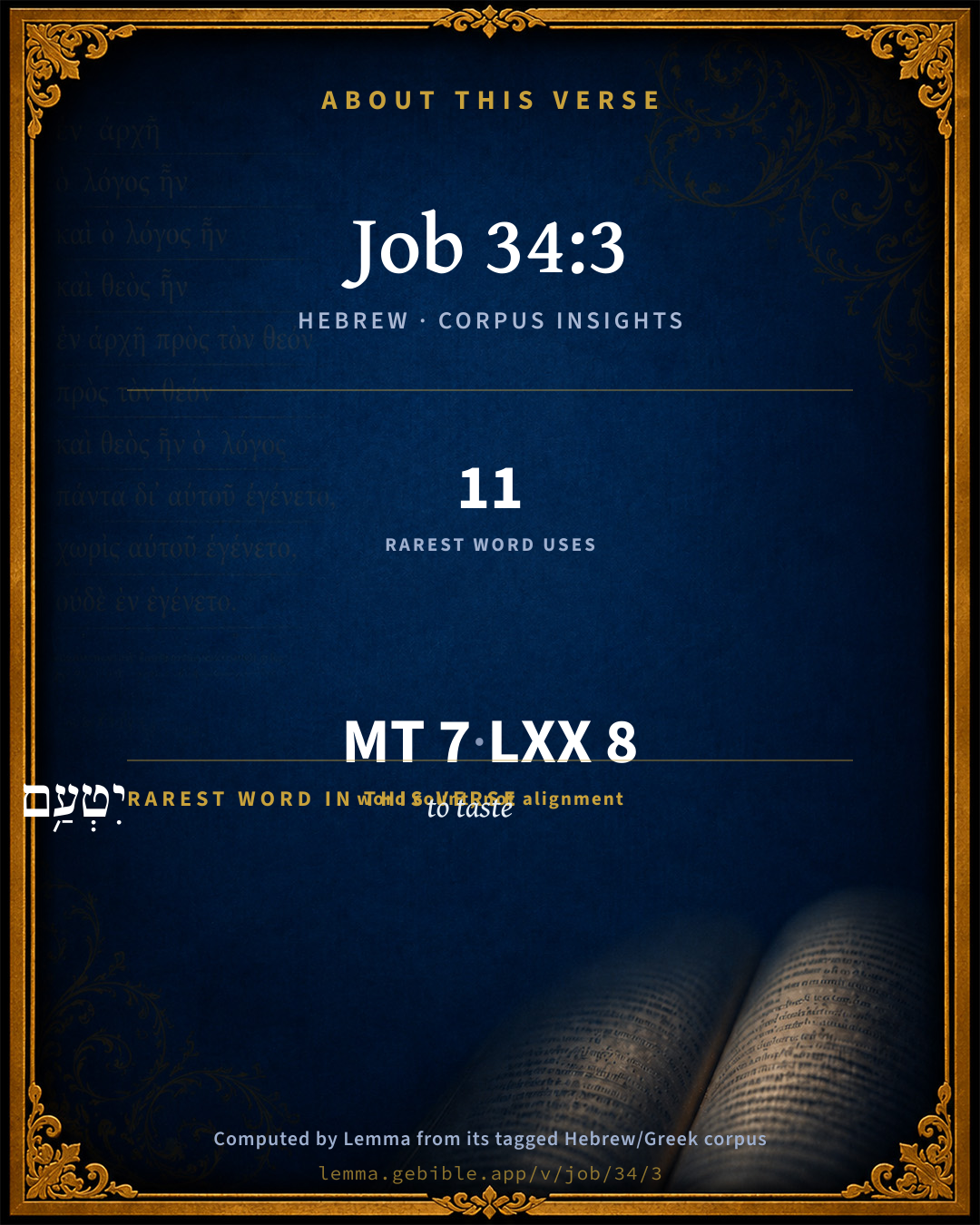
The rarest word here is יִטְעַ֥ם to taste H2938 — appearing just 11 times in the whole Hebrew Bible.

Shared distinctive vocabulary

יִטְעַ֥ם to taste H2938 occurs in 10 verses of the Hebrew Bible. Also found in:

Grammatical profile

  • 3 verbs
  • 3 nouns
  • 1 conjunction

Verb forms

  • תִּבְחָ֑ן Qal · Imperfect
  • יִטְעַ֥ם Qal · Imperfect
  • לֶאֱכֹֽל Qal · Infinitive Construct

Hebrew & Septuagint length

In English translation the verse runs 10 words from the Hebrew and 10 from the Septuagint (LXX English) — the same length.

A rough comparison of the two English renderings, which tokenize alike — not a word-level alignment.

Word counts can differ between the Hebrew and the Greek without any difference in meaning — e.g. the Hebrew direct-object marker אֵת has no separate Greek word, and Greek often adds the article ὁ.

In the original languages it is 7 Hebrew tokens and 8 Greek tokens — but the two are counted differently (Hebrew bundles its prefixes and suffixes into one token; the Greek is in lemma form), so that isn’t a like-for-like length.

Cross-references

6

Topical passages linked to Job 34:3 in the Treasury of Scripture Knowledge — connected by theme and wording, ordered by reader-vote popularity; previews shown in the World English Bible.

  • Job 12:11 Doesn't the ear try words, Even as the palate tastes its food?
  • 1 Corinthians 2:15 But he who is spiritual discerns all things, and he himself is judged by no one.
  • Job 33:2 See now, I have opened my mouth. My tongue has spoken in my mouth.
  • Hebrews 5:14 But solid food is for those who are full grown, who by reason of use have their senses exercised to discern good and evil.
  • Job 6:30 Is there injustice on my tongue? Can't my taste discern mischievous things?
  • Job 31:30 (Yes, I have not allowed my mouth to sin By asking his life with a curse);

Cross-references courtesy of OpenBible.info (CC BY 4.0).

Hebrew and Greek witnesses Masoretic Hebrew ↔ Greek Septuagint

The same verse in the two great witnesses to the Old Testament, shown verse-for-verse.

These are two independent witnesses, not word-aligned to each other, and the Septuagint is shown in lemma (dictionary) form.

Hebrew Job 34:3 Masoretic · Westminster Leningrad Codex

כִּי אֹ֭זֶן מִלִּ֣ין תִּבְחָ֑ן וְ֝חֵ֗ךְ יִטְעַ֥ם לֶאֱכֹֽל

For the ear tries words, As the palate tastes food.

World English Bible · Public Domain

Greek LXX Job 34:3 Septuagint · lemma form

ὅτι οὖς λόγος δοκιμάζω καί λάρυγξ γεύω βρῶσις

For the ear tries words, and the mouth tastes meat.

LXX2012 (modern English Septuagint) · Public Domain

Hebrew: Westminster Leningrad Codex (CC BY 4.0). Greek: Septuagint (public domain); English from LXX2012 (modern English Septuagint) (Public Domain). How the Septuagint differs from the Hebrew →

Commentary

Notes on Job 34:3 from classic Christian and Jewish commentators (each source and its license shown beneath its notes). The classic Christian expositions comment on the surrounding passage and are grouped to its opening verse, so a note may address several verses; the Jewish commentaries on the Tanakh (Rashi and others) are per-verse, so they appear only where the commentator wrote on this verse.

Lemma curates 59 commentaries, every one of them public domain or Creative Commons licensed, each selected and text-cleaned for this edition rather than reprinted as found. About our sources →

Trapp's Complete Commentary

John Trapp

Job 34:3 For the ear trieth words, as the mouth tasteth meat.

Ver. 3. For the ear trieth words] And for that end we have that excellent sense of hearing given us, that we may hear with judgment, and trying all things, hold fast that which is good, 1Th 5:21, taking heed what we hear, Mar 4:24, as by the taste we may take heed what we let down; for else a man may easily eat his own bane, drink his poison: so here, for the soul hath her senses also, Php 1:9, and these habitually exercised to discern good and evil, Heb 5:14. Which while carnal people want, they are carried away as they are led, 1Co 12:2; plucked away with the error of the wicked, 2Pe 3:17; wherried about with every wind of doctrine, Heb 13:9, &c. {See Trapp on "Job 12:1"}

John Trapp, A Commentary or Exposition upon All the Books of the Old and New Testament (1647–1656) — public domain. Text from a community e-Sword module.

Tyndale Open Study Notes

Tyndale Open Resources

34:3-4 ear tests . . . mouth distinguishes: Elihu echoed Job’s earlier complaint about the other counselors’ weak argument that “wisdom belongs to the aged” (12:11-12; see 6:30; Heb 5:14).

Tyndale Open Study Notes — © Tyndale Open Resources, licensed CC BY-SA 4.0. Text via the HelloAO Bible API.

Jamieson, Fausset & Brown

Robert Jamieson, A. R. Fausset & David Brown

palate--(See on Job 12:11; Job 33:2).

Jamieson, Fausset & Brown — Commentary Critical and Explanatory on the Whole Bible (1871) — public domain (CC PDM 1.0). Text via the HelloAO Bible API.

Adam Clarke's Commentary

Verse 3. The ear trieth words] I do not think, with Calmet, that the inward ear, or judgment, is meant simply. The Asiatics valued themselves on the nice and harmonious collection of words, both in speaking and in writing; and perhaps it will be found here that Elihu labours as much for harmonious versification as for pious and weighty sentiments. To connect sense with sound was an object of general pursuit among the Hebrew, Arabic, and Persian poets; and so fond are the latter of euphony, that they often sacrifice both sense and sentiment to it; and some of the Greek poets are not exempt from this fault.

Adam Clarke's Commentary on the Bible (1810–1826) — public domain. Text from a community e-Sword/MySword module.

The Cambridge Bible for Schools and Colleges

gen. ed. J. J. S. Perowne

3. Elihu makes his appeal to his hearers for the ear trieth words. His appeal is to the common reason, or to the common reverent and just thoughts of God in men. The “ear” is the inner ear, the understanding, which is a judge of sentiments as much as, or like as, the palate is a judge of meats, ch. Job_12:11.

The Cambridge Bible for Schools and Colleges (gen. ed. J. J. S. Perowne; Cambridge University Press, 1878–1918) — public domain. Text from a community e-Sword module.

John Gill's Exposition

Let us choose to us judgments,.... Take the part of the question or controversy in which truth and justice lie, and he doubtless has respect to the present controversy with Job;

let us know among ourselves what is good; agree upon that which is best to be done in the present case, what judgment to be made of the dealings of God with Job, and his behaviour under them, and what the best advice to give to him.

John Gill's Exposition of the Whole Bible (1746–1763) — public domain (CC PDM 1.0). Text via the HelloAO Bible API.

Albert Barnes' Notes on the Bible

For the ear trieth words - Ascertains their meaning, and especially determines what words are worth regarding. The object of this is, to fix the attention on what he was about to say; to get the ear so that every word should make its proper impression. The word ear in this place, however, seems not to be used to denote the external organ, but the whole faculty of hearing. It is by hearing that the meaning of what is said is determined, as it is by the taste that the quality of food is discerned.

As the mouth tasteth meat - Margin, as in Hebrew “palate.” The meaning is, as the organ of taste determines the nature of the various articles of food. The same figure is used by Job in Job 12:11.

Albert Barnes' Notes on the Bible (1834–1885) — public domain. Text from a community e-Sword/MySword module.

Haydock's Catholic Bible Commentary

Taste. The most accurate philosophers attribute this faculty to the tongue, (Calmet) rather than to the throat, guttur. Hebrew, "mouth or palate." (Haydock) --- But Eliu speaks agreeably to the notions of the vulgar. (Calmet) --- Intellectus saporum cæteris est in prima lingua, homini et in palato. (Pliny, [Natural History?] xi. 37.)

George Leo Haydock (1774–1849), Haydock's Catholic Family Bible and Commentary, 1859 edition — public domain. Excludes Psalms (Douay-Rheims chapter numbering differs from Protestant) and Deuterocanonical books (Catholic canon only).

Matthew Poole's English Annotations

i.e. Man’s mind judgeth Of things spoken and heard.

The ear, the sense of discipline, is put for the mind, to which things are conveyed by it. See Poole "Job 12:11".

Matthew Poole's English Annotations on the Holy Bible (1683–1685) — public domain. Text from a community e-Sword/MySword module.

Whedon's Commentary on the Bible

Daniel D. Whedon

3. As the mouth tasteth — Literally, As the palate tastes in order to eat.

See note on Job_33:2; Job_12:11.

Daniel D. Whedon (gen. ed.), Commentary on the Old and New Testaments (1874–1909) — public domain. Text from a community e-Sword module.

The Pulpit Commentary

For the ear trieth words, as the mouth tasteth meat. A proverbial expression, already used by Job in the dialogue. (Job_12:11) "It is as much the business of the ear to discriminate between wise and foolish words, as of the palate to distinguish between wholesome and unwholesome food.

HOMILIES BY W.F. ADENEY Ver. 3. The test of truth.

I IT IS LEFT FOR MAN TO TEST TRUTH. There is no unmistakable oracle. In the multitude of voices we have to discover which is the cry of truth, which that of error. We know the voice of God, not because we are assured beforehand that it is he and he only who will speak to us, but because we detect the heavenly utterance in contrast with the many siren songs that would fain allure us to destruction, detect it by its own tones, and not merely because of any authority that assures it to us. The Church may claim to guide us in this important quest; but the Church consists of human members, who have to use those faculties which God has given them, although no doubt the Church is aided with the presence of the Holy Spirit in her midst. So when individual men seek for truth, God"s Spirit is for them a Light and Guide. Still, the search must be made; words must be tried and sifted.

1. This is a warning against credulity. Many voices claim our attention. Let us be careful that we are not deceived.

2. This is a stimulus to thought. We are not to be like the dull earth that gives growth to whatever seeds fall into it ugly weeds as much as beautiful flowers, poisonous plants as well as fruitful crops. We have an independent capacity to sift and winnow, choose and reject. Therefore let us use our minds.

3. This is for the cultivation of our souls. The very effort of testing truth contributes to mental and spiritual growth. When we hold it after testing it, the truth is more real to us than if we had received it without an effort.

4. This should drive us to prayer. How shall we distinguish between the many specious voices? Our unaided faculties are likely to err. Therefore let us seek light from above, not to supersede our own powers, but to strengthen and illuminate them.

II THE TEST OF TRUTH IS LIKE THE TASTE OF FOOD.

1. It is natural. God has given us a natural sense of taste by which to discriminate between what is wholesome and what is noxious in our food, and he has implanted in us a similar faculty of mental and spiritual discernment.

2. It should be trained. In some respects the natural appetite is not a safe guide. The child may delight in sweet but unwholesome delicacies. Some poisons are not distasteful. Therefore the mere perception of agreeableness is not sufficient. Some very pleasant because flattering ideas are very false and hurtful. What is "just to our taste" may be neither true nor good for us. To select favourite ideas is not to obtain certain truths. We have to train the truth-testing faculty to recognize sterling worth in what is not attractive, and to reject meretricious charms.

3. It may be corrupted. The appetite may be vitiated. An unhealthy liking for unwholesome food may be engendered by practice; good, wholesome food may seem disgusting to one who is in a bad state of health. Corrupt thoughts and feelings lead to a degeneration of the truth-testing faculty. Even the natural sense for truth is blunted. The needle ceases to point to the north. The chemical reagent is impure, and so it fails to act as a test. The false and impure soul chooses lies and rejects truth.

4. It needs correction. After all, the test of truth is not like a bodily sense. It is not immediate. It involves reflection. But, in order that the reflection may be true and sound, the whole spiritual nature needs to be pure and simple and healthy. It is dangerous to rely too much on our private faculty of testing truth. Our only safety is in keeping close to Christ, who is the Truth, and to Christ"s Church. which he bade us "hear". W.F.A. (Mat_18:17)

The Pulpit Commentary (1880–1919), ed. H.D.M. Spence-Jones & Joseph S. Exell — public domain. Text from a community e-Sword module.

Rashi

Rabbi Shlomo Yitzchaki (Rashi)

For the ear tests words as the palate tastes food.

Rashi on the Tanakh — English translations: “The Judaica Press complete Tanach with Rashi, translated by A. J. Rosenberg” (CC BY 4.0); “Pentateuch with Rashi's commentary by M. Rosenbaum and A.M. Silbermann, 1929-1934” (public domain); “The Metsudah Tanach series, Lakewood, N.J” (CC BY 4.0); and “The Book of Joshua, Metsudah Publications, 1997” (CC BY 4.0). Text via Sefaria.

Lesson kit

Teaching starters — assembled from the data on this page, not authored interpretation. Every prompt links to the verse data it draws on. Edit before teaching.

Job, in the Wisdom, opens this verse with 7 words (7 distinct Hebrew lemmas). Its most distinctive word is ṭâʻam (“to taste”). A historical commentator’s framing appears above. Read the whole chapter for the surrounding context.

Discussion questions

  1. The word ṭâʻam carries the sense “to taste.” How does it shape the verse?
  2. How does 1 Samuel 14:24, which shares the word «to taste», read alongside this verse?
  3. The translations on this page render this verse differently — a whole-verse word diff, not a word-by-word alignment. What might account for the different wordings?
  4. «תִּבְחָ֑ן» is a Qal Imperfect verb. How does that grammatical form shape the action described?
  5. Compare how Trapp's Complete Commentary and Tyndale Open Study Notes read this verse. Where do they agree or differ?

Things to notice

Reading settings

Reading text

Shown beneath each verse's original-language words.

Old Testament
Old Testament edition

Read the OT as the Masoretic Hebrew (MT) or the Greek Septuagint (LXX).

English shown for the Greek Septuagint (in the Hebrew ↔ Greek comparison).

Comparing translations? Open the Compare panel on any verse page to stack up to four side by side.