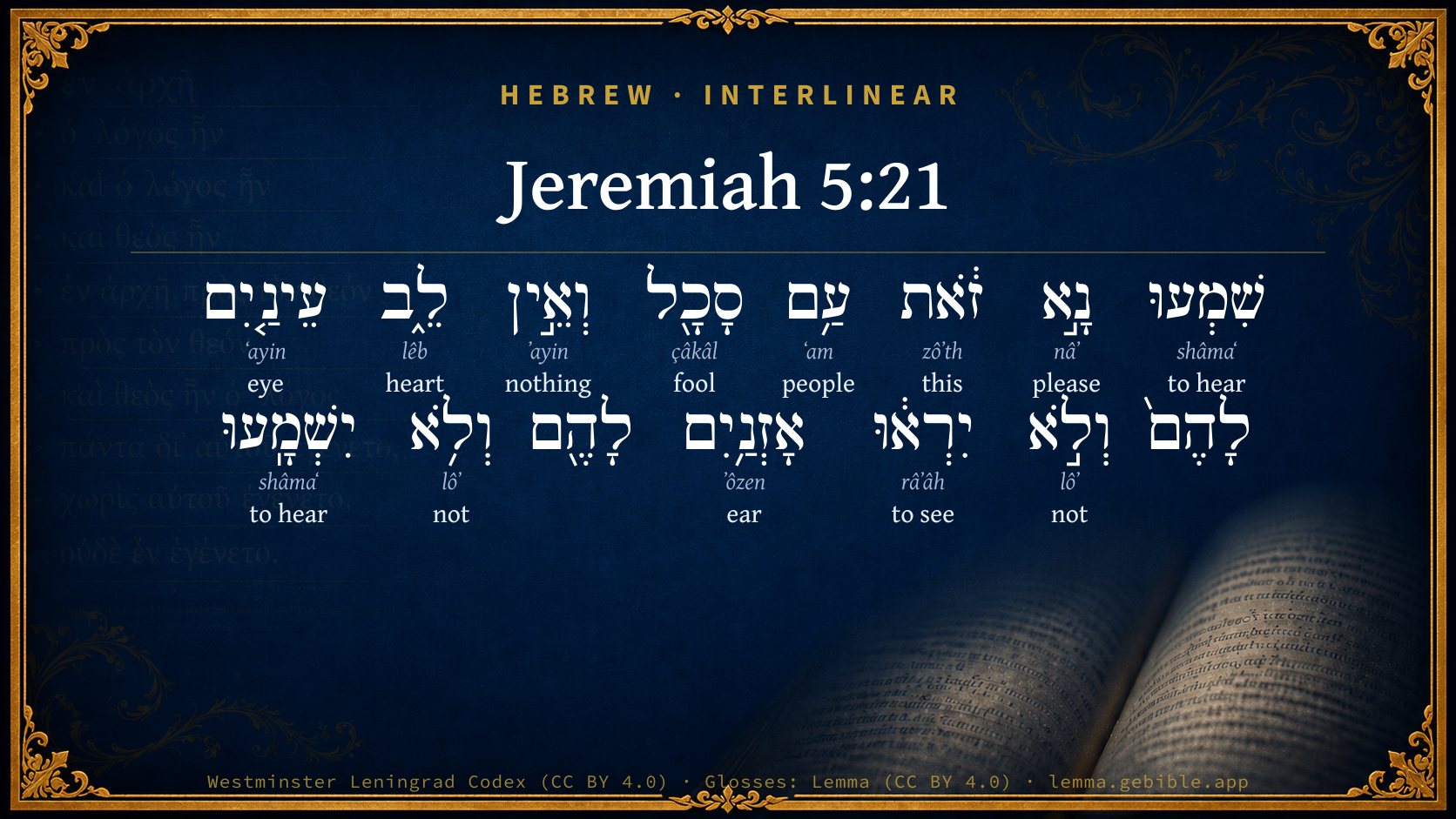
Jeremiah 5:21

Hebrew (Westminster Leningrad Codex) Jeremiah 5:21 appears in the Hebrew Old Testament. The text above is from the Westminster Leningrad Codex. Each word links to its Strong’s number, a concise gloss, and parsing drawn from the Open Scriptures Hebrew Bible morphology. Click any word for its full Brown-Driver-Briggs (BDB) entry.
Download image
Cite this verse

Jeremiah 5:21 (World English Bible). Public Domain. Lemma interlinear Bible study tool, https://lemma.gebible.app/v/jeremiah/5/21.

Show BibTeX & RIS
BibTeX
RIS
English Translation
Hear now this, foolish people, and without understanding; who have eyes, and don't see; who have ears, and don't hear:
World English Bible · Public Domain
Download a study sheet

One document with this verse’s original text, its word-by-word gloss line, the meaning frame, cross-references with their text, attributed commentary, and full source and license credits — printable, and it pastes into notes with its structure intact.

This verse Autodidact and up

Study sheet (.html) Plain text (.txt)

A passage Seminary Student

Up to 50 verses in one chapter. A passage sheet keeps up to 6 commentary sources and 12 cross-references per verse, in the order this page ranks them, and says so on the sheet whenever that leaves anything out. Ask for a single verse and you get the Autodidact verse sheet above.

Everything on this page stays free to read, with no account — the sheet is a download of what is already on screen, not access to it.

Want to remove ads? Support Godless Engineer
Compare translations 3

The same verse in 3 English versions, stacked beneath the original-language interlinear above. Click any original word for its lexicon entry.

Each is an independent rendering of the whole verse — the interlinear is not word-aligned to these translations.

Highlighted words mark where these versions differ — a whole-verse word diff, not a word-by-word alignment.

  • World English Bible Public Domain
    Hear now this, foolish people, and without understanding; who have eyes, and don't see; who have ears, and don't hear:
  • King James Version Public Domain
    Hear now this, O foolish people, and without understanding; which have eyes, and see not; which have ears, and hear not:
  • unfoldingWord Literal Text CC BY-SA 4.0
    ‘Hear this, please, foolish people and without heart; they have eyes but do not see; they have ears but do not hear.

unfoldingWord Literal Text — © unfoldingWord, licensed CC BY-SA 4.0. Word-aligned USFM3 via Door43 (git.door43.org/unfoldingWord/en_ult).

Versions to compare (up to 4)

3 of 4 selected

Show all 18 translations

Every available English version of this verse, each an independent rendering of the whole verse.

  • World English Bible Public Domain
    Hear now this, foolish people, and without understanding; who have eyes, and don't see; who have ears, and don't hear:
  • Berean Standard Bible Public Domain
    “Hear this, O foolish and senseless people, who have eyes but do not see, who have ears but do not hear.
  • Majority Standard Bible Public Domain
    “Hear this, O foolish and senseless people, who have eyes but do not see, who have ears but do not hear.
  • King James Version Public Domain
    Hear now this, O foolish people, and without understanding; which have eyes, and see not; which have ears, and hear not:
  • American Standard Version (1901) Public Domain
    Hear now this, O foolish people, and without understanding; that have eyes, and see not; that have ears, and hear not:
  • Revised Version (1885) Public Domain
    Hear now this, O foolish people, and without understanding; which have eyes, and see not; which have ears, and hear not:
  • Geneva Bible (1599) Public Domain
    Heare nowe this, O foolish people, and without vnderstanding, which haue eyes and see not, which haue eares and heare not.
  • Douay-Rheims (1899) Public Domain
    Hear, O foolish people, and without understanding: who have eyes, and see not: and ears, and hear not.
  • Young's Literal Translation Public Domain
    Hear ye, I pray you, this, O people, foolish and without heart, Eyes they have, and they see not, Ears they have, and they hear not.
  • Literal Standard Version CC BY-SA 4.0
    Now hear this, || O people, foolish and without heart, || They have eyes, and they do not see, || They have ears, and they do not hear.
  • Unlocked Literal Bible CC BY-SA 4.0
    'Hear this, you foolish people who have no understanding; who have eyes but you cannot see, and you have ears but you cannot hear.
  • unfoldingWord Literal Text CC BY-SA 4.0
    ‘Hear this, please, foolish people and without heart; they have eyes but do not see; they have ears but do not hear.
  • Darby Bible Public Domain
    Hear now this, O foolish and heartless people, who have eyes and see not; who have ears, and hear not.
  • World Messianic Bible Public Domain
    ‘Hear this now, foolish people without understanding, who have eyes, and don’t see, who have ears, and don’t hear:
  • Webster's Bible Public Domain
    Hear now this, O foolish people, and without understanding; who have eyes, and see not; who have ears, and hear not:
  • Free Bible Version CC BY-SA 4.0
    Listen to this, you foolish, stupid people, who have eyes but don't see, who have ears but don't hear.
  • Bible in Basic English Public Domain
    Give ear now to this, O foolish people without sense; who have eyes but see nothing, and ears without the power of hearing:
  • JPS Tanakh (1917) Public Domain
    Hear now this, O foolish people, and without understanding, that have eyes, and see not, that have ears, and hear not:

Literal Standard Version (2020), Covenant Press — licensed CC BY-SA 4.0. Text via the HelloAO Bible API (eBible.org). Unlocked Literal Bible (unfoldingWord) — licensed CC BY-SA 4.0. Text via the HelloAO Bible API (eBible.org). unfoldingWord Literal Text — © unfoldingWord, licensed CC BY-SA 4.0. Word-aligned USFM3 via Door43 (git.door43.org/unfoldingWord/en_ult). Free Bible Version, Dr. Jonathan Gallagher — licensed CC BY-SA 4.0. Text via the HelloAO Bible API (eBible.org).

Word by word

More ways to search: Search by grammar → Find every occurrence → Compare this word →

Practice this passage: Drill this verse → Learn its vocabulary →

סָכָ֖ל
çâkâl
H5530
“fool”
Noun, Common, Masculine, Singular, Absolute
Part of Speech
Noun
Type
Common
Gender
Masculine
Number
Singular
State
Absolute
Full BDB Definition

Origin: from H5528

TWOT: 1493a

fool
  1. שִׁמְעוּ shâmaʻ H8085 “hear” Verb, Qal, Imperative, 2nd Person, Masculine, Plural
  2. נָ֣א nâʼ H4994 “please” Particle, Exhortation
  3. זֹ֔את zôʼth H2063 “this” Pronoun, Demonstrative, Feminine, Singular
  4. עַ֥ם ʻam H5971 “people” Noun, Common, Masculine, Singular, Absolute
  5. וְאֵ֣ין ʼayin H369 “and · nothing” Conjunction + Particle, Negative
  6. לֵ֑ב lêb H3820 “heart” Noun, Common, Masculine, Singular, Absolute
  7. עֵינַ֤יִם ʻayin H5869 “eyes” Noun, Common, Both, Dual, Absolute
  8. וְלֹ֣א lôʼ H3808 “and · not” Conjunction + Particle, Negative
  9. יִרְא֔וּ râʼâh H7200 “to see” Verb, Qal, Imperfect, 3rd Person, Masculine, Plural
  10. אָזְנַ֥יִם ʼôzen H241 “ears” Noun, Common, Feminine, Dual, Absolute
  11. וְלֹ֥א lôʼ H3808 “and · not” Conjunction + Particle, Negative
  12. יִשְׁמָֽעוּ shâmaʻ H8085 “to hear” Verb, Qal, Imperfect, 3rd Person, Masculine, Plural

About this verse

These counts appear in no published source. They are computed here, from the morphology-tagged text and Lemma’s own curated glosses. What Lemma adds →

15
words
11
distinct lemmas
Prophets
section

Notable vocabulary

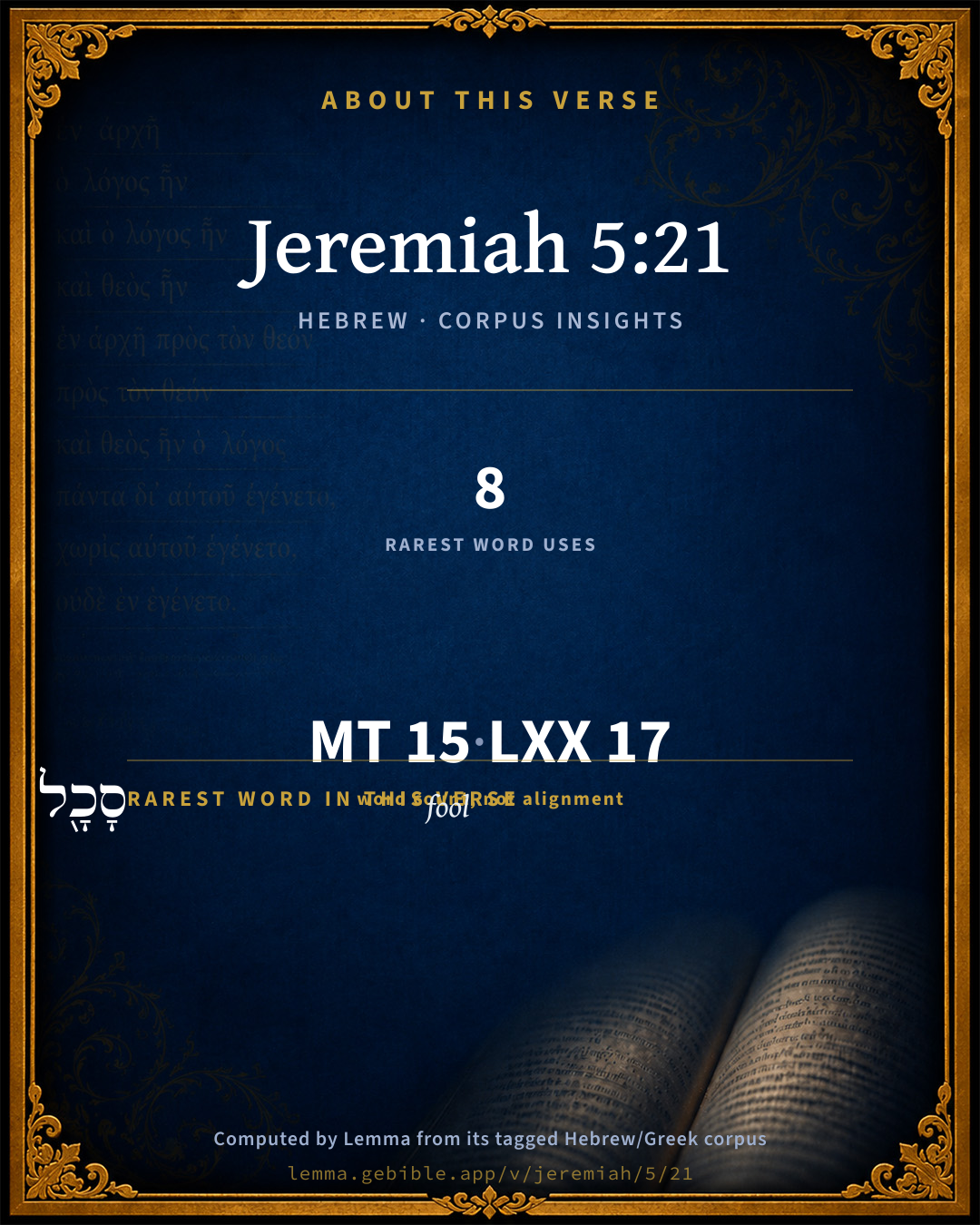
The rarest word here is סָכָ֖ל fool H5530 — appearing just 8 times in the whole Hebrew Bible.

Shared distinctive vocabulary

סָכָ֖ל fool H5530 occurs in 6 verses of the Hebrew Bible. Also found in:

Grammatical profile

  • 3 verbs
  • 5 nouns
  • 1 pronoun
  • 2 prepositions
  • 4 particles

Verb forms

  • שִׁמְעוּ Qal · Imperative
  • יִרְא֔וּ Qal · Imperfect
  • יִשְׁמָֽעוּ Qal · Imperfect

Repetition

Words recur within this verse — often emphatic in Hebrew:

  • שִׁמְעוּ to hear H8085 ×2
  • וְלֹ֣א not H3808 ×2

Hebrew & Septuagint length

In the original languages it is 15 Hebrew tokens and 17 Greek tokens — but the two are counted differently (Hebrew bundles its prefixes and suffixes into one token; the Greek is in lemma form), so that isn’t a like-for-like length.

Cross-references

18

Topical passages linked to Jeremiah 5:21 in the Treasury of Scripture Knowledge — connected by theme and wording, ordered by reader-vote popularity; previews shown in the World English Bible.

  • Ezekiel 12:2 Son of man, you dwell in the midst of the rebellious house, who have eyes to see, and don't see, who have ears to hear, and don't hear; for they are a rebellious house.
  • Acts 28:26 saying, 'Go to this people, and say, In hearing, you will hear, But will in no way understand. In seeing, you will see, But will in no way perceive.
  • Isaiah 6:9–10 He said, "Go, and tell this people, 'You hear indeed, But don't understand; And you see indeed, But don't perceive.'
  • Romans 11:8 According as it is written, "God gave them a spirit of stupor, eyes that they should not see, and ears that they should not hear, to this very day."
  • Jeremiah 4:22 For my people are foolish, they don't know me; they are foolish children, and they have no understanding; they are wise to do evil, but to do good they have no knowledge.
  • Matthew 13:13–15 Therefore I speak to them in parables, because seeing they don't see, and hearing, they don't hear, neither do they understand.
  • John 12:40 "He has blinded their eyes and he hardened their heart, Lest they should see with their eyes, And perceive with their heart, And would turn, And I would heal them."
  • Mark 8:18 Having eyes, don't you see? Having ears, don't you hear? Don't you remember?
  • Psalms 94:8 Consider, you senseless among the people; You fools, when will you be wise?
  • Jeremiah 8:7 Yes, the stork in the sky knows her appointed times; and the turtle-dove and the swallow and the crane observe the time of their coming; but my people don't know Yahweh's law.
  • Proverbs 17:16 Why is there money in the hand of a fool to buy wisdom, Seeing he has no understanding?
  • Isaiah 44:18 They don't know, neither do they consider: for he has shut their eyes, that they can't see; and their hearts, that they can't understand.
  • Jeremiah 5:4 Then I said, Surely these are poor; they are foolish; for they don't know the way of Yahweh, nor the law of their God:
  • Deuteronomy 29:4 but Yahweh has not given you a heart to know, and eyes to see, and ears to hear, to this day.
  • Deuteronomy 32:6 Do you thus requite Yahweh, Foolish people and unwise? Isn't he your father who has bought you? He has made you, and established you.
  • Isaiah 27:11 When the boughs of it are withered, they shall be broken off; the women shall come, and set them on fire; for it is a people of no understanding: therefore he who made them will not have compassion on them, and he who formed them will show them no favor.
  • Jeremiah 10:8 But they are together brutish and foolish: the instruction of idols! it is but a stock.
  • Hosea 7:11 "Ephraim is like an easily deceived dove, without understanding. They call to Egypt. They go to Assyria.

Cross-references courtesy of OpenBible.info (CC BY 4.0).

Hebrew and Greek witnesses Masoretic Hebrew ↔ Greek Septuagint

The same verse in the two great witnesses to the Old Testament, shown verse-for-verse.

These are two independent witnesses, not word-aligned to each other, and the Septuagint is shown in lemma (dictionary) form.

Hebrew Jeremiah 5:21 Masoretic · Westminster Leningrad Codex

שִׁמְעוּ נָ֣א זֹ֔את עַ֥ם סָכָ֖ל וְאֵ֣ין לֵ֑ב עֵינַ֤יִם לָהֶם֙ וְלֹ֣א יִרְא֔וּ אָזְנַ֥יִם לָהֶ֖ם וְלֹ֥א יִשְׁמָֽעוּ

Hear now this, foolish people, and without understanding; who have eyes, and don't see; who have ears, and don't hear:

World English Bible · Public Domain

Greek LXX Structure differs

In the Septuagint, Jeremiah is about an eighth shorter than the Hebrew and arranges its material differently — the Oracles Against the Nations (Hebrew chapters 46–51) appear in the middle of the Greek book, after 25:13. Because the chapter and verse boundaries do not line up, a verse-for-verse comparison with the Hebrew is not shown.

A verse-for-verse comparison isn’t shown here because the chapters and verses don’t line up. Switch to the LXX edition with the MT / LXX toggle above to read the Greek directly.

Hebrew: Westminster Leningrad Codex (CC BY 4.0). Greek: Septuagint (public domain); English from a public-domain English Septuagint. How the Septuagint differs from the Hebrew →

Targum (Aramaic paraphrase)

1

The Targum is the ancient Jewish Aramaic paraphrase of the Hebrew Scriptures — an interpretive translation, not the Hebrew text itself. Onkelos (literal) and Pseudo-Jonathan (expansive) render the Torah, and Jonathan the Prophets. Coverage is partial: where no permissively-licensed English translation exists for a verse, only the Aramaic is shown. This is verse-level text, not a word-by-word alignment to the Hebrew.

  1. Targum Jonathan Prophets (Joshua–Malachi)
    שְׁמָעוּ כְעַן דָא עַמָא טַפְּשָׁא וְלֵית לֵיהּ לֵב דְעַיְנִין לְהוֹן וְלָא חָזָן אוּדְנִין לְהוֹן וְלָא שְׁמָעִין:

    (no public-domain English translation for this verse)

    Targum Jonathan — Aramaic: “Mikraot Gedolot” (public domain). English: “Sefaria Community Translation” (CC0 1.0 (public-domain dedication)); “London "Chaldee Paraphrase," 1871” (public domain). Text via Sefaria.

Commentary

Notes on Jeremiah 5:21 from classic Christian and Jewish commentators (each source and its license shown beneath its notes). The classic Christian expositions comment on the surrounding passage and are grouped to its opening verse, so a note may address several verses; the Jewish commentaries on the Tanakh (Rashi and others) are per-verse, so they appear only where the commentator wrote on this verse.

Lemma curates 59 commentaries, every one of them public domain or Creative Commons licensed, each selected and text-cleaned for this edition rather than reprinted as found. About our sources →

Trapp's Complete Commentary

John Trapp

Jer 5:21 Hear now this, O foolish people, and without understanding; which have eyes, and see not; which have ears, and hear not:

Ver. 21. Hear now this, O foolish people.] They were strangely stupefied, and were therefore thus rippled up. Those that are in a lethargy must have a double quantity of physic to what others have.

And without understanding.] Heb., Without a heart. Cor sapit et pulmo loguitur, &c: The heart is the symbol and seat of wisdom. See Hos 7:11. {See Trapp on "Hos 7:11"}

Which have eyes, and see not, &c.] See Isa 6:9; Isa 42:20. Which have not senses habitually exercised to discern good and evil. {Heb 5:14}

John Trapp, A Commentary or Exposition upon All the Books of the Old and New Testament (1647–1656) — public domain. Text from a community e-Sword module.

Joseph Benson's Commentary

Jer 5:21. Hear this, O foolish people — Ignorant and imprudent, as blind to your interest as to your duty; and without understanding — Hebrew, ואין לב, and there is no heart, or without heart, stupid and regardless of all counsel, wisdom, and common sense. Which have eyes and see not, &c. — Wilfully blind, and obstinately deaf, who will neither see nor hear the word, will, or works of God; of which he gives two instances in the two following verses.

Joseph Benson's Commentary on the Old and New Testaments (1811–1818) — public domain. Text from a community e-Sword module.

Geneva Bible (1599)

Geneva Bible translators

Hebrew, without heart.

Geneva Bible (1599) marginal notes — public domain. Text via Bolls.life.

Jamieson, Fausset & Brown

Robert Jamieson, A. R. Fausset & David Brown

eyes . . . ears, and--Translate, "and yet" (compare Deu 29:4; Isa 6:9). Having powers of perception, they did not use them: still they were responsible for the exercise of them.

Jamieson, Fausset & Brown — Commentary Critical and Explanatory on the Whole Bible (1871) — public domain (CC PDM 1.0). Text via the HelloAO Bible API.

John Calvin's Commentaries

Declare ye then this; and what is it? Hear, O foolish people, etc. Here he first reproves the Jews and Israelites for their stupidity, because they were even without common sense; for the heart in Hebrew means the mind or understanding, as we have seen elsewhere. He then says, that this people were destitute of all understanding. He first calls them fatuous or foolish; but as many are slow and heavy and yet not without common sense, he adds that they were a people without heart or understanding. He seems indeed to add by way of correction, that they had eyes and ears: but his object was ironically to enhance what he had said, and to shew that they were stupid, and no less so than blocks of wood or stones. How so? “Ye have ears and eyes, “he says, “but ye neither see nor hear.”

He no doubt alludes to the idols to which they had become devoted: for it is said in Psalm 115:8, that those who made idols were like them, as well as those who trusted in them; for it had been previously said, that idols had ears but heard not, and eyes but saw not. Jeremiah then indirectly condemns the Jews here for having become so stupid in their superstitions as to be like dead idols: for there is in an idol some likeness to man; it has various members but no understanding. So also he says, the Jews had eyes and ears and the external form of men; but they were at the same time no less stupid than if they were stones or blocks of wood. Now follows the proclamation —

John Calvin's Commentaries (1540-1563) — public domain. Text from the Calvin Translation Society English edition (1840s-50s) via the Christian Classics Ethereal Library (ccel.org). Calvin's coverage is partial (roughly two-thirds of the Bible); uncommented books and verses are honest gaps, never fabricated. The 19th-century editor's footnotes and remarks are omitted so the notes are faithfully Calvin's own voice.

Ellicott's Commentary for English Readers

(21) Which have eyes, and see not.—An almost verbal reproduction from Isa_6:10.

A Bible Commentary for English Readers, edited by Charles John Ellicott (1878–1897) — public domain. Text from a community e-Sword module.

The Cambridge Bible for Schools and Colleges

gen. ed. J. J. S. Perowne

21. understanding] mg. Heb. heart, which was considered as the seat of intelligence. See Jer_24:7 (“an heart to know me”); Hos_7:11 (mg.).

The Cambridge Bible for Schools and Colleges (gen. ed. J. J. S. Perowne; Cambridge University Press, 1878–1918) — public domain. Text from a community e-Sword module.

John Gill's Exposition

Hear now this, O foolish people, and without understanding,.... or, "heart" (a); See Gill on Jer 4:22,

which have eyes, and see not; which have ears, and hear not; like the idols they served, Psa 115:4. this is an upbraiding of them with their folly and stupidity, their want of common sense, their blindness and ignorance; notwithstanding they had the means of light and knowledge, the law, and the prophets.

(a) "et non cor", Pagninus, Montanus; "qui non habes cor", V. L. "excors", Junius & Tremellius, Piscator; "cui cor non est", Cocceius.

John Gill's Exposition of the Whole Bible (1746–1763) — public domain (CC PDM 1.0). Text via the HelloAO Bible API.

Haydock's Catholic Bible Commentary

Understanding. Literally, "heart," chap. iv. 22. (Haydock)

George Leo Haydock (1774–1849), Haydock's Catholic Family Bible and Commentary, 1859 edition — public domain. Excludes Psalms (Douay-Rheims chapter numbering differs from Protestant) and Deuterocanonical books (Catholic canon only).

Matthew Poole's English Annotations

Without understanding, Heb. heart. They have no heart to return, or to any thing of instruction or reformation, but are stupid and sottish, regardless of all counsel, wisdom, and common prudence. The heart is said to be the symbol, and according to Galen the seat, of wisdom; so the poet placeth it, Cor sapit, et joulmo loquitur, fel commovet iram, &c.

Which have eyes, and see not; which have ears, and hear not: see Jer 6:10. They are wilfully blind, and obstinately deaf; will neither see nor hear the word, will, or works of God, of which he giveth two instances in two following verses, Jer 5:22,24, viz. in governing the sea, and appointing the seasons of the year. It may be he alludes herein to their idols, to which they were so much addicted.

Matthew Poole's English Annotations on the Holy Bible (1683–1685) — public domain. Text from a community e-Sword/MySword module.

Whedon's Commentary on the Bible

Daniel D. Whedon

21. Hear… this — The prophet strives to impress upon the people the greatness of their sin, and so of their folly. As in all cases of persistent wickedness it is such stupidity or insanity as men show who have eyes, and see not; or ears, and hear not.

Daniel D. Whedon (gen. ed.), Commentary on the Old and New Testaments (1874–1909) — public domain. Text from a community e-Sword module.

The Pulpit Commentary

Without understanding; literally, without heart. This seems at first sight inconsistent with ver. 23, where the people is described as having indeed a "heart," but one hostile to Jehovah. The explanation is that a course of deliberate sin perverts a man"s moral perceptions. The prophet first of all states the result, and then the cause. So in Eze_12:2, "Which have eyes and see not," etc.; "for they are a rebellions house."

The Pulpit Commentary (1880–1919), ed. H.D.M. Spence-Jones & Joseph S. Exell — public domain. Text from a community e-Sword module.

John Wesley's Explanatory Notes

And hear not - They are wilfully blind, and obstinately deaf, will neither see, nor hear the word, will, or works of God, of which he giveth two instances in the two following verses.

John Wesley, Explanatory Notes Upon the Whole Bible (1754–1765) — public domain. Text via the GEBible commentary corpus.

Lesson kit

Teaching starters — assembled from the data on this page, not authored interpretation. Every prompt links to the verse data it draws on. Edit before teaching.

Jeremiah, in the Prophets, opens this verse with 15 words (11 distinct Hebrew lemmas). Its most distinctive word is çâkâl (“fool”). A historical commentator’s framing appears above. Read the whole chapter for the surrounding context.

Discussion questions

  1. The word çâkâl carries the sense “fool.” How does it shape the verse?
  2. How does Ecclesiastes 2:19, which shares the word «fool», read alongside this verse?
  3. What does the repetition of “to hear” (2× in this one verse) do in this verse?
  4. The translations on this page render this verse differently — a whole-verse word diff, not a word-by-word alignment. What might account for the different wordings?
  5. «שִׁמְעוּ» is a Qal Imperative verb. How does that grammatical form shape the action described?
  6. Compare how Trapp's Complete Commentary and Joseph Benson's Commentary read this verse. Where do they agree or differ?

Things to notice

Reading settings

Reading text

Shown beneath each verse's original-language words.

Old Testament
Old Testament edition

Read the OT as the Masoretic Hebrew (MT) or the Greek Septuagint (LXX).

English shown for the Greek Septuagint (in the Hebrew ↔ Greek comparison).

Comparing translations? Open the Compare panel on any verse page to stack up to four side by side.