
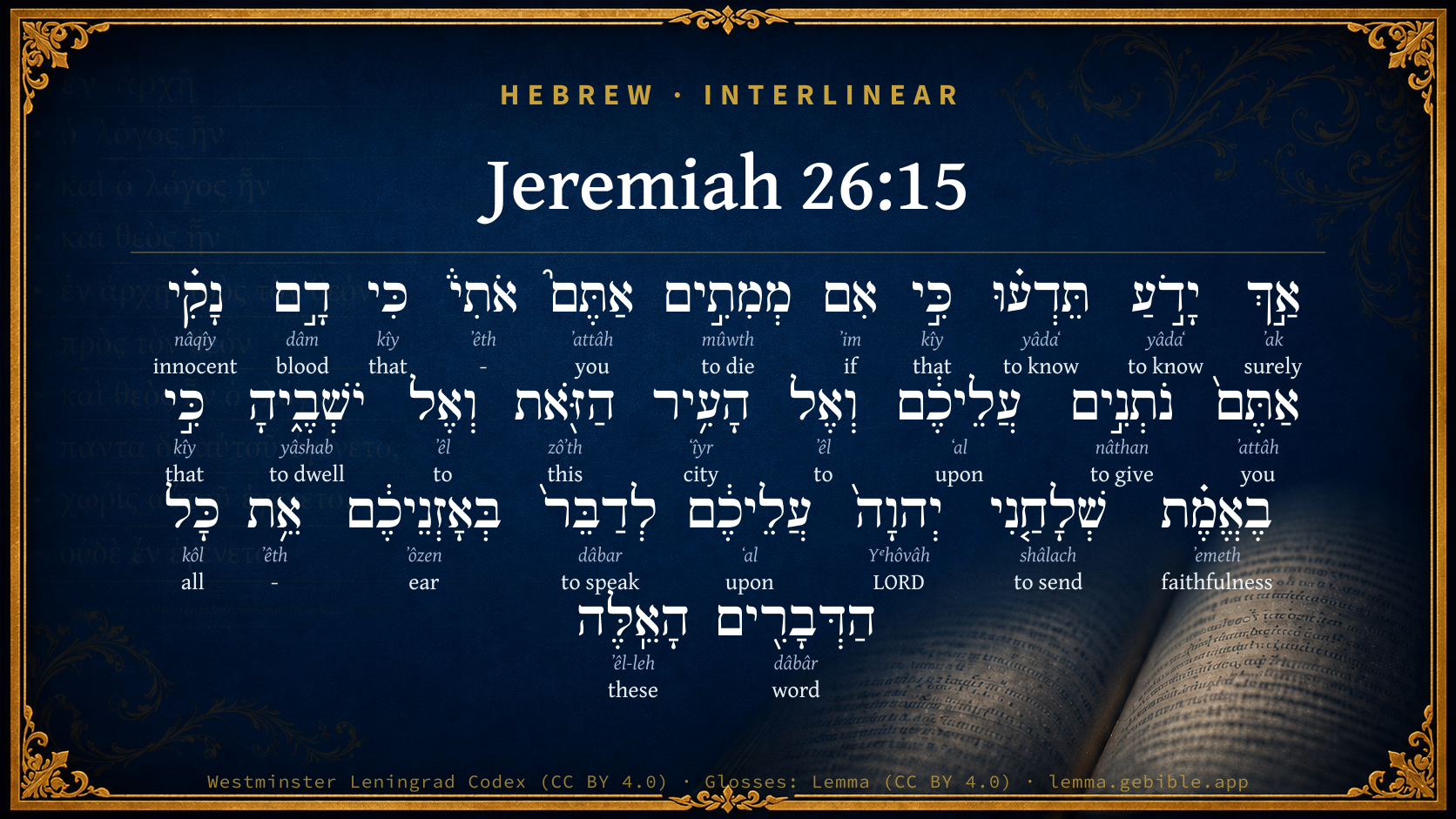
Jeremiah 26:15

Hebrew (Westminster Leningrad Codex) Jeremiah 26:15 appears in the Hebrew Old Testament. The text above is from the Westminster Leningrad Codex. Each word links to its Strong’s number, a concise gloss, and parsing drawn from the Open Scriptures Hebrew Bible morphology. Click any word for its full Brown-Driver-Briggs (BDB) entry.
Download image
Cite this verse

Jeremiah 26:15 (World English Bible). Public Domain. Lemma interlinear Bible study tool, https://lemma.gebible.app/v/jeremiah/26/15.

Show BibTeX & RIS
BibTeX
RIS
English Translation
Only know for certain that, if you put me to death, you will bring innocent blood on yourselves, and on this city, and on the inhabitants of it; for of a truth Yahweh has sent me to you to speak all these words in your ears.
World English Bible · Public Domain
Download a study sheet

One document with this verse’s original text, its word-by-word gloss line, the meaning frame, cross-references with their text, attributed commentary, and full source and license credits — printable, and it pastes into notes with its structure intact.

This verse Autodidact and up

Study sheet (.html) Plain text (.txt)

A passage Seminary Student

Up to 50 verses in one chapter. A passage sheet keeps up to 6 commentary sources and 12 cross-references per verse, in the order this page ranks them, and says so on the sheet whenever that leaves anything out. Ask for a single verse and you get the Autodidact verse sheet above.

Everything on this page stays free to read, with no account — the sheet is a download of what is already on screen, not access to it.

Want to remove ads? Support Godless Engineer
Compare translations 3

The same verse in 3 English versions, stacked beneath the original-language interlinear above. Click any original word for its lexicon entry.

Each is an independent rendering of the whole verse — the interlinear is not word-aligned to these translations.

Highlighted words mark where these versions differ — a whole-verse word diff, not a word-by-word alignment.

  • World English Bible Public Domain
    Only know for certain that, if you put me to death, you will bring innocent blood on yourselves, and on this city, and on the inhabitants of it; for of a truth Yahweh has sent me to you to speak all these words in your ears.
  • King James Version Public Domain
    But know ye for certain, that if ye put me to death, ye shall surely bring innocent blood upon yourselves, and upon this city, and upon the inhabitants thereof: for of a truth the LORD hath sent me unto you to speak all these words in your ears.
  • unfoldingWord Literal Text CC BY-SA 4.0
    Only, knowing you will know that if you are putting me to death, then you are putting innocent blood upon yourselves and upon this city and upon its dwellers, for in truth Yahweh has sent me to you to speak in your ears all these words.”

unfoldingWord Literal Text — © unfoldingWord, licensed CC BY-SA 4.0. Word-aligned USFM3 via Door43 (git.door43.org/unfoldingWord/en_ult).

Versions to compare (up to 4)

3 of 4 selected

Show all 18 translations

Every available English version of this verse, each an independent rendering of the whole verse.

  • World English Bible Public Domain
    Only know for certain that, if you put me to death, you will bring innocent blood on yourselves, and on this city, and on the inhabitants of it; for of a truth Yahweh has sent me to you to speak all these words in your ears.
  • Berean Standard Bible Public Domain
    But know for certain that if you put me to death, you will bring innocent blood upon yourselves, upon this city, and upon its residents; for truly the LORD has sent me to speak all these words in your hearing.”
  • Majority Standard Bible Public Domain
    But know for certain that if you put me to death, you will bring innocent blood upon yourselves, upon this city, and upon its residents; for truly the LORD has sent me to speak all these words in your hearing.”
  • King James Version Public Domain
    But know ye for certain, that if ye put me to death, ye shall surely bring innocent blood upon yourselves, and upon this city, and upon the inhabitants thereof: for of a truth the LORD hath sent me unto you to speak all these words in your ears.
  • American Standard Version (1901) Public Domain
    Only know ye for certain that, if ye put me to death, ye will bring innocent blood upon yourselves, and upon this city, and upon the inhabitants thereof; for of a truth Jehovah hath sent me unto you to speak all these words in your ears.
  • Revised Version (1885) Public Domain
    Only know ye for certain that, if ye put me to death, ye shall bring innocent blood upon yourselves, and upon this city, and upon the inhabitants thereof: for of a truth the LORD hath sent me unto you to speak all these words in your ears.
  • Geneva Bible (1599) Public Domain
    But knowe ye for certaine, that if ye put me to death, ye shall surely bring innocent blood vpon your selues, and vpon this citie, and vpon the inhabitants thereof: for of a trueth the Lord hath sent me vnto you, to speake all these words in your eares.
  • Douay-Rheims (1899) Public Domain
    But know ye, and understand, that if you put me to death, you will shed innocent blood against your own selves, and against this city, and the inhabitants thereof. For in truth the Lord sent me to you, to speak all these words in your hearing.
  • Young's Literal Translation Public Domain
    Only, know ye certainly, that if ye are putting me to death, surely innocent blood ye are putting on yourselves, and on this city, and on its inhabitants; for truly hath Jehovah sent me unto you to speak in your ears all these words.'
  • Literal Standard Version CC BY-SA 4.0
    only, certainly know that if you are putting me to death, you are surely putting innocent blood on yourselves, and on this city, and on its inhabitants; for YHWH has truly sent me to you to speak all these words in your ears.”
  • Unlocked Literal Bible CC BY-SA 4.0
    But you must surely know that if you kill me, then you are bringing innocent blood on yourselves and on this city and its inhabitants, for Yahweh has truly sent me to you to proclaim all these words for your ears.”
  • unfoldingWord Literal Text CC BY-SA 4.0
    Only, knowing you will know that if you are putting me to death, then you are putting innocent blood upon yourselves and upon this city and upon its dwellers, for in truth Yahweh has sent me to you to speak in your ears all these words.”
  • Darby Bible Public Domain
    only know for certain that if ye put me to death, ye shall surely bring innocent blood upon yourselves, and upon this city, and upon the inhabitants thereof; for of a truth Jehovah hath sent me unto you to speak all these words in your ears.
  • World Messianic Bible Public Domain
    Only know for certain that if you put me to death, you will bring innocent blood on yourselves, on this city, and on its inhabitants; for in truth the LORD has sent me to you to speak all these words in your ears.”
  • Webster's Bible Public Domain
    But know ye for certain, that if ye put me to death, ye will surely bring innocent blood upon yourselves, upon this city, and upon its inhabitants: for of a truth the LORD hath sent me to you to speak all these words in your ears.
  • Free Bible Version CC BY-SA 4.0
    But be careful, because you need to be aware that if you kill me, you will make yourselves, this city, and everyone who lives here guilty of murder, because it's true that the Lord sent me to tell you everything he said.”
  • Bible in Basic English Public Domain
    Only be certain that, if you put me to death, you will make yourselves and your town and its people responsible for the blood of one who has done no wrong: for truly, the Lord has sent me to you to say all these words in your ears.
  • JPS Tanakh (1917) Public Domain
    Only know ye for certain that, if ye put me to death, ye will bring innocent blood upon yourselves, and upon this city, and upon the inhabitants thereof; for of a truth the LORD hath sent me unto you to speak all these words in your ears.'

Literal Standard Version (2020), Covenant Press — licensed CC BY-SA 4.0. Text via the HelloAO Bible API (eBible.org). Unlocked Literal Bible (unfoldingWord) — licensed CC BY-SA 4.0. Text via the HelloAO Bible API (eBible.org). unfoldingWord Literal Text — © unfoldingWord, licensed CC BY-SA 4.0. Word-aligned USFM3 via Door43 (git.door43.org/unfoldingWord/en_ult). Free Bible Version, Dr. Jonathan Gallagher — licensed CC BY-SA 4.0. Text via the HelloAO Bible API (eBible.org).

Word by word

More ways to search: Search by grammar → Find every occurrence → Compare this word →

Practice this passage: Drill this verse → Learn its vocabulary →

נָקִ֗י
nâqîy
H5355
“innocent”
Adjective, Adjective, Masculine, Singular, Absolute
Part of Speech
Adjective
Type
Adjective
Gender
Masculine
Number
Singular
State
Absolute
Full BDB Definition

Origin: from H5352

TWOT: 1412a , 1412b

clean, free from, exempt, clear, innocent - free from guilt, clean, innocent - free from punishment - free or exempt from obligations - innocent
  1. אַ֣ךְ ʼak H389 “surely” Particle, Accusative
  2. יָדֹ֣עַ yâdaʻ H3045 “to know” Verb, Qal, Infinitive Absolute
  3. תֵּדְע֗וּ yâdaʻ H3045 “to know” Verb, Qal, Imperfect, 2nd Person, Masculine, Plural
  4. כִּ֣י kîy H3588 “that” Conjunction
  5. אִם ʼim H518 “if” Conjunction
  6. מְמִתִ֣ים mûwth H4191 “dying” Verb, Hiphil, Participle Active, Masculine, Plural, Absolute
  7. אַתֶּם֮ ʼattâh H859 “you” Pronoun, Personal, 2nd Person, Masculine, Plural
  8. אֹתִי֒ ʼêth H853 “- · me” Particle, Direct Object + Suffix, Personal, 1st Person, Common, Singular
  9. כִּי kîy H3588 “that” Conjunction
  10. דָ֣ם dâm H1818 “blood” Noun, Common, Masculine, Singular, Absolute
  11. אַתֶּם֙ ʼattâh H859 “you” Pronoun, Personal, 2nd Person, Masculine, Plural
  12. נֹתְנִ֣ים nâthan H5414 “giving” Verb, Qal, Participle Active, Masculine, Plural, Absolute
  13. עֲלֵיכֶ֔ם ʻal H5921 “upon · you” Preposition + Suffix, Personal, 2nd Person, Masculine, Plural
  14. וְאֶל ʼêl H413 “and · to” Conjunction + Preposition
  15. הָעִ֥יר ʻîyr H5892 “the · city” Particle, Definite Article + Noun, Common, Feminine, Singular, Absolute
  16. הַזֹּ֖את zôʼth H2063 “the · this” Particle, Definite Article + Pronoun, Demonstrative, Feminine, Singular
  17. וְאֶל ʼêl H413 “and · to” Conjunction + Preposition
  18. יֹשְׁבֶ֑יהָ yâshab H3427 “dwelling · her” Verb, Qal, Participle Active, Masculine, Plural, Construct + Suffix, Personal, 3rd Person, Feminine, Singular
  19. כִּ֣י kîy H3588 “that” Conjunction
  20. בֶאֱמֶ֗ת ʼemeth H571 “in/at · faithfulness” Preposition + Noun, Common, Feminine, Singular, Absolute
  21. שְׁלָחַ֤נִי shâlach H7971 “to send · me” Verb, Qal, Perfect, 3rd Person, Masculine, Singular + Suffix, Personal, 1st Person, Common, Singular
  22. יְהוָה֙ Yᵉhôvâh H3068 “LORD” Noun, Proper
  23. עֲלֵיכֶ֔ם ʻal H5921 “upon · you” Preposition + Suffix, Personal, 2nd Person, Masculine, Plural
  24. לְדַבֵּר֙ dâbar H1696 “to speak” Preposition + Verb, Piel, Infinitive Construct
  25. בְּאָזְנֵיכֶ֔ם ʼôzen H241 “in/at · ears · your” Preposition + Noun, Common, Feminine, Dual, Construct + Suffix, Personal, 2nd Person, Masculine, Plural
  26. אֵ֥ת ʼêth H853 “-” Particle, Direct Object
  27. כָּל kôl H3605 “all of” Noun, Common, Masculine, Singular, Construct
  28. הַדְּבָרִ֖ים dâbâr H1697 “the · words” Particle, Definite Article + Noun, Common, Masculine, Plural, Absolute
  29. הָאֵֽלֶּה ʼêl-leh H428 “the · these” Particle, Definite Article + Pronoun, Demonstrative, Common, Plural

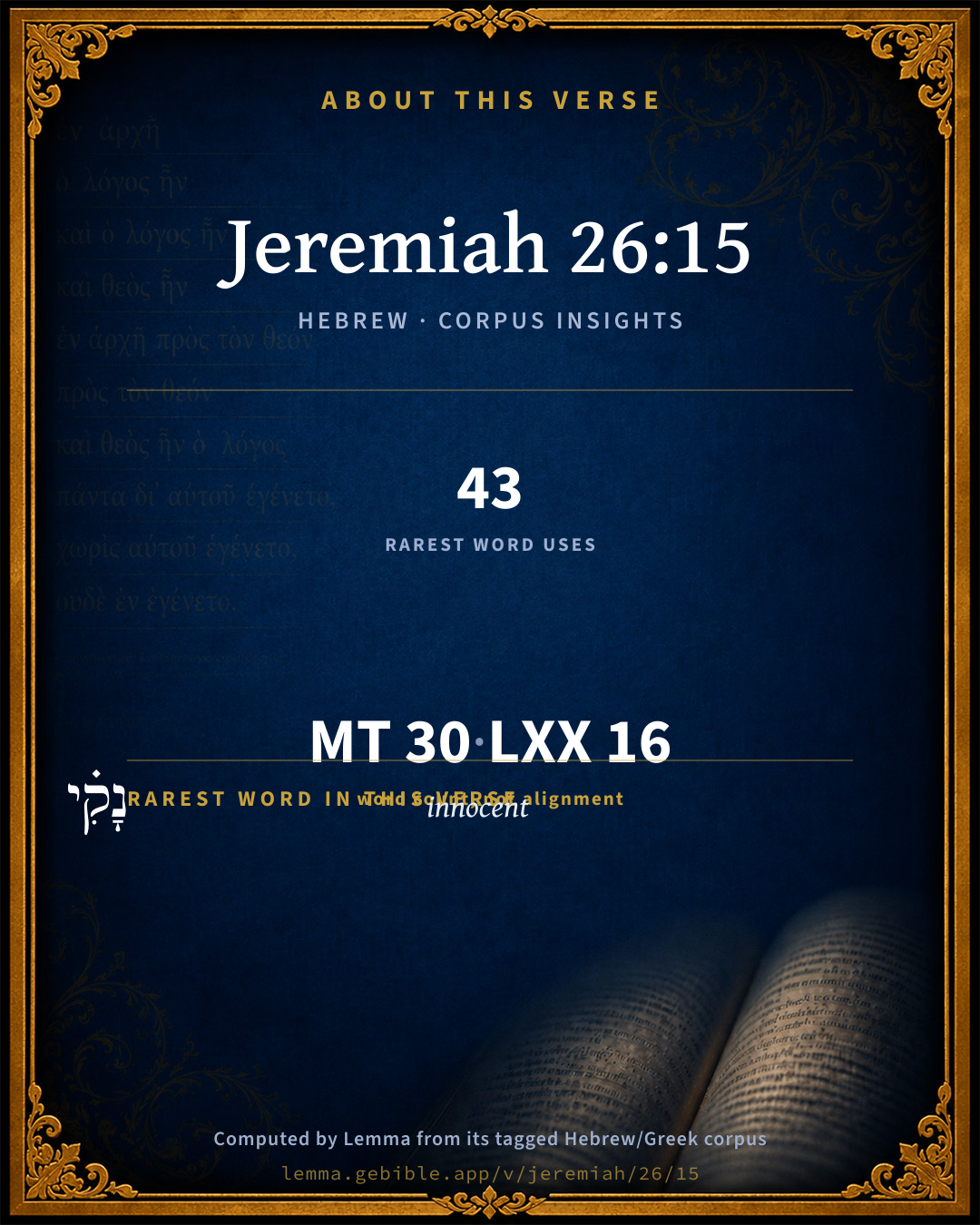
About this verse

These counts appear in no published source. They are computed here, from the morphology-tagged text and Lemma’s own curated glosses. What Lemma adds →

30
words
23
distinct lemmas
Prophets
section

Shared distinctive vocabulary

נָקִ֗י innocent H5355 occurs in 42 verses of the Hebrew Bible. Also found in:

Grammatical profile

  • 7 verbs
  • 7 nouns
  • 1 adjective
  • 4 pronouns
  • 4 prepositions
  • 4 conjunctions
  • 3 particles

Verb forms

  • יָדֹ֣עַ Qal · Infinitive Absolute
  • תֵּדְע֗וּ Qal · Imperfect
  • מְמִתִ֣ים Hiphil · Participle Active
  • נֹתְנִ֣ים Qal · Participle Active
  • יֹשְׁבֶ֑יהָ Qal · Participle Active
  • שְׁלָחַ֤נִי Qal · Perfect
  • לְדַבֵּר֙ Piel · Infinitive Construct

Repetition

Words recur within this verse — often emphatic in Hebrew:

  • יָדֹ֣עַ to know H3045 ×2
  • עֲלֵיכֶ֔ם upon H5921 ×2
  • כִּ֣י that H3588 ×3
  • אַתֶּם֮ you H859 ×2
  • וְאֶל to H413 ×2

Hebrew & Septuagint length

In the original languages it is 30 Hebrew tokens and 16 Greek tokens — but the two are counted differently (Hebrew bundles its prefixes and suffixes into one token; the Greek is in lemma form), so that isn’t a like-for-like length.

Cross-references

17

Topical passages linked to Jeremiah 26:15 in the Treasury of Scripture Knowledge — connected by theme and wording, ordered by reader-vote popularity; previews shown in the World English Bible.

  • Numbers 35:33 So you shall not pollute the land in which you are: for blood, it pollutes the land; and no expiation can be made for the land for the blood that is shed therein, but by the blood of him who shed it.
  • Proverbs 6:17 Haughty eyes, a lying tongue, Hands that shed innocent blood;
  • Jeremiah 7:6 if you don't oppress the foreigner, the fatherless, and the widow, and don't shed innocent blood in this place, neither walk after other gods to your own hurt:
  • Jeremiah 22:3 Thus says Yahweh: Execute you justice and righteousness, and deliver him who is robbed out of the hand of the oppressor: and do no wrong, do no violence, to the foreigner, the fatherless, nor the widow; neither shed innocent blood in this place.
  • Matthew 26:25 Judas, who betrayed him, answered, "It isn't me, is it, Rabbi?" He said to him, "You said it."
  • Acts 7:60 He kneeled down, and cried with a loud voice, "Lord, don't hold this sin against them!" When he had said this, he fell asleep.
  • Revelation 16:6 For they poured out the blood of the saints and the prophets, and you have given them blood to drink. They deserve this."
  • Genesis 4:10 Yahweh said, "What have you done? The voice of your brother's blood cries to me from the ground.
  • Genesis 42:22 Reuben answered them, saying, "Didn't I tell you, saying, 'Don't sin against the child,' and you wouldn't listen? Therefore also, behold, his blood is required."
  • Deuteronomy 19:10 that innocent blood not be shed in the midst of your land, which Yahweh your God gives you for an inheritance, and so blood be on you.
  • 2 Kings 24:4 and also for the innocent blood that he shed; for he filled Jerusalem with innocent blood: and Yahweh would not pardon.
  • Jeremiah 2:30 In vain have I struck your children; they received no correction: your own sword has devoured your prophets, like a destroying lion.
  • Jeremiah 2:34 Also in your skirts is found the blood of the souls of the innocent poor: you did not find them breaking in; but it is because of all these things.
  • Jeremiah 22:17 But your eyes and your heart are not but for your covetousness, and for shedding innocent blood, and for oppression, and for violence, to do it.
  • Matthew 23:30–36 and say, 'If we had lived in the days of our fathers, we wouldn't have been partakers with them in the blood of the prophets.'
  • Matthew 26:4 They took counsel together that they might take Jesus by deceit, and kill him.
  • 1 Thessalonians 2:15–16 who killed both the Lord Jesus and their own prophets, and drove us out, and didn't please God, and are contrary to all men;

Cross-references courtesy of OpenBible.info (CC BY 4.0).

Hebrew and Greek witnesses Masoretic Hebrew ↔ Greek Septuagint

The same verse in the two great witnesses to the Old Testament, shown verse-for-verse.

These are two independent witnesses, not word-aligned to each other, and the Septuagint is shown in lemma (dictionary) form.

Hebrew Jeremiah 26:15 Masoretic · Westminster Leningrad Codex

אַ֣ךְ יָדֹ֣עַ תֵּדְע֗וּ כִּ֣י אִם מְמִתִ֣ים אַתֶּם֮ אֹתִי֒ כִּי דָ֣ם נָקִ֗י אַתֶּם֙ נֹתְנִ֣ים עֲלֵיכֶ֔ם וְאֶל הָעִ֥יר הַזֹּ֖את וְאֶל יֹשְׁבֶ֑יהָ כִּ֣י בֶאֱמֶ֗ת שְׁלָחַ֤נִי יְהוָה֙ עֲלֵיכֶ֔ם לְדַבֵּר֙ בְּאָזְנֵיכֶ֔ם אֵ֥ת כָּל הַדְּבָרִ֖ים הָאֵֽלֶּה

Only know for certain that, if you put me to death, you will bring innocent blood on yourselves, and on this city, and on the inhabitants of it; for of a truth Yahweh has sent me to you to speak all these words in your ears.

World English Bible · Public Domain

Greek LXX Structure differs

In the Septuagint, Jeremiah is about an eighth shorter than the Hebrew and arranges its material differently — the Oracles Against the Nations (Hebrew chapters 46–51) appear in the middle of the Greek book, after 25:13. Because the chapter and verse boundaries do not line up, a verse-for-verse comparison with the Hebrew is not shown.

A verse-for-verse comparison isn’t shown here because the chapters and verses don’t line up. Switch to the LXX edition with the MT / LXX toggle above to read the Greek directly.

Hebrew: Westminster Leningrad Codex (CC BY 4.0). Greek: Septuagint (public domain); English from a public-domain English Septuagint. How the Septuagint differs from the Hebrew →

Targum (Aramaic paraphrase)

1

The Targum is the ancient Jewish Aramaic paraphrase of the Hebrew Scriptures — an interpretive translation, not the Hebrew text itself. Onkelos (literal) and Pseudo-Jonathan (expansive) render the Torah, and Jonathan the Prophets. Coverage is partial: where no permissively-licensed English translation exists for a verse, only the Aramaic is shown. This is verse-level text, not a word-by-word alignment to the Hebrew.

  1. Targum Jonathan Prophets (Joshua–Malachi)
    בְּרַם מֵידַע תֵּידְעוּן אֲרֵי אִם קַטְלִין אַתּוּן יָתִי אֲרֵי דַם זַכַּאי אַתּוּן יָהֲבִין עֲלֵיכוֹן וְעַל קַרְתָּא הָדָא וְעַל יַתְבָהָא אֲרֵי בִקְשׁוֹט שַׁלְחַנִי יְיָ עֲלֵיכוֹן לְאִתְנַבָּאָה קֳדָמֵיכוֹן יַת כָּל פִּתְגָמַיָא הָאִלֵין:

    (no public-domain English translation for this verse)

    Targum Jonathan — Aramaic: “Mikraot Gedolot” (public domain). English: “Sefaria Community Translation” (CC0 1.0 (public-domain dedication)); “London "Chaldee Paraphrase," 1871” (public domain). Text via Sefaria.

Commentary

Notes on Jeremiah 26:15 from classic Christian and Jewish commentators (each source and its license shown beneath its notes). The classic Christian expositions comment on the surrounding passage and are grouped to its opening verse, so a note may address several verses; the Jewish commentaries on the Tanakh (Rashi and others) are per-verse, so they appear only where the commentator wrote on this verse.

Lemma curates 59 commentaries, every one of them public domain or Creative Commons licensed, each selected and text-cleaned for this edition rather than reprinted as found. About our sources →

Trapp's Complete Commentary

John Trapp

Jer 26:15 But know ye for certain, that if ye put me to death, ye shall surely bring innocent blood upon yourselves, and upon this city, and upon the inhabitants thereof: for of a truth the LORD hath sent me unto you to speak all these words in your ears.

Ver. 15. Ye shall surely bring innocent blood, &c.] So Mr Rogers, our proto-martyr in Queen Mary’s days: If God, said he, look not mercifully upon England, the seeds of utter destruction are sown in it already by these hypocritical tyrants, and Antichristian prelates, double traitors to their native country. {a}

{a} Acts and Mon.

John Trapp, A Commentary or Exposition upon All the Books of the Old and New Testament (1647–1656) — public domain. Text from a community e-Sword module.

Jamieson, Fausset & Brown

Robert Jamieson, A. R. Fausset & David Brown

bring . . . upon yourselves--So far will you be from escaping the predicted evils by shedding my blood, that you will, by that very act, only incur heavier penalties (Mat 23:35).

Jamieson, Fausset & Brown — Commentary Critical and Explanatory on the Whole Bible (1871) — public domain (CC PDM 1.0). Text via the HelloAO Bible API.

John Calvin's Commentaries

We now, then, see in what sense Jeremiah regarded his life as in the hand of his enemies, not that he thought himself cast away by God, but that he acknowledged that loosened reins were given to the wicked to rage against him. But we must at the same time bear in mind why he said this; after having conceded that his life was in their hand, he adds, yet knowing know ye, that if ye kill me, ye will bring innocent blood upon yourselves. But he had said before that they might do what seemed them good and right Good and right here is not to be taken for a judgment formed according to the rule of justice, but for a sentence formed iniquitously according to their own will. This is a common mode of speaking in Hebrew. Jeremiah then testifies that he was not solicitous about his life, for he was prepared to offer himself, as it were, as a sacrifice, if the rage of his enemies should go so far. But in warning them to beware of God’s vengeance, his object was not his own safety, but it was to stimulate them to repentance. He then plainly says that he did not fear death, for the Lord would presently shew himself to be his avenger, and that his blood also would be so precious in the sight of God, that the whole city, together with the people, would be punished, were they to deal unjustly with him.

But let us attend to what follows, even that God had sent him. He now takes this principle as granted, that it could not be that God would forsake his servants, to whom he has promised aid when oppressed by the ungodly. God, indeed, ever exhorts his ministers to patience, and he would have them to be prepared for death whenever there is need; yet he promises to bring them help in distress. Jeremiah then relied on this promise, and was thus persuaded that it could not be that God would forsake him; for he cannot disappoint his people, nor forfeit his faith pledged to them. As, then, he was fully persuaded of his own calling, and knew that God was the author of all his preaching, he boldly concluded that his blood could not be shed with impunity. All faithful teachers ought to encourage themselves, for the purpose of discharging strenuously the duties of their office, with this confidence, — that God who has committed to them their office can never forsake them, but will ever bring them help as far as it may be necessary. It now follows, —

John Calvin's Commentaries (1540-1563) — public domain. Text from the Calvin Translation Society English edition (1840s-50s) via the Christian Classics Ethereal Library (ccel.org). Calvin's coverage is partial (roughly two-thirds of the Bible); uncommented books and verses are honest gaps, never fabricated. The 19th-century editor's footnotes and remarks are omitted so the notes are faithfully Calvin's own voice.

Ellicott's Commentary for English Readers

(15) But know ye for certain.—Literally, with the Hebrew emphasis of reduplication, Knowing, know ye. The appeal is addressed, it will be remembered, to the lay judges, the princes, and the people, not to the priests and prophets who accused him. He believes that they at least would shrink from shedding innocent blood. And he solemnly protests that he is innocent of any wilful attack upon what his countrymen revered. He has spoken, but it has been by a constraint above his own will. A “necessity has been laid upon him” (1Co_9:16).

A Bible Commentary for English Readers, edited by Charles John Ellicott (1878–1897) — public domain. Text from a community e-Sword module.

John Gill's Exposition

But know ye for certain, that if ye put me to death,.... Take this along with you, and then do as you will; that if ye take away my life on this account, you may depend upon it; nothing is more certain than this:

ye shall surely bring innocent blood upon yourselves, and upon this city, and upon the inhabitants thereof; that is, the guilt of innocent blood, which would cry for vengeance upon them that brought the accusation, and insisted upon his being brought in guilty; and upon those that sat in judgment, and condemned him; and upon all the inhabitants of the city of Jerusalem, who should agree to the putting him to death:

for of a truth the Lord hath sent me unto you to speak all these words in your ears; and therefore I am no false prophet, and am clear of the charge brought against me; and have said nothing but what I had a mission and an order from the Lord for, of which you may assure yourselves; and therefore he will avenge my blood, should it be shed on that account; so that you will only increase your guilt, and add to that great load that lies upon you, and will be your ruin, unless you repent and reform.

John Gill's Exposition of the Whole Bible (1746–1763) — public domain (CC PDM 1.0). Text via the HelloAO Bible API.

Haydock's Catholic Bible Commentary

Sent me. This was a complete justification. (Calmet) --- None could deny but Jeremias had all the characters of a true prophet, ver. 16. (Haydock)

George Leo Haydock (1774–1849), Haydock's Catholic Family Bible and Commentary, 1859 edition — public domain. Excludes Psalms (Douay-Rheims chapter numbering differs from Protestant) and Deuterocanonical books (Catholic canon only).

Matthew Poole's English Annotations

If you make this sedition, and put me to death for it, you have a natural power to do it, but you will get nothing by it, but further bring down the vengeance of God upon you by shedding my blood without a cause, the guilt of which will be added to your other guilt, and lie upon you, and upon your city: for you may think and talk what you please, it is a certain truth, that I spake nothing out of any evil design, nor of my own head; but only what the Lord sent me to speak.

Matthew Poole's English Annotations on the Holy Bible (1683–1685) — public domain. Text from a community e-Sword/MySword module.

Lesson kit

Teaching starters — assembled from the data on this page, not authored interpretation. Every prompt links to the verse data it draws on. Edit before teaching.

Jeremiah, in the Prophets, opens this verse with 30 words (23 distinct Hebrew lemmas). Its most distinctive word is nâqîy (“innocent”). A historical commentator’s framing appears above. Read the whole chapter for the surrounding context.

Discussion questions

  1. The word nâqîy carries the sense “innocent.” How does it shape the verse?
  2. How does Genesis 24:41, which shares the word «innocent», read alongside this verse?
  3. What does the repetition of “to know” (2× in this one verse) do in this verse?
  4. These translations render this verse differently. What is at stake in choosing one wording over another?
  5. «יָדֹ֣עַ» is a Qal Infinitive Absolute verb. How does that grammatical form shape the action described?
  6. Compare how Trapp's Complete Commentary and Jamieson, Fausset & Brown read this verse. Where do they agree or differ?

Things to notice

Reading settings

Reading text

Shown beneath each verse's original-language words.

Old Testament
Old Testament edition

Read the OT as the Masoretic Hebrew (MT) or the Greek Septuagint (LXX).

English shown for the Greek Septuagint (in the Hebrew ↔ Greek comparison).

Comparing translations? Open the Compare panel on any verse page to stack up to four side by side.