
Numbers 11:18

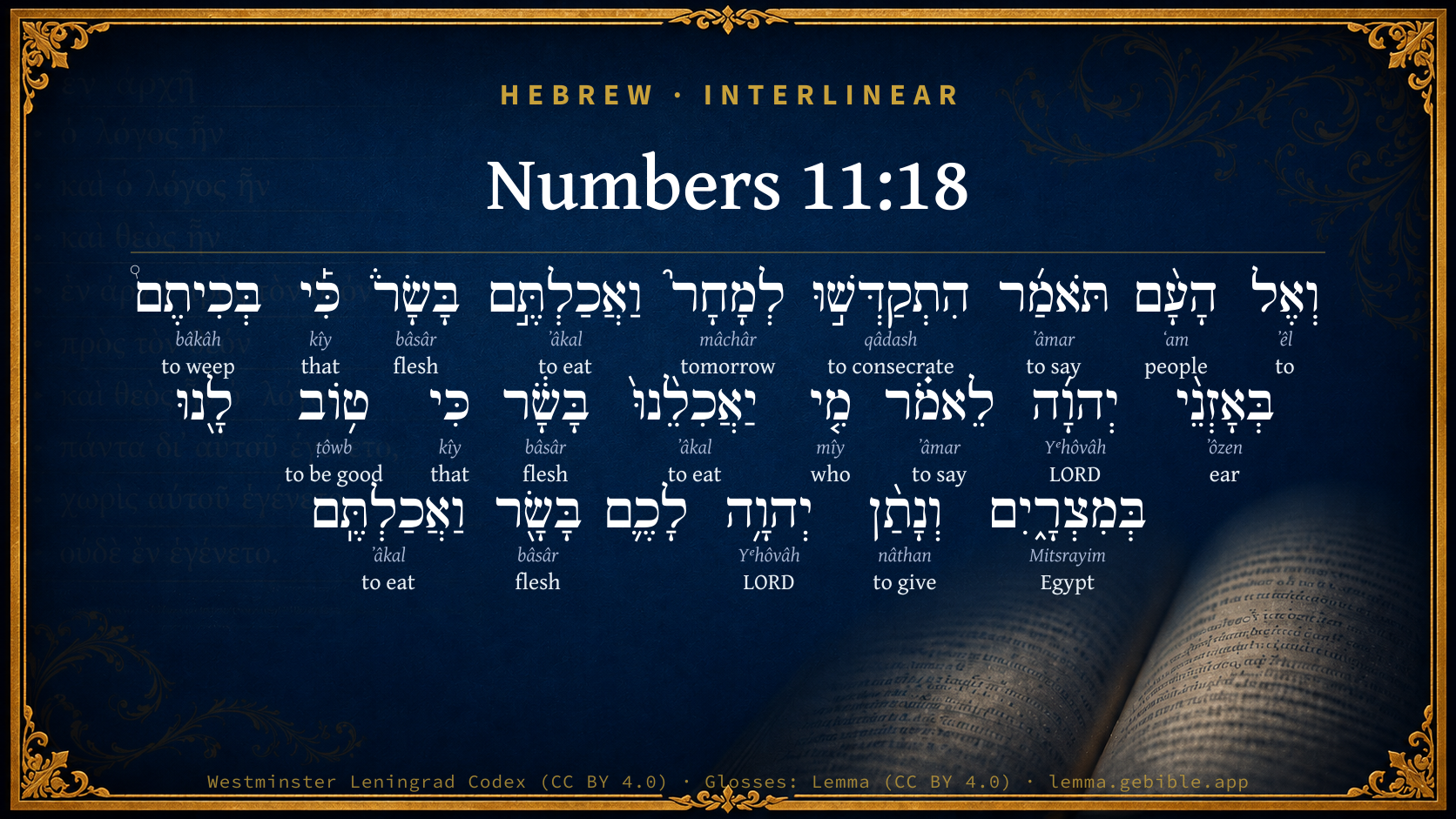
Hebrew (Westminster Leningrad Codex) Numbers 11:18 appears in the Hebrew Old Testament. The text above is from the Westminster Leningrad Codex. Each word links to its Strong’s number, a concise gloss, and parsing drawn from the Open Scriptures Hebrew Bible morphology. Click any word for its full Brown-Driver-Briggs (BDB) entry.
Download image
Cite this verse

Numbers 11:18 (World English Bible). Public Domain. Lemma interlinear Bible study tool, https://lemma.gebible.app/v/numbers/11/18.

Show BibTeX & RIS
BibTeX
RIS
English Translation
Say you to the people, Sanctify yourselves against tomorrow, and you shall eat flesh; for you have wept in the ears of Yahweh, saying, Who shall give us flesh to eat? for it was well with us in Egypt: therefore Yahweh will give you flesh, and you shall eat.
World English Bible · Public Domain
Highlights
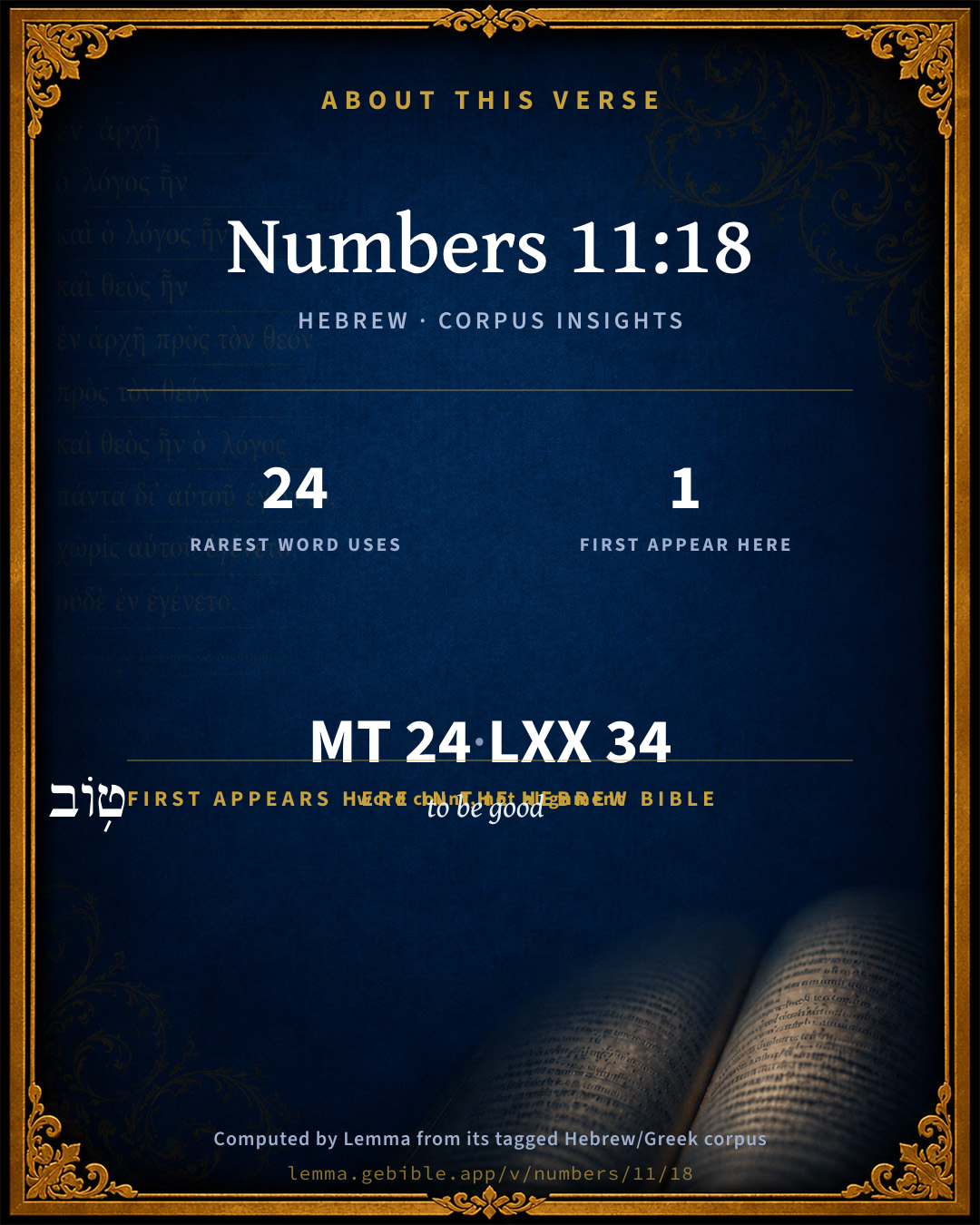
  • 1 first appearance in the Hebrew Bible
Full analysis ↓
Download a study sheet

One document with this verse’s original text, its word-by-word gloss line, the meaning frame, cross-references with their text, attributed commentary, and full source and license credits — printable, and it pastes into notes with its structure intact.

This verse Autodidact and up

Study sheet (.html) Plain text (.txt)

A passage Seminary Student

Up to 50 verses in one chapter. A passage sheet keeps up to 6 commentary sources and 12 cross-references per verse, in the order this page ranks them, and says so on the sheet whenever that leaves anything out. Ask for a single verse and you get the Autodidact verse sheet above.

Everything on this page stays free to read, with no account — the sheet is a download of what is already on screen, not access to it.

Want to remove ads? Support Godless Engineer
Compare translations 3

The same verse in 3 English versions, stacked beneath the original-language interlinear above. Click any original word for its lexicon entry.

Each is an independent rendering of the whole verse — the interlinear is not word-aligned to these translations.

Highlighted words mark where these versions differ — a whole-verse word diff, not a word-by-word alignment.

  • World English Bible Public Domain
    Say you to the people, Sanctify yourselves against tomorrow, and you shall eat flesh; for you have wept in the ears of Yahweh, saying, Who shall give us flesh to eat? for it was well with us in Egypt: therefore Yahweh will give you flesh, and you shall eat.
  • King James Version Public Domain
    And say thou unto the people, Sanctify yourselves against to morrow, and ye shall eat flesh: for ye have wept in the ears of the LORD, saying, Who shall give us flesh to eat? for it was well with us in Egypt: therefore the LORD will give you flesh, and ye shall eat.
  • unfoldingWord Literal Text CC BY-SA 4.0
    And to the people you shall say, ‘Consecrate yourselves for tomorrow, and you shall eat flesh. For you wept in the ears of Yahweh, saying, “Who will feed us flesh? For good for us in Egypt.” And Yahweh shall give to you flesh, and you shall eat.

unfoldingWord Literal Text — © unfoldingWord, licensed CC BY-SA 4.0. Word-aligned USFM3 via Door43 (git.door43.org/unfoldingWord/en_ult).

Versions to compare (up to 4)

3 of 4 selected

Show all 18 translations

Every available English version of this verse, each an independent rendering of the whole verse.

  • World English Bible Public Domain
    Say you to the people, Sanctify yourselves against tomorrow, and you shall eat flesh; for you have wept in the ears of Yahweh, saying, Who shall give us flesh to eat? for it was well with us in Egypt: therefore Yahweh will give you flesh, and you shall eat.
  • Berean Standard Bible Public Domain
    And say to the people: Consecrate yourselves for tomorrow, and you will eat meat, because you have cried out in the hearing of the LORD, saying: ‘Who will feed us meat? For we were better off in Egypt!’ Therefore the LORD will give you meat, and you will eat.
  • Majority Standard Bible Public Domain
    And say to the people: Consecrate yourselves for tomorrow, and you will eat meat, because you have cried out in the hearing of the LORD, saying: ‘Who will feed us meat? For we were better off in Egypt!’ Therefore the LORD will give you meat, and you will eat.
  • King James Version Public Domain
    And say thou unto the people, Sanctify yourselves against to morrow, and ye shall eat flesh: for ye have wept in the ears of the LORD, saying, Who shall give us flesh to eat? for it was well with us in Egypt: therefore the LORD will give you flesh, and ye shall eat.
  • American Standard Version (1901) Public Domain
    And say thou unto the people, Sanctify yourselves against to-morrow, and ye shall eat flesh; for ye have wept in the ears of Jehovah, saying, Who shall give us flesh to eat? for it was well with us in Egypt: therefore Jehovah will give you flesh, and ye shall eat.
  • Revised Version (1885) Public Domain
    And say thou unto the people, Sanctify yourselves against tomorrow, and ye shall eat flesh: for ye have wept in the ears of the LORD, saying, Who shall give us flesh to eat? for it was well with us in Egypt: therefore the LORD will give you flesh, and ye shall eat.
  • Geneva Bible (1599) Public Domain
    Furthermore thou shalt saye vnto the people, Bee sanctified against to morowe, and yee shall eate flesh: for you haue wept in the eares of the Lord, saying, Who shall giue vs flesh to eate? for we were better in Egypt: therefore the Lord will giue you flesh, and ye shall eate.
  • Douay-Rheims (1899) Public Domain
    And thou shalt say to the people: Be ye sanctified: to morrow you shall eat flesh: for I have heard you say: Who will give us flesh to eat? it was well with us in Egypt. That the Lord may give you flesh, and you may eat:
  • Young's Literal Translation Public Domain
    `And unto the people thou dost say, Sanctify yourselves for to-morrow, and ye have eaten flesh (for ye have wept in the ears of Jehovah, saying, Who doth give us flesh? for we `had' good in Egypt) -- and Jehovah hath given to you flesh, and ye have eaten.
  • Literal Standard Version CC BY-SA 4.0
    And you say to the people: Sanctify yourselves for tomorrow, and you have eaten flesh, for you have wept in the ears of YHWH, saying, Who gives us flesh? For we [had] good in Egypt; and YHWH has given flesh to you, and you have eaten.
  • Unlocked Literal Bible CC BY-SA 4.0
    Say to the people, 'Consecrate yourselves, for tomorrow and you will indeed eat meat, for you have wept and Yahweh has heard. You said, “Who will give us meat to eat? It was good for us in Egypt.” Therefore Yahweh will give you meat, and you will eat it.
  • unfoldingWord Literal Text CC BY-SA 4.0
    And to the people you shall say, ‘Consecrate yourselves for tomorrow, and you shall eat flesh. For you wept in the ears of Yahweh, saying, “Who will feed us flesh? For good for us in Egypt.” And Yahweh shall give to you flesh, and you shall eat.
  • Darby Bible Public Domain
    And unto the people shalt thou say, Hallow yourselves for to-morrow, and ye shall eat flesh; for ye have wept in the ears of Jehovah, saying, Who will give us flesh to eat? for it was well with us in Egypt; and Jehovah will give you flesh, and ye shall eat.
  • World Messianic Bible Public Domain
    “Say to the people, ‘Sanctify yourselves in preparation for tomorrow, and you will eat meat; for you have wept in the ears of the LORD, saying, “Who will give us meat to eat? For it was well with us in Egypt.” Therefore the LORD will give you meat, and you will eat.
  • Webster's Bible Public Domain
    And say thou to the people, Sanctify yourselves against to-morrow, and ye shall eat flesh; for ye have wept in the ears of the LORD, saying, Who shall give us flesh to eat? for it was well with us in Egypt: therefore the LORD will give you flesh, and ye shall eat.
  • Free Bible Version CC BY-SA 4.0
    Tell the people: Purify yourselves, for tomorrow you'll have meat to eat, because you were complaining and the Lord heard you saying, ‘Who's going to get us some meat to eat? We were better off in Egypt!’ So the Lord is going to provide you with meat to eat.
  • Bible in Basic English Public Domain
    And say to the people, Make yourselves clean before tomorrow and you will have flesh for your food: for in the ears of the Lord you have been weeping and saying, Who will give us flesh for food? for we were well off in Egypt: and so the Lord will give you flesh, and it will be your food;
  • JPS Tanakh (1917) Public Domain
    And say thou unto the people: Sanctify yourselves against to-morrow, and ye shall eat flesh; for ye have wept in the ears of the LORD, saying: Would that we were given flesh to eat! for it was well with us in Egypt; therefore the LORD will give you flesh, and ye shall eat.

Literal Standard Version (2020), Covenant Press — licensed CC BY-SA 4.0. Text via the HelloAO Bible API (eBible.org). Unlocked Literal Bible (unfoldingWord) — licensed CC BY-SA 4.0. Text via the HelloAO Bible API (eBible.org). unfoldingWord Literal Text — © unfoldingWord, licensed CC BY-SA 4.0. Word-aligned USFM3 via Door43 (git.door43.org/unfoldingWord/en_ult). Free Bible Version, Dr. Jonathan Gallagher — licensed CC BY-SA 4.0. Text via the HelloAO Bible API (eBible.org).

Word by word

More ways to search: Search by grammar → Find every occurrence → Compare this word →

Practice this passage: Drill this verse → Learn its vocabulary →

ט֥וֹב
ṭôwb
H2895
“to be good”
Verb, Qal, Perfect, 3rd Person, Masculine, Singular
Part of Speech
Verb
Stem
Qal
Form
Perfect
Person
3rd Person
Gender
Masculine
Number
Singular
Full BDB Definition

Origin: a primitive root

TWOT: 793

to be good, be pleasing, be joyful, be beneficial, be pleasant, be favourable, be happy, be right - (Qal) - to be pleasant, be delightful - to be glad, be joyful - to be better - to be well with, be good for - to be pleasing - (Hiphil) to do well, do good, act right, act rightly
  1. וְאֶל ʼêl H413 “and · to” Conjunction + Preposition
  2. הָעָ֨ם ʻam H5971 “the · people” Particle, Definite Article + Noun, Common, Masculine, Singular, Absolute
  3. תֹּאמַ֜ר ʼâmar H559 “to say” Verb, Qal, Imperfect, 2nd Person, Masculine, Singular
  4. הִתְקַדְּשׁ֣וּ qâdash H6942 “consecrate” Verb, Hithpael, Imperative, 2nd Person, Masculine, Plural
  5. לְמָחָר֮ mâchâr H4279 “to/for · tomorrow” Preposition + Noun, Common, Masculine, Singular, Absolute
  6. וַאֲכַלְתֶּ֣ם ʼâkal H398 “and · to eat” Conjunction + Verb, Qal, Sequential Perfect, 2nd Person, Masculine, Plural
  7. בָּשָׂר֒ bâsâr H1320 “flesh” Noun, Common, Masculine, Singular, Absolute
  8. כִּ֡י kîy H3588 “that” Conjunction
  9. בְּכִיתֶם֩ bâkâh H1058 “to weep” Verb, Qal, Perfect, 2nd Person, Masculine, Plural
  10. בְּאָזְנֵ֨י ʼôzen H241 “in/at · ears of” Preposition + Noun, Common, Feminine, Dual, Construct
  11. יְהוָ֜ה Yᵉhôvâh H3068 “LORD” Noun, Proper
  12. לֵאמֹ֗ר ʼâmar H559 “to say” Preposition + Verb, Qal, Infinitive Construct
  13. מִ֤י mîy H4310 “who” Particle, Interrogative
  14. יַאֲכִלֵ֨נוּ֙ ʼâkal H398 “to eat · us” Verb, Hiphil, Imperfect, 3rd Person, Masculine, Singular + Suffix, Personal, 1st Person, Common, Plural
  15. בָּשָׂ֔ר bâsâr H1320 “flesh” Noun, Common, Masculine, Singular, Absolute
  16. כִּי kîy H3588 “that” Conjunction
  17. בְּמִצְרָ֑יִם Mitsrayim H4714 “in/at · Egypt” Preposition + Noun, Proper
  18. וְנָתַ֨ן nâthan H5414 “and · to give” Conjunction + Verb, Qal, Sequential Perfect, 3rd Person, Masculine, Singular
  19. יְהוָ֥ה Yᵉhôvâh H3068 “LORD” Noun, Proper
  20. בָּשָׂ֖ר bâsâr H1320 “flesh” Noun, Common, Masculine, Singular, Absolute
  21. וַאֲכַלְתֶּֽם ʼâkal H398 “and · to eat” Conjunction + Verb, Qal, Sequential Perfect, 2nd Person, Masculine, Plural

About this verse

These counts appear in no published source. They are computed here, from the morphology-tagged text and Lemma’s own curated glosses. What Lemma adds →

24
words
15
distinct lemmas
Pentateuch
section

Notable vocabulary

The rarest word here is ט֥וֹב to be good H2895 — appearing just 24 times in the whole Hebrew Bible.

First appearance in Scripture

This word makes its first canonical appearance in the Hebrew Bible here:

  • ט֥וֹב to be good H2895

Shared distinctive vocabulary

ט֥וֹב to be good H2895 occurs in 24 verses of the Hebrew Bible. Also found in:

Grammatical profile

  • 9 verbs
  • 9 nouns
  • 3 prepositions
  • 2 conjunctions
  • 1 particle

Verb forms

  • תֹּאמַ֜ר Qal · Imperfect
  • הִתְקַדְּשׁ֣וּ Hithpael · Imperative
  • וַאֲכַלְתֶּ֣ם Qal · Sequential Perfect
  • בְּכִיתֶם֩ Qal · Perfect
  • לֵאמֹ֗ר Qal · Infinitive Construct
  • יַאֲכִלֵ֨נוּ֙ Hiphil · Imperfect
  • ט֥וֹב Qal · Perfect
  • וְנָתַ֨ן Qal · Sequential Perfect
  • וַאֲכַלְתֶּֽם Qal · Sequential Perfect

Repetition

Words recur within this verse — often emphatic in Hebrew:

  • וַאֲכַלְתֶּ֣ם to eat H398 ×3
  • בָּשָׂר֒ flesh H1320 ×3
  • תֹּאמַ֜ר to say H559 ×2
  • יְהוָ֜ה LORD H3068 ×2
  • כִּ֡י that H3588 ×2

Hebrew & Septuagint length

In English translation the verse runs 49 words from the Hebrew and 53 from the Septuagint (LXX English) — closely comparable.

A rough comparison of the two English renderings, which tokenize alike — not a word-level alignment.

Word counts can differ between the Hebrew and the Greek without any difference in meaning — e.g. the Hebrew direct-object marker אֵת has no separate Greek word, and Greek often adds the article ὁ.

In the original languages it is 24 Hebrew tokens and 34 Greek tokens — but the two are counted differently (Hebrew bundles its prefixes and suffixes into one token; the Greek is in lemma form), so that isn’t a like-for-like length.

Cross-references

10

Topical passages linked to Numbers 11:18 in the Treasury of Scripture Knowledge — connected by theme and wording, ordered by reader-vote popularity; previews shown in the World English Bible.

  • Exodus 19:10 Yahweh said to Moses, "Go to the people, and sanctify them today and tomorrow, and let them wash their garments,
  • Exodus 16:3–7 and the children of Israel said to them, "We wish that we had died by the hand of Yahweh in the land of Egypt, when we sat by the flesh-pots, when we ate our fill of bread, for you have brought us out into this wilderness, to kill this whole assembly with hunger."
  • Numbers 11:1 The people were as murmurers, [speaking] evil in the ears of Yahweh: and when Yahweh heard it, his anger was kindled; and the fire of Yahweh burnt among them, and devoured in the uttermost part of the camp.
  • Acts 7:39 to whom our fathers wouldn't be obedient, but rejected him, and turned back in their hearts to Egypt,
  • Genesis 35:2 Then Jacob said to his household, and to all who were with him, "Put away the foreign gods that are among you, purify yourselves, change your garments.
  • Exodus 19:15 He said to the people, "Be ready by the third day. Don't have sexual relations with a woman."
  • Numbers 11:4–6 The mixed multitude that was among them lusted exceedingly: and the children of Israel also wept again, and said, Who shall give us flesh to eat?
  • Numbers 14:2–3 All the children of Israel murmured against Moses and against Aaron: and the whole congregation said to them, Would that we had died in the land of Egypt! or would that we had died in this wilderness!
  • Joshua 7:13 Up, sanctify the people, and say, Sanctify yourselves against tomorrow: for thus says Yahweh, the God of Israel, There is a devoted thing in the midst of you, Israel; you can not stand before your enemies, until you take away the devoted thing from among you.
  • Judges 21:2 The people came to Bethel, and sat there until evening before God, and lifted up their voices, and wept sore.

Cross-references courtesy of OpenBible.info (CC BY 4.0).

Hebrew and Greek witnesses Masoretic Hebrew ↔ Greek Septuagint

The same verse in the two great witnesses to the Old Testament, shown verse-for-verse.

These are two independent witnesses, not word-aligned to each other, and the Septuagint is shown in lemma (dictionary) form.

Hebrew Numbers 11:18 Masoretic · Westminster Leningrad Codex

וְאֶל הָעָ֨ם תֹּאמַ֜ר הִתְקַדְּשׁ֣וּ לְמָחָר֮ וַאֲכַלְתֶּ֣ם בָּשָׂר֒ כִּ֡י בְּכִיתֶם֩ בְּאָזְנֵ֨י יְהוָ֜ה לֵאמֹ֗ר מִ֤י יַאֲכִלֵ֨נוּ֙ בָּשָׂ֔ר כִּי ט֥וֹב לָ֖נוּ בְּמִצְרָ֑יִם וְנָתַ֨ן יְהוָ֥ה לָכֶ֛ם בָּשָׂ֖ר וַאֲכַלְתֶּֽם

Say you to the people, Sanctify yourselves against tomorrow, and you shall eat flesh; for you have wept in the ears of Yahweh, saying, Who shall give us flesh to eat? for it was well with us in Egypt: therefore Yahweh will give you flesh, and you shall eat.

World English Bible · Public Domain

Greek LXX Numbers 11:18 Septuagint · lemma form

καί ὁ λαός εἶπον ἁγνίζω εἰς αὔριον καί ἐσθίω κρέας ὅτι κλαίω ἔναντι κύριος λέγω τίς ἐγώ ψωμίζω κρέας ὅτι καλός ἐγώ εἰμί ἐν αἴγυπτος καί δίδωμι κύριος σύ κρέας ἐσθίω καί ἐσθίω κρέας

And to the people you shall say, Purify yourselves for the morrow, and you⌃ shall eat flesh; for you⌃ wept before the Lord, saying, Who shall give us flesh to eat? for it was well with us in Egypt: and the Lord shall allow you to eat flesh, and you⌃ shall eat flesh.

LXX2012 (modern English Septuagint) · Public Domain

Hebrew: Westminster Leningrad Codex (CC BY 4.0). Greek: Septuagint (public domain); English from LXX2012 (modern English Septuagint) (Public Domain). How the Septuagint differs from the Hebrew →

Targum (Aramaic paraphrase)

2

The Targum is the ancient Jewish Aramaic paraphrase of the Hebrew Scriptures — an interpretive translation, not the Hebrew text itself. Onkelos (literal) and Pseudo-Jonathan (expansive) render the Torah, and Jonathan the Prophets. Coverage is partial: where no permissively-licensed English translation exists for a verse, only the Aramaic is shown. This is verse-level text, not a word-by-word alignment to the Hebrew.

  1. Targum Onkelos Torah (Genesis–Deuteronomy)
    וּלְעַמָא תֵימַר אִזְדַמְנוּ לִמְחַר וְתֵיכְלוּן בִּשְׂרָא אֲרֵי בְּכִיתוּן קֳדָם יְיָ לְמֵימַר מָן יֵכְלִנָנָא בִּשְׂרָא אֲרֵי טַב לָנָא בְּמִצְרָיִם וְיִתֵּן יְיָ לְכוֹן בִּשְׂרָא וְתֵיכְלוּן

    (no public-domain English translation for this verse)

    Targum Onkelos — Aramaic: “Onkelos Genesis” (public domain); “Onkelos Exodus” (public domain); “Onkelos Leviticus” (public domain); “Onkelos Numbers” (public domain); “Onkelos Deuteronomy” (public domain). English: “Sefaria Community Translation” (CC0 1.0 (public-domain dedication)); “J.W. Etheridge. The Targums of Onkelos and Jonathan Ben Uzziel on the Pentateuch. London: Longmans, Green, 1862” (public domain). Text via Sefaria.

  2. Targum Pseudo-Jonathan Torah (Genesis–Deuteronomy)
    וּלְוַת עַמָא תֵּימַר אִזְדַמְנוּ לִמְחַר וְתֵיכְלוּן בִּשְרָא אֲרוּם בְּכִיתוּן קֳדָם יְיָ לְמֵימַר מַן יַסְפִינָנָא בִּישְרָא אֲרוּם טַב לָנָא בְּמִצְרַיִם וְיִתֵּן יְיָ לְכוֹן בִּישְרָא וְתֵיכְלוּן

    And say thou to the people, Make ready against the morrow that you may eat flesh; because you have lamented before the Lord, saying, Who will give us flesh to eat? for it was better with us in Mizraim. The Lord therefore will give you flesh that you may eat.

    Targum Pseudo-Jonathan — Aramaic: “Targum Jonathan on Genesis” (public domain); “Targum Jonathan on Exodus” (public domain); “Targum Jonathan on Leviticus” (public domain); “Targum Jonathan on Numbers” (public domain); “Targum Jonathan on Deuteronomy” (public domain). English: “The Targum of Jonathan ben Uzziel, trans. J. W. Etheridge, London, 1862” (public domain). Text via Sefaria.

Commentary

Notes on Numbers 11:18 from classic Christian and Jewish commentators (each source and its license shown beneath its notes). The classic Christian expositions comment on the surrounding passage and are grouped to its opening verse, so a note may address several verses; the Jewish commentaries on the Tanakh (Rashi and others) are per-verse, so they appear only where the commentator wrote on this verse.

Lemma curates 59 commentaries, every one of them public domain or Creative Commons licensed, each selected and text-cleaned for this edition rather than reprinted as found. About our sources →

Trapp's Complete Commentary

John Trapp

Num 11:18 And say thou unto the people, Sanctify yourselves against to morrow, and ye shall eat flesh: for ye have wept in the ears of the LORD, saying, Who shall give us flesh to eat? for [it was] well with us in Egypt: therefore the LORD will give you flesh, and ye shall eat.

Ver. 18. Sanctify yourselves.] Ironice dictum; or, Sanctify; that is, Prepare yourselves for the day of slaughter, as in Jer 12:3.

For ye have wept in the ears.] Tears, of what sort soever, have a voice in them, {Psa 39:12} as blood hath. {Gen 4:10}

For it was well with us in Egypt.] Such is the murmuring of those malcontents, that say, It was a merry world before there was so much preaching and teaching.

And ye shall eat.] Flesh with a vengeance; which ye shall eat on earth, but digest in hell. {a}

{a} In terris manducant quod apud inferos digerant. - August.

John Trapp, A Commentary or Exposition upon All the Books of the Old and New Testament (1647–1656) — public domain. Text from a community e-Sword module.

Joseph Benson's Commentary

Num 11:18. Sanctify yourselves — Prepare to meet thy God, O Israel, in the way of his judgments. Prepare yourselves by true repentance, that you may either obtain some mitigation of the plague, or, while your bodies are destroyed by the flesh you desire and eat, your souls may be saved from the wrath of God. Sanctifying is often used for preparing, as Jer 6:4; Jer 12:3. In the ears of the Lord — Not secretly in your closets, but openly and impudently in the doors of your tents, calling heaven and earth to witness.

Joseph Benson's Commentary on the Old and New Testaments (1811–1818) — public domain. Text from a community e-Sword module.

Geneva Bible (1599)

Geneva Bible translators

Prepare yourselves that ye be not unclean.

Geneva Bible (1599) marginal notes — public domain. Text via Bolls.life.

Jamieson, Fausset & Brown

Robert Jamieson, A. R. Fausset & David Brown

say thou unto the people, Sanctify yourselves against to-morrow, and ye shall eat flesh--that is, "prepare yourselves," by repentance and submission, to receive to-morrow the flesh you clamor for. But it is evident that the tenor of the language implied a severe rebuke and that the blessing promised would prove a curse.

Jamieson, Fausset & Brown — Commentary Critical and Explanatory on the Whole Bible (1871) — public domain (CC PDM 1.0). Text via the HelloAO Bible API.

Ellicott's Commentary for English Readers

(18) Sanctify yourselves against to-morrow.—(Comp. Exo_19:10.) The Israelites were required to sanctify themselves by purification for the more immediate manifestation of the Divine presence, although their request was a sinful one, and was granted in judgment as well as—or even more than—in mercy. Comp. Psa_106:15 : “And he gave them their request; but sent leanness into their soul.”

A Bible Commentary for English Readers, edited by Charles John Ellicott (1878–1897) — public domain. Text from a community e-Sword module.

The Cambridge Bible for Schools and Colleges

gen. ed. J. J. S. Perowne

18. And say thou &c.] The combination of the quail narrative with Num_11:16 f. has caused some such expression as And Jehovah said unto Moses to drop out from the beginning of this verse.

Sanctify yourselves] Free yourselves from ceremonial uncleanness. Cf. Exo_19:10; Exo_19:14 f.

The Cambridge Bible for Schools and Colleges (gen. ed. J. J. S. Perowne; Cambridge University Press, 1878–1918) — public domain. Text from a community e-Sword module.

John Gill's Exposition

And say thou unto the people,.... For what follows respects them, as what goes before regarded himself:

sanctify yourselves against tomorrow; or prepare yourselves, as the Targums of Onkelos, and Jonathan, either to receive mercies, or to meet the Lord in the way of his judgments; so Jarchi interprets it,"prepare for punishments,''for what is said should be, and what they had, was not as a blessing, but in a way of punishment:

and ye shall eat flesh; which they lusted after, wept for, and could not be easy without:

for ye have wept in the ears of the Lord; complaining of him, and which he has taken notice of:

saying, who shall give us flesh to eat? for though they so earnestly desired it, they despaired of it, and even called in question the power of God to give it:

for it was well with us in Egypt; where they had their fleshpots, as well as their cucumbers, melons, leeks, onions, and garlic, Exo 16:3; but they forgot how ill it went with them by reason of their hard bondage, when their lives were made bitter by it, notwithstanding their fleshpots, and of which there is not much reason to believe any great share came to them: like to them were their posterity in later times, Jer 44:17,

therefore the Lord will give you flesh; to show his power:

and ye shall eat; to your shame and confusion, not for pleasure or profit.

John Gill's Exposition of the Whole Bible (1746–1763) — public domain (CC PDM 1.0). Text via the HelloAO Bible API.

Haydock's Catholic Bible Commentary

Sanctified. Prepare yourselves to receive flesh. The word is often used in this sense, Jeremias vi. 4, &c. (Onkelos) --- Cease to murmur, and bewail your sin. (Calmet)

George Leo Haydock (1774–1849), Haydock's Catholic Family Bible and Commentary, 1859 edition — public domain. Excludes Psalms (Douay-Rheims chapter numbering differs from Protestant) and Deuterocanonical books (Catholic canon only).

Matthew Poole's English Annotations

Sanctify yourselves, i.e. prepare yourselves, either to receive the miraculous blessings of God, the flesh you desire; or rather,

Prepare to meet thy God, O Israel, in the way of his judgments, and to receive the punishment which God will inflict upon you; for it is evident, from Num 18:20, that God answered them with a curse instead of a blessing. Prepare yourselves by true repentance, that you may either obtain some mitigation of the plague, or, whilst your bodies are destroyed by the flesh you desire and eat, Num 11:33,34, your souls may be saved from the wrath of God. Sanctifying is oft used for preparing, as Jer 6:4; 12:3; 51:28.

In the ears of the Lord; not secretly in your closets, but openly and impudently in the doors of your tents, Num 11:10, calling heaven and earth to witness your cries and complaints.

Matthew Poole's English Annotations on the Holy Bible (1683–1685) — public domain. Text from a community e-Sword/MySword module.

Whedon's Commentary on the Bible

Daniel D. Whedon

18. Sanctify yourselves — As a preparation for this extraordinary manifestation of the Holy One all physical and ceremonial defilement was to be put away from their clothes and persons. See Gen_35:2; Exo_19:10, notes.

For it was well with us in Egypt — This declared superiority of condition beneath the crushing yoke of Pharaoh to their present elevation in the service of the Lord, indicates a depth of moral degradation and spiritual stupor which provokes his just anger.

Daniel D. Whedon (gen. ed.), Commentary on the Old and New Testaments (1874–1909) — public domain. Text from a community e-Sword module.

The Pulpit Commentary

Sanctify yourselves against tomorrow. By certain ablutions, and by avoidance of legal pollution. (see Exo_19:10, Exo_19:14, Exo_19:15) The people were to prepare themselves as for some revelation of God"s holiness and majesty. In truth it was for a revelation of his wrath, and of the bitter consequences of sin. There is about the words, as interpreted by the result, a depth of very terrible meaning; it was as though a traitor, unknowing of his doom, were bidden to a grand ceremonial on the morrow, which ceremonial should be his own execution. For it was well with us in Egypt. These false and wicked words, in which the base ingratitude of the people reached its highest pitch, are repeated to them in the message of God with a quiet sternness which gave no sign to their callous ears of the wrath they had aroused.

Vers. 18-20; 31-35. Self-will surfeited and punished.

I GOD"S TREATMENT OF SELF-WILL. This is always to be well considered where instances of it are found in the Scriptures, because one of the great ends of God"s dealings with us is to establish his holy, wise, and righteous will in place of our low, jealous, ignorant self-will. The way of parents dealing with children is to curb and restrain them at once; but children grow to be men, and what then? We cannot deal effectually with one another, for self-will is in all of us, and so far as temporal circumstances are concerned, it not unfrequently gets much of its own way. When we come to the discipline of the whole man, God only can effectually deal with self-will. He might curb him in at once, but such would not be discipline fit for a man. It might break the spirit, but it would do nothing to enlighten and change; we see here that God"s treatment is to let people walk awhile in their own way. Self-will breaks out in complaints against the manna: self-will then shall have its desire, and what satisfaction it can get from the flesh for which it craves. Its mouth waters at the thought of the fish of Egypt; it shall have quails, which we may presume were an even greater delicacy. So when, in later years, Israel, in envy of surrounding nations, clamoured for a king, forgetting that the King of kings was theirs, God gave them their wish. The bulk of men will only learn by experience. The prodigal son must know the end of riotous living for himself. It is better to take God"s word at the beginning and not sow to the flesh; but men shall have the opportunity if they choose. So God causes his wind to blow and the quails come, an exceeding great multitude. (Psa_68:23-29)

II GOD"S TEST OF SELF-CONTROL. He gives the quails, not for one day"s luxury, but to be the food of a month. As nothing is said to the contrary, we must presume the manna was still continued. Indeed we can easily see the reason for its continuance. God in giving the quails, adds an express and solemn warning. They are to be taken with all their consequences. Sweet at first, they shall turn to objects of bitter loathing. They were given, not in complacency, but in anger, hence they had in them the efficacy of a test. Surely the whole of Israel was not rebellious and murmuring. There must have been men of the Nazarite spirit even then, and the question for them is: "Shall we go out after our wont and gather the manna (Exodus 16), or shall we, like the rest, gratify our appetites with these delicious quails?" Who can doubt that God was watching his own faithful ones, the Israelites indeed in whom there was no guile? There are doubtless many things in the world, the chief use of which is to test the disposition of man to obey God. (Gen_2:16, Gen_2:17) These quails were given, but there was no obligation to eat them. Every Israelite was free to refuse. A timely repentance, and another wind would have blown away the quails as rapidly as they came. There was a lesson if the people would learn it, from the submissive birds to the rebellious human beings.

III GOD"S PENALTY FOR SELF-INDULGENCE. There is a seeming contradiction between verses 19, 20, and verse 33, but it is only seeming. God hastened his judgment and thereby really showed his mercy. As David chose the brief pestilence, and to fall into the hand of the Lord, (2Sa 24) so here God comes with an immediate and sweeping visitation. Besides, it is possible the people neglected the command to sanctify themselves, and thus further provoked the anger already stirred up; when people get lust into their hearts all sense of law is apt to vanish. It was well the people should see clearly the close connection between disobedience and retribution. Thus did God show, even in these quails, the spirit of a good and perfect gift, Nothing in creation is a blessing in itself; God must make it so, and he can easily in his anger turn it to a curse. God, in making the effect of eating the quails so conspicuous and sudden, still further illustrated by contrast the glory of the manna, for this manna was a beautiful type of the true bread that cometh from heaven. The people had never gathered the manna with such greed and application as they had gathered the quails. When a man breaks the law he is at once guilty, and the punishment, if it be deferred, is so as a matter of expediency, not of right. The lapse of time only makes the connection between sin and punishment less obvious, not at all less certain. Y. (Psa_106:15 Gal_6:7-9)

The Pulpit Commentary (1880–1919), ed. H.D.M. Spence-Jones & Joseph S. Exell — public domain. Text from a community e-Sword module.

John Wesley's Explanatory Notes

Sanctify themselves - Prepare to meet thy God, O Israel, in the way of his judgments. Prepare yourselves by true repentance, that you may either obtain some mitigation of the plague, or, whilst your bodies are destroyed by the flesh you desire and eat, your souls may be saved from the wrath of God. Sanctifying is often used for preparing, as Jer. vi, 4; xii, 3. In the ears of the Lord - Not secretly in your closets, but openly and impudently in the doors of your tents, calling heaven and earth to witness.

John Wesley, Explanatory Notes Upon the Whole Bible (1754–1765) — public domain. Text via the GEBible commentary corpus.

Keil & Delitzsch

C. F. Keil & F. Delitzsch

Jehovah would also relieve the complaining of the people, and that in such a way that the murmurers should experience at the same time the holiness of His judgments. The people were to sanctify themselves for the next day, and were then to eat flesh (receive flesh to eat). התקדּשׁ (as in Exo 19:10), to prepare themselves by purifications for the revelation of the glory of God in the miraculous gift of flesh. Jehovah would give them flesh, so that they should eat it not one day, or two, or five, or ten, or twenty, but a whole month long (of "days," as in Gen 29:14; Gen 41:1), "till it come out of your nostrils, and become loathsome unto you," as a punishment for having despised Jehovah in the midst of them, in their contempt of the manna given by God, and for having shown their regret at leaving the land of Egypt in their longing for the provisions of that land.

Keil & Delitzsch — Biblical Commentary on the Old Testament (1861–1891) — public domain (CC PDM 1.0). Text via the HelloAO Bible API. (Old Testament only.)

unfoldingWord translationNotes

Door43 World Missions Community

General Information:

Yahweh continues speaking to Moses.

Who will give us meat to eat?

The Israelites had asked this question in order to complain and to express their desire for something other than manna to eat. It can be expressed as a statement. AT: "We wish that we had meat to eat." (See: Rhetorical Question)

until it comes out of your nostrils

Possible meanings are 1) God speaks of vomiting as if the food would come out through their nostrils. AT: "until you are sick and vomit" or 2) they would eat so much meat that it would be as if it would come out of their nostrils. AT: "until it feels like it would have to come out of your nostrils" (See: Metaphor)

Why did we leave Egypt?

The people had used this question to express regret and to complain. AT: "We never should have left Egypt." (See: Rhetorical Question)

translationWords

consecrate

Egypt

reject

unfoldingWord translationNotes — © Distant Shores Media and the Door43 World Missions Community, licensed CC BY-SA 4.0. Source: git.door43.org/Door43/en_tn.

Rashi

Rabbi Shlomo Yitzchaki (Rashi)

התקדשו means, prepare yourselves to receive punishment. Similarly it states, (Jeremiah 12:3) “and prepare them (והקדשם) for the day of slaughter” (Sifrei Bamidbar 94; cf. Rashi on Exodus 19:10).

Rashi on the Tanakh — English translations: “The Judaica Press complete Tanach with Rashi, translated by A. J. Rosenberg” (CC BY 4.0); “Pentateuch with Rashi's commentary by M. Rosenbaum and A.M. Silbermann, 1929-1934” (public domain); “The Metsudah Tanach series, Lakewood, N.J” (CC BY 4.0); and “The Book of Joshua, Metsudah Publications, 1997” (CC BY 4.0). Text via Sefaria.

Lesson kit

Teaching starters — assembled from the data on this page, not authored interpretation. Every prompt links to the verse data it draws on. Edit before teaching.

Numbers, in the Pentateuch, opens this verse with 24 words (15 distinct Hebrew lemmas). Its most distinctive word is ṭôwb (“to be good”). A historical commentator’s framing appears above. Read the whole chapter for the surrounding context.

Discussion questions

  1. What does “to be good” (ṭôwb) contribute to the verse as a whole?
  2. This is the first place “to be good” appears in Scripture (first appears here). What does its debut here establish?
  3. How does Numbers 24:1, which shares the word «to be good», read alongside this verse?
  4. What does the repetition of “to eat” (3× in this one verse) do in this verse?
  5. The translations on this page render this verse differently — a whole-verse word diff, not a word-by-word alignment. What might account for the different wordings?
  6. «תֹּאמַ֜ר» is a Qal Imperfect verb. How does that grammatical form shape the action described?
  7. Compare how Trapp's Complete Commentary and Joseph Benson's Commentary read this verse. Where do they agree or differ?

Things to notice

Reading settings

Reading text

Shown beneath each verse's original-language words.

Old Testament
Old Testament edition

Read the OT as the Masoretic Hebrew (MT) or the Greek Septuagint (LXX).

English shown for the Greek Septuagint (in the Hebrew ↔ Greek comparison).

Comparing translations? Open the Compare panel on any verse page to stack up to four side by side.