Exodus 24:7

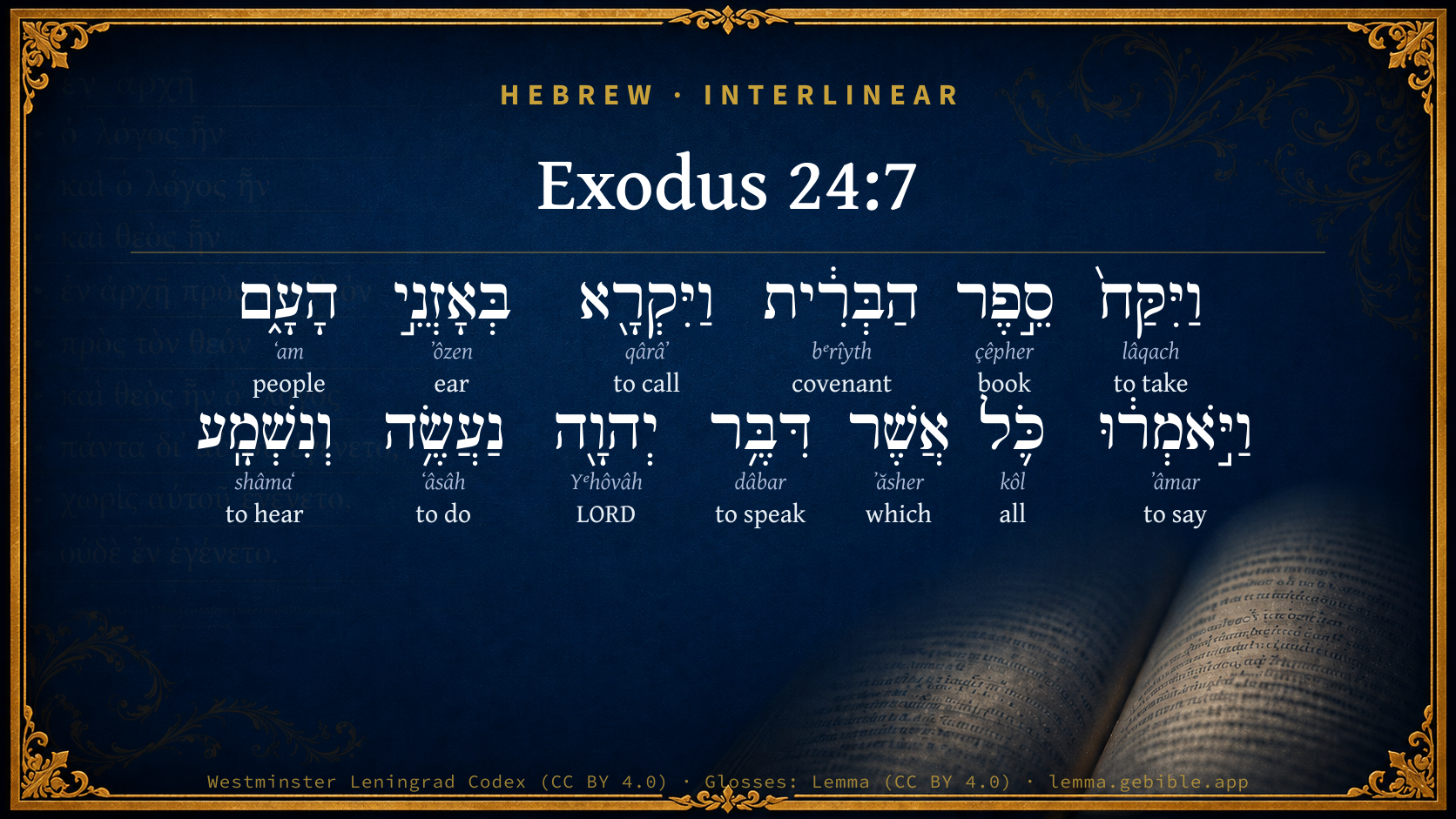
Hebrew (Westminster Leningrad Codex) Exodus 24:7 appears in the Hebrew Old Testament. The text above is from the Westminster Leningrad Codex. Each word links to its Strong’s number, a concise gloss, and parsing drawn from the Open Scriptures Hebrew Bible morphology. Click any word for its full Brown-Driver-Briggs (BDB) entry.
Download image
Cite this verse

Exodus 24:7 (World English Bible). Public Domain. Lemma interlinear Bible study tool, https://lemma.gebible.app/v/exodus/24/7.

Show BibTeX & RIS
BibTeX
RIS
English Translation
He took the book of the covenant and read it in the hearing of the people, and they said, "All that Yahweh has spoken will we do, and be obedient."
World English Bible · Public Domain
Download a study sheet

One document with this verse’s original text, its word-by-word gloss line, the meaning frame, cross-references with their text, attributed commentary, and full source and license credits — printable, and it pastes into notes with its structure intact.

This verse Autodidact and up

Study sheet (.html) Plain text (.txt)

A passage Seminary Student

Up to 50 verses in one chapter. A passage sheet keeps up to 6 commentary sources and 12 cross-references per verse, in the order this page ranks them, and says so on the sheet whenever that leaves anything out. Ask for a single verse and you get the Autodidact verse sheet above.

Everything on this page stays free to read, with no account — the sheet is a download of what is already on screen, not access to it.

Want to remove ads? Support Godless Engineer
Compare translations 3

The same verse in 3 English versions, stacked beneath the original-language interlinear above. Click any original word for its lexicon entry.

Each is an independent rendering of the whole verse — the interlinear is not word-aligned to these translations.

Highlighted words mark where these versions differ — a whole-verse word diff, not a word-by-word alignment.

  • World English Bible Public Domain
    He took the book of the covenant and read it in the hearing of the people, and they said, "All that Yahweh has spoken will we do, and be obedient."
  • King James Version Public Domain
    And he took the book of the covenant, and read in the audience of the people: and they said, All that the LORD hath said will we do, and be obedient.
  • unfoldingWord Literal Text CC BY-SA 4.0
    And he took the Book of the Covenant and read it aloud in the ears of the people. And they said, “We will do and hear all that Yahweh has spoken.”

unfoldingWord Literal Text — © unfoldingWord, licensed CC BY-SA 4.0. Word-aligned USFM3 via Door43 (git.door43.org/unfoldingWord/en_ult).

Versions to compare (up to 4)

3 of 4 selected

Show all 18 translations

Every available English version of this verse, each an independent rendering of the whole verse.

  • World English Bible Public Domain
    He took the book of the covenant and read it in the hearing of the people, and they said, "All that Yahweh has spoken will we do, and be obedient."
  • Berean Standard Bible Public Domain
    Then he took the Book of the Covenant and read it to the people, who replied, “All that the LORD has spoken we will do, and we will be obedient.”
  • Majority Standard Bible Public Domain
    Then he took the Book of the Covenant and read it to the people, who replied, “All that the LORD has spoken we will do, and we will be obedient.”
  • King James Version Public Domain
    And he took the book of the covenant, and read in the audience of the people: and they said, All that the LORD hath said will we do, and be obedient.
  • American Standard Version (1901) Public Domain
    And he took the book of the covenant, and read in the audience of the people: and they said, All that Jehovah hath spoken will we do, and be obedient.
  • Revised Version (1885) Public Domain
    And he took the book of the covenant, and read in the audience of the people: and they said, All that the LORD hath spoken will we do, and be obedient.
  • Geneva Bible (1599) Public Domain
    After he tooke the booke of the couenant, and read it in the audience of the people: who said, All that the Lord hath said, we will do, and be obedient.
  • Douay-Rheims (1899) Public Domain
    And taking the book of the covenant, he read it in the hearing of the people: and they said: All things that the Lord hath spoken we will do, we will be obedient.
  • Young's Literal Translation Public Domain
    and he taketh the Book of the Covenant, and proclaimeth in the ears of the people, and they say, `All that which Jehovah hath spoken we do, and obey.'
  • Literal Standard Version CC BY-SA 4.0
    and he takes the Scroll of the Covenant, and proclaims [it] in the ears of the people, and they say, “All that which YHWH has spoken we do, and we obey.”
  • Unlocked Literal Bible CC BY-SA 4.0
    He took the book of the Covenant and read it aloud to the people. They said, “We will do all that Yahweh has spoken. We will be obedient.”
  • unfoldingWord Literal Text CC BY-SA 4.0
    And he took the Book of the Covenant and read it aloud in the ears of the people. And they said, “We will do and hear all that Yahweh has spoken.”
  • Darby Bible Public Domain
    And he took the book of the covenant, and read [it] in the ears of the people; and they said, All that Jehovah has said will we do, and obey!
  • World Messianic Bible Public Domain
    He took the book of the covenant and read it in the hearing of the people, and they said, “We will do all that the LORD has said, and be obedient.”
  • Webster's Bible Public Domain
    And he took the book of the covenant, and read in the audience of the people: and they said, All that the LORD hath said will we do, and be obedient.
  • Free Bible Version CC BY-SA 4.0
    Then he picked up the Book of the Agreement and read it to the people. They replied, “We will do everything the Lord says. We will obey.”
  • Bible in Basic English Public Domain
    And he took the book of the agreement, reading it in the hearing of the people: and they said, Everything which the Lord has said we will do, and we will keep his laws.
  • JPS Tanakh (1917) Public Domain
    And he took the book of the covenant, and read in the hearing of the people; and they said: 'All that the LORD hath spoken will we do, and obey.'

Literal Standard Version (2020), Covenant Press — licensed CC BY-SA 4.0. Text via the HelloAO Bible API (eBible.org). Unlocked Literal Bible (unfoldingWord) — licensed CC BY-SA 4.0. Text via the HelloAO Bible API (eBible.org). unfoldingWord Literal Text — © unfoldingWord, licensed CC BY-SA 4.0. Word-aligned USFM3 via Door43 (git.door43.org/unfoldingWord/en_ult). Free Bible Version, Dr. Jonathan Gallagher — licensed CC BY-SA 4.0. Text via the HelloAO Bible API (eBible.org).

Word by word

More ways to search: Search by grammar → Find every occurrence → Compare this word →

Practice this passage: Drill this verse → Learn its vocabulary →

סֵ֣פֶר
çêpher
H5612
“book of”
Noun, Common, Masculine, Singular, Construct
Part of Speech
Noun
Type
Common
Gender
Masculine
Number
Singular
State
Construct
Full BDB Definition

Origin: from H5608

TWOT: 1540a , 1540b

book (noun feminine) - missive, document, writing, book (noun masculine) - missive - letter (of instruction), written order, commission, request, written decree - legal document, certificate of divorce, deed of purchase, indictment, sign - book, scroll - book of prophecies - genealogical register - law-book - book (of poems) - book (of kings) - books of the canon, scripture - record book (of God) - book-learning, writing - be able to read (after verb 'to know')
  1. וַיִּקַּח֙ lâqach H3947 “and · to take” Conjunction + Verb, Qal, Sequential Imperfect, 3rd Person, Masculine, Singular
  2. הַבְּרִ֔ית bᵉrîyth H1285 “the · covenant” Particle, Definite Article + Noun, Common, Feminine, Singular, Absolute
  3. וַיִּקְרָ֖א qârâʼ H7121 “and · to call” Conjunction + Verb, Qal, Sequential Imperfect, 3rd Person, Masculine, Singular
  4. בְּאָזְנֵ֣י ʼôzen H241 “in/at · ears of” Preposition + Noun, Common, Feminine, Dual, Construct
  5. הָעָ֑ם ʻam H5971 “the · people” Particle, Definite Article + Noun, Common, Masculine, Singular, Absolute
  6. וַיֹּ֣אמְר֔וּ ʼâmar H559 “and · to say” Conjunction + Verb, Qal, Sequential Imperfect, 3rd Person, Masculine, Plural
  7. כֹּ֛ל kôl H3605 “all” Noun, Common, Masculine, Singular, Absolute
  8. אֲשֶׁר ʼăsher H834 “which” Particle, Relative
  9. דִּבֶּ֥ר dâbar H1696 “to speak” Verb, Piel, Perfect, 3rd Person, Masculine, Singular
  10. יְהוָ֖ה Yᵉhôvâh H3068 “LORD” Noun, Proper
  11. נַעֲשֶׂ֥ה ʻâsâh H6213 “to do” Verb, Qal, Imperfect, 1st Person, Common, Plural
  12. וְנִשְׁמָֽע shâmaʻ H8085 “and · to hear” Conjunction + Verb, Qal, Imperfect, 1st Person, Common, Plural

About this verse

These counts appear in no published source. They are computed here, from the morphology-tagged text and Lemma’s own curated glosses. What Lemma adds →

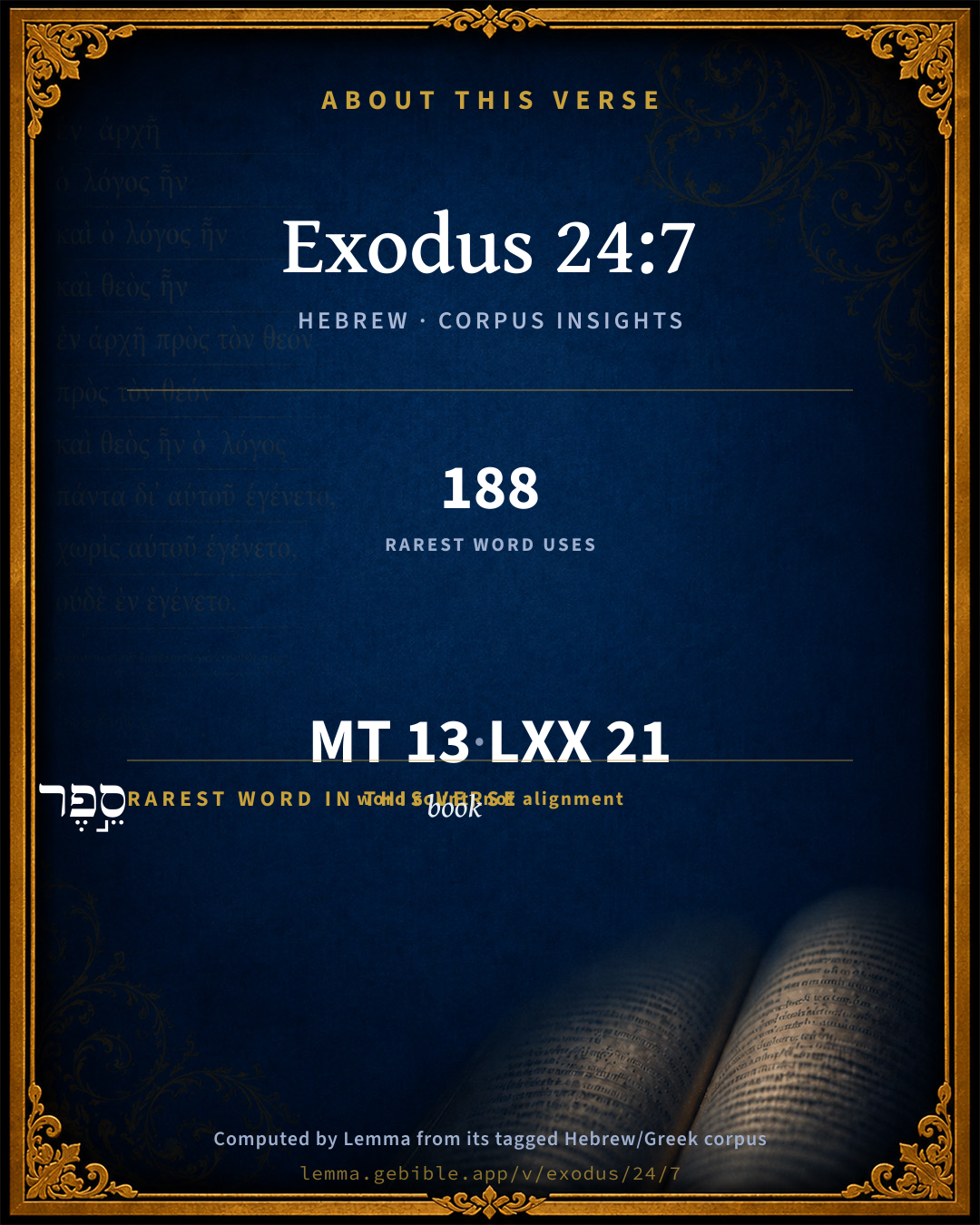
13
words
13
distinct lemmas
Pentateuch
section

Grammatical profile

  • 6 verbs
  • 6 nouns
  • 1 particle

Verb forms

  • וַיִּקַּח֙ Qal · Sequential Imperfect
  • וַיִּקְרָ֖א Qal · Sequential Imperfect
  • וַיֹּ֣אמְר֔וּ Qal · Sequential Imperfect
  • דִּבֶּ֥ר Piel · Perfect
  • נַעֲשֶׂ֥ה Qal · Imperfect
  • וְנִשְׁמָֽע Qal · Imperfect

Hebrew & Septuagint length

In English translation the verse runs 30 words from the Hebrew and 33 from the Septuagint (LXX English) — closely comparable.

A rough comparison of the two English renderings, which tokenize alike — not a word-level alignment.

Word counts can differ between the Hebrew and the Greek without any difference in meaning — e.g. the Hebrew direct-object marker אֵת has no separate Greek word, and Greek often adds the article ὁ.

In the original languages it is 13 Hebrew tokens and 21 Greek tokens — but the two are counted differently (Hebrew bundles its prefixes and suffixes into one token; the Greek is in lemma form), so that isn’t a like-for-like length.

Cross-references

7

Topical passages linked to Exodus 24:7 in the Treasury of Scripture Knowledge — connected by theme and wording, ordered by reader-vote popularity; previews shown in the World English Bible.

  • Deuteronomy 31:11–13 when all Israel is come to appear before Yahweh your God in the place which he shall choose, you shall read this law before all Israel in their hearing.
  • Exodus 24:3–4 Moses came and told the people all the words of Yahweh, and all the ordinances; and all the people answered with one voice, and said, "All the words which Yahweh has spoken will we do."
  • Hebrews 9:18–23 Therefore even the first covenant has not been dedicated without blood.
  • Jeremiah 7:23–24 but this thing I commanded them, saying, Listen to my voice, and I will be your God, and you shall be my people; and walk you in all the way that I command you, that it may be well with you.
  • Acts 13:15 After the reading of the law and the prophets, the rulers of the synagogue sent to them, saying, "Brothers, if you have any word of exhortation for the people, speak."
  • Colossians 4:16 When this letter has been read among you, cause it to be read also in the assembly of the Laodiceans; and that you also read the letter from Laodicea.
  • 1 Thessalonians 5:27 I solemnly charge you by the Lord that this letter be read to all the holy brothers.

Cross-references courtesy of OpenBible.info (CC BY 4.0).

Hebrew and Greek witnesses Masoretic Hebrew ↔ Greek Septuagint

The same verse in the two great witnesses to the Old Testament, shown verse-for-verse.

These are two independent witnesses, not word-aligned to each other, and the Septuagint is shown in lemma (dictionary) form.

Hebrew Exodus 24:7 Masoretic · Westminster Leningrad Codex

וַיִּקַּח֙ סֵ֣פֶר הַבְּרִ֔ית וַיִּקְרָ֖א בְּאָזְנֵ֣י הָעָ֑ם וַיֹּ֣אמְר֔וּ כֹּ֛ל אֲשֶׁר דִּבֶּ֥ר יְהוָ֖ה נַעֲשֶׂ֥ה וְנִשְׁמָֽע

He took the book of the covenant and read it in the hearing of the people, and they said, "All that Yahweh has spoken will we do, and be obedient."

World English Bible · Public Domain

Greek LXX Exodus 24:7 Septuagint · lemma form

καί λαμβάνω ὁ βιβλίον ὁ διαθήκη ἀναγιγνώσκω εἰς ὁ οὖς ὁ λαός καί εἶπον πᾶς ὅσος λαλέω κύριος ποιέω καί ἀκούω

And he took the book of the covenant and read it in the ears of the people, and they said, All things whatever the Lord has spoken we will do and listen therein.

LXX2012 (modern English Septuagint) · Public Domain

Hebrew: Westminster Leningrad Codex (CC BY 4.0). Greek: Septuagint (public domain); English from LXX2012 (modern English Septuagint) (Public Domain). How the Septuagint differs from the Hebrew →

Targum (Aramaic paraphrase)

2

The Targum is the ancient Jewish Aramaic paraphrase of the Hebrew Scriptures — an interpretive translation, not the Hebrew text itself. Onkelos (literal) and Pseudo-Jonathan (expansive) render the Torah, and Jonathan the Prophets. Coverage is partial: where no permissively-licensed English translation exists for a verse, only the Aramaic is shown. This is verse-level text, not a word-by-word alignment to the Hebrew.

  1. Targum Onkelos Torah (Genesis–Deuteronomy)
    וּנְסִיב סִפְרָא דִקְיָמָא וּקְרָא קֳדָם עַמָא וַאֲמָרוּ כֹּל דִי מַלִיל יְיָ נַעְבֵּד וּנְקַבֵּל:

    (no public-domain English translation for this verse)

    Targum Onkelos — Aramaic: “Onkelos Genesis” (public domain); “Onkelos Exodus” (public domain); “Onkelos Leviticus” (public domain); “Onkelos Numbers” (public domain); “Onkelos Deuteronomy” (public domain). English: “Sefaria Community Translation” (CC0 1.0 (public-domain dedication)); “J.W. Etheridge. The Targums of Onkelos and Jonathan Ben Uzziel on the Pentateuch. London: Longmans, Green, 1862” (public domain). Text via Sefaria.

  2. Targum Pseudo-Jonathan Torah (Genesis–Deuteronomy)
    וּנְסֵיב סִפְרָא דְקַיָימָא דְאוֹרַיְיתָא וּקְרָא קֳדָם עַמָא וְאָמָרוּ כָּל פִּתְגָמַיָא דְמַלֵּיל יְיָ נַעֲבֵיד וּנְקַבֵּיל

    And he took the Book of the Covenant of the Law and read before the people; and they said, All the words which the Lord hath spoken we will perform and obey.

    Targum Pseudo-Jonathan — Aramaic: “Targum Jonathan on Genesis” (public domain); “Targum Jonathan on Exodus” (public domain); “Targum Jonathan on Leviticus” (public domain); “Targum Jonathan on Numbers” (public domain); “Targum Jonathan on Deuteronomy” (public domain). English: “The Targum of Jonathan ben Uzziel, trans. J. W. Etheridge, London, 1862” (public domain). Text via Sefaria.

Commentary

Notes on Exodus 24:7 from classic Christian and Jewish commentators (each source and its license shown beneath its notes). The classic Christian expositions comment on the surrounding passage and are grouped to its opening verse, so a note may address several verses; the Jewish commentaries on the Tanakh (Rashi and others) are per-verse, so they appear only where the commentator wrote on this verse.

Lemma curates 59 commentaries, every one of them public domain or Creative Commons licensed, each selected and text-cleaned for this edition rather than reprinted as found. About our sources →

Trapp's Complete Commentary

John Trapp

Exo 24:7 And he took the book of the covenant, and read in the audience of the people: and they said, All that the LORD hath said will we do, and be obedient.

Ver. 7. Will we do, and be obedient.] Christ will enjoy his spouse’s love by a willing contract, not by a ravishment.

John Trapp, A Commentary or Exposition upon All the Books of the Old and New Testament (1647–1656) — public domain. Text from a community e-Sword module.

Tyndale Open Study Notes

Tyndale Open Resources

24:7 Treaties were required to be written down and publicly read . . . aloud. Very likely Moses began at this time to write down, under God’s inspiration, all the things that he believed were authoritative documents for his people.

Tyndale Open Study Notes — © Tyndale Open Resources, licensed CC BY-SA 4.0. Text via the HelloAO Bible API.

Geneva Bible (1599)

Geneva Bible translators

Or, the book of the Law.

Geneva Bible (1599) marginal notes — public domain. Text via Bolls.life.

Adam Clarke's Commentary

Verse 7. The book of the covenant] The writing containing the laws mentioned in the three preceding chapters. As this writing contained the agreement made between God and them, it was called the book of the covenant; but as no covenant was considered to be ratified and binding till a sacrifice had been offered on the occasion, hence the necessity of the sacrifices mentioned here.

Half of the blood being sprinkled on the ALTAR, and half of it sprinkled on the PEOPLE, showed that both GOD and THEY were mutually bound by this covenant. GOD was bound to the PEOPLE to support, defend, and save them; the PEOPLE were bound to GOD to fear, love, and serve him. On the ancient method of making covenants, See Clarke on Ge 6:18; and "Ge 15:18". Thus the blood of the new covenant was necessary to propitiate the throne of justice on the one hand, and to reconcile men to God on the other. On the nature and various kinds of the Jewish offerings, See Clarke on Le 7:1, &c.

Adam Clarke's Commentary on the Bible (1810–1826) — public domain. Text from a community e-Sword/MySword module.

Ellicott's Commentary for English Readers

(7) The book of the covenant—i.e., the book which he had written overnight, the collection of laws and promises which we have in Exo_20:22 to Exo_23:33.

In the audience of the people.—Heb., in the ears of the people.

And they said.—Having heard the ipsissima verba spoken by God to Moses, they repeated their previous acceptance (see Exo_24:3), adding a general promise of obedience.

A Bible Commentary for English Readers, edited by Charles John Ellicott (1878–1897) — public domain. Text from a community e-Sword module.

The Cambridge Bible for Schools and Colleges

gen. ed. J. J. S. Perowne

7. the book of the covenant] The ‘book,’ or scroll, just written (v. 4), containing the laws of Exo_20:22 to Exo_23:33, on the basis of which (v. 8) the ‘covenant’ was to be concluded. If, however, the view expressed on vv. 3, 12 is correct, the ‘book’ will not have included the ‘judgements,’ Exo_21:2 to Exo_22:17.

The Cambridge Bible for Schools and Colleges (gen. ed. J. J. S. Perowne; Cambridge University Press, 1878–1918) — public domain. Text from a community e-Sword module.

John Gill's Exposition

And he took the book of the covenant,.... Which contained the words of the Lord he is said to write, Exo 24:4, and consisted both of laws and judgments required of the people, and to which they had given their assent, and promised obedience to; and of promises made by the Lord of sending his angel before them to guide them in the way, and bring them to Canaan, and to drive the Canaanites from thence, and put the Israelites into the possession of it; so that here were promises on both sides, a restipulation of parties, which made a formal covenant:

and read in the audience of the people; he had rehearsed what was contained in it from his memory, by word of mouth, to which they had assented, Exo 24:3 and having written the same in a book, he read it to them distinctly, that they might the better take notice of the contents of it:

and they said, all that the Lord hath said will we do, and be obedient; which is a repetition and confirmation of what they had before said, and is expressed in stronger terms; so that this was not done suddenly and inconsiderately, and yet they seem not to be so well apprised of their own inability to keep the laws of God, and of the treachery of their own hearts as to their regard to them; see Deu 5:28.

John Gill's Exposition of the Whole Bible (1746–1763) — public domain (CC PDM 1.0). Text via the HelloAO Bible API.

Albert Barnes' Notes on the Bible

The book of the covenant - See Exo 20:22 note. The people had to repeat their assent to the book of the covenant before the blood was thrown upon them. Compare 2Ki 23:2, 2Ki 23:21; 2Ch 34:30.

Albert Barnes' Notes on the Bible (1834–1885) — public domain. Text from a community e-Sword/MySword module.

Matthew Poole's English Annotations

The book of the covenant, wherein Moses had written the conditions of this covenant, to wit, the words and laws of God, above, Exo 24:4.

In the audience of the people, i.e. in the hearing of a great number of them, or of some in the name of all the people, by whom it was read, or otherwise published to all the people successively.

Matthew Poole's English Annotations on the Holy Bible (1683–1685) — public domain. Text from a community e-Sword/MySword module.

Whedon's Commentary on the Bible

Daniel D. Whedon

7. Read in the audience of the people — This would seem to have been the earliest instance of a public reading of Holy Scripture. Comp. Neh_8:1-8.

Daniel D. Whedon (gen. ed.), Commentary on the Old and New Testaments (1874–1909) — public domain. Text from a community e-Sword module.

The Pulpit Commentary

And he took the Book of the Covenant. In this book we have the germ of the Holy Scriptures the first "book" actually mentioned as written in the narrative of the Bible. Genesis may contain other older documents, inserted by Moses, under the sanction of the Holy Spirit, in his compilation. But his own composition, if we except the burst of poesy called forth by the passage of the Red Sea, (Exo_15:1-18) would seem to have commenced with "the Book of the Covenant." Upon this nucleus the rest of the law was based; and it was to explain and enforce the law that Moses composed the Pentateuch. In the audience of the people, Literally, "in the ears of the people," which is equally intelligible, and more graphic. And they said, etc The people made the same answer as before (ver. 3), adding a general promise of obedience to all that God might command in future.

Vers. 7, 8. Consecration.

By the sprinkling of the blood of sacrifice, and by their voluntary acceptance of obligations to obedience, the children of Israel became, formally, the people of Jehovah. They had avouched themselves to be the Lord"s. They had taken on them the vows of his service. They were now consecrated to be doers of his will. The same idea of consecration is embodied in the New Testament word "saint." The believer is one of a sanctified, a consecrated, a priestly people, set specially apart "to offer up spiritual sacrifices acceptable to God by Jesus Christ". (1Pe_2:5)

Consider

I THE NATURE OF CONSECRATION. Consecration, as a Christian duty, involves three ideas separation from evil, devotement to God, and ceaseless pursuit of holiness in heart and life. It has its ground in the fact of redemption, and in the sense of God"s mercies. The consecrated heart then becomes a sanctuary in which God dwells by his Holy Spirit; while this sacred indwelling in turn becomes a new source of obligations to holiness. The holiness we are to aim at is a holiness like God"s own nothing. (1Pe_1:15, 1Pe_1:16) Consecration, if never so complete as the Christian could wish, may always be perfect, at least in aim, in spirit, in intention, in desire. We are expected, like Caleb, to follow the Lord fully. The Divine ideal is the absolute consecration of him who said I come to do thy will, O God." "My meat is to do the will of him that sent me, and to finish his work". (Heb_10:9; Joh_4:34) "I would rather," says Spurgeon, "my child had a perfect copy to write by, though he might never equal it, than that he should have an imperfect copy set before him, because then he would never make a good writer at all." The Scriptural idea of consecration comes out in the light of the usage of the cognate word God himself is the fountain of sanctity or holiness. The whole Mosaic ritual was a grand apparatus for impressing this thought of God"s holiness upon the minds of his worshippers. Everything to be used in his service, as contaminated by sin, required to be purged with blood. (Heb_9:21) To this, in special cases, succeeded an anointing with oil. (Exo_30:25-32) Thus purged and anointed, the sanctuary, person, sacred vessel, or whatever it might be, was regarded as completely sanctified; in other words, as separated from common uses to the service of a holy God. The High Priests and Levites of the Old Covenant were all thus specially sanctified to God. But these things were only shadows; we have the realities corresponding to them under the New Covenant. If a man is really in Christ, he is already, by God"s act, through the sprinkling of the blood of Jesus Christ, and the holy anointing of the Spirit, a consecrated person, and ought to regard himself as such. This is the Divine side of the matter. There is clearly, however, a vast difference between the consecration of a mere utensil, say the golden candlestick, or the pots and vessels of the sanctuary, and the consecration of a living, moral, intelligent being. A material thing is sanctified simply by the act of setting it apart to sacred uses; its nature admits of nothing more. But the consecration of a moral being implies an act on his own part, as well as on God"s, else the consecration has no reality; it is such only in name and form. The essence of it lies in a free, cheerful, self-dedication of the person. (Rom_12:1) Here, then, are two sides of this subject, the Divine and human the ideal and the real which two sides are constantly reappearing in Scripture, sometimes apart, sometimes blending together, sometimes standing side by side, almost with the force of contradictions, e.g. , "Purge out therefore the old leaven, that ye may be a new lump, even as ye are unleavened". (1Co_5:7) In short, God"s consecration gives us a standing and an ideal; but it is only as we consciously accept this standing and ideal as our own, and seek to give them reality by self-dedication, and the strenuous pursuit of holiness, that our consecration becomes truly effectual. God"s consecration of us becomes, so to speak, the ground of our own consecration of ourselves, and of constant striving after that perfection which is implied in the ideal he sets before us. Hence all those manifold Scripture images which imply sanctification as a process, and a work of God"s grace constantly going on within us.

II ADVANTAGES OF CONSECRATION. We come back to the old point that consecration, regarded as a duty, is a personal act whereby, out of a sense of God"s mercies, and specially his grace in redemption, a believer solemnly dedicates himself and all that he has to the service and glory of God. Such consecration, with the surrender of the obedient will, is already, as seen in the previous homily, implicit in every exercise of saving faith. Great moral advantages, however, accrue from making one"s consecration to Christ a distinct solemn act, again and again to be repeated, each time, we shall hope, with more perfect self-surrender; and the remembrance of which is to go along with us in the discharge of every duty. This corresponds pretty nearly to the meaning of the Israelitish covenant.

Consecration is the basis of acceptable service.

(1) Consecration of self precedes all other consecrations; as of time, substance, talents, service, etc. It is only where self is consecrated, that the consecration of anything else is acceptable. What St. Paul says of charity, that without it all special gifts and acts, even feeding the poor, or giving his body to be burned, are valueless, we may say with equal truth of self-dedication. It is self God wants the love, reverence, devotion, service of self; not a mere share of self"s possessions. On the other hand

(2) the consecration of self includes all other consecrations. If we are God"s, then all is God"s that is ours. Our time is God"s; so is our money, our talents, our influence, everything we have. Let Christians ask, whether, in this view of the matter, consecration is in their case being carried out into all its legitimate results. Not that God desires "a gift;" but he desires "fruit that may abound to our account". (Php_4:17)

Consecration secures nobler service; it is likewise a source of immense strength in the active pursuit of holiness. In any course of conduct, we know the value of a definite purpose and aim. Most of all is it important to have as the clear, definite motto of our lives me to live is Christ." We know then exactly what we are living for. Consecration invests a man"s whole being with a sanctity from which evil shrinks back repelled. The same sanctity spreads itself over all he has and does. He feels that he must be holy "in all manner of conversation." Even on the bells of his horses he sees something written, "holiness to the Lord." He has "holy garments;" and his great business is to watch and keep his garments, lest he walk naked, and they see his shame. (Rev_16:15) His body is the temple of the Holy Ghost; and he dare not desecrate with worldly pollutions the place where God dwells. He has definitely separated himself from evil; and he must not return to it.

Consecration resolves questions of casuistry. How often do we find good people, or people who wish to be good, puzzling and perplexing themselves with questions of this kind Dare I read this book? Should I go to this party? May I engage in this amusement? Can I take this profit? Unless we greatly mistake, most of these difficulties would disappear with more perfect consecration. A truly consecrated man carries in his breast a principle which easily guides him through all such cases, and makes many things right and pure to him which others would stumble at, while it leads him to discountenance and condemn much that they would pass unnoticed.

Finally, consecration is absolutely essential to success in prayer. The heart that has not said for Christ," is in no fit state to approach God"s throne to supplicate blessings for Christ"s sake. There must be iniquity hidden away in that heart somewhere; and "if I regard iniquity in my heart, the Lord will not hear me". (Psa_66:18) But the consecrated man, as a true priest of God, has free access to the holiest of all. He asks what he will, and it is given him. Prayer, indeed, is no prayer, unless it is the outcome of a heart which is the seat of deep consecration, and where the Lord is habitually sanctified. Only to such prayer are the promises yea and amen.

From all this, it is manifest that consecration pertains to the deepest essence of religion. Yet many feel as if sometimes they could almost close with Christ, were it not for this very matter of consecration. Their hearts are still clinging to something which God requires them to forego; and clinging to this, they rightly judge that they cannot be Christ"s disciples. Let them reflect that for this something they sacrifice eternal life. J.O.

The Pulpit Commentary (1880–1919), ed. H.D.M. Spence-Jones & Joseph S. Exell — public domain. Text from a community e-Sword module.

unfoldingWord translationNotes

Door43 World Missions Community

We will be obedient

This can be stated in active form. AT: "We will obey everything" (See: Active or Passive)

Then Moses took the blood

This refers to the blood that Moses had put into the bowls. This can be stated clearly. AT: "Then Moses took the blood that was in the bowls" (See: Assumed Knowledge and Implicit Information)

translationWords

covenant

obey

blood

promise

word

unfoldingWord translationNotes — © Distant Shores Media and the Door43 World Missions Community, licensed CC BY-SA 4.0. Source: git.door43.org/Door43/en_tn.

Rashi

Rabbi Shlomo Yitzchaki (Rashi)

ספר הברית THE BOOK OF THE COVENANT — the book which we have said contained the part of the Torah from בראשית till the “Giving of the Torah” including the Commandments that were given to them at Marah (Mekhilta; cf. Rashi on v. 4).

Rashi on the Tanakh — English translations: “The Judaica Press complete Tanach with Rashi, translated by A. J. Rosenberg” (CC BY 4.0); “Pentateuch with Rashi's commentary by M. Rosenbaum and A.M. Silbermann, 1929-1934” (public domain); “The Metsudah Tanach series, Lakewood, N.J” (CC BY 4.0); and “The Book of Joshua, Metsudah Publications, 1997” (CC BY 4.0). Text via Sefaria.

Lesson kit

Teaching starters — assembled from the data on this page, not authored interpretation. Every prompt links to the verse data it draws on. Edit before teaching.

Exodus, in the Pentateuch, opens this verse with 13 words (13 distinct Hebrew lemmas). Its most distinctive word is çêpher (“book”). A historical commentator’s framing appears above. Read the whole chapter for the surrounding context.

Discussion questions

  1. How does “book” (çêpher) shape what this verse is saying?
  2. How does Deuteronomy 31:11–13, which shares this passage’s theme, read alongside this verse?
  3. These translations render this verse differently; the difference is in the English rendering, not the original. What questions does that raise?
  4. «וַיִּקַּח֙» is a Qal Sequential Imperfect verb. How does that grammatical form shape the action described?
  5. Compare how Trapp's Complete Commentary and Tyndale Open Study Notes read this verse. Where do they agree or differ?

Things to notice

Reading settings

Reading text

Shown beneath each verse's original-language words.

Old Testament
Old Testament edition

Read the OT as the Masoretic Hebrew (MT) or the Greek Septuagint (LXX).

English shown for the Greek Septuagint (in the Hebrew ↔ Greek comparison).

Comparing translations? Open the Compare panel on any verse page to stack up to four side by side.