
Isaiah 36:11

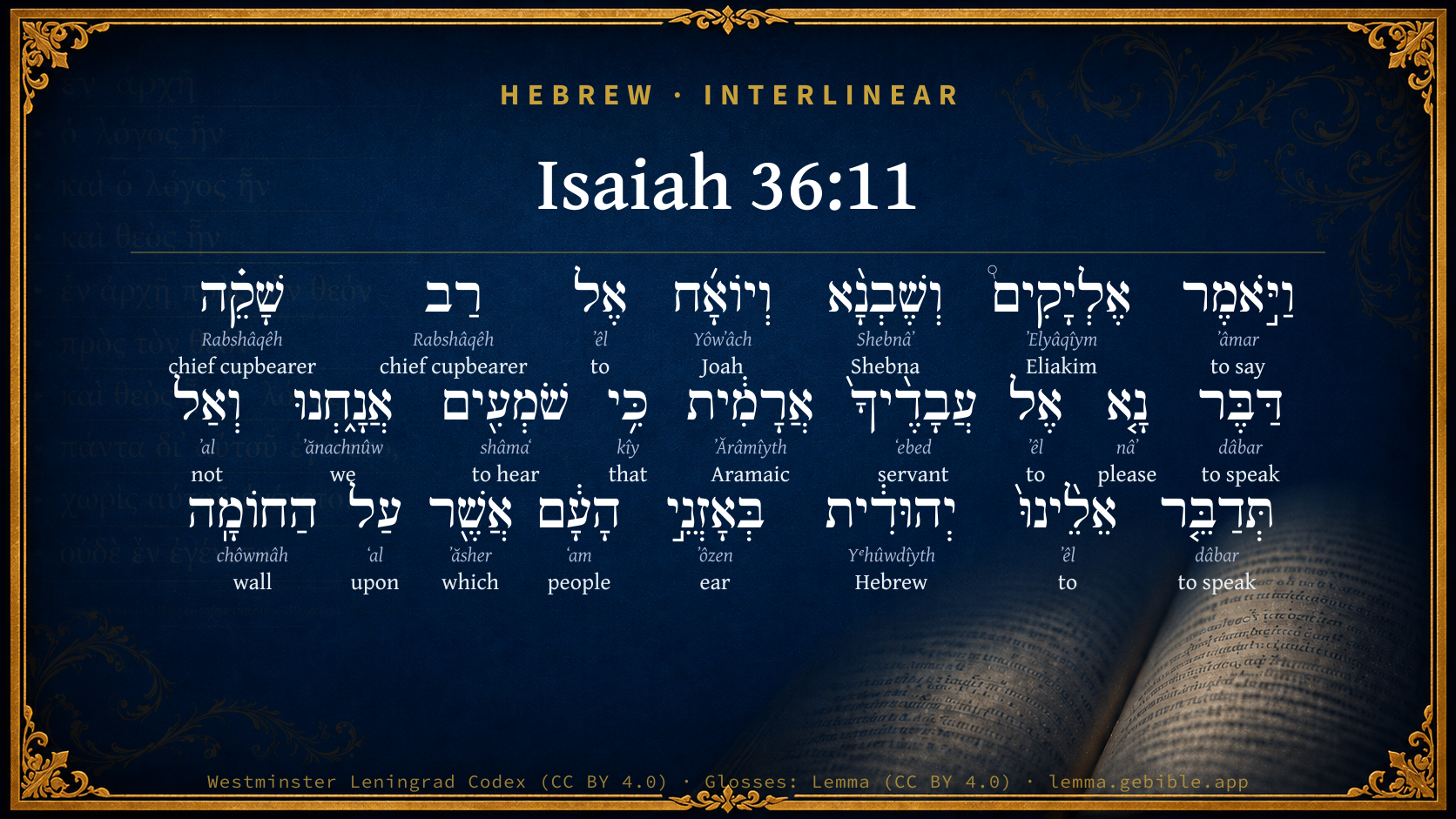
Hebrew (Westminster Leningrad Codex) Isaiah 36:11 appears in the Hebrew Old Testament. The text above is from the Westminster Leningrad Codex. Each word links to its Strong’s number, a concise gloss, and parsing drawn from the Open Scriptures Hebrew Bible morphology. Click any word for its full Brown-Driver-Briggs (BDB) entry.
Download image
Cite this verse

Isaiah 36:11 (World English Bible). Public Domain. Lemma interlinear Bible study tool, https://lemma.gebible.app/v/isaiah/36/11.

Show BibTeX & RIS
BibTeX
RIS
English Translation
Then said Eliakim and Shebna and Joah to Rabshakeh, Please speak, to your servants in the Syrian language; for we understand it: and don't speak to us in the Jews' language, in the ears of the people who are on the wall.
World English Bible · Public Domain
Download a study sheet

One document with this verse’s original text, its word-by-word gloss line, the meaning frame, cross-references with their text, attributed commentary, and full source and license credits — printable, and it pastes into notes with its structure intact.

This verse Autodidact and up

Study sheet (.html) Plain text (.txt)

A passage Seminary Student

Up to 50 verses in one chapter. A passage sheet keeps up to 6 commentary sources and 12 cross-references per verse, in the order this page ranks them, and says so on the sheet whenever that leaves anything out. Ask for a single verse and you get the Autodidact verse sheet above.

Everything on this page stays free to read, with no account — the sheet is a download of what is already on screen, not access to it.

Want to remove ads? Support Godless Engineer
Compare translations 3

The same verse in 3 English versions, stacked beneath the original-language interlinear above. Click any original word for its lexicon entry.

Each is an independent rendering of the whole verse — the interlinear is not word-aligned to these translations.

Highlighted words mark where these versions differ — a whole-verse word diff, not a word-by-word alignment.

  • World English Bible Public Domain
    Then said Eliakim and Shebna and Joah to Rabshakeh, Please speak, to your servants in the Syrian language; for we understand it: and don't speak to us in the Jews' language, in the ears of the people who are on the wall.
  • King James Version Public Domain
    Then said Eliakim and Shebna and Joah unto Rabshakeh, Speak, I pray thee, unto thy servants in the Syrian language; for we understand it: and speak not to us in the Jews' language, in the ears of the people that are on the wall.
  • unfoldingWord Literal Text CC BY-SA 4.0
    And Eliakim, with Shebnah and Joah, said to the Rabshakeh, “Please speak to your servants Aramaic, for we are understanding. But may you not speak Judean to us in the ears of the people who on the wall.”

unfoldingWord Literal Text — © unfoldingWord, licensed CC BY-SA 4.0. Word-aligned USFM3 via Door43 (git.door43.org/unfoldingWord/en_ult).

Versions to compare (up to 4)

3 of 4 selected

Show all 18 translations

Every available English version of this verse, each an independent rendering of the whole verse.

  • World English Bible Public Domain
    Then said Eliakim and Shebna and Joah to Rabshakeh, Please speak, to your servants in the Syrian language; for we understand it: and don't speak to us in the Jews' language, in the ears of the people who are on the wall.
  • Berean Standard Bible Public Domain
    Then Eliakim, Shebna, and Joah said to the Rabshakeh, “Please speak to your servants in Aramaic, since we understand it. Do not speak to us in Hebrew in the hearing of the people on the wall.”
  • Majority Standard Bible Public Domain
    Then Eliakim, Shebna, and Joah said to the Rabshakeh, “Please speak to your servants in Aramaic, since we understand it. Do not speak to us in Hebrew in the hearing of the people on the wall.”
  • King James Version Public Domain
    Then said Eliakim and Shebna and Joah unto Rabshakeh, Speak, I pray thee, unto thy servants in the Syrian language; for we understand it: and speak not to us in the Jews' language, in the ears of the people that are on the wall.
  • American Standard Version (1901) Public Domain
    Then said Eliakim and Shebna and Joah unto Rabshakeh, Speak, I pray thee, unto thy servants in the Syrian language; for we understand it: and speak not to us in the Jews' language, in the ears of the people that are on the wall.
  • Revised Version (1885) Public Domain
    Then said Eliakim and Shebna and Joah unto Rabshakeh, Speak, I pray thee, unto thy servants in the Syrian language; for we understand it: and speak not to us in the Jews’ language, in the ears of the people that are on the wall.
  • Geneva Bible (1599) Public Domain
    Then sayd Eliakim and Shebna and Ioah vnto Rabshakeh, Speake, I pray thee, to thy seruants in the Aramites language, (for we vnderstand it) and talke not with vs in the Iewes tongue, in the audience of the people that are on the wall.
  • Douay-Rheims (1899) Public Domain
    And Eliacim, and Sobna, and Joahe said to Rabsaces: Speak to thy servants in the Syrian tongue: for we understand it: speak not to us in the Jews' language in the hearing of the people, that are upon the wall.
  • Young's Literal Translation Public Domain
    And Eliakim saith -- and Shebna and Joah -- unto Rabshakeh, `Speak, we pray thee, unto thy servants `in' Aramaean, for we are understanding; and do not speak unto us `in' Jewish, in the ears of the people who `are' on the wall.'
  • Literal Standard Version CC BY-SA 4.0
    And Eliakim says—and Shebna and Joah—to Rabshakeh, “Please speak to your servants [in] Aramaic, for we are understanding; and do not speak to us [in] Jewish, in the ears of the people who [are] on the wall.”
  • Unlocked Literal Bible CC BY-SA 4.0
    Then Eliakim son of Hilkiah, and Shebnah, and Joah said to the chief commander, “Please speak to your servants in the Aramean language, Aramaic, for we understand it. Do not speak with us in the language of Judah in the ears of the people who are on the wall.”
  • unfoldingWord Literal Text CC BY-SA 4.0
    And Eliakim, with Shebnah and Joah, said to the Rabshakeh, “Please speak to your servants Aramaic, for we are understanding. But may you not speak Judean to us in the ears of the people who on the wall.”
  • Darby Bible Public Domain
    And Eliakim and Shebna and Joah said to Rab-shakeh, Speak, we pray thee, to thy servants in Syriac, for we understand it; and speak not to us in the Jewish [language] in the ears of the people that are upon the wall.
  • World Messianic Bible Public Domain
    Then Eliakim, Shebna and Joah said to Rabshakeh, “Please speak to your servants in Aramaic, for we understand it. Don’t speak to us in the Jews’ language in the hearing of the people who are on the wall.”
  • Webster's Bible Public Domain
    Then said Eliakim and Shebna and Joah to Rabshakeh, Speak, I pray thee, to thy servants in the Syrian language; for we understand it: and speak not to us in the Jew's language, in the ears of the people that are on the wall.
  • Free Bible Version CC BY-SA 4.0
    Eliakim, Shebnah, and Joah, said to the army general, “Please speak to us, your servants, in Aramaic, for we understand it. Don't speak to us in Hebrew while the people on the wall are listening.”
  • Bible in Basic English Public Domain
    Then Eliakim and Shebna and Joah said to the Rab-shakeh, Please make use of the Aramaean language in talking to your servants, for we are used to it, and do not make use of the Jews' language in the hearing of the people on the wall.
  • JPS Tanakh (1917) Public Domain
    Then said Eliakim and Shebna and Joah unto Rab-shakeh: 'Speak, I pray thee, unto thy servants in the Aramean language, for we understand it; and speak not to us in the Jews' language, in the ears of the people that are on the wall.'

Literal Standard Version (2020), Covenant Press — licensed CC BY-SA 4.0. Text via the HelloAO Bible API (eBible.org). Unlocked Literal Bible (unfoldingWord) — licensed CC BY-SA 4.0. Text via the HelloAO Bible API (eBible.org). unfoldingWord Literal Text — © unfoldingWord, licensed CC BY-SA 4.0. Word-aligned USFM3 via Door43 (git.door43.org/unfoldingWord/en_ult). Free Bible Version, Dr. Jonathan Gallagher — licensed CC BY-SA 4.0. Text via the HelloAO Bible API (eBible.org).

Word by word

More ways to search: Search by grammar → Find every occurrence → Compare this word →

Practice this passage: Drill this verse → Learn its vocabulary →

אֲרָמִ֔ית
ʼĂrâmîyth
H762
“Aramaic”
Noun, Gentilic, Feminine, Singular, Absolute
Part of Speech
Noun
Type
Gentilic
Gender
Feminine
Number
Singular
State
Absolute
Full BDB Definition

Origin: feminine of H761

TWOT: None

Aramaic = "language" - the language of Aram, Aramaic
  1. וַיֹּ֣אמֶר ʼâmar H559 “and · to say” Conjunction + Verb, Qal, Sequential Imperfect, 3rd Person, Masculine, Singular
  2. אֶלְיָקִים֩ ʼElyâqîym H471 “Eliakim” Noun, Proper
  3. וְשֶׁבְנָ֨א Shebnâʼ H7644 “and · Shebna” Conjunction + Noun, Proper
  4. וְיוֹאָ֜ח Yôwʼâch H3098 “and · Joah” Conjunction + Noun, Proper
  5. אֶל ʼêl H413 “to” Preposition
  6. רַב Rabshâqêh H7262 “chief cupbearer” Noun, Proper
  7. שָׁקֵ֗ה Rabshâqêh H7262 “chief cupbearer” Noun, Proper
  8. דַּבֶּר dâbar H1696 “speak” Verb, Piel, Imperative, 2nd Person, Masculine, Singular
  9. נָ֤א nâʼ H4994 “please” Particle, Exhortation
  10. אֶל ʼêl H413 “to” Preposition
  11. עֲבָדֶ֨יךָ֙ ʻebed H5650 “servants · your” Noun, Common, Masculine, Plural, Construct + Suffix, Personal, 2nd Person, Masculine, Singular
  12. כִּ֥י kîy H3588 “that” Conjunction
  13. שֹׁמְעִ֖ים shâmaʻ H8085 “hearing” Verb, Qal, Participle Active, Masculine, Plural, Absolute
  14. אֲנָ֑חְנוּ ʼănachnûw H587 “we” Pronoun, Personal, 1st Person, Common, Plural
  15. וְאַל ʼal H408 “and · not” Conjunction + Particle, Negative
  16. תְּדַבֵּ֤ר dâbar H1696 “to speak” Verb, Piel, Jussive, 2nd Person, Masculine, Singular
  17. אֵלֵ֨ינוּ֙ ʼêl H413 “to · us” Preposition + Suffix, Personal, 1st Person, Common, Plural
  18. יְהוּדִ֔ית Yᵉhûwdîyth H3066 “Hebrew” Noun, Gentilic, Feminine, Singular, Absolute
  19. בְּאָזְנֵ֣י ʼôzen H241 “in/at · ears of” Preposition + Noun, Common, Feminine, Dual, Construct
  20. הָעָ֔ם ʻam H5971 “the · people” Particle, Definite Article + Noun, Common, Masculine, Singular, Absolute
  21. אֲשֶׁ֖ר ʼăsher H834 “which” Particle, Relative
  22. עַל ʻal H5921 “upon” Preposition
  23. הַחוֹמָֽה chôwmâh H2346 “the · wall” Particle, Definite Article + Noun, Common, Feminine, Singular, Absolute

About this verse

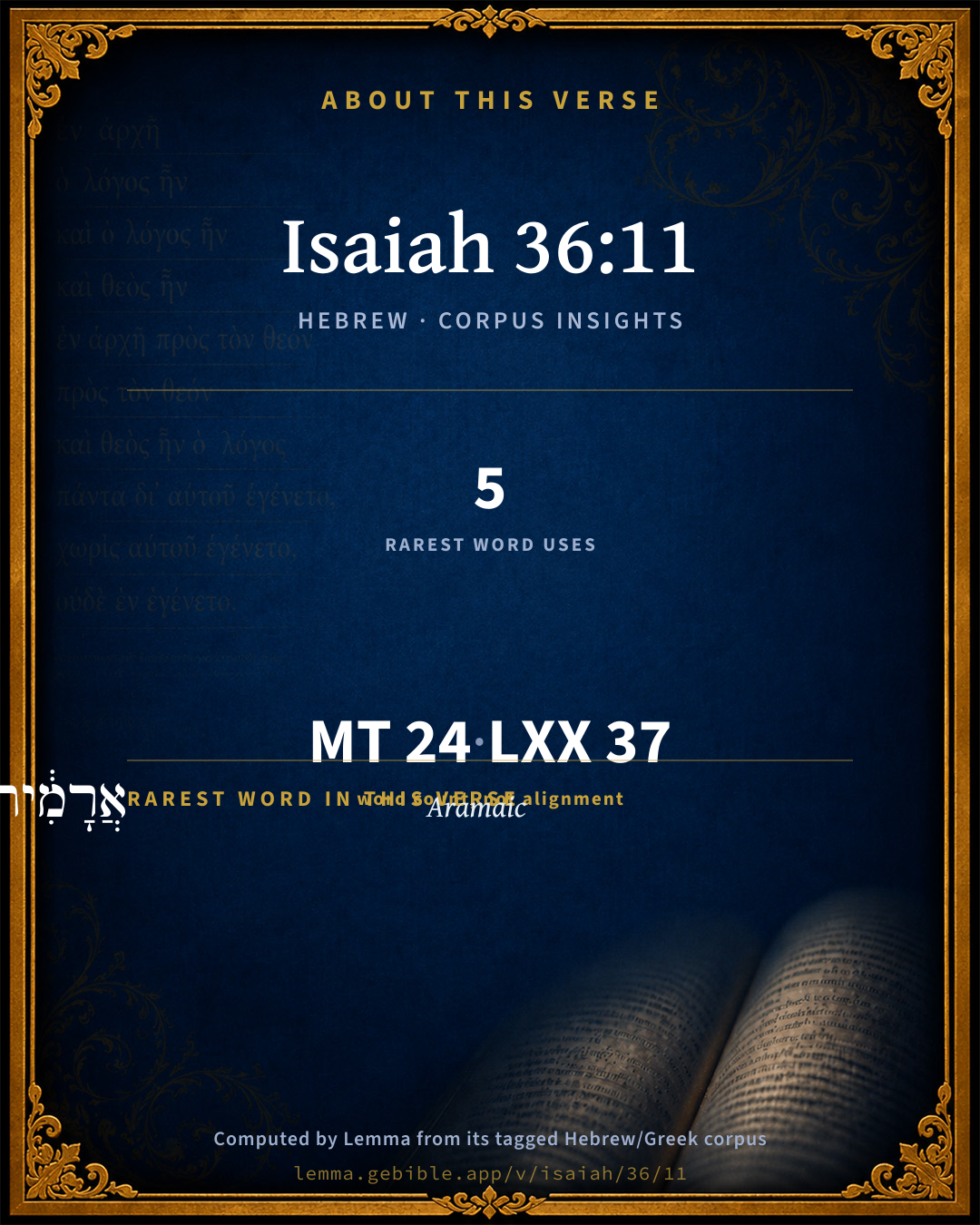
These counts appear in no published source. They are computed here, from the morphology-tagged text and Lemma’s own curated glosses. What Lemma adds →

24
words
20
distinct lemmas
Prophets
section

Notable vocabulary

The rarest word here is אֲרָמִ֔ית Aramaic H762 — appearing just 5 times in the whole Hebrew Bible.

Shared distinctive vocabulary

אֲרָמִ֔ית Aramaic H762 occurs in 4 verses of the Hebrew Bible. Also found in:

Grammatical profile

  • 4 verbs
  • 11 nouns
  • 1 pronoun
  • 4 prepositions
  • 1 conjunction
  • 3 particles

Verb forms

  • וַיֹּ֣אמֶר Qal · Sequential Imperfect
  • דַּבֶּר Piel · Imperative
  • שֹׁמְעִ֖ים Qal · Participle Active
  • תְּדַבֵּ֤ר Piel · Jussive

Repetition

Words recur within this verse — often emphatic in Hebrew:

  • רַב chief cupbearer H7262 ×2
  • דַּבֶּר to speak H1696 ×2
  • אֶל to H413 ×3

Hebrew & Septuagint length

In English translation the verse runs 42 words from the Hebrew and 43 from the Septuagint (LXX English) — closely comparable.

A rough comparison of the two English renderings, which tokenize alike — not a word-level alignment.

Word counts can differ between the Hebrew and the Greek without any difference in meaning — e.g. the Hebrew direct-object marker אֵת has no separate Greek word, and Greek often adds the article ὁ.

In the original languages it is 24 Hebrew tokens and 37 Greek tokens — but the two are counted differently (Hebrew bundles its prefixes and suffixes into one token; the Greek is in lemma form), so that isn’t a like-for-like length.

Cross-references

3

Topical passages linked to Isaiah 36:11 in the Treasury of Scripture Knowledge — connected by theme and wording, ordered by reader-vote popularity; previews shown in the World English Bible.

  • Ezra 4:7 In the days of Artaxerxes wrote Bishlam, Mithredath, Tabeel, and the rest of his companions, to Artaxerxes king of Persia; and the writing of the letter was written in the Syrian [character], and set forth in the Syrian [language].
  • Daniel 2:4 Then spoke the Chaldeans to the king in the Syrian language, O king, live forever: tell your servants the dream, and we will show the interpretation.
  • 2 Kings 18:26–27 Then said Eliakim the son of Hilkiah, and Shebnah, and Joah, to Rabshakeh, Please speak to your servants in the Syrian language; for we understand it: and don't speak with us in the Jews' language, in the ears of the people who are on the wall.

Cross-references courtesy of OpenBible.info (CC BY 4.0).

Hebrew and Greek witnesses Masoretic Hebrew ↔ Greek Septuagint

The same verse in the two great witnesses to the Old Testament, shown verse-for-verse.

These are two independent witnesses, not word-aligned to each other, and the Septuagint is shown in lemma (dictionary) form.

Hebrew Isaiah 36:11 Masoretic · Westminster Leningrad Codex

וַיֹּ֣אמֶר אֶלְיָקִים֩ וְשֶׁבְנָ֨א וְיוֹאָ֜ח אֶל רַב שָׁקֵ֗ה דַּבֶּר נָ֤א אֶל עֲבָדֶ֨יךָ֙ אֲרָמִ֔ית כִּ֥י שֹׁמְעִ֖ים אֲנָ֑חְנוּ וְאַל תְּדַבֵּ֤ר אֵלֵ֨ינוּ֙ יְהוּדִ֔ית בְּאָזְנֵ֣י הָעָ֔ם אֲשֶׁ֖ר עַל הַחוֹמָֽה

Then said Eliakim and Shebna and Joah to Rabshakeh, Please speak, to your servants in the Syrian language; for we understand it: and don't speak to us in the Jews' language, in the ears of the people who are on the wall.

World English Bible · Public Domain

Greek LXX Isaiah 36:11 Septuagint · lemma form

καί εἶπον πρός αὐτός ελιακιμ καί σομνας καί ιωαχ λαλέω πρός ὁ παῖς σύ συριστί ἀκούω γάρ ἐγώ καί μή λαλέω πρός ἐγώ ἰουδαϊστί καί ἵνα τίς λαλέω εἰς ὁ οὖς ὁ ἄνθρωπος ὁ ἐπί ὁ τεῖχος

Then Eliakim and Somnas and Joach said to him, Speak to your servants in the Syrian tongue; for we understand it: and speak not to us in the Jewish tongue: and therefore speak you in the ears of the men on the wall?

LXX2012 (modern English Septuagint) · Public Domain

On this verse, Keil & Delitzsch discusses the Septuagint’s reading. Read the note in Commentary ↓

Hebrew: Westminster Leningrad Codex (CC BY 4.0). Greek: Septuagint (public domain); English from LXX2012 (modern English Septuagint) (Public Domain). How the Septuagint differs from the Hebrew →

Targum (Aramaic paraphrase)

1

The Targum is the ancient Jewish Aramaic paraphrase of the Hebrew Scriptures — an interpretive translation, not the Hebrew text itself. Onkelos (literal) and Pseudo-Jonathan (expansive) render the Torah, and Jonathan the Prophets. Coverage is partial: where no permissively-licensed English translation exists for a verse, only the Aramaic is shown. This is verse-level text, not a word-by-word alignment to the Hebrew.

  1. Targum Jonathan Prophets (Joshua–Malachi)
    וַאֲמַר אֶלְיָקִים וְשֶׁבְנָא וְיוֹאָח לְרַבְשָׁקֵה מַלֵיל כְּעַן עִם עַבְדָךְ אֲרָמִית אֲרֵי שָׁמְעִין אֲנַחְנָא וְלָא תְמַלֵיל עִמָנָא יְהוּדִית קֳדָם עַמָא דִי עַל שׁוּרָא:

    Then said Eliakim and Shebna and Joah unto Rabshakeh, Speak, I pray thee, unto thy servants in the Syrian language; for we understand it: and speak not to us in the Jews' language before the people that are upon the wall.

    Targum Jonathan — Aramaic: “Mikraot Gedolot” (public domain). English: “Sefaria Community Translation” (CC0 1.0 (public-domain dedication)); “London "Chaldee Paraphrase," 1871” (public domain). Text via Sefaria.

Commentary

Notes on Isaiah 36:11 from classic Christian and Jewish commentators (each source and its license shown beneath its notes). The classic Christian expositions comment on the surrounding passage and are grouped to its opening verse, so a note may address several verses; the Jewish commentaries on the Tanakh (Rashi and others) are per-verse, so they appear only where the commentator wrote on this verse.

Lemma curates 59 commentaries, every one of them public domain or Creative Commons licensed, each selected and text-cleaned for this edition rather than reprinted as found. About our sources →

Matthew Henry's Commentary

We may hence learn these lessons: - 1. That, while princes and counsellors have public matters under debate, it is not fair to appeal to the people. It was a reasonable motion which Hezekiah's plenipotentiaries made, that this parley should be held in a language which the people did not understand (Isa 36:11), because reasons of state are secret things and ought to be kept secret, the vulgar being incompetent judges of them. It is therefore an unfair practice, and not doing as men would be done by, to incense subjects against their rulers by base insinuations. 2. Proud and haughty scorners, the fairer they are spoken to, commonly speak the fouler. Nothing could be said more mildly and respectfully than that which Hezekiah's agents said to Rabshakeh. Besides that the thing itself was just which they desired, they called themselves his servants, they petitioned for it: Speak, we pray thee; but this made him the more spiteful and imperious. To give rough answers to those who give us soft answers is one way of rendering evil for good; and those are wicked indeed, and it is to be feared incurable, with whom that which usually turns away wrath does but make bad worse. 3. When Satan would tempt men from trusting in God, and cleaving to him, he does so by insinuating that in yielding to him they may better their condition; but it is a false suggestion, and grossly absurd, and therefore to be rejected with the utmost abhorrence. When the world and the flesh say to us, "Make an agreement with us and come out to us, submit to our dominion and come into our interests, and you shall eat every one of his own vine," they do but deceive us, promising liberty when they would lead us into the basest captivity and slavery. One might as well take Rabshakeh's word as theirs for kind usage and fair quarter; therefore, when they speak fair, believe them not. Let them say what they will, there is no land like the land of promise, the holy land. 4. Nothing can be more absurd in itself, nor a greater affront to the true and living God, than to compare him with the gods of the heathen; as if he could do no more for the protection of his worshippers than they can for the protection of theirs, and as if the God of Israel could as easily be mastered as the gods of Hamath and Arphad, whereas they are vanity and a lie. They are nothing; he is the great I AM: they are the creatures of men's fancy and the works of men's hands; he is the Creator of all things. 5. Presumptuous sinners are ready to think that, because they have been too hard for their fellow-creatures, they are therefore a match for their Creator. This and the other nation they have subdued, and therefore the Lord himself shall not deliver Jerusalem out of their hand. But, though the potsherds may strive with the potsherds of the earth, let them not strive with the potter. 6. It is sometimes prudent not to answer a fool according to his folly. Hezekiah's command was, "Answer him not; it will but provoke him to rail and blaspheme yet more and more; leave it to God to stop his mouth, for you cannot." They had reason enough on their side, but it would be hard to speak it to such an unreasonable adversary without a mixture of passion; and, if they should fall a railing like him, Rabshakeh would be much too hard for them at that weapon. 7. It becomes the people of God to lay to heart the dishonour done to God by the blasphemies of wicked men, though they do not think it prudent to reply to those blasphemies. Though they answered him not a word, yet they rent their clothes, in a holy zeal for the glory of God's name and a holy indignation at the contempt put upon it. They tore their garments when they heard blasphemy, as taking no pleasure in their own ornaments when God's honour suffered.

Matthew Henry's Commentary on the Whole Bible (1708–1710) — public domain (CC PDM 1.0). Text via the HelloAO Bible API.

The Biblical Illustrator

Joseph S. Exell

Isa_36:11

The Syrian language

The Syrian language

The Syrian language i.. Aramaic, spoken between Palestine and the Euphrates, the language of international intercourse and commerce in those days. (A. B. Davidson, D.D.)

The Biblical Illustrator, edited by Joseph S. Exell (c. 1880s–1900s) — public domain. Text from a community e-Sword module.

Tyndale Open Study Notes

Tyndale Open Resources

36:11 Aramaic was the lingua franca used throughout the Assyrian Empire, understood by the elite but not by the common people of Judah.

Tyndale Open Study Notes — © Tyndale Open Resources, licensed CC BY-SA 4.0. Text via the HelloAO Bible API.

Geneva Bible (1599)

Geneva Bible translators

They were afraid, lest by his words, he should have stirred up the people against the King, and also pretended to grow to some appointment with him.

Geneva Bible (1599) marginal notes — public domain. Text via Bolls.life.

Jamieson, Fausset & Brown

Robert Jamieson, A. R. Fausset & David Brown

Syrian--rather, "Aramean": the language spoken north and east of Palestine, and understood by the Assyrians as belonging to the same family of languages as their own: nearly akin to Hebrew also, though not intelligible to the multitude (compare Kg2 5:5-7). "Aram" means a "high land," and includes parts of Assyria as well as Syria.

Jews' language--The men of Judah since the disruption of Israel, claimed the Hebrew as their own peculiarly, as if they were now the only true representatives of the whole Hebrew twelve tribes.

ears of . . . people on . . . wall--The interview is within hearing distance of the city. The people crowd on the wall, curious to hear the Assyrian message. The Jewish rulers fear that it will terrify the people and therefore beg Rab-shakeh to speak Aramean.

Jamieson, Fausset & Brown — Commentary Critical and Explanatory on the Whole Bible (1871) — public domain (CC PDM 1.0). Text via the HelloAO Bible API.

Ellicott's Commentary for English Readers

(11) Speak, I pray thee, unto thy servants . . .—The king’s officers, knowing the “little faith” of their people, are not, perhaps, without misgivings of their own. Might not the townsmen, listening eagerly on the wall, recognise in Rabshakeh’s words an echo of Isaiah’s, and lose courage, as feeling that they were fighting against the God who was chastising them? The Syrian or Aramaic was a common ground for the ambassadors on both sides, as being the language of commerce and diplomacy. Rabshakeh, it would seem, could speak three languages, Assyrian, Syrian, and Hebrew; Hezekiah’s ministers the two latter; the “people on the wall” only the last.

In the Jews’ language.—It is uncertain whether this means simply Hebrew, which Isaiah elsewhere calls the language of Canaan (Isa_19:18), or a special dialect of Judah. The Moabite stone, on the one hand, shows that Hebrew was the common speech of Palestine and the border countries. On the other hand, dialects spring up quickly. Neh_13:24 is the only other passage (the parallels of 2Ki_18:26 and 2Ch_32:18 excepted) in which the term meets us in the narrower sense, and that is after the exile.

A Bible Commentary for English Readers, edited by Charles John Ellicott (1878–1897) — public domain. Text from a community e-Sword module.

The Cambridge Bible for Schools and Colleges

gen. ed. J. J. S. Perowne

11. the Syrian (or Aramean R.V. marg.) language] was the medium of international communication in Western Asia, more especially of commerce. Assyrian on the other hand was a barbarous tongue to the Hebrews (ch. Isa_28:11, Isa_33:19).

the Jews’ language] Hebrew is so called only in one other (post-Exilic) passage, Neh_13:24.

11, 12. The Judæan ministers, fearing the effect of these threats on the people, implore the Rabshakeh to speak to them in Aramaic; but the astute diplomatist immediately perceives his advantage, and sets himself to stir up disaffection amongst the populace.

The Cambridge Bible for Schools and Colleges (gen. ed. J. J. S. Perowne; Cambridge University Press, 1878–1918) — public domain. Text from a community e-Sword module.

John Gill's Exposition

Then said Eliakim and Shebah and Joah unto Rabshakeh,.... That is, one of them addressed him in the name of the rest; for the verb is singular; and what follows confirms it; perhaps Eliakim was the speaker:

speak, I pray thee, unto thy servants in the Syriac language; which was somewhat different from the Hebrew, in which he spoke, and which was not understood by the common people, and for that reason desired:

for we understand it; or hear it; could hear it, so as to understand it; it being common in all courts, as the French tongue now; the Assyrian empire being very large, and so had been learned by these courtiers, for the sake of negotiation or commerce, when the common people had no concern with it:

and speak not to us in the Jews' language, in the ears of the people that are on the wall; the wall of the city, where the commissioners were, who would not venture themselves out of the city, in the hands of so perfidious an enemy: and the men on the wall were such, who either were placed there to defend the city, and so were soldiers, or people that were gathered together to see the ambassadors of the king of Assyria, and to hear, as much as they could, what passed between them and the ministers of Hezekiah; and as this speech of Eliakim's showed great submissiveness in praying and entreating Rabshakeh to speak to them in another language, and a mean abject spirit, in saying they were his servants, so a great degree of timorousness in them, and diffidence of the people, lest they should be terrified, and be for giving up the city at once into the hands of the enemy; this looks like a piece of bad policy, and some think that Shebna was the contriver of it, and the adviser to it, in order to give Rabshakeh a hint of their fears, and of the disposition of the people, and put him in higher spirits, and on railing the more, and thereby still work the more on the people's fears; however, it had this effect on him, as follows.

John Gill's Exposition of the Whole Bible (1746–1763) — public domain (CC PDM 1.0). Text via the HelloAO Bible API.

Albert Barnes' Notes on the Bible

Speak, I pray thee, unto thy servants in the Syrian language - Hebrew, ארמית 'ărâmı̂yt - ‘Aramean.’ Aram, or Aramea, properly meaning a high region, or the highlands, was of wider extent than Syria Proper, and comprehended not only Syria, but Mesopotamia. It usually denotes however, Syria Proper, of which the capital was Damascus. The language of all this country was probably the same - the Syrian or Aramean, a language of the same family as the Hebrew, and having a strong resemblance to that and to the Chaldee. This was not properly the language of Assyria, where probably a dialect composed of the language of the Medes and Persians was employed. But the Syriac language was spoken in different parts of Assyria. It was spoken in Mesopotamia, and doubtless in some of the provinces of the Assyrian empire, and might be presumed to be understood by Rabshakeh, and those with him. The Jews had contact with the Syrians, and those who had been sent out by Hezekiah had learned to speak that. It is not probable that they understood the Medo-Persian tongue that was spoken by the Assyrians usually. The Syriac or Aramean was probably the most common language which was spoken in that region. Its knowledge prevailed in the time of the Saviour, and was that which he usually spoke.

In the Jews’ language - (יחוּדית yehûdı̂yt). The language of Judah. It is remarkable that they did not call it the Hebrew language. But there might have been some national pride in regard to this. The Hebrew language had been the common language of all the Jews, and had been spoken by those of the kingdom of Israel or Samaria, as well as by those of the kingdom of Judah. But after the revolt of the ten tribes it is possible that they might have claimed the language as their own, and regarded the Hebrew - the venerable language of their fathers - as belonging to them especially, as they claimed everything that was sacred or venerable in the nation, and hence, they spoke of it as the language of Judah. The name of Judah, or Jews, which is derived from Judah, was, after the removal of the ten tribes, given to the entire nation - a name which is retained to the present time. In Isa 19:18, it is called the language of Canaan (see the note on that place).

In the ears of the people that are on the wall - This conference took place evidently near the city, and within hearing distance. Doubtless the people of the city, feeling a curiosity to hear the message of the Assyrian, crowded the walls. The Jewish ambassadors were apprehensive that what was said by Rabshakeh would alienate their minds from Hezekiah, and requested that the conference might be conducted in a language which they could not understand.

Albert Barnes' Notes on the Bible (1834–1885) — public domain. Text from a community e-Sword/MySword module.

Whedon's Commentary on the Bible

Daniel D. Whedon

11-13. Then said Elliakim… Shebna… Joah — The alarm of Hezekiah’s officers is now aroused, and they are thrown off their guard. It is singular that they had not seen the trick before. They could understand Aramaic, the language of Rabshakeh, which the hearers on the wall could not. Possibly this dialect was the court language, as the surrounding civil relations required a common language for diplomatic intercourse.

Hath my master sent me to thy master — The suspected intent is now avowed, and Rabshakeh demonstrates his sole interest with the people by straightening up and speaking louder, after having pictured to them the disgusting results of a prospective siege and famine. The repeated use of the king’s name — the great king, the king of Assyria — shows to the people his own ambassadorship, and they realize a direct authority in his words. But Hezekiah is contemptuously never mentioned as king. The aim is to inspire in the people a like contempt. In the person of Rabshakeh “the great king” speaks now.

Daniel D. Whedon (gen. ed.), Commentary on the Old and New Testaments (1874–1909) — public domain. Text from a community e-Sword module.

The Pulpit Commentary

Speak... unto thy servants in the Syrian language; literally, in the Aramaic language. Aramaeans were widely spread over the entire region between the Lower Tigris and the Mediterranean; and their language seems to have been in general use, as a language of commerce. "Private contract tablets in Aramaic and Assyrian have been found in the remains of ancient Nineveh" (Cheyne). Rabshakeh had, perhaps, spoken "in the Jews" language" without any ill intent, thinking that it was the only tongue which Jewish envoys would understand; but his so doing was calculated to affect the minds of the common people, and to shake their allegiance to Hezekiah. The envoys, therefore, requested him to employ a foreign tongue, and suggested Aramaic as one which was familiar to them, and which they supposed that he would understand. His employment of Hebrew had shown them that he was a linguist. In the Jews" language. There was no language peculiar to the Jews as Jews, that is to say, different from the ordinary speech of the Israelites. Both alike spoke Hebrew. In the Old Testament, however, this corn-men language is never called "Hebrew," but either "the tongue of Canaan" (Isa_19:18) or "the Jewish language". (2Ki_18:26, 28 2Ch_32:18 Neh_13:24) Similarly, our own tongue is called "English," though spoken also in Scotland, Wales, Ireland, America, and Australia. In the ears of the people that are on the wall; i.e. of the soldiers placed on the wall to defend it. We must suppose that the conference took place immediately outside the fortifications, so that some of those on the wall could hear.

The Pulpit Commentary (1880–1919), ed. H.D.M. Spence-Jones & Joseph S. Exell — public domain. Text from a community e-Sword module.

Keil & Delitzsch

C. F. Keil & F. Delitzsch

The concluding words, in which the Assyrian boasts of having Jehovah on his side, affect the messengers of Hezekiah in the keenest manner, especially because of the people present. "Then said Eliakim (K. the son of Hilkiyahu), and Shebna, and Joah, to Rabshakeh, Pray, speak to thy servants in Aramaean, for we understand it; and do not speak to (K. with) us in Jewish, in the ears of the people that are on the wall." They spoke Yehūdı̄th, i.e., the colloquial language of the kingdom of Judah. The kingdom of Israel was no longer in existence, and the language of the Israelitish nation, as a whole, might therefore already be called Judaean (Jewish), as in Neh 13:24, more especially as there may have been a far greater dialectical difference between the popular speech of the northern and southern kingdoms, than we can gather from the biblical books that were written in the one or the other. Aramaean ('arâmı̄th), however, appears to have been even then, as it was at a later period (Ezr 4:7), the language of intercourse between the empire of Eastern Asia and the people to the west of the Tigris (compare Alex. Polyhistor in Euseb. chron. arm. i. 43, where Sennacherib is said to have erected a monument with a Chaldean inscription); and consequently educated Judaeans not only understood it, but were able to speak it, more especially those who were in the service of the state. Assyrian, on the contrary, was unintelligible to Judaeans (Isa 28:11; Isa 33:19), although this applied comparatively less to the true Assyrian dialect, which was Semitic, and can be interpreted for the most part from the Hebrew (see Oppert's "Outlines of an Assyrian Grammar" in the Journal Asiatique, 1859), than to the motley language of the Assyrian army, which was a compound of Arian and Turanian elements. The name Sennacherib (Sanchērı̄bh = סן־אסהי־ירב, lxx Sennachēreim, i.e., "Sin, the moon-god, had multiplied the brethren") is Semitic; on the other hand, the name Tartan, which cannot be interpreted either from the Semitic or the Arian, is an example of the element referred to, which was so utterly strange to a Judaean ear.

Keil & Delitzsch — Biblical Commentary on the Old Testament (1861–1891) — public domain (CC PDM 1.0). Text via the HelloAO Bible API. (Old Testament only.)

J. A. Alexander on Isaiah

Joseph Addison Alexander

“Then said Eliakim and Shebna and Joah unto Rabshakeh, Pray speak unto thy servants in Aramean, for we understand (it), and speak not to us in Jewish, in the ears of the people who (are) on the wall.” This request implies an apprehension of the bad effect of his address upon the multitude. Aramean corresponds very nearly to Syrian in latitude of meaning; but the language meant is not what we call Syriac, but an older form, which was probably current, as the French is now, at the courts and among the educated classes of an extensive region. Jewish is Hebrew, so called by the Jews, as the language of the whole British Empire is called English, or as German is sometimes called Saxon. The use of this term here is urged by some as a proof of later date than the time of Isaiah, on the ground that the distinctive name Jewish could not have been common till long after the destruction of the kingdom of the ten tribes, which left Judah the only representative of Israel. But how long after this event may we assume that such a usage became common? The ten tribes were carried into exile by Sennacherib’s father, if not by his grandfather. It is altogether probable that from the time of the great schism between Ephraim and Judah, the latter began to call the national language by its own distinctive name. At the period in question, such a designation was certainly more natural, in the mouths of Jews, than Israelite or even Hebrew. ‘We understand,’ literally, we (are) hearing, (i.e., hearing distinctly and intelligently).

Joseph Addison Alexander, The Prophecies of Isaiah (1846–1847; New York: Scribner, 1870–1878) — public domain. Text from a community e-Sword module.

Kretzmann's Popular Commentary

Paul E. Kretzmann

Rahshakeh’s Efforts to bring about Revolt

v. 11. Then said Eliakim and Shebnah and Joah, the representatives of the king of Judah, unto Rabshakeh, Speak, I pray thee, unto thy servants in the Syrian language, in the Aramaic tongue, as spoken by the Assyrians, for we understand it, and speak not to us in the Jews’ language, in the pure Hebrew, as spoken in and near Jerusalem, in the ears of the people that are on the wall, since they feared that the suggestions made by the Assyrian envoys might have a bad effect upon the inhabitants of the city. This remonstrance, however, exposed the fears of the Jewish leaders, for which reason the enemies were quick to take advantage of it.

v. 12. But Rabshakeh said, Hath my master sent me to thy master and to thee to speak these words, on a secret mission? Hath he not sent me to the men that sit upon the wall, that they may eat their own dung and drink their own piss with you? The messengers of Sennacherib purposely spoke in the Hebrew tongue and with a loud voice, in order to hold before the defenders of the city the fate which awaited them if they would not yield, namely, that of a most terrible starvation, which would drive them to the last extreme in providing food and drink for themselves.

v. 13. Then Rabshakeh, suiting his actions to his words, stood and cried with a loud voice in the Jews’ language and said, Hear ye the words of the great king, the king of Assyria!

v. 14. Thus saith the king, Let not Hezekiah deceive you; for he shall not be able to deliver you, to save them from the fate which was in store for them in case they refused to surrender.

v. 15. Neither let Hezekiah make you trust in the Lord, this being the chief weapon of the believers of all times, saying, The Lord will surely deliver us; this city shall not be delivered into the hand of the king of Assyria, this evidently being the gist of Hezekiah’s assurances, and rightly so.

v. 16. Hearken not to Hezekiah; for thus saith the king of Assyria, Make an agreement with me by a present, that is, Enter into a relation of mutual congratulations with me, the reference being to a surrender with the ratification of peace, at which time people congratulated one another, and come out to me, abandoning and surrendering the city; and eat ye every one of his vine and every one of his fig-tree, this being the Assyrian’s promise to all inhabitants of Jerusalem who would side with him, and drink ye every one the waters of his own cistern, in a peaceful and undisturbed enjoyment of his own land and its products,

v. 17. until I come and take you away to a land like your own land, a land of corn and wine, a land of bread and vineyards. Upon his return from Egypt, which Sennacherib believed he could overcome without difficulty, the Assyrians intended to follow their usual policy of deporting the inhabitants and thus keeping them in subjection most effectively.

v. 18. Beware lest Hezekiah persuade you, saying, The Lord will deliver us, this challenge now being supported by a third consideration. Hath any of the gods of the nations, of the heathen countries round about, delivered his land out of the hand of the king of Assyria?

v. 19. Where are the gods of Hamath, the capital of the country between the Lebanon and the Anti-Lebanon, and Arphad, a city still nearer the Syrian frontier? Where are the gods of Sepharvaim? the southernmost city of Mesopotamia, on the left hank of the Euphrates. And have they, the idols of the heathen, delivered Samaria out of my hand?

v. 20. Who are they among all the gods of these lands that have delivered their land out of my hand that the Lord should deliver Jerusalem out of my hand? One commentator aptly remarks that the speaker forgets his own assertion here,

v. 10. according to which lie had come up against Judah with the Lord. "Liars need good memories. "

v. 21. But they, the men of Judah, also those on the wall, held their peace and answered him not a word, for a single incautious remark might have worked great harm; for the king’s commandment was, saying, Answer him not.

v. 22. Then came Eliakim, the son of Hilkiah, that was over the household, and Shebna, the scribe, and Jaah, the son of Asaph, the recorder, the three envoys of Judah, to Hezekiah with their clothes rent, as a sign of deep grief and sorrow, and told him the words of Rabshakeh. Their obedience is rightly regarded as an example for others to follow.

Paul E. Kretzmann, Popular Commentary of the Bible (1921–1924) — public domain. Text from a community e-Sword module.

unfoldingWord translationNotes

Door43 World Missions Community

Eliakim ... Hilkiah ... Shebnah

See how you translated these men's names in Isaiah 22:20.

Shebnah

See how you translated this man's name in Isaiah 22:15.

Joah ... chief commander

See how you translated this man's name and the phrase "chief commander" the same as you did in Isaiah 36:2-3.

Please speak to your servants

Eliakim, Shebnah, and Joah refer to themselves as the chief commander's servants. This is a polite way to speak to someone who has greater authority.

the Aramean language, Aramaic

"Aramean" is the name of a people group. "Aramaic" is the name of their language. (See: How to Translate Names)

in the ears of the people who are on the wall

The idiom "to speak in someone's ear" means to speak where they can hear you. AT: "where the people who are on the wall may hear us" (See: Idiom)

who are on the wall

This means that they are standing on the wall. The top of the wall was wide and a place where people could sit or stand. The full meaning of this statement can be made clear. AT: "who are standing on the wall" (See: Assumed Knowledge and Implicit Information)

Has my master sent me to your master and to you to speak these words?

The chief commander uses this question to emphasize that his message is for all the people of Judah. This question may be written as a statement. AT: "Certainly, my master has sent me to speak this message to you and to all who can hear." (See: Rhetorical Question)

Has he not sent me to the men who sit on the wall, who will have to ... you?

The chief commander uses this question to emphasize his insult. This can be written as a statement. AT: "My master has sent me to everyone who hears this, who will have to ... you." (See: Rhetorical Question)

will have to eat their own dung and drink their own urine with you

This is a very offensive statement. He is implying that they will need to eat these things because they will have nothing else to eat because their city will be under attack. The full meaning of this statement can be made clear. AT: "will soon need to eat their own dung and drink their own urine, just as you will, because you will have nothing else to eat" (See: Assumed Knowledge and Implicit Information)

translationWords

servant

Aram

people group

lord

word

dung

unfoldingWord translationNotes — © Distant Shores Media and the Door43 World Missions Community, licensed CC BY-SA 4.0. Source: git.door43.org/Door43/en_tn.

Rashi

Rabbi Shlomo Yitzchaki (Rashi)

for we understand it (שֹׁמְעִים, lit. hear.) We understand that language, an expression of hearing (entendenc in O.F.).

do not speak with us in Judean for all the people understand the Judean language, and they are frightened by your words. (Since he said to them, “Say now to Hezekiah,” they thought that he did not come to frighten the people. Since Rabshakeh was an apostate Jew, they thought that even though his master’s orders were incumbent upon Rabshakeh to observe, his heart was attracted to his family and he would take pity upon them.)

Rashi on the Tanakh — English translations: “The Judaica Press complete Tanach with Rashi, translated by A. J. Rosenberg” (CC BY 4.0); “Pentateuch with Rashi's commentary by M. Rosenbaum and A.M. Silbermann, 1929-1934” (public domain); “The Metsudah Tanach series, Lakewood, N.J” (CC BY 4.0); and “The Book of Joshua, Metsudah Publications, 1997” (CC BY 4.0). Text via Sefaria.

Lesson kit

Teaching starters — assembled from the data on this page, not authored interpretation. Every prompt links to the verse data it draws on. Edit before teaching.

Isaiah, in the Prophets, opens this verse with 24 words (20 distinct Hebrew lemmas). Its most distinctive word is ʼĂrâmîyth (“Aramaic”). A historical commentator’s framing appears above. Read the whole chapter for the surrounding context.

Discussion questions

  1. What does “Aramaic” (ʼĂrâmîyth) contribute to the verse as a whole?
  2. 2 Kings 18:26 shares the word «Aramaic» with this verse. How do the two illuminate each other?
  3. “chief cupbearer” occurs 2× in this one verse. What is the effect of the repetition?
  4. The translations on this page render this verse differently — a whole-verse word diff, not a word-by-word alignment. What might account for the different wordings?
  5. The verb «וַיֹּ֣אמֶר» is Qal Sequential Imperfect. How does its form color the action?
  6. Reading how Matthew Henry's Commentary and The Biblical Illustrator read this verse, where do the two commentators agree and where do they part?

Things to notice

Reading settings

Reading text

Shown beneath each verse's original-language words.

Old Testament
Old Testament edition

Read the OT as the Masoretic Hebrew (MT) or the Greek Septuagint (LXX).

English shown for the Greek Septuagint (in the Hebrew ↔ Greek comparison).

Comparing translations? Open the Compare panel on any verse page to stack up to four side by side.