
Isaiah 48:8

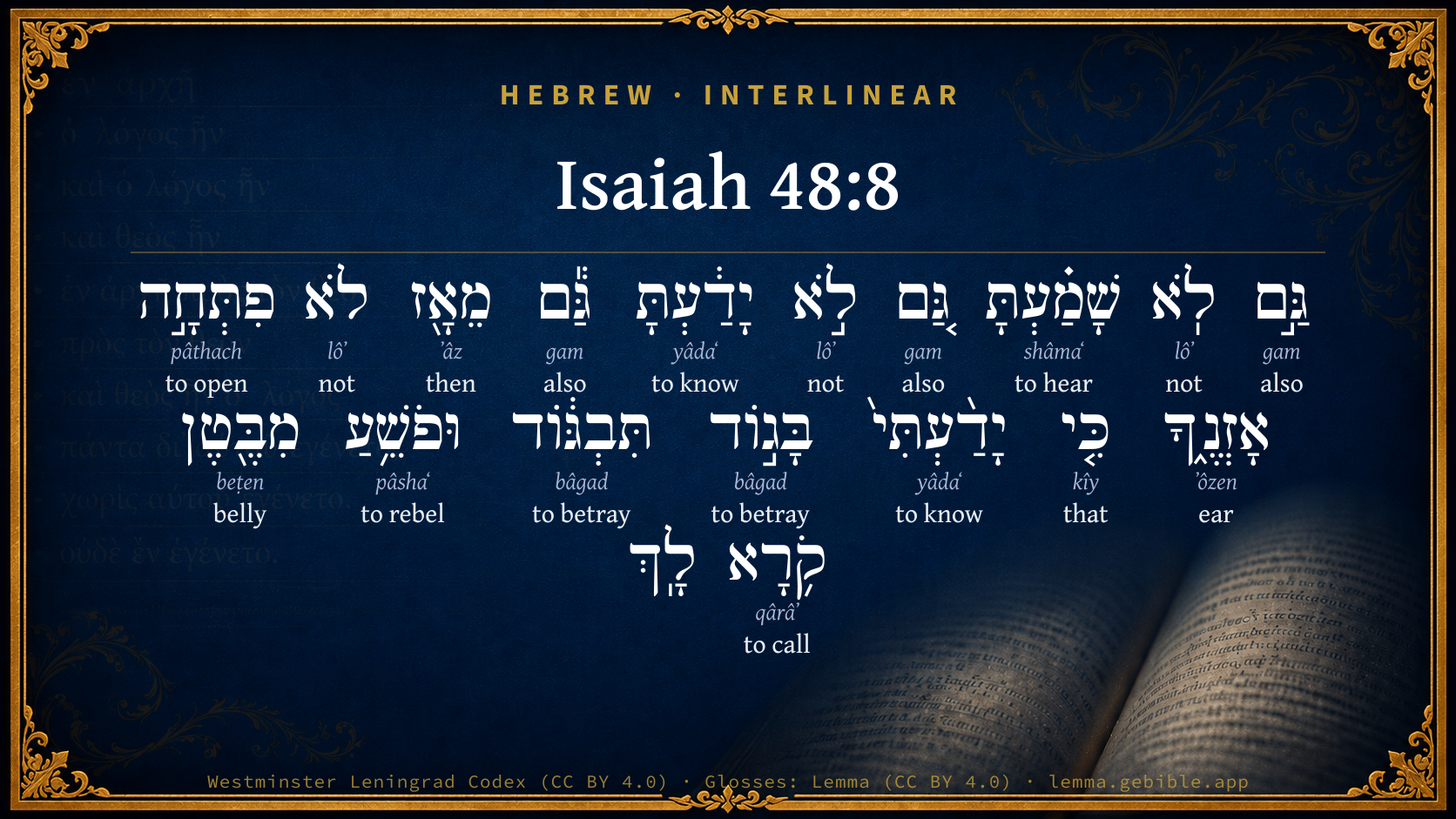
Hebrew (Westminster Leningrad Codex) Isaiah 48:8 appears in the Hebrew Old Testament. The text above is from the Westminster Leningrad Codex. Each word links to its Strong’s number, a concise gloss, and parsing drawn from the Open Scriptures Hebrew Bible morphology. Click any word for its full Brown-Driver-Briggs (BDB) entry.
Download image
Cite this verse

Isaiah 48:8 (World English Bible). Public Domain. Lemma interlinear Bible study tool, https://lemma.gebible.app/v/isaiah/48/8.

Show BibTeX & RIS
BibTeX
RIS
English Translation
Yes, you didn't hear; yes, you didn't know; yes, from of old your ear was not opened: for I knew that you did deal very treacherously, and was called a transgressor from the womb.
World English Bible · Public Domain
Download a study sheet

One document with this verse’s original text, its word-by-word gloss line, the meaning frame, cross-references with their text, attributed commentary, and full source and license credits — printable, and it pastes into notes with its structure intact.

This verse Autodidact and up

Study sheet (.html) Plain text (.txt)

A passage Seminary Student

Up to 50 verses in one chapter. A passage sheet keeps up to 6 commentary sources and 12 cross-references per verse, in the order this page ranks them, and says so on the sheet whenever that leaves anything out. Ask for a single verse and you get the Autodidact verse sheet above.

Everything on this page stays free to read, with no account — the sheet is a download of what is already on screen, not access to it.

Want to remove ads? Support Godless Engineer
Compare translations 3

The same verse in 3 English versions, stacked beneath the original-language interlinear above. Click any original word for its lexicon entry.

Each is an independent rendering of the whole verse — the interlinear is not word-aligned to these translations.

Highlighted words mark where these versions differ — a whole-verse word diff, not a word-by-word alignment.

  • World English Bible Public Domain
    Yes, you didn't hear; yes, you didn't know; yes, from of old your ear was not opened: for I knew that you did deal very treacherously, and was called a transgressor from the womb.
  • King James Version Public Domain
    Yea, thou heardest not; yea, thou knewest not; yea, from that time that thine ear was not opened: for I knew that thou wouldest deal very treacherously, and wast called a transgressor from the womb.
  • unfoldingWord Literal Text CC BY-SA 4.0
    Also you had not heard, also you did not know, also from then your ear was not open, for I knew betraying, you would betray, and from the womb, “rebelling one” was called to you. q1

unfoldingWord Literal Text — © unfoldingWord, licensed CC BY-SA 4.0. Word-aligned USFM3 via Door43 (git.door43.org/unfoldingWord/en_ult).

Versions to compare (up to 4)

3 of 4 selected

Show all 18 translations

Every available English version of this verse, each an independent rendering of the whole verse.

  • World English Bible Public Domain
    Yes, you didn't hear; yes, you didn't know; yes, from of old your ear was not opened: for I knew that you did deal very treacherously, and was called a transgressor from the womb.
  • Berean Standard Bible Public Domain
    You have never heard; you have never understood; for a long time your ears have not been open. For I knew how deceitful you are; you have been called a rebel from birth.
  • Majority Standard Bible Public Domain
    You have never heard; you have never understood; for a long time your ears have not been open. For I knew how deceitful you are; you have been called a rebel from birth.
  • King James Version Public Domain
    Yea, thou heardest not; yea, thou knewest not; yea, from that time that thine ear was not opened: for I knew that thou wouldest deal very treacherously, and wast called a transgressor from the womb.
  • American Standard Version (1901) Public Domain
    Yea, thou heardest not; yea, thou knewest not; yea, from of old thine ear was not opened: for I knew that thou didst deal very treacherously, and wast called a transgressor from the womb.
  • Revised Version (1885) Public Domain
    Yea, thou heardest not; yea, thou knewest not; yea, from of old thine ear was not opened: for I knew that thou didst deal very treacherously, and wast called a transgressor from the womb.
  • Geneva Bible (1599) Public Domain
    Yet thou heardest them not, neither diddest know them, neither yet was thine eare opened of olde: for I knewe that thou wouldest grieuously transgresse: therefore haue I called thee a transgressour from the wombe.
  • Douay-Rheims (1899) Public Domain
    Thou hast neither heard, nor known, neither was thy ear opened of old. For I know that transgressing thou wilt transgress, and I have called thee a transgressor from the womb.
  • Young's Literal Translation Public Domain
    Yea, thou hast not heard, Yea, thou hast not known, Yea, from that time not opened hath thine ear, For I have known thou dealest treacherously, And `Transgressor from the belly,' One is crying to thee.
  • Literal Standard Version CC BY-SA 4.0
    Indeed, you have not heard, || Indeed, you have not known, || Indeed, your ear has not opened from that time, || For I have known you deal treacherously, || And [are] a transgressor from the belly, || One is crying to you.
  • Unlocked Literal Bible CC BY-SA 4.0
    You never heard; you did not know; these things were not unfolded to your ears beforehand. For I knew that you have been very deceitful, and that you have been a rebel from birth.
  • unfoldingWord Literal Text CC BY-SA 4.0
    Also you had not heard, also you did not know, also from then your ear was not open, for I knew betraying, you would betray, and from the womb, “rebelling one” was called to you. q1
  • Darby Bible Public Domain
    Yea, thou heardest not, yea, thou knewest not, yea, from of old thine ear was not opened; for I knew that thou wouldest ever deal treacherously, and thou wast called a transgressor from the womb.
  • World Messianic Bible Public Domain
    Yes, you didn’t hear. Yes, you didn’t know. Yes, from of old your ear was not opened, for I knew that you dealt very treacherously, and were called a transgressor from the womb.
  • Webster's Bible Public Domain
    Yes, thou heardst not; yes, thou knewest not; yes, from that time that thy ear was not opened: for I knew that thou wouldst deal very treacherously, and wast called a transgressor from the womb.
  • Free Bible Version CC BY-SA 4.0
    No, you've never heard that, and you've never known that! Nobody's told you about that before! I know how deviously you operate—you're called “rebels from birth”!
  • Bible in Basic English Public Domain
    Truly you had no word of them, no knowledge of them; no news of them in the past had come to your ears; because I saw how false was your behaviour, and that your heart was turned against me from your earliest days.
  • JPS Tanakh (1917) Public Domain
    Yea, thou heardest not; yea, thou knewest not; yea, from of old thine ear was not opened; for I knew that thou wouldest deal very treacherously, and wast called a transgressor from the womb.

Literal Standard Version (2020), Covenant Press — licensed CC BY-SA 4.0. Text via the HelloAO Bible API (eBible.org). Unlocked Literal Bible (unfoldingWord) — licensed CC BY-SA 4.0. Text via the HelloAO Bible API (eBible.org). unfoldingWord Literal Text — © unfoldingWord, licensed CC BY-SA 4.0. Word-aligned USFM3 via Door43 (git.door43.org/unfoldingWord/en_ult). Free Bible Version, Dr. Jonathan Gallagher — licensed CC BY-SA 4.0. Text via the HelloAO Bible API (eBible.org).

Word by word

More ways to search: Search by grammar → Find every occurrence → Compare this word →

Practice this passage: Drill this verse → Learn its vocabulary →

וּפֹשֵׁ֥עַ
pâshaʻ
H6586
“and · rebelling”
Conjunction + Verb, Qal, Participle Active, Masculine, Singular, Absolute
Part of Speech
Conjunction + Verb
Stem
Qal
Form
Participle Active
Gender
Masculine
Number
Singular
State
Absolute
Full BDB Definition

Origin: a primitive root [identical with H6585 through the idea of expansion]

TWOT: TWOT - 1846

to rebel, transgress, revolt - (Qal) - to rebel, revolt - to transgress - (Niphal) to be rebelled against
  1. גַּ֣ם gam H1571 “also” Particle, Accusative
  2. לֹֽא lôʼ H3808 “not” Particle, Negative
  3. שָׁמַ֗עְתָּ shâmaʻ H8085 “to hear” Verb, Qal, Perfect, 2nd Person, Masculine, Singular
  4. גַּ֚ם gam H1571 “also” Particle, Accusative
  5. לֹ֣א lôʼ H3808 “not” Particle, Negative
  6. יָדַ֔עְתָּ yâdaʻ H3045 “to know” Verb, Qal, Perfect, 2nd Person, Masculine, Singular
  7. גַּ֕ם gam H1571 “also” Particle, Accusative
  8. מֵאָ֖ז ʼâz H227 “from · then” Preposition + Adverb
  9. לֹא lôʼ H3808 “not” Particle, Negative
  10. פִתְּחָ֣ה pâthach H6605 “to open” Verb, Piel, Perfect, 3rd Person, Feminine, Singular
  11. אָזְנֶ֑ךָ ʼôzen H241 “ear · your” Noun, Common, Feminine, Singular, Construct + Suffix, Personal, 2nd Person, Masculine, Singular
  12. כִּ֤י kîy H3588 “that” Conjunction
  13. יָדַ֨עְתִּי֙ yâdaʻ H3045 “to know” Verb, Qal, Perfect, 1st Person, Common, Singular
  14. בָּג֣וֹד bâgad H898 “to betray” Verb, Qal, Infinitive Absolute
  15. תִּבְגּ֔וֹד bâgad H898 “to betray” Verb, Qal, Imperfect, 2nd Person, Masculine, Singular
  16. מִבֶּ֖טֶן beṭen H990 “from · belly” Preposition + Noun, Common, Feminine, Singular, Absolute
  17. קֹ֥רָא qârâʼ H7121 “to call” Verb, Pual, Perfect, 3rd Person, Masculine, Singular

About this verse

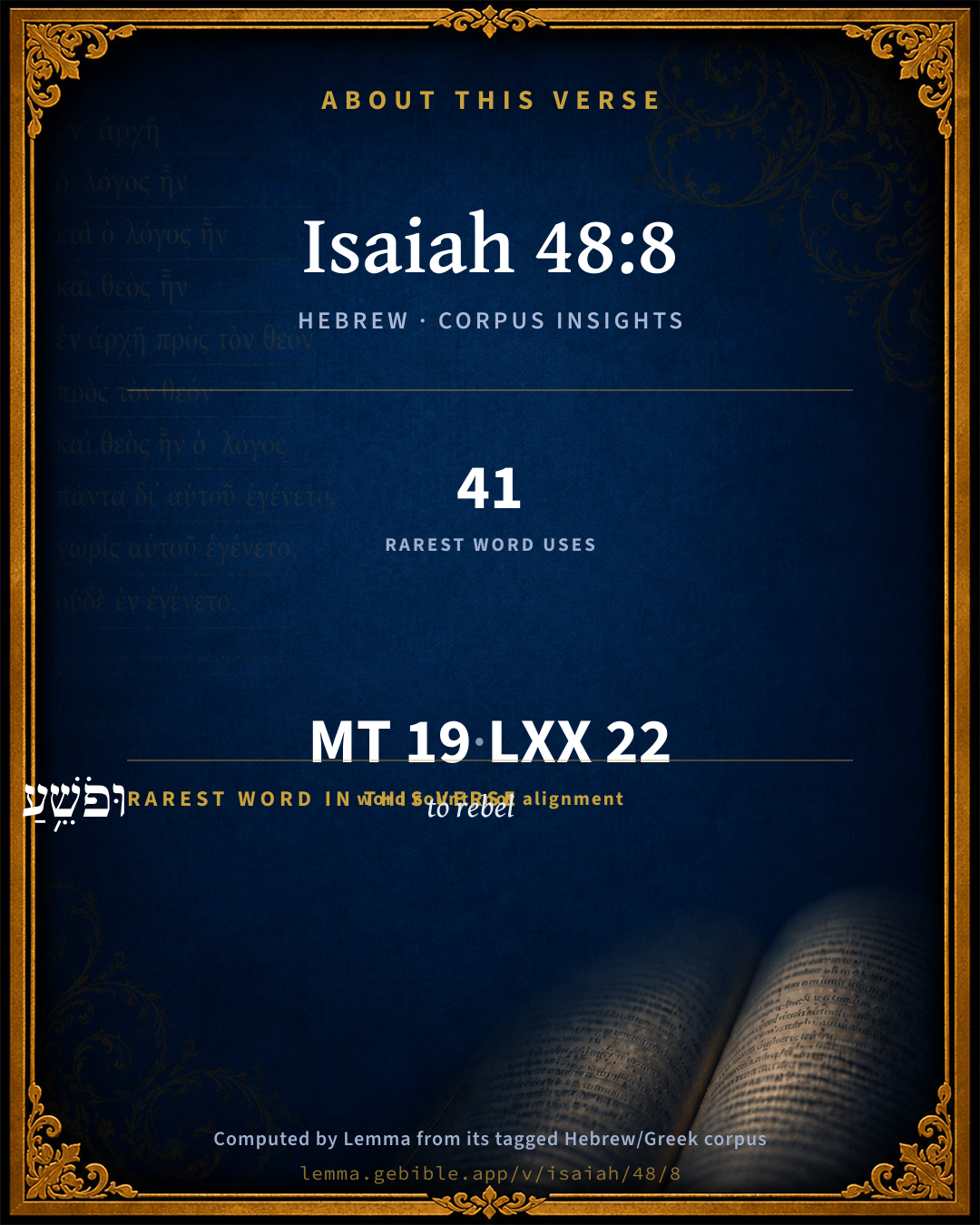
These counts appear in no published source. They are computed here, from the morphology-tagged text and Lemma’s own curated glosses. What Lemma adds →

19
words
12
distinct lemmas
Prophets
section

Shared distinctive vocabulary

וּפֹשֵׁ֥עַ to rebel H6586 occurs in 37 verses of the Hebrew Bible. Also found in:

Grammatical profile

  • 8 verbs
  • 2 nouns
  • 1 preposition
  • 1 conjunction
  • 1 adverb
  • 6 particles

Verb forms

  • שָׁמַ֗עְתָּ Qal · Perfect
  • יָדַ֔עְתָּ Qal · Perfect
  • פִתְּחָ֣ה Piel · Perfect
  • יָדַ֨עְתִּי֙ Qal · Perfect
  • בָּג֣וֹד Qal · Infinitive Absolute
  • תִּבְגּ֔וֹד Qal · Imperfect
  • וּפֹשֵׁ֥עַ Qal · Participle Active
  • קֹ֥רָא Pual · Perfect

Repetition

Words recur within this verse — often emphatic in Hebrew:

  • גַּ֣ם also H1571 ×3
  • יָדַ֔עְתָּ to know H3045 ×2
  • בָּג֣וֹד to betray H898 ×2
  • לֹֽא not H3808 ×3

Hebrew & Septuagint length

In English translation the verse runs 34 words from the Hebrew and 34 from the Septuagint (LXX English) — the same length.

A rough comparison of the two English renderings, which tokenize alike — not a word-level alignment.

Word counts can differ between the Hebrew and the Greek without any difference in meaning — e.g. the Hebrew direct-object marker אֵת has no separate Greek word, and Greek often adds the article ὁ.

In the original languages it is 19 Hebrew tokens and 22 Greek tokens — but the two are counted differently (Hebrew bundles its prefixes and suffixes into one token; the Greek is in lemma form), so that isn’t a like-for-like length.

Cross-references

25

Topical passages linked to Isaiah 48:8 in the Treasury of Scripture Knowledge — connected by theme and wording, ordered by reader-vote popularity; previews shown in the World English Bible.

  • Psalms 58:3 The wicked go astray from the womb. They are wayward as soon as they are born, speaking lies.
  • Hosea 5:7 They are unfaithful to Yahweh; For they have borne illegitimate children. Now the new moon will devour them with their fields.
  • Isaiah 42:19–20 Who is blind, but my servant? or deaf, as my messenger whom I send? Who is blind as he who is at peace, and blind as Yahweh's servant?
  • Jeremiah 6:10 To whom shall I speak and testify, that they may hear? behold, their ear is uncircumcised, and they can't listen: behold, the word of Yahweh is become to them a reproach; they have no delight in it.
  • Ezekiel 16:3–5 and say, Thus says the Lord Yahweh to Jerusalem: Your birth and your birth is of the land of the Canaanite; the Amorite was your father, and your mother was a Hittite.
  • Malachi 2:11 Judah has dealt treacherously, and an abomination is committed in Israel and in Jerusalem; for Judah has profaned the holiness of Yahweh which he loves, and has married the daughter of a foreign god.
  • Matthew 13:13–15 Therefore I speak to them in parables, because seeing they don't see, and hearing, they don't hear, neither do they understand.
  • John 12:39–40 For this cause they couldn't believe, for Isaiah said again,
  • Deuteronomy 9:7–24 Remember, don't forget, how you provoked Yahweh your God to wrath in the wilderness: from the day that you went forth out of the land of Egypt, until you came to this place, you have been rebellious against Yahweh.
  • Psalms 40:6 Sacrifice and offering you didn't desire. You have opened my ears: Burnt offering and sin offering you have not required.
  • Psalms 51:5 Behold, I was brought forth in iniquity. In sin my mother conceived me.
  • Psalms 139:1–4 Yahweh, you have searched me, And you know me.
  • Isaiah 6:9–10 He said, "Go, and tell this people, 'You hear indeed, But don't understand; And you see indeed, But don't perceive.'
  • Isaiah 21:2 A grievous vision is declared to me; the treacherous man deals treacherously, and the destroyer destroys. Go up, Elam; besiege, Media; all the sighing of it have I made to cease.
  • Isaiah 26:11 Yahweh, your hand is lifted up, yet they don't see: but they shall see [your] zeal for the people, and be disappointed; yes, fire shall devour your adversaries.
  • Isaiah 29:10–11 For Yahweh has poured out on you the spirit of deep sleep, and has closed your eyes, the prophets; and your heads, the seers, has he covered.
  • Isaiah 46:8 Remember this, and show yourselves men; bring it again to mind, you transgressors.
  • Isaiah 48:4 Because I knew that you are obstinate, and your neck is an iron sinew, and your brow brass;
  • Isaiah 50:5 The Lord Yahweh has opened my ear, and I was not rebellious, neither turned away backward.
  • Jeremiah 3:7–11 I said after she had done all these things, She will return to me; but she didn't return: and her treacherous sister Judah saw it.
  • Jeremiah 3:20 Surely as a wife treacherously departs from her husband, so have you dealt treacherously with me, house of Israel, says Yahweh.
  • Jeremiah 5:11 For the house of Israel and the house of Judah have dealt very treacherously against me, says Yahweh.
  • Ephesians 2:3 among whom we also all once lived in the lust of our flesh, doing the desires of the flesh and of the mind, and were by nature children of wrath, even as the rest.
  • Jeremiah 5:21 Hear now this, foolish people, and without understanding; who have eyes, and don't see; who have ears, and don't hear:
  • Hosea 6:7 But they, like Adam, have broken the covenant. They were unfaithful to me, there.

Cross-references courtesy of OpenBible.info (CC BY 4.0).

Hebrew and Greek witnesses Masoretic Hebrew ↔ Greek Septuagint

The same verse in the two great witnesses to the Old Testament, shown verse-for-verse.

These are two independent witnesses, not word-aligned to each other, and the Septuagint is shown in lemma (dictionary) form.

Hebrew Isaiah 48:8 Masoretic · Westminster Leningrad Codex

גַּ֣ם לֹֽא שָׁמַ֗עְתָּ גַּ֚ם לֹ֣א יָדַ֔עְתָּ גַּ֕ם מֵאָ֖ז לֹא פִתְּחָ֣ה אָזְנֶ֑ךָ כִּ֤י יָדַ֨עְתִּי֙ בָּג֣וֹד תִּבְגּ֔וֹד וּפֹשֵׁ֥עַ מִבֶּ֖טֶן קֹ֥רָא לָֽךְ

Yes, you didn't hear; yes, you didn't know; yes, from of old your ear was not opened: for I knew that you did deal very treacherously, and was called a transgressor from the womb.

World English Bible · Public Domain

Greek LXX Isaiah 48:8 Septuagint · lemma form

οὔτε γιγνώσκω οὔτε ἐπίσταμαι οὔτε ἀπό ἀρχή ἀναοἴγω σύ ὁ οὖς γιγνώσκω γάρ ὅτι ἀθετέω ἀθετέω καί ἄνομος ἔτι ἐκ κοιλία καλέω

You have neither known, nor understood, neither from the beginning have I opened your ears: for I knew that you would surely deal treacherously, and would be called a transgressor even from the womb.

LXX2012 (modern English Septuagint) · Public Domain

On this verse, The Cambridge Bible for Schools and Colleges discusses the Septuagint’s reading. Read the note in Commentary ↓

Hebrew: Westminster Leningrad Codex (CC BY 4.0). Greek: Septuagint (public domain); English from LXX2012 (modern English Septuagint) (Public Domain). How the Septuagint differs from the Hebrew →

Targum (Aramaic paraphrase)

1

The Targum is the ancient Jewish Aramaic paraphrase of the Hebrew Scriptures — an interpretive translation, not the Hebrew text itself. Onkelos (literal) and Pseudo-Jonathan (expansive) render the Torah, and Jonathan the Prophets. Coverage is partial: where no permissively-licensed English translation exists for a verse, only the Aramaic is shown. This is verse-level text, not a word-by-word alignment to the Hebrew.

  1. Targum Jonathan Prophets (Joshua–Malachi)
    אַף לָא שְׁמַעְתְּ לְמִלֵי נְבִיַיָא אַף לָא קַבֵּילְתָּא אוּלְפַן אוֹרַיְתָא אַף לְפִתְגָמֵי בִּרְכַּן וּלְוָטִין קְיָמִי דַאֲקֵמִית עִמְכוֹן בְּחוֹרֵב לָא אַרִיכֵינְתָּא אוּדְנָךְ לְקַבָּלָא אֲרֵי גְלֵי קֳדָמַי דְשַׁקָרָא תְשַׁקֵר וּמְרוֹד מִמְעַיִן יִתְקְרֵי לָךְ:

    Yea, thou didst not listen to the words of the prophets; yea, thou didst not accept the instruction of the law; yea, thou didst not incline thine ear to receive the words of the blessings and curses of my covenant which I made with you in Horeb; for it was manifest to me that thou wouldest altogether deal falsely, and be called a rebel from the womb.

    Targum Jonathan — Aramaic: “Mikraot Gedolot” (public domain). English: “Sefaria Community Translation” (CC0 1.0 (public-domain dedication)); “London "Chaldee Paraphrase," 1871” (public domain). Text via Sefaria.

Commentary

Notes on Isaiah 48:8 from classic Christian and Jewish commentators (each source and its license shown beneath its notes). The classic Christian expositions comment on the surrounding passage and are grouped to its opening verse, so a note may address several verses; the Jewish commentaries on the Tanakh (Rashi and others) are per-verse, so they appear only where the commentator wrote on this verse.

Lemma curates 59 commentaries, every one of them public domain or Creative Commons licensed, each selected and text-cleaned for this edition rather than reprinted as found. About our sources →

Trapp's Complete Commentary

John Trapp

Isa 48:8 Yea, thou heardest not; yea, thou knewest not; yea, from that time [that] thine ear was not opened: for I knew that thou wouldest deal very treacherously, and wast called a transgressor from the womb.

Ver. 8. Yea, thou heardest not; yea, thou knewest not.] "Yea," so oft used here, is very emphatic, and showeth how hardly sinners are borne down, and made to believe plain truths where they are prepossessed with conceits to the contrary.

And wast called a transgressor from the womb.] Ever since thou madest and worshippedst a golden calf in the wilderness, {See Trapp on "Psa 58:3"} and art still as good at resisting the Holy Ghost as ever thy fathers were. {Act 7:51}

John Trapp, A Commentary or Exposition upon All the Books of the Old and New Testament (1647–1656) — public domain. Text from a community e-Sword module.

The Biblical Illustrator

Joseph S. Exell

Isa_48:8

Yea, thou heardest not

Gods foreknowledge of mans sin

As in a looking-glass, let us see ourselves.

1. Let the unconverted man see his own picture. God has spoken quite as pointedly to you as ever He did to the seed of Israel. He has called you by providences of different kinds. As for the Bible, has it not often addressed you with a voice most clear and simple, Turn ye, turn ye; why will ye die? You have, some of you, been called by the admonitions of godly parents; you were further invited to the path of holiness by loving friends in the Sabbath school. Frequently the voice of Gods minister has bidden you to come to Jesus from the pulpit; and conscience, a nearer pleader still, has echoed the voice of God. And yet it may be said, Yea, thou heardest not; yea, thou knewest not, &c. Three times a yea is put in our text, as if to show Gods wonder at mans obstinacy, and the certainty that such was the state of the heart. It was certainly so. You heard, but it went in at one ear and out at the other; you heard and heard not.

2. More painful still is it to remember that in a certain degree the same accusation may be laid at the door of believers in the Lord Jesus Christ. Even those who have received grace to become the sons of God, have not such a degree of spiritual sensibility as they should have. Having thus reminded you of your sin, trusting we may be led to confess it with deep humility, I have now an encouraging truth to tell to you--that all this folly and ignorance, and obstinacy, and rebellion on our part, was foreknown by God, and notwithstanding that foreknowledge, He yet has been pleased to deal with us in a way of mercy.

I. We shall endeavour to address the truth to THE BELIEVER.

1. The latter part of our text mentions a mournful fact, I knew that thou wouldest deal, &c. Thou art the beloved of heaven, redeemed by blood, called by grace, preserved in Christ Jesus, accepted in the Beloved, on thy way to heaven, and yet thou hast dealt very treacherously; very treacherously with God, thy best friend; with Jesus, whose thou art; with the Holy Spirit, by whom alone thou canst be quickened unto life eternal. That word treacherously is one which a man would not like to have applied to himself in the common transactions of life; he would feel it to be very galling, and, if there were truth in it, very degrading. How treacherous you and I have been to our own vows and promises when we were first converted! Instead of a heavenly mind there have been carnal cares, worldly vanities, and thoughts of evil. Instead of service there has been disobedience; instead of fervency, lukewarmness; instead of patience, petulance; instead of faith, confidence in an arm of flesh. This is not all. It is not merely that we have failed in promises which were made in a period of excitement, but we have been treacherous to obligations which were altogether apart front voluntary vows on our part; we have been treacherous to the most blessed relationships which mercy could have instituted. Know ye not that ye are redeemed men and women, and therefore the property of the Lord Jesus? Have you not found yourselves full often spending your strength for self and for the world, and robbing Jesus of that which He purchased at so dear a price? Remember that we are soldiers of Christ, soldiers enlisted, sworn in for a life-long campaign. As soldiers, by cowardice, disobedience and desertion, we have been treacherous to a very shameful degree. You know what the military doom is of a treacherous soldier on earth! truly, if we had been accused, and condemned by court-martial, and ordered to be shot forthwith, we should have been dealt with most righteously. We have been armed, and carried bows and have turned back in the day of battle. Worst of all is the fact that we have been treacherous to our Lord in a relationship where fidelity constitutes the very essence of bliss, I mean in the marriage bond which exists between our soul and Christ. We are one with Him, by eternal union one, and yet we treat Him ill! Never did He have a thought towards us that was unkind, never one faithless wandering of His holy immutable mind; but as for us, we have thought of a thousand lovers, and suffered our heart to be seduced by rivals, which were no more to be compared with Christ than darkness is to be compared with the blaze of noon.

2. We pass on to the Divine statement of the text, that all this was known. I knew. As the Lord foreknew the fountain of sin, so He knew all the streams which would gush from it. Wherein is the edification to the people of God?

(1) Adore the amazing grace of God.

(2) Our security is clearly manifest.

(3) This truth should tend very much to enhance our sense of the fulness which is treasured up in Christ Jesus.

God has provided for us in Christ, for all the necessities that can occur, for He has foreknown all these necessities.

II. I have to use the text in its relation to UNCONVERTED PERSONS. You have discovered lately the natural vileness of your heart. You have a deep regret for your long delay in seeking mercy. You are willing to acknowledge that there have been special aggravations in your case. Now, the Gospel says to you, Believe in the Lord Jesus Christ, and thou shalt be saved. All these sins, delays, aggravations, and rebellions of yours, were all foreknown to God; therefore, since He has sent the Gospel to you, be not slow to accept it since it is not possible that your sins, whatever they may be, can at all militate against the fact that if you believe and receive the Gospel, you shall be saved. For, if God had not intended to save men upon believing, then, since He foreknew these things, He would never have planned the plan of salvation at all. (C. H. Spurgeon.)

A transgressor from the womb

Native depravity

God here traces all the insincerity, stupidity, obstinacy, ignorance, and unbelief of sinners to the native depravity of their hearts, which led them to disregard His commands and to disbelieve His predictions. The text in this connection naturally leads us to conclude that mankind begin to sin as soon as they become capable of sinning.

I. WHAT WE ARE TO UNDERSTAND BY SIN. Sin is the transgression of the law. The law requires true love to God and man. The transgression of the law, therefore, must essentially consist in something which is directly opposite to pure, holy love. And there is nothing in nature more directly opposite to perfectly disinterested love, than interested love, or selfishness. So that all sin consists in the free, voluntary exercise of selfishness.

II. WHEN MANKIND BECAME CAPABLE OF SINNING. If sin be a voluntary moral exercise, they are not capable of sinning before they become moral agents. Perception, memory, and volition appear to be the essential powers or properties which constitute a free agent. Animals are free agents. They act freely and voluntarily in the view of motives. But God has endowed man with a moral faculty to discern moral good and evil. This we call conscience. Those who allow that a child four years old is a moral agent and knows what is right and wrong, will generally allow that a child two years old is a moral agent and knows what is right and what is wrong. And where shall we stop? Why may we not suppose that a child one year old, or half a year old, is a moral agent, and knows what is right and what is wrong in some cases?

III. THEY DO SIN AS SOON AS THEY BECOME CAPABLE OF SINNING. They certainly discover, as early as possible, impatience, obstinacy, and revenge, which are sinful exercises in any moral agent that can distinguish between right and wrong. The testimony of observation on this subject is strengthened, at least, by the testimony of experience. Every person in the world is conscious of sinning, and of sinning as long ago as he can remember. And now, if we look into the Bible, we shall there find conclusive and infallible evidence that mankind do actually sin as soon as they become moral agents, and are capable of sinning. When we say a serpent is naturally poisonous, we mean that it is poisonous as soon as its nature renders it capable of having poison. So, when the inspired writers speak of mens sinning as soon as they be born, their expressions plainly imply that they are sinners by nature, or begin to sin as soon as they are capable of sinning. These representations of the sinfulness and guilt of childhood are confirmed by Gods providential treatment of children. Death is a natural evil, and was threatened to mankind as a punishment for sin.

IV. WHY THEY ALWAYS HAVE SINFUL BEFORE THEY HAVE HOLY EXERCISES, By one mans disobedience many were made sinners. (N. Emmons, D. D.)

Human depravity

In conversation with Boswell, Dr. Johnson said, with respect to original sin, the inquiry is not necessary; for, whatever is the cause of human corruption, men are evidently and confessedly so corrupt, that all the laws of heaven and earth are insufficient to restrain them from crimes. (Boswells Life of Johnson. )

The Biblical Illustrator, edited by Joseph S. Exell (c. 1880s–1900s) — public domain. Text from a community e-Sword module.

Geneva Bible (1599)

Geneva Bible translators

From the time that I brought thee out of Egypt: for that deliverance was as the birth of the Church.

Geneva Bible (1599) marginal notes — public domain. Text via Bolls.life.

Jamieson, Fausset & Brown

Robert Jamieson, A. R. Fausset & David Brown

heardest not--repeated, as also "knewest not," from Isa 48:7.

from that time--Mine anger towards thee. Omit "that." "Yea, from "the first thine ear did not open itself," namely, to obey them [ROSENMULLER]. "To open the ear" denotes obedient attention (Isa 50:5); or, "was not opened" to receive them; that is, they were not declared by Me to thee previously, since, if thou hadst been informed of them, such is thy perversity, thou couldst not have been kept in check [MAURER]. In the former view, the sense of the words following is, "For I knew that, if I had not foretold the destruction of Babylon so plainly that there could be no perverting of it, thou wouldst have perversely ascribed it to idols, or something else than to Me" (Isa 48:5). Thus they would have relapsed into idolatry, to cure them of which the Babylonian captivity was sent: so they had done (Exo 32:4). After the return, and ever since, they have utterly forsaken idols.

wast called--as thine appropriate appellation (Isa 9:6).

from the womb--from the beginning of Israel's national existence (Isa 44:2).

Jamieson, Fausset & Brown — Commentary Critical and Explanatory on the Whole Bible (1871) — public domain (CC PDM 1.0). Text via the HelloAO Bible API.

The Cambridge Bible for Schools and Colleges

gen. ed. J. J. S. Perowne

8. Yea, thou heardest not &c.] Better: Thou hast neither heard nor known, nor was thine ear opened beforehand. The verbal form for “was opened” is properly transitive. It is used, however, in ch. Isa_60:11 of gates standing open, and in Son_7:13 of the opening of a flower. The LXX. reads “I opened,” and this gives a better sense, the assertion being not that Israel’s ear refused to open, but that Jehovah had not opened it, i.e. had not given a revelation. A similar conception of revelation, though with a different verb, in ch. Isa_22:14; 1Sa_9:15; with the same verb, in ch. Isa_50:5.

that thou wouldest deal very treacherously] Rather: that thou art utterly treacherous. a transgressor] a rebel. Such has been the character of Israel as revealed in its past history; it would have abused the knowledge if the predictions had been made earlier.

The Cambridge Bible for Schools and Colleges (gen. ed. J. J. S. Perowne; Cambridge University Press, 1878–1918) — public domain. Text from a community e-Sword module.

John Gill's Exposition

Yea, thou heardest not; yea, thou knewest not yea, from that time that thine ear was not opened,.... This, as Kimchi rightly observes, is said by way of reproof; showing that they were so far from knowing these things before the prophecy of them was given out, that when it was, they did not hearken or listen to them; they did not understand them, nor receive and embrace them, but turned a deaf ear to them; their hearts being hardened, and they given up blindness of mind; which was the case of the Jews, even when the Messiah, the antitype of Cyrus, came, and there was a more clear revelation of Gospel truths, as was foretold, Isa 6:9. To this sense is the Targum,

"yea, thou has not heard the words of the prophets; yea, thou hast not received the doctrine of the law; yea, thou hast not inclined thine ear to the words of the blessings and curses of the covenant I made with thee at Horeb:''

for I knew that thou wouldest deal very treacherously: with God, and with one another, as they did; and were, as Jeremiah calls them, an assembly of treacherous men; and especially so they were in Christ's time, and to him; one of his own disciples treacherously betrayed him into the hands of the Jews, and they delivered him into the hands of the Gentiles to be crucified and slain; all which he knew before hand, Joh 6:64. And so the Lord knows all the wickedness and unfaithfulness of men, and of his own people, who are by nature children of wrath, as, others; yet this hindered not the designs of his grace, and the discoveries of his love to them, after expressed:

and wast called a transgressor from the womb; from the time of their civil birth, as a people and state, God was their Father that settled and established them; in this sense they were his children, whom he begot, brought up, and nourished; though they rebelled against him, and as soon almost as born, soon after they came out of Egypt, which were the days of their youth, of their infancy as a church and people; witness their murmurings and unbelief, their idolatry in making a golden calf, and worshipping it: and this is applicable to every particular person, and his natural birth, even to everyone of God's elect; who are all conceived in sin, and shapen in iniquity; go astray from God from the womb; and the imagination of whose heart is evil from their youth, and are continually transgressing the righteous law of God, and therefore justly deserve this name.

John Gill's Exposition of the Whole Bible (1746–1763) — public domain (CC PDM 1.0). Text via the HelloAO Bible API.

Albert Barnes' Notes on the Bible

Yea, thou heardest not - This verse is designed to show not only that these events could not have been foreseen by them, but that when they were actually made known to them, they were stupid, dull, and incredulous. It is not only re-affirming what had been said in the previous verses, but is designed to show that they were characteristically and constantly a perverse, hardened, and insensible people. The phrase, ‘thou heardest not,’ therefore means that they did not attend to these things when they were uttered, and were prone to disregard God, and all his predictions and promises.

Yea, from that time that thine ear was not opened - The word ‘that’ which is here supplied by our translators, greatly obscures the sense. The meaning is, ‘from the first, thine ear was not open to receive them’ (Lowth); that is, they were stupid, insensible, and uniformly prone to disregard the messages of God. To open the ear, denotes a prompt and ready attention to what God says (see Isa 50:5), and to close the ear denotes an unwillingness to listen to what is spoken by him.

For I knew that thou wouldest deal very treacherously - I knew that, as a people, you are characteristically false and perfidious. This does not refer to their conduct toward other nations, but to their conduct toward God. They were false and unfaithful to him, and the sense is, that if God had not foretold the destruction of Babylon and their deliverance from it so clearly that there could have been no misunderstanding of it, and no perversion, they would have also perverted this, and ascribed it to something else than to him. Perhaps they might, as their forefathers did, when they came out of Egypt Exo 32:4, have ascribed it to idols (compare Isa 48:5), and the result might have been a relapse into that very sin, to cure which was the design of removing them to Babylon.’

And wast called - This was thy appropriate appellation.

From the womb - From the very commencement of your national history; from the very time when the nation was first organized (see the notes at Isa 44:2).

Albert Barnes' Notes on the Bible (1834–1885) — public domain. Text from a community e-Sword/MySword module.

Haydock's Catholic Bible Commentary

Opened; docile, (Theodoret) or acquainted with these things. Isaias first made known the captivity of Babylon, and its end; and he insists so much, that people may discern the truth of his predictions, and of religion. No atheist can, with a good conscience, hold out against his arguments, chap. xl., &c.

George Leo Haydock (1774–1849), Haydock's Catholic Family Bible and Commentary, 1859 edition — public domain. Excludes Psalms (Douay-Rheims chapter numbering differs from Protestant) and Deuterocanonical books (Catholic canon only).

Matthew Poole's English Annotations

Yea, thou heardest not; yea, thou knewest not; the same thing is repeated again and again, because this was so illustrious a proof of the infinite power and providence of the God of Israel, and so clear and full a discovery of the vanity of idols.

Yea, from that time that thine ear was not opened; Heb. yea, from then (of which phrase see the foregoing verse) thine ear was not opened, i.e. thou didst not hear, to wit, from me; I did not reveal these things unto thee; for so this phrase of opening the ear is understood, 1Sa 9:15; 2Sa 7:27.

I knew that thou wouldest deal treacherously; I knew all these cautions were necessary to cure thine infidelity and apostacy.

Wast called, to wit, justly and truly; or, thou wast indeed such a person; to be called put for to be, as we have oft noted.

Matthew Poole's English Annotations on the Holy Bible (1683–1685) — public domain. Text from a community e-Sword/MySword module.

Whedon's Commentary on the Bible

Daniel D. Whedon

8. Thou knewest not — The phrases in this verse are each and all of them denials of the boast, “Behold, I knew them.” Tried all his life by the subtle and culpable habit of un-faith in the Jews, the prophet foresees the same habit in them when they are just on the eve of actual deliverance from Babylon. He says: I knew that thou wouldest deal… treacherously… a transgressor. All evidence possible from the doings of the Almighty God does not fully convince you. You will still be doubters.

Daniel D. Whedon (gen. ed.), Commentary on the Old and New Testaments (1874–1909) — public domain. Text from a community e-Sword module.

The Pulpit Commentary

Thou heardest not... thou knewest not. Again we seem to hear the voice of complaint, as in vers. 1, 2, 4. Israel had not "ears to hear" to any purpose such highly spiritual truths as those of the coming section. They had not profited by what was taught concerning Christ in the Law and the Psalms. From that time that thine ear was not opened; rather, from that time thine ear hath not been open. "From that time" means "from of old," or "from the beginning."

The Pulpit Commentary (1880–1919), ed. H.D.M. Spence-Jones & Joseph S. Exell — public domain. Text from a community e-Sword module.

John Wesley's Explanatory Notes

Yea - The same thing is repeated, because this was so illustrious a proof of the infinite power and providence of God. Thine ear - Thou didst not hear, I did not reveal these things unto thee: for so this phrase of opening the ear is understood, 1 Sam. ix, 15. I knew - I knew all these cautions were necessary to cure thine infidelity. Called - Justly, thou wast indeed such.

John Wesley, Explanatory Notes Upon the Whole Bible (1754–1765) — public domain. Text via the GEBible commentary corpus.

J. A. Alexander on Isaiah

Joseph Addison Alexander

“Nay, thou didst not hear; nay, thou didst not know.” The idiomatic form of this sentence is not easily expressed in a translation, which, if too exact, will fail to show the true connection. Having given the perverseness of the people as a reason why they knew so much by previous revelation, He now assigns it as a reason why they knew so little. These, although at first sight inconsistent statements, are but varied aspects of the same thing. God had told them so much beforehand, lest they should ascribe the event to other causes. He had told them no more, because He knew that they would wickedly abuse His favor. In a certain sense and to a certain extent, it was true that they had heard and known these things beforehand. In another sense, and beyond that extent, it was equally true that they had neither heard nor known them. It was true that they had heard, but it was also true that they had not heard. The strict sense of the clause is, ‘likewise thou hadst not heard, likewise thou hadst not known;’ but as this form of expression is quite foreign from our idiom, ‘nay’ may be substituted, not as a synonym but as an equivalent. The ‘yea’ of the common version fails to indicate the true connection, by suggesting the idea of a climax rather than that of an antithesis, of ‘something more’ rather than ‘of something different’. “Likewise of old (or beforehand) thine ear was not open,” literally, ‘did not open’, the Hebrew usage coinciding with the English in giving to this verb both a transitive and intransitive sense. (For another clear example of the latter, see below, Isa 60:11) The sense is not, that because they would not hear or know what was revealed, God denounced them as traitors and apostates; but that because they were traitors and apostates, He would not allow them to hear or know the things in question. “I know thou wilt (or I knew thou wouldest) act very treacherously.” Some suppose the emphatic repetition of the verb to express certainty rather than intensity, and both may be included, (i.e., both would perhaps be unavoidably suggested by this form of expression to a Hebrew reader). “And apostate (rebel, or deserter) from the womb was called to thee,” (i.e., this name was used in calling thee, or thou wast called). Besides the idiom in the syntax, there is here another instance of the use of the verb ‘call’ or ‘name’ to express the real character. They were so called, (i.e., they might have been so, they deserved to be so). (See above, on Isa 1:26) Here, as in Isa 42:2; Isa 42:24, most interpreters explain the womb as meaning Egypt, but in all the cases, it seems far more natural to understand this trait of the description as belonging rather to the sign than the thing signified, as representing no specific circumstance of time or place in the history of Israel, but simply the infancy or birth of the ideal person substituted for him.

Joseph Addison Alexander, The Prophecies of Isaiah (1846–1847; New York: Scribner, 1870–1878) — public domain. Text from a community e-Sword module.

unfoldingWord translationNotes

Door43 World Missions Community

General Information:

Yahweh continues speaking to the people of Israel.

these things were not unfolded to your ears beforehand

Yahweh speaks of explaining something as if it were unfolding it. The word "ears" represents the people who are listening. This can be stated in active form. AT: "I did not explain these things to you beforehand" (See: Metaphor and Synecdoche and Active or Passive)

from birth

Yahweh speaks of the nation's beginning as if it were its birth. (See: Metaphor)

translationWords

deceive

rebel

unfoldingWord translationNotes — © Distant Shores Media and the Door43 World Missions Community, licensed CC BY-SA 4.0. Source: git.door43.org/Door43/en_tn.

Rashi

Rabbi Shlomo Yitzchaki (Rashi)

Neither did you hearken Jonathan renders: Neither did you hearken to the words of the prophets, neither did you accept the teaching of the Torah, nor did you bend your ear to the words of the blessings and the curses of My covenant that I established with you at Horeb.

for I knew that you would deal treacherously When I came down to save you from the hands of the Egyptians, it was revealed to Me that you would eventually deal treacherously. Nevertheless, I kept the oath of the Patriarchs. This is what is stated (Ex. 3:7): “I saw the affliction of My people.” [The Hebrew expression for “I saw,” is רָאֹה רָאִיתִי, a double verb form, which denotes] two seeings. I see that they will eventually deal treacherously, but, nevertheless, I saw the affliction of My people. Rabbi Tanhuma expounded it in this manner.

and...transgressor from the womb Since you were in Egypt, as it is related in Ezekiel (20:5): “And I made Myself known in the land of Egypt, etc. (v. 7) and I said to them, [Cast away, each man the abominations of his eyes, and do not contaminate yourselves with the idols of Egypt].”

Rashi on the Tanakh — English translations: “The Judaica Press complete Tanach with Rashi, translated by A. J. Rosenberg” (CC BY 4.0); “Pentateuch with Rashi's commentary by M. Rosenbaum and A.M. Silbermann, 1929-1934” (public domain); “The Metsudah Tanach series, Lakewood, N.J” (CC BY 4.0); and “The Book of Joshua, Metsudah Publications, 1997” (CC BY 4.0). Text via Sefaria.

Ibn Ezra

Rabbi Abraham ibn Ezra

Yea, thou knowest not, etc., I knew, etc. That is, I know it for certain, that thou hast not heard of it, or I knew it, that thou wouldst not listen, that thou wouldst be treacherous against me, and not believe in my words.

From the womb. I knew thee since thou camest to existence. In the opposite sense this expression is used in Jer. 1:5: Before I formed thee in the belly, I knew thee. And thou wast called a transgressor from the womb. This refers to the decrees of the Almighty. I shall fully explain this subject in my commentary on the book of Jeremiah.

פתחה Hath opened itself; it is an elliptical expression.

Ibn Ezra on the Tanakh — English translations: “Sefaria Community Translation” (CC0 1.0 (public-domain dedication)); “Yalkut, Sifsei Chachomim Chumash, Metsudah Publications, 2009” (CC BY 4.0); and “Commentary of Ibn Ezra on Isaiah - trans. by M. Friedlander, 1873” (public domain). Text via Sefaria.

Lesson kit

Teaching starters — assembled from the data on this page, not authored interpretation. Every prompt links to the verse data it draws on. Edit before teaching.

Isaiah, in the Prophets, opens this verse with 19 words (12 distinct Hebrew lemmas). Its most distinctive word is pâshaʻ (“to rebel”). A historical commentator’s framing appears above. Read the whole chapter for the surrounding context.

Discussion questions

  1. How does “to rebel” (pâshaʻ) shape what this verse is saying?
  2. How does 1 Kings 8:50, which shares the word «to rebel», read alongside this verse?
  3. What does the repetition of “also” (3× in this one verse) do in this verse?
  4. These translations render this verse differently; the difference is in the English rendering, not the original. What questions does that raise?
  5. «שָׁמַ֗עְתָּ» is a Qal Perfect verb. How does that grammatical form shape the action described?
  6. Compare how Trapp's Complete Commentary and The Biblical Illustrator read this verse. Where do they agree or differ?

Things to notice

Reading settings

Reading text

Shown beneath each verse's original-language words.

Old Testament
Old Testament edition

Read the OT as the Masoretic Hebrew (MT) or the Greek Septuagint (LXX).

English shown for the Greek Septuagint (in the Hebrew ↔ Greek comparison).

Comparing translations? Open the Compare panel on any verse page to stack up to four side by side.