
Job 29:11

Hebrew (Westminster Leningrad Codex) Job 29:11 appears in the Hebrew Old Testament. The text above is from the Westminster Leningrad Codex. Each word links to its Strong’s number, a concise gloss, and parsing drawn from the Open Scriptures Hebrew Bible morphology. Click any word for its full Brown-Driver-Briggs (BDB) entry.
Download image
Cite this verse

Job 29:11 (World English Bible). Public Domain. Lemma interlinear Bible study tool, https://lemma.gebible.app/v/job/29/11.

Show BibTeX & RIS
BibTeX
RIS
English Translation
For when the ear heard me, then it blessed me; And when the eye saw me, it commended me:
World English Bible · Public Domain
Download a study sheet

One document with this verse’s original text, its word-by-word gloss line, the meaning frame, cross-references with their text, attributed commentary, and full source and license credits — printable, and it pastes into notes with its structure intact.

This verse Autodidact and up

Study sheet (.html) Plain text (.txt)

A passage Seminary Student

Up to 50 verses in one chapter. A passage sheet keeps up to 6 commentary sources and 12 cross-references per verse, in the order this page ranks them, and says so on the sheet whenever that leaves anything out. Ask for a single verse and you get the Autodidact verse sheet above.

Everything on this page stays free to read, with no account — the sheet is a download of what is already on screen, not access to it.

Want to remove ads? Support Godless Engineer
Compare translations 3

The same verse in 3 English versions, stacked beneath the original-language interlinear above. Click any original word for its lexicon entry.

Each is an independent rendering of the whole verse — the interlinear is not word-aligned to these translations.

Highlighted words mark where these versions differ — a whole-verse word diff, not a word-by-word alignment.

  • World English Bible Public Domain
    For when the ear heard me, then it blessed me; And when the eye saw me, it commended me:
  • King James Version Public Domain
    When the ear heard me, then it blessed me; and when the eye saw me, it gave witness to me:
  • unfoldingWord Literal Text CC BY-SA 4.0
    For the ear heard, and they blessed me, and the eye saw, and they attested me

unfoldingWord Literal Text — © unfoldingWord, licensed CC BY-SA 4.0. Word-aligned USFM3 via Door43 (git.door43.org/unfoldingWord/en_ult).

Versions to compare (up to 4)

3 of 4 selected

Show all 18 translations

Every available English version of this verse, each an independent rendering of the whole verse.

  • World English Bible Public Domain
    For when the ear heard me, then it blessed me; And when the eye saw me, it commended me:
  • Berean Standard Bible Public Domain
    For those who heard me called me blessed, and those who saw me commended me,
  • Majority Standard Bible Public Domain
    For those who heard me called me blessed, and those who saw me commended me,
  • King James Version Public Domain
    When the ear heard me, then it blessed me; and when the eye saw me, it gave witness to me:
  • American Standard Version (1901) Public Domain
    For when the ear heard `me', then it blessed me; And when the eye saw `me', it gave witness unto me:
  • Revised Version (1885) Public Domain
    For when the ear heard me, then it blessed me; and when the eye saw me, it gave witness unto me:
  • Geneva Bible (1599) Public Domain
    And when the eare heard me, it blessed me: and when the eye sawe me, it gaue witnesse to me.
  • Douay-Rheims (1899) Public Domain
    The ear that heard me blessed me, and the eye that saw me gave witness to me:
  • Young's Literal Translation Public Domain
    For the ear heard, and declareth me happy, And the eye hath seen, and testifieth `to' me.
  • Literal Standard Version CC BY-SA 4.0
    For the ear heard, and declares me blessed, || And the eye has seen, and testifies [to] me.
  • Unlocked Literal Bible CC BY-SA 4.0
    For after their ears heard me, they would then bless me; after their eyes saw me, they would then give witness to me and approve of me
  • unfoldingWord Literal Text CC BY-SA 4.0
    For the ear heard, and they blessed me, and the eye saw, and they attested me
  • Darby Bible Public Domain
    When the ear heard [me], then it blessed me, and when the eye saw [me], it gave witness to me;
  • World Messianic Bible Public Domain
    For when the ear heard me, then it blessed me, and when the eye saw me, it commended me,
  • Webster's Bible Public Domain
    When the ear heard me, then it blessed me; and when the eye saw me, it gave witness to me:
  • Free Bible Version CC BY-SA 4.0
    Everyone who listened to me praised me; whoever saw me commended me,
  • Bible in Basic English Public Domain
    For when it came to their ears, men said that I was truly happy; and when their eyes saw, they gave witness to me;
  • JPS Tanakh (1917) Public Domain
    For when the ear heard me, then it blessed me, and when the eye saw me, it gave witness unto me;

Literal Standard Version (2020), Covenant Press — licensed CC BY-SA 4.0. Text via the HelloAO Bible API (eBible.org). Unlocked Literal Bible (unfoldingWord) — licensed CC BY-SA 4.0. Text via the HelloAO Bible API (eBible.org). unfoldingWord Literal Text — © unfoldingWord, licensed CC BY-SA 4.0. Word-aligned USFM3 via Door43 (git.door43.org/unfoldingWord/en_ult). Free Bible Version, Dr. Jonathan Gallagher — licensed CC BY-SA 4.0. Text via the HelloAO Bible API (eBible.org).

Word by word

More ways to search: Search by grammar → Find every occurrence → Compare this word →

Practice this passage: Drill this verse → Learn its vocabulary →

וַֽתְּאַשְּׁרֵ֑נִי
ʼâshar
H833
“and · to go straight · me”
Conjunction + Verb, Piel, Sequential Imperfect, 3rd Person, Feminine, Singular + Suffix, Personal, 1st Person, Common, Singular
Part of Speech
Conjunction + Verb
Stem
Piel
Form
Sequential Imperfect
Person
3rd Person
Gender
Feminine
Number
Singular
Full BDB Definition

Origin: a primitive root

TWOT: 183

to go straight, walk, go on, advance, make progress - (Qal) to go straight on, make progress - (Piel) - to go straight on, advance - to lead on (causative) - to set right, righten - to pronounce happy, call blessed - (Pual) - to be advanced, be led on - to be made happy, be blessed
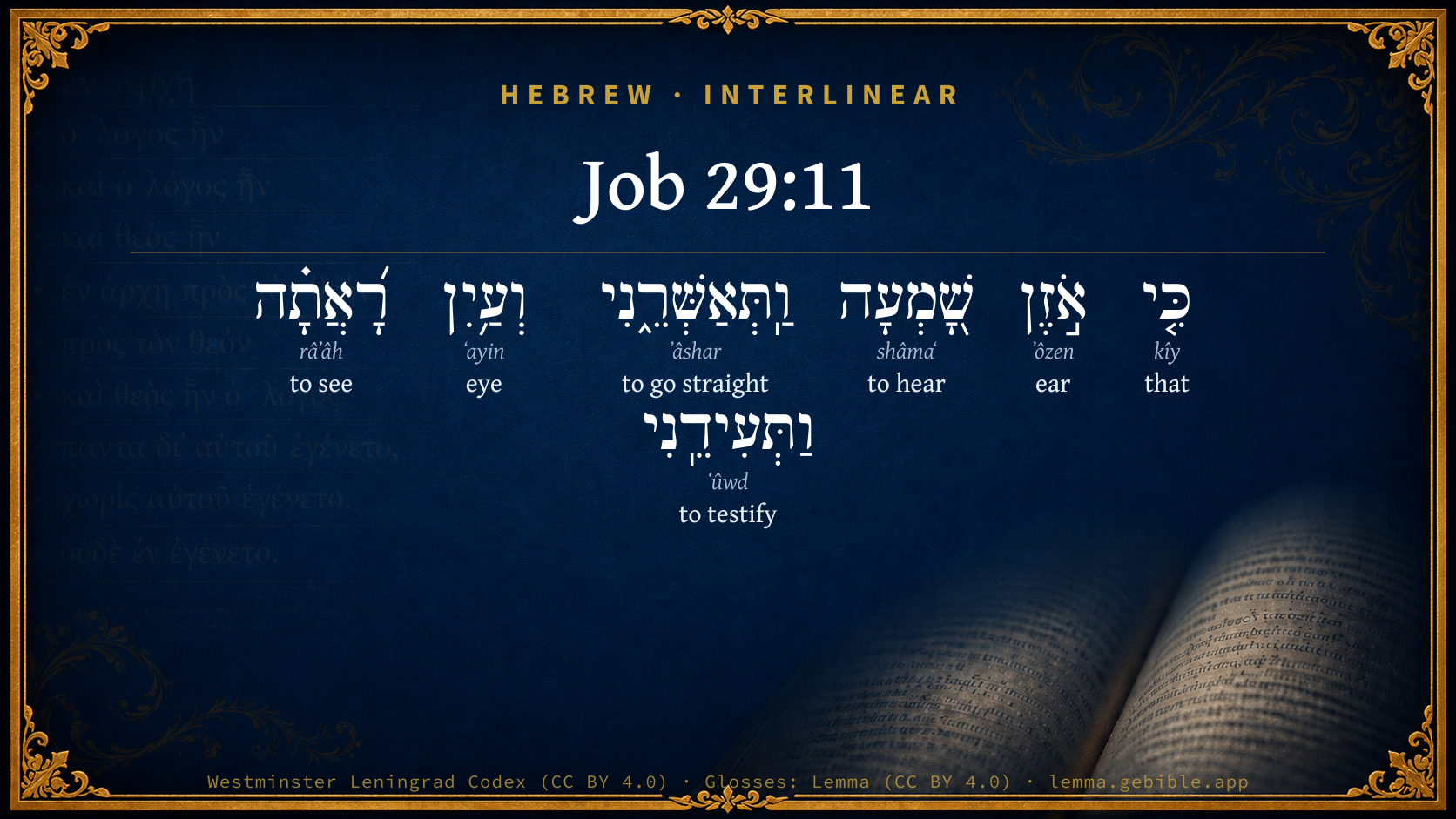
  1. כִּ֤י kîy H3588 “that” Conjunction
  2. אֹ֣זֶן ʼôzen H241 “ear” Noun, Common, Feminine, Singular, Absolute
  3. שָׁ֭מְעָה shâmaʻ H8085 “to hear” Verb, Qal, Perfect, 3rd Person, Feminine, Singular
  4. וְעַ֥יִן ʻayin H5869 “and · eye” Conjunction + Noun, Common, Both, Singular, Absolute
  5. רָ֝אֲתָ֗ה râʼâh H7200 “to see” Verb, Qal, Perfect, 3rd Person, Feminine, Singular
  6. וַתְּעִידֵֽנִי ʻûwd H5749 “and · to testify · me” Conjunction + Verb, Hiphil, Sequential Imperfect, 3rd Person, Feminine, Singular + Suffix, Personal, 1st Person, Common, Singular

About this verse

These counts appear in no published source. They are computed here, from the morphology-tagged text and Lemma’s own curated glosses. What Lemma adds →

7
words
7
distinct lemmas
Wisdom
section

Notable vocabulary

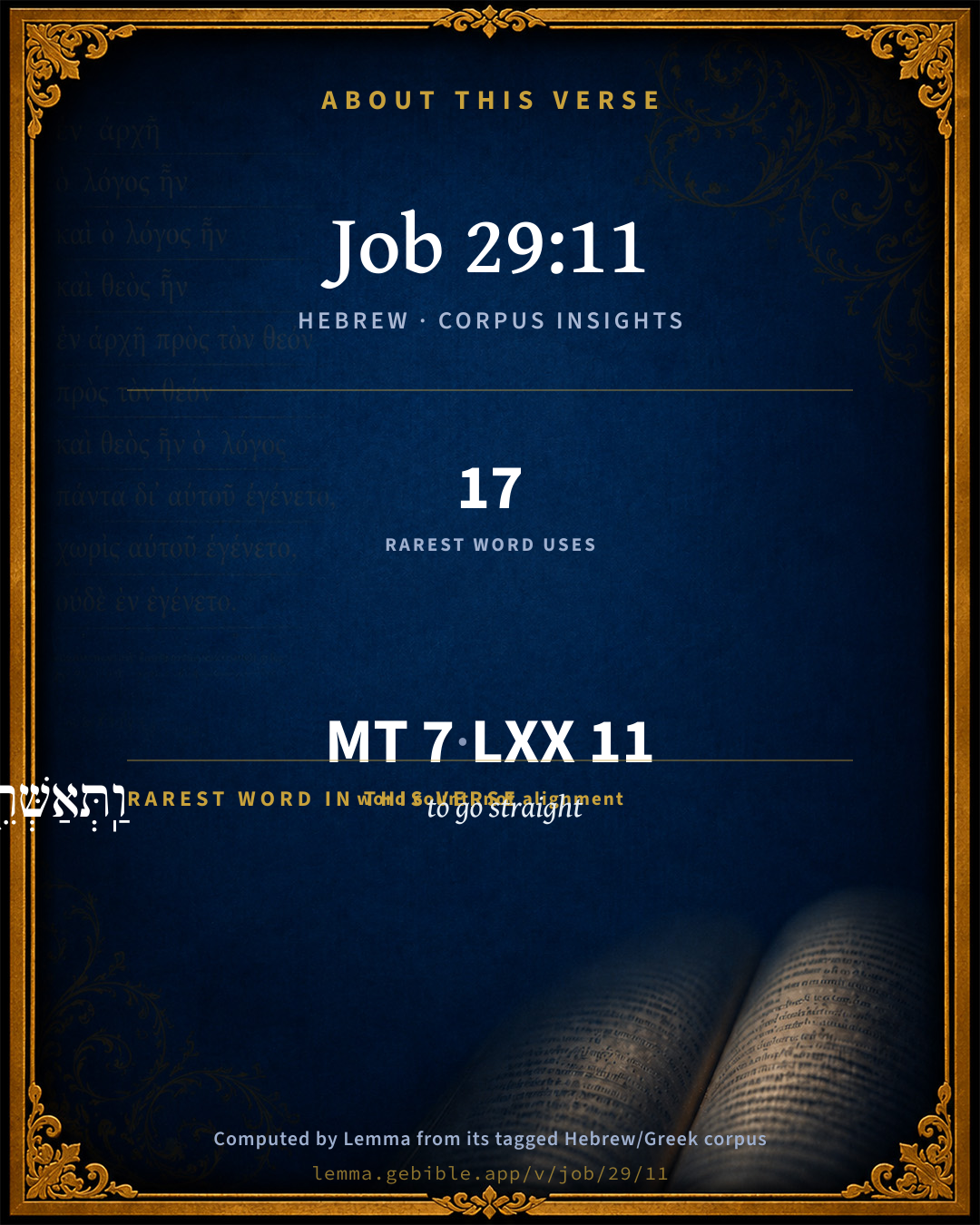
The rarest word here is וַֽתְּאַשְּׁרֵ֑נִי to go straight H833 — appearing just 17 times in the whole Hebrew Bible.

Shared distinctive vocabulary

וַֽתְּאַשְּׁרֵ֑נִי to go straight H833 occurs in 15 verses of the Hebrew Bible. Also found in:

Grammatical profile

  • 4 verbs
  • 2 nouns
  • 1 conjunction

Verb forms

  • שָׁ֭מְעָה Qal · Perfect
  • וַֽתְּאַשְּׁרֵ֑נִי Piel · Sequential Imperfect
  • רָ֝אֲתָ֗ה Qal · Perfect
  • וַתְּעִידֵֽנִי Hiphil · Sequential Imperfect

Hebrew & Septuagint length

In English translation the verse runs 19 words from the Hebrew and 15 from the Septuagint (LXX English) — closely comparable.

A rough comparison of the two English renderings, which tokenize alike — not a word-level alignment.

Word counts can differ between the Hebrew and the Greek without any difference in meaning — e.g. the Hebrew direct-object marker אֵת has no separate Greek word, and Greek often adds the article ὁ.

In the original languages it is 7 Hebrew tokens and 11 Greek tokens — but the two are counted differently (Hebrew bundles its prefixes and suffixes into one token; the Greek is in lemma form), so that isn’t a like-for-like length.

Cross-references

4

Topical passages linked to Job 29:11 in the Treasury of Scripture Knowledge — connected by theme and wording, ordered by reader-vote popularity; previews shown in the World English Bible.

  • Luke 4:22 All testified about him, and wondered at the gracious words which proceeded out of his mouth, and they said, "Isn't this Joseph's son?"
  • Job 31:20 If his heart hasn't blessed me, If he hasn't been warmed with my sheep's fleece;
  • Proverbs 29:2 When the righteous thrive, the people rejoice; But when the wicked rule, the people groan.
  • Luke 11:27 It came to pass, as he said these things, a certain woman out of the multitude lifted up her voice, and said to him, "Blessed is the womb that bore you, and the breasts which nursed you!"

Cross-references courtesy of OpenBible.info (CC BY 4.0).

Hebrew and Greek witnesses Masoretic Hebrew ↔ Greek Septuagint

The same verse in the two great witnesses to the Old Testament, shown verse-for-verse.

These are two independent witnesses, not word-aligned to each other, and the Septuagint is shown in lemma (dictionary) form.

Hebrew Job 29:11 Masoretic · Westminster Leningrad Codex

כִּ֤י אֹ֣זֶן שָׁ֭מְעָה וַֽתְּאַשְּׁרֵ֑נִי וְעַ֥יִן רָ֝אֲתָ֗ה וַתְּעִידֵֽנִי

For when the ear heard me, then it blessed me; And when the eye saw me, it commended me:

World English Bible · Public Domain

Greek LXX Job 29:11 Septuagint · lemma form

ὅτι οὖς ἀκούω καί μακαρίζω ἐγώ ὀφθαλμός δέ ὁράω ἐγώ ἐκκλίνω

For the ear heard, and blessed me; and the eye saw me, and turned aside.

LXX2012 (modern English Septuagint) · Public Domain

On this verse, Haydock's Catholic Bible Commentary discusses the Septuagint’s reading. Read the note in Commentary ↓

Hebrew: Westminster Leningrad Codex (CC BY 4.0). Greek: Septuagint (public domain); English from LXX2012 (modern English Septuagint) (Public Domain). How the Septuagint differs from the Hebrew →

Commentary

Notes on Job 29:11 from classic Christian and Jewish commentators (each source and its license shown beneath its notes). The classic Christian expositions comment on the surrounding passage and are grouped to its opening verse, so a note may address several verses; the Jewish commentaries on the Tanakh (Rashi and others) are per-verse, so they appear only where the commentator wrote on this verse.

Lemma curates 59 commentaries, every one of them public domain or Creative Commons licensed, each selected and text-cleaned for this edition rather than reprinted as found. About our sources →

Trapp's Complete Commentary

John Trapp

Job 29:11 When the ear heard [me], then it blessed me; and when the eye saw [me], it gave witness to me:

Ver. 11. When the ear heard me, then it blessed me] That is, it praised me, and praised God for me, as for a common blessing; so weighty were my words, and so just my sentence, not unlike that of the Areopagites, in Athens, which was so upright, that none could ever say that he was unjustly condemned by them; but both parties, as well those that were cast as they that cast them, were alike contented, Hττωμενοι στεργουσι ομοιως τοις κεκρατηκασι.

And when the eye saw me, it gave witness to me] Job (though he neither sought it, nor was puffed up with it) had that Pulchrum monstrari, et dicier, Hic est. The like happiness befell Demosthenes at Athens and Pliny at Rome, ουτος εστιν ο Dημοσθενης.

John Trapp, A Commentary or Exposition upon All the Books of the Old and New Testament (1647–1656) — public domain. Text from a community e-Sword module.

Joseph Benson's Commentary

Job 29:11-12. When the ear heard me, then it blessed me — Prayed to God to bless me, and pronounced a blessing upon me, because of the integrity, justice, and wisdom which were observed in all my discourses and actions, and of the satisfaction which I gave to all; as well as on account of the relief which I afforded to the oppressed, by my equitable decrees in all causes which were brought before me. When the eye saw me it gave witness to me — Gave testimony to my pious, and just, and blameless conversation. Because I delivered the poor — From his potent oppressor. Men did not honour me for my great wealth or power, but for my impartial justice and pity to the afflicted, and courage in maintaining their cause and right against their mighty adversaries. The fatherless, and him that had none to help him — None would own or help them, partly because they were poor, and unable to recompense them for it, and partly because their enemies were great, and likely to crush both them and their helpers; which made Job’s virtue more remarkable.

Joseph Benson's Commentary on the Old and New Testaments (1811–1818) — public domain. Text from a community e-Sword module.

Whedon's Commentary on the Bible

Daniel D. Whedon

Second strophe — This prosperity rested on the solid basis is of benevolence, philanthropy, and righteousness, which had become habitual with him, as if incorporated into his very nature, Job_29:11-17.

11. It blessed me — His character, as a public functionary, not only commanded the reverence of the aged and the great, but the esteem and affection of all. The friend of God is the friend of man.

Daniel D. Whedon (gen. ed.), Commentary on the Old and New Testaments (1874–1909) — public domain. Text from a community e-Sword module.

Geneva Bible (1599)

Geneva Bible translators

All that heard me, praised me.

Testifying, that I did good justice.

Geneva Bible (1599) marginal notes — public domain. Text via Bolls.life.

Jamieson, Fausset & Brown

Robert Jamieson, A. R. Fausset & David Brown

blessed--extolled my virtues (Pro 31:28). Omit "me" after "heard"; whoever heard of me (in general, not in the market place, Job 29:7-10) praised me.

gave witness--to my honorable character. Image from a court of justice (Luk 4:22).

the eye--that is, "face to face"; antithesis to

ear--that is, report of me.

Jamieson, Fausset & Brown — Commentary Critical and Explanatory on the Whole Bible (1871) — public domain (CC PDM 1.0). Text via the HelloAO Bible API.

Adam Clarke's Commentary

Verse 11. When the ear heard me] This and the six following verses present us with a fine exhibition of a man full of benevolence and charity, acting up to the highest dictates of those principles, and rendering the miserable of all descriptions happy, by the constant exercise of his unconfined philanthropy.

Adam Clarke's Commentary on the Bible (1810–1826) — public domain. Text from a community e-Sword/MySword module.

Ellicott's Commentary for English Readers

(11) When the ear heard me, then it blessed me.—This is a direct negative to the charges of Eliphaz in Job_22:6, &c. He has felt them too deeply to pass them by in total silence.

A Bible Commentary for English Readers, edited by Charles John Ellicott (1878–1897) — public domain. Text from a community e-Sword module.

The Cambridge Bible for Schools and Colleges

gen. ed. J. J. S. Perowne

11. This verse may read,

For the ear that heard of me blessed me,

And the eye that saw me gave witness to me.

Those who had only heard of him by report “blessed” him, that is, “called him happy,” as one whom blessing and prosperity must follow because of his benevolence and mercy to the needy; and they who saw him as he lived among men bore testimony to his goodness—as Job_29:12 indicates.

11–17. The ground of this universal reverence—Job’s benevolent care of the poor and his strict justice to their cause.

The Cambridge Bible for Schools and Colleges (gen. ed. J. J. S. Perowne; Cambridge University Press, 1878–1918) — public domain. Text from a community e-Sword module.

John Gill's Exposition

When the ear heard me, then it blessed me,.... The ear of the common people assembled together to hear causes tried, and how they would go; when they heard Job give his opinion in court, or the definitive sentence passed by him as a judge, they all applauded his wisdom and justice; they highly praised and commended him; in which sense the word "blessed" is used, Pro 31:28; or they wished a blessing on him; they prayed for his welfare, as it becomes people to do for those that are in authority, especially wise and faithful magistrates; or they accounted him a blessed man, and called him so, Luk 1:48; as he was, both in a temporal sense, being blessed with a great plenty of earthly things, and also blessed with all spiritual blessings in Christ, with an abundance of grace, and with a title to eternal glory; as well as he was blessed as a magistrate, with great wisdom, and with great integrity and uprightness in the discharge of his office:

and when the eye saw me, it gave witness to me: of his gracefulness and gravity, of his honesty and faithfulness, of his good behaviour among his neighbours, and of his wise conduct in the courts of judicature.

John Gill's Exposition of the Whole Bible (1746–1763) — public domain (CC PDM 1.0). Text via the HelloAO Bible API.

Albert Barnes' Notes on the Bible

When the ear heard me. - A personification for “they who heard me speak, blessed me.” That is, they commended or praised me.

And when the eye saw me - All who saw me.

It gave witness to me - That is, the fixed attention to what he said and the admiration which was shown by the eyes of the multitudes, were witnesses of the respect and honor in which he was held. Gray has a beautiful expression similar to this when he says,

“He reads his history in a nation’s eyes.”

Albert Barnes' Notes on the Bible (1834–1885) — public domain. Text from a community e-Sword/MySword module.

Haydock's Catholic Bible Commentary

Gave. Septuagint, "winked," through approbation. (Calmet)

George Leo Haydock (1774–1849), Haydock's Catholic Family Bible and Commentary, 1859 edition — public domain. Excludes Psalms (Douay-Rheims chapter numbering differs from Protestant) and Deuterocanonical books (Catholic canon only).

Matthew Poole's English Annotations

It blessed me, i.e. pronounced me to be a man blessed of God with eminent gifts and graces; or heartily prayed for God’s blessing upon me, because of that wisdom and integrity which they saw in all my actions, and of the satisfaction which I gave to all, and the relief which I gave to the oppressed, by my righteous and equitable decrees in all causes which were brought before me.

When the eye saw me, it gave witness to me; when my appearance gave them occasion to speak of me, they gave testimony to my pious, and just, and blameless conversation. So far was I from being, or being thought to be, guilty of those crimes wherewith you charge me; of which see Job 22:9.

Matthew Poole's English Annotations on the Holy Bible (1683–1685) — public domain. Text from a community e-Sword/MySword module.

The Pulpit Commentary

When the ear heard me, then it blessed me. Job, having described his reception by the nobles and chief men of the city, proceeds to speak of the behaviour of the common people. The former were respectful and attent, the latter rejoiced and made acclamation. Being of the class most exposed to oppression and wrong, they hailed in the patriarch a champion and a protector. They were sure of redress and justice where he was the judge. And when the eye saw me, it gave witness to me. The eye of the poor man lighted up with joy and rejoicing as Job sat down upon the seat of judgment, thus hearing witness to his fairness, candour, and integrity.

The Pulpit Commentary (1880–1919), ed. H.D.M. Spence-Jones & Joseph S. Exell — public domain. Text from a community e-Sword module.

John Wesley's Explanatory Notes

Witness - Gave testimony to my pious, and just, and blameless conversation.

John Wesley, Explanatory Notes Upon the Whole Bible (1754–1765) — public domain. Text via the GEBible commentary corpus.

Keil & Delitzsch

C. F. Keil & F. Delitzsch

11 For an ear heard, and called me happy;

And an eye saw, and bear witness to me:

12 For I rescued the sufferer who cried for help,

And the orphan, and him that had no helper.

13 The blessing of him that was ready to perish came upon me,

And I made the widow's heart rejoice.

14 I put on justice, and it put me on;

As a robe and turban was my integrity.

Thus imposing was the impression of his personal appearance wherever he appeared; for (כּי explic.) the fulness of the blessing of the possession of power and of prosperity which he enjoyed was so extraordinary, that one had only to hear of it to call him happy, and that, especially if any one saw it with his own eyes, he was obliged to bear laudatory testimony to him. The futt. consec. affirm what was the inevitable consequence of hearing and seeing; העיד, seq. acc., is used like הזכּיר in the signification of laudatory recognition. The expression is not brachylogical for ותּעד לּי (vid., on Job 31:18); for from Kg1 21:10, Kg1 21:13, we perceive that העיד with the acc. of the person signifies to make any one the subject of assertion, whether he be lower or higher in rank (comp. the New Testament word, especially in Luke, μαρτυρεῖσθαι). It was, however, not merely the outward manifestation of his unusual prosperity which called forth such admiration, but his active benevolence united with the abundant resources at his command. For where there was a sufferer who cried for help he, relieved him, especially orphans and those who had no helper. ולא־עזר לו is either a new third object, or a closer definition of what precedes: the orphan and (in this state of orphanhood) helpless one. The latter is more probable both here and in the Salomonic primary passage, Psa 72:12; in the other case ואשׁר אין־עזר לח might be expected.

Job 29:13

The blessing (בּרכּת with closely closed penult.) of those who stood on the brink of destruction (אובד, interiturus, as Job 31:19; Pro 31:6), and owed their rescue to him, came upon him; and the heart of the widow to whom he gave assistance, compensating for the assistance of her lost husband, he filled with gladness (הרנין causative, as Psa 65:9). For the primary attribute, the fundamental character of his way of thinking and acting, was צדק, a holding fast to the will of God, which before everything else calls for sympathizing love (root צדק, Arab. ṣdq, to be hard, firm, stiff, e.g., rumh-un sadq-un, according to the Kamus: a hard, firm, straight spear), and משׁפּט, judgment and decision in favour of right and equity against wrong and injustice. Righteousness is here called the garment which he put on (as Psa 132:9, comp. Isa 11:5; Isa 59:17), and right is the robe and turban with which he adorns himself (comp. Isa 61:10); as by Arabian poets noble attributes are also called garments, which God puts on any one, or which any one puts on himself (albasa).

(Note: In Beidhwi, if I remember rightly, this expression occurs once, Arab. 'l-tdrr‛ blbls 'l-tqwy, i.e., "clothing one's self in the armour of the fear of God.")

Righteousness is compared to the לבושׁ (corresponding to the thob, i.e., garment, indusium, of the nomads) which is worn on the naked body, justice to the צניף, a magnificent turban (corresponding to the kefije, consisting of a thick cotton cloth, and fastened with a cord made of camel's hair), and the magnificent robe (corresponding to the second principal article of clothing, the ‛abâ). The lxx, Jer., Syr., and Arab. wrongly refer ויּלבּשׁני to משׁפטי of the second half of the verse, while, on the contrary, it is said of צדק, per antanaclasin, that Job put this on, and this in turn put Job on, induit; for וילבשׁני, as the usage of the language, as we have it, elsewhere shows, does not signify: it (righteousness) clothed me well (Umbr.), or: adorned me (Ew., Vaih.), also not: it dressed me out (Schlottm.), but only: it put me on as a garment, i.e., it made me so its own, that my whole appearance was the representation of itself, as in Jdg 6:34 and twice in the Chronicles, of the Spirit of Jehovah it is said that He puts on any one, induit, when He makes any one the organ of His own manifestation.

Keil & Delitzsch — Biblical Commentary on the Old Testament (1861–1891) — public domain (CC PDM 1.0). Text via the HelloAO Bible API. (Old Testament only.)

unfoldingWord translationNotes

Door43 World Missions Community

after their ears heard me ... after their eyes saw me

The ears represent those who heard him, and the eyes represent those who saw him. AT: "after they heard what I told them ... after they saw me" (See: Synecdoche)

they would then give witness to me and approve of me

"they would witness approvingly of me"

I rescued the one who was poor when he cried out

Here "the one who was poor" refers to any poor person. AT: "I used to rescue poor people who cried out" (See: Generic Noun Phrases)

The blessing of him who was about to perish came on me

Someone's blessing coming on another represents that person blessing another. AT: "He who was about to perish would bless me" (See: Metaphor)

him who was about to perish

This represents anyone who was about to die. AT: "those who were about to die" (See: Generic Noun Phrases)

I caused the widow's heart to sing for joy

Here "the widow's heart" represents any widow. AT: "I caused widows to sing joyfully" (See: Synecdoche and Generic Noun Phrases)

translationWords

bless

testimony

perish

heart

unfoldingWord translationNotes — © Distant Shores Media and the Door43 World Missions Community, licensed CC BY-SA 4.0. Source: git.door43.org/Door43/en_tn.

Rashi

Rabbi Shlomo Yitzchaki (Rashi)

For the ear that heard my word praised me.

and the eye [that] saw my greatness and the propriety of my traits in all places.

Rashi on the Tanakh — English translations: “The Judaica Press complete Tanach with Rashi, translated by A. J. Rosenberg” (CC BY 4.0); “Pentateuch with Rashi's commentary by M. Rosenbaum and A.M. Silbermann, 1929-1934” (public domain); “The Metsudah Tanach series, Lakewood, N.J” (CC BY 4.0); and “The Book of Joshua, Metsudah Publications, 1997” (CC BY 4.0). Text via Sefaria.

Lesson kit

Teaching starters — assembled from the data on this page, not authored interpretation. Every prompt links to the verse data it draws on. Edit before teaching.

Job, in the Wisdom, opens this verse with 7 words (7 distinct Hebrew lemmas). Its most distinctive word is ʼâshar (“to go straight”). A historical commentator’s framing appears above. Read the whole chapter for the surrounding context.

Discussion questions

  1. How does “to go straight” (ʼâshar) shape what this verse is saying?
  2. Genesis 30:13 shares the word «to go straight» with this verse. How do the two illuminate each other?
  3. These translations render this verse differently. What is at stake in choosing one wording over another?
  4. The verb «שָׁ֭מְעָה» is Qal Perfect. How does its form color the action?
  5. Reading how Trapp's Complete Commentary and Joseph Benson's Commentary read this verse, where do the two commentators agree and where do they part?

Things to notice

Reading settings

Reading text

Shown beneath each verse's original-language words.

Old Testament
Old Testament edition

Read the OT as the Masoretic Hebrew (MT) or the Greek Septuagint (LXX).

English shown for the Greek Septuagint (in the Hebrew ↔ Greek comparison).

Comparing translations? Open the Compare panel on any verse page to stack up to four side by side.