
Job 28:22

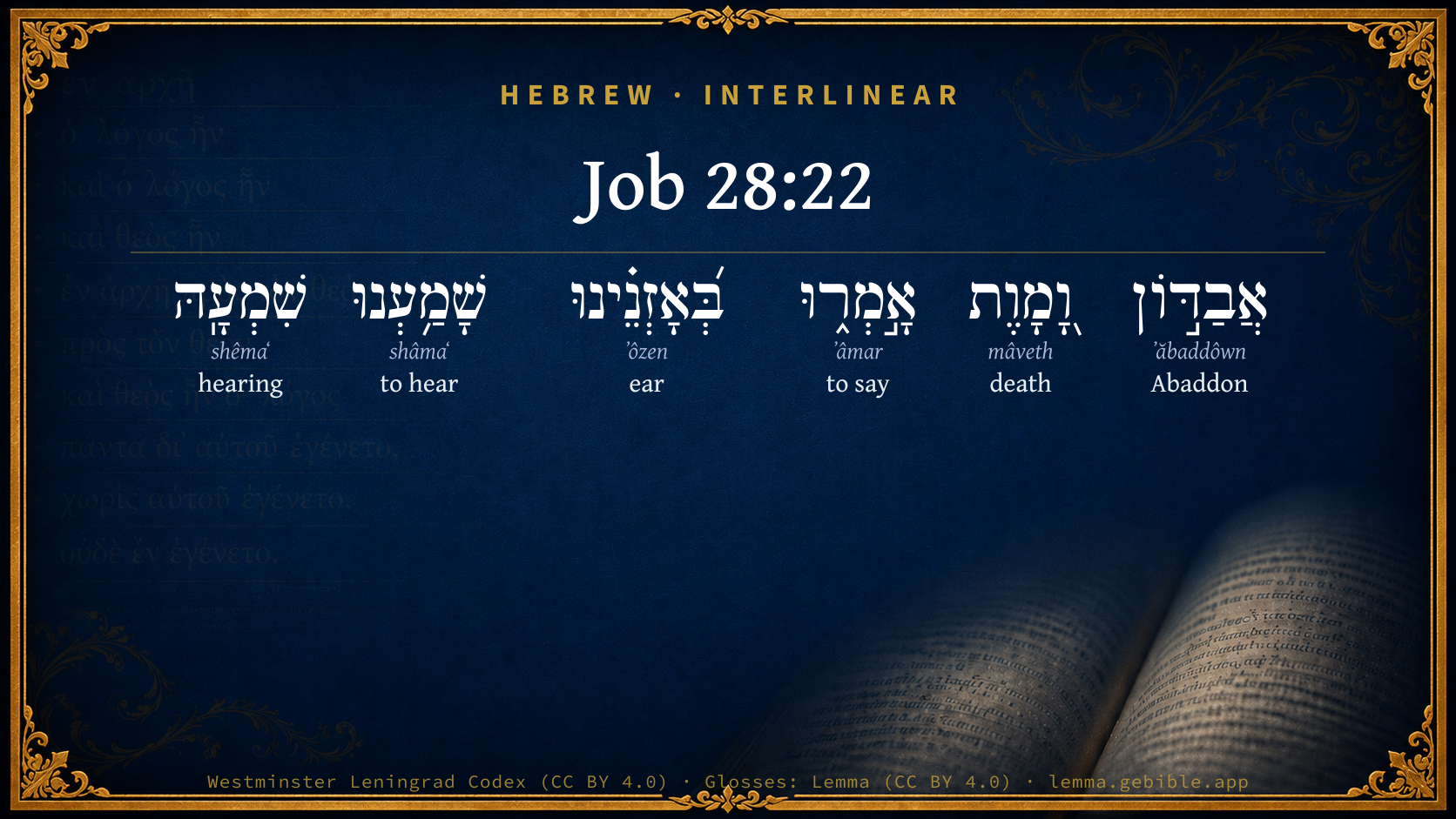
Hebrew (Westminster Leningrad Codex) Job 28:22 appears in the Hebrew Old Testament. The text above is from the Westminster Leningrad Codex. Each word links to its Strong’s number, a concise gloss, and parsing drawn from the Open Scriptures Hebrew Bible morphology. Click any word for its full Brown-Driver-Briggs (BDB) entry.
Download image
Cite this verse

Job 28:22 (World English Bible). Public Domain. Lemma interlinear Bible study tool, https://lemma.gebible.app/v/job/28/22.

Show BibTeX & RIS
BibTeX
RIS
English Translation
Destruction and Death say, 'We have heard a rumor of it with our ears.'
World English Bible · Public Domain
Download a study sheet

One document with this verse’s original text, its word-by-word gloss line, the meaning frame, cross-references with their text, attributed commentary, and full source and license credits — printable, and it pastes into notes with its structure intact.

This verse Autodidact and up

Study sheet (.html) Plain text (.txt)

A passage Seminary Student

Up to 50 verses in one chapter. A passage sheet keeps up to 6 commentary sources and 12 cross-references per verse, in the order this page ranks them, and says so on the sheet whenever that leaves anything out. Ask for a single verse and you get the Autodidact verse sheet above.

Everything on this page stays free to read, with no account — the sheet is a download of what is already on screen, not access to it.

Want to remove ads? Support Godless Engineer
Compare translations 3

The same verse in 3 English versions, stacked beneath the original-language interlinear above. Click any original word for its lexicon entry.

Each is an independent rendering of the whole verse — the interlinear is not word-aligned to these translations.

Highlighted words mark where these versions differ — a whole-verse word diff, not a word-by-word alignment.

  • World English Bible Public Domain
    Destruction and Death say, 'We have heard a rumor of it with our ears.'
  • King James Version Public Domain
    Destruction and death say, We have heard the fame thereof with our ears.
  • unfoldingWord Literal Text CC BY-SA 4.0
    Abaddon and death say, ‘We have heard a rumor of it with our ears.’

unfoldingWord Literal Text — © unfoldingWord, licensed CC BY-SA 4.0. Word-aligned USFM3 via Door43 (git.door43.org/unfoldingWord/en_ult).

Versions to compare (up to 4)

3 of 4 selected

Show all 18 translations

Every available English version of this verse, each an independent rendering of the whole verse.

  • World English Bible Public Domain
    Destruction and Death say, 'We have heard a rumor of it with our ears.'
  • Berean Standard Bible Public Domain
    Abaddon and Death say, ‘We have heard a rumor about it.’
  • Majority Standard Bible Public Domain
    Abaddon and Death say, ‘We have heard a rumor about it.’
  • King James Version Public Domain
    Destruction and death say, We have heard the fame thereof with our ears.
  • American Standard Version (1901) Public Domain
    Destruction and Death say, We have heard a rumor thereof with our ears.
  • Revised Version (1885) Public Domain
    Destruction and Death say, We have heard a rumour thereof with our ears.
  • Geneva Bible (1599) Public Domain
    Destruction and death say, We haue heard the fame thereof with our eares.
  • Douay-Rheims (1899) Public Domain
    Destruction and death have said: With our ears we have heard the fame thereof.
  • Young's Literal Translation Public Domain
    Destruction and death have said: `With our ears we have heard its fame.'
  • Literal Standard Version CC BY-SA 4.0
    Destruction and death have said: With our ears we have heard its fame.
  • Unlocked Literal Bible CC BY-SA 4.0
    Destruction and Death say, 'We have heard just a rumor about it with our ears.'
  • unfoldingWord Literal Text CC BY-SA 4.0
    Abaddon and death say, ‘We have heard a rumor of it with our ears.’
  • Darby Bible Public Domain
    Destruction and death say, We have heard its report with our ears.
  • World Messianic Bible Public Domain
    Destruction and Death say, ‘We have heard a rumor of it with our ears.’
  • Webster's Bible Public Domain
    Destruction and death say, We have heard the fame of it with our ears.
  • Free Bible Version CC BY-SA 4.0
    Abaddon and Death say, ‘We've only heard a rumor of it.’
  • Bible in Basic English Public Domain
    Destruction and Death say, We have only had word of it with our ears.
  • JPS Tanakh (1917) Public Domain
    Destruction and Death say: 'We have heard a rumor thereof with our ears.'

Literal Standard Version (2020), Covenant Press — licensed CC BY-SA 4.0. Text via the HelloAO Bible API (eBible.org). Unlocked Literal Bible (unfoldingWord) — licensed CC BY-SA 4.0. Text via the HelloAO Bible API (eBible.org). unfoldingWord Literal Text — © unfoldingWord, licensed CC BY-SA 4.0. Word-aligned USFM3 via Door43 (git.door43.org/unfoldingWord/en_ult). Free Bible Version, Dr. Jonathan Gallagher — licensed CC BY-SA 4.0. Text via the HelloAO Bible API (eBible.org).

Word by word

More ways to search: Search by grammar → Find every occurrence → Compare this word →

Practice this passage: Drill this verse → Learn its vocabulary →

About this verse

These counts appear in no published source. They are computed here, from the morphology-tagged text and Lemma’s own curated glosses. What Lemma adds →

6
words
6
distinct lemmas
Wisdom
section

Notable vocabulary

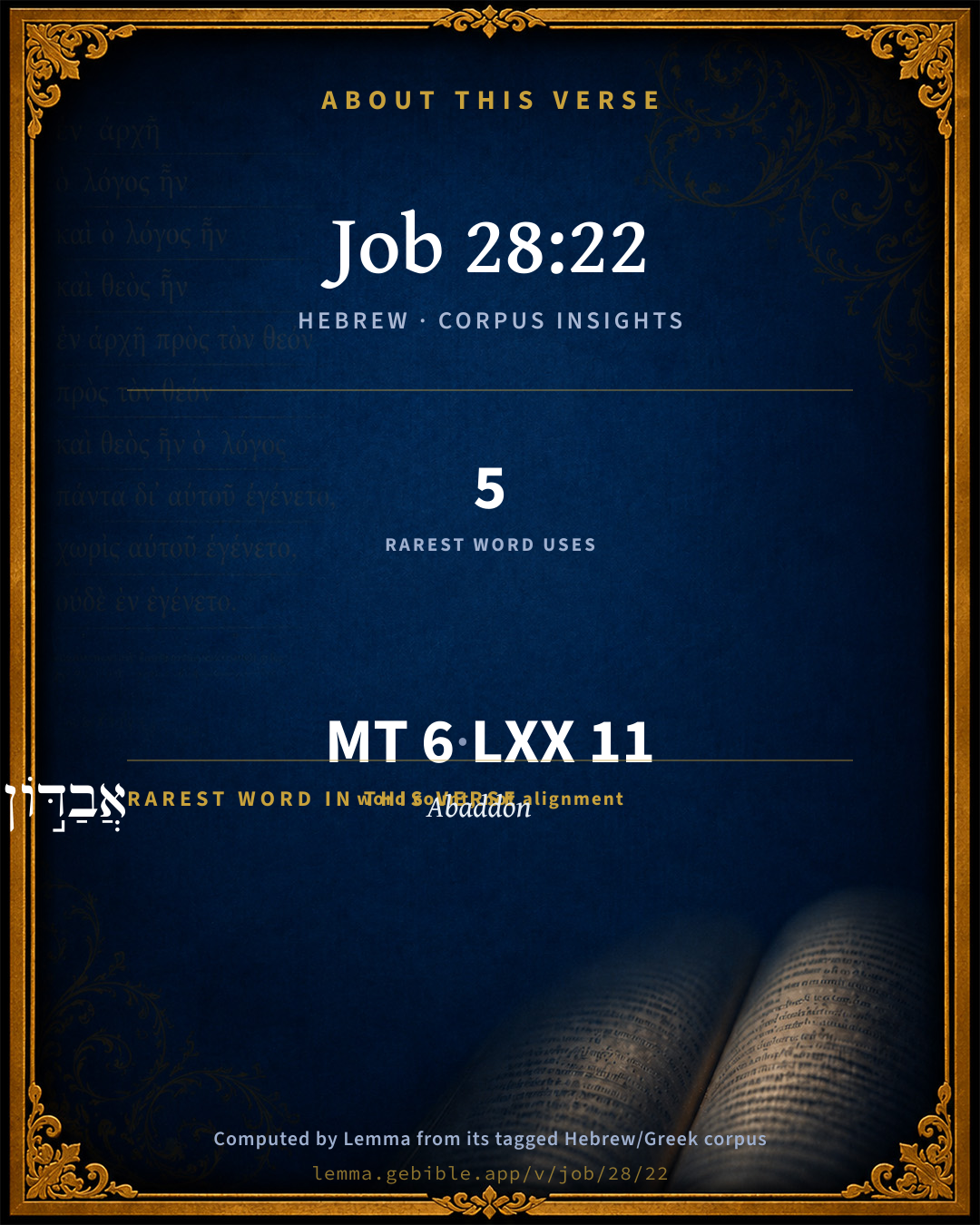
The rarest word here is אֲבַדּ֣וֹן Abaddon H11 — appearing just 5 times in the whole Hebrew Bible.

Shared distinctive vocabulary

אֲבַדּ֣וֹן Abaddon H11 occurs in 5 verses of the Hebrew Bible. Also found in:

Grammatical profile

  • 2 verbs
  • 4 nouns

Verb forms

  • אָ֣מְר֑וּ Qal · Perfect
  • שָׁמַ֥עְנוּ Qal · Perfect

Hebrew & Septuagint length

In English translation the verse runs 14 words from the Hebrew and 11 from the Septuagint (LXX English) — closely comparable.

A rough comparison of the two English renderings, which tokenize alike — not a word-level alignment.

Word counts can differ between the Hebrew and the Greek without any difference in meaning — e.g. the Hebrew direct-object marker אֵת has no separate Greek word, and Greek often adds the article ὁ.

In the original languages it is 6 Hebrew tokens and 11 Greek tokens — but the two are counted differently (Hebrew bundles its prefixes and suffixes into one token; the Greek is in lemma form), so that isn’t a like-for-like length.

Cross-references

3

Topical passages linked to Job 28:22 in the Treasury of Scripture Knowledge — connected by theme and wording, ordered by reader-vote popularity; previews shown in the World English Bible.

  • Job 26:6 Sheol is naked before God, And Abaddon has no covering.
  • Psalms 83:10–12 Who perished at Endor, Who became as dung for the earth.
  • Job 28:14 The deep says, 'It isn't in me.' The sea says, 'It isn't with me.'

Cross-references courtesy of OpenBible.info (CC BY 4.0).

Hebrew and Greek witnesses Masoretic Hebrew ↔ Greek Septuagint

The same verse in the two great witnesses to the Old Testament, shown verse-for-verse.

These are two independent witnesses, not word-aligned to each other, and the Septuagint is shown in lemma (dictionary) form.

Hebrew Job 28:22 Masoretic · Westminster Leningrad Codex

אֲבַדּ֣וֹן וָ֭מָוֶת אָ֣מְר֑וּ בְּ֝אָזְנֵ֗ינוּ שָׁמַ֥עְנוּ שִׁמְעָֽהּ

Destruction and Death say, 'We have heard a rumor of it with our ears.'

World English Bible · Public Domain

Greek LXX Job 28:22 Septuagint · lemma form

ὁ ἀπώλεια καί ὁ θάνατος εἶπον ἀκούω δέ αὐτός ὁ κλέος

Destruction and Death said, We have heard the report of it.

LXX2012 (modern English Septuagint) · Public Domain

Hebrew: Westminster Leningrad Codex (CC BY 4.0). Greek: Septuagint (public domain); English from LXX2012 (modern English Septuagint) (Public Domain). How the Septuagint differs from the Hebrew →

Commentary

Notes on Job 28:22 from classic Christian and Jewish commentators (each source and its license shown beneath its notes). The classic Christian expositions comment on the surrounding passage and are grouped to its opening verse, so a note may address several verses; the Jewish commentaries on the Tanakh (Rashi and others) are per-verse, so they appear only where the commentator wrote on this verse.

Lemma curates 59 commentaries, every one of them public domain or Creative Commons licensed, each selected and text-cleaned for this edition rather than reprinted as found. About our sources →

The Cambridge Bible for Schools and Colleges

gen. ed. J. J. S. Perowne

22. destruction and death] Heb. Abaddon and Death. Abaddon is Sheol, the realm of the dead, here personified, as also is Death. Comp. Rev_1:18; Rev_9:11, and see on ch. Job_26:6.

the fame thereof] i. e. the report or rumour thereof. Destruction and Death have only heard of Wisdom, they have no knowledge of it, much less is it to be found with them. It is not true, alas! in this sense that

There must be wisdom with great Death.

The words “we have heard the report thereof” ascribe neither a less nor a greater knowledge of Wisdom to Death than the living possess. Both are equally ignorant of it, and equally without it. As Job_28:13-14 told how Wisdom was nowhere to be found in the upper world so Job_28:22 states that it is not to be found in the under world. The process of exhaustion is complete: Wisdom is nowhere to be found, neither in the bowels of the earth nor in the markets of mankind, in the deep nor in the sea; neither in the land of the living nor in the place of the dead.

The Cambridge Bible for Schools and Colleges (gen. ed. J. J. S. Perowne; Cambridge University Press, 1878–1918) — public domain. Text from a community e-Sword module.

Trapp's Complete Commentary

John Trapp

Job 28:22 Destruction and death say, We have heard the fame thereof with our ears.

Ver. 22. Destruction and death say, &c.] That is, the dead in the grave, and damned in hell, as some gloss it. Others, man in his corrupt estate, though a child of death, yet capable of salvation; and the wisdom of God hath found out a way to save him by his Son, letting in life by the ear, according to that, "Hear, and your souls shall live," Isa 55:3. The dead in sins and trespasses shall hear the voice of the Son of God (in the preaching of the word), and shall live, the life of grace here, and of glory hereafter, Joh 5:25. These have heard of God’s wisdom in his various dealings with the sons of men, and that with their ears; both with the gristles that grow on their heads, and with the inward ears of their minds, so that one sound hath pierced both, but yet the one half hath not been told them; they can truly say, as the queen of Sheba said to Solomon, Thou hast added wisdom and goodness to the fame, 1Ki 10:7. And as David in the person of Christ, Psa 16:11, "Thou wilt show me the path of life"; whereby is hinted that Christ himself, as man, did not so fully understand in the days of his flesh the unconceivable joys of heaven, as he did afterwards, when his whole person was glorified with the glory which, as God, he had with the Father before the world was, Joh 17:5.

John Trapp, A Commentary or Exposition upon All the Books of the Old and New Testament (1647–1656) — public domain. Text from a community e-Sword module.

Joseph Benson's Commentary

Job 28:22. Destruction and death — Either, 1st, Men that are dead, and thereby freed from the encumbrance of their bodies, which depressed their minds, and whose faculties are more raised and enlarged than those of men still in the body; or, rather, 2d, The grave, the habitation of the dead, to which these things are here ascribed, as they are to the depths and to the sea, Job 28:14, by a common figure. These inward recesses of the earth are as little acquainted with this wisdom as the upper regions: and had they a tongue they could only say, We have heard the fame thereof — We know it only by slight and uncertain rumours. But though they cannot give an account of it themselves, yet there is a world, on which these dark regions border, where we shall see it clearly. Have patience, says death, I will fetch thee shortly to a place where even this wisdom shall be found. When the veil of flesh is rent, and the interposing clouds are scattered, we shall know what God doth, though we know not now.

Joseph Benson's Commentary on the Old and New Testaments (1811–1818) — public domain. Text from a community e-Sword module.

Jamieson, Fausset & Brown

Robert Jamieson, A. R. Fausset & David Brown

That is, the abodes of destruction and of the dead. "Death" put for Sheol (Job 30:23; Job 26:6; Psa 9:13).

We have [only] heard--the report of her. We have not seen her. In the land of the living (Job 28:13) the workings of Wisdom are seen, though not herself. In the regions of the dead she is only heard of, her actings on nature not being seen (Ecc 9:10).

Jamieson, Fausset & Brown — Commentary Critical and Explanatory on the Whole Bible (1871) — public domain (CC PDM 1.0). Text via the HelloAO Bible API.

Adam Clarke's Commentary

Verse 22. Destruction and death say, We have heard the fame thereof] אבדון ומות Abaddon vamaveth, the destroyer, and his offspring death. This is the very name that is given to the devil in Greek letters Αβαδδων, Re 9:11, and is rendered by the Greek word Απολλυων, Apollyon, a word exactly of the same meaning. No wonder death and the devil are brought in here as saying they had heard the fame of wisdom, seeing Job 28:28 defines it to be the fear of the Lord, and a departure from evil; things point blank contrary to the interests of Satan, and the extension of the empire of death.

Adam Clarke's Commentary on the Bible (1810–1826) — public domain. Text from a community e-Sword/MySword module.

Ellicott's Commentary for English Readers

(22) Destruction and death say.—That destruction and death should have heard the fame of wisdom is natural, as it consists in departing from the evil which leads to their abode.

A Bible Commentary for English Readers, edited by Charles John Ellicott (1878–1897) — public domain. Text from a community e-Sword module.

John Gill's Exposition

God understandeth the way thereof,.... And he only; not the way that men can come at the knowledge of wisdom, which at present appears to be past finding out; but rather the way which wisdom itself takes, and is in the deep, and its footsteps not known by any other, and the grounds and reasons of its taking such a course it does; which are only understood by the Lord: it may be applied to spiritual wisdom in men, and the way to come at it; which God only knows and instructs in, and is his special and peculiar gift; and to Christ, the wisdom of God, and the way which he has taken in the council and covenant of grace and peace, for the salvation of his people; and which he took in time, in the assumption of human nature, and by sufferings and death to obtain it for them:

and he knoweth the place thereof; the seat of wisdom within himself, the source of all his dealings with men, his sovereign will and pleasure in his own heart; the place of spiritual wisdom and knowledge, the heart of a regenerate man, where his Gospel is, and has come with power, and took place and works effectually; and where Christ, the Logos, the Wisdom of God is, even with himself, and in his bosom, as in the times of Job, and now at his right hand, in human nature.

John Gill's Exposition of the Whole Bible (1746–1763) — public domain (CC PDM 1.0). Text via the HelloAO Bible API.

Albert Barnes' Notes on the Bible

Destruction - This is a personification which is exceedingly sublime. Job had spoken of the wonderful discoveries made by science, but none of them had disclosed true wisdom. It had not been discovered in the shaft which the miner sank deep in the earth; in the hidden regions which he laid open to day, nor by the birds that saw to the farthest distance, or that were regarded as the interpreters of the will of the gods. It was natural to ask whether it might not have been discovered in the vast profound of the nether world - the regions of death and of night; and whether by making a bold appeal to the king that reigned there, a response might not be heard that would be more satisfactory. In Job 28:14, the appeal had been made to the sea - with all its vast stores; here the appeal is to far deeper regions - to the nether world of darkness and of death. On the word used here (אבדון 'ăbaddôn), “destruction,” see the notes at Job 26:6. It is employed here, as in that place, to denote the nether world - the abode of departed spirits - the world where those are who have been destroyed by death, and to which the destruction of the grave is the entrance.

And death - Death is used here to denote “Sheol,” or the abode of the spirits of the dead. The sense is, that those deep and dark regions had simply heard the distant report of wisdom but they did not understand it, and that if one went down there it would not be fully revealed to him. Perhaps there is an allusion to the natural expectation that, if one could go down and converse with the dead, he could find out much more than can be known on earth. It was to be presumed that they would understand much more about the unseen and future world, and about the plans and government of God, than man can know here. It was on this belief, and on the hope that some league or alliance could be made with the dead, inducing them to communicate what they knew, that the science of necromancy was founded; see the notes at Isa 8:19.

We have heard the fame thereof - We have heard the report of it, or a rumor of it. The meaning is, that they did not understand it fully, and that if man could penetrate to those dark regions, he could not get the information which he desired. Wisdom is still at such an immense distance that it is only a report, or rumor of it, which has reached us.

Albert Barnes' Notes on the Bible (1834–1885) — public domain. Text from a community e-Sword/MySword module.

Haydock's Catholic Bible Commentary

Destruction. Hebrew abaddon, which is before (chap. xxvi. 6.) used to signify the bottomless abyss. There, too late! the dead become acquainted with the value and nature of wisdom. (Haydock) --- But their knowledge is imperfect, and of no use to us. (Calmet)

George Leo Haydock (1774–1849), Haydock's Catholic Family Bible and Commentary, 1859 edition — public domain. Excludes Psalms (Douay-Rheims chapter numbering differs from Protestant) and Deuterocanonical books (Catholic canon only).

Matthew Poole's English Annotations

Destruction and death; either,

1. Men that are dead, and thereby freed from the encumbrance of their bodies, which depress their minds, and have more raised thoughts than men that live here. Or,

2. The grave, the place of the dead, to which these things are here ascribed, as they are to the depths, and to the sea, Job 28:14, by a figure called prosopopaeia. If a man should search for this wisdom, either amongst living men, or amongst the dead, he could not find it; yea, though he should and might inquire of all men that formerly lived in the world, some of whom were persons of prodigious wit and learning, and of vast experience, as having lived nigh a thousand years, and made it their great business in that time to search out the depths of this Divine wisdom in the administration of the world.

We have heard the fame thereof; we know it only by slight and uncertain rumours, but not fully and perfectly.

Matthew Poole's English Annotations on the Holy Bible (1683–1685) — public domain. Text from a community e-Sword/MySword module.

Whedon's Commentary on the Bible

Daniel D. Whedon

22. We have heard the fame thereof — The silence of the living suggests appeal to the dead. New regions of being may perchance have opened new resources of knowledge. In sublime figure the poet summons destruction (Hebrew, Abaddon, see Job_26:6) and death. All the information they can give is hearsay. They have heard a vague report. In the gloomy view of the ancients, death gave but little increase of knowledge. If the living know not, much less the dead.

Third strophe — With God is the lofty abode of wisdom, as is attested by its display in the creation and ordering of the world. True wisdom he imparts to man through obedience to the divine law and through the fear of God — two divinely appointed conservators against wickedness and the consequent doom of those who practice evil, Job_28:23-28. “The last of these three divisions (of the chapter), into which the highest truths are compressed, is for emphasis the shortest, in its calmness and abrupt ending the most solemn, because the thought finds no expression that is altogether adequate, floating in a height that is immeasurable, but opening a boundless field for further reflection.” — Ewald.

Daniel D. Whedon (gen. ed.), Commentary on the Old and New Testaments (1874–1909) — public domain. Text from a community e-Sword module.

The Pulpit Commentary

Destruction and death say, We have heard the fame thereof with our ears. "Death and destruction" seem to represent the inhabitants of Sheol the world of the departed. Job personifies them, and represents them as saying, that in their gloomy and remote abode (Job_10:21, Job_10:22) they have heard some dim rumour, some vague report, of the "place" of wisdom and understanding, the nature of which, however, they do not communicate to him. His idea seems to be that their knowledge on the subject does not much transcend the knowledge of living men, whom he regards as profoundly ignorant with respect to it. He thus prepares the way for his assertion in the next verse. Man, neither living nor dead, can make any answer to the great question raised; but

The Pulpit Commentary (1880–1919), ed. H.D.M. Spence-Jones & Joseph S. Exell — public domain. Text from a community e-Sword module.

John Wesley's Explanatory Notes

Death - The grave, the place of the dead, to 'which these things are here ascribed, as they are to the depths, and to the sea, by a common figure. Though they cannot give an account of it themselves yet there is a world, on which these dark regions border, where we shall see it clearly. Have patience, says death: I will fetch thee shortly to a place where even this wisdom shall be found. When the veil of flesh is rent, and the interposing clouds are scattered, we shall know what God doth, though we know not now.

John Wesley, Explanatory Notes Upon the Whole Bible (1754–1765) — public domain. Text via the GEBible commentary corpus.

Rashi

Rabbi Shlomo Yitzchaki (Rashi)

Destruction and death said Those who destroy themselves and kill themselves over it said, “With our ears we heard its report that if one toils with it, it endures with him.” And others say as in the Aggadah that I explained above, that Satan came before the Omnipresent and asked Him, “Where is the Torah?” He said to him etc. That is what is written, “Destruction and death said, ‘With our ears we heard its report that it was given to Israel.’ But...”

Rashi on the Tanakh — English translations: “The Judaica Press complete Tanach with Rashi, translated by A. J. Rosenberg” (CC BY 4.0); “Pentateuch with Rashi's commentary by M. Rosenbaum and A.M. Silbermann, 1929-1934” (public domain); “The Metsudah Tanach series, Lakewood, N.J” (CC BY 4.0); and “The Book of Joshua, Metsudah Publications, 1997” (CC BY 4.0). Text via Sefaria.

Lesson kit

Teaching starters — assembled from the data on this page, not authored interpretation. Every prompt links to the verse data it draws on. Edit before teaching.

Job, in the Wisdom, opens this verse with 6 words (6 distinct Hebrew lemmas). Its most distinctive word is ʼăbaddôwn (“Abaddon”). A historical commentator’s framing appears above. Read the whole chapter for the surrounding context.

Discussion questions

  1. The word ʼăbaddôwn carries the sense “Abaddon.” How does it shape the verse?
  2. How does Job 26:6, which shares the word «Abaddon», read alongside this verse?
  3. These translations render this verse differently. What is at stake in choosing one wording over another?
  4. «אָ֣מְר֑וּ» is a Qal Perfect verb. How does that grammatical form shape the action described?
  5. Compare how The Cambridge Bible for Schools and Colleges and Trapp's Complete Commentary read this verse. Where do they agree or differ?

Things to notice

Reading settings

Reading text

Shown beneath each verse's original-language words.

Old Testament
Old Testament edition

Read the OT as the Masoretic Hebrew (MT) or the Greek Septuagint (LXX).

English shown for the Greek Septuagint (in the Hebrew ↔ Greek comparison).

Comparing translations? Open the Compare panel on any verse page to stack up to four side by side.