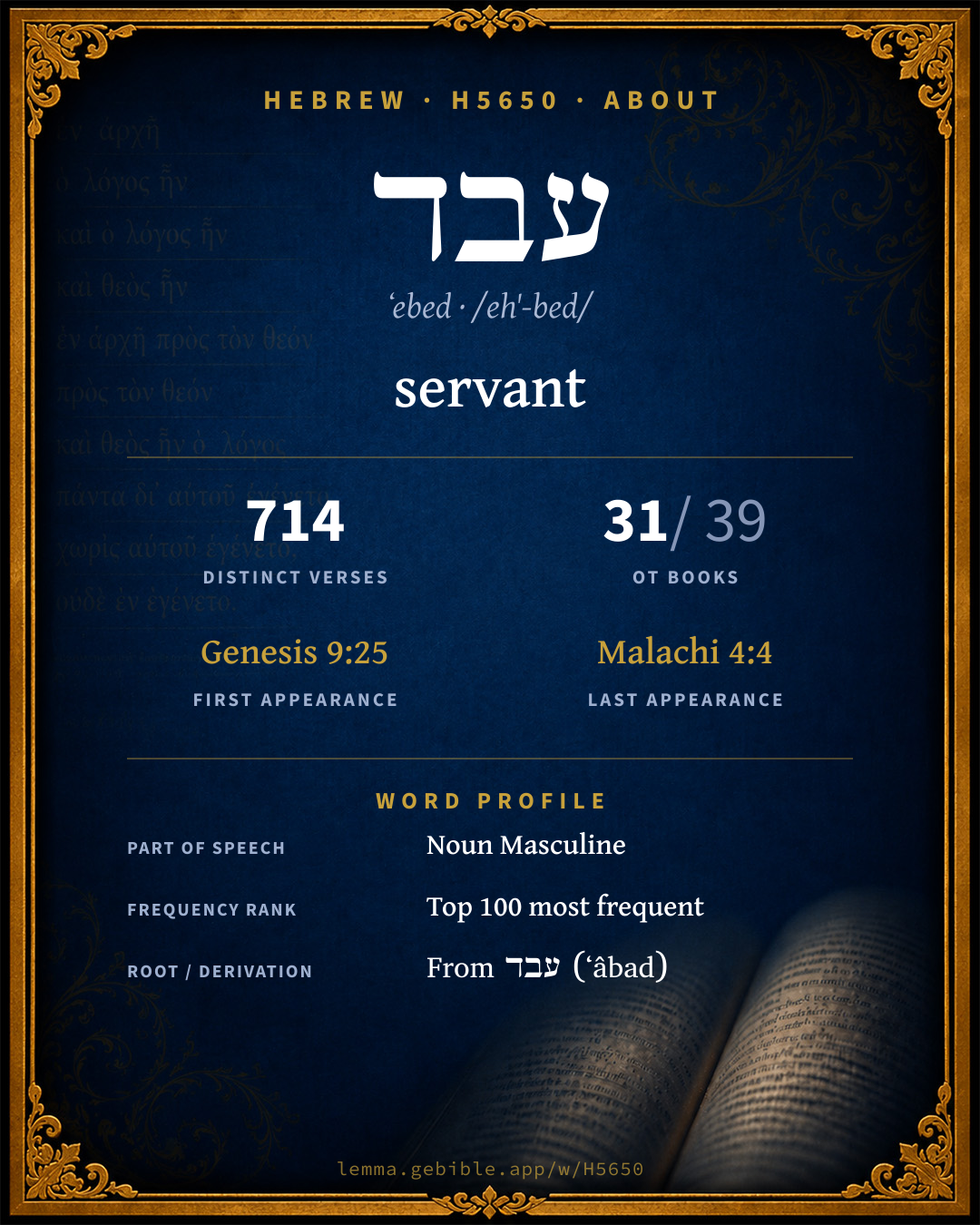
עֶ֫בֶד
servant
‘servant’ is one of 7 main senses fuller range ↓
Full lexicon entry — Brown-Driver-Briggs (BDB)
From Brown-Driver-Briggs (BDB)
Where this word appears
See every Construct-state word in the Hebrew Bible →
Grammar key — what these labels mean
Part of speech
- Noun
- A naming word — a person, place, thing, or idea.
Noun type
- Common
- A common noun — a general class of person, place, or thing (“king,” “city,” “water”), not a specific name.
State
- Construct
- A noun bound to a following noun in a possessive / “of” relationship (the construct chain).
- Absolute
- The independent form of a noun, not bound to a following word.
Gender
- Masculine
- Grammatically masculine.
Number
- Singular
- One.
- Plural
- More than one (in Hebrew, generally three or more).
Every verse where H5650 appears in the Book of 2 Samuel — 85 distinct verses. Click any verse to open its interlinear word-by-word view. Verse text shown in the World English Bible for context — . Each verse’s Hebrew form is shown with its reference; the English is not keyword-highlighted, since the data carries no word-level English alignment. Use “Compare translations” on any verse to read it across multiple English versions. This concordance covers the Hebrew Bible; Septuagint (Greek Old Testament) occurrences are not indexed here.
2 Samuel
- 2 Samuel 2:12 וְ/עַבְדֵ֖י conj + n c mp cs Abner the son of Ner, and the servants of Ish-bosheth the son of Saul, went out from Mahanaim to Gibeon.
- 2 Samuel 2:13 וְ/עַבְדֵ֤י conj + n c mp cs Joab the son of Zeruiah, and the servants of David, went out, and met them by the pool of Gibeon; and they sat down, the one on the one side of the pool, and the other on the other side of the pool.
- 2 Samuel 2:15 מֵ/עַבְדֵ֥י prep + n c mp cs Then they arose and went over by number: twelve for Benjamin, and for Ish-bosheth the son of Saul, and twelve of the servants of David.
- 2 Samuel 2:17 עַבְדֵ֥י n c mp cs The battle was very severe that day: and Abner was beaten, and the men of Israel, before the servants of David.
- 2 Samuel 2:30 מֵ/עַבְדֵ֥י prep + n c mp cs Joab returned from following Abner: and when he had gathered all the people together, there lacked of David's servants nineteen men and Asahel.
- 2 Samuel 2:31 וְ/עַבְדֵ֣י conj + n c mp cs But the servants of David had struck of Benjamin, and of Abner's men, [so that] three hundred sixty men died.
- 2 Samuel 3:18 עַבְדִּ֗/י n c ms cs + sfx pers 1cs now then do it; for Yahweh has spoken of David, saying, By the hand of my servant David I will save my people Israel out of the hand of the Philistines, and out of the hand of all their enemies.
- 2 Samuel 3:22 עַבְדֵ֨י n c mp cs Behold, the servants of David and Joab came from a foray, and brought in a great spoil with them: but Abner was not with David in Hebron; for he had sent him away, and he was gone in peace.
- 2 Samuel 3:38 עֲבָדָ֑י/ו n c mp cs + sfx pers 3ms The king said to his servants, "Don't you know that there a prince and a great man has fallen this day in Israel?
- 2 Samuel 6:20 עֲבָדָ֔י/ו n c mp cs + sfx pers 3ms Then David returned to bless his household. Michal the daughter of Saul came out to meet David, and said, How glorious was the king of Israel today, who uncovered himself today in the eyes of the handmaids of his servants, as one of the vain fellows shamelessly uncovers himself!
- 2 Samuel 7:5 עַבְדִּ֣/י n c ms cs + sfx pers 1cs Go and tell my servant David, Thus says Yahweh, Shall you build me a house for me to dwell in?
- 2 Samuel 7:8 לְ/עַבְדִּ֣/י prep + n c ms cs + sfx pers 1cs Now therefore thus shall you tell my servant David, Thus says Yahweh of Hosts, I took you from the sheep pen, from following the sheep, that you should be prince over my people, over Israel;
- 2 Samuel 7:19 עַבְדְּ/ךָ֖ n c ms cs + sfx pers 2ms This was yet a small thing in your eyes, Lord Yahweh; but you have spoken also of your servant's house for a great while to come; and this [too] after the manner of men, Lord Yahweh!
- 2 Samuel 7:20 עַבְדְּ/ךָ֖ n c ms cs + sfx pers 2ms What can David say more to you? for you know your servant, Lord Yahweh.
- 2 Samuel 7:21 עַבְדֶּֽ/ךָ n c ms cs + sfx pers 2ms For your word's sake, and according to your own heart, have you worked all this greatness, to make your servant know it.
- 2 Samuel 7:25 עַבְדְּ/ךָ֙ n c ms cs + sfx pers 2ms Now, Yahweh God, the word that you have spoken concerning your servant, and concerning his house, confirm you it forever, and do as you have spoken.
- 2 Samuel 7:26 עַבְדְּ/ךָ֣ n c ms cs + sfx pers 2ms Let your name be magnified forever, saying, Yahweh of hosts is God over Israel; and the house of your servant David shall be established before you.
- 2 Samuel 7:27 עַבְדְּ/ךָ֙ עַבְדְּ/ךָ֙ n c ms cs + sfx pers 2ms n c ms cs + sfx pers 2ms For you, Yahweh of Hosts, the God of Israel, have revealed to your servant, saying, I will build you a house: therefore has your servant found in his heart to pray this prayer to you.
- 2 Samuel 7:28 עַבְדְּ/ךָ֔ n c ms cs + sfx pers 2ms Now, O Lord Yahweh, you are God, and your words are truth, and you have promised this good thing to your servant:
- 2 Samuel 7:29 עַבְדְּ/ךָ֔ עַבְדְּ/ךָ֖ n c ms cs + sfx pers 2ms n c ms cs + sfx pers 2ms now therefore let it please you to bless the house of your servant, that it may continue forever before you; for you, Lord Yahweh, have spoken it: and with your blessing let the house of your servant be blessed forever.
- 2 Samuel 8:2 לַ/עֲבָדִ֖ים prep + n c mp He struck Moab, and measured them with the line, making them to lie down on the ground; and he measured two lines to put to death, and one full line to keep alive. The Moabites became servants to David, and brought tribute.
- 2 Samuel 8:6 לַ/עֲבָדִ֖ים prep + n c mp Then David put garrisons in Syria of Damascus; and the Syrians became servants to David, and brought tribute. Yahweh gave victory to David wherever he went.
- 2 Samuel 8:7 עַבְדֵ֣י n c mp cs David took the shields of gold that were on the servants of Hadadezer, and brought them to Jerusalem.
- 2 Samuel 8:14 עֲבָדִ֣ים n c mp He put garrisons in Edom; throughout all Edom put he garrisons, and all the Edomites became servants to David. Yahweh gave victory to David wherever he went.
- 2 Samuel 9:2 עֶ֨בֶד֙ עַבְדֶּֽ/ךָ n c ms n c ms cs + sfx pers 2ms There was of the house of Saul a servant whose name was Ziba, and they called him to David; and the king said to him, Are you Ziba? He said, Your servant is he.
- 2 Samuel 9:6 עַבְדֶּֽ/ךָ n c ms cs + sfx pers 2ms Mephibosheth, the son of Jonathan, the son of Saul, came to David, and fell on his face, and did obeisance. David said, Mephibosheth. He answered, Behold, your servant!
- 2 Samuel 9:8 עַבְדֶּ֑/ךָ n c ms cs + sfx pers 2ms He did obeisance, and said, "What is your servant, that you should look on such a dead dog as I am?"
- 2 Samuel 9:10 וַ/עֲבָדֶ֜י/ךָ עֲבָדִֽים conj + n c mp cs + sfx pers 2ms n c mp You shall till the land for him, you, and your sons, and your servants; and you shall bring in [the fruits], that your master's son may have bread to eat: but Mephibosheth your master's son shall eat bread always at my table." Now Ziba had fifteen sons and twenty servants.
- 2 Samuel 9:11 עַבְדּ֔/וֹ עַבְדֶּ֑/ךָ n c ms cs + sfx pers 3ms n c ms cs + sfx pers 2ms Then said Ziba to the king, According to all that my lord the king commands his servant, so shall your servant do. As for Mephibosheth, [said the king], he shall eat at my table, as one of the king's sons.
- 2 Samuel 9:12 עֲבָדִ֖ים n c mp Mephibosheth had a young son, whose name was Mica. All that lived in the house of Ziba were servants to Mephibosheth.
- 2 Samuel 10:2 עֲבָדָ֖י/ו עַבְדֵ֣י n c mp cs + sfx pers 3ms n c mp cs David said, I will show kindness to Hanun the son of Nahash, as his father shown kindness to me. So David sent by his servants to comfort him concerning his father. David's servants came into the land of the children of Ammon.
- 2 Samuel 10:3 עֲבָדָ֖י/ו n c mp cs + sfx pers 3ms But the princes of the children of Ammon said to Hanun their lord, Do you think that David honors your father, in that he has sent comforters to you? Hasn't David sent his servants to you to search the city, and to spy it out, and to overthrow it?
- 2 Samuel 10:4 עַבְדֵ֣י n c mp cs So Hanun took David's servants, and shaved off the one half of their beards, and cut off their garments in the middle, even to their buttocks, and sent them away.
- 2 Samuel 10:19 עַבְדֵ֣י n c mp cs When all the kings who were servants to Hadarezer saw that they were put to the worse before Israel, they made peace with Israel, and served them. So the Syrians feared to help the children of Ammon any more.
- 2 Samuel 11:1 עֲבָדָ֨י/ו n c mp cs + sfx pers 3ms It happened, at the return of the year, at the time when kings go out [to battle], that David sent Joab, and his servants with him, and all Israel; and they destroyed the children of Ammon, and besieged Rabbah. But David stayed at Jerusalem.
- 2 Samuel 11:9 עַבְדֵ֣י n c mp cs But Uriah slept at the door of the king's house with all the servants of his lord, and didn't go down to his house.
- 2 Samuel 11:11 וְ/עַבְדֵ֤י conj + n c mp cs Uriah said to David, The ark, and Israel, and Judah, abide in booths; and my lord Joab, and the servants of my lord, are encamped in the open field; shall I then go into my house, to eat and to drink, and to lie with my wife? as you live, and as your soul lives, I will not do this thing.
- 2 Samuel 11:13 עַבְדֵ֣י n c mp cs When David had called him, he ate and drink before him; and he made him drunk: and at even he went out to lie on his bed with the servants of his lord, but didn't go down to his house.
- 2 Samuel 11:17 מֵ/עַבְדֵ֣י prep + n c mp cs The men of the city went out, and fought with Joab: and there fell some of the people, even of the servants of David; and Uriah the Hittite died also.
- 2 Samuel 11:21 עַבְדְּ/ךָ֛ n c ms cs + sfx pers 2ms who struck Abimelech the son of Jerubbesheth? Didn't a woman cast an upper millstone on him from the wall, so that he died at Thebez? Why did you go so near the wall?' then shall you say, 'Your servant Uriah the Hittite is dead also.'"
- 2 Samuel 11:24 עֲבָדֶ֨/ךָ֙ מֵ/עַבְדֵ֣י עַבְדְּ/ךָ֛ n c mp cs + sfx pers 2ms prep + n c mp cs n c ms cs + sfx pers 2ms The shooters shot at your servants from off the wall; and some of the king's servants are dead, and your servant Uriah the Hittite is dead also.
- 2 Samuel 12:18 עַבְדֵ֨י n c mp cs It happened on the seventh day, that the child died. The servants of David feared to tell him that the child was dead; for they said, Behold, while the child was yet alive, we spoke to him, and he didn't listen to our voice: how will he then vex himself, if we tell him that the child is dead!
- 2 Samuel 12:19 עֲבָדָי/ו֙ עֲבָדָ֛י/ו n c mp cs + sfx pers 3ms n c mp cs + sfx pers 3ms But when David saw that his servants were whispering together, David perceived that the child was dead; and David said to his servants, Is the child dead? They said, He is dead.
- 2 Samuel 12:21 עֲבָדָי/ו֙ n c mp cs + sfx pers 3ms Then said his servants to him, What thing is this that you have done? you did fast and weep for the child, while it was alive; but when the child was dead, you did rise and eat bread.
- 2 Samuel 13:24 לְ/עַבְדֶּ֑/ךָ וַ/עֲבָדָ֖י/ו עַבְדֶּֽ/ךָ prep + n c ms cs + sfx pers 2ms conj + n c mp cs + sfx pers 3ms n c ms cs + sfx pers 2ms Absalom came to the king, and said, See now, your servant has sheep-shearers; let the king, I pray you, and his servants go with your servant.
- 2 Samuel 13:31 עֲבָדָ֥י/ו n c mp cs + sfx pers 3ms Then the king arose, and tore his garments, and lay on the earth; and all his servants stood by with their clothes torn.
- 2 Samuel 13:35 עַבְדְּ/ךָ֖ n c ms cs + sfx pers 2ms Jonadab said to the king, Behold, the king's sons are come: as your servant said, so it is.
- 2 Samuel 13:36 עֲבָדָ֔י/ו n c mp cs + sfx pers 3ms It happened, as soon as he had made an end of speaking, that behold, the king's sons came, and lifted up their voice, and wept: and the king also and all his servants wept very sore.
- 2 Samuel 14:19 עַבְדְּ/ךָ֤ n c ms cs + sfx pers 2ms The king said, Is the hand of Joab with you in all this? The woman answered, As your soul lives, my lord the king, none can turn to the right hand or to the left from anything that my lord the king has spoken; for your servant Joab, he bade me, and he put all these words in the mouth of your handmaid;
- 2 Samuel 14:20 עַבְדְּ/ךָ֥ n c ms cs + sfx pers 2ms to change the face of the matter has your servant Joab done this thing: and my lord is wise, according to the wisdom of an angel of God, to know all things that are in the earth.
- 2 Samuel 14:22 עַבְדְּ/ךָ֜ עבד/ו עַבְדֶּֽ/ךָ n c ms cs + sfx pers 2ms n c ms cs + sfx pers 3ms n c ms cs + sfx pers 2ms Joab fell to the ground on his face, and did obeisance, and blessed the king: and Joab said, Today your servant knows that I have found favor in your sight, my lord, king, in that the king has performed the request of his servant.
- 2 Samuel 14:30 עֲבָדָ֜י/ו עַבְדֵ֧י n c mp cs + sfx pers 3ms n c mp cs Therefore he said to his servants, Behold, Joab's field is near mine, and he has barley there; go and set it on fire. Absalom's servants set the field on fire.
- 2 Samuel 14:31 עֲבָדֶ֛/ךָ n c mp cs + sfx pers 2ms Then Joab arose, and came to Absalom to his house, and said to him, Why have your servants set my field on fire?
- 2 Samuel 15:2 עַבְדֶּֽ/ךָ n c ms cs + sfx pers 2ms Absalom rose up early, and stood beside the way of the gate: and it was so, that when any man had a suit which should come to the king for judgment, then Absalom called to him, and said, Of what city are you? He said, Your servant is of one of the tribes of Israel.
- 2 Samuel 15:8 עַבְדְּ/ךָ֔ n c ms cs + sfx pers 2ms For your servant vowed a vow while I abode at Geshur in Syria, saying, If Yahweh shall indeed bring me again to Jerusalem, then I will serve Yahweh.
- 2 Samuel 15:14 עֲבָדָ֨י/ו n c mp cs + sfx pers 3ms David said to all his servants who were with him at Jerusalem, Arise, and let us flee; for else none of us shall escape from Absalom: make speed to depart, lest he overtake us quickly, and bring down evil on us, and strike the city with the edge of the sword.
- 2 Samuel 15:15 עַבְדֵֽי עֲבָדֶֽי/ךָ n c mp cs n c mp cs + sfx pers 2ms The king's servants said to the king, Behold, your servants are ready to do whatever my lord the king shall choose.
- 2 Samuel 15:18 עֲבָדָי/ו֙ n c mp cs + sfx pers 3ms All his servants passed on beside him; and all the Cherethites, and all the Pelethites, and all the Gittites, six hundred men who came after him from Gath, passed on before the king.
- 2 Samuel 15:21 עַבְדֶּֽ/ךָ n c ms cs + sfx pers 2ms Ittai answered the king, and said, As Yahweh lives, and as my lord the king lives, surely in what place my lord the king shall be, whether for death or for life, even there also will your servant be.
- 2 Samuel 15:34 עַבְדְּ/ךָ֨ עֶ֣בֶד עַבְדֶּ֑/ךָ n c ms cs + sfx pers 2ms n c ms cs n c ms cs + sfx pers 2ms but if you return to the city, and tell Absalom, I will be your servant, O king; as I have been your father's servant in time past, so will I now be your servant; then will you defeat for me the counsel of Ahithophel.
- 2 Samuel 16:6 עַבְדֵ֖י n c mp cs He cast stones at David, and at all the servants of king David: and all the people and all the mighty men were on his right hand and on his left.
- 2 Samuel 16:11 עֲבָדָ֔י/ו n c mp cs + sfx pers 3ms David said to Abishai, and to all his servants, Behold, my son, who came forth from my bowels, seeks my life: how much more [may] this Benjamite now [do it]? let him alone, and let him curse; for Yahweh has invited him.
- 2 Samuel 17:20 עַבְדֵי֩ n c mp cs Absalom's servants came to the woman to the house; and they said, Where are Ahimaaz and Jonathan? The woman said to them, They have gone over the brook of water. When they had sought and could not find them, they returned to Jerusalem.
- 2 Samuel 18:7 עַבְדֵ֣י n c mp cs The people of Israel were struck there before the servants of David, and there was a great slaughter there that day of twenty thousand men.
- 2 Samuel 18:9 עַבְדֵ֣י n c mp cs Absalom happened to meet the servants of David. Absalom was riding on his mule, and the mule went under the thick boughs of a great oak, and his head caught hold of the oak, and he was taken up between the sky and earth; and the mule that was under him went on.
- 2 Samuel 18:29 עֶ֨בֶד עַבְדֶּ֔/ךָ n c ms cs n c ms cs + sfx pers 2ms The king said, Is it well with the young man Absalom? Ahimaaz answered, When Joab sent the king's servant, even me your servant, I saw a great tumult, but I don't know what it was.
- 2 Samuel 19:5 עֲבָדֶ֗י/ךָ n c mp cs + sfx pers 2ms Joab came into the house to the king, and said, You have shamed this day the faces of all your servants, who this day have saved your life, and the lives of your sons and of your daughters, and the lives of your wives, and the lives of your concubines;
- 2 Samuel 19:6 וַ/עֲבָדִ֔ים conj + n c mp in that you love those who hate you, and hate those who love you. For you have declared this day, that princes and servants are nothing to you: for this day I perceive that if Absalom had lived, and all we had died this day, then it had pleased you well.
- 2 Samuel 19:7 עֲבָדֶ֑י/ךָ n c mp cs + sfx pers 2ms Now therefore arise, go forth, and speak comfortably to your servants; for I swear by Yahweh, if you don't go forth, there will not stay a man with you this night: and that will be worse to you than all the evil that has happened to you from your youth until now.
- 2 Samuel 19:14 עֲבָדֶֽי/ךָ n c mp cs + sfx pers 2ms He bowed the heart of all the men of Judah, even as [the heart of] one man; so that they sent to the king, [saying], Return you, and all your servants.
- 2 Samuel 19:17 עֲבָדָ֖י/ו n c mp cs + sfx pers 3ms There were a thousand men of Benjamin with him, and Ziba the servant of the house of Saul, and his fifteen sons and his twenty servants with him; and they went through the Jordan in the presence of the king.
- 2 Samuel 19:19 עַבְדְּ/ךָ֔ n c ms cs + sfx pers 2ms He said to the king, Don't let my lord impute iniquity to me, neither do you remember that which your servant did perversely the day that my lord the king went out of Jerusalem, that the king should take it to his heart.
- 2 Samuel 19:20 עַבְדְּ/ךָ֔ n c ms cs + sfx pers 2ms For your servant does know that I have sinned: therefore, behold, I am come this day the first of all the house of Joseph to go down to meet my lord the king.
- 2 Samuel 19:26 עַבְדִּ֣/י עַבְדְּ/ךָ֜ עַבְדֶּֽ/ךָ n c ms cs + sfx pers 1cs n c ms cs + sfx pers 2ms n c ms cs + sfx pers 2ms He answered, My lord, O king, my servant deceived me: for your servant said, I will saddle me a donkey, that I may ride thereon, and go with the king; because your servant is lame.
- 2 Samuel 19:27 בְּ/עַבְדְּ/ךָ֔ prep + n c ms cs + sfx pers 2ms He has slandered your servant to my lord the king; but my lord the king is as an angel of God: do therefore what is good in your eyes.
- 2 Samuel 19:28 עַבְדְּ/ךָ֔ n c ms cs + sfx pers 2ms For all my father's house were but dead men before my lord the king; yet you set your servant among those who ate at your own table. What right therefore have I yet that I should cry any more to the king?
- 2 Samuel 19:35 עַבְדְּ/ךָ֙ עַבְדְּ/ךָ֥ n c ms cs + sfx pers 2ms n c ms cs + sfx pers 2ms I am this day eighty years old: can I discern between good and bad? can your servant taste what I eat or what I drink? can I hear any more the voice of singing men and singing women? why then should your servant be yet a burden to my lord the king?
- 2 Samuel 19:36 עַבְדְּ/ךָ֛ n c ms cs + sfx pers 2ms Your servant would but just go over the Jordan with the king: and why should the king recompense it me with such a reward?
- 2 Samuel 19:37 עַבְדְּ/ךָ֙ עַבְדְּ/ךָ֣ n c ms cs + sfx pers 2ms n c ms cs + sfx pers 2ms Please let your servant turn back again, that I may die in my own city, by the grave of my father and my mother. But behold, your servant Chimham; let him go over with my lord the king; and do to him what shall seem good to you.
- 2 Samuel 20:6 עַבְדֵ֤י n c mp cs David said to Abishai, Now will Sheba the son of Bichri do us more harm than did Absalom: take your lord's servants, and pursue after him, lest he get him fortified cities, and escape out of our sight.
- 2 Samuel 21:15 וַ/עֲבָדָ֥י/ו conj + n c mp cs + sfx pers 3ms The Philistines had war again with Israel; and David went down, and his servants with him, and fought against the Philistines. David grew faint;
- 2 Samuel 21:22 עֲבָדָֽי/ו n c mp cs + sfx pers 3ms These four were born to the giant in Gath; and they fell by the hand of David, and by the hand of his servants.
- 2 Samuel 24:10 עַבְדְּ/ךָ֔ n c ms cs + sfx pers 2ms David's heart struck him after that he had numbered the people. David said to Yahweh, I have sinned greatly in that which I have done: but now, Yahweh, put away, I beg you, the iniquity of your servant; for I have done very foolishly.
- 2 Samuel 24:20 עֲבָדָ֔י/ו n c mp cs + sfx pers 3ms Araunah looked forth, and saw the king and his servants coming on toward him: and Araunah went out, and bowed himself before the king with his face to the ground.
- 2 Samuel 24:21 עַבְדּ֑/וֹ n c ms cs + sfx pers 3ms Araunah said, Why is my lord the king come to his servant? David said, To buy the threshing floor of you, to build an altar to Yahweh, that the plague may be stayed from the people.
About this entry
At a glance — auto-summarized from this page’s data, not written by a person. Every figure links to its source below. This summary describes the numbers; it doesn’t interpret them.
“servant” is the headline sense of the Hebrew noun עבד (ʻebed). Carrying more than one sense, it rewards its full sense range. With 714 verses in 31 books, it is one of the most common word in the Hebrew Bible. Scripture first uses it in Genesis 9:25. From the same root come עבד, מעבד and עבד. See the sense tree, 714-verse concordance, and the renderings breakdown below.
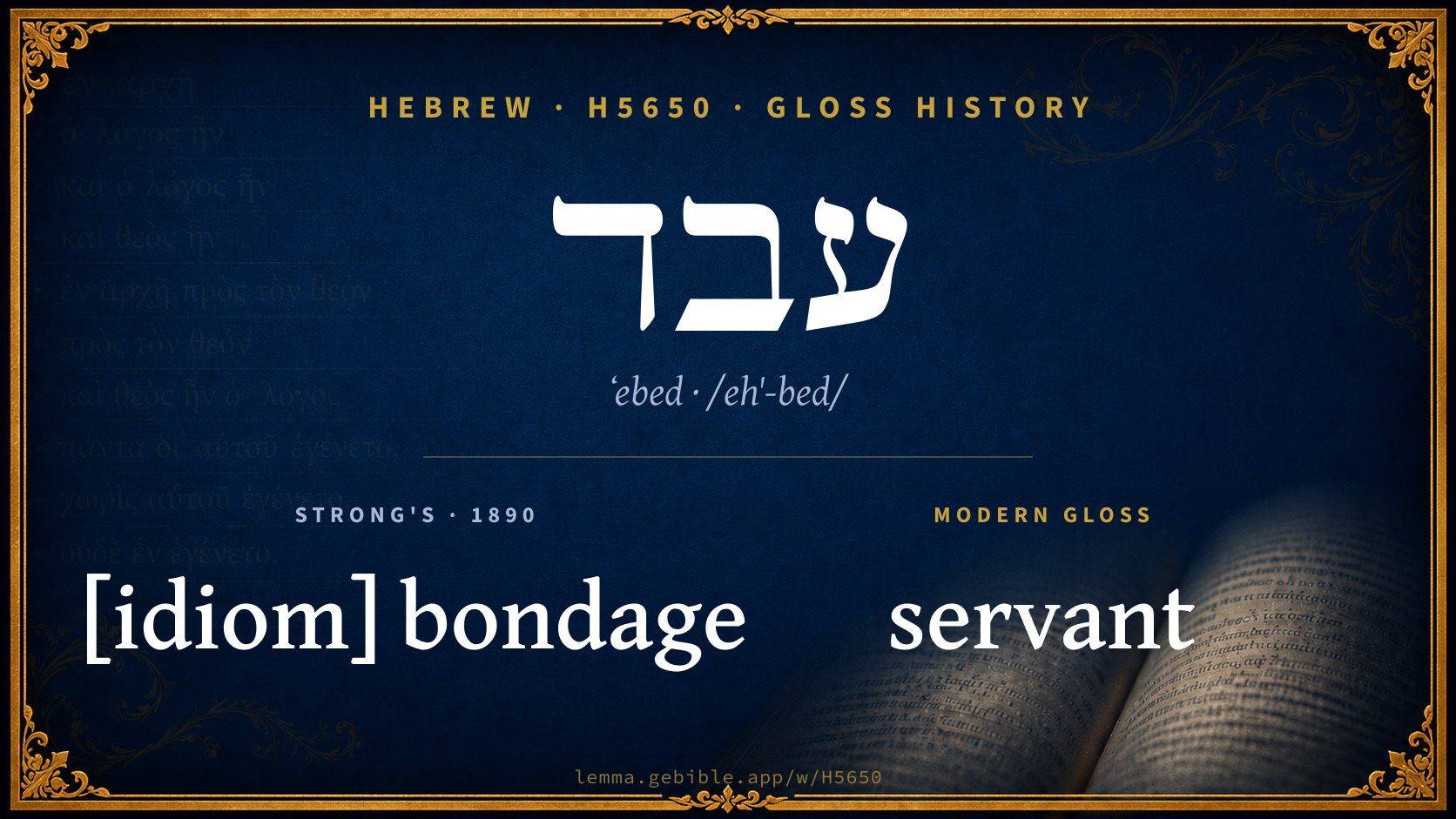
Gloss history
Strong's 1890 vs modern scholarship
About this word
Strong's H5650 catalogs a Hebrew word from the Hebrew Old Testament.
These counts are not copied from any lexicon or concordance. They are computed here, from the morphology-tagged Hebrew Old Testament. What Lemma adds →
- 714
- distinct verses
- The word appears in 714 distinct verses.
- 31 / 39
- OT books
- The word appears in 31 of 39 Old Testament books.
- #58
- by frequency
- Top 100 most frequent Hebrew words (rank 58 of 8,640 Hebrew words by occurrence).
View all 714 occurrences in the concordance →
By section of the Old Testament
By traditional corpus
Conventional, traditional groupings — biblical authorship is debated, so this is a traditional corpus grouping, not an authorship claim. Each share is this word’s portion of its verses in that division of the Hebrew canon. Each figure is a share of the word’s 714 distinct verses.
- Prophets (Nevi'im) 371 verses · 52%
- Writings (Ketuvim) 179 verses · 25%
- Torah (Pentateuch) 164 verses · 23%
How translations render this word
Counts come from each version’s own published word-to-Strong’s tagging or interlinear alignment — an approximate guide to how each version renders this word, not a word-level alignment the data otherwise carries. Because each total is that version’s own tagged count, the per-version totals vary from one another and need not match the appearance or distinct-verse counts above. These counts may also differ from a printed concordance because Lemma counts each distinctly tagged rendering and does not collapse phrase taggings into a single head-word total. This is a fixed set of word-tagged versions (KJV, ASV, BSB, ULT) and does not change with the reading translation you choose elsewhere. Each version’s license is shown beside its name below (and on Sources).
BDB lists this Strong’s number as 2 distinct words (homographs). Each count above pools all of them and is not split by sense — see the Senses section below. A low-frequency rendering may belong to a different one of those words, not the primary meaning.
- King James Version†: Servant 284×, Servants 253×, All his servants 16×
- American Standard Version†: Servant 252×, Servants 192×, 's servants 36×
- Berean Standard Bible†: Servant 296×, Servants 257×, Officials 31×
- unfoldingWord Literal Text†: Servant 278×, Servants 244×, Servants of 82×
King James Version Public Domain
Renders H5650 across 799† tagged occurrences — most commonly:
Plus other, less common renderings. Plus 115 renderings that appear only once — usually multi-word phrases or single function words the recovered tagging swept in, not distinct renderings. Not rendered by a distinct English word in 1 further occurrence.
American Standard Version Public Domain
Renders H5650 across 796† tagged occurrences — most commonly:
Plus other, less common renderings. Plus 140 renderings that appear only once — usually multi-word phrases or single function words the recovered tagging swept in, not distinct renderings.
Berean Standard Bible Public Domain
Renders H5650 across 788† tagged occurrences — most commonly:
Plus other, less common renderings. Plus 58 renderings that appear only once — usually multi-word phrases or single function words the recovered tagging swept in, not distinct renderings. Not rendered by a distinct English word in 12 further occurrences.
unfoldingWord Literal Text CC BY-SA 4.0
Renders H5650 across 799† tagged occurrences — most commonly:
Plus other, less common renderings. Plus 42 renderings that appear only once — usually multi-word phrases or single function words the recovered tagging swept in, not distinct renderings.
9 senses and sub-senses in the full BDB
What do BDB’s symbols mean?
BDB uses these scholarly abbreviations:
| Symbol | Meaning |
|---|---|
| 𝔊 | the Septuagint (the ancient Greek translation, LXX) |
| 𝔙 | the Vulgate (the Latin translation) |
| 𝔖 | the Syriac version (the Peshitta) |
| 𝔗 | the Targum (the Aramaic translation) |
| ψ | the Psalms |
| √ | root (the underlying root or stem) |
| ‖ | parallel passage (a synonymous or contrasted parallel) |
| † | the dagger: every passage where the word occurs is cited |
The 9 senses and sub-senses the full Brown-Driver-Briggs lexicon distinguishes for this word, in lexicon order (not ranked by frequency), with BDB’s own verbatim wording and sub-sense lettering. Shown in Hebrew script with BDB’s own scholarly abbreviations. The condensed entry is in the Lexicon Entry tab. See also the Forms in the corpus table below.
עבד I slave, servant (on format. LagBN 77)
- 1. slave, servant of household Gn 39:17, 19; 41:12; 50:2; Ex 21:2 +; man-servant, ‖ אמה Ex 20:10 Lv 25:6; Dt 5:14; Jb 31:13 +; ‖ שׁפחה Gn 12:16; 32:6; Je 34:11; Is 14:2 +; + אדון Dt 23:16; Is 24:2; Mal 1:6 +; מִקְנַת כֶּסֶף Ex 12:44 or יְלִיד בַּיִת Je 2:14; עֶבֶד עֲבָדִים servant of servants, humblest servant, Gn 9:25; †בֵּית עֲבָדִים house of slaves, especially Israel in Egypt Ex 13:3, 14; 20:2 (RD) Dt 5:6; 6:12; 7:8; 8:14; 13:6, 11 Jos 24:17; Ju 6:8 Je 34:13; Mi 6:4; †וזכרת כי עבד היית מצרים (ארץ)ב and thou shalt remember that thou wast a slave in (the land of) Egypt Dt 5:15; 15:15; 16:12; 24:18, 22; king of Babylon is slave to י׳ Je 25:9; 27:6; 43:10; the borrower to the lender Pr 22:7; fig. of beast Jb 40:28; of things Gn 47:19. e.g. Genesis 39:17
- 2. Subjects, of chief Gn 26:15, 19, 25, 32; 27:37; 32:17(×2) +; of king 21:25 Ex 7:28, 29; 1 K 9:27; Dt 29:1 +; vassal kings 2 S 10:19; tributary nations 8:2, 6, 14 = 1 Ch 18:2, 6, 13; specif. officers of king 1 S 19:1; 21:8; 2 S 11:13; Pr 14:35 +; עַבְדֵי פַרְעֹה Gn 40:20; 41:10; ע׳ שָׁאוּל 1 S 16:17; 18:22; 28:7; ע׳ הַמֶּלֶךְ 1 K 1:47 Est 3:3 +; עֶבֶד הַמֶּלֶךְ 2 K 22:12 = 2 Ch 34:20 (a court official); opp. שַׂר Pr 19:10; Ec 10:7; מֶלֶךְ Pr 30:22; ambassadors Nu 22:18 2 S 10:2; soldiers of army 1 S 17:8; 25:10; 2 S 2:12, + officers of army 1 S 29:3; 1 K 11:26; 2 K 25:8; Is 36:9. e.g. Genesis 26:15
- 3. Servants, worshippers, of God: †עַבְדֵי יהוה 2 K 9:7; 10:23; Is 54:17, cf. Gn 50:17; Is 56:6; עֲבָדָיו Dt 32:36 = ψ 135:14, Is 65:15; 66:14 ψ 34:23; 69:37 Ne 2:20; ‖ עַמּוֹ ψ 105:25 cf. Dt 32:43; עֲבָדַי Is 65:8, 9, 13(×3), 14; עֲבָדֶיךָ 1 K 8:23; Is 63:17 (‖ שִׁבְטֵי נחלתך), ψ 89:51; 90:13, 16; 102:15, 29; 119:91, 79:2, 10 (‖ חֲסִידֶיךָ); delivered from Egypt Lv 25:42, 55(×2); 26:13 (P); עַבְדְּךָ ψ 119:125; 143:2, ‖ בֶּן־אֲמָתֶ֑ךָ 86:16; 116:16(×2); specif. angels Jb 4:18; and ancient worthies, patriarchs Ex 32:13 (J) Dt 9:27; Abraham Gn 26:24 (J) ψ 105:6, 42; Isaac Gn 24:14 (J); Jacob, Israel Ez 28:25; 37:25 1 Ch 16:13; Moses †Ex 14:31; Jos 18:7 (J) Nu 12:7, 8 (E) Dt 34:5 (?) Jos 1:1, 2, 7, 13, 15; 8:31, 33; 9:24; 11:12, 15; 12:6(×2); 13:8; 14:7; 22:2, 4, 5 (all D), 1 K 8:53, 56; 2 K 18:12; 21:8; 1 Ch 6:34; 2 Ch 1:3; 24:6, 9; Ne 1:8; 9:14; 10:30 ψ 105:26 Mal 3:22 Dn 9:11; Joshua †Jos 24:29 (E) Ju 2:8; Caleb †Nu 14:24 (J); Job †Jb 1:8; 2:3; 42:7, 8(×3); David 2 S 3:18; 7:5, 8, 26 + 27 times; Hezekiah †2 Ch 32:16; Zerubbabel †Hag 2:23; Eliakim †Is 22:20.—The צֶמַח Zc 3:8 cf. 6:12 is also servant of י׳ as Messianic builder of temple (see BrMP 442 ff.). e.g. 2 Kings 9:7
- 4. servant of י׳, in a special sense: of Levitical singers using benedictions in temple ψ 113:1; 134:1; 135:1; usually of prophets, עֲבָדַי הַנְּבִיאִים my servants the prophets 2 K 9:7; 17:13; Je 7:25; 26:5; 29:19; 35:15; 44:4; Ez 38:17; Zc 1:6; עֲבָדָיו הַנְּבִיאִים 2 K 17:23; 21:10; 24:2; Je 25:4; Am 3:7; Dn 9:10; עֲבָדֶיךָ הנביאים Ezr 9:11; Dn 9:6; specif. Ahia 1 K 14:18; 15:29; Elijah 2 K 9:36; 10:10; Jonah 2 K 14:25; Isaiah Is 20:3; עַבְדּוֹ, ‖ מלאכיו 44:26; as one calling to fear י׳ 50:10. e.g. Psalms 113:1
- 5. Israel as a people is servant of י׳: יִשְׂרָאֵל Is 41:8, 9; 44:21(×2); 49:3 ψ 136:22; יעקב Is 44:1, 2; 45:4; 48:20; Je 30:10; 46:27, 28; עַבְדִּי = עֶבֶד יהוה, ‖ מַלְאָכִי, as having a mission to the nations Is 42:19(×2); and chosen as witness of י׳ 43:10. But there is also an ideal servant chosen and endowed with the divine Spirit to be a covenant of Israel and a light of the nations Is 42:1 (cf. v 2–6); formed to bring back Jacob, raise up the tribes, and become salvation to the end of the earth 49:5, 6, 7; bearing the sins of all as a lamb and a trespass-offering, and yet prospering and justifying many as interposing martyr 52:13; 53:11: many understand of ideal Israel, contr. with the actual; al. of personif. ‖ with Zion the wife and mother, disting. from unworthy Israel as Zion from her apostate children; al. of ideal prophetic writer; al. of ideal prophetic person; al. (especially in Is 53) of an actual proph. known to writer and his readers; [in any case it is Messianic, v. Mt 8:16, 17; 12:16–21 Lk 4:17–22 Phil 2:5–11]; see De Is ii. 174 DaExpos. 1884, 358 ff. Di Du Che al. on Is 42, 53, Dr Is 168 ff. BrMP 345 ff., also GieBeitr. 146 ff. Berthol Is 53. e.g. Isaiah 41:8
- 6. In polite address of equals or superiors the Hebrews used עַבְדְּךָ thy servant = 1 pers. sing., I, Gn 18:3; 1 S 20:7, 8(×2) 2 K 8:13 +; עֲבָדֶיךָ thy servants = we Gn 42:11; Is 36:11; also עַבְדּוֹ his servant = I, 1 S 26:18, 19; 2 S 14:22; 24:21 +; also in addressing God, especially in prayer Ex 4:10; Nu 11:11; Ju 15:18; 1 S 3:9, 10; 25:39; 2 S 24:10 ψ 19:12, 14; 27:9; 31:17; 35:27; 69:18; 109:28; 143:2 +. e.g. Genesis 18:3
- 7. Phrases are: †עבד (היה), c. לְ pers., become servant to Gn 9:26, 27; 44:10, 16, 17, 33; 47:19, 25 (J) Dt 6:21; 15:17; 2 S 8:14; 2 K 17:3; 24:1; 1 Ch 18:2, 6, 13; 2 Ch 10:7; Pr 11:29; 12:9; 22:7; †היה לעבד, c. לְ pers., Gn 44:9 (J) 50:18 (E) 1 S 8:17; 17:9(×2); 27:12 2 S 8:2, 6; Je 34:16; †כבשׁ לעבדים 2 Ch 28:10 Ne 5:5; Je 34:11; לקח לע׳ Gn 43:18 (J) 2 K 4:1; Jb 40:28. e.g. Genesis 9:26
עבד II m. (servant of God = עַבְדְּאֵל)
- 1. father of Gaal Ju 9:26, 28, 30, 31, 35 (GFM, after HollenbThLz 1891, 371 [cf. BuIb. 1892, 63] עֹבֵד, as 𝔊L; v. also GrayProp. N. 184, 272); 𝔊 Ιωβηλ, A 𝔊L Αβεδ. e.g. Judges 9:26
- 2. a companion of Ezra Ezr 8:6; 𝔊 Ωβηθ, 𝔊L Αμιναδαβ.—For list of Arabic names beginning with عبد v. NöZMG xli (1887), 724 ff., cf. also id.ib. xlii (1888), 486 WeHeid. 2, 2 ff. e.g. Ezra 8:6
Senses from the full Brown-Driver-Briggs lexicon (Brown, Driver, Briggs; Oxford 1906 — public domain), digitized via Sefaria, supplemented by the OpenScriptures HebrewLexicon (CC BY 4.0). Full attribution on Sources.
Word origin
I. n.m. slave, servant (on format. LagBN 77);—ע׳ Gn 9:25 +, עָ֑בֶד 44:10 +; sf. עַבְדִּי 26:24 +; עַבְדְּךָ 19:19 +; עַבְדֶּ֫ךָ 18:3 +; pl. עֲבָדִים 9:25 +, עַבְדֵי 21:25 +; sf. עֲבָדַי Lv 25:42 +, עַבְדֵיכֶם Jos 9:11 +, etc.;—
II. n.pr.m. (servant of God = עַבְדְּאֵל);—
— Brown-Driver-Briggs (Oxford 1906, public domain), digitized via Sefaria, supplemented by the OpenScriptures HebrewLexicon (CC BY 4.0). See Sources.
Derived from עבד (ʻâbad) (H5647) — to serve.
Jastrow Dictionary
A second Hebrew/Aramaic lexicon for comparison, covering Aramaic and post-biblical (Talmudic, Targumic, Midrashic) usage that the biblical-Hebrew BDB does not. Matched by lemma rather than by Strong’s number, so a lemma may carry more than one Jastrow headword (shown separately below), and the entries cover usage well beyond the Bible.
עֲבַד I
- (corresp. to h. עָשָׂה)
- 1. to do, labor; to make; to act. Targ. Gen. I, 7. Ib. XXXI, 26; a. v. fr.—Ber. 60ᵇ לעולם … כל דעביד רחמנא לטב Ms. M. (ed. לטב עביד; v. Rabb. D. S. a. l. note 3) man should train himself always to say, Whatever the Merciful One does, is for good; Yalk. Job 893 כל … לטב עביד. Tem. 4ᵇ אי עביד מהני, v. הֲנִי. Yeb. 37ᵃ מי עָבוּד רבנן תקנתא וכ׳ (not עביד) have the Rabbis adopted special measures for priests &c.? Ib. עַבְדִּינָן כרבנן we act (decide) in accordance with the opinion of the Rabbis. Keth. 60ᵇ לא עַבְדֵי נשי דחנקן וכ׳ women will not do such a thing as strangling their children. Kidd. 50ᵃ לא ע׳ אינש דמשוי וכ׳ a man will not declare himself a wrongdoer; a. v. fr.
- 2. to do, fare, prosper. Lev. R. s. 5, end מה את עָבֵיד how art thou?; ומה ארעא עֲבִידָא and how does the field fare?; מה תורין עַבְדִין how are the oxen? Ib. ע׳ לב טב he assumes cheerfulness. Gen. R. s. 13 כל שיחתן … עַבְדַּת ארעא all the talk of people turns on the land (material prosperity): ‘the land is doing well’ (crops promise to be good); ‘the land is not doing well’; a. fr.
- 3. to spend time. Y. Shebi. VIII, 38ᵇ top עביד טמיר במערתא וכ׳ he remained hidden in a cave &c.; ib. IX, 38ᵈ. Y. Shek. V, 48ᵈ top עַבְדַת טמירא וכ׳ she (the ass) remained hidden with them &c.; Gen. R. s. 60 עבדת גבון; a. fr.—Part. pass. עָבִיד; f. עֲבִידָא made, liable to, likely, used to. Y. Peah III, 17ᵈ bot. היך ע׳ how did it happen (i.e. in what case would it make a practical difference for the slave)? R. Hash. 22ᵇ, a. e. מילתא דע׳ לאיגלויי, v. גְּלֵי. Shebu. 46ᵃ, v. גְּזַם; a. fr.
- 1. to make, produce. Targ. O. Ex. XXXII, 10 אַעַבֵּיד ed. Berl. (oth. אַעֲבֵיד; Y. אֶעְבַּד). Ib. XXX, 37; a. fr.—Lev. R. s. 28, end, v. infra.
- 2. to cause to prosper. Gen. R. s. 13 כל תפלתן … מרי תַעֲבִיד ארעא יכ׳ all the prayers of men turn on the earth (mundane affairs): Lord, make the land (crop) thrive, make the land prosper; a. e.
- 3. to work through. Part. pass. מְעַבַּד, מְעַבְּדָא. B. Mets. 116ᵇ טינא דמע׳ thoroughly kneaded clay.
- to be done; to be made, become. Targ. Gen. XXIX, 26. Targ. Koh. VIII, 4. Targ. Ps. LXII, 4; a. fr.—Lam. R. to II, 2 בעית לאִיעַבְדָּא וכ׳ (not לאיבדא, לעיבדא) dost thou want to be made a senator? Lev. R. s. 28, end מאן דעַבֵּיד … אתע׳ וכ׳ he who made the comes …, is now to become a bather &c.; Esth. R. to VI, 10 האי גברא מְעַבֵּיד … עביד בלן (corr. acc.); a. fr. [Zeb. 75ᵇ דאיעבד, read: דאיערוב, v. עֲרַב I.]—V. דִּיעֲבַד.
עָבַד
- (b. h.) [to work]
- 1. to serve, work for. Gitt. IV, 5 עוֹבֵד את רבו וכ׳ works one day for his master, and one for himself; a. fr. Esp. to do priestly service. Ḥull. 24ᵇ אחיו הכהנים … לַעֲבוֹד וכ׳ his brother priests allow him not to serve, until he is twenty years of age.
- 2. to prepare; to till the ground; to dress (hides). Gen. R. s. 22 קין עובד אדמה Cain the tiller of the ground. Y. Ab. Zar. II, 41ᵇ bot. גוי עוֹבְדָן; Tosef. ib. IV (V), 10 עוֹבְדוֹ, v. דָּבַב I; (Bab. ib. 33ᵃ עיבדן). Y. Sabb. I, 4ᵇ top נתן כלים … ומצאו עובד בו וכ׳ if one gave a gentile garments to wash, and found him working at them on the Sabbath; a. fr.—Part. pass. עָבוּד, pl. עֲבוּדִין dressed, v. infra.
- 3. (v. עֲבוֹדָה) to use esp. for idolatrous purposes; to worship. Tem. VI, 1, v. infra. Ab. Zar. III, 7 (defining אשרה) כל שעוֹבְדִין אותה a tree which is itself worshipped (not one at which idolatrous rites are performed). Ib. הואיל … הן עובדין since they worship merely the image (under the tree). Snh. VII, 6 העובד ע"ז אחד העובד וכ׳ he who worships an idol, whether he goes through the regular forms of that particular worship (v. ib. 60ᵇ), or sacrifices &c. Ab. Zar. III, 5 העכומ"ז העובדין וכ׳ as to idolaters that worship mountains and hills (as deities), they (the territories) may be used, but what is on them is forbidden. Ib. 45ᵇ אילן … ולבסוף עֲבָדוֹ if one planted a tree and afterwards made it a subject of worship. Ib. 46ᵃ ועוֹבְדֵיהֶן בסייף and those (Jews) who worship them are put to death by the sword; Tosef. ib. VI (VII), 8. Sabb. 56ᵇ אילמלי לא … ולא עָבְדוּ ישראל ע"א had David not listened to evil gossip (against Mephibosheth), … Israel would not have worshipped idols (under Jeroboam). Ib. 105ᵇ עד שיאמר לו עֲבוֹד ע"ז until he (the tempter) finally tells him, worship idols; Tosef. B. Kam. IX, 31. Ḥull. 13ᵇ נכרים שבח"ל לאו עוֹבְדֵי ע"א הן gentiles outside of Palestine must not be considered as idolaters; a. v. fr.
- 1. to be prepared, dressed. Tosef. B. Kam. l. c. עורות שאינן נֶעֱבָדִין ed. Zuck. (oth. ed. עֲבוּדִין) undressed hides; a. e.
- 2. to be used, esp. for illicit purposes; to be worshipped. Tem. l. c. המוקצה והנ׳ the animal designated for idolatrous purposes and the one used; expl. כל שעובדין אותו whatever they may use it for ((e.g. yoking the ox, shearing the sheep for the benefit of idolatrous temples). Ib. 28ᵃ נעבדה בהן עבירה an illicit act has been done with them (by coupling them); ib. לא נֵתְעַבְּדָה בה עבירה no sinful act has been done with it (by which to unfit it for the altar). Ab. Zar. 46ᵇ יש נ׳ במחובר אצל גבוה does the law forbidding the use in divine worship of objects which have been used for idolatrous purposes include things fixed in the ground? Ib. יש שינוי בנ׳ does change of form restore to legitimate use objects otherwise forbidden on account of their use in connection with idolatry? a. fr.
- same, v. supra.
- to enslave, oppress. Yalk. Ex. 162 הֶעֱבִידוֹ בכל וכ׳ he (Esau) oppressed him with all sorts of troubles.
- to prepare, esp. to dress hides. Sabb. VII, 2 (among the labors forbidden on the Sabbath) והמְעַבֵּד את עורו dressing the hide of the deer (to fit it for parchment). Ib. 75ᵇ חייב משום מעבד is guilty of a Sabbath offence coming under the category of tanning. Gitt. 54ᵇ גוילין … לא עִיבַּדְתִּין לשמן I did not prepare the parchment sheets with the proper intention; a. fr.
עֶבֶד
- preced. wds.) slave, servant. Kidd. 20ᵃ הקונה ע׳ עברי וכ׳ he who buys a Hebrew slave, has, so to say, bought a master over himself. Sabb. 89ᵃ כלום יש ע׳ שנותן וכ׳ dare a servant salute his master (first)? Snh. 58ᵇ (ref. to Prov. XII, 11) אם … כע׳ לאדמה וכ׳ if a man makes himself a slave to the soil, he will be satisfied with bread &c. Kidd. I, 3 ע׳ כנעני נקנה וכ׳ a Canaanite (gentile) slave is acquired by money, by deed &c. Ib. III, 13 ממזר … הולד ע׳ if a bastard marries a slave, the child is a slave; הרי זה ע׳ ממזר the child is a bastard slave (subject to the disabilities of both). Shebu. 47ᵇ ע׳ מלך כמלך a king’s officer is like a king (the inferior person is raised by association with a superior); a. v. fr.—Pl. עֲבָדִים. Kidd. 22ᵇ (ref. to Lev. XXV, 55) כי לי … ולא ע׳ לע׳ ‘the children of Israel are my servants’, but they must not make themselves servants of servants (of human beings). Ab. I, 3 אל תהיו כע׳ וכ׳ be not like the servants that wait upon their master for the sake of getting their fare (reward), v. פְּרָס; a. fr. e.g. Proverbs 12:11
עֲבַד
- 1. same. Targ. Gen. IX, 25 (O. ed. Berl. עַבַד; ed. Vien. עֶבֶד). Ib. 26; a. fr.—Gen. R. s. 86 ע׳ זבין … ע׳ לתרויהון a slave (Potiphar) buys, the son of a handmaid (the Ishmaelite) sells, and the free man (Joseph) is the slave of both; Koh. R. to X, 7. Gitt. 13ᵃ, a. e. ע׳ בהפקרא וכ׳, v. הֶפְקֵרָא; a. fr.—[Y. Ber. IV, 7ᶜ נפק ע׳, read: עוּבְדָּא.]—Pl. עַבְדִּין, עַבְדַּיָּא, עַבְדֵּי. Targ. Gen. XXIV, 25. Targ. Is. LIV, 17. Targ. Prov. XII, 9; a. fr.—B. Kam. 97ᵃ הוה תקיף ע׳ דאינשי וכ׳ used to seize slaves of men against whom he had a claim &c. Kidd. 70ᵃ רגיל דקרי אינשי ע׳ he is in the habit of calling people slaves; a. fr.
- 2. worshipper. Ned. 62ᵇ ע׳ דנורא fire-worshipper (Geber); a. e.
A Dictionary of the Targumim, the Talmud Babli and Yerushalmi, and the Midrashic Literature (Marcus Jastrow; London, Luzac, 1903) — Public Domain. Digitized via Sefaria. Digitized via Sefaria. Full attribution on Sources.
Forms in the corpus
The 257 distinct written forms H5650 takes in the Hebrew Bible, most frequent first — each parse links to that state’s occurrences in the concordance. Hebrew forms include their vowel points and cantillation, so a single lemma takes many written forms.
The 60 most common forms are shown; 197 rarer forms follow in the full concordance.
Same root — word family
Other BDB entries built from the same root as H5650, grouped by Strong’s listed origin. These share a root / origin per the lexicon — not necessarily a shared meaning. Each links to that word’s own entry.
Derives from
Shares the same root
- מעבד maʻbâd H4566 work
- עבד ʻăbad H5648 to make
- עבד ʻăbâd H5652 work
- עבדה ʻăbôdâh H5656 service
- עבדה ʻăbuddâh H5657 service
- עבדות ʻabdûwth H5659 bondage
Proper names from this root
People and places named from this root — a name, not an additional meaning of the word.
- עבדא ʻAbdâʼ H5653 Abda
- עבד אדום ʻÔbêd ʼĔdôwm H5654 Obed-edom
- עבדאל ʻAbdᵉʼêl H5655 Abdeel
- עבדון ʻAbdôwn H5658 Abdon
- עבדי ʻAbdîy H5660 Abdi
- עבדיה ʻÔbadyâh H5662 Obadiah
- עובד ʻÔwbêd H5744 Obed
- עבד ʻEbed H5651 Ebed
- עבדיאל ʻAbdîyʼêl H5661 Abdiel
- עבד מלך ʻEbed Melek H5663 Ebed-melech
Compare all same-root words → Showing 4 of 18 — not the complete family. 10 of the same-root words are proper names (people or places). They share a root, not necessarily a meaning.
Septuagint verse parallels
This word appears in 637 verses that also exist in the Greek Old Testament (Septuagint), out of the 714 Hebrew verses it occurs in. You can read those verses in Greek by switching the Old Testament edition to the Septuagint.
Read these verses in the Septuagint
- Genesis 9:25
- Exodus 4:10
- Leviticus 25:6
- Numbers 11:11
- Deuteronomy 3:24
- Joshua 1:1
- Judges 2:8
- 1 Samuel 3:9
- 2 Samuel 2:12
- 1 Kings 1:2
- 2 Kings 1:13
- 1 Chronicles 2:34
This is a verse-level parallel only — the same verses exist in both the Hebrew and Greek Old Testaments. No word-level Hebrew↔Greek correspondence is claimed: the data carries no such alignment, so no Greek word is shown as this Hebrew word’s translation. Coverage is not total — the Septuagint omits the deuterocanon and renumbers the Psalms, so some Hebrew verses have no direct Greek parallel.