2 Samuel 7:21

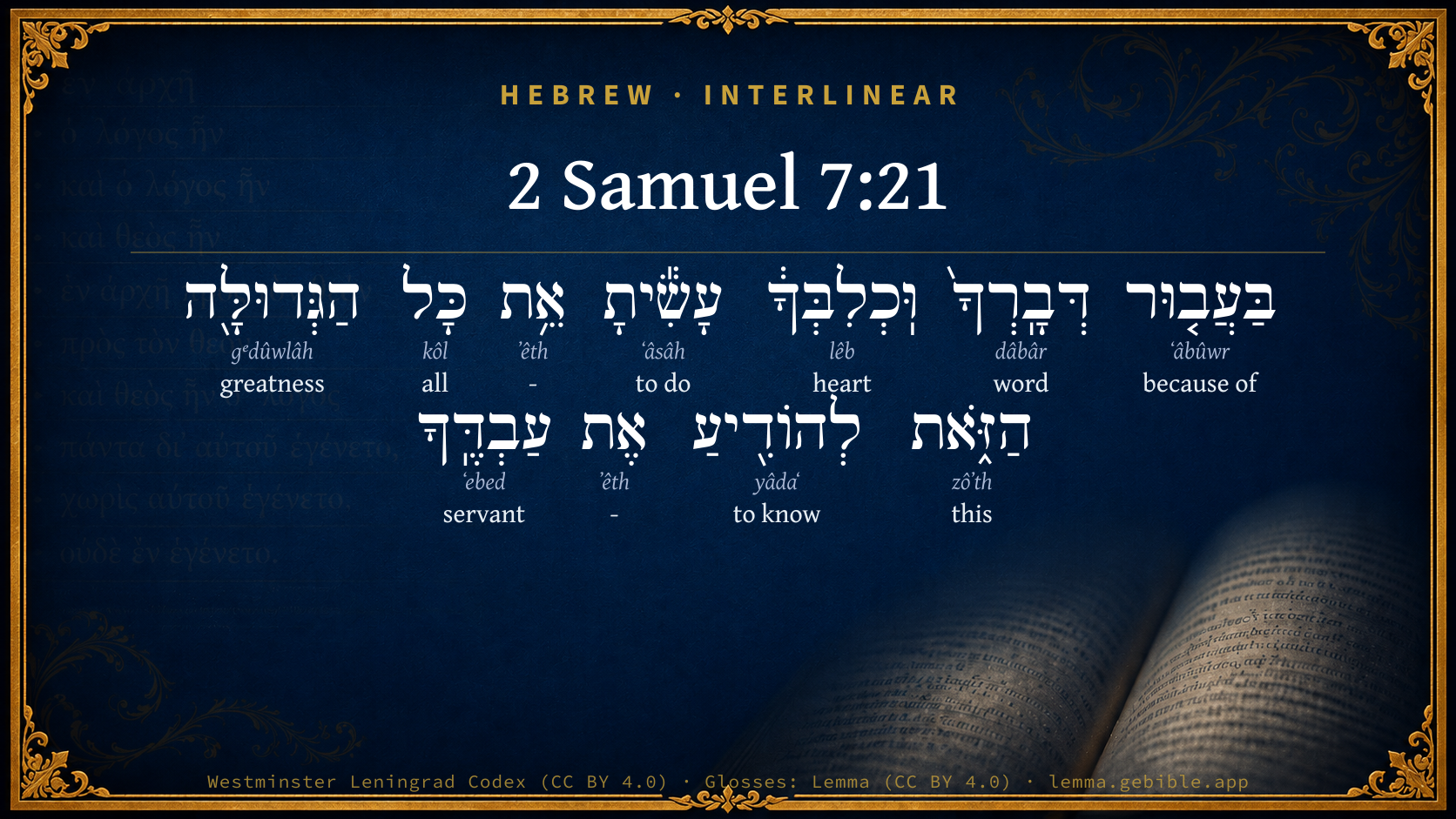
Hebrew (Westminster Leningrad Codex) 2 Samuel 7:21 appears in the Hebrew Old Testament. The text above is from the Westminster Leningrad Codex. Each word links to its Strong’s number, a concise gloss, and parsing drawn from the Open Scriptures Hebrew Bible morphology. Click any word for its full Brown-Driver-Briggs (BDB) entry.
Download image
Cite this verse

2 Samuel 7:21 (World English Bible). Public Domain. Lemma interlinear Bible study tool, https://lemma.gebible.app/v/2-samuel/7/21.

Show BibTeX & RIS
BibTeX
RIS
English Translation
For your word's sake, and according to your own heart, have you worked all this greatness, to make your servant know it.
World English Bible · Public Domain
Highlights
  • 1 first appearance in the Hebrew Bible
Full analysis ↓
Download a study sheet

One document with this verse’s original text, its word-by-word gloss line, the meaning frame, cross-references with their text, attributed commentary, and full source and license credits — printable, and it pastes into notes with its structure intact.

This verse Autodidact and up

Study sheet (.html) Plain text (.txt)

A passage Seminary Student

Up to 50 verses in one chapter. A passage sheet keeps up to 6 commentary sources and 12 cross-references per verse, in the order this page ranks them, and says so on the sheet whenever that leaves anything out. Ask for a single verse and you get the Autodidact verse sheet above.

Everything on this page stays free to read, with no account — the sheet is a download of what is already on screen, not access to it.

Want to remove ads? Support Godless Engineer
Compare translations 3

The same verse in 3 English versions, stacked beneath the original-language interlinear above. Click any original word for its lexicon entry.

Each is an independent rendering of the whole verse — the interlinear is not word-aligned to these translations.

Highlighted words mark where these versions differ — a whole-verse word diff, not a word-by-word alignment.

  • World English Bible Public Domain
    For your word's sake, and according to your own heart, have you worked all this greatness, to make your servant know it.
  • King James Version Public Domain
    For thy word's sake, and according to thine own heart, hast thou done all these great things, to make thy servant know them.
  • unfoldingWord Literal Text CC BY-SA 4.0
    For the sake of your word and according to your heart, you have done all this greatness, to make your servant know.

unfoldingWord Literal Text — © unfoldingWord, licensed CC BY-SA 4.0. Word-aligned USFM3 via Door43 (git.door43.org/unfoldingWord/en_ult).

Versions to compare (up to 4)

3 of 4 selected

Show all 18 translations

Every available English version of this verse, each an independent rendering of the whole verse.

  • World English Bible Public Domain
    For your word's sake, and according to your own heart, have you worked all this greatness, to make your servant know it.
  • Berean Standard Bible Public Domain
    For the sake of Your word and according to Your own heart, You have accomplished this great thing and revealed it to Your servant.
  • Majority Standard Bible Public Domain
    For the sake of Your word and according to Your own heart, You have accomplished this great thing and revealed it to Your servant.
  • King James Version Public Domain
    For thy word's sake, and according to thine own heart, hast thou done all these great things, to make thy servant know them.
  • American Standard Version (1901) Public Domain
    For thy word's sake, and according to thine own heart, hast thou wrought all this greatness, to make thy servant know it.
  • Revised Version (1885) Public Domain
    For thy word’s sake, and according to thine own heart, hast thou wrought all this greatness, to make thy servant know it.
  • Geneva Bible (1599) Public Domain
    For thy words sake, and according to thine owne heart hast thou done all these great things, to make them knowen vnto thy seruant.
  • Douay-Rheims (1899) Public Domain
    For thy word's sake, and according to thy own heart thou hast done all these great things, so that thou wouldst make it known to thy servant.
  • Young's Literal Translation Public Domain
    Because of Thy word, and according to Thy heart, Thou hast done all this greatness, to cause Thy servant to know `it'.
  • Literal Standard Version CC BY-SA 4.0
    Because of Your word, and according to Your heart, You have done all this greatness, to cause Your servant to know [it].
  • Unlocked Literal Bible CC BY-SA 4.0
    For your word's sake, and to fulfill your own purpose, you have done this great thing and revealed it to your servant.
  • unfoldingWord Literal Text CC BY-SA 4.0
    For the sake of your word and according to your heart, you have done all this greatness, to make your servant know.
  • Darby Bible Public Domain
    For thy word's sake, and according to thine own heart, hast thou done all this greatness, to make thy servant know [it].
  • World Messianic Bible Public Domain
    For your word’s sake, and according to your own heart, you have worked all this greatness, to make your servant know it.
  • Webster's Bible Public Domain
    For thy word's sake, and according to thy own heart, hast thou done all these great things, to make thy servant know them.
  • Free Bible Version CC BY-SA 4.0
    You're doing all this for me and you have explained it to me, your servant, because of your promise and because it's what you want to do.
  • Bible in Basic English Public Domain
    Because of your word and from your heart, you have done all this great work, and let your servant see it.
  • JPS Tanakh (1917) Public Domain
    For Thy word's sake, and according to Thine own heart, hast Thou wrought all this greatness, to make Thy servant know it.

Literal Standard Version (2020), Covenant Press — licensed CC BY-SA 4.0. Text via the HelloAO Bible API (eBible.org). Unlocked Literal Bible (unfoldingWord) — licensed CC BY-SA 4.0. Text via the HelloAO Bible API (eBible.org). unfoldingWord Literal Text — © unfoldingWord, licensed CC BY-SA 4.0. Word-aligned USFM3 via Door43 (git.door43.org/unfoldingWord/en_ult). Free Bible Version, Dr. Jonathan Gallagher — licensed CC BY-SA 4.0. Text via the HelloAO Bible API (eBible.org).

Word by word

More ways to search: Search by grammar → Find every occurrence → Compare this word →

Practice this passage: Drill this verse → Learn its vocabulary →

הַגְּדוּלָּ֖ה
gᵉdûwlâh
H1420
“the · greatness”
Particle, Definite Article + Noun, Common, Feminine, Singular, Absolute
Part of Speech
Particle + Noun
Type
Common
Gender
Feminine
Number
Singular
State
Absolute
Full BDB Definition

Origin: from H1419

TWOT: 315e

greatness - of man - of God's greatness (as an attribute)
  1. בַּעֲב֤וּר ʻâbûwr H5668 “in/at · because of of” Preposition + Noun, Common, Masculine, Singular, Construct
  2. דְּבָֽרְךָ֙ dâbâr H1697 “word · your” Noun, Common, Masculine, Singular, Construct + Suffix, Personal, 2nd Person, Masculine, Singular
  3. וּֽכְלִבְּךָ֔ lêb H3820 “and · like/as · heart · your” Conjunction + Preposition + Noun, Common, Masculine, Singular, Construct + Suffix, Personal, 2nd Person, Masculine, Singular
  4. עָשִׂ֕יתָ ʻâsâh H6213 “to do” Verb, Qal, Perfect, 2nd Person, Masculine, Singular
  5. אֵ֥ת ʼêth H853 “-” Particle, Direct Object
  6. כָּל kôl H3605 “all of” Noun, Common, Masculine, Singular, Construct
  7. הַזֹּ֑את zôʼth H2063 “the · this” Particle, Definite Article + Pronoun, Demonstrative, Feminine, Singular
  8. לְהוֹדִ֖יעַ yâdaʻ H3045 “to know” Preposition + Verb, Hiphil, Infinitive Construct
  9. אֶת ʼêth H853 “-” Particle, Direct Object
  10. עַבְדֶּֽךָ ʻebed H5650 “servant · your” Noun, Common, Masculine, Singular, Construct + Suffix, Personal, 2nd Person, Masculine, Singular

About this verse

These counts appear in no published source. They are computed here, from the morphology-tagged text and Lemma’s own curated glosses. What Lemma adds →

11
words
10
distinct lemmas
Historical
section

Notable vocabulary

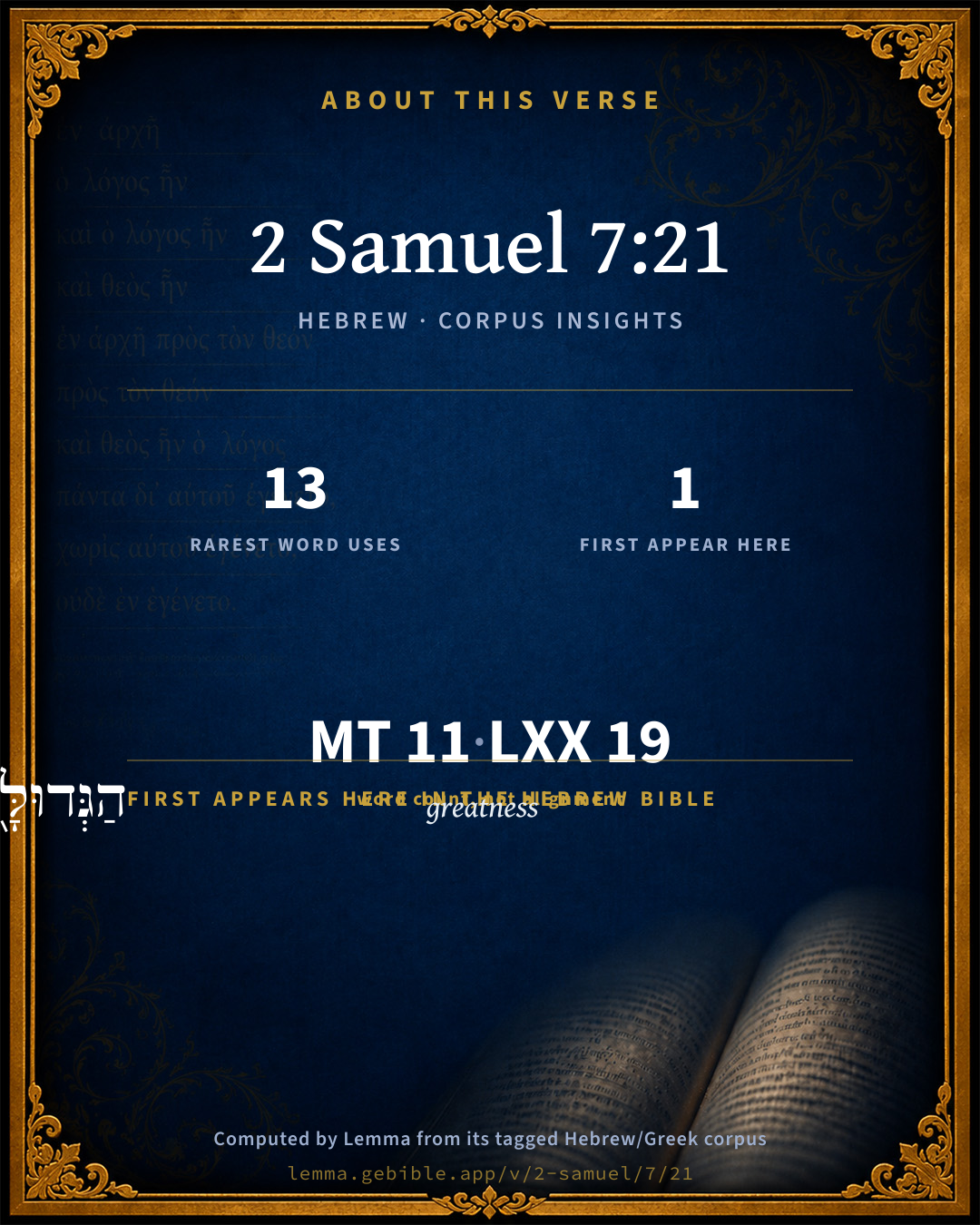
The rarest word here is הַגְּדוּלָּ֖ה greatness H1420 — appearing just 13 times in the whole Hebrew Bible.

First appearance in Scripture

This word makes its first canonical appearance in the Hebrew Bible here:

  • הַגְּדוּלָּ֖ה greatness H1420

Shared distinctive vocabulary

הַגְּדוּלָּ֖ה greatness H1420 occurs in 11 verses of the Hebrew Bible. Also found in:

Grammatical profile

  • 2 verbs
  • 6 nouns
  • 1 pronoun
  • 2 particles

Verb forms

  • עָשִׂ֕יתָ Qal · Perfect
  • לְהוֹדִ֖יעַ Hiphil · Infinitive Construct

Hebrew & Septuagint length

In English translation the verse runs 22 words from the Hebrew and 26 from the Septuagint (LXX English) — closely comparable.

A rough comparison of the two English renderings, which tokenize alike — not a word-level alignment.

Word counts can differ between the Hebrew and the Greek without any difference in meaning — e.g. the Hebrew direct-object marker אֵת has no separate Greek word, and Greek often adds the article ὁ.

In the original languages it is 11 Hebrew tokens and 19 Greek tokens — but the two are counted differently (Hebrew bundles its prefixes and suffixes into one token; the Greek is in lemma form), so that isn’t a like-for-like length.

Cross-references

14

Topical passages linked to 2 Samuel 7:21 in the Treasury of Scripture Knowledge — connected by theme and wording, ordered by reader-vote popularity; previews shown in the World English Bible.

  • Psalms 115:1 Not to us, Yahweh, not to us, But to your name give glory, For your loving kindness, and for your truth's sake.
  • Psalms 138:2 I will bow down toward your holy temple, And give thanks to your Name for your loving kindness and for your truth; For you have exalted your Name and your Word above all.
  • Ephesians 3:11 according to the eternal purpose which he purposed in Christ Jesus our Lord;
  • Luke 12:32 Don't be afraid, little flock, for it is your Father's good pleasure to give you the Kingdom.
  • 1 Corinthians 1:1 Paul, called to be an apostle of Jesus Christ through the will of God, and our brother Sosthenes,
  • Ephesians 1:9 making known to us the mystery of his will, according to his good pleasure which he purposed in him
  • Numbers 23:19 God is not a man, that he should lie, Neither the son of man, that he should repent: Has he said, and will he not do it? Or has he spoken, and will he not make it good?
  • Deuteronomy 9:5 Not for your righteousness, or for the uprightness of your heart, do you go in to possess their land; but for the wickedness of these nations Yahweh your God does drive them out from before you, and that he may establish the word which Yahweh swore to your fathers, to Abraham, to Isaac, and to Jacob.
  • Joshua 23:14–15 Behold, this day I am going the way of all the earth: and you know in all your hearts and in all your souls, that not one thing has failed of all the good things which Yahweh your God spoke concerning you; all are happen to you, not one thing has failed of it.
  • Matthew 11:26 Yes, Father, for so it was well-pleasing in your sight.
  • Matthew 24:35 Heaven and earth will pass away, but my words will not pass away.
  • Luke 1:54–55 He has given help to Israel, his servant, that he might remember mercy,
  • Luke 1:72 To show mercy towards our fathers, To remember his holy covenant,
  • Luke 10:21 In that same hour Jesus rejoiced in the Holy Spirit, and said, "I thank you, O Father, Lord of heaven and earth, that you have hidden these things from the wise and understanding, and revealed them to little children. Yes, Father, for so it was well-pleasing in your sight."

Cross-references courtesy of OpenBible.info (CC BY 4.0).

Hebrew and Greek witnesses Masoretic Hebrew ↔ Greek Septuagint

The same verse in the two great witnesses to the Old Testament, shown verse-for-verse.

These are two independent witnesses, not word-aligned to each other, and the Septuagint is shown in lemma (dictionary) form.

Hebrew 2 Samuel 7:21 Masoretic · Westminster Leningrad Codex

בַּעֲב֤וּר דְּבָֽרְךָ֙ וּֽכְלִבְּךָ֔ עָשִׂ֕יתָ אֵ֥ת כָּל הַגְּדוּלָּ֖ה הַזֹּ֑את לְהוֹדִ֖יעַ אֶת עַבְדֶּֽךָ

For your word's sake, and according to your own heart, have you worked all this greatness, to make your servant know it.

World English Bible · Public Domain

Greek LXX 2 Samuel 7:21 Septuagint · lemma form

διά ὁ λόγος σύ ποιέω καί κατά ὁ καρδία σύ ποιέω πᾶς ὁ μεγαλωσύνη οὗτος γνωρίζω ὁ δοῦλος σύ

And you have wrought for your servant's sake, and according to your heart you have wrought all this greatness, to make it known to your servant,

LXX2012 (modern English Septuagint) · Public Domain

On this verse, The Cambridge Bible for Schools and Colleges discusses the Septuagint’s reading. Read the note in Commentary ↓

Hebrew: Westminster Leningrad Codex (CC BY 4.0). Greek: Septuagint (public domain); English from LXX2012 (modern English Septuagint) (Public Domain). How the Septuagint differs from the Hebrew →

Targum (Aramaic paraphrase)

1

The Targum is the ancient Jewish Aramaic paraphrase of the Hebrew Scriptures — an interpretive translation, not the Hebrew text itself. Onkelos (literal) and Pseudo-Jonathan (expansive) render the Torah, and Jonathan the Prophets. Coverage is partial: where no permissively-licensed English translation exists for a verse, only the Aramaic is shown. This is verse-level text, not a word-by-word alignment to the Hebrew.

  1. Targum Jonathan Prophets (Joshua–Malachi)
    בְּדִיל מֵימְרָךְ וּכְלִבָּךְ עֲבַדְתָּ יַת כָּל רַבְרְבָתָא הָדָא לְהוֹדָעָא יַת עַבְדָךְ:

    (no public-domain English translation for this verse)

    Targum Jonathan — Aramaic: “Mikraot Gedolot” (public domain). English: “Sefaria Community Translation” (CC0 1.0 (public-domain dedication)); “London "Chaldee Paraphrase," 1871” (public domain). Text via Sefaria.

Commentary

Notes on 2 Samuel 7:21 from classic Christian and Jewish commentators (each source and its license shown beneath its notes). The classic Christian expositions comment on the surrounding passage and are grouped to its opening verse, so a note may address several verses; the Jewish commentaries on the Tanakh (Rashi and others) are per-verse, so they appear only where the commentator wrote on this verse.

Lemma curates 59 commentaries, every one of them public domain or Creative Commons licensed, each selected and text-cleaned for this edition rather than reprinted as found. About our sources →

Trapp's Complete Commentary

John Trapp

2Sa 7:21 For thy word’s sake, and according to thine own heart, hast thou done all these great things, to make thy servant know [them].

Ver. 21. For thy word’s sake,] i.e., For thy Christ’s sake, saith Junius: or for thy promise’s sake made unto me by Nathan, as 2Sa 7:25.

And according to thine own heart, &c., ] i.e., Ex mere motu, out of pure and unexcited love thou didst give thy word and promise: and for thy word’s sake thou wilt perform it.

John Trapp, A Commentary or Exposition upon All the Books of the Old and New Testament (1647–1656) — public domain. Text from a community e-Sword module.

Tyndale Open Study Notes

Tyndale Open Resources

7:21 God’s will, rather than David’s personal ambition, enabled David to accomplish great things. • you have done: David spoke of what God promised to do for his heirs over the generations as an already-accomplished fact, showing his unshakable belief in God’s faithfulness.

Tyndale Open Study Notes — © Tyndale Open Resources, licensed CC BY-SA 4.0. Text via the HelloAO Bible API.

The Cambridge Bible for Schools and Colleges

gen. ed. J. J. S. Perowne

21. For thy word’s sake] To fulfil Thy promises made to me through Samuel. The reading of 1Ch_17:19, and of the LXX. here, is for thy servant’s sake.

The Cambridge Bible for Schools and Colleges (gen. ed. J. J. S. Perowne; Cambridge University Press, 1878–1918) — public domain. Text from a community e-Sword module.

John Gill's Exposition

For thy word's sake,.... For the sake of the promise he had made to him by Samuel, that he should be king, and his kingdom should be established; or for the sake of the Messiah, that should spring from him; the Memra, as the Targum, the essential Word of God; and so the Septuagint version, "because of thy servant", with which agrees the parallel text in Ch1 17:19,

and according to thine own heart; of his own sovereign good will and pleasure, of his own grace, as the Arabic version, and not according to the merits and deserts of David:

hast thou done all these great things; in making him king of Israel, and settling the kingdom in his posterity to the times of the Messiah, who should spring from him:

to make thy servant know them; as he now did by Nathan the prophet, what he and his should enjoy for time to come; so that it is not only a blessing to have favours designed, purposed, and promised, but to have the knowledge of them, to know the things that are freely given of God.

John Gill's Exposition of the Whole Bible (1746–1763) — public domain (CC PDM 1.0). Text via the HelloAO Bible API.

Haydock's Catholic Bible Commentary

Word’s sake. Some copies (Haydock) of the Septuagint read "servant’s sake," as 1 Paralipomenon xvii. (Calmet)

George Leo Haydock (1774–1849), Haydock's Catholic Family Bible and Commentary, 1859 edition — public domain. Excludes Psalms (Douay-Rheims chapter numbering differs from Protestant) and Deuterocanonical books (Catholic canon only).

Matthew Poole's English Annotations

For thy word’s sake; that thou mightest fulfil thy promises made to me by Samuel and Nathan, and thereby demonstrate thy faithfulness.

According to thine own heart, i. e. of thine own mere liberality and good pleasure, without any desert of mine. So far was David, though now a very gracious man, from thinking his actions meritorious.

To make thy servant know them, i.e. that thy gracious and wonderful purposes of mercy towards me, which lay hid in thine own heart, might be manifested unto me and others by thy most kind words and actions. So it agrees with 1Ch 17:19.

Matthew Poole's English Annotations on the Holy Bible (1683–1685) — public domain. Text from a community e-Sword/MySword module.

Whedon's Commentary on the Bible

Daniel D. Whedon

21. For thy word’s sake — The word is the promise of the perpetuity of the throne of David, which was magnified before all Israel, and in later times referred to as the “sure mercies of David.” The Divine purpose to exalt the throne of David involved, also, the purpose of magnifying the word of prophecy.

Daniel D. Whedon (gen. ed.), Commentary on the Old and New Testaments (1874–1909) — public domain. Text from a community e-Sword module.

The Pulpit Commentary

For thy word"s sake; In 1Ch_17:19 we read, "For thy servant"s sake." The phrase seemed, perhaps, to the Chronicler difficult, but it does not mean "because of thy previous promise," for no such promise had been given, but "because thou hast now said it." Nor does it imply pre-existing merit in David, but that God had now chosen to declare his will, and what was according to his own heart. It thus makes God"s own good will and pleasure the cause of the great honours bestowed upon David. Instead of these great things, the Hebrew has this great thing; that is, the lasting continuance of David"s family.

God"s works and God"s heart and words.

David looks on those great things which God had promised him as if already accomplished, so great confidence had he in the power and faithfulness of the Promiser; and, conscious that they were due to no worthiness or power of his own, he acknowledges that all originated in the heart of God and were simply in fulfilment of his word, by which they had become known to himself. For the will and the work and the word he praises God.

I GOD DOES GREAT THINGS ON BEHALF OF HIS PEOPLE. The works of creation are great and according to his own heart, originating in himself, and on a scale proportionate to his own greatness. So with the works of his providence. But we will apply the words to redemption. The works included in this are indeed great. They are on a scale of grandeur worthy of God.

1. The methods employed are great. The Incarnation the union of God and man in one Person. The display of the glory of God in the earthly life of Christ, and at his death, resurrection, and ascension. His exaltation to be "Lord of all." The descent and operations of the Holy Spirit.

2. The work effected on behalf of man is great. The atonement especially, and all involved in it. The conquest over sin and Satan and death. The opening of the way to God and heaven.

3. The work wrought in and towards men is great.

(1) In respect to each believer. Illumination, regeneration, pardon, peace, holiness, perfection, glory everlasting, together with the special guidance and government of God"s providence tending to and issuing in these great results.

(2) In respect to the multitude redeemed and saved.

(3) In respect to the final deliverance and exaltation with the Church of the whole creation (Rom_8:19-22; Eph_1:10)

II GOD DOES THESE GREAT THINGS "ACCORDING TO HIS OWN HEART.

1. They spring from his heart. They are done spontaneously, of his own free grace and will "his own good pleasure." Not at the prompting of others, for none other could have conceived them. Not under a sense of obligation, for we had no claim upon him, except that our sin and misery appealed to his compassion. They originated in the Divine mind, sprang from the Divine love.

2. They befit his heart. They bear the stamp of the Divine nature; are worthy of his infinite wisdom, righteousness, benevolence, and power; are the grandest display of them. "It became him," etc.. (Heb_2:10)

All thy ways Are worthy of thyself Divine; But the bright glories of thy grace Beyond thine other wonders shine.

III GOD DOES THESE GREAT THINGS IN FULFILMENT OF HIS OWN WORD. "For thy Word"s sake.

1. He announces them by his Word. "To make thy servant know them." The things which God has done and will do he makes known. It is thus they become available to each and all to whom the Word is communicated. For the knowledge is the chief part of the means by which salvation is wrought. "The gospel... is the power of God unto salvation to every one that believeth" (Rom_1:16; see also (Rom_10:13, Rom_10:14; 1Co_1:17, 1Co_1:18, 1Co_1:23; Jam_1:18; 1Pe_1:22, 1Pe_1:23) Thus also we are assured of the completion of the work of redemption. For by the promises our God lays himself under obligation to perfect the salvation of all believers. It is, therefore, a great privilege to know these great things which God works.

2. He accomplishes them according to his Word. He cannot do otherwise. He "cannot lie". (Tit_1:2) "He abideth faithful; he cannot deny himself". (2Ti_2:13) Moreover, "what he hath promised, he is able also to perform". (Rom_4:21) Now that he has given his Word, "for his Word"s sake" if there were no other reason, he will do "all these great things.

Then:

1. Let us, like David, adore and praise our God for his wondrous works, and for making them known to us. How glorious he appears in these works! Let us ascribe glory to him.

2. Let believers rest assured of the complete accomplishment of the work of their own redemption. They have the Word and the heart of God, and his actual works for them and in them, to give them assurance.

3. Let us fear, lest we should fail, through negligence and unbelief, to appropriate the redemption so wondrously wrought for us, notwithstanding our knowledge of it. (see Heb_2:1-4) G.W.

The Pulpit Commentary (1880–1919), ed. H.D.M. Spence-Jones & Joseph S. Exell — public domain. Text from a community e-Sword module.

John Wesley's Explanatory Notes

Thy word's sake - That thou mightest fulfil thy promises made to me, and thereby demonstrate thy faithfulness. Own heart - Or thy own mere liberality and good pleasure, without any desert of mine. So far was David, though a very gracious man, from thinking his actions meritorious.

John Wesley, Explanatory Notes Upon the Whole Bible (1754–1765) — public domain. Text via the GEBible commentary corpus.

unfoldingWord translationNotes

Door43 World Missions Community

For your word's sake

"Because of what you promised to do"

to fulfill your own purpose

"to accomplish what you planned to do"

to your servant

David refers to himself as "your servant." It can be stated in first person. AT: "to me" (See: First, Second, or Third Person)

as we have heard with our own ears

The phrase "with our own ears" is used for emphasis. AT: "as we ourselves have heard" (See: Idiom)

as we have heard

Here "we" refers to David and the nation of Israel. (See: Exclusive and Inclusive "We")

What nation is like your people Israel, the one nation on earth whom you, God, went and rescued for yourself?

David uses a question emphasize that there is no other nation like Israel. AT: "There is no nation like your people Israel, the one nation on earth whom you, God, went and rescued for yourself." (See: Rhetorical Question)

to make a name for yourself

Here "name" represents Yahweh's reputation. AT: "to make all people know who you are" (See: Metonymy)

for your land

Here "land" represents the people. AT: "for your people" (See: Metonymy)

You drove out nations

Here "nations" represents the people groups that were living in Canaan. (See: Metonymy)

translationWords

word of God

reveal

servant

Lord Yahweh

God

nation

people of God

earth

name

fear

works

cast out

false god

unfoldingWord translationNotes — © Distant Shores Media and the Door43 World Missions Community, licensed CC BY-SA 4.0. Source: git.door43.org/Door43/en_tn.

Rashi

Rabbi Shlomo Yitzchaki (Rashi)

Because of Your word. To fulfill that which You told Shmuel to make me king.

And due to [the will of] Your Heart. It is Your will [that I become king] and not because I am worthy.

Of which You have informed Your servant. The announcement of which You have informed me.

Rashi on the Tanakh — English translations: “The Judaica Press complete Tanach with Rashi, translated by A. J. Rosenberg” (CC BY 4.0); “Pentateuch with Rashi's commentary by M. Rosenbaum and A.M. Silbermann, 1929-1934” (public domain); “The Metsudah Tanach series, Lakewood, N.J” (CC BY 4.0); and “The Book of Joshua, Metsudah Publications, 1997” (CC BY 4.0). Text via Sefaria.

Lesson kit

Teaching starters — assembled from the data on this page, not authored interpretation. Every prompt links to the verse data it draws on. Edit before teaching.

2 Samuel, in the Historical, opens this verse with 11 words (10 distinct Hebrew lemmas). Its most distinctive word is gᵉdûwlâh (“greatness”). A historical commentator’s framing appears above. Read the whole chapter for the surrounding context.

Discussion questions

  1. The word gᵉdûwlâh carries the sense “greatness.” How does it shape the verse?
  2. This is the first place “greatness” appears in Scripture (first appears here). What does its debut here establish?
  3. How does 2 Samuel 7:23, which shares the word «greatness», read alongside this verse?
  4. These translations render this verse differently. What is at stake in choosing one wording over another?
  5. «עָשִׂ֕יתָ» is a Qal Perfect verb. How does that grammatical form shape the action described?
  6. Compare how Trapp's Complete Commentary and Tyndale Open Study Notes read this verse. Where do they agree or differ?

Things to notice

Reading settings

Reading text

Shown beneath each verse's original-language words.

Old Testament
Old Testament edition

Read the OT as the Masoretic Hebrew (MT) or the Greek Septuagint (LXX).

English shown for the Greek Septuagint (in the Hebrew ↔ Greek comparison).

Comparing translations? Open the Compare panel on any verse page to stack up to four side by side.