
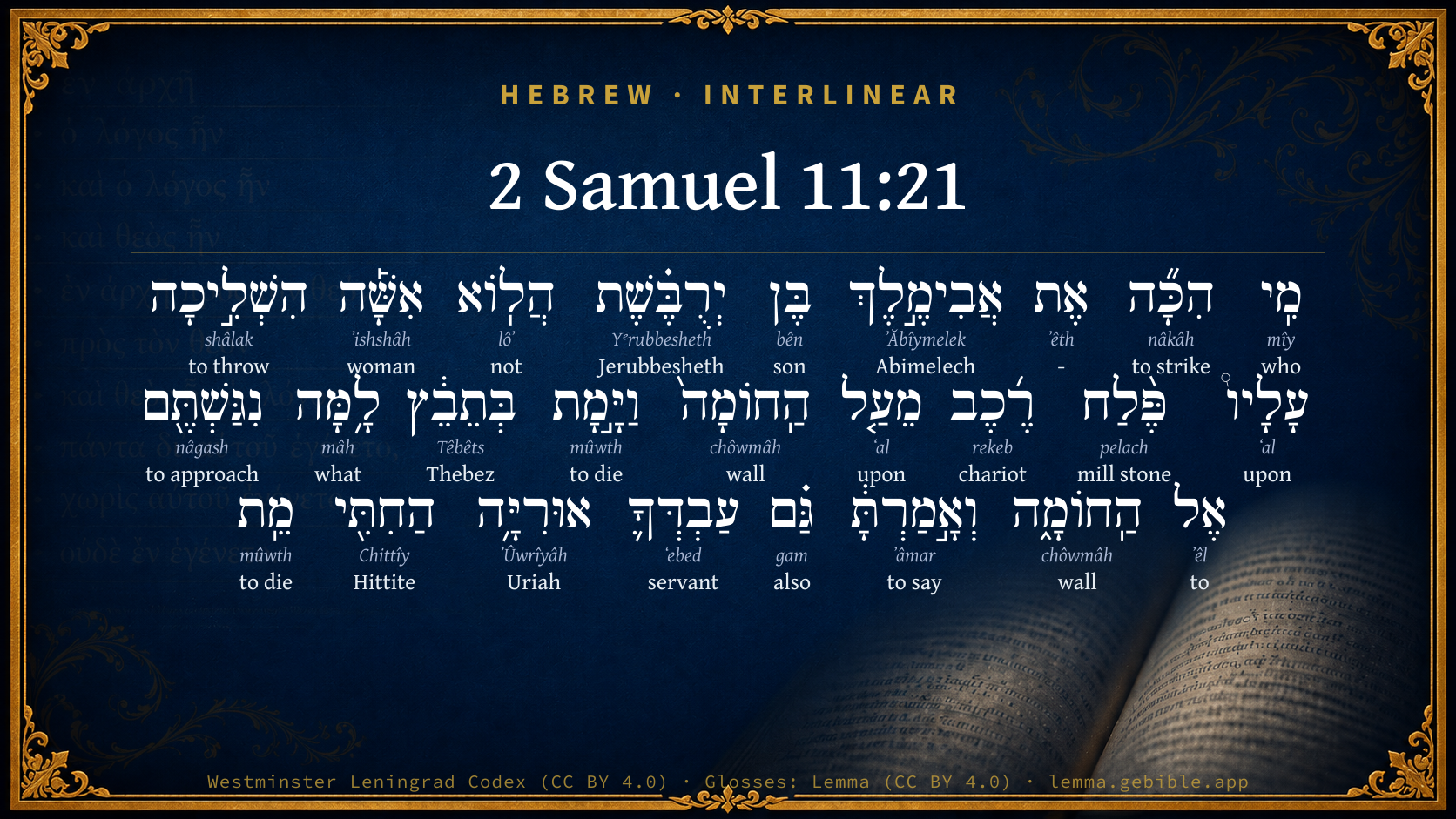
2 Samuel 11:21

Hebrew (Westminster Leningrad Codex) 2 Samuel 11:21 appears in the Hebrew Old Testament. The text above is from the Westminster Leningrad Codex. Each word links to its Strong’s number, a concise gloss, and parsing drawn from the Open Scriptures Hebrew Bible morphology. Click any word for its full Brown-Driver-Briggs (BDB) entry.
Download image
Cite this verse

2 Samuel 11:21 (World English Bible). Public Domain. Lemma interlinear Bible study tool, https://lemma.gebible.app/v/2-samuel/11/21.

Show BibTeX & RIS
BibTeX
RIS
English Translation
who struck Abimelech the son of Jerubbesheth? Didn't a woman cast an upper millstone on him from the wall, so that he died at Thebez? Why did you go so near the wall?' then shall you say, 'Your servant Uriah the Hittite is dead also.'"
World English Bible · Public Domain
Highlights
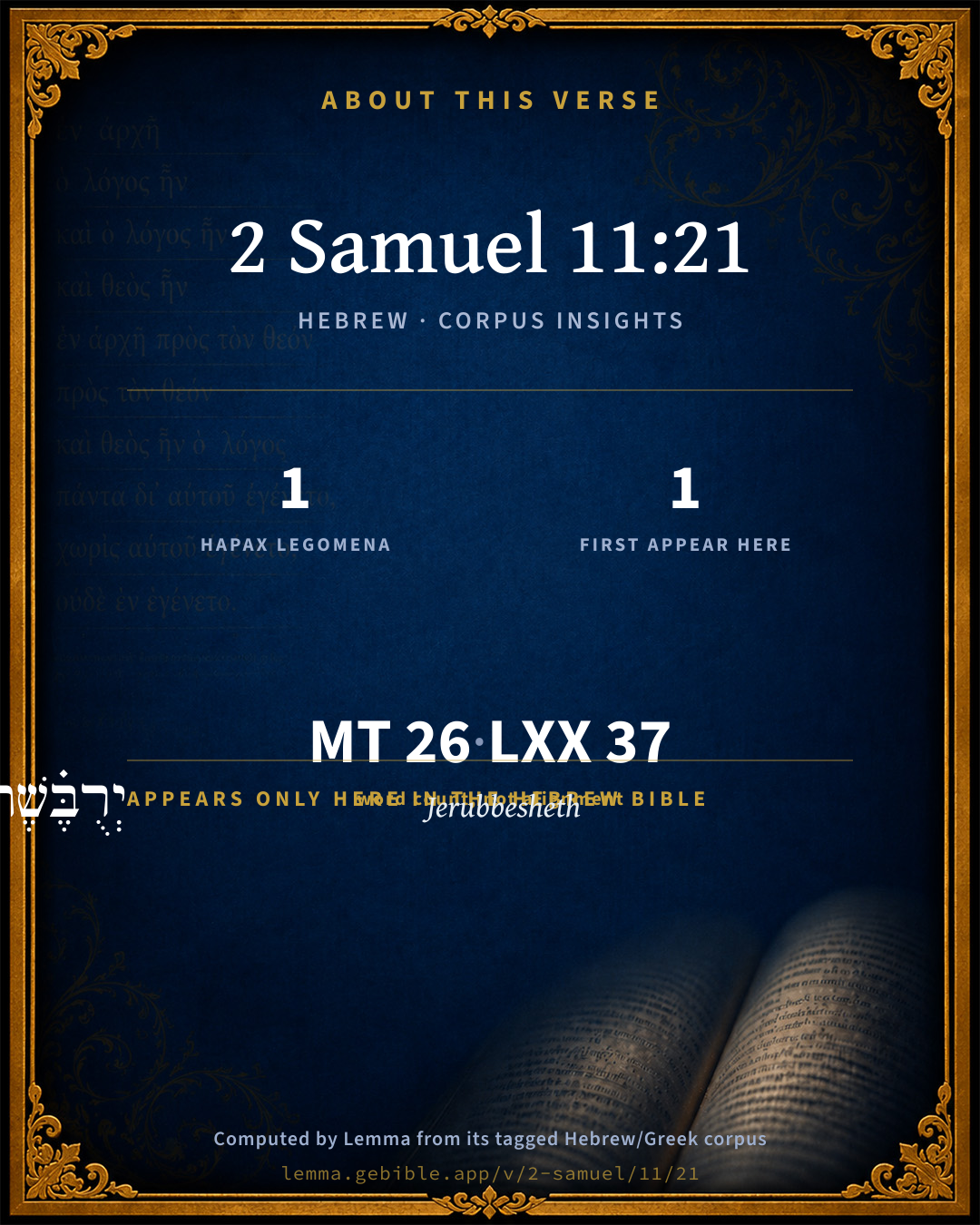
  • 1 hapax legomenon — only here in the Hebrew Bible
  • 1 first appearance in the Hebrew Bible
Full analysis ↓
Download a study sheet

One document with this verse’s original text, its word-by-word gloss line, the meaning frame, cross-references with their text, attributed commentary, and full source and license credits — printable, and it pastes into notes with its structure intact.

This verse Autodidact and up

Study sheet (.html) Plain text (.txt)

A passage Seminary Student

Up to 50 verses in one chapter. A passage sheet keeps up to 6 commentary sources and 12 cross-references per verse, in the order this page ranks them, and says so on the sheet whenever that leaves anything out. Ask for a single verse and you get the Autodidact verse sheet above.

Everything on this page stays free to read, with no account — the sheet is a download of what is already on screen, not access to it.

Want to remove ads? Support Godless Engineer
Compare translations 3

The same verse in 3 English versions, stacked beneath the original-language interlinear above. Click any original word for its lexicon entry.

Each is an independent rendering of the whole verse — the interlinear is not word-aligned to these translations.

Highlighted words mark where these versions differ — a whole-verse word diff, not a word-by-word alignment.

  • World English Bible Public Domain
    who struck Abimelech the son of Jerubbesheth? Didn't a woman cast an upper millstone on him from the wall, so that he died at Thebez? Why did you go so near the wall?' then shall you say, 'Your servant Uriah the Hittite is dead also.'"
  • King James Version Public Domain
    Who smote Abimelech the son of Jerubbesheth? did not a woman cast a piece of a millstone upon him from the wall, that he died in Thebez? why went ye nigh the wall? then say thou, Thy servant Uriah the Hittite is dead also.
  • unfoldingWord Literal Text CC BY-SA 4.0
    Who struck Abimelech, the son of Jerubbesheth? Did not a woman throw a piece of a millstone onto him from the wall, and he died in Thebez? Why did you draw near to the wall?’ then you shall say, ‘Your servant Uriah the Hittite is also dead.’”

unfoldingWord Literal Text — © unfoldingWord, licensed CC BY-SA 4.0. Word-aligned USFM3 via Door43 (git.door43.org/unfoldingWord/en_ult).

Versions to compare (up to 4)

3 of 4 selected

Show all 18 translations

Every available English version of this verse, each an independent rendering of the whole verse.

  • World English Bible Public Domain
    who struck Abimelech the son of Jerubbesheth? Didn't a woman cast an upper millstone on him from the wall, so that he died at Thebez? Why did you go so near the wall?' then shall you say, 'Your servant Uriah the Hittite is dead also.'"
  • Berean Standard Bible Public Domain
    Who was the one to strike Abimelech son of Jerubbesheth? Was it not a woman who dropped an upper millstone on him from the wall, so that he died in Thebez? Why did you get so close to the wall?’ If so, then you are to say, ‘Your servant Uriah the Hittite is dead as well.’”
  • Majority Standard Bible Public Domain
    Who struck Abimelech son of Jerubbesheth? Was it not a woman who dropped an upper millstone on him from the wall, so that he died in Thebez? Why did you get so close to the wall?’ If he asks you this, then you are to say, ‘Your servant Uriah the Hittite is dead as well.’”
  • King James Version Public Domain
    Who smote Abimelech the son of Jerubbesheth? did not a woman cast a piece of a millstone upon him from the wall, that he died in Thebez? why went ye nigh the wall? then say thou, Thy servant Uriah the Hittite is dead also.
  • American Standard Version (1901) Public Domain
    who smote Abimelech the son of Jerubbesheth? did not a woman cast an upper millstone upon him from the wall, so that he died at Thebez? why went ye so nigh the wall? then shalt thou say, Thy servant Uriah the Hittite is dead also.
  • Revised Version (1885) Public Domain
    who smote Abimelech the son of Jerubbesheth? did not a woman cast an upper millstone upon him from the wall, that he died at Thebez? why went ye so nigh the wall? then shalt thou say, Thy servant Uriah the Hittite is dead also.
  • Geneva Bible (1599) Public Domain
    Who smote Abimelech sonne of Ierubesheth? did not a woman cast a piece of a milstone vpon him from the wall, and he died in Thebez? why went you nie the wall? Then say thou, Thy seruant Vriah the Hittite is also dead.
  • Douay-Rheims (1899) Public Domain
    Who killed Abimelech the son of Jerobaal? did not a woman cast a piece of a millstone upon him from the wall, and slew him in Thebes? Why did you go near the wall? Thou shalt say: Thy servant Urias the Hethite is also slain.
  • Young's Literal Translation Public Domain
    Who smote Abimelech son of Jerubbesheth? did not a woman cast on him a piece of a rider from the wall, and he dieth in Thebez? why drew ye nigh unto the wall? that thou hast said, Also thy servant Uriah the Hittite is dead.'
  • Literal Standard Version CC BY-SA 4.0
    Who struck Abimelech son of Jerubbesheth? Did a woman not cast a piece of a rider from the wall on him, and he dies in Thebez? Why did you draw near to the wall? That you have said, Also—your servant Uriah the Hittite is dead.”
  • Unlocked Literal Bible CC BY-SA 4.0
    Who killed Abimelech son of Jerub-Besheth? Did not a woman cast an upper millstone on him from the wall, so that he died at Thebez? Why did you go so near the wall?' Then you must answer, 'Your servant Uriah the Hittite is dead also.'”
  • unfoldingWord Literal Text CC BY-SA 4.0
    Who struck Abimelech, the son of Jerubbesheth? Did not a woman throw a piece of a millstone onto him from the wall, and he died in Thebez? Why did you draw near to the wall?’ then you shall say, ‘Your servant Uriah the Hittite is also dead.’”
  • Darby Bible Public Domain
    Who smote Abimelech the son of Jerubbesheth? did not a woman cast the upper stone of a handmill from the wall, that he died in Thebez? why did ye go near the wall? -- then say thou, Thy servant Urijah the Hittite is dead also.
  • World Messianic Bible Public Domain
    Who struck Abimelech the son of Jerubbesheth? Didn’t a woman cast an upper millstone on him from the wall, so that he died at Thebez? Why did you go so near the wall?’ then you shall say, ‘Your servant Uriah the Hittite is also dead.’”
  • Webster's Bible Public Domain
    Who smote Abimelech the son of Jerubbesheth? did not a woman cast a piece of a millstone upon him from the wall, that he died in Thebez? why went ye nigh the wall? then say thou, Thy servant Uriah the Hittite is dead also.
  • Free Bible Version CC BY-SA 4.0
    Who killed Abimelech, son of Jerub-Besheth? Wasn't it a woman who dropped a millstone on him from the wall, killing him there in Thebez? Why on earth did you get so close to the wall?’ Just tell him, ‘In addition, your officer Uriah the Hittite was killed.’”
  • Bible in Basic English Public Domain
    Who put Abimelech, the son of Jerubbaal, to death? did not a woman send a great stone down on him from the wall, putting him to death at Thebez? why did you go so near the wall? Then say to him, Your servant Uriah the Hittite is among the dead.
  • JPS Tanakh (1917) Public Domain
    who smote Abimelech the son of Jerubbesheth? did not a woman cast an upper millstone upon him from the wall, that he died at Thebez? why went ye so nigh the wall? then shalt thou say: Thy servant Uriah the Hittite is dead also.'

Literal Standard Version (2020), Covenant Press — licensed CC BY-SA 4.0. Text via the HelloAO Bible API (eBible.org). Unlocked Literal Bible (unfoldingWord) — licensed CC BY-SA 4.0. Text via the HelloAO Bible API (eBible.org). unfoldingWord Literal Text — © unfoldingWord, licensed CC BY-SA 4.0. Word-aligned USFM3 via Door43 (git.door43.org/unfoldingWord/en_ult). Free Bible Version, Dr. Jonathan Gallagher — licensed CC BY-SA 4.0. Text via the HelloAO Bible API (eBible.org).

Word by word

More ways to search: Search by grammar → Find every occurrence → Compare this word →

Practice this passage: Drill this verse → Learn its vocabulary →

יְרֻבֶּ֗שֶׁת
Yᵉrubbesheth
H3380
“Jerubbesheth”
Noun, Proper
Part of Speech
Noun
Type
Proper
Full BDB Definition

Origin: from H7378 and H1322

TWOT: None

Jerubbesheth = "shame will contend" - a variant name of Jerubbaal (the other name of Gideon H3378 ) substituting the word 'shame' for the name of the pagan god 'Baal'
  1. מִֽי mîy H4310 “who” Particle, Interrogative
  2. הִכָּ֞ה nâkâh H5221 “to strike” Verb, Hiphil, Perfect, 3rd Person, Masculine, Singular
  3. אֶת ʼêth H853 “-” Particle, Direct Object
  4. אֲבִימֶ֣לֶךְ ʼĂbîymelek H40 “Abimelech” Noun, Proper
  5. בֶּן bên H1121 “son of” Noun, Common, Masculine, Singular, Construct
  6. הֲלֽוֹא lôʼ H3808 “not” Particle, Interrogative + Particle, Negative
  7. אִשָּׁ֡ה ʼishshâh H802 “woman” Noun, Common, Feminine, Singular, Absolute
  8. הִשְׁלִ֣יכָה shâlak H7993 “to throw” Verb, Hiphil, Perfect, 3rd Person, Feminine, Singular
  9. עָלָיו֩ ʻal H5921 “upon · him” Preposition + Suffix, Personal, 3rd Person, Masculine, Singular
  10. פֶּ֨לַח pelach H6400 “mill stone of” Noun, Common, Feminine, Singular, Construct
  11. רֶ֜כֶב rekeb H7393 “chariot” Noun, Common, Masculine, Singular, Absolute
  12. מֵעַ֤ל ʻal H5921 “from · upon” Preposition + Preposition
  13. הַֽחוֹמָה֙ chôwmâh H2346 “the · wall” Particle, Definite Article + Noun, Common, Feminine, Singular, Absolute
  14. וַיָּ֣מָת mûwth H4191 “and · to die” Conjunction + Verb, Qal, Sequential Imperfect, 3rd Person, Masculine, Singular
  15. בְּתֵבֵ֔ץ Têbêts H8405 “in/at · Thebez” Preposition + Noun, Proper
  16. לָ֥מָּה mâh H4100 “to/for · what” Preposition + Particle, Interrogative
  17. נִגַּשְׁתֶּ֖ם nâgash H5066 “to approach” Verb, Niphal, Perfect, 2nd Person, Masculine, Plural
  18. אֶל ʼêl H413 “to” Preposition
  19. הַֽחוֹמָ֑ה chôwmâh H2346 “the · wall” Particle, Definite Article + Noun, Common, Feminine, Singular, Absolute
  20. וְאָ֣מַרְתָּ֔ ʼâmar H559 “and · to say” Conjunction + Verb, Qal, Sequential Perfect, 2nd Person, Masculine, Singular
  21. גַּ֗ם gam H1571 “also” Particle, Accusative
  22. עַבְדְּךָ֛ ʻebed H5650 “servant · your” Noun, Common, Masculine, Singular, Construct + Suffix, Personal, 2nd Person, Masculine, Singular
  23. אוּרִיָּ֥ה ʼÛwrîyâh H223 “Uriah” Noun, Proper
  24. הַחִתִּ֖י Chittîy H2850 “the · Hittite” Particle, Definite Article + Noun, Gentilic, Masculine, Singular, Absolute
  25. מֵֽת mûwth H4191 “to die” Verb, Qal, Perfect, 3rd Person, Masculine, Singular

About this verse

These counts appear in no published source. They are computed here, from the morphology-tagged text and Lemma’s own curated glosses. What Lemma adds →

26
words
23
distinct lemmas
Historical
section

Notable vocabulary

1 hapax legomenon — a word that appears only here in the entire Hebrew Bible:

  • יְרֻבֶּ֗שֶׁת Jerubbesheth H3380

First appearance in Scripture

This word makes its first canonical appearance in the Hebrew Bible here:

  • יְרֻבֶּ֗שֶׁת Jerubbesheth H3380

Shared distinctive vocabulary

בְּתֵבֵ֔ץ Thebez H8405 occurs in 2 verses of the Hebrew Bible. Also found in:

Grammatical profile

  • 6 verbs
  • 12 nouns
  • 3 prepositions
  • 5 particles

Verb forms

  • הִכָּ֞ה Hiphil · Perfect
  • הִשְׁלִ֣יכָה Hiphil · Perfect
  • וַיָּ֣מָת Qal · Sequential Imperfect
  • נִגַּשְׁתֶּ֖ם Niphal · Perfect
  • וְאָ֣מַרְתָּ֔ Qal · Sequential Perfect
  • מֵֽת Qal · Perfect

Repetition

Words recur within this verse — often emphatic in Hebrew:

  • עָלָיו֩ upon H5921 ×2
  • הַֽחוֹמָה֙ wall H2346 ×2
  • וַיָּ֣מָת to die H4191 ×2

Hebrew & Septuagint length

In English translation the verse runs 45 words from the Hebrew and 51 from the Septuagint (LXX English) — closely comparable.

A rough comparison of the two English renderings, which tokenize alike — not a word-level alignment.

Word counts can differ between the Hebrew and the Greek without any difference in meaning — e.g. the Hebrew direct-object marker אֵת has no separate Greek word, and Greek often adds the article ὁ.

In the original languages it is 26 Hebrew tokens and 37 Greek tokens — but the two are counted differently (Hebrew bundles its prefixes and suffixes into one token; the Greek is in lemma form), so that isn’t a like-for-like length.

Cross-references

8

Topical passages linked to 2 Samuel 11:21 in the Treasury of Scripture Knowledge — connected by theme and wording, ordered by reader-vote popularity; previews shown in the World English Bible.

  • Judges 7:1 Then Jerubbaal, who is Gideon, and all the people who were with him, rose up early, and encamped beside the spring of Harod: and the camp of Midian was on the north side of them, by the hill of Moreh, in the valley.
  • Judges 9:50–54 Then went Abimelech to Thebez, and encamped against Thebez, and took it.
  • Judges 6:32 Therefore on that day he named him Jerubbaal, saying, Let Baal contend against him, because he has broken down his altar.
  • 2 Samuel 3:27 When Abner was returned to Hebron, Joab took him aside into the midst of the gate to speak with him quietly, and struck him there in the body, so that he died, for the blood of Asahel his brother.
  • 2 Samuel 3:34 Your hands were not bound, nor your feet put into fetters: As a man falls before the children of iniquity, so did you fall. All the people wept again over him.
  • Psalms 39:8 Deliver me from all my transgressions. Don't make me the reproach of the foolish.
  • Isaiah 14:10 All they shall answer and tell you, Are you also become weak as we? are you become like us?
  • Ezekiel 16:51–52 Neither has Samaria committed half of your sins; but you have multiplied your abominations more than they, and have justified your sisters by all your abominations which you have done.

Cross-references courtesy of OpenBible.info (CC BY 4.0).

Hebrew and Greek witnesses Masoretic Hebrew ↔ Greek Septuagint

The same verse in the two great witnesses to the Old Testament, shown verse-for-verse.

These are two independent witnesses, not word-aligned to each other, and the Septuagint is shown in lemma (dictionary) form.

Hebrew 2 Samuel 11:21 Masoretic · Westminster Leningrad Codex

מִֽי הִכָּ֞ה אֶת אֲבִימֶ֣לֶךְ בֶּן יְרֻבֶּ֗שֶׁת הֲלֽוֹא אִשָּׁ֡ה הִשְׁלִ֣יכָה עָלָיו֩ פֶּ֨לַח רֶ֜כֶב מֵעַ֤ל הַֽחוֹמָה֙ וַיָּ֣מָת בְּתֵבֵ֔ץ לָ֥מָּה נִגַּשְׁתֶּ֖ם אֶל הַֽחוֹמָ֑ה וְאָ֣מַרְתָּ֔ גַּ֗ם עַבְדְּךָ֛ אוּרִיָּ֥ה הַחִתִּ֖י מֵֽת

who struck Abimelech the son of Jerubbesheth? Didn't a woman cast an upper millstone on him from the wall, so that he died at Thebez? Why did you go so near the wall?' then shall you say, 'Your servant Uriah the Hittite is dead also.'"

World English Bible · Public Domain

Greek LXX 2 Samuel 11:21 Septuagint · lemma form

τίς πατάσσω ὁ αβιμελεχ υἱός ιεροβααλ οὐ γυνή ῥίπτω ἐπί αὐτός κλάσμα μύλος ἐπάνωθε ὁ τεῖχος καί ἀποθνήσκω ἐν θαμασι ἵνα τίς προςἄγω πρός ὁ τεῖχος καί εἶπον καί γέ ουριας ὁ δοῦλος σύ ὁ χετταῖος ἀποθνήσκω

Who struck Abimelech the son of Jerobaal son of Ner? did not a woman cast a piece of a millstone upon him from above the wall, and he died in Thamasi? why did you⌃ draw near to the wall? then you shall say, Your servant Urias the Chettite is also dead.

LXX2012 (modern English Septuagint) · Public Domain

On this verse, The Pulpit Commentary discusses the Septuagint’s reading. Read the note in Commentary ↓

Hebrew: Westminster Leningrad Codex (CC BY 4.0). Greek: Septuagint (public domain); English from LXX2012 (modern English Septuagint) (Public Domain). How the Septuagint differs from the Hebrew →

Targum (Aramaic paraphrase)

1

The Targum is the ancient Jewish Aramaic paraphrase of the Hebrew Scriptures — an interpretive translation, not the Hebrew text itself. Onkelos (literal) and Pseudo-Jonathan (expansive) render the Torah, and Jonathan the Prophets. Coverage is partial: where no permissively-licensed English translation exists for a verse, only the Aramaic is shown. This is verse-level text, not a word-by-word alignment to the Hebrew.

  1. Targum Jonathan Prophets (Joshua–Malachi)
    מַן קְטַל יַת אֲבִימֶלֶךְ בַּר יְרֻבֶּשֶׁת הֲלָא אִתְּתָא רְמָת עֲלוֹהִי פַלְגוּת רֶכֶב רֵחַיָא מִן שׁוּרָא וּמִית בְּתֵבֵץ לְמָא אִתְקָרִבְתּוּן לְשׁוּרָא וְתֵימַר אַף עַבְדָךְ אוּרִיָה חִתָּאָה מִית:

    (no public-domain English translation for this verse)

    Targum Jonathan — Aramaic: “Mikraot Gedolot” (public domain). English: “Sefaria Community Translation” (CC0 1.0 (public-domain dedication)); “London "Chaldee Paraphrase," 1871” (public domain). Text via Sefaria.

Commentary

Notes on 2 Samuel 11:21 from classic Christian and Jewish commentators (each source and its license shown beneath its notes). The classic Christian expositions comment on the surrounding passage and are grouped to its opening verse, so a note may address several verses; the Jewish commentaries on the Tanakh (Rashi and others) are per-verse, so they appear only where the commentator wrote on this verse.

Lemma curates 59 commentaries, every one of them public domain or Creative Commons licensed, each selected and text-cleaned for this edition rather than reprinted as found. About our sources →

Trapp's Complete Commentary

John Trapp

2Sa 11:21 Who smote Abimelech the son of Jerubbesheth? did not a woman cast a piece of a millstone upon him from the wall, that he died in Thebez? why went ye nigh the wall? then say thou, Thy servant Uriah the Hittite is dead also.

Ver. 21. Who smote Abimelech.] See Jdg 9:53. {See Trapp on "Jdg 9:53"} A commander-in-chief had need be a good historian, ne fiat historia. Tamerlane read much at spare times, in a certain book, wherein was contained the lives of his ancestors and other valiant worthies; not therewith vainly to deceive the time, but to make use thereof by the imitation of that which was by them worthily done, and declining of such dangers, as they, by their rashness or oversight, fell into. {a}

{a} Turk. Hist, 218.

John Trapp, A Commentary or Exposition upon All the Books of the Old and New Testament (1647–1656) — public domain. Text from a community e-Sword module.

Tyndale Open Study Notes

Tyndale Open Resources

11:21 Wasn’t Abimelech . . . killed . . . by a woman: Cp. Judg 9:54.

Tyndale Open Study Notes — © Tyndale Open Resources, licensed CC BY-SA 4.0. Text via the HelloAO Bible API.

Geneva Bible (1599)

Geneva Bible translators

Meaning, Gideon, Judg. 9:52, 53.

Geneva Bible (1599) marginal notes — public domain. Text via Bolls.life.

Ellicott's Commentary for English Readers

(21) Who smote Abimelech?—See Jdg_9:53. Joab anticipated David’s anger at his apparent rashness, and charged the messenger, when he should observe it, to mention’s Uriah’s death. This was not likely to awaken any suspicion in the messenger, as it would appear to him rather as an effort on Joab’s part to throw the blame from himself upon Uriah as the leader of the assaulting party. The messenger appears to have told all in one breath, so that there was no opportunity for David to express displeasure. The reference to the case of Abimelech shows how familiar the Israelites were with the past history of their people.

A Bible Commentary for English Readers, edited by Charles John Ellicott (1878–1897) — public domain. Text from a community e-Sword module.

The Cambridge Bible for Schools and Colleges

gen. ed. J. J. S. Perowne

21. Who smote Abimelech] See Jdg_9:50-54. This reference is interesting, as shewing a familiarity with the history of the time of the Judges; but whether it was preserved by written annals or by oral tradition, is uncertain. It is not likely that our Book of Judges was in existence in its present form.

Jerubbesheth] Jerubbaal or Gideon (Jdg_6:32). The form Jerubbesheth occurs here only. The Sept. reads Jerubbaal, and this was perhaps the original reading, altered for the reasons stated in the note to ch. 2Sa_2:8.

in Thebez] Only mentioned here and in Judges, but its site and name are both preserved by the village of Tubâs, about ten miles N. E. of Shechem.

The Cambridge Bible for Schools and Colleges (gen. ed. J. J. S. Perowne; Cambridge University Press, 1878–1918) — public domain. Text from a community e-Sword module.

John Gill's Exposition

Who smote Abimelech the son of Jerubbesheth?.... The same with Jerubbaal, who was Gideon, Jdg 6:32; Baal, one part of his name, was the name of an idol, and sometimes called Bosheth or Besheth, which signifies shame, being a shameful idol; Gideon had a son called Abimelech, who was smitten, and it is here asked, by whom?

did not a woman cast a millstone upon him from the wall, that he died in Thebez? which should have been a warning not to go too near the wall of an enemy; the history is recorded in Jdg 9:52,

why went ye nigh the wall? exposing your lives to so much danger, and by which so many lives were lost:

then say thou, thy servant Uriah the Hittite is dead also; the whole has not been told, the worst of all is, as the messenger was to represent it, that brave gallant soldier Uriah is dead; this Joab ordered to be told last, as knowing very well it would pacify the king's wrath, and was the agreeable news he wanted to hear.

John Gill's Exposition of the Whole Bible (1746–1763) — public domain (CC PDM 1.0). Text via the HelloAO Bible API.

Albert Barnes' Notes on the Bible

Who smote Abimelech ... - This reference indicates the existence in David’s time of the national annals of that period in an accessible form, and the king’s habit of reading, or having read to him, the history of his country. (Compare Est 6:1.)

Albert Barnes' Notes on the Bible (1834–1885) — public domain. Text from a community e-Sword/MySword module.

Haydock's Catholic Bible Commentary

Jerobaal? Hebrews write Jeroboseth, to avoid the mention of Baal, as they also do with respect to the name of Isboseth, who was probably called Isbaal. (Calmet) See Judges, ix. 57. --- Joab supposed that David might probably adduce this instance, to shew the danger of approaching too near the wall, as it had proved destructive to part of his army, and had been fatal to Abimelech. But it seems the messenger did not allow him time to express any resentment, before he told him the agreeable news, which he desired so much to hear, ver. 24. (Haydock)

George Leo Haydock (1774–1849), Haydock's Catholic Family Bible and Commentary, 1859 edition — public domain. Excludes Psalms (Douay-Rheims chapter numbering differs from Protestant) and Deuterocanonical books (Catholic canon only).

Matthew Poole's English Annotations

Jerubbesheth, called also Jerubbaal, Jdg 9:1. See Poole "2Sa 2:8". Thy servant Uriah the Hittite is dead also; which he knew would be acceptable news to the king, and therefore allay his wrath. This indeed might make the messenger suspect that David had a hand in Uriah’s death; and possibly Joab might say so for that very reason, that these matters by degrees being known, David might be hardened in sin, and so Joab might have the greater interest in him.

Matthew Poole's English Annotations on the Holy Bible (1683–1685) — public domain. Text from a community e-Sword/MySword module.

Whedon's Commentary on the Bible

Daniel D. Whedon

21. Son of Jerubbesheth — Rather, of Jerubbaal. See Judges 9.

Daniel D. Whedon (gen. ed.), Commentary on the Old and New Testaments (1874–1909) — public domain. Text from a community e-Sword module.

The Pulpit Commentary

Jerubbesheth; in Jud_1:6:32 called Jerubbaal, that is, Gideon. (On the substitution of Besheth, or more correctly Bosheth, for Baal, see notes on (2Sa_2:8 2Sa_9:6) It is remarkable that the LXX, Vulgate, and Syriac all read here Jerubbaal, though, like the Hebrew, they have Ishbosheth and Mephibosheth. Probably the change, which was not made until after the days of Jezebel, was only gradually carried out by the scribes.

Ver. 21. (JERUSALEM, RABBAH.)

Warnings from history.

smote Abimelech," etc.? "History is philosophy teaching by example." It is full of doctrines, principles, examples, warnings. (1Sa_12:8-12) This event, which had taken place two hundred and thirty years before, was familiar to Joab and others; and, viewed as a warning, likely to be recalled by the king to point his reproof. (Jud_1:9:53) Of such warnings observe that they

I ARE OF IMMENSE SERVICE; in making general lessons concerning danger and duty:

1. More distinct.

2. More impressive.

3. More beneficial.

They are beacon lights, danger signals, startling voices; and leach that in the way of inconsideration, rashness, and presumption, there is imminent peril; that destruction may come unexpectedly, suddenly, and by a feeble hand woman slew him;" and that; (although neither Joab nor David laid it to heart) every violation of God"s Law is surely followed by retribution. (Jud_1:9:56, 57) They are "written for our admonition". (1Co_10:11)

II SHOULD BE DULY HEEDED.

1. Intelligently studied.

2. Constantly remembered.

3. Practically observed.

They are "written for our learning". (Rom_15:4) "The world exists for the education of each man. There is no age or state of society or mode of action in history to which there is not something corresponding in his life. Everything tends in a most wonderful manner to abbreviate itself and yield its whole nature to him" (Emerson).

III MAY BE DELIBERATELY SLIGHTED.

1. For some immediate personal advantage.

2. From the persuasion of immunity, though others perish (ver. 17).

3. With a plausible excuse, when remonstrated with.

servant Uriah the Hittite is dead also." "Joab quoted God"s Word, but was not careful to keep it" (Wordsworth).

IV WILL BE ASSUREDLY VINDICATED.

1. By the occurrence of similar events. (1Ki_2:34) "The history of the past is a prophecy of the future.

2. In the bitter experience of the obdurate.

3. With ever-increasing clearness and force to successive Generations."remember the days of old," etc.. D. (Deu_32:7)

The Pulpit Commentary (1880–1919), ed. H.D.M. Spence-Jones & Joseph S. Exell — public domain. Text from a community e-Sword module.

unfoldingWord translationNotes

Door43 World Missions Community

Who killed Abimelech son of Jerub-Besheth?

Joab says that David may rebuke him by asking these rhetorical questions. This can be written as a statement. AT: "Remember how Abimelech son of Jerub-Besheth was killed!" (See: Rhetorical Question)

Abimelech son of Jerub-Besheth

This is the name of a man. His father is also know by the name Gideon. (See: How to Translate Names)

Did not a woman cast an upper millstone on him from the wall, so that he died at Thebez?

Joab says that David may rebuke him by asking these rhetorical questions. This can be written as a statement. AT: "Remember he died at Thebez when a woman cast an upper millstone on him from the top of the wall." (See: Rhetorical Question)

millstone

a heavy stone that would roll, used to crush grain for making bread

from the wall

"from the top of the city wall"

Thebez

This is the name of a city. (See: How to Translate Names)

Why did you go so near the wall?

Joab says that David may rebuke him by asking these rhetorical questions. This can be written as a statement. AT: "You should not have gone so near the wall!" (See: Rhetorical Question)

translationWords

Abimelech

Uriah

Hittite

die

unfoldingWord translationNotes — © Distant Shores Media and the Door43 World Missions Community, licensed CC BY-SA 4.0. Source: git.door43.org/Door43/en_tn.

Rashi

Rabbi Shlomo Yitzchaki (Rashi)

The son of Yerubeshes. This is Gidon who fought with Boshes, which is the Baal.

Rashi on the Tanakh — English translations: “The Judaica Press complete Tanach with Rashi, translated by A. J. Rosenberg” (CC BY 4.0); “Pentateuch with Rashi's commentary by M. Rosenbaum and A.M. Silbermann, 1929-1934” (public domain); “The Metsudah Tanach series, Lakewood, N.J” (CC BY 4.0); and “The Book of Joshua, Metsudah Publications, 1997” (CC BY 4.0). Text via Sefaria.

Lesson kit

Teaching starters — assembled from the data on this page, not authored interpretation. Every prompt links to the verse data it draws on. Edit before teaching.

2 Samuel, in the Historical, opens this verse with 26 words (23 distinct Hebrew lemmas). Its most distinctive word is Yᵉrubbesheth (“Jerubbesheth”). A historical commentator’s framing appears above. Read the whole chapter for the surrounding context.

Discussion questions

  1. How does “Jerubbesheth” (Yᵉrubbesheth) shape what this verse is saying?
  2. This verse holds 1 word here found nowhere else in the Hebrew Bible. What might the rare word draw attention to?
  3. The word “Jerubbesheth” first appears here in Scripture. What is being introduced at this debut?
  4. Judges 9:50 shares the word «Thebez» with this verse. How do the two illuminate each other?
  5. “upon” occurs 2× in this one verse. What is the effect of the repetition?
  6. The translations on this page render this verse differently — a whole-verse word diff, not a word-by-word alignment. What might account for the different wordings?
  7. The verb «הִכָּ֞ה» is Hiphil Perfect. How does its form color the action?
  8. Reading how Trapp's Complete Commentary and Tyndale Open Study Notes read this verse, where do the two commentators agree and where do they part?

Things to notice

  • 1 word in this verse appears nowhere else in the Hebrew Bible.
  • 1 word makes its first canonical appearance in Scripture here.
  • This verse counts 26 Hebrew ↔ 37 Greek words.
  • These translations choose different wording for 16 words in this verse.
  • “upon” occurs 2× in this single verse.

Reading settings

Reading text

Shown beneath each verse's original-language words.

Old Testament
Old Testament edition

Read the OT as the Masoretic Hebrew (MT) or the Greek Septuagint (LXX).

English shown for the Greek Septuagint (in the Hebrew ↔ Greek comparison).

Comparing translations? Open the Compare panel on any verse page to stack up to four side by side.