2 Samuel 8:7

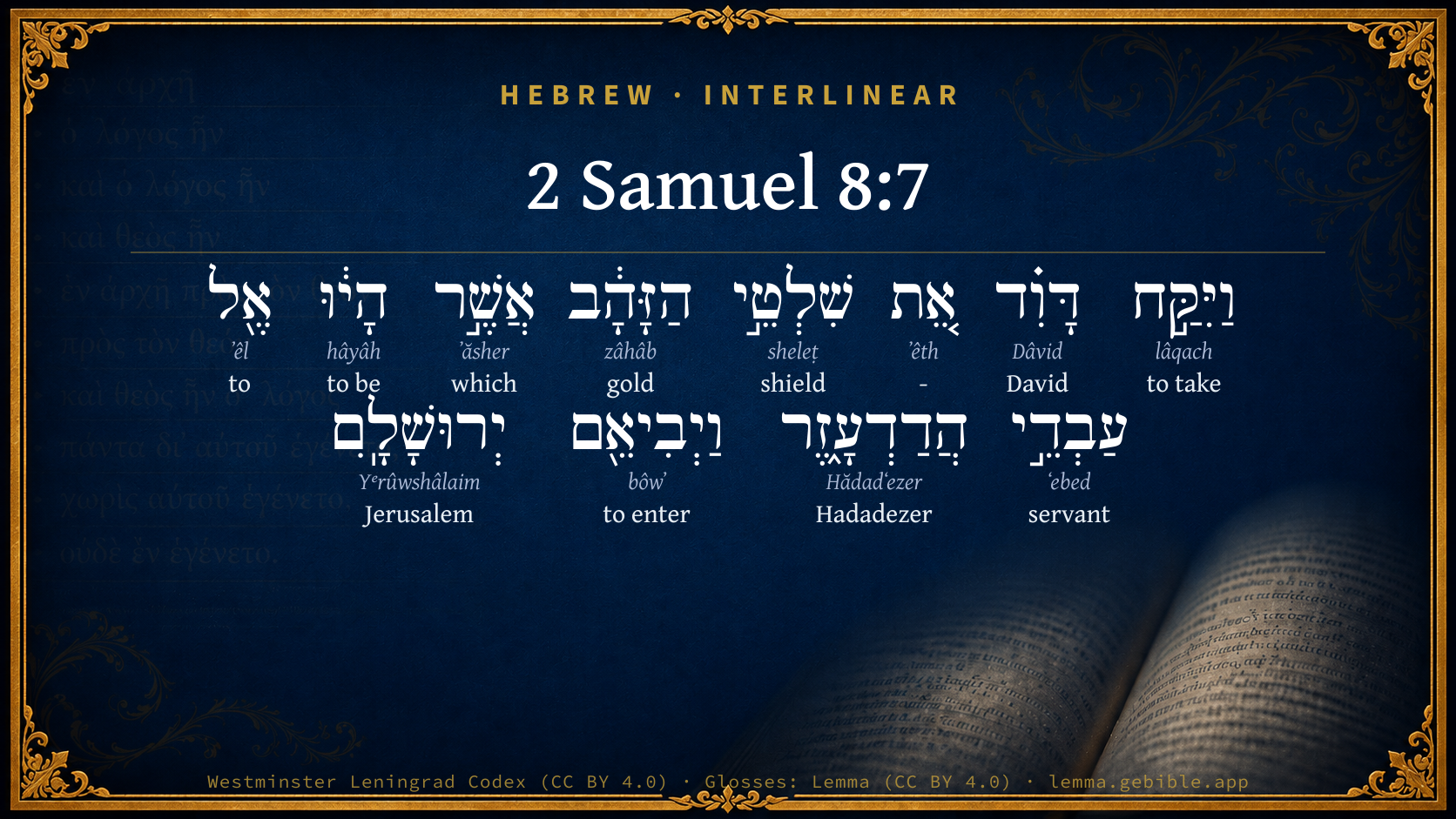
Hebrew (Westminster Leningrad Codex) 2 Samuel 8:7 appears in the Hebrew Old Testament. The text above is from the Westminster Leningrad Codex. Each word links to its Strong’s number, a concise gloss, and parsing drawn from the Open Scriptures Hebrew Bible morphology. Click any word for its full Brown-Driver-Briggs (BDB) entry.
Download image
Cite this verse

2 Samuel 8:7 (World English Bible). Public Domain. Lemma interlinear Bible study tool, https://lemma.gebible.app/v/2-samuel/8/7.

Show BibTeX & RIS
BibTeX
RIS
English Translation
David took the shields of gold that were on the servants of Hadadezer, and brought them to Jerusalem.
World English Bible · Public Domain
Highlights Full analysis ↓
Download a study sheet

One document with this verse’s original text, its word-by-word gloss line, the meaning frame, cross-references with their text, attributed commentary, and full source and license credits — printable, and it pastes into notes with its structure intact.

This verse Autodidact and up

Study sheet (.html) Plain text (.txt)

A passage Seminary Student

Up to 50 verses in one chapter. A passage sheet keeps up to 6 commentary sources and 12 cross-references per verse, in the order this page ranks them, and says so on the sheet whenever that leaves anything out. Ask for a single verse and you get the Autodidact verse sheet above.

Everything on this page stays free to read, with no account — the sheet is a download of what is already on screen, not access to it.

Want to remove ads? Support Godless Engineer
Compare translations 3

The same verse in 3 English versions, stacked beneath the original-language interlinear above. Click any original word for its lexicon entry.

Each is an independent rendering of the whole verse — the interlinear is not word-aligned to these translations.

Highlighted words mark where these versions differ — a whole-verse word diff, not a word-by-word alignment.

  • World English Bible Public Domain
    David took the shields of gold that were on the servants of Hadadezer, and brought them to Jerusalem.
  • King James Version Public Domain
    And David took the shields of gold that were on the servants of Hadadezer, and brought them to Jerusalem.
  • unfoldingWord Literal Text CC BY-SA 4.0
    And David took the shields of gold that were on the servants of Hadadezer, and he brought them Jerusalem.

unfoldingWord Literal Text — © unfoldingWord, licensed CC BY-SA 4.0. Word-aligned USFM3 via Door43 (git.door43.org/unfoldingWord/en_ult).

Versions to compare (up to 4)

3 of 4 selected

Show all 18 translations

Every available English version of this verse, each an independent rendering of the whole verse.

  • World English Bible Public Domain
    David took the shields of gold that were on the servants of Hadadezer, and brought them to Jerusalem.
  • Berean Standard Bible Public Domain
    And David took the gold shields that belonged to the officers of Hadadezer and brought them to Jerusalem.
  • Majority Standard Bible Public Domain
    And David took the gold shields that belonged to the officers of Hadadezer and brought them to Jerusalem.
  • King James Version Public Domain
    And David took the shields of gold that were on the servants of Hadadezer, and brought them to Jerusalem.
  • American Standard Version (1901) Public Domain
    And David took the shields of gold that were on the servants of Hadadezer, and brought them to Jerusalem.
  • Revised Version (1885) Public Domain
    And David took the shields of gold that were on the servants of Hadadezer, and brought them to Jerusalem.
  • Geneva Bible (1599) Public Domain
    And Dauid tooke the shieldes of gold that beloged to the seruants of Hadadezer, and brought them to Ierusalem.
  • Douay-Rheims (1899) Public Domain
    And David took the arms of gold, which the servants of Adarezer wore, and brought them to Jerusalem.
  • Young's Literal Translation Public Domain
    and David taketh the shields of gold which were on the servants of Hadadezer, and bringeth them to Jerusalem;
  • Literal Standard Version CC BY-SA 4.0
    and David takes the shields of gold which were on the servants of Hadadezer, and brings them to Jerusalem;
  • Unlocked Literal Bible CC BY-SA 4.0
    David took the golden shields that were on Hadadezer's servants and brought them to Jerusalem.
  • unfoldingWord Literal Text CC BY-SA 4.0
    And David took the shields of gold that were on the servants of Hadadezer, and he brought them Jerusalem.
  • Darby Bible Public Domain
    And David took the shields of gold that were on the servants of Hadadezer, and brought them to Jerusalem.
  • World Messianic Bible Public Domain
    David took the shields of gold that were on the servants of Hadadezer, and brought them to Jerusalem.
  • Webster's Bible Public Domain
    And David took the shields of gold that were on the servants of Hadadezer, and brought them to Jerusalem.
  • Free Bible Version CC BY-SA 4.0
    David took the shields of gold that belonged to Hadadezer's officers and brought them to Jerusalem.
  • Bible in Basic English Public Domain
    And David took their gold body-covers from the servants of Hadadezer and took them to Jerusalem.
  • JPS Tanakh (1917) Public Domain
    And David took the shields of gold that were on the servants of Hadadezer, and brought them to Jerusalem.

Literal Standard Version (2020), Covenant Press — licensed CC BY-SA 4.0. Text via the HelloAO Bible API (eBible.org). Unlocked Literal Bible (unfoldingWord) — licensed CC BY-SA 4.0. Text via the HelloAO Bible API (eBible.org). unfoldingWord Literal Text — © unfoldingWord, licensed CC BY-SA 4.0. Word-aligned USFM3 via Door43 (git.door43.org/unfoldingWord/en_ult). Free Bible Version, Dr. Jonathan Gallagher — licensed CC BY-SA 4.0. Text via the HelloAO Bible API (eBible.org).

Word by word

More ways to search: Search by grammar → Find every occurrence → Compare this word →

Practice this passage: Drill this verse → Learn its vocabulary →

שִׁלְטֵ֣י
sheleṭ
H7982
“shields of”
Noun, Common, Masculine, Plural, Construct
Part of Speech
Noun
Type
Common
Gender
Masculine
Number
Plural
State
Construct
Full BDB Definition

Origin: from H7980

TWOT: 2397a

shield
  1. וַיִּקַּ֣ח lâqach H3947 “and · to take” Conjunction + Verb, Qal, Sequential Imperfect, 3rd Person, Masculine, Singular
  2. דָּוִ֗ד Dâvid H1732 “David” Noun, Proper
  3. אֵ֚ת ʼêth H853 “-” Particle, Direct Object
  4. הַזָּהָ֔ב zâhâb H2091 “the · gold” Particle, Definite Article + Noun, Common, Masculine, Singular, Absolute
  5. אֲשֶׁ֣ר ʼăsher H834 “which” Particle, Relative
  6. הָי֔וּ hâyâh H1961 “to be” Verb, Qal, Perfect, 3rd Person, Common, Plural
  7. אֶ֖ל ʼêl H413 “to” Preposition
  8. עַבְדֵ֣י ʻebed H5650 “servants of” Noun, Common, Masculine, Plural, Construct
  9. הֲדַדְעָ֑זֶר Hădadʻezer H1909 “Hadadezer” Noun, Proper
  10. וַיְבִיאֵ֖ם bôwʼ H935 “and · to enter · them” Conjunction + Verb, Hiphil, Sequential Imperfect, 3rd Person, Masculine, Singular + Suffix, Personal, 3rd Person, Masculine, Plural
  11. יְרוּשָׁלִָֽם Yᵉrûwshâlaim H3389 “Jerusalem” Noun, Proper

About this verse

These counts appear in no published source. They are computed here, from the morphology-tagged text and Lemma’s own curated glosses. What Lemma adds →

12
words
12
distinct lemmas
Historical
section

Notable vocabulary

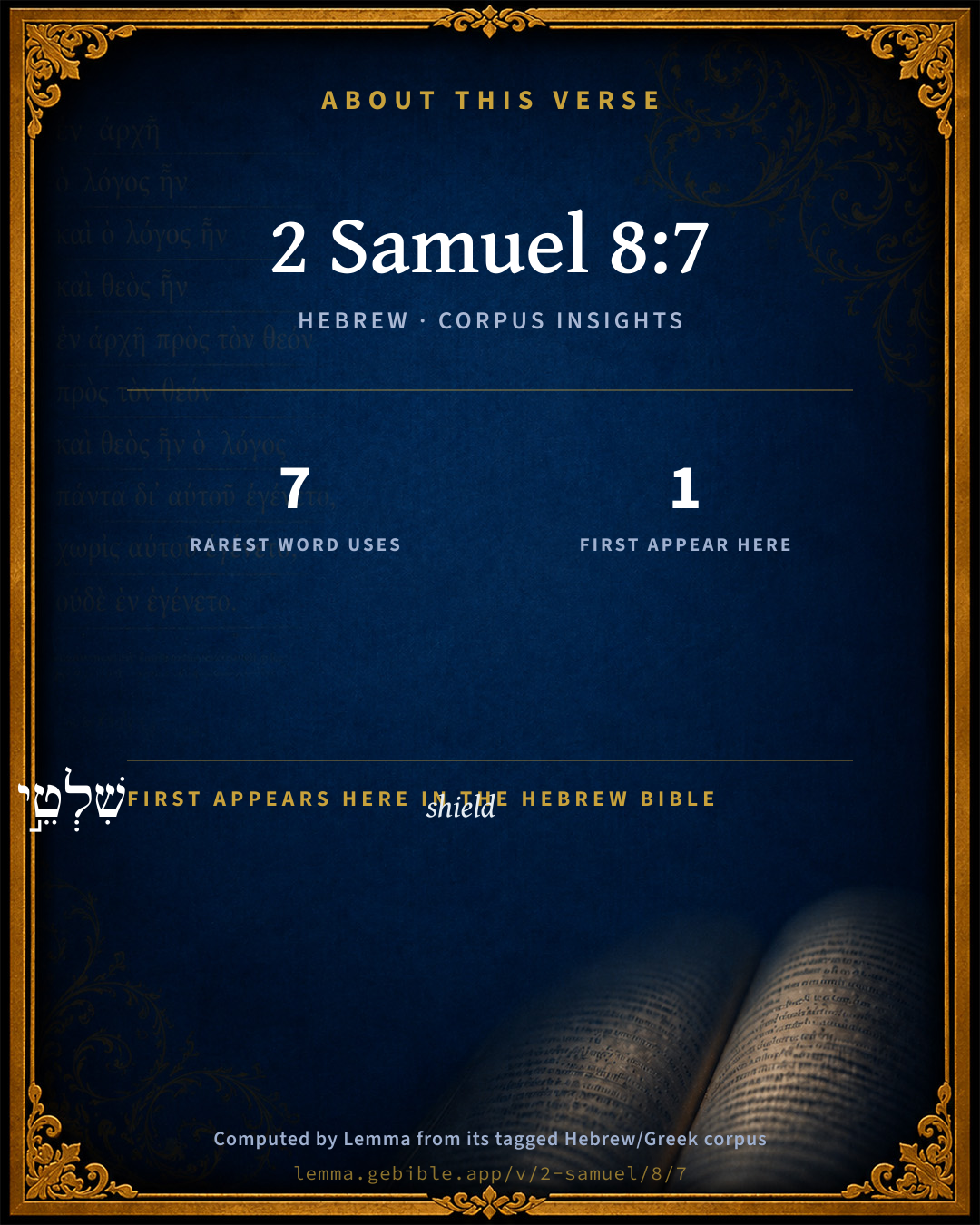
The rarest word here is שִׁלְטֵ֣י shield H7982 — appearing just 7 times in the whole Hebrew Bible.

First appearance in Scripture

This word makes its first canonical appearance in the Hebrew Bible here:

  • שִׁלְטֵ֣י shield H7982

Shared distinctive vocabulary

שִׁלְטֵ֣י shield H7982 occurs in 7 verses of the Hebrew Bible. Also found in:

Grammatical profile

  • 3 verbs
  • 6 nouns
  • 1 preposition
  • 2 particles

Verb forms

  • וַיִּקַּ֣ח Qal · Sequential Imperfect
  • הָי֔וּ Qal · Perfect
  • וַיְבִיאֵ֖ם Hiphil · Sequential Imperfect

Hebrew & Septuagint length

In English translation the verse runs 18 words from the Hebrew and 42 from the Septuagint (LXX English) — the Septuagint runs noticeably longer here. See the side-by-side →

A rough comparison of the two English renderings, which tokenize alike — not a word-level alignment.

Word counts can differ between the Hebrew and the Greek without any difference in meaning — e.g. the Hebrew direct-object marker אֵת has no separate Greek word, and Greek often adds the article ὁ.

Cross-references

4

Topical passages linked to 2 Samuel 8:7 in the Treasury of Scripture Knowledge — connected by theme and wording, ordered by reader-vote popularity; previews shown in the World English Bible.

  • 1 Kings 10:16–17 King Solomon made two hundred bucklers of beaten gold; six hundred [shekels] of gold went to one buckler.
  • 1 Kings 14:26–27 and he took away the treasures of the house of Yahweh, and the treasures of the king's house; he even took away all: and he took away all the shields of gold which Solomon had made.
  • 1 Chronicles 18:7 David took the shields of gold that were on the servants of Hadarezer, and brought them to Jerusalem.
  • 2 Chronicles 9:15–16 King Solomon made two hundred bucklers of beaten gold; six hundred [shekels] of beaten gold went to one buckler.

Cross-references courtesy of OpenBible.info (CC BY 4.0).

Hebrew and Greek witnesses Masoretic Hebrew ↔ Greek Septuagint

The same verse in the two great witnesses to the Old Testament, shown verse-for-verse.

Here the Septuagint runs noticeably longer than the Hebrew — LXX2012 (modern English Septuagint) 42 words vs World English Bible 18. A rough length comparison of the two English translations, not a word-level alignment — read both below.

These are two independent witnesses, not word-aligned to each other, and the Septuagint is shown in lemma (dictionary) form.

Hebrew 2 Samuel 8:7 Masoretic · Westminster Leningrad Codex

וַיִּקַּ֣ח דָּוִ֗ד אֵ֚ת שִׁלְטֵ֣י הַזָּהָ֔ב אֲשֶׁ֣ר הָי֔וּ אֶ֖ל עַבְדֵ֣י הֲדַדְעָ֑זֶר וַיְבִיאֵ֖ם יְרוּשָׁלִָֽם

David took the shields of gold that were on the servants of Hadadezer, and brought them to Jerusalem.

World English Bible · Public Domain

Greek LXX 2 Samuel 8:7 Septuagint · lemma form

καί λαμβάνω δαυίδ ὁ χλίδων ὁ χρυσοῦς ὅς εἰμί ἐπί ὁ παῖς ὁ αδρααζαρ βασιλεύς σουβα καί φέρω αὐτός εἰς ἰερουσαλήμ καί λαμβάνω αὐτός σουσακιμ βασιλεύς αἴγυπτος ἐν ὁ ἀναβαίνω αὐτός εἰς ἰερουσαλήμ ἐν ἡμέρα ροβοαμ υἱός σολομών

And David took the golden bracelets which were on the servants of Adraazar king of Suba, and brought them to Jerusalem. And Susakim king of Egypt took them, when he went up to Jerusalem in the days of Roboam son of Solomon.

LXX2012 (modern English Septuagint) · Public Domain

On this verse, Ellicott's Commentary for English Readers discusses the Septuagint’s reading. Read the note in Commentary ↓

Hebrew: Westminster Leningrad Codex (CC BY 4.0). Greek: Septuagint (public domain); English from LXX2012 (modern English Septuagint) (Public Domain). How the Septuagint differs from the Hebrew →

Targum (Aramaic paraphrase)

1

The Targum is the ancient Jewish Aramaic paraphrase of the Hebrew Scriptures — an interpretive translation, not the Hebrew text itself. Onkelos (literal) and Pseudo-Jonathan (expansive) render the Torah, and Jonathan the Prophets. Coverage is partial: where no permissively-licensed English translation exists for a verse, only the Aramaic is shown. This is verse-level text, not a word-by-word alignment to the Hebrew.

  1. Targum Jonathan Prophets (Joshua–Malachi)
    וּנְסִיב דָוִד יַת שִׁלְטֵי דְדַהֲבָא דַהֲווֹ עַל עַבְדֵי הֲדַדְעֶזֶר וְאַיְתִינוּן לִירוּשְׁלֵם:

    (no public-domain English translation for this verse)

    Targum Jonathan — Aramaic: “Mikraot Gedolot” (public domain). English: “Sefaria Community Translation” (CC0 1.0 (public-domain dedication)); “London "Chaldee Paraphrase," 1871” (public domain). Text via Sefaria.

Commentary

Notes on 2 Samuel 8:7 from classic Christian and Jewish commentators (each source and its license shown beneath its notes). The classic Christian expositions comment on the surrounding passage and are grouped to its opening verse, so a note may address several verses; the Jewish commentaries on the Tanakh (Rashi and others) are per-verse, so they appear only where the commentator wrote on this verse.

Lemma curates 59 commentaries, every one of them public domain or Creative Commons licensed, each selected and text-cleaned for this edition rather than reprinted as found. About our sources →

Trapp's Complete Commentary

John Trapp

2Sa 8:7 And David took the shields of gold that were on the servants of Hadadezer, and brought them to Jerusalem.

Ver. 7. And David took the shields of gold.] As Alexander had his Argyraspides, {a} so Hadadezer his Chrysaspides; as if they had been masters of those two islands in India, called Chryse and Argyre, for the plenty of gold and silver there.

{a} Polyhist., cap. 65.

John Trapp, A Commentary or Exposition upon All the Books of the Old and New Testament (1647–1656) — public domain. Text from a community e-Sword module.

Joseph Benson's Commentary

2Sa 8:7. The shields of gold that were on the servants of Hadadezer — It hath been the practice of many princes to make the arms of their soldiers ornamental and precious, partly from the love of splendour and magnificence, and partly to influence the courage of those, that carried them: since nothing else could secure them from becoming a property and a prey to the enemy. Some think, however, the meaning here is, Which were with the servants; that is, committed to their custody, as being kept in the king’s armory; for it is not probable, they think, that they carried shields of gold into the field.

Joseph Benson's Commentary on the Old and New Testaments (1811–1818) — public domain. Text from a community e-Sword module.

Tyndale Open Study Notes

Tyndale Open Resources

8:7 gold shields: See also 2 Kgs 11:10. • brought . . . to Jerusalem: In conformity with God’s stipulations for a good king (Deut 17:17), David dedicated these valuable items to God (see 2 Sam 8:11) rather than hoarding them for his own wealth and splendor.

Tyndale Open Study Notes — © Tyndale Open Resources, licensed CC BY-SA 4.0. Text via the HelloAO Bible API.

Geneva Bible (1599)

Geneva Bible translators

For the use of the Temple.

Geneva Bible (1599) marginal notes — public domain. Text via Bolls.life.

Adam Clarke's Commentary

Verse 7. David took the shields of gold] We know not what these were. Some translate arms, others quivers, others bracelets, others collars, and others shields. They were probably costly ornaments by which the Syrian soldiers were decked and distinguished. And those who are called servants here, were probably the choice troops or body-guard of Hadadezer, as the argyraspides were of Alexander the Great. See Quintus Curtius.

Adam Clarke's Commentary on the Bible (1810–1826) — public domain. Text from a community e-Sword/MySword module.

Ellicott's Commentary for English Readers

(7) Shields of gold.—Solomon also “made shields of gold” (1Ki_10:17), which appear to have been a mark of oriental magnificence. Solomon’s shields were ultimately carried off by Shishak (1Ki_14:25-28). The LXX. has here a curious addition, saying that Shishak carried off the shields which David captured, a manifest error, since those were made by Solomon.

A Bible Commentary for English Readers, edited by Charles John Ellicott (1878–1897) — public domain. Text from a community e-Sword module.

The Cambridge Bible for Schools and Colleges

gen. ed. J. J. S. Perowne

7. that were on the servants of Hadadezer] Or, that belonged to, &c. Probably it was his bodyguard which was distinguished by these golden shields. Similarly a corps of the Macedonian army under Alexander the Great was known as “the silver-shields” (ἀργυράσπιδες).

The Septuagint adds at the end of the verse: “And Susakim [i.e. Shishak] king of Egypt took them, when he went up to Jerusalem in the days of Roboam the son of Solomon.” In 1Ki_14:26 there is a corresponding addition in the Sept.: “And the golden spears which David took from the hand of the servants of Adraazar king of Soba and carried to Jerusalem, he took them all.”

The Cambridge Bible for Schools and Colleges (gen. ed. J. J. S. Perowne; Cambridge University Press, 1878–1918) — public domain. Text from a community e-Sword module.

John Gill's Exposition

And David took the shields of gold that were on the servants of Hadadezer,.... That were found with them, which they had in their hands; these must be supposed to be with the principal officers of his army; or golden chains, as Aquila, or golden bracelets on their arms, as the Septuagint; the Syriac version is "quivers of gold", such as they put arrows into, and so Jarchi and R. Isaiah understand it of such, and refer to Jer 51:11; and so Josephus (r):

and brought them to Jerusalem; where they were laid up, and converted to the use of the sanctuary Solomon built; see Sol 4:4.

(r) Ut supra, (Antiqu. l. 7. c. 5.) sect. 3.

John Gill's Exposition of the Whole Bible (1746–1763) — public domain (CC PDM 1.0). Text via the HelloAO Bible API.

Haydock's Catholic Bible Commentary

Arms. "Quivers," Paralipomenon and Syriac. "Bucklers," Hebrew and Chaldean. "Bracelets," Septuagint. (Calmet) --- These bucklers might be for ornament, like those of Solomon, 3 Kings x. 16. (Salien) --- They were taken afterwards by Sesac, king of Egypt. (Josephus, [Antiquities?] vii. 6.) (Haydock)

George Leo Haydock (1774–1849), Haydock's Catholic Family Bible and Commentary, 1859 edition — public domain. Excludes Psalms (Douay-Rheims chapter numbering differs from Protestant) and Deuterocanonical books (Catholic canon only).

Matthew Poole's English Annotations

That were on the servants, or rather, which were with the servants, i.e. committed to their custody, as being kept in the king’s armory; for it is not probable they carried them into the field.

Matthew Poole's English Annotations on the Holy Bible (1683–1685) — public domain. Text from a community e-Sword/MySword module.

Whedon's Commentary on the Bible

Daniel D. Whedon

7. Shields of gold — Golden plated shields; an evidence of the wealth of the kingdom of Zobah.

Daniel D. Whedon (gen. ed.), Commentary on the Old and New Testaments (1874–1909) — public domain. Text from a community e-Sword module.

The Pulpit Commentary

Shields of gold. Probably they were plated with gold, and were borne by Hadarezer"s bodyguard. But it is very uncertain whether shields are really meant. The word in Syriac means "quivers." Jerome evidently could not at first find out what it signified, as he in this place translates in the Vulgate "arms," but subsequently he became better, informed. The LXX renders "bracelets," and adds that they were carried away from Jerusalem by Shishak in the days of Rehoboam. There is no contradiction in this with what is said in 1Ki_14:26, as what Solomon made were undoubtedly shields, such being the certain meaning of the word in the Hebrew, and its rendering in all the versions. No version renders the word used here "shield." In the parallel place (1Ch_18:7) the Syriac and Vulgate render it "quivers," the LXX "collars," and the Arabic "plates of gold hung on the trappings of the horses." As they were captured from a Syrian king, they probably retained their Syriac name, and if so they were "quivers."

The Pulpit Commentary (1880–1919), ed. H.D.M. Spence-Jones & Joseph S. Exell — public domain. Text from a community e-Sword module.

John Wesley's Explanatory Notes

On the servants - Or rather, which were with the servants, that is, committed to their custody, as being kept in the king's armoury: for it is not probable they carried them into the field.

John Wesley, Explanatory Notes Upon the Whole Bible (1754–1765) — public domain. Text via the GEBible commentary corpus.

Keil & Delitzsch

C. F. Keil & F. Delitzsch

Of the booty taken in these wars, David carried the golden shields which he took from the servants, i.e., the governors and vassal princes, of Hadadezer, to Jerusalem.

(Note: The lxx has this additional clause: "And Shishak the king of Egypt took them away, when he went up against Jerusalem in the days of Rehoboam the son of Solomon," which is neither to be found in the Chronicles nor in any other ancient version, and is merely an inference drawn by the Greek translator, or by some copyists of the lxx, from Kg1 14:25-28, taken in connection with the fact that the application of the brass is given in Ch1 18:8. But, in the first place, the author of this gloss has overlooked the fact that the golden shields of Rehoboam which Shishak carried away, were not those captured by David, but those which Solomon had had made, according to Kg1 10:16, for the retainers of his palace; and in the second place, he has not observed that, according to Sa2 8:11 of this chapter, and also of the Chronicles, David dedicated to the Lord all the gold and silver that he had taken, i.e., put it in the treasury of the sanctuary to be reserved for the future temple, and that at the end of his reign he handed over to his son and successor Solomon all the gold, silver, iron, and brass that he had collected for the purpose, to be applied to the building of the temple (Ch1 22:14., Ch1 29:2.). Consequently the clause in question, which Thenius would adopt from the lxx into our own text, is nothing more than the production of a presumptuous Alexandrian, whose error lies upon the very surface, so that the question of its genuineness cannot for a moment be entertained.)

Shelet signifies "a shield," according to the Targums and Rabbins, and this meaning is applicable to all the passages in which the word occurs; whilst the meaning "equivalent" cannot be sustained either by the rendering πανοπλία adopted by Aquila and Symmachus in Kg2 11:10, or by the renderings of the Vulgate, viz., arma in loc. and armatura in Sol 4:4, or by an appeal to the etymology (vid., Gesenius' Thes. and Dietrich's Lexicon).

Keil & Delitzsch — Biblical Commentary on the Old Testament (1861–1891) — public domain (CC PDM 1.0). Text via the HelloAO Bible API. (Old Testament only.)

unfoldingWord translationNotes

Door43 World Missions Community

David took ... King David took

Here David represents his soldiers. AT: "David's soldiers took ... King David's soldiers took" (See: Metonymy)

Tebah and Berothai

These are the names of places. (See: How to Translate Names)

translationWords

gold

shield

servant

Jerusalem

bronze

unfoldingWord translationNotes — © Distant Shores Media and the Door43 World Missions Community, licensed CC BY-SA 4.0. Source: git.door43.org/Door43/en_tn.

Rashi

Rabbi Shlomo Yitzchaki (Rashi)

The golden quivers. They are the quivers in which the arrows are put as you say, (Yirmeyah 51:11). "clean out the arrows, till the quivers." All these chapters have been set near the chapter concerning the Beis Hamikdash because from all these wars [Dovid] gathered consecrated items for the needs of the House [i.e., Beis Hamikdash].

Rashi on the Tanakh — English translations: “The Judaica Press complete Tanach with Rashi, translated by A. J. Rosenberg” (CC BY 4.0); “Pentateuch with Rashi's commentary by M. Rosenbaum and A.M. Silbermann, 1929-1934” (public domain); “The Metsudah Tanach series, Lakewood, N.J” (CC BY 4.0); and “The Book of Joshua, Metsudah Publications, 1997” (CC BY 4.0). Text via Sefaria.

Lesson kit

Teaching starters — assembled from the data on this page, not authored interpretation. Every prompt links to the verse data it draws on. Edit before teaching.

2 Samuel, in the Historical, opens this verse with 12 words (12 distinct Hebrew lemmas). Its most distinctive word is sheleṭ (“shield”). The Greek Septuagint runs longer here. A historical commentator’s framing appears above. Read the whole chapter for the surrounding context.

Discussion questions

  1. The word sheleṭ carries the sense “shield.” How does it shape the verse?
  2. The word “shield” first appears here in Scripture. What is being introduced at this debut?
  3. 2 Kings 11:10 shares the word «shield» with this verse. How do the two illuminate each other?
  4. Compared with the Hebrew, the Septuagint runs longer here. What questions does that raise?
  5. The verb «וַיִּקַּ֣ח» is Qal Sequential Imperfect. How does its form color the action?
  6. Reading how Trapp's Complete Commentary and Joseph Benson's Commentary read this verse, where do the two commentators agree and where do they part?

Things to notice

Reading settings

Reading text

Shown beneath each verse's original-language words.

Old Testament
Old Testament edition

Read the OT as the Masoretic Hebrew (MT) or the Greek Septuagint (LXX).

English shown for the Greek Septuagint (in the Hebrew ↔ Greek comparison).

Comparing translations? Open the Compare panel on any verse page to stack up to four side by side.