
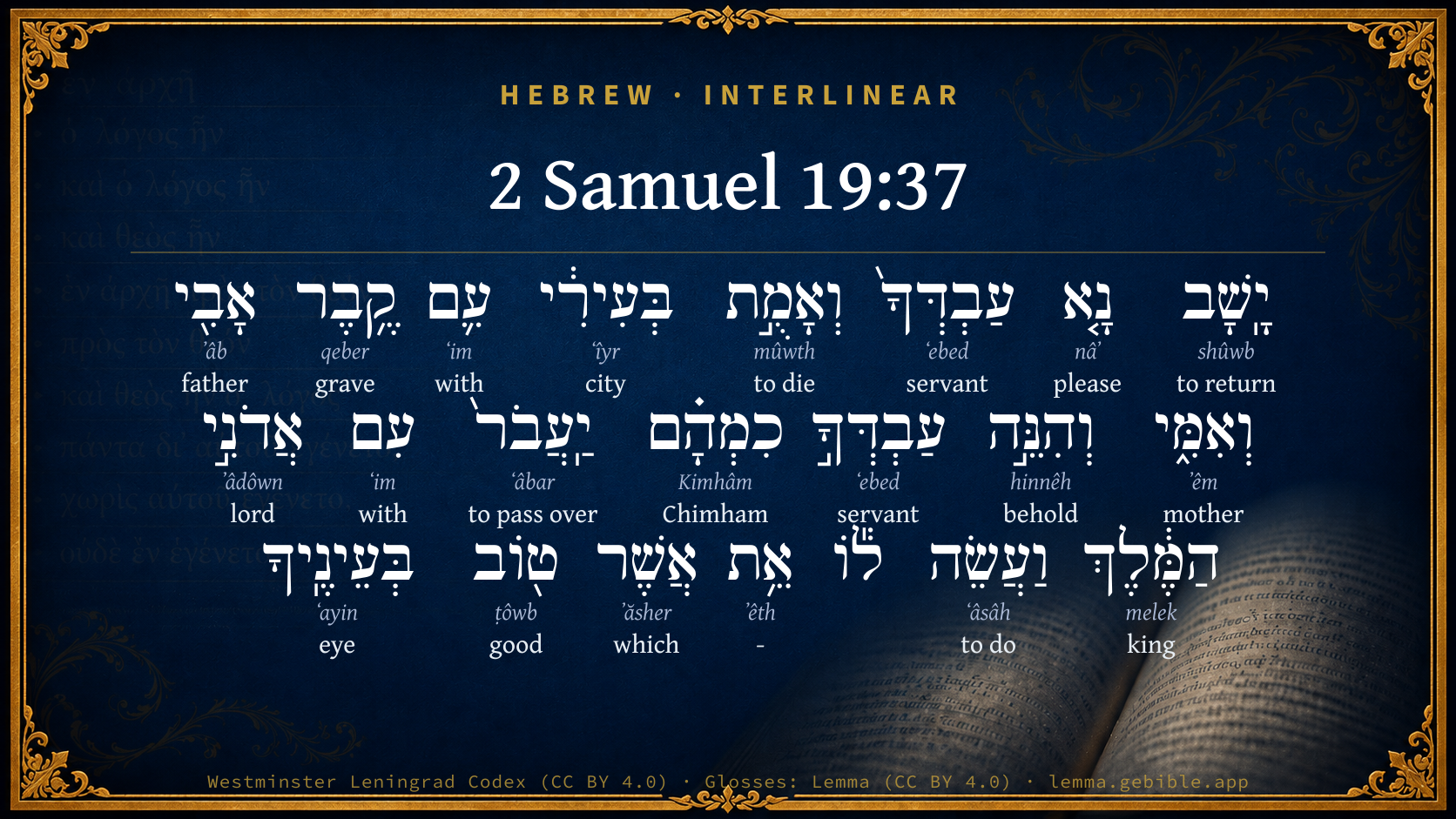
2 Samuel 19:37

Hebrew (Westminster Leningrad Codex) 2 Samuel 19:37 appears in the Hebrew Old Testament. The text above is from the Westminster Leningrad Codex. Each word links to its Strong’s number, a concise gloss, and parsing drawn from the Open Scriptures Hebrew Bible morphology. Click any word for its full Brown-Driver-Briggs (BDB) entry.
Download image
Cite this verse

2 Samuel 19:37 (World English Bible). Public Domain. Lemma interlinear Bible study tool, https://lemma.gebible.app/v/2-samuel/19/37.

Show BibTeX & RIS
BibTeX
RIS
English Translation
Please let your servant turn back again, that I may die in my own city, by the grave of my father and my mother. But behold, your servant Chimham; let him go over with my lord the king; and do to him what shall seem good to you.
World English Bible · Public Domain
Highlights
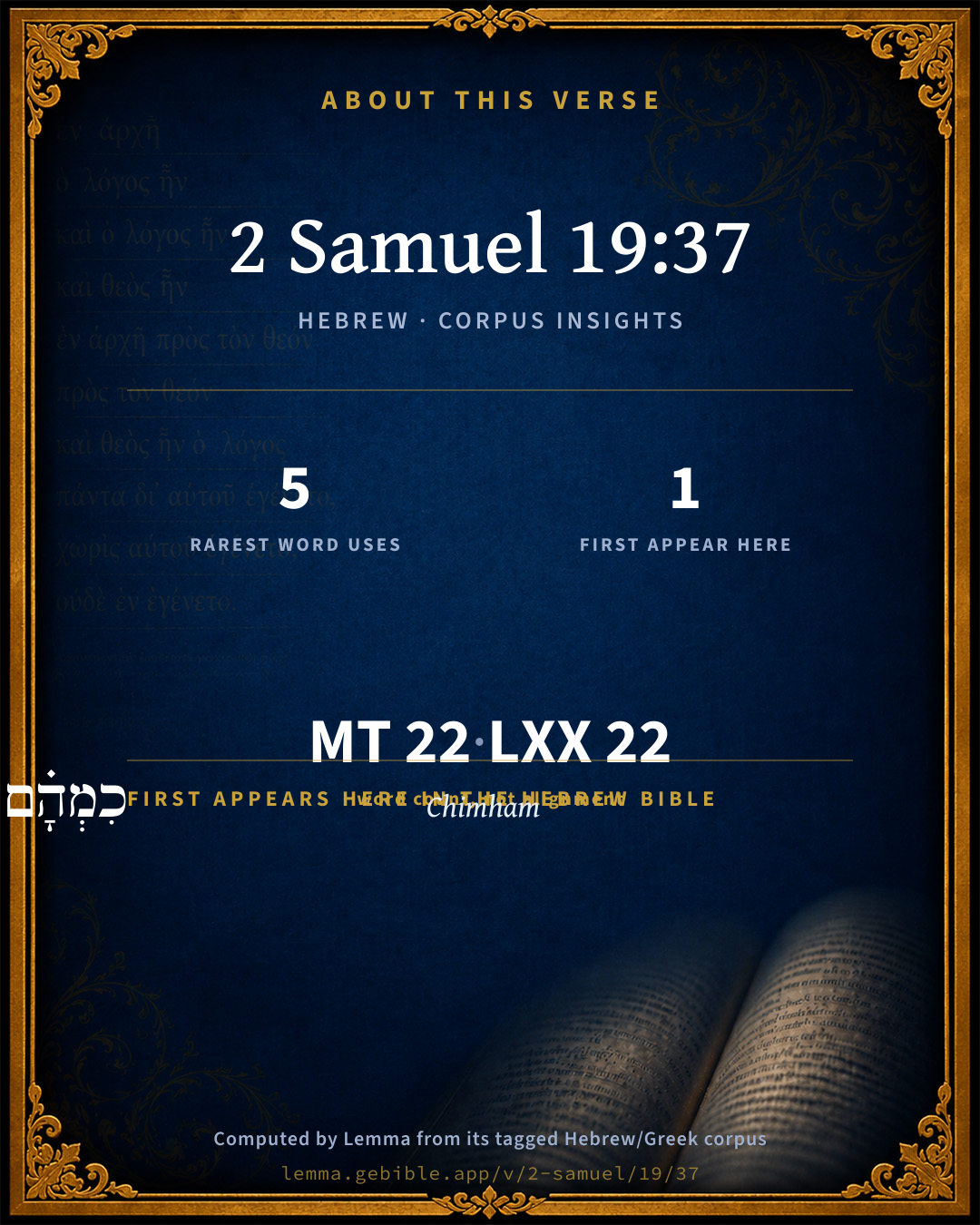
  • 1 first appearance in the Hebrew Bible
Full analysis ↓
Download a study sheet

One document with this verse’s original text, its word-by-word gloss line, the meaning frame, cross-references with their text, attributed commentary, and full source and license credits — printable, and it pastes into notes with its structure intact.

This verse Autodidact and up

Study sheet (.html) Plain text (.txt)

A passage Seminary Student

Up to 50 verses in one chapter. A passage sheet keeps up to 6 commentary sources and 12 cross-references per verse, in the order this page ranks them, and says so on the sheet whenever that leaves anything out. Ask for a single verse and you get the Autodidact verse sheet above.

Everything on this page stays free to read, with no account — the sheet is a download of what is already on screen, not access to it.

Want to remove ads? Support Godless Engineer
Compare translations 3

The same verse in 3 English versions, stacked beneath the original-language interlinear above. Click any original word for its lexicon entry.

Each is an independent rendering of the whole verse — the interlinear is not word-aligned to these translations.

Highlighted words mark where these versions differ — a whole-verse word diff, not a word-by-word alignment.

  • World English Bible Public Domain
    Please let your servant turn back again, that I may die in my own city, by the grave of my father and my mother. But behold, your servant Chimham; let him go over with my lord the king; and do to him what shall seem good to you.
  • King James Version Public Domain
    Let thy servant, I pray thee, turn back again, that I may die in mine own city, and be buried by the grave of my father and of my mother. But behold thy servant Chimham; let him go over with my lord the king; and do to him what shall seem good unto thee.
  • unfoldingWord Literal Text CC BY-SA 4.0
    Please let your servant return, and let me die in my city by the grave of my father and my mother. But behold your servant Chimham. Let him cross over with my lord the king, and do for him what good in your eyes.”

unfoldingWord Literal Text — © unfoldingWord, licensed CC BY-SA 4.0. Word-aligned USFM3 via Door43 (git.door43.org/unfoldingWord/en_ult).

Versions to compare (up to 4)

3 of 4 selected

Show all 18 translations

Every available English version of this verse, each an independent rendering of the whole verse.

  • World English Bible Public Domain
    Please let your servant turn back again, that I may die in my own city, by the grave of my father and my mother. But behold, your servant Chimham; let him go over with my lord the king; and do to him what shall seem good to you.
  • Berean Standard Bible Public Domain
    Please let your servant return, that I may die in my own city near the tomb of my father and mother. But here is your servant Chimham. Let him cross over with my lord the king, and do for him what is good in your sight.”
  • Majority Standard Bible Public Domain
    Please let your servant return, that I may die in my own city near the tomb of my father and mother. But here is your servant Chimham. Let him cross over with my lord the king, and do for him what is good in your sight.”
  • King James Version Public Domain
    Let thy servant, I pray thee, turn back again, that I may die in mine own city, and be buried by the grave of my father and of my mother. But behold thy servant Chimham; let him go over with my lord the king; and do to him what shall seem good unto thee.
  • American Standard Version (1901) Public Domain
    Let thy servant, I pray thee, turn back again, that I may die in mine own city, by the grave of my father and my mother. But behold, thy servant Chimham; let him go over with my lord the king; and do to him what shall seem good unto thee.
  • Revised Version (1885) Public Domain
    Let thy servant, I pray thee, turn back again, that I may die in mine own city, by the grave of my father and my mother. But behold, thy servant Chimham; let him go over with my lord the king; and do to him what shall seem good unto thee.
  • Geneva Bible (1599) Public Domain
    I pray thee, let thy seruant turne backe againe, that I may die in mine owne citie, and be buryed in the graue of my father and of my mother: but beholde thy seruant Chimham, let him goe with my lorde the king, and doe to him what shall please thee.
  • Douay-Rheims (1899) Public Domain
    But I beseech thee let thy servant return, and die in my own city, and be buried by the sepulchre of my father, and of my mother. But there is thy servant Chamaam, let him go with thee, my lord, the king, and do to him whatsoever seemeth good to thee.
  • Young's Literal Translation Public Domain
    Let, I pray thee, thy servant turn back again, and I die in mine own city, near the burying-place of my father and of my mother, -- and lo, thy servant Chimham, let him pass over with my lord the king, and do thou to him that which `is' good in thine eyes.'
  • Literal Standard Version CC BY-SA 4.0
    Please let your servant turn back again, and I die in my own city, near the burying-place of my father and of my mother—and behold, your servant Chimham, let him pass over with my lord the king, and do to him that which [is] good in your eyes.”
  • Unlocked Literal Bible CC BY-SA 4.0
    Please let your servant return back home, so I may die in my own city by the grave of my father and my mother. But see, here is your servant Kimham. Let him cross over with my master the king, and do for him what seems good to you.”
  • unfoldingWord Literal Text CC BY-SA 4.0
    Please let your servant return, and let me die in my city by the grave of my father and my mother. But behold your servant Chimham. Let him cross over with my lord the king, and do for him what good in your eyes.”
  • Darby Bible Public Domain
    Let thy servant, I pray thee, turn back again, that I may die in mine own city, by the grave of my father and of my mother. But behold thy servant Chimham: let him go over with my lord the king; and do to him what seems good to thee.
  • World Messianic Bible Public Domain
    Please let your servant turn back again, that I may die in my own city, by the grave of my father and my mother. But behold, your servant Chimham; let him go over with my lord the king; and do to him what shall seem good to you.”
  • Webster's Bible Public Domain
    Let thy servant, I pray thee, return again, that I may die in my own city, and be buried by the grave of my father and of my mother. But behold thy servant Chimham; let him go over with my lord the king; and do to him what shall seem good to thee.
  • Free Bible Version CC BY-SA 4.0
    Then let your servant go back home, that I may die in my home town near the tomb of my father and mother. But here is your servant, my son Chimham. Let him cross over with Your Majesty, and treat him as you think best.”
  • Bible in Basic English Public Domain
    Let your servant now go back again, so that when death comes to me, it may be in my town and by the resting-place of my father and mother. But here is your servant Chimham: let him go with my lord the king, and do for him what seems good to you.
  • JPS Tanakh (1917) Public Domain
    (19-38) Let thy servant, I pray thee, turn back, that I may die in mine own city, by the grave of my father and my mother. But behold thy servant Chimham; let him go over with my lord the king; and do to him what shall seem good unto thee.'

Literal Standard Version (2020), Covenant Press — licensed CC BY-SA 4.0. Text via the HelloAO Bible API (eBible.org). Unlocked Literal Bible (unfoldingWord) — licensed CC BY-SA 4.0. Text via the HelloAO Bible API (eBible.org). unfoldingWord Literal Text — © unfoldingWord, licensed CC BY-SA 4.0. Word-aligned USFM3 via Door43 (git.door43.org/unfoldingWord/en_ult). Free Bible Version, Dr. Jonathan Gallagher — licensed CC BY-SA 4.0. Text via the HelloAO Bible API (eBible.org).

Word by word

More ways to search: Search by grammar → Find every occurrence → Compare this word →

Practice this passage: Drill this verse → Learn its vocabulary →

כִמְהָ֗ם
Kimhâm
H3643
“Chimham”
Noun, Proper
Part of Speech
Noun
Type
Proper
Full BDB Definition

Origin: from H3642

TWOT: None

Chimham = "their longing" - a follower and probably a son of Barzillai the Gileadite who returned from beyond Jordan with David; apparently David bestowed on him a possession in Bethlehem on which in later times an inn was standing (noun proper masculine) - apparently the inn in Bethlehem located on the possession given by David to Chimham the follower or son of Barzillai the Gileadite (noun proper locative)
  1. יָֽשָׁב shûwb H7725 “to return” Verb, Qal, Jussive, 3rd Person, Masculine, Singular
  2. נָ֤א nâʼ H4994 “please” Particle, Exhortation
  3. עַבְדְּךָ֙ ʻebed H5650 “servant · your” Noun, Common, Masculine, Singular, Construct + Suffix, Personal, 2nd Person, Masculine, Singular
  4. וְאָמֻ֣ת mûwth H4191 “and · to die” Conjunction + Verb, Qal, Imperfect, 1st Person, Common, Singular
  5. בְּעִירִ֔י ʻîyr H5892 “in/at · city · my” Preposition + Noun, Common, Feminine, Singular, Construct + Suffix, Personal, 1st Person, Common, Singular
  6. עִ֛ם ʻim H5973 “with” Preposition
  7. קֶ֥בֶר qeber H6913 “grave of” Noun, Common, Masculine, Singular, Construct
  8. אָבִ֖י ʼâb H1 “father · my” Noun, Common, Masculine, Singular, Construct + Suffix, Personal, 1st Person, Common, Singular
  9. וְאִמִּ֑י ʼêm H517 “and · mother · my” Conjunction + Noun, Common, Feminine, Singular, Construct + Suffix, Personal, 1st Person, Common, Singular
  10. וְהִנֵּ֣ה hinnêh H2009 “and · behold” Conjunction + Particle, Demonstrative
  11. עַבְדְּךָ֣ ʻebed H5650 “servant · your” Noun, Common, Masculine, Singular, Construct + Suffix, Personal, 2nd Person, Masculine, Singular
  12. יַֽעֲבֹר֙ ʻâbar H5674 “to pass over” Verb, Qal, Jussive, 3rd Person, Masculine, Singular
  13. עִם ʻim H5973 “with” Preposition
  14. אֲדֹנִ֣י ʼâdôwn H113 “lord · my” Noun, Common, Masculine, Singular, Construct + Suffix, Personal, 1st Person, Common, Singular
  15. הַמֶּ֔לֶךְ melek H4428 “the · king” Particle, Definite Article + Noun, Common, Masculine, Singular, Absolute
  16. וַעֲשֵׂה ʻâsâh H6213 “and · do” Conjunction + Verb, Qal, Imperative, 2nd Person, Masculine, Singular
  17. אֵ֥ת ʼêth H853 “-” Particle, Direct Object
  18. אֲשֶׁר ʼăsher H834 “which” Particle, Relative
  19. ט֖וֹב ṭôwb H2896 “good” Verb, Qal, Perfect, 3rd Person, Masculine, Singular
  20. בְּעֵינֶֽיךָ ʻayin H5869 “in/at · eyes · your” Preposition + Noun, Common, Both, Dual, Construct + Suffix, Personal, 2nd Person, Masculine, Singular

About this verse

These counts appear in no published source. They are computed here, from the morphology-tagged text and Lemma’s own curated glosses. What Lemma adds →

22
words
19
distinct lemmas
Historical
section

Notable vocabulary

The rarest word here is כִמְהָ֗ם Chimham H3643 — appearing just 5 times in the whole Hebrew Bible.

First appearance in Scripture

This word makes its first canonical appearance in the Hebrew Bible here:

  • כִמְהָ֗ם Chimham H3643

Shared distinctive vocabulary

כִמְהָ֗ם Chimham H3643 occurs in 4 verses of the Hebrew Bible. Also found in:

Grammatical profile

  • 5 verbs
  • 10 nouns
  • 3 prepositions
  • 4 particles

Verb forms

  • יָֽשָׁב Qal · Jussive
  • וְאָמֻ֣ת Qal · Imperfect
  • יַֽעֲבֹר֙ Qal · Jussive
  • וַעֲשֵׂה Qal · Imperative
  • ט֖וֹב Qal · Perfect

Repetition

Words recur within this verse — often emphatic in Hebrew:

  • עַבְדְּךָ֙ servant H5650 ×2
  • עִ֛ם with H5973 ×2

Hebrew & Septuagint length

In English translation the verse runs 48 words from the Hebrew and 49 from the Septuagint (LXX English) — closely comparable.

A rough comparison of the two English renderings, which tokenize alike — not a word-level alignment.

Word counts can differ between the Hebrew and the Greek without any difference in meaning — e.g. the Hebrew direct-object marker אֵת has no separate Greek word, and Greek often adds the article ὁ.

In the original languages it is 22 Hebrew tokens and 22 Greek tokens — but the two are counted differently (Hebrew bundles its prefixes and suffixes into one token; the Greek is in lemma form), so that isn’t a like-for-like length.

Cross-references

12

Topical passages linked to 2 Samuel 19:37 in the Treasury of Scripture Knowledge — connected by theme and wording, ordered by reader-vote popularity; previews shown in the World English Bible.

  • 1 Kings 2:7 But show kindness to the sons of Barzillai the Gileadite, and let them be of those who eat at your table; for so they came to me when I fled from Absalom your brother.
  • Jeremiah 41:17 and they departed, and lived in Geruth Chimham, which is by Bethlehem, to go to enter into Egypt,
  • 2 Samuel 19:40 So the king went over to Gilgal, and Chimham went over with him: and all the people of Judah brought the king over, and also half the people of Israel.
  • Genesis 47:30 but when I sleep with my fathers, you shall carry me out of Egypt, and bury me in their burying place." He said, "I will do as you have said."
  • Genesis 48:21 Israel said to Joseph, "Behold, I am dying, but God will be with you, and bring you again to the land of your fathers.
  • Genesis 49:29–31 He charged them, and said to them, "I am to be gathered to my people. Bury me with my fathers in the cave that is in the field of Ephron the Hittite,
  • Genesis 50:13 for his sons carried him into the land of Canaan, and buried him in the cave of the field of Machpelah, which Abraham bought with the field, for a possession of a burying-place, from Ephron the Hittite, before Mamre.
  • Joshua 23:14 Behold, this day I am going the way of all the earth: and you know in all your hearts and in all your souls, that not one thing has failed of all the good things which Yahweh your God spoke concerning you; all are happen to you, not one thing has failed of it.
  • 1 Kings 13:22 but came back, and have eaten bread and drunk water in the place of which he said to you, Eat no bread, and drink no water; your body shall not come to the tomb of your fathers.
  • Luke 2:29–30 "Now you are releasing your servant, Master, According to your word, in peace;
  • 2 Timothy 4:6 For I am already being offered, and the time of my departure has come.
  • 2 Peter 1:14 knowing that the putting off of my tent comes swiftly, even as our Lord Jesus Christ made clear to me.

Cross-references courtesy of OpenBible.info (CC BY 4.0).

Hebrew and Greek witnesses Masoretic Hebrew ↔ Greek Septuagint

The same verse in the two great witnesses to the Old Testament, shown verse-for-verse.

These are two independent witnesses, not word-aligned to each other, and the Septuagint is shown in lemma (dictionary) form.

Hebrew 2 Samuel 19:37 Masoretic · Westminster Leningrad Codex

יָֽשָׁב נָ֤א עַבְדְּךָ֙ וְאָמֻ֣ת בְּעִירִ֔י עִ֛ם קֶ֥בֶר אָבִ֖י וְאִמִּ֑י וְהִנֵּ֣ה עַבְדְּךָ֣ כִמְהָ֗ם יַֽעֲבֹר֙ עִם אֲדֹנִ֣י הַמֶּ֔לֶךְ וַעֲשֵׂה ל֕וֹ אֵ֥ת אֲשֶׁר ט֖וֹב בְּעֵינֶֽיךָ

Please let your servant turn back again, that I may die in my own city, by the grave of my father and my mother. But behold, your servant Chimham; let him go over with my lord the king; and do to him what shall seem good to you.

World English Bible · Public Domain

Greek LXX 2 Samuel 19:37 Septuagint · lemma form

ὡς βραχύς διαβαίνω ὁ δοῦλος σύ ὁ ἰορδάνης μετά ὁ βασιλεύς καί ἵνα τίς ἀντι ἀποδίδωμι ἐγώ ὁ βασιλεύς ὁ ἀνταπόδοσις οὗτος

Let, I pray you, your servant remain, and I will die in my city, by the tomb of my father and of my mother. And, behold, your servant Chamaam shall go over with my lord the king; and do you to him as it seems good in your eyes.

LXX2012 (modern English Septuagint) · Public Domain

Hebrew: Westminster Leningrad Codex (CC BY 4.0). Greek: Septuagint (public domain); English from LXX2012 (modern English Septuagint) (Public Domain). How the Septuagint differs from the Hebrew →

Targum (Aramaic paraphrase)

1

The Targum is the ancient Jewish Aramaic paraphrase of the Hebrew Scriptures — an interpretive translation, not the Hebrew text itself. Onkelos (literal) and Pseudo-Jonathan (expansive) render the Torah, and Jonathan the Prophets. Coverage is partial: where no permissively-licensed English translation exists for a verse, only the Aramaic is shown. This is verse-level text, not a word-by-word alignment to the Hebrew.

  1. Targum Jonathan Prophets (Joshua–Malachi)
    כִּזְעֵיר יֶעְבַּר עַבְדָךְ יַת יַרְדְנָא עִם מַלְכָּא וּלְמָה יְשַׁלְמִנַנִי מַלְכָּא תַּשְׁלוּמָא הָדָא:

    (no public-domain English translation for this verse)

    Targum Jonathan — Aramaic: “Mikraot Gedolot” (public domain). English: “Sefaria Community Translation” (CC0 1.0 (public-domain dedication)); “London "Chaldee Paraphrase," 1871” (public domain). Text via Sefaria.

Commentary

Notes on 2 Samuel 19:37 from classic Christian and Jewish commentators (each source and its license shown beneath its notes). The classic Christian expositions comment on the surrounding passage and are grouped to its opening verse, so a note may address several verses; the Jewish commentaries on the Tanakh (Rashi and others) are per-verse, so they appear only where the commentator wrote on this verse.

Lemma curates 59 commentaries, every one of them public domain or Creative Commons licensed, each selected and text-cleaned for this edition rather than reprinted as found. About our sources →

Trapp's Complete Commentary

John Trapp

2Sa 19:37 Let thy servant, I pray thee, turn back again, that I may die in mine own city, [and be buried] by the grave of my father and of my mother. But behold thy servant Chimham; let him go over with my lord the king; and do to him what shall seem good unto thee.

Ver. 37. That I may die in mine own city.] Where I may retire and rest me, prepare for death, lay hold on eternal life. This is, or ought to be, the old man’s chief study.

John Trapp, A Commentary or Exposition upon All the Books of the Old and New Testament (1647–1656) — public domain. Text from a community e-Sword module.

The Biblical Illustrator

Joseph S. Exell

2Sa_19:37

Let thy servant, I pray thee, turn back again, that I may die in mine own city.

Dying at home

In our last great trial, in our conflict with the king of terrors, what a consolation to feel that our friends are about us, that we are at home.

1. How much earthly friends may help us in the hour of death.

2. The limitation of this help.

3. The Christians consolation that wherever death may overtake him he will die in the midst of friends. His Elder Brother will be there, and God, his father, and he will be encompassed with a host of heavenly witnesses, friends in Jesus Christ. Through death we will go from our earthly home to our heavenly home. (Homiletic Review.)

Going home to die

When Sir Walter Scott returned from Italy, in sickness and mental affliction, and was approaching his home in Selkirkshire, the old familiar landmarks seemed to recall him to his wonted animation. That is Gala Water! Yonder are the Eildon Hills! was his joyous exclamation. When at last Abbotsford appeared in sight, he became so excited that he desired to be raised up in the carriage that he might look on his beautiful home. Yet he was only going home to die.

Love of home

Sir Walter Scott used to say that he loved the honest grey hills of Scotland as his very life, and that if he did not see the heather once a year be thought he should die.

The Biblical Illustrator, edited by Joseph S. Exell (c. 1880s–1900s) — public domain. Text from a community e-Sword module.

Geneva Bible (1599)

Geneva Bible translators

My son.

Geneva Bible (1599) marginal notes — public domain. Text via Bolls.life.

Jamieson, Fausset & Brown

Robert Jamieson, A. R. Fausset & David Brown

buried by the grave of my father and of my mother--This is an instance of the strong affection of people in the East towards the places of sepulture appropriated to their families.

Jamieson, Fausset & Brown — Commentary Critical and Explanatory on the Whole Bible (1871) — public domain (CC PDM 1.0). Text via the HelloAO Bible API.

Adam Clarke's Commentary

Verse 37. Thy servant Chimham] It is generally understood that this was Barzillai's son; and this is probable from 1Kg 2:7, where, when David was dying, he said, Show kindness to the sons of Barzillai: and it is very probable that this Chimham was one of them. In Jer 41:17 mention is made of the habitation of Chimham, which was near to Bethlehem; and it is reasonably conjectured that David had left that portion, which was probably a part of his paternal estate, to this son of Barzillai.

Adam Clarke's Commentary on the Bible (1810–1826) — public domain. Text from a community e-Sword/MySword module.

Ellicott's Commentary for English Readers

(37) Chimham.—It appears from 1Ki_2:7, where David gives charge to Solomon to care for Barzillai’s sons, that Chimham was his son. This might be supposed from the narrative here, but is not expressly stated. In Jer_41:17 mention is made of “the habitation of Chimham, which is by Bethlehem,” from which it is supposed that David conveyed to Chimham a house upon his own paternal estate.

A Bible Commentary for English Readers, edited by Charles John Ellicott (1878–1897) — public domain. Text from a community e-Sword module.

The Cambridge Bible for Schools and Colleges

gen. ed. J. J. S. Perowne

37. and be buried by the grave, &c.] The ancient affection for the family sepulchre is very remarkable. See Jdg_8:32; 2Sa_2:32; 2Sa_17:23; 2Sa_21:14; 1Ki_13:22.

Chimham] Barzillai’s son, who with his brothers was specially commended to Solomon’s care (1Ki_2:7). From the mention of “the habitation of Chimham which is by Bethlehem” in Jer_41:17, it has been ingeniously inferred that Chimham received a grant of land from David’s patrimony at Bethlehem, which retained his name for at least four centuries. See Stanley’s Lect. II. 152.

The Cambridge Bible for Schools and Colleges (gen. ed. J. J. S. Perowne; Cambridge University Press, 1878–1918) — public domain. Text from a community e-Sword module.

John Gill's Exposition

Let thy servant, I pray thee, turn back again,.... To his own city, after he is gone ever Jordan, and seen the king a little way on his journey:

that I may die in my own city: the city of Rogelim, where perhaps he was born, and had lived all his days, and where it is natural for people to desire to die, even in their native place:

and be buried by the grave of my father, and of my mother: or "in" their grave, as Kimchi and Ben Melech, in the sepulchre of his fathers, where men usually choose to be buried:

but behold, thy servant Chimham: who was his son; and so the Syriac and Arabic versions express it, my son Chimham:

let him go over with my lord the king; not only over Jordan, but to Jerusalem with him:

and do to him what shall seem good unto thee; advance him, and put him into any post or office the king should think fit, or bestow a pension upon him, or give him an estate to live upon, or whatever he pleased.

John Gill's Exposition of the Whole Bible (1746–1763) — public domain (CC PDM 1.0). Text via the HelloAO Bible API.

Albert Barnes' Notes on the Bible

Chimham - From marginal references it appears that Chimham, having accepted David’s offer, came and settled near Bethlehem. His house was still called after him at the time of the captivity.

Albert Barnes' Notes on the Bible (1834–1885) — public domain. Text from a community e-Sword/MySword module.

Haydock's Catholic Bible Commentary

Chamaam, is supposed to have been the son of the good old man. (Calmet)

George Leo Haydock (1774–1849), Haydock's Catholic Family Bible and Commentary, 1859 edition — public domain. Excludes Psalms (Douay-Rheims chapter numbering differs from Protestant) and Deuterocanonical books (Catholic canon only).

Matthew Poole's English Annotations

Chimham, Barzillai’s son, 1Ki 2:7

Matthew Poole's English Annotations on the Holy Bible (1683–1685) — public domain. Text from a community e-Sword/MySword module.

Whedon's Commentary on the Bible

Daniel D. Whedon

37. By the grave of my father — The natives of a hill country generally have a tender desire to be buried among their kindred and their native hills.

Chimham — Generally supposed to have been a son of Barzillai, whom David kindly remembered at his death, (1Ki_2:7,) and whose dwelling near Beth-lehem, probably given him from David’s paternal estate, is spoken of by the prophet Jeremiah. Jer_41:17.

Daniel D. Whedon (gen. ed.), Commentary on the Old and New Testaments (1874–1909) — public domain. Text from a community e-Sword module.

The Pulpit Commentary

That I may die in mine own city...by the grave of my father and of my mother. The inserted words, "and be buried," are very matter of fact and commonplace. What Barzillai wished was that, when death overtook him, it should find him in the old abode of his family, where his father and mother had.died, and where their tombs were. This regard for the family sepulchre was hereditary among the Israelites, who followed in it the example of their forefather. (see Gen_49:29-31) Chimham. David remembered Barzillai"s kindness to the last, and. on his dying bed specially commended Chimham and his brothers to the care of Solomon. In Jer_41:17 we read of "the habitation of Chimham, which is by Bethlehem," whence it has been supposed that David also endowed the sen of Barzillai with land near his own city. Stanley ("Jewish Church," 2:201) considers that this was a caravanserai founded by Chimham for the hospitable lodging of travellers on their way to Egypt, and that Mary and Joseph found shelter there. It lay to the south of Bethlehem; but there is nothing more than the name to connect it with the son of Barzillai. In ver. 40 he is called in the Hebrew Chimhan.

The Pulpit Commentary (1880–1919), ed. H.D.M. Spence-Jones & Joseph S. Exell — public domain. Text from a community e-Sword module.

John Wesley's Explanatory Notes

That I may die in mine own city - That my bones may with little ado, be carried to the place of their rest. The grave is ready for me: let me go and get ready for it, go and die in my nest.

John Wesley, Explanatory Notes Upon the Whole Bible (1754–1765) — public domain. Text via the GEBible commentary corpus.

unfoldingWord translationNotes

Door43 World Missions Community

General Information:

Barzillai asks that Kimham be allowed to take his place instead with David.

Kimham

This is the name of a man. (See: How to Translate Names)

by the grave of my father and my mother

This does not mean that he wants to die right next to their graves, but rather, that he wants to die in the city where they are buried. This can be stated clearly. AT: "where my father's and my mother's graves are" or "where my father and my mother are buried" (See: Assumed Knowledge and Implicit Information)

Let him cross over

This refers to crossing the Jordan River. AT: "Let him cross over the Jordan" (See: Ellipsis)

translationWords

die

grave

unfoldingWord translationNotes — © Distant Shores Media and the Door43 World Missions Community, licensed CC BY-SA 4.0. Source: git.door43.org/Door43/en_tn.

Rashi

Rabbi Shlomo Yitzchaki (Rashi)

Your servant will just cross over. You servant will accompany you a little further after you cross the Yardein.

This type of reward. That is not good for me.

Rashi on the Tanakh — English translations: “The Judaica Press complete Tanach with Rashi, translated by A. J. Rosenberg” (CC BY 4.0); “Pentateuch with Rashi's commentary by M. Rosenbaum and A.M. Silbermann, 1929-1934” (public domain); “The Metsudah Tanach series, Lakewood, N.J” (CC BY 4.0); and “The Book of Joshua, Metsudah Publications, 1997” (CC BY 4.0). Text via Sefaria.

Lesson kit

Teaching starters — assembled from the data on this page, not authored interpretation. Every prompt links to the verse data it draws on. Edit before teaching.

2 Samuel, in the Historical, opens this verse with 22 words (19 distinct Hebrew lemmas). Its most distinctive word is Kimhâm (“Chimham”). A historical commentator’s framing appears above. Read the whole chapter for the surrounding context.

Discussion questions

  1. What does “Chimham” (Kimhâm) contribute to the verse as a whole?
  2. This is the first place “Chimham” appears in Scripture (first appears here). What does its debut here establish?
  3. How does 2 Samuel 19:38, which shares the word «Chimham», read alongside this verse?
  4. What does the repetition of “servant” (2× in this one verse) do in this verse?
  5. These translations render this verse differently. What is at stake in choosing one wording over another?
  6. «יָֽשָׁב» is a Qal Jussive verb. How does that grammatical form shape the action described?
  7. Compare how Trapp's Complete Commentary and The Biblical Illustrator read this verse. Where do they agree or differ?

Things to notice

Reading settings

Reading text

Shown beneath each verse's original-language words.

Old Testament
Old Testament edition

Read the OT as the Masoretic Hebrew (MT) or the Greek Septuagint (LXX).

English shown for the Greek Septuagint (in the Hebrew ↔ Greek comparison).

Comparing translations? Open the Compare panel on any verse page to stack up to four side by side.