2 Samuel 7:5

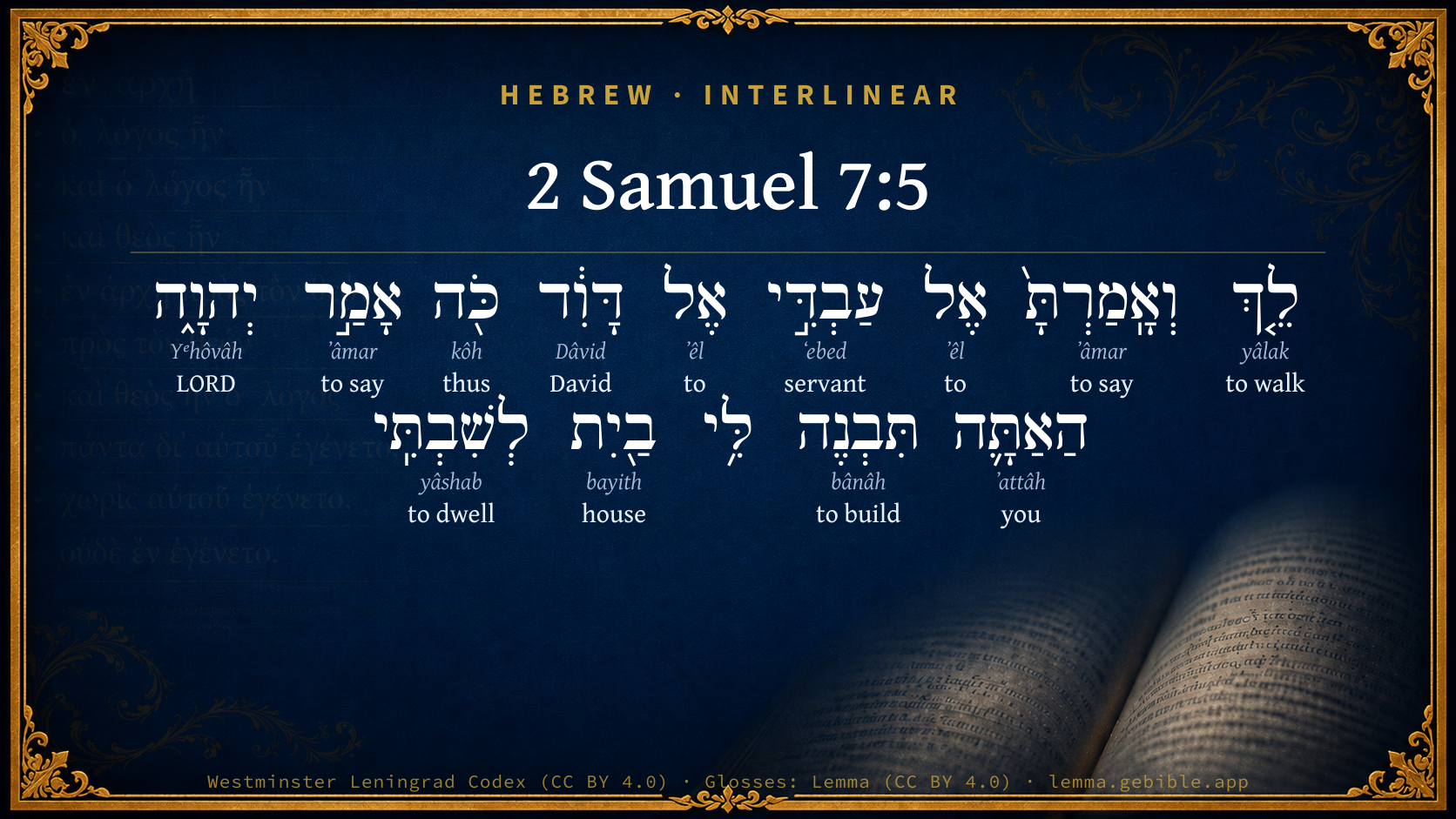
Hebrew (Westminster Leningrad Codex) 2 Samuel 7:5 appears in the Hebrew Old Testament. The text above is from the Westminster Leningrad Codex. Each word links to its Strong’s number, a concise gloss, and parsing drawn from the Open Scriptures Hebrew Bible morphology. Click any word for its full Brown-Driver-Briggs (BDB) entry.
Download image
Cite this verse

2 Samuel 7:5 (World English Bible). Public Domain. Lemma interlinear Bible study tool, https://lemma.gebible.app/v/2-samuel/7/5.

Show BibTeX & RIS
BibTeX
RIS
English Translation
Go and tell my servant David, Thus says Yahweh, Shall you build me a house for me to dwell in?
World English Bible · Public Domain
Download a study sheet

One document with this verse’s original text, its word-by-word gloss line, the meaning frame, cross-references with their text, attributed commentary, and full source and license credits — printable, and it pastes into notes with its structure intact.

This verse Autodidact and up

Study sheet (.html) Plain text (.txt)

A passage Seminary Student

Up to 50 verses in one chapter. A passage sheet keeps up to 6 commentary sources and 12 cross-references per verse, in the order this page ranks them, and says so on the sheet whenever that leaves anything out. Ask for a single verse and you get the Autodidact verse sheet above.

Everything on this page stays free to read, with no account — the sheet is a download of what is already on screen, not access to it.

Want to remove ads? Support Godless Engineer
Compare translations 3

The same verse in 3 English versions, stacked beneath the original-language interlinear above. Click any original word for its lexicon entry.

Each is an independent rendering of the whole verse — the interlinear is not word-aligned to these translations.

Highlighted words mark where these versions differ — a whole-verse word diff, not a word-by-word alignment.

  • World English Bible Public Domain
    Go and tell my servant David, Thus says Yahweh, Shall you build me a house for me to dwell in?
  • King James Version Public Domain
    Go and tell my servant David, Thus saith the LORD, Shalt thou build me an house for me to dwell in?
  • unfoldingWord Literal Text CC BY-SA 4.0
    “Go, and you shall say to my servant, to David, ‘Thus says Yahweh, “You, will you build for me a house for my dwelling?

unfoldingWord Literal Text — © unfoldingWord, licensed CC BY-SA 4.0. Word-aligned USFM3 via Door43 (git.door43.org/unfoldingWord/en_ult).

Versions to compare (up to 4)

3 of 4 selected

Show all 18 translations

Every available English version of this verse, each an independent rendering of the whole verse.

  • World English Bible Public Domain
    Go and tell my servant David, Thus says Yahweh, Shall you build me a house for me to dwell in?
  • Berean Standard Bible Public Domain
    “Go and tell My servant David that this is what the LORD says: Are you the one to build for Me a house to dwell in?
  • Majority Standard Bible Public Domain
    “Go and tell My servant David that this is what the LORD says: Are you the one to build for Me a house to dwell in?
  • King James Version Public Domain
    Go and tell my servant David, Thus saith the LORD, Shalt thou build me an house for me to dwell in?
  • American Standard Version (1901) Public Domain
    Go and tell my servant David, Thus saith Jehovah, Shalt thou build me a house for me to dwell in?
  • Revised Version (1885) Public Domain
    Go and tell my servant David, Thus saith the LORD, Shalt thou build me an house for me to dwell in?
  • Geneva Bible (1599) Public Domain
    Goe and tell my seruant Dauid, Thus saieth the Lord, Shalt thou buylde me an house for my dwelling?
  • Douay-Rheims (1899) Public Domain
    Go, and say to my servant David: Thus saith the Lord: Shalt thou build me a house to dwell in?
  • Young's Literal Translation Public Domain
    `Go, and thou hast said unto My servant, unto David, Thus said Jehovah, Dost thou build for Me a house for My dwelling in?
  • Literal Standard Version CC BY-SA 4.0
    “Go, and you have said to My servant, to David, Thus said YHWH: Do you build for Me a house for My dwelling in?
  • Unlocked Literal Bible CC BY-SA 4.0
    “Go and tell David my servant, 'This is what Yahweh says: Will you build me a house in which to live?
  • unfoldingWord Literal Text CC BY-SA 4.0
    “Go, and you shall say to my servant, to David, ‘Thus says Yahweh, “You, will you build for me a house for my dwelling?
  • Darby Bible Public Domain
    Go and say to my servant, to David, Thus saith Jehovah: Wilt thou build me a house for me to dwell in?
  • World Messianic Bible Public Domain
    “Go and tell my servant David, ‘The LORD says, “Should you build me a house for me to dwell in?
  • Webster's Bible Public Domain
    Go and tell my servant David, Thus saith the LORD, Wilt thou build me a house for me to dwell in?
  • Free Bible Version CC BY-SA 4.0
    “Go and tell my servant David, This is what the Lord says: Should you be the one to build a house for me to live in?
  • Bible in Basic English Public Domain
    Go and say to my servant David, The Lord says, Are you to be the builder of a house, a living-place for me?
  • JPS Tanakh (1917) Public Domain
    'Go and tell My servant David: Thus saith the LORD: Shalt thou build Me a house for Me to dwell in?

Literal Standard Version (2020), Covenant Press — licensed CC BY-SA 4.0. Text via the HelloAO Bible API (eBible.org). Unlocked Literal Bible (unfoldingWord) — licensed CC BY-SA 4.0. Text via the HelloAO Bible API (eBible.org). unfoldingWord Literal Text — © unfoldingWord, licensed CC BY-SA 4.0. Word-aligned USFM3 via Door43 (git.door43.org/unfoldingWord/en_ult). Free Bible Version, Dr. Jonathan Gallagher — licensed CC BY-SA 4.0. Text via the HelloAO Bible API (eBible.org).

Word by word

More ways to search: Search by grammar → Find every occurrence → Compare this word →

Practice this passage: Drill this verse → Learn its vocabulary →

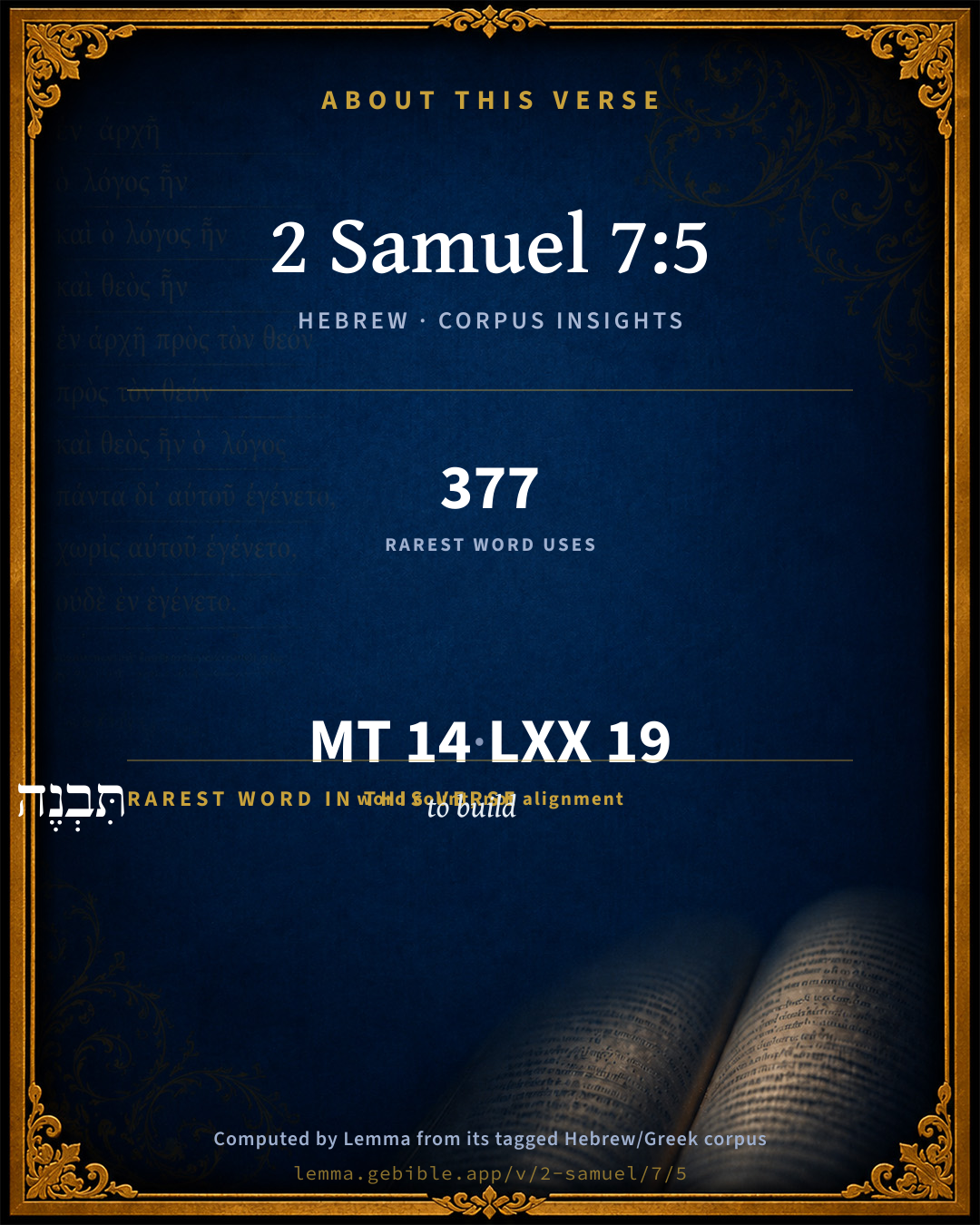
תִּבְנֶה
bânâh
H1129
“to build”
Verb, Qal, Imperfect, 2nd Person, Masculine, Singular
Part of Speech
Verb
Stem
Qal
Form
Imperfect
Person
2nd Person
Gender
Masculine
Number
Singular
Full BDB Definition

Origin: a primitive root

TWOT: 255

to build, rebuild, establish, cause to continue - (Qal) - to build, rebuild - to build a house (i.e., establish a family) - (Niphal) - to be built - to be rebuilt - established (of restored exiles) (figuratively) - established (made permanent) - to be built up (of childless wife becoming the mother of a family through the children of a concubine)
  1. לֵ֤ךְ yâlak H3212 “walk” Verb, Qal, Imperative, 2nd Person, Masculine, Singular
  2. וְאָֽמַרְתָּ֙ ʼâmar H559 “and · to say” Conjunction + Verb, Qal, Perfect, 2nd Person, Masculine, Singular
  3. אֶל ʼêl H413 “to” Preposition
  4. עַבְדִּ֣י ʻebed H5650 “servant · my” Noun, Common, Masculine, Singular, Construct + Suffix, Personal, 1st Person, Common, Singular
  5. אֶל ʼêl H413 “to” Preposition
  6. דָּוִ֔ד Dâvid H1732 “David” Noun, Proper
  7. כֹּ֖ה kôh H3541 “thus” Adverb
  8. אָמַ֣ר ʼâmar H559 “to say” Verb, Qal, Perfect, 3rd Person, Masculine, Singular
  9. יְהוָ֑ה Yᵉhôvâh H3068 “LORD” Noun, Proper
  10. הַאַתָּ֛ה ʼattâh H859 “you” Particle, Interrogative + Pronoun, Personal, 2nd Person, Masculine, Singular
  11. בַ֖יִת bayith H1004 “house” Noun, Common, Masculine, Singular, Absolute
  12. לְשִׁבְתִּֽי yâshab H3427 “to dwell · me” Preposition + Verb, Qal, Infinitive Construct + Suffix, Personal, 1st Person, Common, Singular

About this verse

These counts appear in no published source. They are computed here, from the morphology-tagged text and Lemma’s own curated glosses. What Lemma adds →

14
words
11
distinct lemmas
Historical
section

Grammatical profile

  • 5 verbs
  • 4 nouns
  • 1 pronoun
  • 3 prepositions
  • 1 adverb

Verb forms

  • לֵ֤ךְ Qal · Imperative
  • וְאָֽמַרְתָּ֙ Qal · Perfect
  • אָמַ֣ר Qal · Perfect
  • תִּבְנֶה Qal · Imperfect
  • לְשִׁבְתִּֽי Qal · Infinitive Construct

Repetition

Words recur within this verse — often emphatic in Hebrew:

  • וְאָֽמַרְתָּ֙ to say H559 ×2
  • אֶל to H413 ×2

Hebrew & Septuagint length

In English translation the verse runs 20 words from the Hebrew and 23 from the Septuagint (LXX English) — closely comparable.

A rough comparison of the two English renderings, which tokenize alike — not a word-level alignment.

Word counts can differ between the Hebrew and the Greek without any difference in meaning — e.g. the Hebrew direct-object marker אֵת has no separate Greek word, and Greek often adds the article ὁ.

In the original languages it is 14 Hebrew tokens and 19 Greek tokens — but the two are counted differently (Hebrew bundles its prefixes and suffixes into one token; the Greek is in lemma form), so that isn’t a like-for-like length.

Cross-references

5

Topical passages linked to 2 Samuel 7:5 in the Treasury of Scripture Knowledge — connected by theme and wording, ordered by reader-vote popularity; previews shown in the World English Bible.

  • 1 Kings 5:3–4 You know how that David my father could not build a house for the name of Yahweh his God for the wars which were about him on every side, until Yahweh put them under the soles of his feet.
  • 1 Kings 8:16–19 Since the day that I brought forth my people Israel out of Egypt, I chose no city out of all the tribes of Israel to build a house, that my name might be there; but I chose David to be over my people Israel.
  • 1 Chronicles 17:4 Go and tell David my servant, Thus says Yahweh, You shall not build me a house to dwell in:
  • 1 Chronicles 22:7–8 David said to Solomon his son, As for me, it was in my heart to build a house to the name of Yahweh my God.
  • 1 Chronicles 23:3–32 The Levites were numbered from thirty years old and upward: and their number by their polls, man by man, was thirty-eight thousand.

Cross-references courtesy of OpenBible.info (CC BY 4.0).

Hebrew and Greek witnesses Masoretic Hebrew ↔ Greek Septuagint

The same verse in the two great witnesses to the Old Testament, shown verse-for-verse.

These are two independent witnesses, not word-aligned to each other, and the Septuagint is shown in lemma (dictionary) form.

Hebrew 2 Samuel 7:5 Masoretic · Westminster Leningrad Codex

לֵ֤ךְ וְאָֽמַרְתָּ֙ אֶל עַבְדִּ֣י אֶל דָּוִ֔ד כֹּ֖ה אָמַ֣ר יְהוָ֑ה הַאַתָּ֛ה תִּבְנֶה לִּ֥י בַ֖יִת לְשִׁבְתִּֽי

Go and tell my servant David, Thus says Yahweh, Shall you build me a house for me to dwell in?

World English Bible · Public Domain

Greek LXX 2 Samuel 7:5 Septuagint · lemma form

πορεύομαι καί εἶπον πρός ὁ δοῦλος ἐγώ δαυίδ ὅδε λέγω κύριος οὐ σύ οἰκοδομέω ἐγώ οἶκος ὁ καταοἰκέω ἐγώ

Go, and say to my servant David, Thus says the Lord, You shall not build me a house for me to dwell in.

LXX2012 (modern English Septuagint) · Public Domain

On this verse, Ellicott's Commentary for English Readers discusses the Septuagint’s reading. Read the note in Commentary ↓

Hebrew: Westminster Leningrad Codex (CC BY 4.0). Greek: Septuagint (public domain); English from LXX2012 (modern English Septuagint) (Public Domain). How the Septuagint differs from the Hebrew →

Targum (Aramaic paraphrase)

1

The Targum is the ancient Jewish Aramaic paraphrase of the Hebrew Scriptures — an interpretive translation, not the Hebrew text itself. Onkelos (literal) and Pseudo-Jonathan (expansive) render the Torah, and Jonathan the Prophets. Coverage is partial: where no permissively-licensed English translation exists for a verse, only the Aramaic is shown. This is verse-level text, not a word-by-word alignment to the Hebrew.

  1. Targum Jonathan Prophets (Joshua–Malachi)
    אֱזֵיל וְתֵימַר לְעַבְדִי לְדָוִד כִּדְנַן אֲמַר יְיָ הַאַתְּ תִּבְנֵי קֳדָמַי בֵּיתָא לְאַשְׁרָאָה שְׁכִנְתִּי בָּהּ:

    (no public-domain English translation for this verse)

    Targum Jonathan — Aramaic: “Mikraot Gedolot” (public domain). English: “Sefaria Community Translation” (CC0 1.0 (public-domain dedication)); “London "Chaldee Paraphrase," 1871” (public domain). Text via Sefaria.

Commentary

Notes on 2 Samuel 7:5 from classic Christian and Jewish commentators (each source and its license shown beneath its notes). The classic Christian expositions comment on the surrounding passage and are grouped to its opening verse, so a note may address several verses; the Jewish commentaries on the Tanakh (Rashi and others) are per-verse, so they appear only where the commentator wrote on this verse.

Lemma curates 59 commentaries, every one of them public domain or Creative Commons licensed, each selected and text-cleaned for this edition rather than reprinted as found. About our sources →

Trapp's Complete Commentary

John Trapp

2Sa 7:5 Go and tell my servant David, Thus saith the LORD, Shalt thou build me an house for me to dwell in?

Ver. 5. Shalt thou build me an house?] q.d., In no wise. I accept of thy good will, {1Ki 8:18} and will see thee well satisfied for the same: but I have other work for thee to do, {1Ki 5:3} and shall reserve this piece of service for thy son, as more suitable to his peaceable reign, wherein "the righteous shall flourish, and abundance of peace to all people." {Psa 72:7}

John Trapp, A Commentary or Exposition upon All the Books of the Old and New Testament (1647–1656) — public domain. Text from a community e-Sword module.

The Biblical Illustrator

Joseph S. Exell

2Sa_7:5-17

Shalt thou build me an house for me to dwell in?

Folded hands

1. Let us understand that a purpose may be good, yet Providence may see fit to deny its accomplishment. That is to say, God may take the will for the deed. We may work up a sort of personal enthusiasm, and because the end appears right in our eyes, may expect that Providence will immediately accept it; but, the question is not whether the plan is good, but whether it is Gods plan for us in which to serve Him. These so-called crises of human existence are sometimes nothing more nor less than mere crises of human will, dictating to God what ought to be done.

2. Let us remember that a wish may be intense, and yet it is not on that account to be granted. We act so often from mixed motives that we are not always the ones to know whether wishes we cherish are not wiles of the devil. The day has been for many a child of God, when he struggled with some most eager and passionate desire of his heart; God denied it, and the believer has lived to thank Him on the bended knees of his grateful soul. God has promised to grant, not what we seek or crave or implore in set terms, but what we need (Php_4:19).

3. Let us acknowledge that sometimes a human heart is too full of unworthy feeling for success in high spiritual endeavour. Hence the Lord does not entrust this to such agents. This hard decision for David is not without its parallel in modern experience. Are none of us men of blood? It is related of Richard the Lion-hearted that for seven whole years he would not suffer himself to take the Sacrament, because he was conscious of real hatred in his heart towards the king of France. It is possibly a poignant experience, but it may be profitable to acknowledge, There are things I cannot do, because God is holier than I am. For this will leave the way open for fresh increases in holiness at once; and it also settles ones mind down to give over impossibilities, and take up what is legitimately within reach.

4. Let us admit freely, that an intention may be excellent, and yet have to be surrendered into anothers hands. This plan of David was good, but Solomon was to carry it out; that was all (1Ki_8:18). God may choose to have his work done by those whom he selects, and not by volunteers.

5. Let us believe that a human heart may be apparently broken, and yet remain full of joy. Every now and then we fall on some new chapter which shows King Davids frank delight in this lowly task permitted to him (1Ch_28:2-8). He rouses the whole nation with his enthusiasm; and yet his first sentence of address is a candid statement of his purpose which the Lord had thwarted the moment he mentioned it, and now of the purpose which had come in the place of it, making him as happy as a child. Now let us add only an illustration of this whole thought, and finish. Two boys, Franz Knigstein and Albrecht Durer, once lived together in Nuremberg; they were going to be artists, and had entered Michael Wohlgemuths study for instruction. The parents of both were poor, and were struggling to keep their sons at their work, until they should be able to care for themselves. Of these two pupils, the master knew that Albrecht possessed genius, but Franz would never make a painter of whom he should be proud. But both were industrious and frugal and affectionate. They loved each other tenderly, and were kind and faithful unto all at home. Years passed on: one went to Italy, the other continued study in Germany. Ere long Franz married, and, by and by, Albrecht; and the old people died, and times were hard, and art was dull. Albrecht feared that Franz had not the artist spirit, and could never succeed. Once they planned together to make an etching of the passion of our Lord; when they came to show each other what had been accomplished, the picture of Franz was cold and lifeless, while that of Albrecht was full of beauty. Franz himself saw it then. He was in middle life, and so far as he knew he had been a failure. He must give it up; he could not be successful as an artist. But he did not complain; only for a passionate moment he buried his face in his hands. Then he said in broken tones, though still full of courage: The good Lord gave me no such gift as this; but he has something yet for me to do; some homely work shall be found for me; I was blind so long, so much time I have lost; be you the artist of Nuremberg, and I O, Franz! be quiet an instant, exclaimed Albrecht; and a quick rush was made to the paper before him on the table. Only a few lines with a swift pencil: Franz thought he was adding another stroke to his etching, and waited patiently leaning over the mantel with his fingers twined and clasped. And then, next day. Albrecht showed his friend the sheet: Why, those are only my own hands, said Franz; where did you get them? And there was hardly need of an answer. I took them as you stood, making the sad surrender of your life so very, very bravely; and I murmured to myself, those hands that may never paint a picture, can now most certainly make one; I have faith in those folded hands, my brother-friend: they will go to mens hearts in the years to come! And, sure enough, the prophecy was true; for over the artistic world has gone the tale, and over the worlds of love and duty has gone the picture; and the Folded Hands, by Albrecht Durer, are but the hands of Franz Knigstein once folded in sweet, brave resignation, when he gave up his dearest wish, and yet believed the good Lord had a homely duty for him to do, worth the doing. That is the picture which hangs up over my table, and has hung there for years; a mere copy of an etching that belongs in the gallery of Vienna. What it means is, there are some things, my Christian friend, you and I can never do! But there are others we can do, and we can always do something towards accomplishing a preparation for some one else to finish; and what matters all the humiliation, if only the dear Lord gets the glory? (C. S. Robinson, D. D.)

The Biblical Illustrator, edited by Joseph S. Exell (c. 1880s–1900s) — public domain. Text from a community e-Sword module.

Tyndale Open Study Notes

Tyndale Open Resources

7:5 Are you the one? God wanted someone to build him a house, but David wasn’t the right person.

Tyndale Open Study Notes — © Tyndale Open Resources, licensed CC BY-SA 4.0. Text via the HelloAO Bible API.

Geneva Bible (1599)

Geneva Bible translators

Meaning, he should not: yet Nathan speaking according to man’s judgment and not by the spirit of prophecy, permitted him.

Geneva Bible (1599) marginal notes — public domain. Text via Bolls.life.

Adam Clarke's Commentary

Verse 5. Shalt thou build me a house] That is, Thou shalt not: this is the force of the interrogative in such a case.

Adam Clarke's Commentary on the Bible (1810–1826) — public domain. Text from a community e-Sword/MySword module.

Ellicott's Commentary for English Readers

(5) Shalt thou build?—The question implies the negative, as it is expressed in 1Ch_17:5, and as it is here translated in the LXX. and Syriac.

After David was told that he should not be allowed to build a temple for God as he desired, he is promised that God will make for him a sure house, and will accept the building of the temple from his son. David is called “my servant,” an expression used only of those eminent and faithful in the service of God, as Moses and Joshua, thus showing—as in fact the whole message does—that the prohibition conveyed nothing of Divine displeasure; but no reason for it is here expressed.[33] But in, David’s parting charge to Solomon (1Ch_22:8), and to the heads of the nation (1Ch_28:3), he says, “the word of the Lord came unto” him, giving as the reason, “because thou hast shed much blood on the earth,” and “hast been a man of war.” Those wars had been necessary, under the circumstances in which he was placed, and had never been disapproved of God; still the mere fact that he had been a man of blood unfitted him for this sacred office.

[33] Two reasons for the prohibition are found by nearly all commentators in this message itself. (1) That God must first build “a house “for David before he could properly build a temple for God; and (2) that the kingdom was not yet sufficiently established and peaceful for a temple to be built. But neither of these are assigned as reasons m the Divine word, and it is better to keep only to that which is assigned, however these other facts may convince us of the fitness and propriety of the postponement of David’s purpose.

A Bible Commentary for English Readers, edited by Charles John Ellicott (1878–1897) — public domain. Text from a community e-Sword module.

The Cambridge Bible for Schools and Colleges

gen. ed. J. J. S. Perowne

5. my servant David] Any Israelite might call Himself God’s servant in addressing God: but only a few who were raised up to do special service, such as Moses and Joshua, are honoured by being thus distinctively styled “Servants of Jehovah.” See Introd. p. 44.

Shalt thou build] Thou is emphatic. The question of course is equivalent to a negative.

The Cambridge Bible for Schools and Colleges (gen. ed. J. J. S. Perowne; Cambridge University Press, 1878–1918) — public domain. Text from a community e-Sword module.

John Gill's Exposition

Go and tell my servant David,.... The Lord speaks very honourably and respectfully of him, owns him to be his servant in other things, though he did not choose to employ him in this; and though he was not the person, nor this the time, to build the house of the Lord, yet, as he showed a good will towards it, so far it was acceptable to God:

thus saith the Lord, shalt thou build me an house for me to dwell in? no, thou shalt not, as appears from Ch1 17:4; which seems to be expressed with much spirit, and some degree of resentment, to resolve on such a work, without seeking to know his mind in it. Eupolemus (u) an Heathen, confirms this account, only instead of a prophet he speaks of an angel, whose name he says was Dinnathan, who, when David was desirous of building a temple for God, and very anxious to be shown the place where the altar was to be erected, this angel appeared to him; and, though he showed him the place for the altar, forbad him building it, because he was polluted with human blood, and had been engaged in wars many years, and bid him leave the building of it to his son.

(u) Apud Euseb. Evangel. Praepar. l. 9. c. 30. p. 447.

John Gill's Exposition of the Whole Bible (1746–1763) — public domain (CC PDM 1.0). Text via the HelloAO Bible API.

Matthew Poole's English Annotations

i.e. Thou shalt not. Or, Wilt thou build, &c.? Dost thou purpose it?

Matthew Poole's English Annotations on the Holy Bible (1683–1685) — public domain. Text from a community e-Sword/MySword module.

Whedon's Commentary on the Bible

Daniel D. Whedon

5. Shalt thou build me a house — Is not such a purpose on thy part presumption? Nay, rather, I will make thee a house. Compare 2Sa_7:11. The question implies a negative answer, and in 1Ch_17:4, we have, “Thou shalt not build me a house.”

Daniel D. Whedon (gen. ed.), Commentary on the Old and New Testaments (1874–1909) — public domain. Text from a community e-Sword module.

The Pulpit Commentary

Shalt thou, etc.? The question implies an answer in the negative; but there is no disapproval of David"s purpose as such; but only the deferring of its full execution unto the days of his son. There is more than this. The idea which runs through the Divine message is that the dwelling of Jehovah in a tent was a fitting symbol of Israel"s unquiet possession of the laud. It was David"s mission to give them tranquillity and security in the region which they had conquered long ago, but wherein they had never hitherto been able to maintain their liberty unimpaired. Then, upon the accomplishment of David"s special duty, his son, Shelomo, i.e. the peaceful, was to build the solid temple, as the proof that Jehovah had now taken permanent possession of the land. We find also a further thought, namely, that the building of the temple signified "the making for David of a house." In its full significance this means that the tribe of Judah and the lineage of David were now chosen by God as the ancestors of the Messiah.

The Pulpit Commentary (1880–1919), ed. H.D.M. Spence-Jones & Joseph S. Exell — public domain. Text from a community e-Sword module.

John Wesley's Explanatory Notes

Shalt thou - That is, thou shalt not.

John Wesley, Explanatory Notes Upon the Whole Bible (1754–1765) — public domain. Text via the GEBible commentary corpus.

Lesson kit

Teaching starters — assembled from the data on this page, not authored interpretation. Every prompt links to the verse data it draws on. Edit before teaching.

2 Samuel, in the Historical, opens this verse with 14 words (11 distinct Hebrew lemmas). Its most distinctive word is bânâh (“to build”). A historical commentator’s framing appears above. Read the whole chapter for the surrounding context.

Discussion questions

  1. How does “to build” (bânâh) shape what this verse is saying?
  2. How does 1 Kings 5:3–4, which shares this passage’s theme, read alongside this verse?
  3. What does the repetition of “to say” (2× in this one verse) do in this verse?
  4. These translations render this verse differently; the difference is in the English rendering, not the original. What questions does that raise?
  5. «לֵ֤ךְ» is a Qal Imperative verb. How does that grammatical form shape the action described?
  6. Compare how Trapp's Complete Commentary and The Biblical Illustrator read this verse. Where do they agree or differ?

Things to notice

Reading settings

Reading text

Shown beneath each verse's original-language words.

Old Testament
Old Testament edition

Read the OT as the Masoretic Hebrew (MT) or the Greek Septuagint (LXX).

English shown for the Greek Septuagint (in the Hebrew ↔ Greek comparison).

Comparing translations? Open the Compare panel on any verse page to stack up to four side by side.