
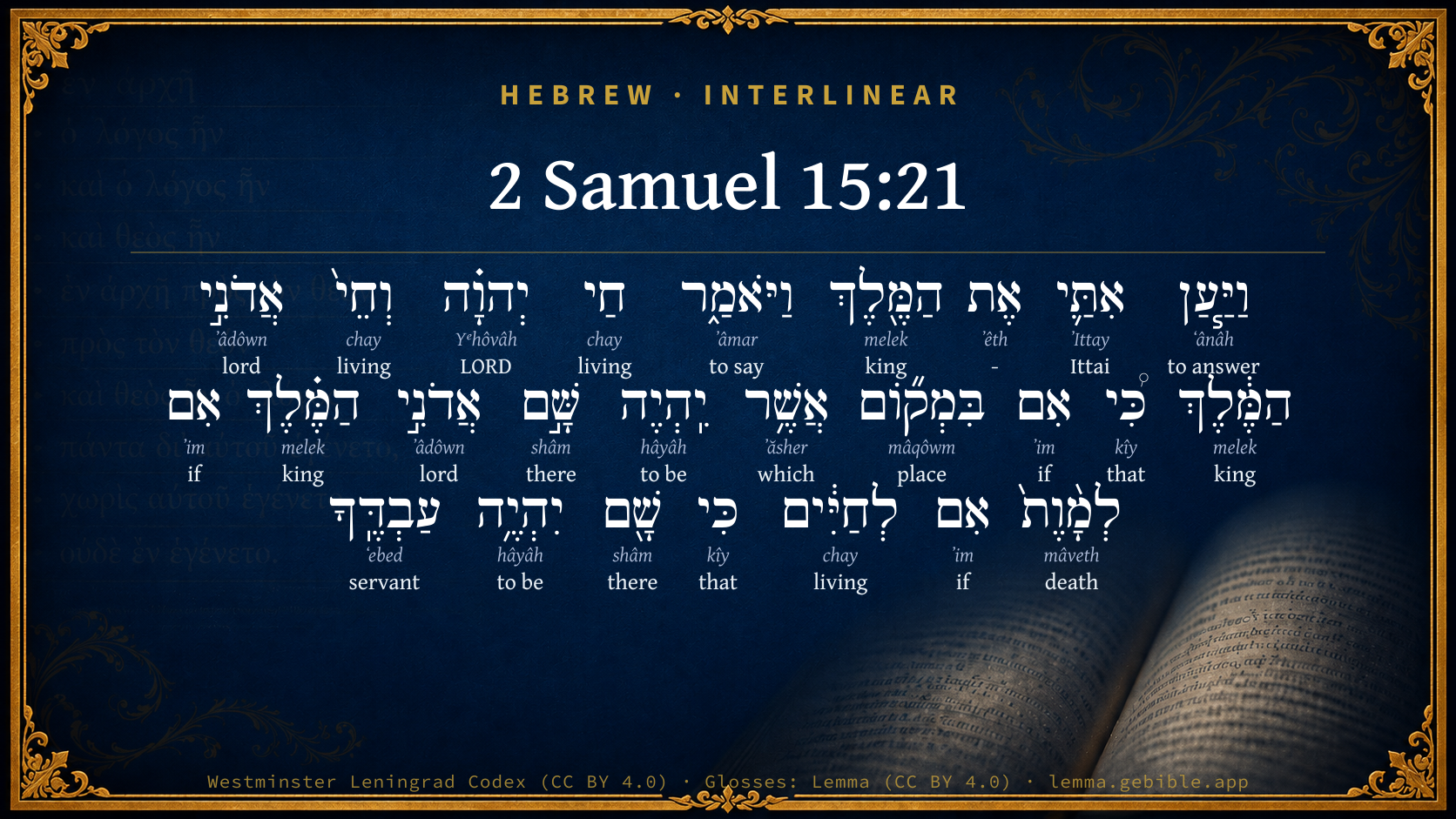
2 Samuel 15:21

Hebrew (Westminster Leningrad Codex) 2 Samuel 15:21 appears in the Hebrew Old Testament. The text above is from the Westminster Leningrad Codex. Each word links to its Strong’s number, a concise gloss, and parsing drawn from the Open Scriptures Hebrew Bible morphology. Click any word for its full Brown-Driver-Briggs (BDB) entry.
Download image
Cite this verse

2 Samuel 15:21 (World English Bible). Public Domain. Lemma interlinear Bible study tool, https://lemma.gebible.app/v/2-samuel/15/21.

Show BibTeX & RIS
BibTeX
RIS
English Translation
Ittai answered the king, and said, As Yahweh lives, and as my lord the king lives, surely in what place my lord the king shall be, whether for death or for life, even there also will your servant be.
World English Bible · Public Domain
Download a study sheet

One document with this verse’s original text, its word-by-word gloss line, the meaning frame, cross-references with their text, attributed commentary, and full source and license credits — printable, and it pastes into notes with its structure intact.

This verse Autodidact and up

Study sheet (.html) Plain text (.txt)

A passage Seminary Student

Up to 50 verses in one chapter. A passage sheet keeps up to 6 commentary sources and 12 cross-references per verse, in the order this page ranks them, and says so on the sheet whenever that leaves anything out. Ask for a single verse and you get the Autodidact verse sheet above.

Everything on this page stays free to read, with no account — the sheet is a download of what is already on screen, not access to it.

Want to remove ads? Support Godless Engineer
Compare translations 3

The same verse in 3 English versions, stacked beneath the original-language interlinear above. Click any original word for its lexicon entry.

Each is an independent rendering of the whole verse — the interlinear is not word-aligned to these translations.

Highlighted words mark where these versions differ — a whole-verse word diff, not a word-by-word alignment.

  • World English Bible Public Domain
    Ittai answered the king, and said, As Yahweh lives, and as my lord the king lives, surely in what place my lord the king shall be, whether for death or for life, even there also will your servant be.
  • King James Version Public Domain
    And Ittai answered the king, and said, As the LORD liveth, and as my lord the king liveth, surely in what place my lord the king shall be, whether in death or life, even there also will thy servant be.
  • unfoldingWord Literal Text CC BY-SA 4.0
    But Ittai answered the king and said, “The life of Yahweh and the life of my lord the king, surely in the place where my lord the king will be there, whether to death, whether to life, that there your servant shall be.”

unfoldingWord Literal Text — © unfoldingWord, licensed CC BY-SA 4.0. Word-aligned USFM3 via Door43 (git.door43.org/unfoldingWord/en_ult).

Versions to compare (up to 4)

3 of 4 selected

Show all 18 translations

Every available English version of this verse, each an independent rendering of the whole verse.

  • World English Bible Public Domain
    Ittai answered the king, and said, As Yahweh lives, and as my lord the king lives, surely in what place my lord the king shall be, whether for death or for life, even there also will your servant be.
  • Berean Standard Bible Public Domain
    But Ittai answered the king, “As surely as the LORD lives, and as my lord the king lives, wherever my lord the king may be, whether it means life or death, there will your servant be!”
  • Majority Standard Bible Public Domain
    But Ittai answered the king, “As surely as the LORD lives, and as my lord the king lives, wherever my lord the king may be, whether it means life or death, there will your servant be!”
  • King James Version Public Domain
    And Ittai answered the king, and said, As the LORD liveth, and as my lord the king liveth, surely in what place my lord the king shall be, whether in death or life, even there also will thy servant be.
  • American Standard Version (1901) Public Domain
    And Ittai answered the king, and said, As Jehovah liveth, and as my lord the king liveth, surely in what place my lord the king shall be, whether for death or for life, even there also will thy servant be.
  • Revised Version (1885) Public Domain
    And Ittai answered the king, and said, As the LORD liveth, and as my lord the king liveth, surely in what place my lord the king shall be, whether for death or for life, even there also will thy servant be.
  • Geneva Bible (1599) Public Domain
    And Ittai answered the King, and sayde, As the Lord liueth, and as my lord the King liueth, in what place my lord the King shalbe, whether in death or life, euen there surely will thy seruant bee.
  • Douay-Rheims (1899) Public Domain
    And Ethai answered the king, saying: As the Lord liveth, and as my lord the king liveth: in what place soever thou shalt be, my lord, O king, either in death, or in life, there will thy servant be.
  • Young's Literal Translation Public Domain
    And Ittai answereth the king and saith, `Jehovah liveth, and my lord the king liveth, surely in the place where my lord the king is -- if for death, if for life, surely there is thy servant.'
  • Literal Standard Version CC BY-SA 4.0
    And Ittai answers the king and says, “YHWH lives, and my lord the king lives, surely in the place where my lord the king is—if for death, if for life, surely your servant is there.”
  • Unlocked Literal Bible CC BY-SA 4.0
    But Ittai answered the king and said, “As Yahweh lives, and as my master the king lives, surely in whatever place where my master the king goes, there also will your servant go, whether that means living or dying.”
  • unfoldingWord Literal Text CC BY-SA 4.0
    But Ittai answered the king and said, “The life of Yahweh and the life of my lord the king, surely in the place where my lord the king will be there, whether to death, whether to life, that there your servant shall be.”
  • Darby Bible Public Domain
    And Ittai answered the king and said, [As] Jehovah liveth, and [as] my lord the king liveth, surely in what place my lord the king shall be, whether in death or life, even there also will thy servant be.
  • World Messianic Bible Public Domain
    Ittai answered the king and said, “As the LORD lives, and as my lord the king lives, surely in what place my lord the king is, whether for death or for life, your servant will be there also.”
  • Webster's Bible Public Domain
    And Ittai answered the king, and said, As the LORD liveth, and as my lord the king liveth, surely in what place my lord the king shall be, whether in death or life, even there also will thy servant be.
  • Free Bible Version CC BY-SA 4.0
    But Ittai answered the king, “As the Lord lives, and as Your Majesty lives, wherever Your Majesty may be, whether dead or alive, that's where your servant will be!”
  • Bible in Basic English Public Domain
    And Ittai the Gittite in answer said, By the living Lord, and by the life of my lord the king, in whatever place my lord the king may be, for life or death, there will your servant be.
  • JPS Tanakh (1917) Public Domain
    And Ittai answered the king, and said: 'As the LORD liveth, and as my lord the king liveth, surely in what place my lord the king shall be, whether for death or for life, even there also will thy servant be.'

Literal Standard Version (2020), Covenant Press — licensed CC BY-SA 4.0. Text via the HelloAO Bible API (eBible.org). Unlocked Literal Bible (unfoldingWord) — licensed CC BY-SA 4.0. Text via the HelloAO Bible API (eBible.org). unfoldingWord Literal Text — © unfoldingWord, licensed CC BY-SA 4.0. Word-aligned USFM3 via Door43 (git.door43.org/unfoldingWord/en_ult). Free Bible Version, Dr. Jonathan Gallagher — licensed CC BY-SA 4.0. Text via the HelloAO Bible API (eBible.org).

Word by word

More ways to search: Search by grammar → Find every occurrence → Compare this word →

Practice this passage: Drill this verse → Learn its vocabulary →

אִתַּ֛י
ʼIttay
H863
“Ittai”
Noun, Proper
Part of Speech
Noun
Type
Proper
Full BDB Definition

Origin: from H854

TWOT: None

Ittai or Ithai = "with me" - a Gittite commander from Gath in David's army - one of David's 30 mighty warriors, a Benjamite
  1. וַיַּ֧עַן ʻânâh H6030 “and · to answer” Conjunction + Verb, Qal, Sequential Imperfect, 3rd Person, Masculine, Singular
  2. אֶת ʼêth H853 “-” Particle, Direct Object
  3. הַמֶּ֖לֶךְ melek H4428 “the · king” Particle, Definite Article + Noun, Common, Masculine, Singular, Absolute
  4. וַיֹּאמַ֑ר ʼâmar H559 “and · to say” Conjunction + Verb, Qal, Sequential Imperfect, 3rd Person, Masculine, Singular
  5. חַי chay H2416 “living” Adjective, Adjective, Masculine, Singular, Absolute
  6. יְהוָ֗ה Yᵉhôvâh H3068 “LORD” Noun, Proper
  7. וְחֵי֙ chay H2416 “and · living of” Conjunction + Noun, Common, Both, Singular, Construct
  8. אֲדֹנִ֣י ʼâdôwn H113 “lord · my” Noun, Common, Masculine, Singular, Construct + Suffix, Personal, 1st Person, Common, Singular
  9. הַמֶּ֔לֶךְ melek H4428 “the · king” Particle, Definite Article + Noun, Common, Masculine, Singular, Absolute
  10. כִּ֠י kîy H3588 “that” Conjunction
  11. אִם ʼim H518 “if” Conjunction
  12. בִּמְק֞וֹם mâqôwm H4725 “in/at · place of” Preposition + Noun, Common, Masculine, Singular, Construct
  13. אֲשֶׁ֥ר ʼăsher H834 “which” Particle, Relative
  14. יִֽהְיֶה hâyâh H1961 “to be” Verb, Qal, Imperfect, 3rd Person, Masculine, Singular
  15. שָּׁ֣ם shâm H8033 “there” Adverb
  16. אֲדֹנִ֣י ʼâdôwn H113 “lord · my” Noun, Common, Masculine, Singular, Construct + Suffix, Personal, 1st Person, Common, Singular
  17. הַמֶּ֗לֶךְ melek H4428 “the · king” Particle, Definite Article + Noun, Common, Masculine, Singular, Absolute
  18. אִם ʼim H518 “if” Conjunction
  19. לְמָ֨וֶת֙ mâveth H4194 “to/for · death” Preposition + Noun, Common, Masculine, Singular, Absolute
  20. אִם ʼim H518 “if” Conjunction
  21. לְחַיִּ֔ים chay H2416 “to/for · living things” Preposition + Noun, Common, Masculine, Plural, Absolute
  22. כִּי kîy H3588 “that” Conjunction
  23. שָׁ֖ם shâm H8033 “there” Adverb
  24. יִהְיֶ֥ה hâyâh H1961 “to be” Verb, Qal, Imperfect, 3rd Person, Masculine, Singular
  25. עַבְדֶּֽךָ ʻebed H5650 “servant · your” Noun, Common, Masculine, Singular, Construct + Suffix, Personal, 2nd Person, Masculine, Singular

About this verse

These counts appear in no published source. They are computed here, from the morphology-tagged text and Lemma’s own curated glosses. What Lemma adds →

26
words
16
distinct lemmas
Historical
section

Notable vocabulary

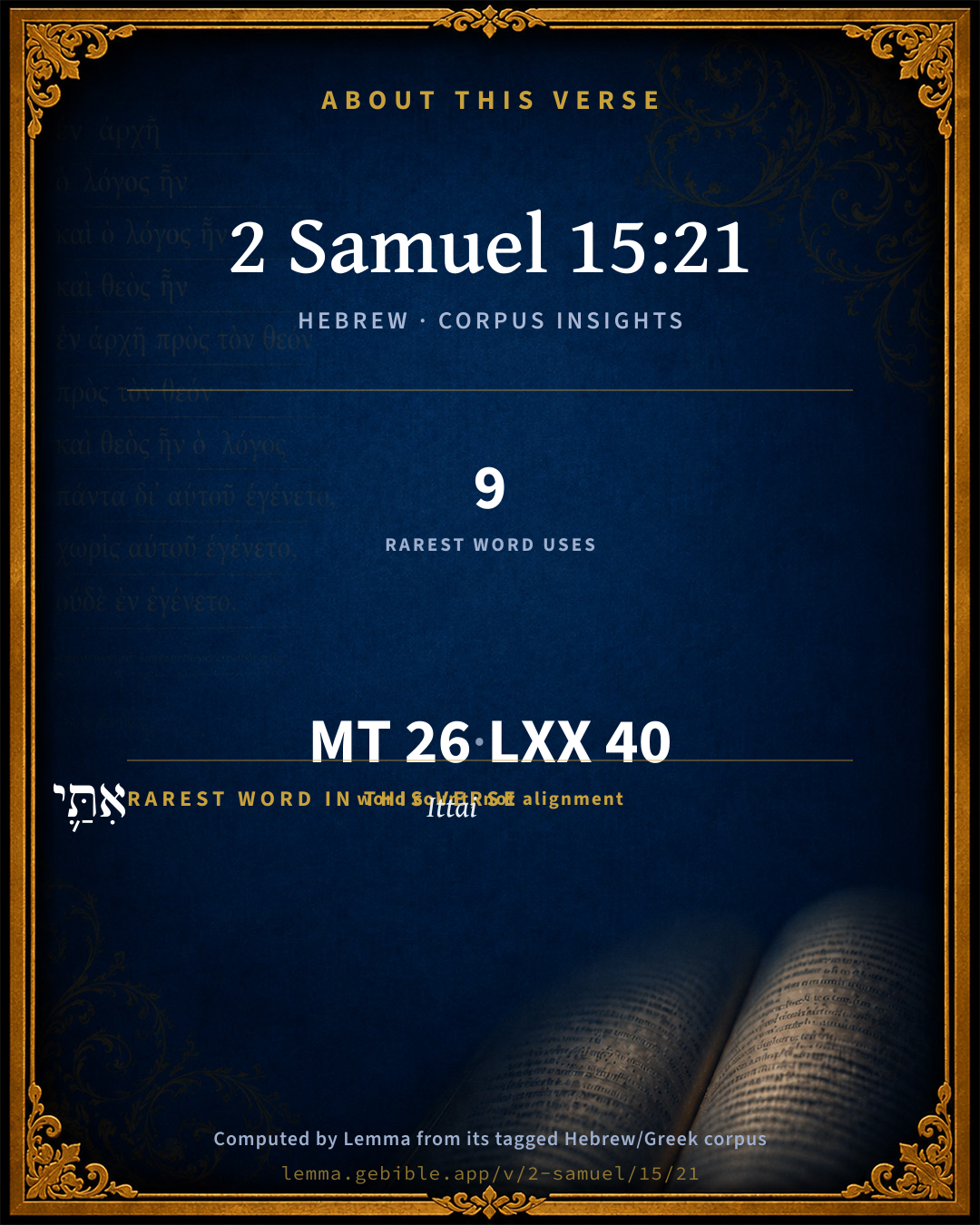
The rarest word here is אִתַּ֛י Ittai H863 — appearing just 9 times in the whole Hebrew Bible.

Shared distinctive vocabulary

אִתַּ֛י Ittai H863 occurs in 8 verses of the Hebrew Bible. Also found in:

Grammatical profile

  • 4 verbs
  • 12 nouns
  • 1 adjective
  • 5 conjunctions
  • 2 adverbs
  • 2 particles

Verb forms

  • וַיַּ֧עַן Qal · Sequential Imperfect
  • וַיֹּאמַ֑ר Qal · Sequential Imperfect
  • יִֽהְיֶה Qal · Imperfect
  • יִהְיֶ֥ה Qal · Imperfect

Repetition

Words recur within this verse — often emphatic in Hebrew:

  • הַמֶּ֖לֶךְ king H4428 ×3
  • חַי living H2416 ×3
  • אֲדֹנִ֣י lord H113 ×2
  • יִֽהְיֶה to be H1961 ×2
  • שָּׁ֣ם there H8033 ×2
  • אִם if H518 ×3
  • כִּ֠י that H3588 ×2

Hebrew & Septuagint length

In English translation the verse runs 39 words from the Hebrew and 38 from the Septuagint (LXX English) — closely comparable.

A rough comparison of the two English renderings, which tokenize alike — not a word-level alignment.

Word counts can differ between the Hebrew and the Greek without any difference in meaning — e.g. the Hebrew direct-object marker אֵת has no separate Greek word, and Greek often adds the article ὁ.

In the original languages it is 26 Hebrew tokens and 40 Greek tokens — but the two are counted differently (Hebrew bundles its prefixes and suffixes into one token; the Greek is in lemma form), so that isn’t a like-for-like length.

Cross-references

14

Topical passages linked to 2 Samuel 15:21 in the Treasury of Scripture Knowledge — connected by theme and wording, ordered by reader-vote popularity; previews shown in the World English Bible.

  • Ruth 1:16–17 Ruth said, "Don't entreat me to leave you, and to return from following after you, for where you go, I will go; and where you lodge, I will lodge; your people shall be my people, and your God my God;
  • Proverbs 17:17 A friend loves at all times; And a brother is born for adversity.
  • 2 Kings 4:30 The mother of the child said, As Yahweh lives, and as your soul lives, I will not leave you. He arose, and followed her.
  • 2 Kings 2:2 Elijah said to Elisha, Please wait here, for Yahweh has sent me as far as Bethel. Elisha said, As Yahweh lives, and as your soul lives, I will not leave you. So they went down to Bethel.
  • 2 Kings 2:4 Elijah said to him, Elisha, please wait here, for Yahweh has sent me to Jericho. He said, As Yahweh lives, and as your soul lives, I will not leave you. So they came to Jericho.
  • 2 Kings 2:6 Elijah said to him, "Please wait here, for Yahweh has sent me to the Jordan." He said, "As Yahweh lives, and as your soul lives, I will not leave you." They two went on.
  • Proverbs 18:24 A man of many companions may be ruined, But there is a friend who sticks closer than a brother.
  • Acts 11:23 who, when he had come, and had seen the grace of God, was glad. He exhorted them all, that with purpose of heart they should remain near to the Lord.
  • Acts 21:13 Then Paul answered, "What are you doing, weeping and breaking my heart? For I am ready not only to be bound, but also to die at Jerusalem for the name of the Lord Jesus."
  • 2 Corinthians 7:3 I say this not to condemn you, for I have said before, that you are in our hearts to die together and live together.
  • 1 Samuel 20:3 David swore moreover, and said, Your father knows well that I have found favor in your eyes; and he says, Don't let Jonathan know this, lest he be grieved: but truly as Yahweh lives, and as your soul lives, there is but a step between me and death.
  • 1 Samuel 25:26 Now therefore, my lord, as Yahweh lives, and as your soul lives, seeing Yahweh has withheld you from blood guiltiness, and from avenging yourself with your own hand, now therefore let your enemies, and those who seek evil to my lord, be as Nabal.
  • Matthew 8:19–20 A scribe came, and said to him, "Teacher, I will follow you wherever you go."
  • John 6:66–69 At this, many of his disciples went back, and walked no more with him.

Cross-references courtesy of OpenBible.info (CC BY 4.0).

Hebrew and Greek witnesses Masoretic Hebrew ↔ Greek Septuagint

The same verse in the two great witnesses to the Old Testament, shown verse-for-verse.

These are two independent witnesses, not word-aligned to each other, and the Septuagint is shown in lemma (dictionary) form.

Hebrew 2 Samuel 15:21 Masoretic · Westminster Leningrad Codex

וַיַּ֧עַן אִתַּ֛י אֶת הַמֶּ֖לֶךְ וַיֹּאמַ֑ר חַי יְהוָ֗ה וְחֵי֙ אֲדֹנִ֣י הַמֶּ֔לֶךְ כִּ֠י אִם בִּמְק֞וֹם אֲשֶׁ֥ר יִֽהְיֶה שָּׁ֣ם אֲדֹנִ֣י הַמֶּ֗לֶךְ אִם לְמָ֨וֶת֙ אִם לְחַיִּ֔ים כִּי שָׁ֖ם יִהְיֶ֥ה עַבְדֶּֽךָ

Ittai answered the king, and said, As Yahweh lives, and as my lord the king lives, surely in what place my lord the king shall be, whether for death or for life, even there also will your servant be.

World English Bible · Public Domain

Greek LXX 2 Samuel 15:21 Septuagint · lemma form

καί ἀποκρίνω εθθι ὁ βασιλεύς καί εἶπον ζάω κύριος καί ζάω ὁ κύριος ἐγώ ὁ βασιλεύς ὅτι εἰς ὁ τόπος ὅς ἐάν εἰμί ὁ κύριος ἐγώ καί ἐάν εἰς θάνατος καί ἐάν εἰς ζωή ὅτι ἐκεῖ εἰμί ὁ δοῦλος σύ

And Ethi answered the king and said, As the Lord lives and as my lord the king lives, in the place wherever my lord shall be, whether it be for death or life, there shall your servant be.

LXX2012 (modern English Septuagint) · Public Domain

Hebrew: Westminster Leningrad Codex (CC BY 4.0). Greek: Septuagint (public domain); English from LXX2012 (modern English Septuagint) (Public Domain). How the Septuagint differs from the Hebrew →

Targum (Aramaic paraphrase)

1

The Targum is the ancient Jewish Aramaic paraphrase of the Hebrew Scriptures — an interpretive translation, not the Hebrew text itself. Onkelos (literal) and Pseudo-Jonathan (expansive) render the Torah, and Jonathan the Prophets. Coverage is partial: where no permissively-licensed English translation exists for a verse, only the Aramaic is shown. This is verse-level text, not a word-by-word alignment to the Hebrew.

  1. Targum Jonathan Prophets (Joshua–Malachi)
    וַאֲתֵיב אִתַּי יַת מַלְכָּא וַאֲמַר קַיָים הוּא יְיָ וְקַיָים רִיבּוֹנִי מַלְכָּא אֱלָהֵין בְּאַתְרָא דִיהֵי תַמָן רִבּוֹנִי מַלְכָּא אִם לְמוֹתָא וְאִם לְחַיֵי אֲרֵי תַמָן יְהֵי עַבְדָךְ:

    (no public-domain English translation for this verse)

    Targum Jonathan — Aramaic: “Mikraot Gedolot” (public domain). English: “Sefaria Community Translation” (CC0 1.0 (public-domain dedication)); “London "Chaldee Paraphrase," 1871” (public domain). Text via Sefaria.

Commentary

Notes on 2 Samuel 15:21 from classic Christian and Jewish commentators (each source and its license shown beneath its notes). The classic Christian expositions comment on the surrounding passage and are grouped to its opening verse, so a note may address several verses; the Jewish commentaries on the Tanakh (Rashi and others) are per-verse, so they appear only where the commentator wrote on this verse.

Lemma curates 59 commentaries, every one of them public domain or Creative Commons licensed, each selected and text-cleaned for this edition rather than reprinted as found. About our sources →

Trapp's Complete Commentary

John Trapp

2Sa 15:21 And Ittai answered the king, and said, [As] the LORD liveth, and [as] my lord the king liveth, surely in what place my lord the king shall be, whether in death or life, even there also will thy servant be.

Ver. 21. Even there also will thy servant be.] Such fast and faithful friends are gone on pilgrimage; and their return is uncertain.

John Trapp, A Commentary or Exposition upon All the Books of the Old and New Testament (1647–1656) — public domain. Text from a community e-Sword module.

Joseph Benson's Commentary

2Sa 15:21. Ittai answered, Surely in what place, &c. — Admirable and noble fidelity this in a stranger, when a son was a rebel against the father! He is a friend indeed, who loves at all times, and will cleave to us in adversity. Thus should we cleave to the Son of David, so that neither life nor death may separate us from him. Reader, is this the resolution of thy heart? Dost thou belong to Christ, and is it thy disposition never to leave him?

Joseph Benson's Commentary on the Old and New Testaments (1811–1818) — public domain. Text from a community e-Sword module.

MacLaren's Expositions of Holy Scripture

Alexander MacLaren

2 Samuel

ITTAI OF GATH

2Sa 15:21.

It was the darkest hour in David’s life. No more pathetic page is found in the Old Testament than that which tells the story of his flight before Absalom. He is crushed by the consciousness that his punishment is deserved-the bitter fruit of the sin that filled all his later life with darkness. His courage and his buoyancy have left him. He has no spirit to make a stand or strike a blow. If Shimei runs along the hillside abreast of him, shrieking curses as he goes, all he says is: ‘Let him curse; for the Lord hath bidden him.’

So, heartbroken and spiritless, he leaves Jerusalem. And as soon as he has got clear of the city he calls a halt, in order that he may muster his followers and see on whom he may depend. Foremost among the little band come six hundred men from Gath-Philistines-from Goliath’s city. These men, singularly enough, the king had chosen as his bodyguard; perhaps he was not altogether sure of the loyalty of his own subjects, and possibly felt safer with foreign mercenaries, who could have no secret leanings to the deposed house of Saul. Be that as it may, the narrative tells us that these men had ‘come after him from Gath.’ He had been there twice in the old days, in his flight from Saul, and the second visit had extended over something more than a year. Probably during that period his personal attraction, and his reputation as a brilliant leader, had led these rough soldiers to attach themselves to his service, and to be ready to forsake home and kindred in order to fight beside him.

At all events here they are, ‘faithful among the faithless,’ as foreign soldiers surrounding a king often are-notably, for instance, the Swiss guard in the French Revolution. Their strong arms might have been of great use to David, but his generosity cannot think of involving them in his fall, and so he says to them: ‘I am not going to fight; I have no plan. I am going where I can. You go back and “worship the rising sun.” Absalom will take you and be glad of your help. And as for me, I thank you for your past loyalty. Mercy and peace be with you!’

It is a beautiful nature that in the depth of sorrow shrinks from dragging other people down with itself. Generosity breeds generosity, and this Philistine captain breaks out into a burst of passionate devotion, garnished, in soldier fashion, with an unnecessary oath or two, but ringing very sincere and meaning a great deal. As for himself and his men, they have chosen their side. Whoever goes, they stay. Whatever befalls, they stick by David; and if the worst come to the worst they can all die together, and their corpses lie in firm ranks round about their dead king. David’s heart is touched and warmed by their outspoken loyalty; he yields and accepts their service. Ittai and his noble six hundred tramp on, out of our sight, and all their households behind them. Now what is there in all that, to make a sermon out of?

I. First, look at the picture of that Philistine soldier, as teaching us what grand passionate self-sacrifice may be evolved out of the roughest natures.

Analyse his words, and do you not hear, ringing in them, three things, which are the seed of all nobility and splendour in human character? First, a passionate personal attachment; then, that love issuing, as such love always does, in willing sacrifice that recks not for a moment of personal consequences; that is ready to accept anything for itself if it can serve the object of its devotion, and will count life well expended if it is flung away in such a service. And we see, lastly, in these words a supreme restful delight in the presence of him whom the heart loves. For Ittai and his men, the one thing needful was to be beside him in whose eye they had lived, from whose presence they had caught inspiration; their trusted leader, before whom their souls bowed down. So then this vehement speech is the pure language of love.

Now these three things,-a passionate personal attachment, issuing in spontaneous heroism of self-abandonment, and in supreme satisfaction in the beloved presence,-may spring up in the rudest, roughest nature. A Philistine soldier was not a very likely man in whom to find refined and lofty emotion. He was hard by nature, hardened by his rough trade; and unconscious that he was doing anything at all heroic or great. Something had smitten this rock, and out of it there came the pure refreshing stream. And so I say to you, the weakest and the lowest, the roughest and the hardest, the most selfishly absorbed man and woman among us, has lying in him and her dormant capacities for flaming up into such a splendour of devotion and magnificence of heroic self-sacrifice as is represented in these words of my text. A mother will do it for her child, and never think that she has done anything extraordinary; husbands will do such things for wives; wives for husbands; friends and lovers for one another. All who know the sweetness and power of the bond of affection know that there is nothing more gladsome than to fling oneself away for the sake of those whom we love. And the capacity for such love and sacrifice lies in all of us. Prosaic, commonplace people as we are, with no great field on which to work out our heroisms; yet we have it in us to love and give ourselves away thus, if once the heart be stirred.

And lastly, this capacity which lies dormant in all of us, if once it is roused to action, will make a man blessed and dignified as nothing else will. The joy of unselfish love is the purest joy that man can taste; the joy of perfect self-sacrifice is the highest joy that humanity can possess, and they lie open for us all.

And wherever, in some humble measure, these emotions of which I have been speaking are realised, there you see weakness springing up into strength, and the ignoble into loftiness. Astronomers tell us that sometimes a star that has shone inconspicuous, and stood low down in their catalogues as of fifth or sixth magnitude, will all at once flame out, having kindled and caught fire somehow, and will blaze in the heavens, outshining Jupiter and Venus. And so some poor, vulgar, narrow nature, touched by this Promethean fire of pure love that leads to perfect sacrifice, will ‘flame in the forehead of the morning sky’ an undying splendour, and a light for evermore.

Brethren, my appeal to you is a very plain and simple one, founded on these facts:-You all have that capacity in you, and you all are responsible for the use of it. What have you done with it? Is there any person or thing in this world that has ever been able to lift you up out of your miserable selves? Is there any magnet that has proved strong enough to raise you from the low levels along which your life creeps? Have you ever known the thrill of resolving to become the bondservant and the slave of some great cause not your own? Or are you, as so many of you are, like spiders living in the midst of your web, mainly intent upon what you can catch by it? You have these capacities slumbering in you. Have you ever set a light to that inert mass of enthusiasm that lies within you? Have you ever woke up the sleeper? Look at this rough soldier of my text, and learn from him the lesson that there is nothing that so ennobles and dignifies a commonplace nature as enthusiasm for a great cause, or self-sacrificing love for a worthy heart.

II. The second remark which I make is this:-These possibilities of love and sacrifice point plainly to God in Christ as their true object.

‘Whose image and superscription hath it?’ said Christ, looking at the Roman denarius that they brought and laid on His palm. If the Emperor’s head is on it, why, then, he has a right to it as tribute. And then He went on to say, ‘Render, therefore, unto Caesar the things which are Caesar’s, and unto God the things that are God’s.’ So there are things that have God’s image and superscription stamped on them, and such are our hearts, our whole constitution and nature. As plainly as the penny had the head of Tiberius on it, and therefore proclaimed that he was Emperor where it was current, so plainly does every soul carry in the image of God the witness that He is its owner and that it should be rendered in tribute to Him.

And amongst all these marks of a divine possession and a divine destination printed upon human nature, it seems to me that none is plainer than this fact, that we can all of us thus give ourselves away in the abandonment of a profound and all-surrendering love. That capacity unmistakably proclaims that it is destined to be directed towards God and to find its rest in Him. As distinctly as some silver cup, with its owner’s initials and arms engraved upon it, declares itself to be ‘meet for the master’s use,’ so distinctly does your soul, by reason of this capacity, proclaim that it is meant to be turned to Him in whom alone all love can find its perfect satisfaction; for whom alone it is supremely blessed and great to lose life itself; and who only has authority over human spirits.

We are made with hearts that need to rest upon an absolute love; we are made with understandings that need to grasp a pure, a perfect, and, as I believe, paradoxical though it may sound, a personal Truth. We are made with wills that crave for an absolute authoritative command, and we are made with a moral nature that needs a perfect holiness. And we need all that love, truth, authority, purity, to be gathered into one, for our misery is that, when we set out to look for treasures, we have to go into many lands and to many merchants, to buy many goodly pearls. But we need One of great price, in which all our wealth may be invested. We need that One to be an undying and perpetual possession. There is One to whom our love can ever cleave, and fear none of the sorrows or imperfections that make earthward-turned love a rose with many a thorn, One for whom it is pure gain to lose ourselves, One who is plainly the only worthy recipient of the whole love and self-surrender of the heart.

That One is God, revealed and brought near to us in Jesus Christ. In that great Saviour we have a love at once divine and human, we have the great transcendent instance of love leading to sacrifice. On that love and sacrifice for us Christ builds His claim on us for our hearts, and our all. Life alone can communicate life; it is only light that can diffuse light. It is only love that can kindle love; it is only sacrifice that can inspire sacrifice. And so He comes to us, and asks that we should just love Him back again as He has loved us. He first gives Himself utterly for and to us, and then asks us to give ourselves wholly to Him. He first yields up His own life, and then He says: ‘He that loseth his life for My sake shall find it.’ The object, the true object, for all this depth of love which lies slumbering in our hearts, is God in Christ, the Christ that died for us.

III. And now, lastly, observe that the terrible misdirection of these capacities is the sin and the misery of the world.

I will not say that such emotions, even when expended on creatures, are ever wasted. For however unworthy may be the objects on which they are lavished, the man himself is the better and the higher for having cherished them. The mother, when she forgets self in her child, though her love and self-forgetfulness and self-sacrifice may, in some respects, be called but an animal instinct, is elevated and ennobled by the exercise of them. The patriot and the thinker, the philanthropist, ay! even-although I take him to be the lowest in the scale-the soldier who, in some cause which he thinks to be a good one, and not merely in the tigerish madness of the battlefield, throws away his life-are lifted in the scale of being by their self-abnegation.

And so I am not going to say that when men love each other passionately and deeply, and sacrifice themselves for one another, or for some cause or purpose affecting only temporal matters, the precious elixir of love is wasted. God forbid! But I do say that all these objects, sweet and gracious as some of them are, ennobling and elevating as some of them are, if they are taken apart from God, are insufficient to fill your hearts: and that if they are slipped in between you and God, as they often are, then they bring sin and sorrow.

There is nothing more tragic in this world than the misdirection of man’s capacity for love and sacrifice. It is like the old story in the Book of Daniel, which tells how the heathen monarch made a great feast, and when the wine began to inflame the guests, sent for the sacred vessels taken from the Temple of Jerusalem, that had been used for Jehovah’s worship; and {as the narrative says, with a kind of shudder at the profanation}, ‘They brought the golden vessels that were taken out of the temple of the House of God, which was at Jerusalem, and the king and his princes, his wives and his concubines, drank in them. They drank wine and praised the gods.’ So this heart of mine, which, as I said, has the Master’s initials and His arms engraven upon it, in token that it is His cup, I too often fill with the poisonous and intoxicating draught of earthly pleasure and earthly affections; and as I drink it, the madness goes through my veins, and I praise gods of my own making instead of Him whom alone I ought to love.

Ah, brethren! we should be our own rebukers in this matter, and the heroism of the world should put to shame the cowardice and the selfishness of the Church. Contrast the depth of your affection for your household with the tepidity of your love for your Saviour. Contrast the willingness with which you sacrifice yourself for some dear one with the grudgingness with which you yield yourselves to Him. Contrast the rest and the sense of satisfaction in the presence of those whom you love, and your desolation when they are absent, with the indifference whether you have Christ beside you or not. And remember that the measure of your power of loving is the measure of your obligation to love your Lord; and that if you are all frost to Him and all fervour to them, then in a very solemn sense ‘a man’s foes shall be they of his own household.’ ‘He that loveth father or mother more than Me is not worthy of Me.’

And so let me gather all that I have been saying into the one earnest beseeching of you that you would bring that power of uncalculating love and self-sacrificing affection which is in you, and would fasten it where it ought to fix-on Christ who died on the cross for you. Such a love will bring blessedness to you. Such a love will ennoble and dignify your whole nature, and make you a far greater and fairer man or woman than you ever otherwise could be. Like some little bit of black carbon put into an electric current, my poor nature will flame into beauty and radiance when that spark touches it. So love Him and be at peace; give yourselves to Him and He will give you back yourselves, ennobled and transfigured by the surrender. Lay yourselves on His altar, and that altar will sanctify both the giver and the gift. If you can take this rough Philistine soldier’s words in their spirit, and in a higher sense say, ‘Whether I live I live unto the Lord, or whether I die I die unto the Lord; living or dying, I am the Lord’s,’ He will let you enlist in His army; and give you for your marching orders this command and this hope, ‘If any man serve Me let him follow Me; and where I am there shall also My servant be.’

Alexander MacLaren, Expositions of Holy Scripture (1904–1910) — public domain. Text from a community e-Sword module.

The Cambridge Bible for Schools and Colleges

gen. ed. J. J. S. Perowne

21. Ittai answered] Compare Ruth’s answer to her mother-in-law (Rth_1:16-17).

The Cambridge Bible for Schools and Colleges (gen. ed. J. J. S. Perowne; Cambridge University Press, 1878–1918) — public domain. Text from a community e-Sword module.

John Gill's Exposition

And Ittai answered the king, and said,.... With an oath, as follows:

as the Lord liveth, and as my lord the king liveth; which he took to confirm what he after says, and to put an end to the debate between them:

surely, in what place my lord the king shall be, whether in death or life, even there also will thy servant be; signifying that he would attend him wherever he went, hazard his life in his cause, and live and die with him.

John Gill's Exposition of the Whole Bible (1746–1763) — public domain (CC PDM 1.0). Text via the HelloAO Bible API.

Whedon's Commentary on the Bible

Daniel D. Whedon

21. Ittai answered — This answer, so solemn and so full of loyalty to David, won for him such a place in the king’s heart that he subsequently advanced him to the command of a third part of his army, and made him a peer of Joab and Abishai. See 2Sa_18:2.

Daniel D. Whedon (gen. ed.), Commentary on the Old and New Testaments (1874–1909) — public domain. Text from a community e-Sword module.

The Pulpit Commentary

Ittai an example to Christians.

It is interesting to find a Gentile, and he a Gittite, so attached to David, so devoted in duty to him, and so honoured as to have (2Sa_18:2) been entrusted with the command of one-third of the army in the battle with Absalom and his forces. The proposal of David (vers. 19, 20) was generous and reasonable; but to Ittai"s loyal spirit was quite inadmissible. He expresses his determination to cleave to David whether for life or for death; and swears to do so by the life of God and the life of the king. His devotedness presents an example to subjects and soldiers, to servants and friends. His language is worthy of adoption by us in addressing our glorious King, the Divine Son of David. It reminds us of the words of Peter, when speaking for all the twelve (Joh_6:68) and when speaking only for himself, (Joh_13:17) and which expressed his genuine determination, notwithstanding his subsequent fall. It reminds us also of the exhortation of Barnabas to the new converts at Antioch, "that with purpose of heart they would cleave unto the Lord" (Act_11:23) an exhortation which meets with a cordial response in every Christian"s heart. His resolve, his vow, is to cleave unto Christ for life and death; to follow him whithersoever he may lead.

I WHENCE THIS DETERMINATION ARISES. Primarily from the marvellous power of Christ to attract and attach to himself the hearts of men. David had a similar power, of an inferior kind and on a smaller scale. Christ draws and influences, not only by his character and works, but by his Spirit working directly in the heart. But regarded as springing from the Christian"s heart, the resolve and vow are the result of:

1. Faith in Jesus Christ as the Son of God, the Saviour and King of men. Who has, therefore, a right to supreme homage and service ( (Joh_6:69).

2. Ardent love to him. In return for his love; (2Co_5:14, 2Co_5:15) and as the result of knowledge and experience, perception of his Divine and human excellences, delight in his society and service.

3. Desire and hope to make him some suitable return for his love and self-sacrifice, and the invaluable blessings he has secured and conferred. The ardent Christian will pant for, and delight in, opportunities for serving Christ at the cost of peril, loss, suffering, disgrace with the world, or even sacrifice of life; and for showing his fidelity when others forsake him.

4. Conviction that safety, happiness, and life everlasting are to be found only with Christ.

Whither, ah! whither should I go, A wretched wanderer from my Lord? Can this dark world of sin and woe One glimpse of happiness afford? Depart from thee! "Tis death; "tis more endless ruin, deep despair!

5. Memory of past vows. "I have sworn, and I will perform it". (Psa_119:106)

II HOW IT IS TO BE FULFILLED. Not merely by warm feelings at times of special devotion, or by words of endearment, or promise, or lavish praise; but by:

1. Bold confession of Christ before men. Wearing his uniform, marching under his banner, acknowledging him openly as King and Captain.

2. Union and communion with his people. In profession of his Name, in worship, at the Lord"s table, in social life, etc. Christ is in his Church; they are his visible representatives; openly with them all should be who wish to be "in what place their Lord the King may be.

3. Visiting constantly the places where Christ is specially to be found, and avoiding those which he avoids. Frequenting the closet, the sanctuary, the houses of poor, sick, and dying brethren. Avoiding the haunts of dissipation and iniquity. Going nowhere where we cannot think with satisfaction that Christ is near and approving.

1. Active and zealous cooperation with Aim. Doing, daring, enduring, in promoting his kingdom and the welfare of mankind. "Always abounding in the work of the Lord". (1Co_15:58) "Enduring hardship, as a

2. good soldier of Jesus Christ". (2Ti_2:3) Pressing eagerly to the front with Christ where his battles are to be fought, as Ittai with David, regardless of difficulties, danger, or death.

3. Perseverance in all. Which is the crowning proof of the deep sincerity of the determination.

III THE REWARDS OF SUCH DEVOTEDNESS.

1. Now. Further opportunities of, calls to, and fitness for, service, suffering, and honour.

What his guerdon here? Many a sorrow, many a labour, Many a tear.

But with these, the manifested presence of Christ, and his smile and words of approval; the pleasures which accompany the exercise of the powers in the noblest possible employment, and those which arise from association with the noblest of God"s creatures in earth and heaven.

2. Hereafter. To be with Christ and share his glory and bliss evermore. "Enter into the joy of thy Lord". (Mat_25:21) "If we endure, we shall also reign with him". G.W. (2Ti_2:12, Revised Version)

The Pulpit Commentary (1880–1919), ed. H.D.M. Spence-Jones & Joseph S. Exell — public domain. Text from a community e-Sword module.

John Wesley's Explanatory Notes

Will thy servant be - He is a friend indeed, who loves at all times, and will cleave to us in adversity. Thus should we cleave to the Son of David, that neither life, nor death may separate us from his love.

John Wesley, Explanatory Notes Upon the Whole Bible (1754–1765) — public domain. Text via the GEBible commentary corpus.

Keil & Delitzsch

C. F. Keil & F. Delitzsch

But Ittai replied with a solemn oath, "Assuredly at the place where my lord the king shall be (stay), whether for death or life, there will thy servant be." אם כּי means "only," as in Gen 40:14, Job 42:8; here, in a declaration on oath, it is equivalent to assuredly (vid., Ewald, 356, b.). The Chethib is therefore correct, and the erasure of אם in the Keri is a bad emendation. The כּי in the apodosis is either an emphatic declaration, yea, or like ὅτι merely introduces a distinct assertion.

Keil & Delitzsch — Biblical Commentary on the Old Testament (1861–1891) — public domain (CC PDM 1.0). Text via the HelloAO Bible API. (Old Testament only.)

Kretzmann's Popular Commentary

Paul E. Kretzmann

Hushai goes to Jerusalem

v. 31. And one told David, saying, Ahithophel, in whom David had trusted as his secret counselor, is among the conspirators with Absalom. And David said, in a brief sigh commending the matter to the Lord, O Lord, I pray Thee, turn the counsel of Ahithophel into foolishness. The way for the fulfillment of this prayer was immediately prepared.

v. 32. And it came to pass that, when David was come to the top of the mount, where he worshiped God, or, where men were wont to worship God, for the summits of hills, the so-called high places, were still used for that purpose at the time of David, behold, Hushai the Archite, came to meet him with his coat rent and earth upon his head, as a token of his sympathetic grief;

v. 33. unto whom David said, if thou passest on with me, joining his forces in the campaign which was sure to come, then thou shalt be a burden unto me, probably on account of his advanced age and feeble condition:

v. 34. but if thou return to the city and say unto Absalom, I will be thy servant, O king; as I have been thy father’s servant hitherto, in the capacity of private counselor, 2Sa 16:16; 1Ch 27:33, so will I now also be thy servant, then mayest thou for me, in the interest of David, defeat the counsel of Ahithophel. In this way Hushai could be of assistance in defeating the insurrection and restoring the rightful king to the throne.

v. 35. And hast thou not there with thee Zadok and Abiathar, the priests? These two men also held to the cause of David. Therefore it shall be that what thing so ever thou shalt hear out of the king’s house, thou shalt tell it to Zadok and Abiathar, the priests, with whom David had arranged to have such reports forwarded to him.

v. 36. Behold, they have there with them their two sons, Ahimaaz, Zadok’s son, and Jonathan, Abiathar’s son; and by them ye shall send unto me everything that ye can hear.

v. 37. So Hushai, David’s friend, for such he remained during the events which followed, came into the city, and Absalom came into Jerusalem, at about the same time. Note: It is the duty of all Christians not only to pray against the evil projects of the enemies, but also, so far as in them lies, to do all in their power to thwart the evil designs of the enemies against the kingdom of Christ.

Paul E. Kretzmann, Popular Commentary of the Bible (1921–1924) — public domain. Text from a community e-Sword module.

unfoldingWord translationNotes

Door43 World Missions Community

As Yahweh lives, and as my master the king lives

Here the speaker is making a solemn promise. He compare the certainty the he will fulfill his promise to the certainty that Yahweh and the king are alive. AT: "I solemnly promise that as surely as Yahweh and the king live" (See: Simile)

your servant

Ittai refers to himself this way to honor the king.

whether that means living or dying

"even if I get killed supporting you"

All the country wept with a loud voice

Many of the people of Israel wept loudly when they saw the king leaving. Here this is generalized by saying that the whole country wept. AT: "All the people along the road wept" or "Many of the people wept" (See: Hyperbole and Generalization)

with a loud voice

Here the many people who were weeping are spoken of as if they shared one loud voice. AT: "loudly" (See: Metaphor)

Kidron Valley

This is the name of a place near Jerusalem. (See: How to Translate Names)

translationWords

Yahweh

servant

David

voice

unfoldingWord translationNotes — © Distant Shores Media and the Door43 World Missions Community, licensed CC BY-SA 4.0. Source: git.door43.org/Door43/en_tn.

Lesson kit

Teaching starters — assembled from the data on this page, not authored interpretation. Every prompt links to the verse data it draws on. Edit before teaching.

2 Samuel, in the Historical, opens this verse with 26 words (16 distinct Hebrew lemmas). Its most distinctive word is ʼIttay (“Ittai”). A historical commentator’s framing appears above. Read the whole chapter for the surrounding context.

Discussion questions

  1. How does “Ittai” (ʼIttay) shape what this verse is saying?
  2. 2 Samuel 15:19 shares the word «Ittai» with this verse. How do the two illuminate each other?
  3. “king” occurs 3× in this one verse. What is the effect of the repetition?
  4. These translations render this verse differently; the difference is in the English rendering, not the original. What questions does that raise?
  5. The verb «וַיַּ֧עַן» is Qal Sequential Imperfect. How does its form color the action?
  6. Reading how Trapp's Complete Commentary and Joseph Benson's Commentary read this verse, where do the two commentators agree and where do they part?

Things to notice

Reading settings

Reading text

Shown beneath each verse's original-language words.

Old Testament
Old Testament edition

Read the OT as the Masoretic Hebrew (MT) or the Greek Septuagint (LXX).

English shown for the Greek Septuagint (in the Hebrew ↔ Greek comparison).

Comparing translations? Open the Compare panel on any verse page to stack up to four side by side.