
1 Kings 8:28

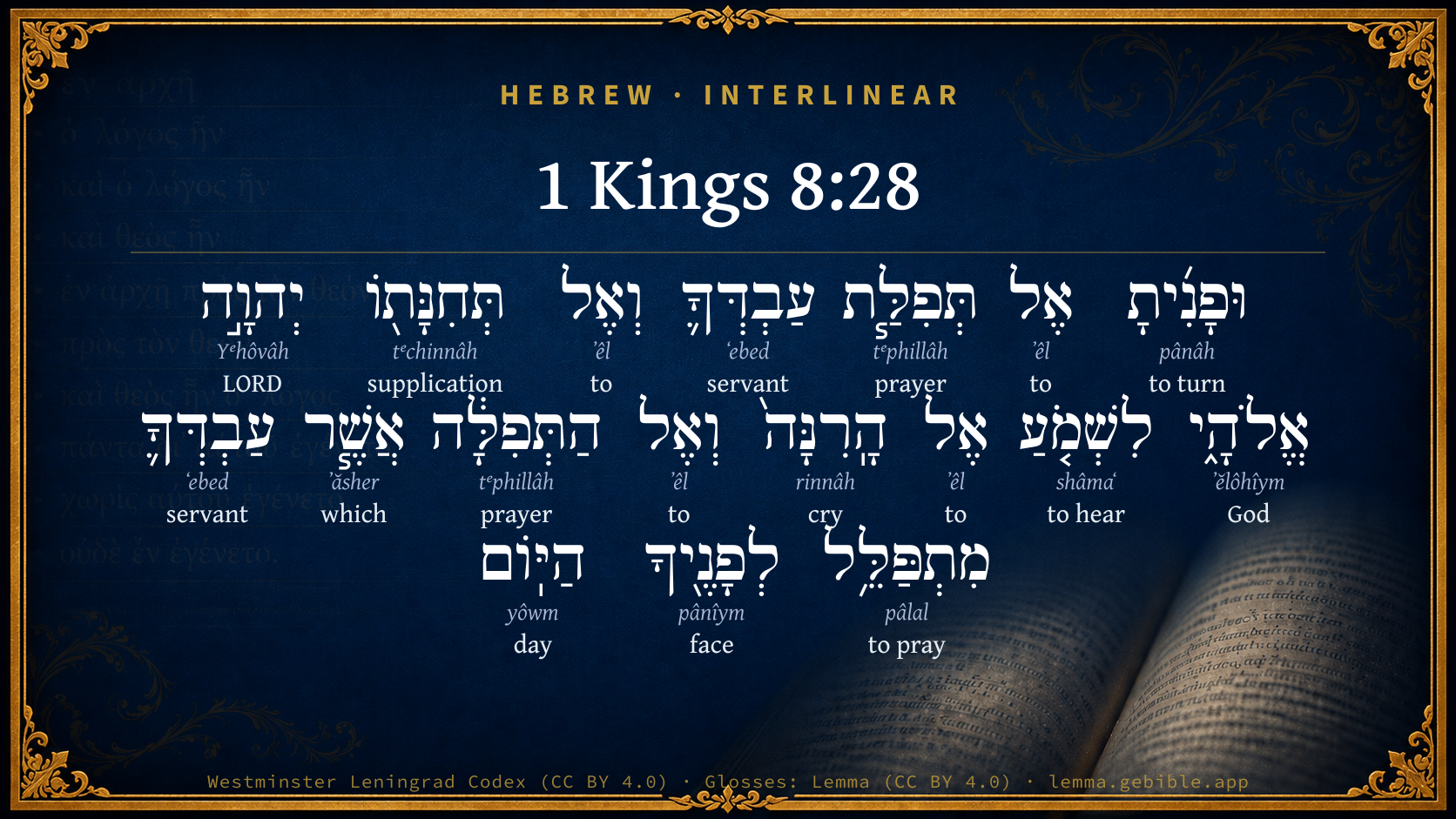
Hebrew (Westminster Leningrad Codex) 1 Kings 8:28 appears in the Hebrew Old Testament. The text above is from the Westminster Leningrad Codex. Each word links to its Strong’s number, a concise gloss, and parsing drawn from the Open Scriptures Hebrew Bible morphology. Click any word for its full Brown-Driver-Briggs (BDB) entry.
Download image
Cite this verse

1 Kings 8:28 (World English Bible). Public Domain. Lemma interlinear Bible study tool, https://lemma.gebible.app/v/1-kings/8/28.

Show BibTeX & RIS
BibTeX
RIS
English Translation
Yet have respect for the prayer of your servant, and for his supplication, Yahweh my God, to listen to the cry and to the prayer which your servant prays before you this day;
World English Bible · Public Domain
Highlights
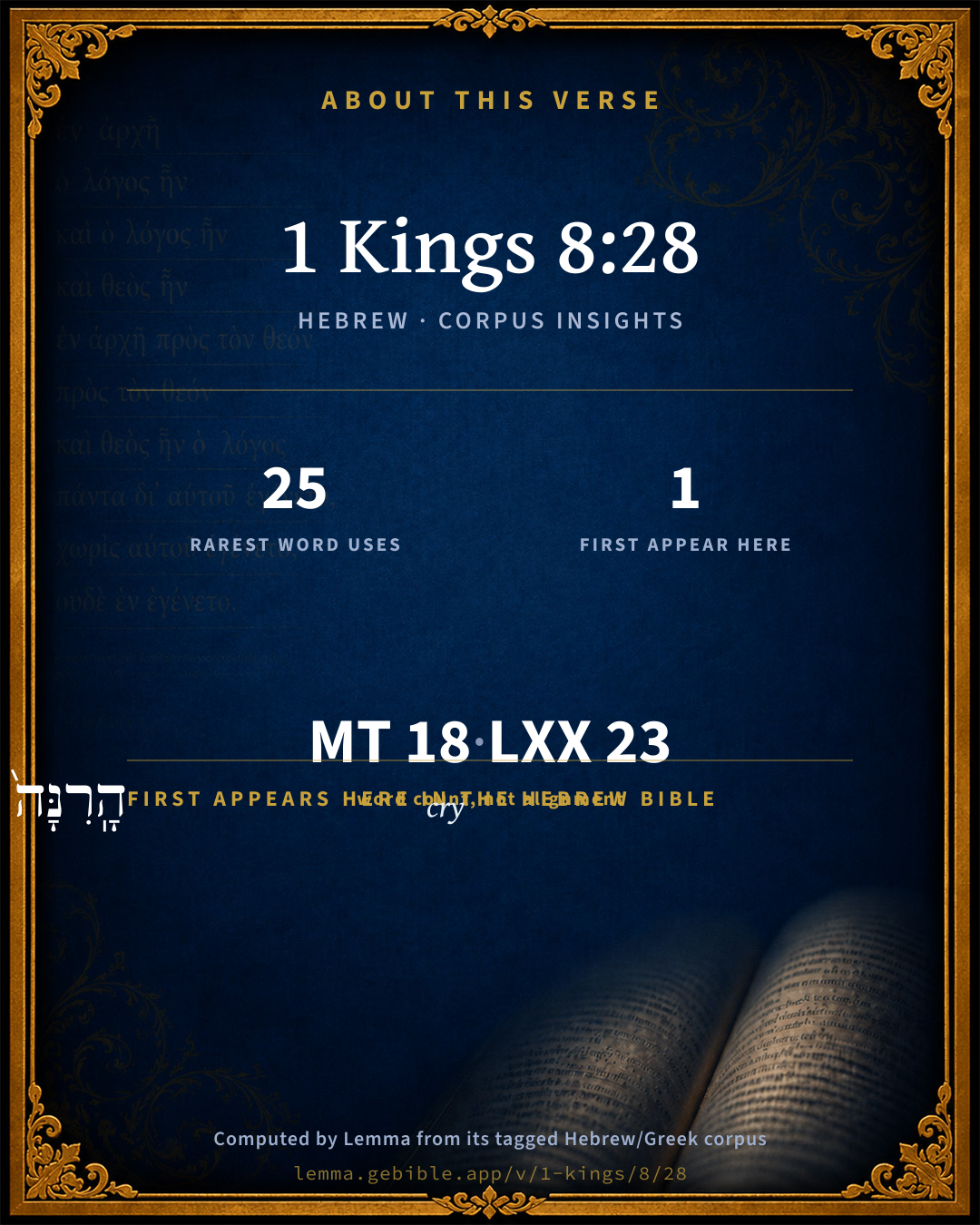
  • 1 first appearance in the Hebrew Bible
Full analysis ↓
Download a study sheet

One document with this verse’s original text, its word-by-word gloss line, the meaning frame, cross-references with their text, attributed commentary, and full source and license credits — printable, and it pastes into notes with its structure intact.

This verse Autodidact and up

Study sheet (.html) Plain text (.txt)

A passage Seminary Student

Up to 50 verses in one chapter. A passage sheet keeps up to 6 commentary sources and 12 cross-references per verse, in the order this page ranks them, and says so on the sheet whenever that leaves anything out. Ask for a single verse and you get the Autodidact verse sheet above.

Everything on this page stays free to read, with no account — the sheet is a download of what is already on screen, not access to it.

Want to remove ads? Support Godless Engineer
Compare translations 3

The same verse in 3 English versions, stacked beneath the original-language interlinear above. Click any original word for its lexicon entry.

Each is an independent rendering of the whole verse — the interlinear is not word-aligned to these translations.

Highlighted words mark where these versions differ — a whole-verse word diff, not a word-by-word alignment.

  • World English Bible Public Domain
    Yet have respect for the prayer of your servant, and for his supplication, Yahweh my God, to listen to the cry and to the prayer which your servant prays before you this day;
  • King James Version Public Domain
    Yet have thou respect unto the prayer of thy servant, and to his supplication, O LORD my God, to hearken unto the cry and to the prayer, which thy servant prayeth before thee to day:
  • unfoldingWord Literal Text CC BY-SA 4.0
    Yet may you turn to the prayer of your servant and to his supplication, Yahweh my God, to listen to the cry and to the prayer that your servant is praying to your face today,

unfoldingWord Literal Text — © unfoldingWord, licensed CC BY-SA 4.0. Word-aligned USFM3 via Door43 (git.door43.org/unfoldingWord/en_ult).

Versions to compare (up to 4)

3 of 4 selected

Show all 18 translations

Every available English version of this verse, each an independent rendering of the whole verse.

  • World English Bible Public Domain
    Yet have respect for the prayer of your servant, and for his supplication, Yahweh my God, to listen to the cry and to the prayer which your servant prays before you this day;
  • Berean Standard Bible Public Domain
    Yet regard the prayer and plea of Your servant, O LORD my God, so that You may hear the cry and the prayer that Your servant is praying before You today.
  • Majority Standard Bible Public Domain
    Yet regard the prayer and plea of Your servant, O LORD my God, so that You may hear the cry and the prayer that Your servant is praying before You today.
  • King James Version Public Domain
    Yet have thou respect unto the prayer of thy servant, and to his supplication, O LORD my God, to hearken unto the cry and to the prayer, which thy servant prayeth before thee to day:
  • American Standard Version (1901) Public Domain
    Yet have thou respect unto the prayer of thy servant, and to his supplication, O Jehovah my God, to hearken unto the cry and to the prayer which thy servant prayeth before thee this day;
  • Revised Version (1885) Public Domain
    Yet have thou respect unto the prayer of thy servant, and to his supplication, O LORD my God, to hearken unto the cry and to the prayer which thy servant prayeth before thee this day:
  • Geneva Bible (1599) Public Domain
    But haue thou respect vnto the prayer of thy seruant, and to his supplication, O Lord, my God, to heare the cry and prayer which thy seruant prayeth before thee this day:
  • Douay-Rheims (1899) Public Domain
    But have regard to the prayer of thy servant, and to his supplications, O Lord my God: hear the hymn and the prayer, which thy servant prayeth before thee this day:
  • Young's Literal Translation Public Domain
    `Then thou hast turned unto the prayer of Thy servant, and unto his supplication, O Jehovah my God, to hearken unto the cry and unto the prayer which Thy servant is praying before Thee to-day,
  • Literal Standard Version CC BY-SA 4.0
    Then You have turned to the prayer of Your servant, and to his supplication, O YHWH my God, to listen to the cry and to the prayer which Your servant is praying before You today,
  • Unlocked Literal Bible CC BY-SA 4.0
    Yet please respect this prayer of your servant and his request, Yahweh my God; listen to the cry and prayer that your servant prays before you today.
  • unfoldingWord Literal Text CC BY-SA 4.0
    Yet may you turn to the prayer of your servant and to his supplication, Yahweh my God, to listen to the cry and to the prayer that your servant is praying to your face today,
  • Darby Bible Public Domain
    Yet have respect unto the prayer of thy servant, and to his supplication, Jehovah, my God, to hearken unto the cry and to the prayer which thy servant prayeth before thee this day;
  • World Messianic Bible Public Domain
    Yet have respect for the prayer of your servant and for his supplication, LORD my God, to listen to the cry and to the prayer which your servant prays before you today;
  • Webster's Bible Public Domain
    Yet have thou respect to the prayer of thy servant, and to his supplication, O LORD my God, to hearken to the cry and to the prayer, which thy servant prayeth before thee this day:
  • Free Bible Version CC BY-SA 4.0
    Please hear the prayer of your servant and his request, Lord my God. Please hear the appeals and the prayers that your servant is presenting before you today.
  • Bible in Basic English Public Domain
    Still, let your heart be turned to the prayer of your servant, O Lord God, and to his prayer for grace; give ear to the cry and the prayer which your servant sends up to you this day;
  • JPS Tanakh (1917) Public Domain
    Yet have Thou respect unto the prayer of Thy servant, and to his supplication, O LORD my God, to hearken unto the cry and to the prayer which Thy servant prayeth before Thee this day;

Literal Standard Version (2020), Covenant Press — licensed CC BY-SA 4.0. Text via the HelloAO Bible API (eBible.org). Unlocked Literal Bible (unfoldingWord) — licensed CC BY-SA 4.0. Text via the HelloAO Bible API (eBible.org). unfoldingWord Literal Text — © unfoldingWord, licensed CC BY-SA 4.0. Word-aligned USFM3 via Door43 (git.door43.org/unfoldingWord/en_ult). Free Bible Version, Dr. Jonathan Gallagher — licensed CC BY-SA 4.0. Text via the HelloAO Bible API (eBible.org).

Word by word

More ways to search: Search by grammar → Find every occurrence → Compare this word →

Practice this passage: Drill this verse → Learn its vocabulary →

תְּחִנָּת֖וֹ
tᵉchinnâh
H8467
“supplication · his”
Noun, Common, Feminine, Singular, Construct + Suffix, Personal, 3rd Person, Masculine, Singular
Part of Speech
Noun
Type
Common
Gender
Feminine
Number
Singular
State
Construct
Full BDB Definition

Origin: from H2603

TWOT: 694f

favour, supplication, supplication for favour - favour - supplication for favour
  1. וּפָנִ֜יתָ pânâh H6437 “and · to turn” Conjunction + Verb, Qal, Sequential Perfect, 2nd Person, Masculine, Singular
  2. אֶל ʼêl H413 “to” Preposition
  3. תְּפִלַּ֧ת tᵉphillâh H8605 “prayer of” Noun, Common, Feminine, Singular, Construct
  4. עַבְדְּךָ֛ ʻebed H5650 “servant · your” Noun, Common, Masculine, Singular, Construct + Suffix, Personal, 2nd Person, Masculine, Singular
  5. וְאֶל ʼêl H413 “and · to” Conjunction + Preposition
  6. יְהוָ֣ה Yᵉhôvâh H3068 “LORD” Noun, Proper
  7. אֱלֹהָ֑י ʼĕlôhîym H430 “God(s) · my” Noun, Common, Masculine, Plural, Construct + Suffix, Personal, 1st Person, Common, Singular
  8. לִשְׁמֹ֤עַ shâmaʻ H8085 “to hear” Preposition + Verb, Qal, Infinitive Construct
  9. אֶל ʼêl H413 “to” Preposition
  10. הָֽרִנָּה֙ rinnâh H7440 “the · cry” Particle, Definite Article + Noun, Common, Feminine, Singular, Absolute
  11. וְאֶל ʼêl H413 “and · to” Conjunction + Preposition
  12. הַתְּפִלָּ֔ה tᵉphillâh H8605 “the · prayer” Particle, Definite Article + Noun, Common, Feminine, Singular, Absolute
  13. אֲשֶׁ֧ר ʼăsher H834 “which” Particle, Relative
  14. עַבְדְּךָ֛ ʻebed H5650 “servant · your” Noun, Common, Masculine, Singular, Construct + Suffix, Personal, 2nd Person, Masculine, Singular
  15. מִתְפַּלֵּ֥ל pâlal H6419 “praying” Verb, Hithpael, Participle Active, Masculine, Singular, Absolute
  16. לְפָנֶ֖יךָ pânîym H6440 “to/for · face(s) · your” Preposition + Noun, Common, Both, Plural, Construct + Suffix, Personal, 2nd Person, Masculine, Singular
  17. הַיּֽוֹם yôwm H3117 “the · day” Particle, Definite Article + Noun, Common, Masculine, Singular, Absolute

About this verse

These counts appear in no published source. They are computed here, from the morphology-tagged text and Lemma’s own curated glosses. What Lemma adds →

18
words
13
distinct lemmas
Historical
section

Notable vocabulary

The rarest word here is תְּחִנָּת֖וֹ supplication H8467 — appearing just 25 times in the whole Hebrew Bible.

First appearance in Scripture

This word makes its first canonical appearance in the Hebrew Bible here:

  • הָֽרִנָּה֙ cry H7440

Shared distinctive vocabulary

תְּחִנָּת֖וֹ supplication H8467 occurs in 24 verses of the Hebrew Bible. Also found in:

Grammatical profile

  • 3 verbs
  • 10 nouns
  • 4 prepositions
  • 1 particle

Verb forms

  • וּפָנִ֜יתָ Qal · Sequential Perfect
  • לִשְׁמֹ֤עַ Qal · Infinitive Construct
  • מִתְפַּלֵּ֥ל Hithpael · Participle Active

Repetition

Words recur within this verse — often emphatic in Hebrew:

  • תְּפִלַּ֧ת prayer H8605 ×2
  • עַבְדְּךָ֛ servant H5650 ×2
  • אֶל to H413 ×4

Hebrew & Septuagint length

In English translation the verse runs 33 words from the Hebrew and 27 from the Septuagint (LXX English) — closely comparable.

A rough comparison of the two English renderings, which tokenize alike — not a word-level alignment.

Word counts can differ between the Hebrew and the Greek without any difference in meaning — e.g. the Hebrew direct-object marker אֵת has no separate Greek word, and Greek often adds the article ὁ.

In the original languages it is 18 Hebrew tokens and 23 Greek tokens — but the two are counted differently (Hebrew bundles its prefixes and suffixes into one token; the Greek is in lemma form), so that isn’t a like-for-like length.

Cross-references

10

Topical passages linked to 1 Kings 8:28 in the Treasury of Scripture Knowledge — connected by theme and wording, ordered by reader-vote popularity; previews shown in the World English Bible.

  • 2 Chronicles 6:19 Yet have you respect to the prayer of your servant, and to his supplication, Yahweh my God, to listen to the cry and to the prayer which your servant prays before you;
  • Psalms 4:1 Answer me when I call, God of my righteousness. Give me relief from my distress. Have mercy on me, and hear my prayer.
  • Psalms 5:1 Give ear to my words, Yahweh. Consider my meditation.
  • Psalms 86:3 Be merciful to me, Lord, For I call to you all day long.
  • Psalms 88:1–2 Yahweh, the God of my salvation, I have cried day and night before you.
  • Psalms 141:2 Let my prayer be set before you like incense; The lifting up of my hands like the evening sacrifice.
  • Daniel 9:17–19 Now therefore, our God, listen to the prayer of your servant, and to his petitions, and cause your face to shine on your sanctuary that is desolate, for the Lord's sake.
  • Luke 18:1 He also spoke a parable to them that they must always pray, and not give up,
  • Luke 18:7 Won't God avenge his chosen ones, who are crying out to him day and night, and yet he exercises patience with them?
  • Psalms 86:6–7 Hear, Yahweh, my prayer. Listen to the voice of my petitions.

Cross-references courtesy of OpenBible.info (CC BY 4.0).

Hebrew and Greek witnesses Masoretic Hebrew ↔ Greek Septuagint

The same verse in the two great witnesses to the Old Testament, shown verse-for-verse.

These are two independent witnesses, not word-aligned to each other, and the Septuagint is shown in lemma (dictionary) form.

Hebrew 1 Kings 8:28 Masoretic · Westminster Leningrad Codex

וּפָנִ֜יתָ אֶל תְּפִלַּ֧ת עַבְדְּךָ֛ וְאֶל תְּחִנָּת֖וֹ יְהוָ֣ה אֱלֹהָ֑י לִשְׁמֹ֤עַ אֶל הָֽרִנָּה֙ וְאֶל הַתְּפִלָּ֔ה אֲשֶׁ֧ר עַבְדְּךָ֛ מִתְפַּלֵּ֥ל לְפָנֶ֖יךָ הַיּֽוֹם

Yet have respect for the prayer of your servant, and for his supplication, Yahweh my God, to listen to the cry and to the prayer which your servant prays before you this day;

World English Bible · Public Domain

Greek LXX 1 Kings 8:28 Septuagint · lemma form

καί ἐπιβλέπω ἐπί ὁ δέησις ἐγώ κύριος ὁ θεός ἰσραήλ ἀκούω ὁ τέρψις ὅς ὁ δοῦλος σύ προςεὔχομαι ἐνώπιον σύ πρός σύ σήμερον

Yet, O Lord God of Israel, you shall look upon my petition, to hear the prayer which your servant prays to you in your presence this day,

LXX2012 (modern English Septuagint) · Public Domain

Hebrew: Westminster Leningrad Codex (CC BY 4.0). Greek: Septuagint (public domain); English from LXX2012 (modern English Septuagint) (Public Domain). How the Septuagint differs from the Hebrew →

Targum (Aramaic paraphrase)

1

The Targum is the ancient Jewish Aramaic paraphrase of the Hebrew Scriptures — an interpretive translation, not the Hebrew text itself. Onkelos (literal) and Pseudo-Jonathan (expansive) render the Torah, and Jonathan the Prophets. Coverage is partial: where no permissively-licensed English translation exists for a verse, only the Aramaic is shown. This is verse-level text, not a word-by-word alignment to the Hebrew.

  1. Targum Jonathan Prophets (Joshua–Malachi)
    וְתִתְפְּנֵי לִצְלוֹתָא דְעַבְדָךְ וּלְבָעוּתֵיהּ יְיָ אֱלֹהָי לְקַבָּלָא צְלוֹתָא וּבָעוּתָא דְעַבְדָךְ מְצַלֵי קָדָמָךְ יוֹמָא דֵין:

    (no public-domain English translation for this verse)

    Targum Jonathan — Aramaic: “Mikraot Gedolot” (public domain). English: “Sefaria Community Translation” (CC0 1.0 (public-domain dedication)); “London "Chaldee Paraphrase," 1871” (public domain). Text via Sefaria.

Commentary

Notes on 1 Kings 8:28 from classic Christian and Jewish commentators (each source and its license shown beneath its notes). The classic Christian expositions comment on the surrounding passage and are grouped to its opening verse, so a note may address several verses; the Jewish commentaries on the Tanakh (Rashi and others) are per-verse, so they appear only where the commentator wrote on this verse.

Lemma curates 59 commentaries, every one of them public domain or Creative Commons licensed, each selected and text-cleaned for this edition rather than reprinted as found. About our sources →

Trapp's Complete Commentary

John Trapp

1Ki 8:28 Yet have thou respect unto the prayer of thy servant, and to his supplication, O LORD my God, to hearken unto the cry and to the prayer, which thy servant prayeth before thee to day:

Ver. 28. Yet have thou respect,] q.d., Though thou art immense and infinite in thine own nature, yet, &c.

And to his supplication.] Or, Deprecation.

John Trapp, A Commentary or Exposition upon All the Books of the Old and New Testament (1647–1656) — public domain. Text from a community e-Sword module.

Joseph Benson's Commentary

1Ki 8:28-29. Yet have thou respect, &c. — Though thou art not comprehended within this place, yet show thyself to be graciously present here, by accepting and granting my present request here offered unto thee. That thine eyes may be open toward this house — To behold it with favourable regards, and have a gracious respect unto all that come to present their petitions here. Thou hast said, My name shall be there — My presence, glory, and grace. Hearken to the prayer which thy servant shall make toward this place — This temple, to which Solomon now looked, and to which he directs the people to look in their prayers. Not as if he thought all the devout prayers, offered up to God by those who had no knowledge of this house, or regard to it, were therefore rejected; but he desired that the sensible tokens of the divine presence, with which this house was blessed, might always give sensible encouragement and comfort to believing petitioners.

Joseph Benson's Commentary on the Old and New Testaments (1811–1818) — public domain. Text from a community e-Sword module.

The Cambridge Bible for Schools and Colleges

gen. ed. J. J. S. Perowne

28. Yet have thou respect] Literally the Hebrew is “Yet thou wilt have respect.” The tense is chosen to intimate the assurance in the mind of the king that the prayers made will be answered.

The Cambridge Bible for Schools and Colleges (gen. ed. J. J. S. Perowne; Cambridge University Press, 1878–1918) — public domain. Text from a community e-Sword module.

John Gill's Exposition

Yet have thou respect to the prayer of thy servant, and to his supplication, O Lord my God,.... Meaning himself, who, though a king acknowledged himself, and esteemed it an honour to be the servant of the Lord, and who was also an humble suppliant of his, and desired his prayers and supplications might be attended to:

to hearken unto the cry and to the prayer which thy servant prayeth before thee this day; the particulars of which follow.

John Gill's Exposition of the Whole Bible (1746–1763) — public domain (CC PDM 1.0). Text via the HelloAO Bible API.

Matthew Poole's English Annotations

Though thou art not comprehended within this place, yet show thyself to be graciously present here, by accepting and granting my present requests here tendered unto thee.

Matthew Poole's English Annotations on the Holy Bible (1683–1685) — public domain. Text from a community e-Sword/MySword module.

The Pulpit Commentary

Yet have thou respect unto the prayer of thy servant = the prayer I now offer, which is that thou wilt hear all future prayers offered here, mine and my people"s and to his supplication, O Lord my God, to hearken unto the cry and to the prayer Three words are used here, hlpiT hNjiT, and hN; r. The first (from llpthi, precatus est; see ver. 29) is apparently a general term for prayer; the second (from nj propitius fuit) is properly a cry for mercy; hence an earnest prayer or supplication; while the third signifies a joyful cry; hence a mournful cry or prayer which thy servant prayeth before thee today.

The Prayer of Dedication.

Describe the scene at the dedication of the temple. Note the fact that it is a king who leads his people to God"s footstool. Show the influence of earthly rulers, who not only affect surrounding nations by their policy, but degrade or exalt the moral life of their people by their personal character, and by the tone of their court. Our reasons for thankfulness in the present reign. Contrast the influence of Victoria with that of Charles II or George IV Apply the same principle to other kings of men, i.e., to rulers of thought in literature and science. How heavy the responsibility of those who use their kingliness to lead men from God into the dreariness of scepticism; how glorious the powers they may employ to exalt the Lord our God. Solomon is a proof that wisdom is better than knowledge. On this occasion he prayed as the representative and leader of others. A prayer so prominent in Scripture, so remarkable in circumstances, so acceptable to God, deserves consideration, that we may see its elements. It presents the following characteristics:

I GRATEFUL ACKNOWLEDGMENT OF THE PAST. "In everything give thanks". 1Th_5:18) "By prayer and supplication, with thanksgiving, make your requests known". (Php_4:6) "It is a good thing to give thanks unto the Lord". (Psa_92:1) "Bless the Lord, O my soul, and forget not all his benefits" (Psa_103:2) Notice the causes of Solomon"s thanksgiving:

(1) God"s goodness to his father (ver. 24). Home blessings so wholly unmerited, so richly beneficial.

(2) Divine deliverance from bondage (ver. 51). Egypt a type of sorrow, slavery to evil habit, etc.

(3) Separation and consecration for God"s purposes (ver. 53). The honor of this. Its responsibilities. Its signs.

(4) Rest and quietude (ver. 56). "He hath given rest unto his people Israel." The blessedness of peace to a country, exemplified by the contrast between Solomon"s and David"s reigns. The freedom from harassing anxieties experienced by many is from God. The rest of heart, which may be ours amidst the distresses of life, is from Him. "Peace I leave with you". (Joh_14:27) "Heart quiet from the fear of evil". (Pro_1:8) See also 2Co_4:8. For all such blessings we should give God thanks.

II CONFIDENCE IN THE PROMISES. (See ver. 29 as example.) Show how the patriarchs ever reminded God of His promises. Illustrate also from the pleadings of Moses and the prophets. Prove from Christ"s own words that the promises are renewed and enlarged for us, and that only on them cat. our expectancy of blessing be founded. The utility of prayer cannot be demonstrated by reason, but by revelation. In the spiritual realm we know Divine laws by Divine declaration, the truth of which is confirmed by the experience of those who fulfilling the required conditions, test them. "Ask and it shall be given you" (Mat_7:7) is a promise. But appended to it is the requirement of faith. "Without faith it is impossible to please God". (Heb_11:6) "According to your faith, so be it unto you." See also Jam_1:5-7 Mat_21:22, etc.

III ENLARGEMENT OF HEART (ver. 41, "moreover concerning a stranger," etc.) The prayer is remarkable on the part of a Jewish king. Give evidences of the narrowness and selfishness of the nation. We might expect this feeling in all its intensity on such an occasion as the consecration of this temple. But Solomon"s sympathies overflowed national prejudices. The tendency of prayer is to enlarge the heart. Christians pray together who never work together. They who are nearest to God"s throne are nearest to each other. As we pray, our yearnings go further afield, and we think kindly of the erring, pitifully of the lost, forgivingly of the wrong doers.

IV LONGING FOR THE GLORY OF GOD. Solomon"s chief wish in regard to the temple is expressed in verse 60, "that all the people of the earth may know that the Lord is God, and that there is none else." Our Lord"s prayer is like Solomon"s in this, that it ends in an ascription of "the kingdom, and the power, and the glory," to God. So with all true prayer. It ends in praise. See how David, in the Psalms, prayed himself out of sadness into joy; out of confession into thankfulness and praise. If we ask something for ourselves, or for others, it should be with the implied wish that it may be granted or withheld, as may be, for our welfare and God"s glory. The yearning of each Christian should be that of the Lord Jesus, "Father, glorify thy name. A.R.

The Pulpit Commentary (1880–1919), ed. H.D.M. Spence-Jones & Joseph S. Exell — public domain. Text from a community e-Sword module.

John Wesley's Explanatory Notes

Yet - Tho' thou art not comprehended within this place, yet shew thyself to be graciously present here, by accepting and granting my present requests here tendered unto thee.

John Wesley, Explanatory Notes Upon the Whole Bible (1754–1765) — public domain. Text via the GEBible commentary corpus.

Lesson kit

Teaching starters — assembled from the data on this page, not authored interpretation. Every prompt links to the verse data it draws on. Edit before teaching.

1 Kings, in the Historical, opens this verse with 18 words (13 distinct Hebrew lemmas). Its most distinctive word is tᵉchinnâh (“supplication”). A historical commentator’s framing appears above. Read the whole chapter for the surrounding context.

Discussion questions

  1. How does “supplication” (tᵉchinnâh) shape what this verse is saying?
  2. This is the first place “cry” appears in Scripture (first appears here). What does its debut here establish?
  3. How does Joshua 11:20, which shares the word «supplication», read alongside this verse?
  4. What does the repetition of “prayer” (2× in this one verse) do in this verse?
  5. The translations on this page render this verse differently — a whole-verse word diff, not a word-by-word alignment. What might account for the different wordings?
  6. «וּפָנִ֜יתָ» is a Qal Sequential Perfect verb. How does that grammatical form shape the action described?
  7. Compare how Trapp's Complete Commentary and Joseph Benson's Commentary read this verse. Where do they agree or differ?

Things to notice

Reading settings

Reading text

Shown beneath each verse's original-language words.

Old Testament
Old Testament edition

Read the OT as the Masoretic Hebrew (MT) or the Greek Septuagint (LXX).

English shown for the Greek Septuagint (in the Hebrew ↔ Greek comparison).

Comparing translations? Open the Compare panel on any verse page to stack up to four side by side.