Judges 9:26

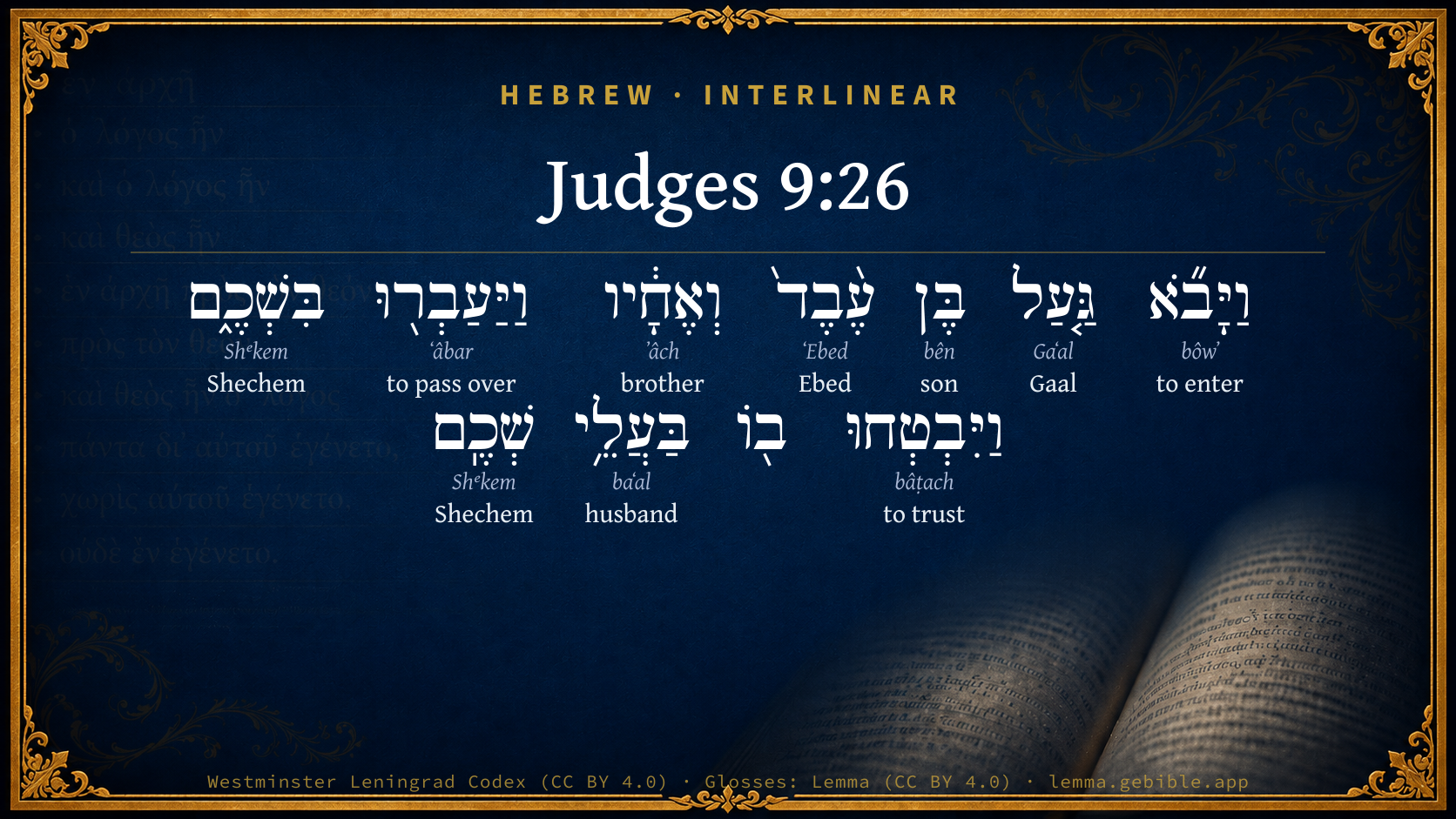
Hebrew (Westminster Leningrad Codex) Judges 9:26 appears in the Hebrew Old Testament. The text above is from the Westminster Leningrad Codex. Each word links to its Strong’s number, a concise gloss, and parsing drawn from the Open Scriptures Hebrew Bible morphology. Click any word for its full Brown-Driver-Briggs (BDB) entry.
Download image
Cite this verse

Judges 9:26 (World English Bible). Public Domain. Lemma interlinear Bible study tool, https://lemma.gebible.app/v/judges/9/26.

Show BibTeX & RIS
BibTeX
RIS
English Translation
Gaal the son of Ebed came with his brothers, and went over to Shechem; and the men of Shechem put their trust in him.
World English Bible · Public Domain
Highlights
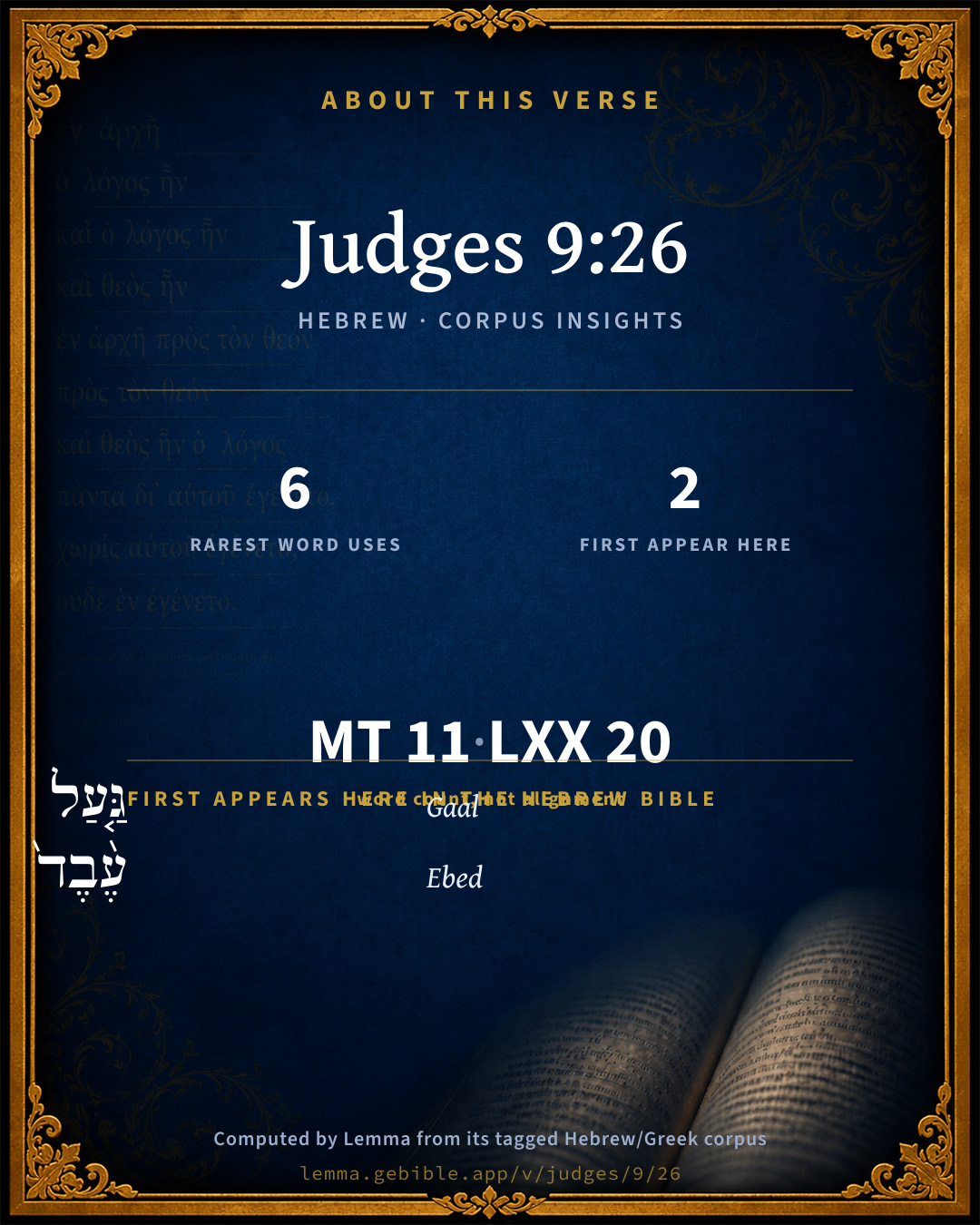
  • 2 first appearances in the Hebrew Bible
Full analysis ↓
Download a study sheet

One document with this verse’s original text, its word-by-word gloss line, the meaning frame, cross-references with their text, attributed commentary, and full source and license credits — printable, and it pastes into notes with its structure intact.

This verse Autodidact and up

Study sheet (.html) Plain text (.txt)

A passage Seminary Student

Up to 50 verses in one chapter. A passage sheet keeps up to 6 commentary sources and 12 cross-references per verse, in the order this page ranks them, and says so on the sheet whenever that leaves anything out. Ask for a single verse and you get the Autodidact verse sheet above.

Everything on this page stays free to read, with no account — the sheet is a download of what is already on screen, not access to it.

Want to remove ads? Support Godless Engineer
Compare translations 3

The same verse in 3 English versions, stacked beneath the original-language interlinear above. Click any original word for its lexicon entry.

Each is an independent rendering of the whole verse — the interlinear is not word-aligned to these translations.

Highlighted words mark where these versions differ — a whole-verse word diff, not a word-by-word alignment.

  • World English Bible Public Domain
    Gaal the son of Ebed came with his brothers, and went over to Shechem; and the men of Shechem put their trust in him.
  • King James Version Public Domain
    And Gaal the son of Ebed came with his brethren, and went over to Shechem: and the men of Shechem put their confidence in him.
  • unfoldingWord Literal Text CC BY-SA 4.0
    Then Gaal, the son of Ebed, came with his brothers and they went over into Shechem. And the lords of Shechem trusted in him.

unfoldingWord Literal Text — © unfoldingWord, licensed CC BY-SA 4.0. Word-aligned USFM3 via Door43 (git.door43.org/unfoldingWord/en_ult).

Versions to compare (up to 4)

3 of 4 selected

Show all 18 translations

Every available English version of this verse, each an independent rendering of the whole verse.

  • World English Bible Public Domain
    Gaal the son of Ebed came with his brothers, and went over to Shechem; and the men of Shechem put their trust in him.
  • Berean Standard Bible Public Domain
    Meanwhile, Gaal son of Ebed came with his brothers and crossed into Shechem, and the leaders of Shechem put their confidence in him.
  • Majority Standard Bible Public Domain
    Meanwhile, Gaal son of Ebed came with his brothers and crossed into Shechem, and the leaders of Shechem put their confidence in him.
  • King James Version Public Domain
    And Gaal the son of Ebed came with his brethren, and went over to Shechem: and the men of Shechem put their confidence in him.
  • American Standard Version (1901) Public Domain
    And Gaal the son of Ebed came with his brethren, and went over to Shechem; and the men of Shechem put their trust in him.
  • Revised Version (1885) Public Domain
    And Gaal the son of Ebed came with his brethren, and went over to Shechem: and the men of Shechem put their trust in him.
  • Geneva Bible (1599) Public Domain
    Then Gaal the sonne of Ebed came with his brethren, and they went to Shechem: and the men of Shechem put their confidence in him.
  • Douay-Rheims (1899) Public Domain
    And Gaal the son of Obed came with his brethren, and went over to Sichem. And the inhabitants of Sichem taking courage at his coming,
  • Young's Literal Translation Public Domain
    And Gaal son of Ebed cometh -- also his brethren -- and they pass over into Shechem, and the masters of Shechem trust in him,
  • Literal Standard Version CC BY-SA 4.0
    And Gaal son of Ebed comes—also his brothers—and they pass over into Shechem, and the masters of Shechem trust in him,
  • Unlocked Literal Bible CC BY-SA 4.0
    Gaal son of Ebed came with his relatives and they went over to Shechem. The leaders of Shechem had confidence in him.
  • unfoldingWord Literal Text CC BY-SA 4.0
    Then Gaal, the son of Ebed, came with his brothers and they went over into Shechem. And the lords of Shechem trusted in him.
  • Darby Bible Public Domain
    And Ga'al the son of Ebed moved into Shechem with his kinsmen; and the men of Shechem put confidence in him.
  • World Messianic Bible Public Domain
    Gaal the son of Ebed came with his brothers and went over to Shechem; and the men of Shechem put their trust in him.
  • Webster's Bible Public Domain
    And Gaal the son of Ebed came with his brethren, and went over to Shechem: and the men of Shechem put their confidence in him.
  • Free Bible Version CC BY-SA 4.0
    Gaal, son of Ebed, had moved to Shechem with his relatives, and he gained the loyalty of the leaders of Shechem.
  • Bible in Basic English Public Domain
    Then Gaal, the son of Ebed, came with his brothers, and went over to Shechem; and the men of Shechem put their faith in him.
  • JPS Tanakh (1917) Public Domain
    And Gaal the son of Ebed came with his brethren, and went on to Shechem; and the men of Shechem put their trust in him.

Literal Standard Version (2020), Covenant Press — licensed CC BY-SA 4.0. Text via the HelloAO Bible API (eBible.org). Unlocked Literal Bible (unfoldingWord) — licensed CC BY-SA 4.0. Text via the HelloAO Bible API (eBible.org). unfoldingWord Literal Text — © unfoldingWord, licensed CC BY-SA 4.0. Word-aligned USFM3 via Door43 (git.door43.org/unfoldingWord/en_ult). Free Bible Version, Dr. Jonathan Gallagher — licensed CC BY-SA 4.0. Text via the HelloAO Bible API (eBible.org).

Word by word

More ways to search: Search by grammar → Find every occurrence → Compare this word →

Practice this passage: Drill this verse → Learn its vocabulary →

עֶ֨בֶד֙
ʻEbed
H5651
“Ebed”
Noun, Proper
Part of Speech
Noun
Type
Proper
Full BDB Definition

Origin: the same as H5650

TWOT: None

Ebed = "servant" - father of Gaal in the time of the judges - son of Jonathan and one of the sons of Adin who returned from exile with Ezra
  1. וַיָּבֹ֞א bôwʼ H935 “and · to enter” Conjunction + Verb, Qal, Sequential Imperfect, 3rd Person, Masculine, Singular
  2. גַּ֤עַל Gaʻal H1603 “Gaal” Noun, Proper
  3. בֶּן bên H1121 “son of” Noun, Common, Masculine, Singular, Construct
  4. וְאֶחָ֔יו ʼâch H251 “and · brothers · his” Conjunction + Noun, Common, Masculine, Plural, Construct + Suffix, Personal, 3rd Person, Masculine, Singular
  5. וַיַּעַבְר֖וּ ʻâbar H5674 “and · to pass over” Conjunction + Verb, Qal, Sequential Imperfect, 3rd Person, Masculine, Plural
  6. בִּשְׁכֶ֑ם Shᵉkem H7927 “in/at · Shechem” Preposition + Noun, Proper
  7. וַיִּבְטְחוּ bâṭach H982 “and · to trust” Conjunction + Verb, Qal, Sequential Imperfect, 3rd Person, Masculine, Plural
  8. בַּעֲלֵ֥י baʻal H1167 “husbands of” Noun, Common, Masculine, Plural, Construct
  9. שְׁכֶֽם Shᵉkem H7927 “Shechem” Noun, Proper

About this verse

These counts appear in no published source. They are computed here, from the morphology-tagged text and Lemma’s own curated glosses. What Lemma adds →

11
words
9
distinct lemmas
Historical
section

Notable vocabulary

The rarest word here is עֶ֨בֶד֙ Ebed H5651 — appearing just 6 times in the whole Hebrew Bible.

First appearance in Scripture

These words make their first canonical appearance in the Hebrew Bible here:

  • גַּ֤עַל Gaal H1603
  • עֶ֨בֶד֙ Ebed H5651

Shared distinctive vocabulary

עֶ֨בֶד֙ Ebed H5651 occurs in 6 verses of the Hebrew Bible. Also found in:

Grammatical profile

  • 3 verbs
  • 7 nouns
  • 1 preposition

Verb forms

  • וַיָּבֹ֞א Qal · Sequential Imperfect
  • וַיַּעַבְר֖וּ Qal · Sequential Imperfect
  • וַיִּבְטְחוּ Qal · Sequential Imperfect

Repetition

A word recurs within this verse — often emphatic in Hebrew:

  • בִּשְׁכֶ֑ם Shechem H7927 ×2

Hebrew & Septuagint length

In English translation the verse runs 24 words from the Hebrew and 21 from the Septuagint (LXX English) — closely comparable.

A rough comparison of the two English renderings, which tokenize alike — not a word-level alignment.

Word counts can differ between the Hebrew and the Greek without any difference in meaning — e.g. the Hebrew direct-object marker אֵת has no separate Greek word, and Greek often adds the article ὁ.

In the original languages it is 11 Hebrew tokens and 20 Greek tokens — but the two are counted differently (Hebrew bundles its prefixes and suffixes into one token; the Greek is in lemma form), so that isn’t a like-for-like length.

Cross-references

2

Topical passages linked to Judges 9:26 in the Treasury of Scripture Knowledge — connected by theme and wording, ordered by reader-vote popularity; previews shown in the World English Bible.

  • Genesis 13:8 Abram said to Lot, "Please, let there be no strife between me and you, and between my herdsmen and your herdsmen; for we are relatives.
  • Genesis 19:7 He said, "Please, my brothers, don't act so wickedly.

Cross-references courtesy of OpenBible.info (CC BY 4.0).

Hebrew and Greek witnesses Masoretic Hebrew ↔ Greek Septuagint

The same verse in the two great witnesses to the Old Testament, shown verse-for-verse.

These are two independent witnesses, not word-aligned to each other, and the Septuagint is shown in lemma (dictionary) form.

Hebrew Judges 9:26 Masoretic · Westminster Leningrad Codex

וַיָּבֹ֞א גַּ֤עַל בֶּן עֶ֨בֶד֙ וְאֶחָ֔יו וַיַּעַבְר֖וּ בִּשְׁכֶ֑ם וַיִּבְטְחוּ ב֖וֹ בַּעֲלֵ֥י שְׁכֶֽם

Gaal the son of Ebed came with his brothers, and went over to Shechem; and the men of Shechem put their trust in him.

World English Bible · Public Domain

Greek LXX Judges 9:26 Septuagint · lemma form

καί ἔρχομαι γααλ υἱός ιωβηλ καί ὁ ἀδελφός αὐτός καί παραἔρχομαι ἐν σικιμα καί ἐλπίζω ἐν αὐτός ὁ ἀνήρ σικιμα

And Gaal son of Jobel came, and his brethren, and passed by Sicima, and the men of Sicima trusted in him.

LXX2012 (modern English Septuagint) · Public Domain

On this verse, The Cambridge Bible for Schools and Colleges discusses the Septuagint’s reading. Read the note in Commentary ↓

Hebrew: Westminster Leningrad Codex (CC BY 4.0). Greek: Septuagint (public domain); English from LXX2012 (modern English Septuagint) (Public Domain). How the Septuagint differs from the Hebrew →

Targum (Aramaic paraphrase)

1

The Targum is the ancient Jewish Aramaic paraphrase of the Hebrew Scriptures — an interpretive translation, not the Hebrew text itself. Onkelos (literal) and Pseudo-Jonathan (expansive) render the Torah, and Jonathan the Prophets. Coverage is partial: where no permissively-licensed English translation exists for a verse, only the Aramaic is shown. This is verse-level text, not a word-by-word alignment to the Hebrew.

  1. Targum Jonathan Prophets (Joshua–Malachi)
    וַאֲתָא גַעַל בַּר עֶבֶד וַאֲחוֹהִי וַעֲבָרוּ בִּשְׁכֶם וְאִתְרְחִיצוּ עֲלוֹהִי יָתְבֵי שְׁכֶם:

    (no public-domain English translation for this verse)

    Targum Jonathan — Aramaic: “Mikraot Gedolot” (public domain). English: “Sefaria Community Translation” (CC0 1.0 (public-domain dedication)); “London "Chaldee Paraphrase," 1871” (public domain). Text via Sefaria.

Commentary

Notes on Judges 9:26 from classic Christian and Jewish commentators (each source and its license shown beneath its notes). The classic Christian expositions comment on the surrounding passage and are grouped to its opening verse, so a note may address several verses; the Jewish commentaries on the Tanakh (Rashi and others) are per-verse, so they appear only where the commentator wrote on this verse.

Lemma curates 59 commentaries, every one of them public domain or Creative Commons licensed, each selected and text-cleaned for this edition rather than reprinted as found. About our sources →

The Cambridge Bible for Schools and Colleges

gen. ed. J. J. S. Perowne

26–41. Gaal stirs up the Shechemites: Abimelech defeats them

26. Gaal the son of Ebed] i.e. of a slave; but pronounce throughout Obed, with LXX. cod. B (Ιωβηλ for Ιωβηδ) and Vulgate; a common name. Gaal is described as a new-comer, whether an Israelite or a Canaanite is not clear. Jdg_9:26-33 seem to be parallel to Jdg_9:22-25; both narrate the rise of treason in Shechem, and both lead up to parallel accounts of Abimelech’s retaliation.

The Cambridge Bible for Schools and Colleges (gen. ed. J. J. S. Perowne; Cambridge University Press, 1878–1918) — public domain. Text from a community e-Sword module.

Trapp's Complete Commentary

John Trapp

Jdg 9:26 And Gaal the son of Ebed came with his brethren, and went over to Shechem: and the men of Shechem put their confidence in him.

Ver. 26. And Gaal the son of Ebed.] This thrasonical fellow, no less ambitious, subtle, and seditious than Abimelech, offereth to head the Shechemites, whom he saw to be at this time in a disorder, and to lead them against Abimelech.

Put their confidence in him.] As before they had done in Abimelech, {Jdg 9:15} and were now grown no whit wiser by what they had suffered, but ripened apace for utter ruin.

John Trapp, A Commentary or Exposition upon All the Books of the Old and New Testament (1647–1656) — public domain. Text from a community e-Sword module.

Joseph Benson's Commentary

Jdg 9:26. Gaal — It is not known who he was; but it is evident he was a man very considerable for wealth, and strength, and interest, and that he was ill pleased with Abimelech’s power. Went to Shechem — By his presence and counsel to animate and assist them against Abimelech.

Joseph Benson's Commentary on the Old and New Testaments (1811–1818) — public domain. Text from a community e-Sword module.

Jamieson, Fausset & Brown

Robert Jamieson, A. R. Fausset & David Brown

Gaal . . . came with his brethren . . ., and the men of Shechem put their confidence in him--An insurrection of the original Canaanites, headed by this man, at last broke out in Shechem.

Jamieson, Fausset & Brown — Commentary Critical and Explanatory on the Whole Bible (1871) — public domain (CC PDM 1.0). Text via the HelloAO Bible API.

Adam Clarke's Commentary

Verse 26. Gaal the son of Ebed] Of this person we know no more than is here told. He was probably one of the descendants of the Canaanites, who hoped from the state of the public mind, and their disaffection to Abimelech, to cause a revolution, and thus to restore the ancient government as it was under Hamor, the father of Shechem.

Adam Clarke's Commentary on the Bible (1810–1826) — public domain. Text from a community e-Sword/MySword module.

Ellicott's Commentary for English Readers

(26) Gaal the son of Ebed.—We are not told any further who he was; but the context leads us to infer that he was one of these freebooters, and probably belonged to the Canaanite population. His “brethren” may have formed the nucleus of a marauding band. Josephus says he was “a certain chief, with his soldiers and kinsmen.” For Ebed some MSS. and versions read Eber, and some Jobel. “Gaal Ben-Ebed” (“loathing son of a slave “) sounds like some contemptuous distortion of his real name.

Went over to Shechem.—Possibly he had been practising brigandage on the other side of the Jordan.

A Bible Commentary for English Readers, edited by Charles John Ellicott (1878–1897) — public domain. Text from a community e-Sword module.

John Gill's Exposition

Before they kept within the city, and durst not stir out to gather in the vintage, the time being come, for fear of the troops of Abimelech; for their lying in wait for him, and the robberies committed being made known to him, he had prepared to raise some forces, and attack them, of which they had had information; but now being encouraged with the protection of Gaal, they ventured out to gather their grapes in their vineyards without fear:

and trode the grapes, and made merry: sung songs and danced, as was usual at the ingathering of the fruits of the earth, and treading the winepress, Isa 16:10 though Abendana thinks this joy and merriment were made to their idol, to whom they gave the praise of their vintage, they should have done to the true God, and what follows may seem to confirm it:

and they went into the house of their god; the temple of Baalberith, Jdg 9:5.

and did eat and drink; in their idol temple, as was the manner of idolaters to do, bringing their firstfruits to rejoice, and make glad with:

and cursed Abimelech; wished they had never seen him and known him, hoped they should be rid of him in a little time, and that he would meet with his deserved disgrace and punishment; and this they did in that very temple from whence they had taken money to assist him in making way for his government of them; so fickle and changeable were they.

John Gill's Exposition of the Whole Bible (1746–1763) — public domain (CC PDM 1.0). Text via the HelloAO Bible API.

Albert Barnes' Notes on the Bible

It does not appear who Gaal, son of Ebed, was; he may have been an officer sent by Abimelech with a force to bring the men of Shechem back to their allegiance, but who tried to turn the rebellion to his own account. He got into Shechem with a band of men, “his brethren,” unopposed by Zebul, Abimelech’s officer, and soon gained the confidence of the Shechemites,

Albert Barnes' Notes on the Bible (1834–1885) — public domain. Text from a community e-Sword/MySword module.

Matthew Poole's English Annotations

It is not known who or of what tribe

Gaal was; but it is evident that he was a man very considerable for wealth, and strength, and counsel, and interest, and ill-pleased with Abimelech’s power.

Went over to Shechem, by his presence and counsel to animate and assist them against Abimelech.

Matthew Poole's English Annotations on the Holy Bible (1683–1685) — public domain. Text from a community e-Sword/MySword module.

Whedon's Commentary on the Bible

Daniel D. Whedon

26. Put their confidence in him — Entrusted him with the command of the rebellion, which he was but too ready to accept. Gaal seems to have been, as Keil expresses it, a sort of “knight-errant, who went about the country with his brethren, that is, as captain of a company of freebooters, and was welcomed in Shechem, because the Shechemites, who were dissatisfied with the rule of Abimelech, hoped to find in him a man who would be able to render them good service in their revolt from Abimelech.”

Daniel D. Whedon (gen. ed.), Commentary on the Old and New Testaments (1874–1909) — public domain. Text from a community e-Sword module.

The Pulpit Commentary

Gaal the son of Ebed. Who he was, or of what tribe or race he and his brethren were, we have no means of knowing; he seems to have been an adventurer who sought to turn the growing disaffection of the Shechemites to his own advantage by offering himself as a leader of the malcontents. Several MSS. and editions and versions read Eber for Ebed.

The Pulpit Commentary (1880–1919), ed. H.D.M. Spence-Jones & Joseph S. Exell — public domain. Text from a community e-Sword module.

John Wesley's Explanatory Notes

Gaal - It is not known who he was; but it is evident, he was a man very considerable for wealth, and strength and interest; and ill-pleased with Abimelech's power. Went to Shechem - By his presence and council to animate and assist them against Abimelech.

John Wesley, Explanatory Notes Upon the Whole Bible (1754–1765) — public domain. Text via the GEBible commentary corpus.

unfoldingWord translationNotes

Door43 World Missions Community

Gaal ... Ebed

These are names of men. (See: How to Translate Names)

had confidence in him

The word "confidence" is an abstract noun that can be stated with the verb "trust." AT: "trusted him" (See: Abstract Nouns)

They went out into the field

Here "They" refers to Gaal and his relatives and the men of Shechem.

they trampled on them

They did this to squeeze out the grape juice to make wine with it. (See: Assumed Knowledge and Implicit Information)

trampled

"crushed" or "stomped"

in the house

Here "house" represents a temple. (See: Metonymy)

translationWords

Shechem

confidence

grape

vineyard

festival

house

false god

curse

Abimelech

unfoldingWord translationNotes — © Distant Shores Media and the Door43 World Missions Community, licensed CC BY-SA 4.0. Source: git.door43.org/Door43/en_tn.

Rashi

Rabbi Shlomo Yitzchaki (Rashi)

Ga'al ben Eved. He was from another nation.

Rashi on the Tanakh — English translations: “The Judaica Press complete Tanach with Rashi, translated by A. J. Rosenberg” (CC BY 4.0); “Pentateuch with Rashi's commentary by M. Rosenbaum and A.M. Silbermann, 1929-1934” (public domain); “The Metsudah Tanach series, Lakewood, N.J” (CC BY 4.0); and “The Book of Joshua, Metsudah Publications, 1997” (CC BY 4.0). Text via Sefaria.

Lesson kit

Teaching starters — assembled from the data on this page, not authored interpretation. Every prompt links to the verse data it draws on. Edit before teaching.

Judges, in the Historical, opens this verse with 11 words (9 distinct Hebrew lemmas). Its most distinctive word is ʻEbed (“Ebed”). A historical commentator’s framing appears above. Read the whole chapter for the surrounding context.

Discussion questions

  1. The word ʻEbed carries the sense “Ebed.” How does it shape the verse?
  2. 2 words make their first appearance in Scripture here. What does this debut establish?
  3. How does Judges 9:28, which shares the word «Ebed», read alongside this verse?
  4. What does the repetition of “Shechem” (2× in this one verse) do in this verse?
  5. The translations on this page render this verse differently — a whole-verse word diff, not a word-by-word alignment. What might account for the different wordings?
  6. «וַיָּבֹ֞א» is a Qal Sequential Imperfect verb. How does that grammatical form shape the action described?
  7. Compare how The Cambridge Bible for Schools and Colleges and Trapp's Complete Commentary read this verse. Where do they agree or differ?

Things to notice

Reading settings

Reading text

Shown beneath each verse's original-language words.

Old Testament
Old Testament edition

Read the OT as the Masoretic Hebrew (MT) or the Greek Septuagint (LXX).

English shown for the Greek Septuagint (in the Hebrew ↔ Greek comparison).

Comparing translations? Open the Compare panel on any verse page to stack up to four side by side.