
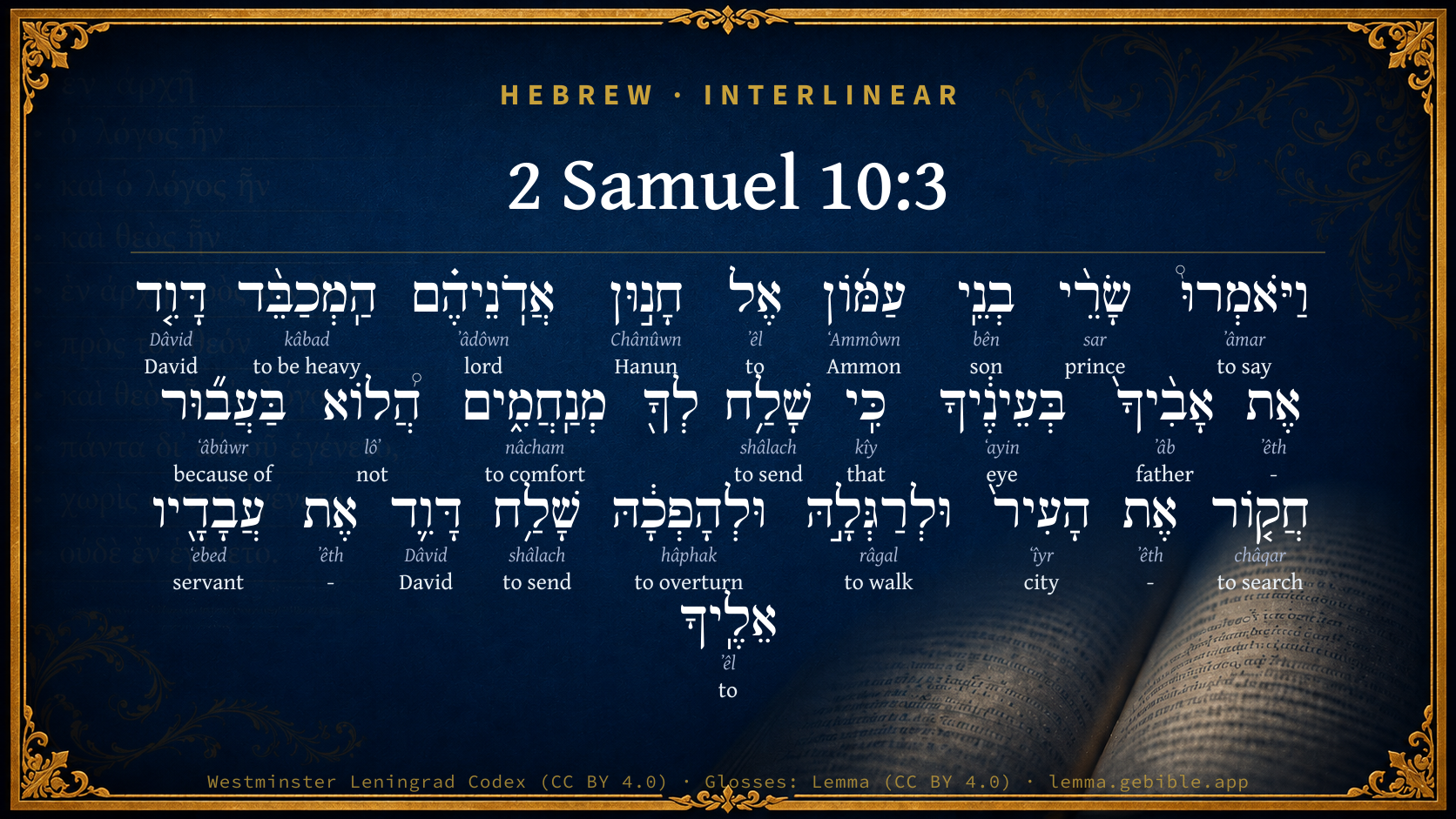
2 Samuel 10:3

Hebrew (Westminster Leningrad Codex) 2 Samuel 10:3 appears in the Hebrew Old Testament. The text above is from the Westminster Leningrad Codex. Each word links to its Strong’s number, a concise gloss, and parsing drawn from the Open Scriptures Hebrew Bible morphology. Click any word for its full Brown-Driver-Briggs (BDB) entry.
Download image
Cite this verse

2 Samuel 10:3 (World English Bible). Public Domain. Lemma interlinear Bible study tool, https://lemma.gebible.app/v/2-samuel/10/3.

Show BibTeX & RIS
BibTeX
RIS
English Translation
But the princes of the children of Ammon said to Hanun their lord, Do you think that David honors your father, in that he has sent comforters to you? Hasn't David sent his servants to you to search the city, and to spy it out, and to overthrow it?
World English Bible · Public Domain
Download a study sheet

One document with this verse’s original text, its word-by-word gloss line, the meaning frame, cross-references with their text, attributed commentary, and full source and license credits — printable, and it pastes into notes with its structure intact.

This verse Autodidact and up

Study sheet (.html) Plain text (.txt)

A passage Seminary Student

Up to 50 verses in one chapter. A passage sheet keeps up to 6 commentary sources and 12 cross-references per verse, in the order this page ranks them, and says so on the sheet whenever that leaves anything out. Ask for a single verse and you get the Autodidact verse sheet above.

Everything on this page stays free to read, with no account — the sheet is a download of what is already on screen, not access to it.

Want to remove ads? Support Godless Engineer
Compare translations 3

The same verse in 3 English versions, stacked beneath the original-language interlinear above. Click any original word for its lexicon entry.

Each is an independent rendering of the whole verse — the interlinear is not word-aligned to these translations.

Highlighted words mark where these versions differ — a whole-verse word diff, not a word-by-word alignment.

  • World English Bible Public Domain
    But the princes of the children of Ammon said to Hanun their lord, Do you think that David honors your father, in that he has sent comforters to you? Hasn't David sent his servants to you to search the city, and to spy it out, and to overthrow it?
  • King James Version Public Domain
    And the princes of the children of Ammon said unto Hanun their lord, Thinkest thou that David doth honor thy father, that he hath sent comforters unto thee? hath not David rather sent his servants unto thee, to search the city, and to spy it out, and to overthrow it?
  • unfoldingWord Literal Text CC BY-SA 4.0
    And the commanders of the sons of Ammon said to Hanun their master, “In your eyes, is David honoring your father, since he has sent consolers to you? not in order to explore the city and to spy on it and to overthrow it David has sent his servants to you?”

unfoldingWord Literal Text — © unfoldingWord, licensed CC BY-SA 4.0. Word-aligned USFM3 via Door43 (git.door43.org/unfoldingWord/en_ult).

Versions to compare (up to 4)

3 of 4 selected

Show all 18 translations

Every available English version of this verse, each an independent rendering of the whole verse.

  • World English Bible Public Domain
    But the princes of the children of Ammon said to Hanun their lord, Do you think that David honors your father, in that he has sent comforters to you? Hasn't David sent his servants to you to search the city, and to spy it out, and to overthrow it?
  • Berean Standard Bible Public Domain
    the princes of the Ammonites said to Hanun their lord, “Just because David has sent you comforters, do you really believe he is showing respect for your father? Has not David instead sent his servants to explore the city, spy it out, and overthrow it?”
  • Majority Standard Bible Public Domain
    the princes of the Ammonites said to Hanun their lord, “Just because David has sent you comforters, do you really believe he is showing respect for your father? Has not David instead sent his servants to explore the city, spy it out, and overthrow it?”
  • King James Version Public Domain
    And the princes of the children of Ammon said unto Hanun their lord, Thinkest thou that David doth honor thy father, that he hath sent comforters unto thee? hath not David rather sent his servants unto thee, to search the city, and to spy it out, and to overthrow it?
  • American Standard Version (1901) Public Domain
    But the princes of the children of Ammon said unto Hanun their lord, Thinkest thou that David doth honor thy father, in that he hath sent comforters unto thee? hath not David sent his servants unto thee to search the city, and to spy it out, and to overthrow it?
  • Revised Version (1885) Public Domain
    But the princes of the children of Ammon said unto Hanun their lord, Thinkest thou that David doth honour thy father, that he hath sent comforters unto thee? hath not David sent his servants unto thee to search the city, and to spy it out, and to overthrow it?
  • Geneva Bible (1599) Public Domain
    And the princes of the children of Ammon sayde vnto Hanun their lorde, Thinkest thou that Dauid doth honour thy father, that he hath sent comforters to thee? hath not Dauid rather sent his seruants vnto thee, to search the citie, and to spie it out, and to ouerthrow it?
  • Douay-Rheims (1899) Public Domain
    The princes of the children of Ammon said to Hanon their lord: Thinkest thou that for the honour of thy father, David hath sent comforters to thee, and hath not David rather sent his servants to thee to search, and spy into the city, and overthrow it?
  • Young's Literal Translation Public Domain
    And the heads of the Bene-Ammon say unto Hanun their lord, `Is David honouring thy father in thine eyes because he hath sent to thee comforters? for to search the city, and to spy it, and to overthrow it, hath not David sent his servants unto thee?'
  • Literal Standard Version CC BY-SA 4.0
    And the heads of the sons of Ammon say to their lord Hanun, “Is David honoring your father in your eyes because he has sent comforters to you? For has David not sent his servants to you to search the city, and to spy it, and to overthrow it?”
  • Unlocked Literal Bible CC BY-SA 4.0
    But the leaders of the people of Ammon said to Hanun their master, “Do you really think that David is honoring your father because he has sent men to comfort you? Has not David sent his servants to you to look at the city, to spy it out, in order to overthrow it?”
  • unfoldingWord Literal Text CC BY-SA 4.0
    And the commanders of the sons of Ammon said to Hanun their master, “In your eyes, is David honoring your father, since he has sent consolers to you? not in order to explore the city and to spy on it and to overthrow it David has sent his servants to you?”
  • Darby Bible Public Domain
    And the princes of the children of Ammon said to Hanun their lord, Is it, in thine eyes, to honour thy father that David has sent comforters to thee? Is it not to search the city and to spy it out, and to overthrow it, that David has sent his servants to thee?
  • World Messianic Bible Public Domain
    But the princes of the children of Ammon said to Hanun their lord, “Do you think that David honors your father, in that he has sent comforters to you? Hasn’t David sent his servants to you to search the city, to spy it out, and to overthrow it?”
  • Webster's Bible Public Domain
    And the princes of the children of Ammon said to Hanun their lord, Thinkest thou that David doth honor thy father, that he hath sent comforters to thee? hath not David rather sent his servants to thee, to search the city, and to spy it out, and to overthrow it?
  • Free Bible Version CC BY-SA 4.0
    the Ammonite military leaders said to Hanun their king, “Do you really believe David sent condolences to you out of respect for your father? Isn't it more likely that David sent his representatives to scout out the city, spy on it, and then conquer it?”
  • Bible in Basic English Public Domain
    But the chiefs of the children of Ammon said to Hanun their lord, Does it seem to you that David is honouring your father by sending comforters to you? has he not sent his servants to go through the town and make secret observation of it, and overcome it?
  • JPS Tanakh (1917) Public Domain
    But the princes of the children of Ammon said unto Hanun their lord: 'Thinkest thou that David doth honour thy father, that he hath sent comforters unto thee? hath not David sent his servants unto thee to search the city, and to spy it out, and to overthrow it?'

Literal Standard Version (2020), Covenant Press — licensed CC BY-SA 4.0. Text via the HelloAO Bible API (eBible.org). Unlocked Literal Bible (unfoldingWord) — licensed CC BY-SA 4.0. Text via the HelloAO Bible API (eBible.org). unfoldingWord Literal Text — © unfoldingWord, licensed CC BY-SA 4.0. Word-aligned USFM3 via Door43 (git.door43.org/unfoldingWord/en_ult). Free Bible Version, Dr. Jonathan Gallagher — licensed CC BY-SA 4.0. Text via the HelloAO Bible API (eBible.org).

Word by word

More ways to search: Search by grammar → Find every occurrence → Compare this word →

Practice this passage: Drill this verse → Learn its vocabulary →

חָנ֣וּן
Chânûwn
H2586
“Hanun”
Noun, Proper
Part of Speech
Noun
Type
Proper
Full BDB Definition

Origin: from H2603

TWOT: None

Hanun = "gracious" - son of Nahash and king of Ammon who dishonoured David's ambassadors and lost the subsequent war with David - a man who, with the people of Zanoah, repaired the ravine gate in the wall of Jerusalem - the 6th son of Zalaph, who also assisted in the repair of the wall of Jerusalem, apparently on the east side
  1. וַיֹּאמְרוּ֩ ʼâmar H559 “and · to say” Conjunction + Verb, Qal, Sequential Imperfect, 3rd Person, Masculine, Plural
  2. שָׂרֵ֨י sar H8269 “princes of” Noun, Common, Masculine, Plural, Construct
  3. בְנֵֽי bên H1121 “sons of” Noun, Common, Masculine, Plural, Construct
  4. עַמּ֜וֹן ʻAmmôwn H5983 “Ammon” Noun, Proper
  5. אֶל ʼêl H413 “to” Preposition
  6. אֲדֹֽנֵיהֶ֗ם ʼâdôwn H113 “lords · their” Noun, Common, Masculine, Plural, Construct + Suffix, Personal, 3rd Person, Masculine, Plural
  7. הַֽמְכַבֵּ֨ד kâbad H3513 “being heavy” Particle, Interrogative + Verb, Piel, Participle Active, Masculine, Singular, Absolute
  8. דָּוִ֤ד Dâvid H1732 “David” Noun, Proper
  9. אֶת ʼêth H853 “-” Particle, Direct Object
  10. אָבִ֨יךָ֙ ʼâb H1 “father · your” Noun, Common, Masculine, Singular, Construct + Suffix, Personal, 2nd Person, Masculine, Singular
  11. בְּעֵינֶ֔יךָ ʻayin H5869 “in/at · eyes · your” Preposition + Noun, Common, Both, Dual, Construct + Suffix, Personal, 2nd Person, Masculine, Singular
  12. כִּֽי kîy H3588 “that” Conjunction
  13. שָׁלַ֥ח shâlach H7971 “to send” Verb, Qal, Perfect, 3rd Person, Masculine, Singular
  14. מְנַֽחֲמִ֑ים nâcham H5162 “comforting” Verb, Piel, Participle Active, Masculine, Plural, Absolute
  15. הֲ֠לוֹא lôʼ H3808 “not” Particle, Interrogative + Particle, Negative
  16. בַּעֲב֞וּר ʻâbûwr H5668 “in/at · because of of” Preposition + Noun, Common, Masculine, Singular, Construct
  17. חֲק֤וֹר châqar H2713 “to search” Verb, Qal, Infinitive Construct
  18. אֶת ʼêth H853 “-” Particle, Direct Object
  19. הָעִיר֙ ʻîyr H5892 “the · city” Particle, Definite Article + Noun, Common, Feminine, Singular, Absolute
  20. וּלְרַגְּלָ֣הּ râgal H7270 “and · to walk · her” Conjunction + Preposition + Verb, Piel, Infinitive Construct + Suffix, Personal, 3rd Person, Feminine, Singular
  21. וּלְהָפְכָ֔הּ hâphak H2015 “and · to overturn · her” Conjunction + Preposition + Verb, Qal, Infinitive Construct + Suffix, Personal, 3rd Person, Feminine, Singular
  22. שָׁלַ֥ח shâlach H7971 “to send” Verb, Qal, Perfect, 3rd Person, Masculine, Singular
  23. דָּוִ֛ד Dâvid H1732 “David” Noun, Proper
  24. אֶת ʼêth H853 “-” Particle, Direct Object
  25. עֲבָדָ֖יו ʻebed H5650 “servants · his” Noun, Common, Masculine, Plural, Construct + Suffix, Personal, 3rd Person, Masculine, Singular
  26. אֵלֶֽיךָ ʼêl H413 “to · you” Preposition + Suffix, Personal, 2nd Person, Masculine, Singular

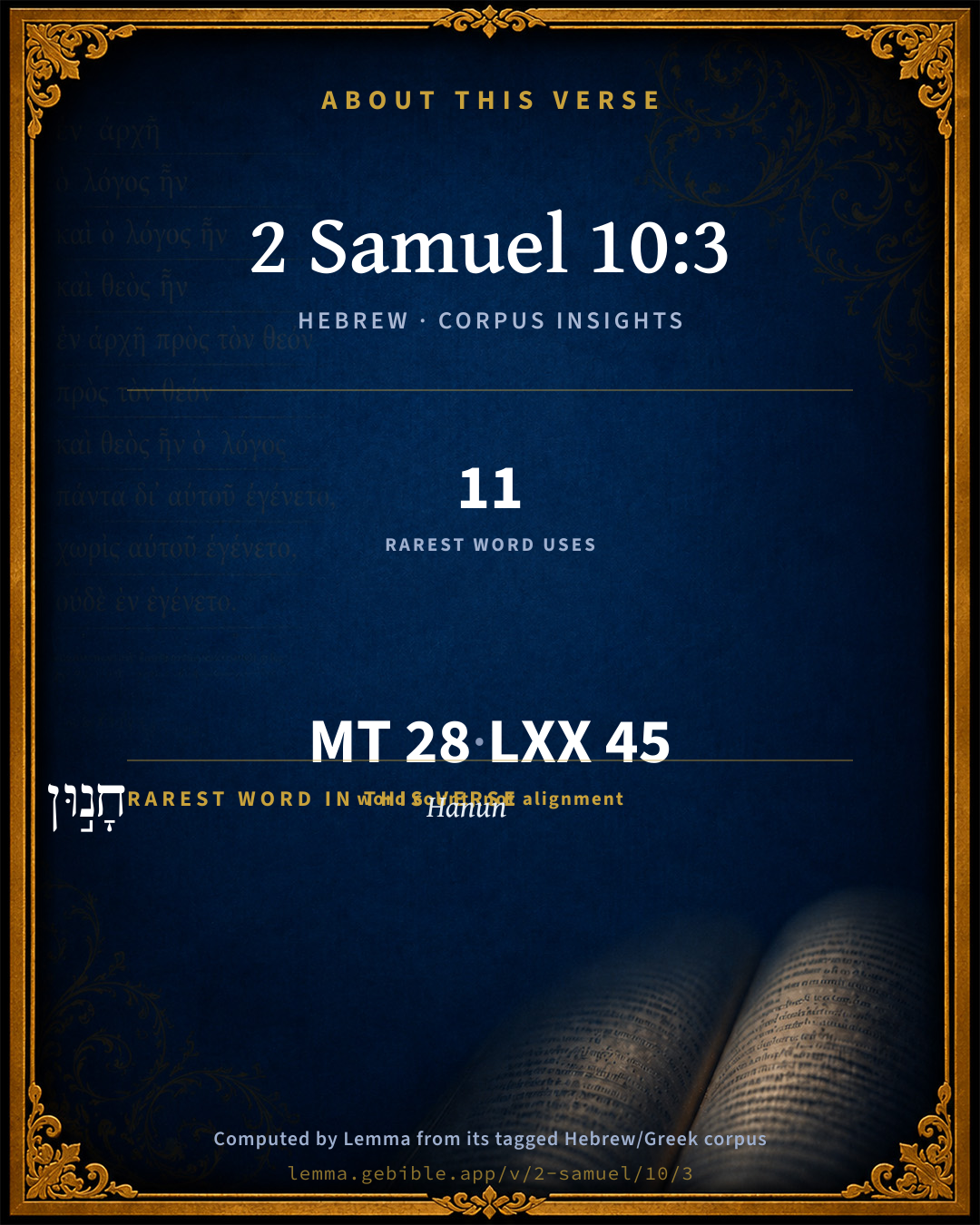
About this verse

These counts appear in no published source. They are computed here, from the morphology-tagged text and Lemma’s own curated glosses. What Lemma adds →

28
words
22
distinct lemmas
Historical
section

Notable vocabulary

The rarest word here is חָנ֣וּן Hanun H2586 — appearing just 11 times in the whole Hebrew Bible.

Shared distinctive vocabulary

חָנ֣וּן Hanun H2586 occurs in 10 verses of the Hebrew Bible. Also found in:

Grammatical profile

  • 8 verbs
  • 12 nouns
  • 3 prepositions
  • 1 conjunction
  • 4 particles

Verb forms

  • וַיֹּאמְרוּ֩ Qal · Sequential Imperfect
  • הַֽמְכַבֵּ֨ד Piel · Participle Active
  • שָׁלַ֥ח Qal · Perfect
  • מְנַֽחֲמִ֑ים Piel · Participle Active
  • חֲק֤וֹר Qal · Infinitive Construct
  • וּלְרַגְּלָ֣הּ Piel · Infinitive Construct
  • וּלְהָפְכָ֔הּ Qal · Infinitive Construct
  • שָׁלַ֥ח Qal · Perfect

Repetition

Words recur within this verse — often emphatic in Hebrew:

  • דָּוִ֤ד David H1732 ×2
  • שָׁלַ֥ח to send H7971 ×2
  • אֶל to H413 ×2

Hebrew & Septuagint length

In English translation the verse runs 49 words from the Hebrew and 50 from the Septuagint (LXX English) — closely comparable.

A rough comparison of the two English renderings, which tokenize alike — not a word-level alignment.

Word counts can differ between the Hebrew and the Greek without any difference in meaning — e.g. the Hebrew direct-object marker אֵת has no separate Greek word, and Greek often adds the article ὁ.

In the original languages it is 28 Hebrew tokens and 45 Greek tokens — but the two are counted differently (Hebrew bundles its prefixes and suffixes into one token; the Greek is in lemma form), so that isn’t a like-for-like length.

Cross-references

4

Topical passages linked to 2 Samuel 10:3 in the Treasury of Scripture Knowledge — connected by theme and wording, ordered by reader-vote popularity; previews shown in the World English Bible.

  • Genesis 42:9 Joseph remembered the dreams which he dreamed about them, and said to them, "You are spies! You have come to see the nakedness of the land."
  • Genesis 42:16 Send one of you, and let him get your brother, and you shall be bound, that your words may be tested, whether there is truth in you, or else by the life of Pharaoh surely you are spies."
  • 1 Corinthians 13:5 doesn't behave itself inappropriately, doesn't seek its own way, is not provoked, takes no account of evil;
  • 1 Corinthians 13:7 bears all things, believes all things, hopes all things, endures all things.

Cross-references courtesy of OpenBible.info (CC BY 4.0).

Hebrew and Greek witnesses Masoretic Hebrew ↔ Greek Septuagint

The same verse in the two great witnesses to the Old Testament, shown verse-for-verse.

These are two independent witnesses, not word-aligned to each other, and the Septuagint is shown in lemma (dictionary) form.

Hebrew 2 Samuel 10:3 Masoretic · Westminster Leningrad Codex

וַיֹּאמְרוּ֩ שָׂרֵ֨י בְנֵֽי עַמּ֜וֹן אֶל חָנ֣וּן אֲדֹֽנֵיהֶ֗ם הַֽמְכַבֵּ֨ד דָּוִ֤ד אֶת אָבִ֨יךָ֙ בְּעֵינֶ֔יךָ כִּֽי שָׁלַ֥ח לְךָ֖ מְנַֽחֲמִ֑ים הֲ֠לוֹא בַּעֲב֞וּר חֲק֤וֹר אֶת הָעִיר֙ וּלְרַגְּלָ֣הּ וּלְהָפְכָ֔הּ שָׁלַ֥ח דָּוִ֛ד אֶת עֲבָדָ֖יו אֵלֶֽיךָ

But the princes of the children of Ammon said to Hanun their lord, Do you think that David honors your father, in that he has sent comforters to you? Hasn't David sent his servants to you to search the city, and to spy it out, and to overthrow it?

World English Bible · Public Domain

Greek LXX 2 Samuel 10:3 Septuagint · lemma form

καί εἶπον ὁ ἄρχων υἱός αμμων πρός αννων ὁ κύριος αὐτός μή παρά ὁ δοξάζω δαυίδ ὁ πατήρ σύ ἐνώπιόν σύ ὅτι ἀποστέλλω σύ παρακαλέω ἀλλά οὐ ὅπως ἐρευνάω ὁ πόλις καί κατασκοπέω αὐτός καί ὁ κατασκέπτομαι αὐτός ἀποστέλλω δαυίδ ὁ παῖς αὐτός πρός σύ

And the princes of the children of Ammon said to Annon their lord, Is it to honor your father before you that David has sent comforters to you? Has not David rather sent his servants to you that they should search the city, and spy it out and examine it?

LXX2012 (modern English Septuagint) · Public Domain

Hebrew: Westminster Leningrad Codex (CC BY 4.0). Greek: Septuagint (public domain); English from LXX2012 (modern English Septuagint) (Public Domain). How the Septuagint differs from the Hebrew →

Targum (Aramaic paraphrase)

1

The Targum is the ancient Jewish Aramaic paraphrase of the Hebrew Scriptures — an interpretive translation, not the Hebrew text itself. Onkelos (literal) and Pseudo-Jonathan (expansive) render the Torah, and Jonathan the Prophets. Coverage is partial: where no permissively-licensed English translation exists for a verse, only the Aramaic is shown. This is verse-level text, not a word-by-word alignment to the Hebrew.

  1. Targum Jonathan Prophets (Joshua–Malachi)
    וַאֲמַרוּ רַבְרְבֵי בְּנֵי עַמוֹן לְחָנוּן רִבּוֹנֵיהוֹן הַמְיַקֵר דָוִד יַת אֲבוּךְ בְּעֵינָךְ אֲרֵי שְׁלַח לָךְ מְנַחֲמִין הֲלָא בְּדִיל לְמֶחְקַר יַת קַרְתָּא וּלְאַלָלוּתָהּ וּלְבַדְקָהּ שְׁלַח דָוִד יַת עַבְדוֹהִי לְוָתָךְ:

    (no public-domain English translation for this verse)

    Targum Jonathan — Aramaic: “Mikraot Gedolot” (public domain). English: “Sefaria Community Translation” (CC0 1.0 (public-domain dedication)); “London "Chaldee Paraphrase," 1871” (public domain). Text via Sefaria.

Commentary

Notes on 2 Samuel 10:3 from classic Christian and Jewish commentators (each source and its license shown beneath its notes). The classic Christian expositions comment on the surrounding passage and are grouped to its opening verse, so a note may address several verses; the Jewish commentaries on the Tanakh (Rashi and others) are per-verse, so they appear only where the commentator wrote on this verse.

Lemma curates 59 commentaries, every one of them public domain or Creative Commons licensed, each selected and text-cleaned for this edition rather than reprinted as found. About our sources →

Trapp's Complete Commentary

John Trapp

2Sa 10:3 And the princes of the children of Ammon said unto Hanun their lord, Thinkest thou that David doth honour thy father, that he hath sent comforters unto thee? hath not David [rather] sent his servants unto thee, to search the city, and to spy it out, and to overthrow it?

Ver. 3. Thinkest thou that David, &c.?] q.d, We think otherwise: wicked men muse as they use, and measure others by their own foot. These tale bearers - besides the old quarrel {Gen 3:15 compare Mat 23:13 Act 13:10 Pro 29:27 1Jn 3:8} - retained a hereditary hatred against Israel. See Deu 23:3-5. And hence these evil surmises, calumnies, and sinful counsels, whereof at length themselves had the worst.

“ηδε κακη βουλη τω βουλευσαντι κακιστη”

John Trapp, A Commentary or Exposition upon All the Books of the Old and New Testament (1647–1656) — public domain. Text from a community e-Sword module.

Joseph Benson's Commentary

2Sa 10:3-4. Hath not David sent to search the city? — Nothing is so well meant, but it maybe ill interpreted; and is wont to be so by men who love none but themselves. And shaved off the one half of their beards, and cut off their garments in the middle — He must not only have been very credulous, but of a bad and hasty temper; otherwise he would have dismissed them civilly, how much soever his courtiers suspected them; or have kept them in an honourable custody till the truth had been discovered. But this was the highest disgrace he could put upon them. For the wearing of long beards and long garments was then, as it is still, the fashion of the East, where they were deemed badges of honour; and consequently the cutting off and curtailing of either was regarded as the greatest indignity; nay, in some places, the cutting off the beard was not only looked upon as a matter of the highest reproach, but also of the severest punishment. So it was anciently among the Indians, as we learn from Nicholas Damascenus, mentioned by Stobæus, who says, that the king commanded the greatest offenders to be shaven, as the greatest punishment he could inflict upon them. And so it is at this day among the Persians. And it was one of the most infamous punishments of cowardice in Sparta, that they who turned their backs in the day of battle were obliged to appear abroad with one half of their beards shaved, and the other unshaved. There were two reasons which caused the eastern people of old, as they cause them at present, to look upon the beard as venerable: 1st, They considered it as a natural ornament, designed to distinguish men from women. 2d, It was the mark of a free man, in opposition to slaves. So that, in every view, the indignity offered by Hanun to the ambassadors of David was capital, and, it seems, the greatest he could have done them. It was a violation of the law of nature, of hospitality, and the right of nations. Insult and contumely were added to the disgrace; half the beard was cut off to make them look ridiculous, and half the robe to make their figures at once more contemptible and indecent. — Delaney, Bishop Patrick, and Plut. in Agesilao.

Joseph Benson's Commentary on the Old and New Testaments (1811–1818) — public domain. Text from a community e-Sword module.

Geneva Bible (1599)

Geneva Bible translators

Hebrew, in thine eyes doth David.

Their arrogant malice would not suffer them to see the simplicity of David’s heart: therefore their counsel turned to the destruction of their country.

Geneva Bible (1599) marginal notes — public domain. Text via Bolls.life.

Jamieson, Fausset & Brown

Robert Jamieson, A. R. Fausset & David Brown

the princes of the children of Ammon said unto Hanun--Their suspicion was not warranted either by any overt act or by any cherished design of David: it must have originated in their knowledge of the denunciations of God's law against them (Deu 23:3-6), and of David's policy in steadfastly adhering to it.

Jamieson, Fausset & Brown — Commentary Critical and Explanatory on the Whole Bible (1871) — public domain (CC PDM 1.0). Text via the HelloAO Bible API.

Adam Clarke's Commentary

Verse 3. Thinkest thou that David doth honour thy father] It has been a matter of just complaint through all the history of mankind, that there is little sincerity in courts. Courtiers, especially, are suspicious of each other, and often mislead their sovereigns. They feel themselves to be insincere, and suspect others to be so too.

Adam Clarke's Commentary on the Bible (1810–1826) — public domain. Text from a community e-Sword/MySword module.

Ellicott's Commentary for English Readers

(3) To search the city.—The capital, and almost the only city of the Ammonites was Rabbah; it was strongly fortified, and a knowledge of its interior would be important to an enemy. The suspicions of the Ammonites may have been roused by David’s growing power, and especially by his conquest of the neighbouring Moabites.

A Bible Commentary for English Readers, edited by Charles John Ellicott (1878–1897) — public domain. Text from a community e-Sword module.

The Cambridge Bible for Schools and Colleges

gen. ed. J. J. S. Perowne

3. the princes of the children of Ammon] The new king’s counsellors were as foolish as Rehoboam’s advisers (1Ki_12:10-11). Their unjust suspicions of David’s motives may have been excited by his recent conquest of Moab.

the city] Rabbah, which was strongly fortified. See ch. 2Sa_11:1.

The Cambridge Bible for Schools and Colleges (gen. ed. J. J. S. Perowne; Cambridge University Press, 1878–1918) — public domain. Text from a community e-Sword module.

John Gill's Exposition

And the princes of the children of Ammon said to Hanun their lord,.... His nobles and prime ministers, the courtiers that were about him:

thinkest thou that David doth honour thy father, that he hath sent comforters unto thee? could he imagine that David was sincere, and that he really meant to do honour to the memory of his father, and comfort him under the loss of him, by sending his ambassadors to him on such an errand? there was no reason, they thought, to believe this, since an Israelite was forbidden to seek their peace and prosperity, or ask of it, nor might Ammonite enter into their congregation unto the tenth generation, Deu 23:3; and indeed some have thought that David did not do a right thing in sending this embassy, and was justly requited; but it is certain he acted according to the laws of friendship, and was cordial and sincere in what he did, though these courtiers of Hanun put an ill construction on his conduct, their minds being filled with enmity against the Israelites:

hath not David rather sent his servants unto thee to search the city,

and to spy it out, and to overthrow it? to reconnoitre the place, to observe, as they walked about in it, which were the weakest and most defenceless parts of it, and what avenues there were to it, and which were most accessible, that they might the better know how to attack it, and destroy it; these surmises and suspicions they endeavoured to fill the king's head with, to set him against them, and treat them ill.

John Gill's Exposition of the Whole Bible (1746–1763) — public domain (CC PDM 1.0). Text via the HelloAO Bible API.

Albert Barnes' Notes on the Bible

The princes ... - Compare Rehoboam’s advisers 1Ki 12:10-11. It is not improbable that David’s severe treatment of Moab 2Sa 8:2 was in part the cause of the fear of the Ammonites that a similar treatment was in store for themselves.

Albert Barnes' Notes on the Bible (1834–1885) — public domain. Text from a community e-Sword/MySword module.

Haydock's Catholic Bible Commentary

It. Thus, by their insinuations, they pervert the good dispositions of their prince, and by too much policy bring ruin on the nation. (Haydock) --- History affords many examples of similar effects of worldly wisdom. (Menochius)

George Leo Haydock (1774–1849), Haydock's Catholic Family Bible and Commentary, 1859 edition — public domain. Excludes Psalms (Douay-Rheims chapter numbering differs from Protestant) and Deuterocanonical books (Catholic canon only).

Matthew Poole's English Annotations

To observe where the city is weakest, and may soonest be taken. The ground of this suspicion was, partly, the conscience of their ill deserts and carriage towards the Israelites, whose quarrel David had espoused; partly, the opinion they had of David’s policy; and partly, the severity of God’s law, particularly against them, Deu 23:6, which might easily come to their ears. And they knew David was a zealous asserter of God’s laws.

Matthew Poole's English Annotations on the Holy Bible (1683–1685) — public domain. Text from a community e-Sword/MySword module.

Whedon's Commentary on the Bible

Daniel D. Whedon

3. The princes — The chiefs or sheiks of the people, who acted as counsellors of the king.

Thinkest thou — “Courtiers, especially, are suspicious of each other, and often mislead their sovereigns. They feel themselves to be insincere, and suspect others to be so too.” — Clarke.

To search the city — This city was Rabbah, the capital city of the children of Ammon. See on 2Sa_12:26; Deu_3:11; Jos_13:25.

Daniel D. Whedon (gen. ed.), Commentary on the Old and New Testaments (1874–1909) — public domain. Text from a community e-Sword module.

The Pulpit Commentary

Thinkest thou that David doth honour thy father! This insinuation arose probably from ill will, stirred up by David"s success in war; and, with that distrust with which neighbouring nations too often regard one another, they see in his embassy only a purpose of spying into their defences with view to future attack. Rabbah, their city, was a place strong beth naturally and by reason of its fortifications.

The Pulpit Commentary (1880–1919), ed. H.D.M. Spence-Jones & Joseph S. Exell — public domain. Text from a community e-Sword module.

Rashi

Rabbi Shlomo Yitzchaki (Rashi)

Do you think Dovid honors your father. Does it appear in your eyes that Dovid is honoring your father? They are warned, "Do not seek peace with them", and he is seeking peace with you?

Rashi on the Tanakh — English translations: “The Judaica Press complete Tanach with Rashi, translated by A. J. Rosenberg” (CC BY 4.0); “Pentateuch with Rashi's commentary by M. Rosenbaum and A.M. Silbermann, 1929-1934” (public domain); “The Metsudah Tanach series, Lakewood, N.J” (CC BY 4.0); and “The Book of Joshua, Metsudah Publications, 1997” (CC BY 4.0). Text via Sefaria.

Lesson kit

Teaching starters — assembled from the data on this page, not authored interpretation. Every prompt links to the verse data it draws on. Edit before teaching.

2 Samuel, in the Historical, opens this verse with 28 words (22 distinct Hebrew lemmas). Its most distinctive word is Chânûwn (“Hanun”). A historical commentator’s framing appears above. Read the whole chapter for the surrounding context.

Discussion questions

  1. What does “Hanun” (Chânûwn) contribute to the verse as a whole?
  2. How does 2 Samuel 10:1, which shares the word «Hanun», read alongside this verse?
  3. What does the repetition of “David” (2× in this one verse) do in this verse?
  4. These translations render this verse differently; the difference is in the English rendering, not the original. What questions does that raise?
  5. «וַיֹּאמְרוּ֩» is a Qal Sequential Imperfect verb. How does that grammatical form shape the action described?
  6. Compare how Trapp's Complete Commentary and Joseph Benson's Commentary read this verse. Where do they agree or differ?

Things to notice

Reading settings

Reading text

Shown beneath each verse's original-language words.

Old Testament
Old Testament edition

Read the OT as the Masoretic Hebrew (MT) or the Greek Septuagint (LXX).

English shown for the Greek Septuagint (in the Hebrew ↔ Greek comparison).

Comparing translations? Open the Compare panel on any verse page to stack up to four side by side.