2 Samuel 19:36

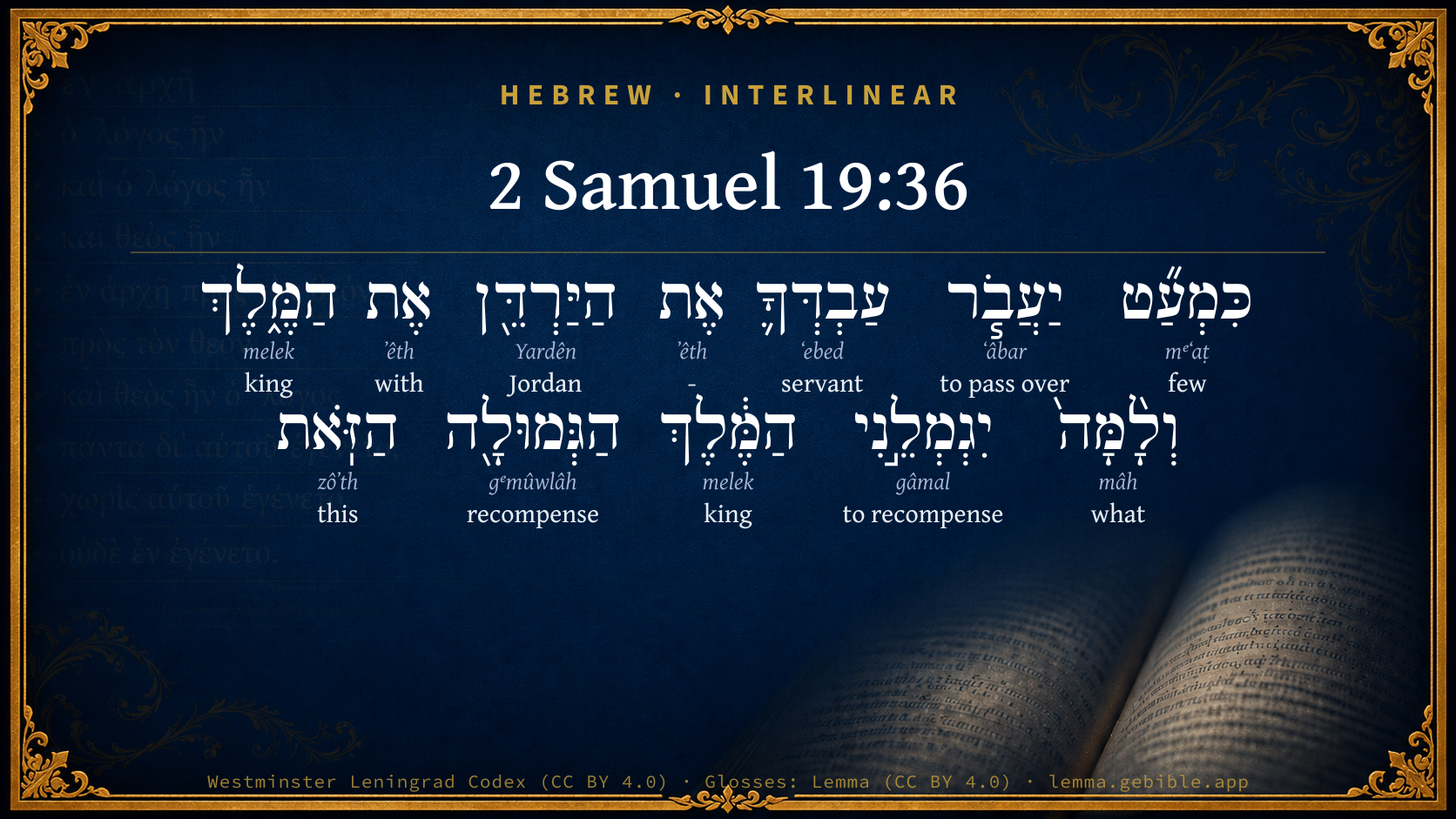
Hebrew (Westminster Leningrad Codex) 2 Samuel 19:36 appears in the Hebrew Old Testament. The text above is from the Westminster Leningrad Codex. Each word links to its Strong’s number, a concise gloss, and parsing drawn from the Open Scriptures Hebrew Bible morphology. Click any word for its full Brown-Driver-Briggs (BDB) entry.
Download image
Cite this verse

2 Samuel 19:36 (World English Bible). Public Domain. Lemma interlinear Bible study tool, https://lemma.gebible.app/v/2-samuel/19/36.

Show BibTeX & RIS
BibTeX
RIS
English Translation
Your servant would but just go over the Jordan with the king: and why should the king recompense it me with such a reward?
World English Bible · Public Domain
Highlights
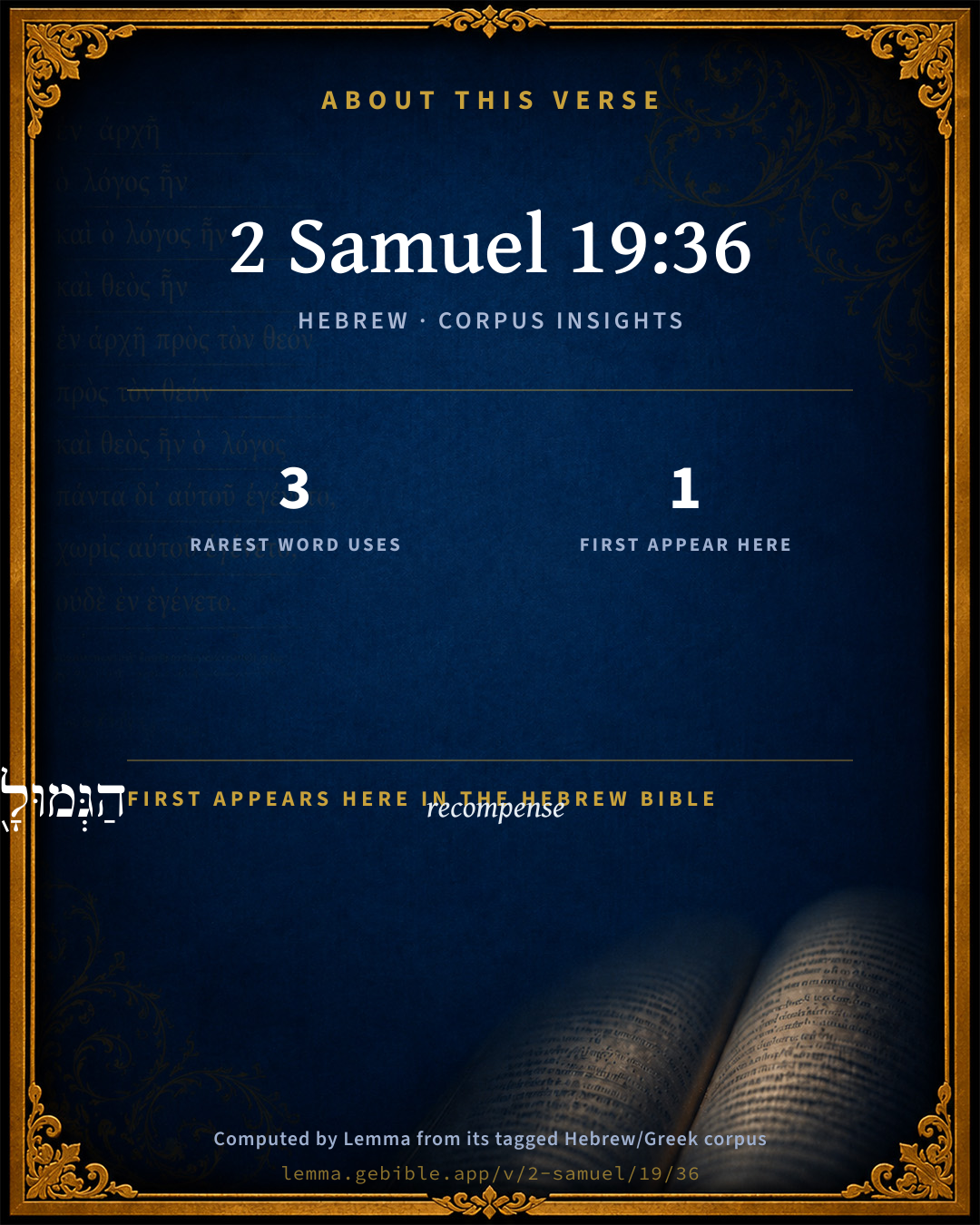
  • 1 first appearance in the Hebrew Bible
Full analysis ↓
Download a study sheet

One document with this verse’s original text, its word-by-word gloss line, the meaning frame, cross-references with their text, attributed commentary, and full source and license credits — printable, and it pastes into notes with its structure intact.

This verse Autodidact and up

Study sheet (.html) Plain text (.txt)

A passage Seminary Student

Up to 50 verses in one chapter. A passage sheet keeps up to 6 commentary sources and 12 cross-references per verse, in the order this page ranks them, and says so on the sheet whenever that leaves anything out. Ask for a single verse and you get the Autodidact verse sheet above.

Everything on this page stays free to read, with no account — the sheet is a download of what is already on screen, not access to it.

Want to remove ads? Support Godless Engineer
Compare translations 3

The same verse in 3 English versions, stacked beneath the original-language interlinear above. Click any original word for its lexicon entry.

Each is an independent rendering of the whole verse — the interlinear is not word-aligned to these translations.

Highlighted words mark where these versions differ — a whole-verse word diff, not a word-by-word alignment.

  • World English Bible Public Domain
    Your servant would but just go over the Jordan with the king: and why should the king recompense it me with such a reward?
  • King James Version Public Domain
    Thy servant will go a little way over Jordan with the king: and why should the king recompense it me with such a reward?
  • unfoldingWord Literal Text CC BY-SA 4.0
    According to a little your servant will go across the Jordan with the king. But why will the king reward me this reward?

unfoldingWord Literal Text — © unfoldingWord, licensed CC BY-SA 4.0. Word-aligned USFM3 via Door43 (git.door43.org/unfoldingWord/en_ult).

Versions to compare (up to 4)

3 of 4 selected

Show all 18 translations

Every available English version of this verse, each an independent rendering of the whole verse.

  • World English Bible Public Domain
    Your servant would but just go over the Jordan with the king: and why should the king recompense it me with such a reward?
  • Berean Standard Bible Public Domain
    Your servant could go with the king only a short distance past the Jordan; why should the king repay me with such a reward?
  • Majority Standard Bible Public Domain
    Your servant will go with the king only a short distance past the Jordan; why should the king repay me with such a reward?
  • King James Version Public Domain
    Thy servant will go a little way over Jordan with the king: and why should the king recompense it me with such a reward?
  • American Standard Version (1901) Public Domain
    Thy servant would but just go over the Jordan with the king: and why should the king recompense it me with such a reward?
  • Revised Version (1885) Public Domain
    Thy servant would but just go over Jordan with the king: and why should the king recompense it me with such a reward?
  • Geneva Bible (1599) Public Domain
    Thy seruant will goe a litle way ouer Iorden with the King, and why wil the king recompence it me with such a rewarde?
  • Douay-Rheims (1899) Public Domain
    I thy servant will go on a little way from the Jordan with thee: I need not this recompense.
  • Young's Literal Translation Public Domain
    As a little thing, thy servant doth pass over the Jordan with the king, and why doth the king recompense me this recompense?
  • Literal Standard Version CC BY-SA 4.0
    As a little thing, your servant passes over the Jordan with the king, and why does the king repay me this repayment?
  • Unlocked Literal Bible CC BY-SA 4.0
    Your servant would like to just go over the Jordan with the king. Why should the king repay me with such a reward?
  • unfoldingWord Literal Text CC BY-SA 4.0
    According to a little your servant will go across the Jordan with the king. But why will the king reward me this reward?
  • Darby Bible Public Domain
    Thy servant will go a little way over the Jordan with the king; and why should the king recompense it to me with this reward?
  • World Messianic Bible Public Domain
    Your servant will just go over the Jordan with the king. Why should the king repay me with such a reward?
  • Webster's Bible Public Domain
    Thy servant will go a little way over Jordan with the king: and why should the king recompense me with such a reward?
  • Free Bible Version CC BY-SA 4.0
    For your servant to cross the Jordan River with the king is enough reward for me!
  • Bible in Basic English Public Domain
    Your servant's desire was only to take the king over Jordan; why is the king to give me such a reward?
  • JPS Tanakh (1917) Public Domain
    (19-37) Thy servant would but just go over the Jordan with the king; and why should the king recompense it me with such a reward?

Literal Standard Version (2020), Covenant Press — licensed CC BY-SA 4.0. Text via the HelloAO Bible API (eBible.org). Unlocked Literal Bible (unfoldingWord) — licensed CC BY-SA 4.0. Text via the HelloAO Bible API (eBible.org). unfoldingWord Literal Text — © unfoldingWord, licensed CC BY-SA 4.0. Word-aligned USFM3 via Door43 (git.door43.org/unfoldingWord/en_ult). Free Bible Version, Dr. Jonathan Gallagher — licensed CC BY-SA 4.0. Text via the HelloAO Bible API (eBible.org).

Word by word

More ways to search: Search by grammar → Find every occurrence → Compare this word →

Practice this passage: Drill this verse → Learn its vocabulary →

הַגְּמוּלָ֖ה
gᵉmûwlâh
H1578
“the · recompense”
Particle, Definite Article + Noun, Common, Feminine, Singular, Absolute
Part of Speech
Particle + Noun
Type
Common
Gender
Feminine
Number
Singular
State
Absolute
Full BDB Definition

Origin: from H1576

TWOT: 360b

dealing, recompense
  1. כִּמְעַ֞ט mᵉʻaṭ H4592 “like/as · few” Preposition + Noun, Common, Masculine, Singular, Absolute
  2. יַעֲבֹ֧ר ʻâbar H5674 “to pass over” Verb, Qal, Imperfect, 3rd Person, Masculine, Singular
  3. עַבְדְּךָ֛ ʻebed H5650 “servant · your” Noun, Common, Masculine, Singular, Construct + Suffix, Personal, 2nd Person, Masculine, Singular
  4. אֶת ʼêth H853 “-” Particle, Direct Object
  5. הַיַּרְדֵּ֖ן Yardên H3383 “the · Jordan” Particle, Definite Article + Noun, Proper
  6. אֶת ʼêth H854 “with” Preposition
  7. הַמֶּ֑לֶךְ melek H4428 “the · king” Particle, Definite Article + Noun, Common, Masculine, Singular, Absolute
  8. וְלָ֨מָּה֙ mâh H4100 “and · to/for · what” Conjunction + Preposition + Particle, Interrogative
  9. יִגְמְלֵ֣נִי gâmal H1580 “to recompense · me” Verb, Qal, Imperfect, 3rd Person, Masculine, Singular + Suffix, Personal, 1st Person, Common, Singular
  10. הַמֶּ֔לֶךְ melek H4428 “the · king” Particle, Definite Article + Noun, Common, Masculine, Singular, Absolute
  11. הַזֹּֽאת zôʼth H2063 “the · this” Particle, Definite Article + Pronoun, Demonstrative, Feminine, Singular

About this verse

These counts appear in no published source. They are computed here, from the morphology-tagged text and Lemma’s own curated glosses. What Lemma adds →

12
words
11
distinct lemmas
Historical
section

Notable vocabulary

The rarest word here is הַגְּמוּלָ֖ה recompense H1578 — appearing just 3 times in the whole Hebrew Bible.

First appearance in Scripture

This word makes its first canonical appearance in the Hebrew Bible here:

  • הַגְּמוּלָ֖ה recompense H1578

Shared distinctive vocabulary

הַגְּמוּלָ֖ה recompense H1578 occurs in 3 verses of the Hebrew Bible. Also found in:

Grammatical profile

  • 2 verbs
  • 6 nouns
  • 1 pronoun
  • 1 preposition
  • 2 particles

Verb forms

  • יַעֲבֹ֧ר Qal · Imperfect
  • יִגְמְלֵ֣נִי Qal · Imperfect

Repetition

A word recurs within this verse — often emphatic in Hebrew:

  • הַמֶּ֑לֶךְ king H4428 ×2

Hebrew & Septuagint length

In English translation the verse runs 24 words from the Hebrew and 21 from the Septuagint (LXX English) — closely comparable.

A rough comparison of the two English renderings, which tokenize alike — not a word-level alignment.

Word counts can differ between the Hebrew and the Greek without any difference in meaning — e.g. the Hebrew direct-object marker אֵת has no separate Greek word, and Greek often adds the article ὁ.

Cross-references

1

Topical passages linked to 2 Samuel 19:36 in the Treasury of Scripture Knowledge — connected by theme and wording, ordered by reader-vote popularity; previews shown in the World English Bible.

  • Luke 6:38 "Give, and it will be given to you: good measure, pressed down, shaken together, and running over, will be given to you. For with the same measure you measure it will be measured back to you."

Cross-references courtesy of OpenBible.info (CC BY 4.0).

Hebrew and Greek witnesses Masoretic Hebrew ↔ Greek Septuagint

The same verse in the two great witnesses to the Old Testament, shown verse-for-verse.

These are two independent witnesses, not word-aligned to each other, and the Septuagint is shown in lemma (dictionary) form.

Hebrew 2 Samuel 19:36 Masoretic · Westminster Leningrad Codex

כִּמְעַ֞ט יַעֲבֹ֧ר עַבְדְּךָ֛ אֶת הַיַּרְדֵּ֖ן אֶת הַמֶּ֑לֶךְ וְלָ֨מָּה֙ יִגְמְלֵ֣נִי הַמֶּ֔לֶךְ הַגְּמוּלָ֖ה הַזֹּֽאת

Your servant would but just go over the Jordan with the king: and why should the king recompense it me with such a reward?

World English Bible · Public Domain

Greek LXX 2 Samuel 19:36 Septuagint · lemma form

υἱός ὀγδοήκοντα ἔτος ἐγώ εἰμί σήμερον μή γιγνώσκω ἀνά μέσος ἀγαθός καί κακός ἤ γεύω ὁ δοῦλος σύ ἔτι ὅς ἐσθίω ἤ πίνω ἤ ἀκούω ἔτι φωνή ᾄδω καί ᾄδω ἵνα τίς εἰμί ἔτι ὁ δοῦλος σύ εἰς φορτίον ἐπί ὁ κύριος ἐγώ ὁ βασιλεύς

Your servant will go a little way over Jordan with the king: and why does the king return me this recompense?

LXX2012 (modern English Septuagint) · Public Domain

Hebrew: Westminster Leningrad Codex (CC BY 4.0). Greek: Septuagint (public domain); English from LXX2012 (modern English Septuagint) (Public Domain). How the Septuagint differs from the Hebrew →

Targum (Aramaic paraphrase)

1

The Targum is the ancient Jewish Aramaic paraphrase of the Hebrew Scriptures — an interpretive translation, not the Hebrew text itself. Onkelos (literal) and Pseudo-Jonathan (expansive) render the Torah, and Jonathan the Prophets. Coverage is partial: where no permissively-licensed English translation exists for a verse, only the Aramaic is shown. This is verse-level text, not a word-by-word alignment to the Hebrew.

  1. Targum Jonathan Prophets (Joshua–Malachi)
    בַּר תַּמְנָן שְׁנִין אֲנָא יוֹמָא דֵין הַאִידַע בֵּין טַב לְבִישׁ אִם יִטְעַם עַבְדָךְ יַת מָה דְאֵיכוּל וְיַת מָה דְאֶשְׁתֵּי אִם אֶשְׁמַע עוֹד בְּקַל כִּנְרִין וְתוּשְׁבָּחָן וּלְמָה יְהֵי עַבְדָךְ עוֹד לְמַטוּל עַל רִבּוֹנִי מַלְכָּא:

    (no public-domain English translation for this verse)

    Targum Jonathan — Aramaic: “Mikraot Gedolot” (public domain). English: “Sefaria Community Translation” (CC0 1.0 (public-domain dedication)); “London "Chaldee Paraphrase," 1871” (public domain). Text via Sefaria.

Commentary

Notes on 2 Samuel 19:36 from classic Christian and Jewish commentators (each source and its license shown beneath its notes). The classic Christian expositions comment on the surrounding passage and are grouped to its opening verse, so a note may address several verses; the Jewish commentaries on the Tanakh (Rashi and others) are per-verse, so they appear only where the commentator wrote on this verse.

Lemma curates 59 commentaries, every one of them public domain or Creative Commons licensed, each selected and text-cleaned for this edition rather than reprinted as found. About our sources →

Trapp's Complete Commentary

John Trapp

2Sa 19:36 Thy servant will go a little way over Jordan with the king: and why should the king recompense it me with such a reward?

Ver. 36. And why should the king recompense it me with such a reward?] The saints in heaven say so doubtless; being wholly swallowed up with admiration at that "excessive and eternal weight of glory," so freely conferred upon them. For coals we shall have pearls, said that martyr to his fellows; joys without measure or mixture; desiderio generante satistatem, et satistate desiderium parante, as Bernard {a} hath it; desire begetting satiety, and satiety bringing forth desire.

{a} De Pass. Dom.

John Trapp, A Commentary or Exposition upon All the Books of the Old and New Testament (1647–1656) — public domain. Text from a community e-Sword module.

Joseph Benson's Commentary

2Sa 19:36-38. Why should the king recompense it me with such a reward?— Since he had but done his duty to his sovereign, he did not expect to be so highly rewarded for it. That I may die in mine own city — That my bones may, with little ado, be carried to the place of their rest. The grave is ready for me; let me go and get ready for it, go and die in my house. But behold thy servant Chimham — That he might not seem rude in refusing the king’s gracious offer, he desires him to transfer his kindness to his son, and bestow upon him what he pleased. The king answered, Chimham shall go over with me — He readily consented to take the young man with him, promised to provide for him, and assured Barzillai he would do every thing else he desired.

Joseph Benson's Commentary on the Old and New Testaments (1811–1818) — public domain. Text from a community e-Sword module.

John Gill's Exposition

Thy servant will go a little way over Jordan with the king,.... That is, go a little way after he was over Jordan with him, and then return to his own city:

and why should the king recompense it with such a reward? the sense is, why should the king recompense so trifling a thing as I have done, and which was but my duty, with such a reward, as to maintain me in so grand a manner at his court?

John Gill's Exposition of the Whole Bible (1746–1763) — public domain (CC PDM 1.0). Text via the HelloAO Bible API.

Haydock's Catholic Bible Commentary

With thee. He did not proceed as far as Galgal; (Haydock) but took his leave of the king, intimating, what we never witness at the present day, that he was too old to enjoy the pleasures of a court! (Calmet)

George Leo Haydock (1774–1849), Haydock's Catholic Family Bible and Commentary, 1859 edition — public domain. Excludes Psalms (Douay-Rheims chapter numbering differs from Protestant) and Deuterocanonical books (Catholic canon only).

Matthew Poole's English Annotations

A little way over Jordan; a little onward in thy way to Jerusalem, and then return.

Recompense it me, or, recompense me, to wit, for my small kindness to thee at Mahanaim, which was but a part of my duty to thee.

Matthew Poole's English Annotations on the Holy Bible (1683–1685) — public domain. Text from a community e-Sword/MySword module.

Rashi

Rabbi Shlomo Yitzchaki (Rashi)

Between something good or bad? Between good food and bad food. Our Rabbis of blessed memory said, He overindulged in sexual relations causing old age to overtake him.

Rashi on the Tanakh — English translations: “The Judaica Press complete Tanach with Rashi, translated by A. J. Rosenberg” (CC BY 4.0); “Pentateuch with Rashi's commentary by M. Rosenbaum and A.M. Silbermann, 1929-1934” (public domain); “The Metsudah Tanach series, Lakewood, N.J” (CC BY 4.0); and “The Book of Joshua, Metsudah Publications, 1997” (CC BY 4.0). Text via Sefaria.

Lesson kit

Teaching starters — assembled from the data on this page, not authored interpretation. Every prompt links to the verse data it draws on. Edit before teaching.

2 Samuel, in the Historical, opens this verse with 12 words (11 distinct Hebrew lemmas). Its most distinctive word is gᵉmûwlâh (“recompense”). A historical commentator’s framing appears above. Read the whole chapter for the surrounding context.

Discussion questions

  1. The word gᵉmûwlâh carries the sense “recompense.” How does it shape the verse?
  2. The word “recompense” first appears here in Scripture. What is being introduced at this debut?
  3. Isaiah 59:18 shares the word «recompense» with this verse. How do the two illuminate each other?
  4. “king” occurs 2× in this one verse. What is the effect of the repetition?
  5. The translations on this page render this verse differently — a whole-verse word diff, not a word-by-word alignment. What might account for the different wordings?
  6. The verb «יַעֲבֹ֧ר» is Qal Imperfect. How does its form color the action?
  7. Reading how Trapp's Complete Commentary and Joseph Benson's Commentary read this verse, where do the two commentators agree and where do they part?

Things to notice

  • 1 word makes its first canonical appearance in Scripture here.
  • These translations choose different wording for 11 words in this verse.
  • “king” occurs 2× in this single verse.
  • 11 distinct Hebrew lemmas span 12 words in this verse.

Reading settings

Reading text

Shown beneath each verse's original-language words.

Old Testament
Old Testament edition

Read the OT as the Masoretic Hebrew (MT) or the Greek Septuagint (LXX).

English shown for the Greek Septuagint (in the Hebrew ↔ Greek comparison).

Comparing translations? Open the Compare panel on any verse page to stack up to four side by side.