2 Samuel 9:12

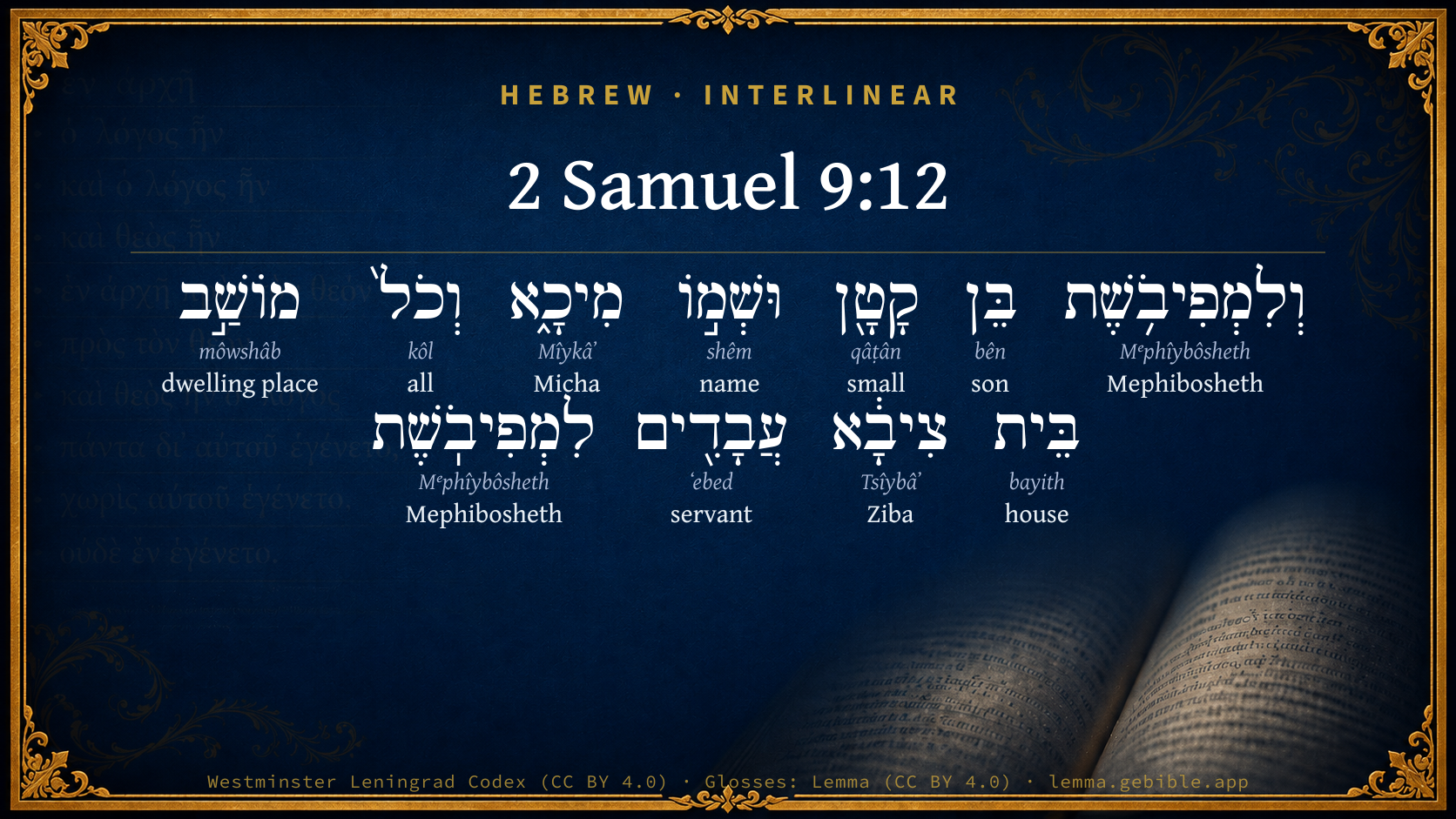
Hebrew (Westminster Leningrad Codex) 2 Samuel 9:12 appears in the Hebrew Old Testament. The text above is from the Westminster Leningrad Codex. Each word links to its Strong’s number, a concise gloss, and parsing drawn from the Open Scriptures Hebrew Bible morphology. Click any word for its full Brown-Driver-Briggs (BDB) entry.
Download image
Cite this verse

2 Samuel 9:12 (World English Bible). Public Domain. Lemma interlinear Bible study tool, https://lemma.gebible.app/v/2-samuel/9/12.

Show BibTeX & RIS
BibTeX
RIS
English Translation
Mephibosheth had a young son, whose name was Mica. All that lived in the house of Ziba were servants to Mephibosheth.
World English Bible · Public Domain
Highlights
  • 1 first appearance in the Hebrew Bible
Full analysis ↓
Download a study sheet

One document with this verse’s original text, its word-by-word gloss line, the meaning frame, cross-references with their text, attributed commentary, and full source and license credits — printable, and it pastes into notes with its structure intact.

This verse Autodidact and up

Study sheet (.html) Plain text (.txt)

A passage Seminary Student

Up to 50 verses in one chapter. A passage sheet keeps up to 6 commentary sources and 12 cross-references per verse, in the order this page ranks them, and says so on the sheet whenever that leaves anything out. Ask for a single verse and you get the Autodidact verse sheet above.

Everything on this page stays free to read, with no account — the sheet is a download of what is already on screen, not access to it.

Want to remove ads? Support Godless Engineer
Compare translations 3

The same verse in 3 English versions, stacked beneath the original-language interlinear above. Click any original word for its lexicon entry.

Each is an independent rendering of the whole verse — the interlinear is not word-aligned to these translations.

Highlighted words mark where these versions differ — a whole-verse word diff, not a word-by-word alignment.

  • World English Bible Public Domain
    Mephibosheth had a young son, whose name was Mica. All that lived in the house of Ziba were servants to Mephibosheth.
  • King James Version Public Domain
    And Mephibosheth had a young son, whose name was Micha. And all that dwelt in the house of Ziba were servants unto Mephibosheth.
  • unfoldingWord Literal Text CC BY-SA 4.0
    Now to Mephibosheth a young son, and his name Mica. And all of the dwelling of the house of Ziba servants to Mephibosheth.

unfoldingWord Literal Text — © unfoldingWord, licensed CC BY-SA 4.0. Word-aligned USFM3 via Door43 (git.door43.org/unfoldingWord/en_ult).

Versions to compare (up to 4)

3 of 4 selected

Show all 18 translations

Every available English version of this verse, each an independent rendering of the whole verse.

  • World English Bible Public Domain
    Mephibosheth had a young son, whose name was Mica. All that lived in the house of Ziba were servants to Mephibosheth.
  • Berean Standard Bible Public Domain
    And Mephibosheth had a young son named Mica, and all who dwelt in the house of Ziba were servants of Mephibosheth.
  • Majority Standard Bible Public Domain
    And Mephibosheth had a young son named Mica, and all who dwelt in the house of Ziba were servants of Mephibosheth.
  • King James Version Public Domain
    And Mephibosheth had a young son, whose name was Micha. And all that dwelt in the house of Ziba were servants unto Mephibosheth.
  • American Standard Version (1901) Public Domain
    And Mephibosheth had a young son, whose name was Mica. And all that dwelt in the house of Ziba were servants unto Mephibosheth.
  • Revised Version (1885) Public Domain
    And Mephibosheth had a young son, whose name was Mica. And all that dwelt in the house of Ziba were servants unto Mephibosheth.
  • Geneva Bible (1599) Public Domain
    Mephibosheth also had a yong sonne named Micha, and all that dwelled in the house of Ziba, were seruants vnto Mephibosheth.
  • Douay-Rheims (1899) Public Domain
    And Miphiboseth had a young son whose name was Micha: and all the kindred of the house of Siba served Miphiboseth.
  • Young's Literal Translation Public Domain
    And Mephibosheth hath a young son, and his name `is' Micha, and every one dwelling in the house of Ziba `are' servants to Mephibosheth.
  • Literal Standard Version CC BY-SA 4.0
    And Mephibosheth has a young son, and his name [is] Micha, and everyone dwelling in the house of Ziba [are] servants to Mephibosheth.
  • Unlocked Literal Bible CC BY-SA 4.0
    Mephibosheth had a young son whose name was Mika. All who lived in the house of Ziba were servants of Mephibosheth.
  • unfoldingWord Literal Text CC BY-SA 4.0
    Now to Mephibosheth a young son, and his name Mica. And all of the dwelling of the house of Ziba servants to Mephibosheth.
  • Darby Bible Public Domain
    And Mephibosheth had a young son, whose name was Mica. And all who dwelt in the house of Ziba were servants to Mephibosheth.
  • World Messianic Bible Public Domain
    Mephibosheth had a young son, whose name was Mica. All who lived in Ziba’s house were servants to Mephibosheth.
  • Webster's Bible Public Domain
    And Mephibosheth had a young son, whose name was Micah. And all that dwelt in the house of Ziba were servants to Mephibosheth.
  • Free Bible Version CC BY-SA 4.0
    Mephibosheth had a young son named Mica. All the people who lived in Ziba's house became Mephibosheth's servants.
  • Bible in Basic English Public Domain
    And Mephibosheth had a young son named Mica. And all the people living in the house of Ziba were servants to Mephibosheth.
  • JPS Tanakh (1917) Public Domain
    Now Mephibosheth had a young son, whose name was Mica. And all that dwelt in the house of Ziba were servants unto Mephibosheth.

Literal Standard Version (2020), Covenant Press — licensed CC BY-SA 4.0. Text via the HelloAO Bible API (eBible.org). Unlocked Literal Bible (unfoldingWord) — licensed CC BY-SA 4.0. Text via the HelloAO Bible API (eBible.org). unfoldingWord Literal Text — © unfoldingWord, licensed CC BY-SA 4.0. Word-aligned USFM3 via Door43 (git.door43.org/unfoldingWord/en_ult). Free Bible Version, Dr. Jonathan Gallagher — licensed CC BY-SA 4.0. Text via the HelloAO Bible API (eBible.org).

Word by word

More ways to search: Search by grammar → Find every occurrence → Compare this word →

Practice this passage: Drill this verse → Learn its vocabulary →

מִיכָ֑א
Mîykâʼ
H4316
“Micha”
Noun, Proper
Part of Speech
Noun
Type
Proper
Full BDB Definition

Origin: a variation for H4318

TWOT: None

Micha = "who is like God" - son of Mephibosheth - a Levite who signed the covenant with Nehemiah - father of Mattaniah, a Gershonite Levite and descendant of Asaph
  1. וְלִמְפִיבֹ֥שֶׁת Mᵉphîybôsheth H4648 “and · to/for · Mephibosheth” Conjunction + Preposition + Noun, Proper
  2. בֵּן bên H1121 “son” Noun, Common, Masculine, Singular, Absolute
  3. קָטָ֖ן qâṭân H6996 “small” Adjective, Adjective, Masculine, Singular, Absolute
  4. וּשְׁמ֣וֹ shêm H8034 “and · name · his” Conjunction + Noun, Common, Masculine, Singular, Construct + Suffix, Personal, 3rd Person, Masculine, Singular
  5. וְכֹל֙ kôl H3605 “and · all of” Conjunction + Noun, Common, Masculine, Singular, Construct
  6. מוֹשַׁ֣ב môwshâb H4186 “dwelling place of” Noun, Common, Masculine, Singular, Construct
  7. בֵּית bayith H1004 “house of” Noun, Common, Masculine, Singular, Construct
  8. צִיבָ֔א Tsîybâʼ H6717 “Ziba” Noun, Proper
  9. עֲבָדִ֖ים ʻebed H5650 “servants” Noun, Common, Masculine, Plural, Absolute
  10. לִמְפִיבֹֽשֶׁת Mᵉphîybôsheth H4648 “to/for · Mephibosheth” Preposition + Noun, Proper

About this verse

These counts appear in no published source. They are computed here, from the morphology-tagged text and Lemma’s own curated glosses. What Lemma adds →

11
words
10
distinct lemmas
Historical
section

Notable vocabulary

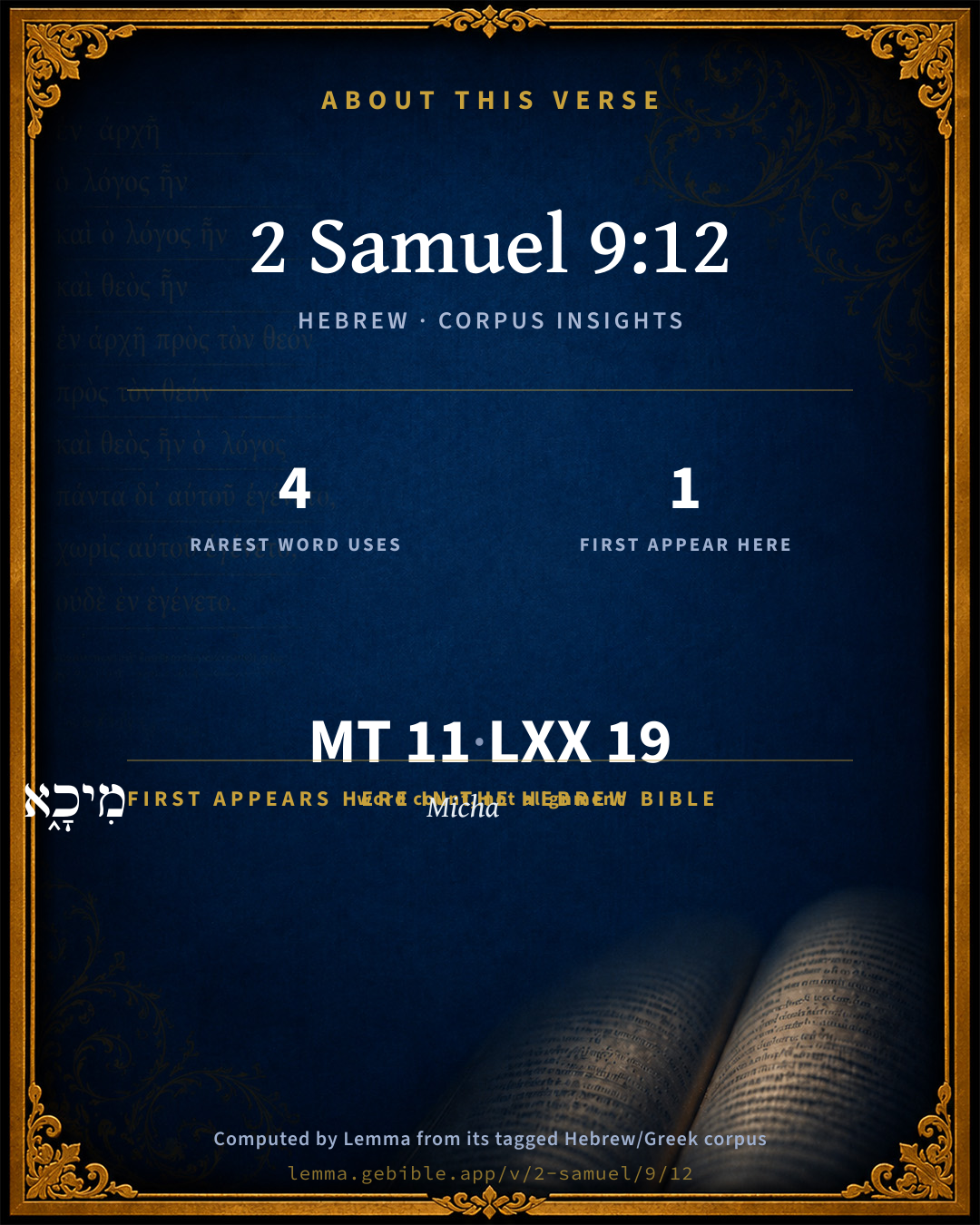
The rarest word here is מִיכָ֑א Micha H4316 — appearing just 4 times in the whole Hebrew Bible.

First appearance in Scripture

This word makes its first canonical appearance in the Hebrew Bible here:

  • מִיכָ֑א Micha H4316

Shared distinctive vocabulary

מִיכָ֑א Micha H4316 occurs in 4 verses of the Hebrew Bible. Also found in:

Grammatical profile

  • 10 nouns
  • 1 adjective

Repetition

A word recurs within this verse — often emphatic in Hebrew:

  • וְלִמְפִיבֹ֥שֶׁת Mephibosheth H4648 ×2

Hebrew & Septuagint length

In English translation the verse runs 21 words from the Hebrew and 21 from the Septuagint (LXX English) — the same length.

A rough comparison of the two English renderings, which tokenize alike — not a word-level alignment.

Word counts can differ between the Hebrew and the Greek without any difference in meaning — e.g. the Hebrew direct-object marker אֵת has no separate Greek word, and Greek often adds the article ὁ.

In the original languages it is 11 Hebrew tokens and 19 Greek tokens — but the two are counted differently (Hebrew bundles its prefixes and suffixes into one token; the Greek is in lemma form), so that isn’t a like-for-like length.

Cross-references

4

Topical passages linked to 2 Samuel 9:12 in the Treasury of Scripture Knowledge — connected by theme and wording, ordered by reader-vote popularity; previews shown in the World English Bible.

  • 1 Chronicles 8:8 Shaharaim became the father of children in the field of Moab, after he had sent them away; Hushim and Baara were his wives.
  • 1 Chronicles 8:34–40 The son of Jonathan was Merib Baal; and Merib Baal became the father of Micah.
  • 1 Chronicles 9:40–44 The son of Jonathan was Merib Baal; and Merib Baal became the father of Micah.
  • Micah 7:5–6 Don't trust in a neighbor. Don't put confidence in a friend. With the woman lying in your embrace, Be careful of the words of your mouth!

Cross-references courtesy of OpenBible.info (CC BY 4.0).

Hebrew and Greek witnesses Masoretic Hebrew ↔ Greek Septuagint

The same verse in the two great witnesses to the Old Testament, shown verse-for-verse.

These are two independent witnesses, not word-aligned to each other, and the Septuagint is shown in lemma (dictionary) form.

Hebrew 2 Samuel 9:12 Masoretic · Westminster Leningrad Codex

וְלִמְפִיבֹ֥שֶׁת בֵּן קָטָ֖ן וּשְׁמ֣וֹ מִיכָ֑א וְכֹל֙ מוֹשַׁ֣ב בֵּית צִיבָ֔א עֲבָדִ֖ים לִמְפִיבֹֽשֶׁת

Mephibosheth had a young son, whose name was Mica. All that lived in the house of Ziba were servants to Mephibosheth.

World English Bible · Public Domain

Greek LXX 2 Samuel 9:12 Septuagint · lemma form

καί ὁ μεμφιβοσθε υἱός μικρός καί ὄνομα αὐτός μιχα καί πᾶς ὁ κατοίκησις ὁ οἶκος σιβα δοῦλος ὁ μεμφιβοσθε

And Memphibosthe had a little son, and his name was Micha: and all the household of Siba were servants to Memphibosthe.

LXX2012 (modern English Septuagint) · Public Domain

Hebrew: Westminster Leningrad Codex (CC BY 4.0). Greek: Septuagint (public domain); English from LXX2012 (modern English Septuagint) (Public Domain). How the Septuagint differs from the Hebrew →

Targum (Aramaic paraphrase)

1

The Targum is the ancient Jewish Aramaic paraphrase of the Hebrew Scriptures — an interpretive translation, not the Hebrew text itself. Onkelos (literal) and Pseudo-Jonathan (expansive) render the Torah, and Jonathan the Prophets. Coverage is partial: where no permissively-licensed English translation exists for a verse, only the Aramaic is shown. This is verse-level text, not a word-by-word alignment to the Hebrew.

  1. Targum Jonathan Prophets (Joshua–Malachi)
    וְלִמְפִיבֹשֶׁת בָּרָא זְעֵירָא וּשְׁמֵיהּ מִיכָה וְכֹל מוֹתַב בֵּית צִיבָא עַבְדִין לִמְפִיבֹשֶׁת:

    (no public-domain English translation for this verse)

    Targum Jonathan — Aramaic: “Mikraot Gedolot” (public domain). English: “Sefaria Community Translation” (CC0 1.0 (public-domain dedication)); “London "Chaldee Paraphrase," 1871” (public domain). Text via Sefaria.

Commentary

Notes on 2 Samuel 9:12 from classic Christian and Jewish commentators (each source and its license shown beneath its notes). The classic Christian expositions comment on the surrounding passage and are grouped to its opening verse, so a note may address several verses; the Jewish commentaries on the Tanakh (Rashi and others) are per-verse, so they appear only where the commentator wrote on this verse.

Lemma curates 59 commentaries, every one of them public domain or Creative Commons licensed, each selected and text-cleaned for this edition rather than reprinted as found. About our sources →

Trapp's Complete Commentary

John Trapp

2Sa 9:12 And Mephibosheth had a young son, whose name [was] Micha. And all that dwelt in the house of Ziba [were] servants unto Mephibosheth.

Ver. 12. And Mephibosheth had a younq son.] It was no small while, therefore, ere poor Mephibosheth was thought upon - see 2Sa 9:1; twenty years at least.

Were servants unto Mephibosheth.] He was master of the house, and Ziba but steward; till, by his false and foolish calumnies, he had wormed out his master.

John Trapp, A Commentary or Exposition upon All the Books of the Old and New Testament (1647–1656) — public domain. Text from a community e-Sword module.

Jamieson, Fausset & Brown

Robert Jamieson, A. R. Fausset & David Brown

Mephibosheth had a young son, whose name was Micah--Whether born before or after his residence in Jerusalem, cannot be ascertained. But through him the name and memory of the excellent Jonathan was preserved (see Ch1 8:34-35; Ch1 9:40-41).

Next: 2 Samuel Chapter 10

Jamieson, Fausset & Brown — Commentary Critical and Explanatory on the Whole Bible (1871) — public domain (CC PDM 1.0). Text via the HelloAO Bible API.

The Cambridge Bible for Schools and Colleges

gen. ed. J. J. S. Perowne

12. Micha] He had a numerous posterity. See 1Ch_8:34, ff., where he is called Micah.

The Cambridge Bible for Schools and Colleges (gen. ed. J. J. S. Perowne; Cambridge University Press, 1878–1918) — public domain. Text from a community e-Sword module.

John Gill's Exposition

And Mephibosheth had a young son, whose name was Micha,.... What his age was is not said from him sprung a progeny of several generations, Ch1 8:34,

and all that dwelt in the house Ziba were servants to Mephibosheth; his sons and his servants.

John Gill's Exposition of the Whole Bible (1746–1763) — public domain (CC PDM 1.0). Text via the HelloAO Bible API.

Albert Barnes' Notes on the Bible

Mephibosheth was five years old at Saul’s death. He may have been thirteen at David’s accession to the throne of Israel. In the eighth year of David’s reign over all Israel he would have been twenty-one. His having a son at this time indicates that we are about the 10th year of David’s reign.

Micha - Or Micah; who, as far as we know, was Mephibosheth’s only son, and had a numerous posterity (marginal references).

Albert Barnes' Notes on the Bible (1834–1885) — public domain. Text from a community e-Sword/MySword module.

Matthew Poole's English Annotations

Mephibosheth had a young son; either, first, Before he was discovered and brought to the king; and then David seems guilty of a great error in forgetting his dear Jonathan so long; although his long and continued wars, both civil and foreign, might afford him some excuse, as filling his mind and time with business of another nature. Or, secondly, After that time; for there is nothing here which determines when this son was born. Whose name was

Micha; who also had other children and grandchildren, to keep up the name and memory of worthy and famous Jonathan. See 1Ch 8:34,35; 9:40,41.

Matthew Poole's English Annotations on the Holy Bible (1683–1685) — public domain. Text from a community e-Sword/MySword module.

Whedon's Commentary on the Bible

Daniel D. Whedon

12. Micha — Called Micah in 1Ch_8:35, where it appears that the posterity of Jonathan continued through many generations.

Daniel D. Whedon (gen. ed.), Commentary on the Old and New Testaments (1874–1909) — public domain. Text from a community e-Sword module.

The Pulpit Commentary

Micha. This son of Mephibosheth became the representative of the house of Saul, and had a numerous offspring, who were leading men in the tribe of Benjamin until the Captivity. (see 1Ch_8:35-40 1Ch_9:40-44)

The Pulpit Commentary (1880–1919), ed. H.D.M. Spence-Jones & Joseph S. Exell — public domain. Text from a community e-Sword module.

Rashi

Rabbi Shlomo Yitzchaki (Rashi)

Those who dwelled in the house of Tsivoh. His children and his slaves.

Rashi on the Tanakh — English translations: “The Judaica Press complete Tanach with Rashi, translated by A. J. Rosenberg” (CC BY 4.0); “Pentateuch with Rashi's commentary by M. Rosenbaum and A.M. Silbermann, 1929-1934” (public domain); “The Metsudah Tanach series, Lakewood, N.J” (CC BY 4.0); and “The Book of Joshua, Metsudah Publications, 1997” (CC BY 4.0). Text via Sefaria.

Lesson kit

Teaching starters — assembled from the data on this page, not authored interpretation. Every prompt links to the verse data it draws on. Edit before teaching.

2 Samuel, in the Historical, opens this verse with 11 words (10 distinct Hebrew lemmas). Its most distinctive word is Mîykâʼ (“Micha”). A historical commentator’s framing appears above. Read the whole chapter for the surrounding context.

Discussion questions

  1. How does “Micha” (Mîykâʼ) shape what this verse is saying?
  2. This is the first place “Micha” appears in Scripture (first appears here). What does its debut here establish?
  3. How does 1 Chronicles 9:15, which shares the word «Micha», read alongside this verse?
  4. What does the repetition of “Mephibosheth” (2× in this one verse) do in this verse?
  5. The translations on this page render this verse differently — a whole-verse word diff, not a word-by-word alignment. What might account for the different wordings?
  6. Compare how Trapp's Complete Commentary and Jamieson, Fausset & Brown read this verse. Where do they agree or differ?

Things to notice

Reading settings

Reading text

Shown beneath each verse's original-language words.

Old Testament
Old Testament edition

Read the OT as the Masoretic Hebrew (MT) or the Greek Septuagint (LXX).

English shown for the Greek Septuagint (in the Hebrew ↔ Greek comparison).

Comparing translations? Open the Compare panel on any verse page to stack up to four side by side.