
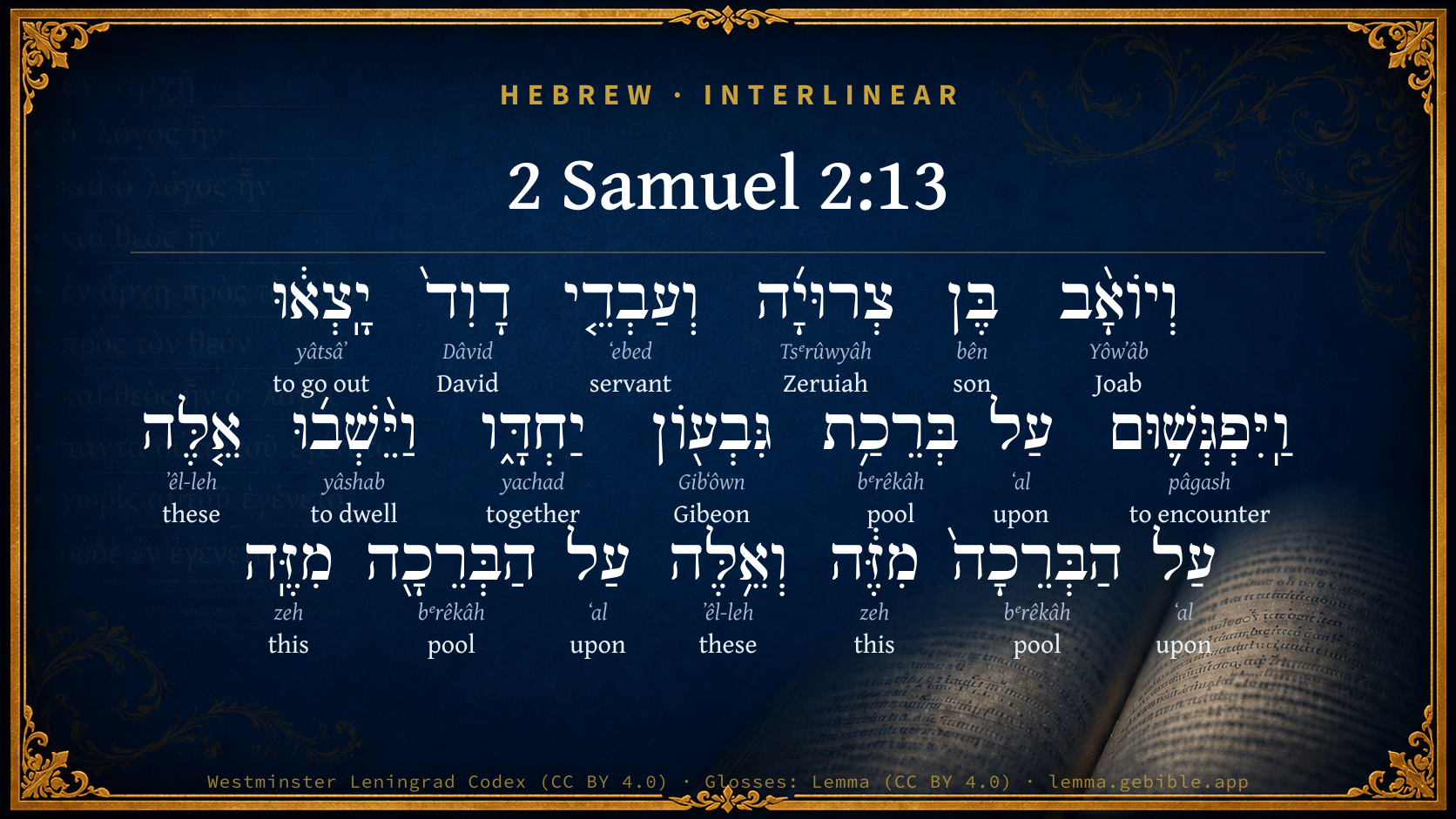
2 Samuel 2:13

Hebrew (Westminster Leningrad Codex) 2 Samuel 2:13 appears in the Hebrew Old Testament. The text above is from the Westminster Leningrad Codex. Each word links to its Strong’s number, a concise gloss, and parsing drawn from the Open Scriptures Hebrew Bible morphology. Click any word for its full Brown-Driver-Briggs (BDB) entry.
Download image
Cite this verse

2 Samuel 2:13 (World English Bible). Public Domain. Lemma interlinear Bible study tool, https://lemma.gebible.app/v/2-samuel/2/13.

Show BibTeX & RIS
BibTeX
RIS
English Translation
Joab the son of Zeruiah, and the servants of David, went out, and met them by the pool of Gibeon; and they sat down, the one on the one side of the pool, and the other on the other side of the pool.
World English Bible · Public Domain
Highlights
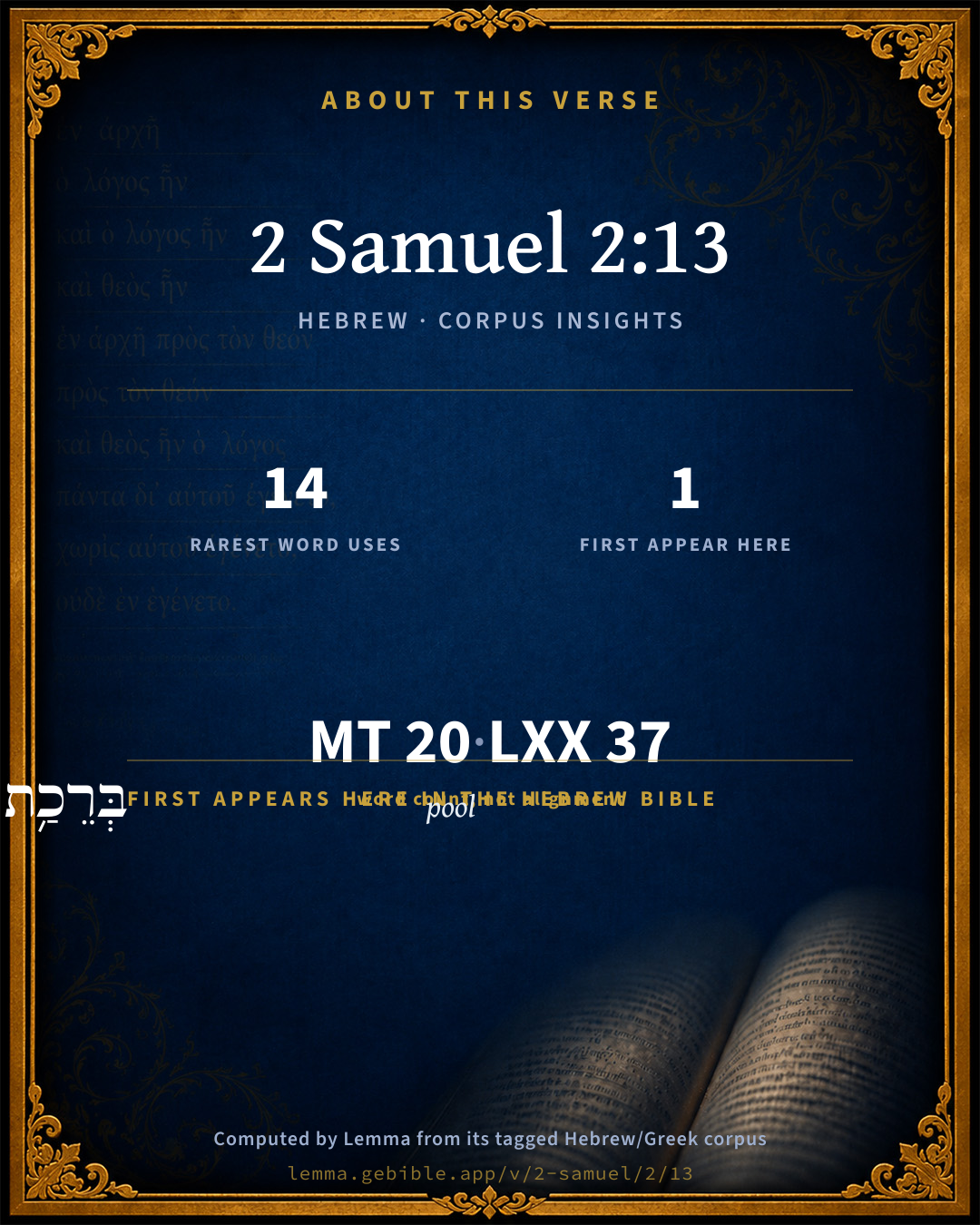
  • 1 first appearance in the Hebrew Bible
Full analysis ↓
Download a study sheet

One document with this verse’s original text, its word-by-word gloss line, the meaning frame, cross-references with their text, attributed commentary, and full source and license credits — printable, and it pastes into notes with its structure intact.

This verse Autodidact and up

Study sheet (.html) Plain text (.txt)

A passage Seminary Student

Up to 50 verses in one chapter. A passage sheet keeps up to 6 commentary sources and 12 cross-references per verse, in the order this page ranks them, and says so on the sheet whenever that leaves anything out. Ask for a single verse and you get the Autodidact verse sheet above.

Everything on this page stays free to read, with no account — the sheet is a download of what is already on screen, not access to it.

Want to remove ads? Support Godless Engineer
Compare translations 3

The same verse in 3 English versions, stacked beneath the original-language interlinear above. Click any original word for its lexicon entry.

Each is an independent rendering of the whole verse — the interlinear is not word-aligned to these translations.

Highlighted words mark where these versions differ — a whole-verse word diff, not a word-by-word alignment.

  • World English Bible Public Domain
    Joab the son of Zeruiah, and the servants of David, went out, and met them by the pool of Gibeon; and they sat down, the one on the one side of the pool, and the other on the other side of the pool.
  • King James Version Public Domain
    And Joab the son of Zeruiah, and the servants of David, went out, and met together by the pool of Gibeon: and they sat down, the one on the one side of the pool, and the other on the other side of the pool.
  • unfoldingWord Literal Text CC BY-SA 4.0
    And Joab, the son of Zeruiah, and the servants of David went out and encountered them together by the pool of Gibeon. And they sat down, these by the pool on this and these by the pool on that.

unfoldingWord Literal Text — © unfoldingWord, licensed CC BY-SA 4.0. Word-aligned USFM3 via Door43 (git.door43.org/unfoldingWord/en_ult).

Versions to compare (up to 4)

3 of 4 selected

Show all 18 translations

Every available English version of this verse, each an independent rendering of the whole verse.

  • World English Bible Public Domain
    Joab the son of Zeruiah, and the servants of David, went out, and met them by the pool of Gibeon; and they sat down, the one on the one side of the pool, and the other on the other side of the pool.
  • Berean Standard Bible Public Domain
    So Joab son of Zeruiah, along with the servants of David, marched out and met them by the pool of Gibeon. And the two camps took up positions on opposite sides of the pool.
  • Majority Standard Bible Public Domain
    So Joab son of Zeruiah and the servants of David marched out and met them by the pool of Gibeon. And the two groups took up positions on opposite sides of the pool.
  • King James Version Public Domain
    And Joab the son of Zeruiah, and the servants of David, went out, and met together by the pool of Gibeon: and they sat down, the one on the one side of the pool, and the other on the other side of the pool.
  • American Standard Version (1901) Public Domain
    And Joab the son of Zeruiah, and the servants of David, went out, and met them by the pool of Gibeon; and they sat down, the one on the one side of the pool, and the other on the other side of the pool.
  • Revised Version (1885) Public Domain
    And Joab the son of Zeruiah, and the servants of David, went out, and met them by the pool of Gibeon; and they sat down, the one on the one side of the pool, and the other on the other side of the pool.
  • Geneva Bible (1599) Public Domain
    And Ioab the sonne of Zeruiah, and the seruants of Dauid went out and met one another by the poole of Gibeon: and they sate downe, the one on the one side of the poole, and the other on the otherside of the poole.
  • Douay-Rheims (1899) Public Domain
    And Joab the son of Sarvia, and the servants of David went out, and met them by the pool of Gabaon. And when they were come together, they sat down over against one another: the one on the one side of the pool, and the other on the other side.
  • Young's Literal Translation Public Domain
    And Joab son of Zeruiah, and servants of David, have gone out, and they meet by the pool of Gibeon together, and sit down, these by the pool on this `side', and these by the pool on that.
  • Literal Standard Version CC BY-SA 4.0
    And Joab son of Zeruiah, and servants of David, have gone out, and they meet by the pool of Gibeon together, and sit down, these by the pool on this [side], and these by the pool on that [side].
  • Unlocked Literal Bible CC BY-SA 4.0
    Joab son of Zeruiah and the servants of David went out and met them by the pool of Gibeon. There they sat down, one group on one side of the pool and the other on the other side.
  • unfoldingWord Literal Text CC BY-SA 4.0
    And Joab, the son of Zeruiah, and the servants of David went out and encountered them together by the pool of Gibeon. And they sat down, these by the pool on this and these by the pool on that.
  • Darby Bible Public Domain
    And Joab the son of Zeruiah, and the servants of David, went out. And they met together by the pool of Gibeon; and they sat down, these on the one side of the pool, and those on the other side of the pool.
  • World Messianic Bible Public Domain
    Joab the son of Zeruiah and David’s servants went out, and met them by the pool of Gibeon; and they sat down, the one on the one side of the pool and the other on the other side of the pool.
  • Webster's Bible Public Domain
    And Joab the son of Zeruiah, and the servants of David went out, and met together by the pool of Gibeon: and they sat down, the one on the one side of the pool, and the other on the other side of the pool.
  • Free Bible Version CC BY-SA 4.0
    Joab, son of Zeruiah, and David's men set off and met them at the pool of Gibeon, where they all sat down, facing each other across the pool.
  • Bible in Basic English Public Domain
    And Joab, the son of Zeruiah, and the servants of David, went out and came face to face with them by the pool of Gibeon; and they took up their position, facing one another on opposite sides of the pool.
  • JPS Tanakh (1917) Public Domain
    And Joab the son of Zeruiah, and the servants of David, went out; and they met together by the pool of Gibeon, and sat down, the one on the one side of the pool, and the other on the other side of the pool.

Literal Standard Version (2020), Covenant Press — licensed CC BY-SA 4.0. Text via the HelloAO Bible API (eBible.org). Unlocked Literal Bible (unfoldingWord) — licensed CC BY-SA 4.0. Text via the HelloAO Bible API (eBible.org). unfoldingWord Literal Text — © unfoldingWord, licensed CC BY-SA 4.0. Word-aligned USFM3 via Door43 (git.door43.org/unfoldingWord/en_ult). Free Bible Version, Dr. Jonathan Gallagher — licensed CC BY-SA 4.0. Text via the HelloAO Bible API (eBible.org).

Word by word

More ways to search: Search by grammar → Find every occurrence → Compare this word →

Practice this passage: Drill this verse → Learn its vocabulary →

וַֽיִּפְגְּשׁ֛וּם
pâgash
H6298
“and · to encounter · them”
Conjunction + Verb, Qal, Sequential Imperfect, 3rd Person, Masculine, Plural + Suffix, Personal, 3rd Person, Masculine, Plural
Part of Speech
Conjunction + Verb
Stem
Qal
Form
Sequential Imperfect
Person
3rd Person
Gender
Masculine
Number
Plural
Full BDB Definition

Origin: a primitive root

TWOT: 1733

to meet, join, encounter - (Qal) to meet, encounter - (Niphal) to meet together, meet each other - (Piel) to meet, encounter
  1. וְיוֹאָ֨ב Yôwʼâb H3097 “and · Joab” Conjunction + Noun, Proper
  2. בֶּן bên H1121 “son of” Noun, Common, Masculine, Singular, Construct
  3. צְרוּיָ֜ה Tsᵉrûwyâh H6870 “Zeruiah” Noun, Proper
  4. וְעַבְדֵ֤י ʻebed H5650 “and · servants of” Conjunction + Noun, Common, Masculine, Plural, Construct
  5. דָוִד֙ Dâvid H1732 “David” Noun, Proper
  6. יָֽצְא֔וּ yâtsâʼ H3318 “to go out” Verb, Qal, Perfect, 3rd Person, Common, Plural
  7. עַל ʻal H5921 “upon” Preposition
  8. בְּרֵכַ֥ת bᵉrêkâh H1295 “pool of” Noun, Common, Feminine, Singular, Construct
  9. גִּבְע֖וֹן Gibʻôwn H1391 “Gibeon” Noun, Proper
  10. יַחְדָּ֑ו yachad H3162 “together” Adverb
  11. וַיֵּ֨שְׁב֜וּ yâshab H3427 “and · to dwell” Conjunction + Verb, Qal, Sequential Imperfect, 3rd Person, Masculine, Plural
  12. אֵ֤לֶּה ʼêl-leh H428 “these” Pronoun, Demonstrative, Common, Plural
  13. עַל ʻal H5921 “upon” Preposition
  14. הַבְּרֵכָה֙ bᵉrêkâh H1295 “the · pool” Particle, Definite Article + Noun, Common, Feminine, Singular, Absolute
  15. מִזֶּ֔ה zeh H2088 “from · this” Preposition + Pronoun, Demonstrative, Masculine, Singular
  16. וְאֵ֥לֶּה ʼêl-leh H428 “and · these” Conjunction + Pronoun, Demonstrative, Common, Plural
  17. עַל ʻal H5921 “upon” Preposition
  18. הַבְּרֵכָ֖ה bᵉrêkâh H1295 “the · pool” Particle, Definite Article + Noun, Common, Feminine, Singular, Absolute
  19. מִזֶּֽה zeh H2088 “from · this” Preposition + Pronoun, Demonstrative, Masculine, Singular

About this verse

These counts appear in no published source. They are computed here, from the morphology-tagged text and Lemma’s own curated glosses. What Lemma adds →

20
words
14
distinct lemmas
Historical
section

Notable vocabulary

The rarest word here is וַֽיִּפְגְּשׁ֛וּם to encounter H6298 — appearing just 14 times in the whole Hebrew Bible.

First appearance in Scripture

This word makes its first canonical appearance in the Hebrew Bible here:

  • בְּרֵכַ֥ת pool H1295

Shared distinctive vocabulary

וַֽיִּפְגְּשׁ֛וּם to encounter H6298 occurs in 14 verses of the Hebrew Bible. Also found in:

Grammatical profile

  • 3 verbs
  • 9 nouns
  • 4 pronouns
  • 3 prepositions
  • 1 adverb

Verb forms

  • יָֽצְא֔וּ Qal · Perfect
  • וַֽיִּפְגְּשׁ֛וּם Qal · Sequential Imperfect
  • וַיֵּ֨שְׁב֜וּ Qal · Sequential Imperfect

Repetition

Words recur within this verse — often emphatic in Hebrew:

  • עַל upon H5921 ×3
  • בְּרֵכַ֥ת pool H1295 ×3
  • אֵ֤לֶּה these H428 ×2
  • מִזֶּ֔ה this H2088 ×2

Hebrew & Septuagint length

In English translation the verse runs 43 words from the Hebrew and 45 from the Septuagint (LXX English) — closely comparable.

A rough comparison of the two English renderings, which tokenize alike — not a word-level alignment.

Word counts can differ between the Hebrew and the Greek without any difference in meaning — e.g. the Hebrew direct-object marker אֵת has no separate Greek word, and Greek often adds the article ὁ.

In the original languages it is 20 Hebrew tokens and 37 Greek tokens — but the two are counted differently (Hebrew bundles its prefixes and suffixes into one token; the Greek is in lemma form), so that isn’t a like-for-like length.

Cross-references

8

Topical passages linked to 2 Samuel 2:13 in the Treasury of Scripture Knowledge — connected by theme and wording, ordered by reader-vote popularity; previews shown in the World English Bible.

  • 2 Samuel 8:16 Joab the son of Zeruiah was over the host; and Jehoshaphat the son of Ahilud was recorder;
  • 1 Chronicles 2:16 and their sisters were Zeruiah and Abigail. The sons of Zeruiah: Abishai, and Joab, and Asahel, three.
  • 2 Samuel 2:18 The three sons of Zeruiah were there, Joab, and Abishai, and Asahel: and Asahel was as light of foot as a wild gazelle.
  • 2 Samuel 20:23 Now Joab was over all the host of Israel; and Benaiah the son of Jehoiada was over the Cherethites and over the Pelethites;
  • 1 Kings 1:7 He conferred with Joab the son of Zeruiah, and with Abiathar the priest: and they following Adonijah helped him.
  • 1 Kings 2:28–35 The news came to Joab; for Joab had turned after Adonijah, though he didn't turn after Absalom. Joab fled to the Tent of Yahweh, and caught hold on the horns of the altar.
  • 1 Chronicles 11:6 David said, Whoever strikes the Jebusites first shall be chief and captain. Joab the son of Zeruiah went up first, and was made chief.
  • Jeremiah 41:12 then they took all the men, and went to fight with Ishmael the son of Nethaniah, and found him by the great waters that are in Gibeon.

Cross-references courtesy of OpenBible.info (CC BY 4.0).

Hebrew and Greek witnesses Masoretic Hebrew ↔ Greek Septuagint

The same verse in the two great witnesses to the Old Testament, shown verse-for-verse.

These are two independent witnesses, not word-aligned to each other, and the Septuagint is shown in lemma (dictionary) form.

Hebrew 2 Samuel 2:13 Masoretic · Westminster Leningrad Codex

וְיוֹאָ֨ב בֶּן צְרוּיָ֜ה וְעַבְדֵ֤י דָוִד֙ יָֽצְא֔וּ וַֽיִּפְגְּשׁ֛וּם עַל בְּרֵכַ֥ת גִּבְע֖וֹן יַחְדָּ֑ו וַיֵּ֨שְׁב֜וּ אֵ֤לֶּה עַל הַבְּרֵכָה֙ מִזֶּ֔ה וְאֵ֥לֶּה עַל הַבְּרֵכָ֖ה מִזֶּֽה

Joab the son of Zeruiah, and the servants of David, went out, and met them by the pool of Gibeon; and they sat down, the one on the one side of the pool, and the other on the other side of the pool.

World English Bible · Public Domain

Greek LXX 2 Samuel 2:13 Septuagint · lemma form

καί ιωαβ υἱός σαρουιας καί ὁ παῖς δαυίδ ἐκἔρχομαι ἐκ χεβρων καί συνἀντάω αὐτός ἐπί ὁ κρήνη ὁ γαβαων ἐπί ὁ αὐτός καί καταἵζω οὗτος ἐπί ὁ κρήνη ὁ γαβαων ἐντεῦθεν καί οὗτος ἐπί ὁ κρήνη ἐντεῦθεν

And Joab the son of Saruia, and the servants of David, went forth from Chebron, and met them at the fountain of Gabaon, at the same place: and these sat down by the fountain on this side, and those by the fountain on that side.

LXX2012 (modern English Septuagint) · Public Domain

Hebrew: Westminster Leningrad Codex (CC BY 4.0). Greek: Septuagint (public domain); English from LXX2012 (modern English Septuagint) (Public Domain). How the Septuagint differs from the Hebrew →

Targum (Aramaic paraphrase)

1

The Targum is the ancient Jewish Aramaic paraphrase of the Hebrew Scriptures — an interpretive translation, not the Hebrew text itself. Onkelos (literal) and Pseudo-Jonathan (expansive) render the Torah, and Jonathan the Prophets. Coverage is partial: where no permissively-licensed English translation exists for a verse, only the Aramaic is shown. This is verse-level text, not a word-by-word alignment to the Hebrew.

  1. Targum Jonathan Prophets (Joshua–Malachi)
    וְיוֹאָב בַּר צְרוּיָה וְעַבְדֵי דָוִד נְפַקוּ וְעַרְעוּנוּן עַל בְּרֵיכָתָא דִבְגִבְעוֹן כַּחֲדָא וּשְׁרוֹ אִילֵין עַל בְּרֵיכָתָא מִיכָּא וְאִילֵין עַל בֵּרֵיכָתָא מִיכָּא:

    (no public-domain English translation for this verse)

    Targum Jonathan — Aramaic: “Mikraot Gedolot” (public domain). English: “Sefaria Community Translation” (CC0 1.0 (public-domain dedication)); “London "Chaldee Paraphrase," 1871” (public domain). Text via Sefaria.

Commentary

Notes on 2 Samuel 2:13 from classic Christian and Jewish commentators (each source and its license shown beneath its notes). The classic Christian expositions comment on the surrounding passage and are grouped to its opening verse, so a note may address several verses; the Jewish commentaries on the Tanakh (Rashi and others) are per-verse, so they appear only where the commentator wrote on this verse.

Lemma curates 59 commentaries, every one of them public domain or Creative Commons licensed, each selected and text-cleaned for this edition rather than reprinted as found. About our sources →

Trapp's Complete Commentary

John Trapp

2Sa 2:13 And Joab the son of Zeruiah, and the servants of David, went out, and met together by the pool of Gibeon: and they sat down, the one on the one side of the pool, and the other on the other side of the pool.

Ver. 13. And then sat down.] David and his men were loath to fight, unless it were in their own necessary defence. He remembered his oath to Saul, not to attempt against his house: and therefore came not hither himself in person, but sent Joab, with directions to hold off till needs must.

John Trapp, A Commentary or Exposition upon All the Books of the Old and New Testament (1647–1656) — public domain. Text from a community e-Sword module.

Tyndale Open Study Notes

Tyndale Open Resources

2:13 The pool of Gibeon extends down some 80 feet to the water table. Archaeologists estimate that the original diggers had to remove about 3,000 tons of limestone to create it.

Tyndale Open Study Notes — © Tyndale Open Resources, licensed CC BY-SA 4.0. Text via the HelloAO Bible API.

Ellicott's Commentary for English Readers

(13) Joab the son of Zeruiah.—Zeruiah was David’s sister (1Ch_2:16), and Joab the most prominent of her three distinguished sons. Subsequently, by his successful leading of the forlorn hope in the siege of Jerusalem (1Ch_11:6; comp. 2Sa_5:8), he became permanently established as commanaer-in-chief of David’s army. He was undoubtedly among “the brethren of David” who came down to him at the cave of Adullam (1Sa_22:1), though he is not mentioned by name, like his brother Abishai (1Sa_26:6-9), in the narrative of David’s outlawry.

The pool of Gibeon is a large reservoir or tank, arranged to store the overflow from a subterranean reservoir fed by a spring in the rocky hill-side. Its ruins still remain, about 120 feet long by 100 broad. The hostile forces halted in full sight of each other on the opposite sides of the pool.

A Bible Commentary for English Readers, edited by Charles John Ellicott (1878–1897) — public domain. Text from a community e-Sword module.

The Cambridge Bible for Schools and Colleges

gen. ed. J. J. S. Perowne

13. Joab the son of Zeruiah] The eldest of David’s three nephews, the son of his sister Zeruiah (1Ch_2:16). Next to the king himself he occupies the most conspicuous position in the history of David’s reign. Already he appears to have acted as commander-in-chief of the army, though his formal appointment to that post was the reward of his valour at the capture of Jebus (1Ch_11:6; 2Sa_8:16). In this capacity he (a) conducted the war against the Syrians and Ammonites (2Sa_10:7); (b) completed the conquest of Edom (1Ki_11:15-16); (c) defeated the Ammonites in a second war, and took their capital (2Sa_11:1; 2Sa_12:26).

With a too ready subservience he carried out David’s plan for getting rid of Uriah (2Sa_11:14 ff.), a service which increased his influence over David, by giving him the possession of his guilty secret. (See Blunt’s Undesigned Coincidences, Part II. ch. II.) We find Him scheming to secure the restoration of Absalom to David’s favour (2 Samuel 14), yet remaining loyal to David in Absalom’s rebellion (2Sa_18:2).

The vindictive unscrupulousness of his character is illustrated by his murder of Abner in revenge for the death of Asahel (2Sa_3:27); of Absalom, in spite of David’s express command (2Sa_18:14); of Amasa, who was appointed to supersede him (2Sa_20:10).

Too valuable to be dispensed with, too fierce to be controlled, he was a continual source of vexation to David (2Sa_3:39), who gave Solomon a dying charge not to leave his crimes unpunished (1Ki_2:5-6). His complicity in Adonijah’s rebellion filled up the measure of his iniquity, and he met a traitor’s death in spite of his taking sanctuary at the altar in Gibeon (1Ki_2:28-34).

by the pool of Gibeon] “A few rods from the village [of El-Jib], just below the top of the ridge towards the north, is a fine fountain of water. It is in a cave excavated in and under the high rock, so as to form a large subterranean reservoir. Not far below it, among the olive trees, are the remains of another open reservoir, perhaps 120 feet in length by 100 in breadth.” Robinson, Bibl. Res. I. 455. The “pool of Gibeon” may well be the waters of this fountain and reservoir. It is again referred to in Jer_41:12 as “the great waters that are in Gibeon.”

they sat down] i.e. halted and encamped.

The Cambridge Bible for Schools and Colleges (gen. ed. J. J. S. Perowne; Cambridge University Press, 1878–1918) — public domain. Text from a community e-Sword module.

John Gill's Exposition

And Joab the son of Zeruiah,.... A sister of David, and this her son was general of David's army:

and the servants of David, went out; that is, his army went out from Hebron to Gibeon, which was twenty four miles (d) to meet that under Abner; for though he had but one tribe with him, and Ishbosheth had all the rest, yet Judah was a numerous, powerful, and warlike tribe; and besides many out of the other tribes had joined them, and, above all, God was on their side, and they had his promise to rely upon with respect to the establishment of the kingdom in the house of David, and his power and providence to trust in, and therefore went out boldly and cheerfully to meet the armies of Israel under Abner:

and met together by the pool of Gibeon; the same perhaps with the great waters in Gibeon, Jer 41:12,

and they sat down, the one on the one side of the pool, and the other on the other side of the pool; facing one another, and watching each other's motions.

(d) Bunting's Travels, p. 146.

John Gill's Exposition of the Whole Bible (1746–1763) — public domain (CC PDM 1.0). Text via the HelloAO Bible API.

Albert Barnes' Notes on the Bible

On the east of the hill (El-jib, the ancient Gibeon) is a copious spring, which issues in a cave excavated in the limestone rock, so as to form a large reservoir. In the trees further down are the remains of a pool or tank of considerable size (120 feet by 110 feet). This is doubtless “the pool of Gibeon.”

Sat down - i. e. halted and encamped.

Albert Barnes' Notes on the Bible (1834–1885) — public domain. Text from a community e-Sword/MySword module.

Matthew Poole's English Annotations

Went out, to battle.

Quest. How could or durst this one tribe oppose all the rest?

Answ. First, This tribe was very numerous and valiant of themselves, and they had a king of extraordinary courage, and conduct, and success. Secondly, There were great numbers of the other tribes which favoured them, as appears from 1Ch 12. Thirdly, They had the encouragement of special promises of God, made both to their tribe and to David.

Met together, i. e. met the opposite army, and put themselves into a posture for battle.

Matthew Poole's English Annotations on the Holy Bible (1683–1685) — public domain. Text from a community e-Sword/MySword module.

Whedon's Commentary on the Bible

Daniel D. Whedon

13. Joab — Who here appears as leader of David’s men, but was not made captain of his hosts till after the capture of the Jebusites. Chap. 2Sa_5:8, and 1Ch_11:6.

The pool of Gibeon — The same as the great waters of Gibeon mentioned Jer_41:12. It is probably identical with the great reservoir still seen just northeast of the city, and supplied with water from a fine fountain in the rocks just above it. The fountain “is in a cave excavated in and under the high rock, so as to form a large subterranean reservoir. Not far below it, among the olive trees, are the remains of another open reservoir, about the size of that at Hebron, perhaps one hundred and twenty feet in length by one hundred feet in breadth. It was doubtless anciently intended to receive the superfluous waters of the cavern.” — Robinson.

Daniel D. Whedon (gen. ed.), Commentary on the Old and New Testaments (1874–1909) — public domain. Text from a community e-Sword module.

The Pulpit Commentary

The pool of Gibson. As Gibeon, which lay about six miles northwest from Jerusalem, was twenty-six miles distant from Hebron, and about the same distance from Mahauaim, it is plain that David knew of Abner"s march. Possibly he had been summoned to yield his kingdom up to Ishbosheth as the rightful lord, but, while taking no measures to extend his rule, he felt himself justified in defending his election to be king ever Judah. The pool of Gibeon is described by Robinson ("Researches," 2:136) as "an open tank about a hundred and twenty feet in length and a hundred in breadth, surrounded by a grove of olive trees. Above it, excavated in the rock, is a subterranean reservoir, to receive the water from a copious spring, from which the overflow descends into the tank below." As neither party was willing to shed the first blood in a civil war, of which the Philistines would reap the benefit, they both halted in sight of one another on opposite sides of the hill, with the tank below them in the middle.

Vers. 13-17. (GIBSON.)

Fratricidal strife.

that place was called Helkath-Hazzurim" (ver. 16). The hostile attitude assumed by Abner appeared to David to render necessary active measures in self-defence. It is not said that he inquired of the Lord. If he had done so the conflict which ensued between brethren might possibly have been averted. As it was, he sent an army of observation under the command of Joab, who (although not mentioned before) had doubtless accompanied him in his exile, (1Sa_22:1) and was now general of his forces. And Joab and "the servants of David" marched to Gibeon and encamped opposite Abner "and the servants of Ishbosheth" (ver. 13). At length Abner, impatient of delay, challenged a conflict between certain picked men on each side, not merely "to see which were best" (Josephus), but either to decide the day by the issue or to draw on a general engagement. Joab readily accepted the challenge, and the conflict commenced. It was

I BEGUN RECKLESSLY. "Let the young men arise and play fight before us." "Let them arise" (ver. 14).

1. Self-interest, ambition, and envy often quench the love of brethren (vers.26, 27), and indispose them to seek reconciliation with each other.

2. The indulgence of evil passion blinds men to the consequences of theirwords and actions.

3. Familiarity with scenes of strife and war tends to produce insensibility tohuman suffering and slaughter. That a deadly struggle could be spoken of as a pastime shows how lightly life was estimated and how heartlessly it was sacrificed. "Ambitious and bloody men often consider the dire trade of war and the slaughter of their fellow creatures as a mere diversion" (Scott).

Some seek diversion in the tented field, And make the sorrows of mankind their sport. But war"s a game which, were their subjects wise, Kings should not play at. (Cowper.)

II WAGED FEROCIOUSLY. "And they caught each other by the head," etc. (ver. 16).

1. When the love which should prevail among brethren gives place towrath, that wrath is generally most intense and cruel. Civil wars are proverbially more bitter than any other.

2. Men are sometimes so intent upon injuring their opponents as to forgetto defend themselves, and rush upon their own destruction.

3. The attempt to end strife by means of strife is commonly vain; "it israther a spur to further effusion of blood than a bridle to hinder the same." "What can war but endless war still breed?

4. The issue of the conflict does not necessarily prove the justice of thecause.

5. Mutual strife tends to mutual extermination. "All they that take thesword shall perish by the sword". (Mat_26:52) The "field of sharp blades" was a lasting memorial of destructiveness rather than of courage; a warning rather than a pattern.

III EXTENDED RAPIDLY. "And there was a very sore battle that day," etc. (ver. 17).

1. The strife of a few excites the wrathful passions of many, by whom it iswitnessed.

2. Every injurious word and act furnishes an additional impulse to wrathand retaliation; and the conflict goes on increasing.

3. That which at first may be easily checked passes entirely beyond Control."the beginning of strife is as when one letteth out water," etc. (Pro_17:14 Pro_26:21)

IV ENDED LAMENTABLY. "Abner was beaten," and three hundred and sixty of his men died; Joab"s brother Asahel was slain, with nineteen of David"s servants. "In war God punishes the sins of both parties.

1. He who gave the challenge and commenced the conflict was the first tocomplain of the result (ver. 26), and was bitterly reproached as the cause thereof (ver. 27).

2. He who accepted the challenge was filled with grief and revenge.

3. Both sides experienced heavy loss and sorrow.

4. Even David could not but regret the weakening of the nation in presenceof the common foe; or fail to see in the strife of brethren the consequences of his own faithlessness. (1Sa_27:1, 1Sa_27:10, 1Sa_27:11) If he had not taken up his abode with the Philistines the conflict would probably never have occurred.

REMARKS.

1. When men commence a quarrel they little know where it will end.

2. Strife should be diligently checked at the beginning.

3. "Let us fight that good fight only whereof the apostle speaks, which isbetween the flesh and the spirit, which only hath the profitable end, the glorious theatre, the godly armour, and the blessed reward of assured triumph" (Guild) D.

The Pulpit Commentary (1880–1919), ed. H.D.M. Spence-Jones & Joseph S. Exell — public domain. Text from a community e-Sword module.

John Wesley's Explanatory Notes

Met - That is, met the opposite army, and put themselves in a posture for battle.

John Wesley, Explanatory Notes Upon the Whole Bible (1754–1765) — public domain. Text via the GEBible commentary corpus.

Lesson kit

Teaching starters — assembled from the data on this page, not authored interpretation. Every prompt links to the verse data it draws on. Edit before teaching.

2 Samuel, in the Historical, opens this verse with 20 words (14 distinct Hebrew lemmas). Its most distinctive word is pâgash (“to encounter”). A historical commentator’s framing appears above. Read the whole chapter for the surrounding context.

Discussion questions

  1. How does “to encounter” (pâgash) shape what this verse is saying?
  2. This is the first place “pool” appears in Scripture (first appears here). What does its debut here establish?
  3. How does Genesis 32:17, which shares the word «to encounter», read alongside this verse?
  4. What does the repetition of “upon” (3× in this one verse) do in this verse?
  5. These translations render this verse differently. What is at stake in choosing one wording over another?
  6. «יָֽצְא֔וּ» is a Qal Perfect verb. How does that grammatical form shape the action described?
  7. Compare how Trapp's Complete Commentary and Tyndale Open Study Notes read this verse. Where do they agree or differ?

Things to notice

Reading settings

Reading text

Shown beneath each verse's original-language words.

Old Testament
Old Testament edition

Read the OT as the Masoretic Hebrew (MT) or the Greek Septuagint (LXX).

English shown for the Greek Septuagint (in the Hebrew ↔ Greek comparison).

Comparing translations? Open the Compare panel on any verse page to stack up to four side by side.