Ecclesiastes 7:21

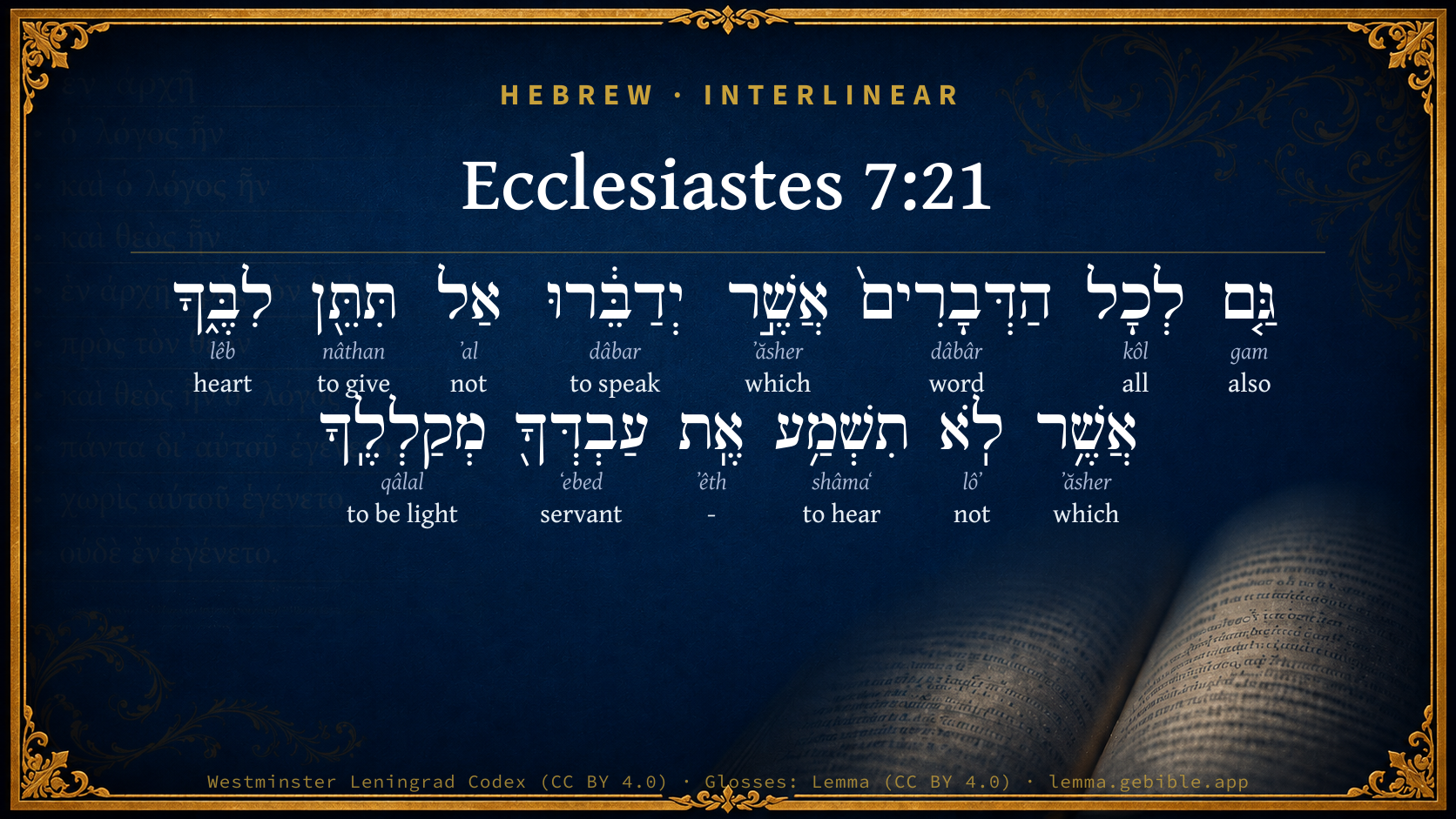
Hebrew (Westminster Leningrad Codex) Ecclesiastes 7:21 appears in the Hebrew Old Testament. The text above is from the Westminster Leningrad Codex. Each word links to its Strong’s number, a concise gloss, and parsing drawn from the Open Scriptures Hebrew Bible morphology. Click any word for its full Brown-Driver-Briggs (BDB) entry.
Download image
Cite this verse

Ecclesiastes 7:21 (World English Bible). Public Domain. Lemma interlinear Bible study tool, https://lemma.gebible.app/v/ecclesiastes/7/21.

Show BibTeX & RIS
BibTeX
RIS
English Translation
Also don't take heed to all words that are spoken, lest you hear your servant curse you;
World English Bible · Public Domain
Download a study sheet

One document with this verse’s original text, its word-by-word gloss line, the meaning frame, cross-references with their text, attributed commentary, and full source and license credits — printable, and it pastes into notes with its structure intact.

This verse Autodidact and up

Study sheet (.html) Plain text (.txt)

A passage Seminary Student

Up to 50 verses in one chapter. A passage sheet keeps up to 6 commentary sources and 12 cross-references per verse, in the order this page ranks them, and says so on the sheet whenever that leaves anything out. Ask for a single verse and you get the Autodidact verse sheet above.

Everything on this page stays free to read, with no account — the sheet is a download of what is already on screen, not access to it.

Want to remove ads? Support Godless Engineer
Compare translations 3

The same verse in 3 English versions, stacked beneath the original-language interlinear above. Click any original word for its lexicon entry.

Each is an independent rendering of the whole verse — the interlinear is not word-aligned to these translations.

Highlighted words mark where these versions differ — a whole-verse word diff, not a word-by-word alignment.

  • World English Bible Public Domain
    Also don't take heed to all words that are spoken, lest you hear your servant curse you;
  • King James Version Public Domain
    Also take no heed unto all words that are spoken; lest thou hear thy servant curse thee:
  • unfoldingWord Literal Text CC BY-SA 4.0
    Also, to all of the words that they say, do not give your heart, so that you will not hear your servant belittling you.

unfoldingWord Literal Text — © unfoldingWord, licensed CC BY-SA 4.0. Word-aligned USFM3 via Door43 (git.door43.org/unfoldingWord/en_ult).

Versions to compare (up to 4)

3 of 4 selected

Show all 18 translations

Every available English version of this verse, each an independent rendering of the whole verse.

  • World English Bible Public Domain
    Also don't take heed to all words that are spoken, lest you hear your servant curse you;
  • Berean Standard Bible Public Domain
    Do not pay attention to every word that is spoken, or you may hear your servant cursing you.
  • Majority Standard Bible Public Domain
    Do not pay attention to every word that is spoken, or you may hear your servant cursing you.
  • King James Version Public Domain
    Also take no heed unto all words that are spoken; lest thou hear thy servant curse thee:
  • American Standard Version (1901) Public Domain
    Also take not heed unto all words that are spoken, lest thou hear thy servant curse thee;
  • Revised Version (1885) Public Domain
    Also take not heed unto all words that are spoken; lest thou hear thy servant curse thee:
  • Geneva Bible (1599) Public Domain
    Wisedome shall strengthen the wise man more then ten mightie princes that are in ye citie.
  • Douay-Rheims (1899) Public Domain
    For there is no just man upon earth, that doth good, and sinneth not.
  • Young's Literal Translation Public Domain
    Also to all the words that they speak give not thy heart, that thou hear not thy servant reviling thee.
  • Literal Standard Version CC BY-SA 4.0
    Also to all the words that they speak do not give your heart, that you do not hear your servant reviling you.
  • Unlocked Literal Bible CC BY-SA 4.0
    Do not listen to every word that is spoken, because you might hear your servant curse you.
  • unfoldingWord Literal Text CC BY-SA 4.0
    Also, to all of the words that they say, do not give your heart, so that you will not hear your servant belittling you.
  • Darby Bible Public Domain
    Also give not heed unto all words that are spoken, lest thou hear thy servant curse thee.
  • World Messianic Bible Public Domain
    Also don’t take heed to all words that are spoken, lest you hear your servant curse you;
  • Webster's Bible Public Domain
    Also take no heed to all words that are spoken; lest thou hear thy servant curse thee:
  • Free Bible Version CC BY-SA 4.0
    Don't take to heart everything that people say, otherwise you may hear your servant talking badly about you,
  • Bible in Basic English Public Domain
    Do not give ear to all the words which men say, for fear of hearing the curses of your servant.
  • JPS Tanakh (1917) Public Domain
    Also take not heed unto all words that are spoken, lest thou hear thy servant curse thee;

Literal Standard Version (2020), Covenant Press — licensed CC BY-SA 4.0. Text via the HelloAO Bible API (eBible.org). Unlocked Literal Bible (unfoldingWord) — licensed CC BY-SA 4.0. Text via the HelloAO Bible API (eBible.org). unfoldingWord Literal Text — © unfoldingWord, licensed CC BY-SA 4.0. Word-aligned USFM3 via Door43 (git.door43.org/unfoldingWord/en_ult). Free Bible Version, Dr. Jonathan Gallagher — licensed CC BY-SA 4.0. Text via the HelloAO Bible API (eBible.org).

Word by word

More ways to search: Search by grammar → Find every occurrence → Compare this word →

Practice this passage: Drill this verse → Learn its vocabulary →

מְקַלְלֶֽךָ
qâlal
H7043
“being light · you”
Verb, Piel, Participle Active, Masculine, Singular, Construct + Suffix, Personal, 2nd Person, Masculine, Singular
Part of Speech
Verb
Stem
Piel
Form
Participle Active
Gender
Masculine
Number
Singular
State
Construct
Full BDB Definition

Origin: a primitive root

TWOT: 2028

to be slight, be swift, be trifling, be of little account, be light - (Qal) - to be slight, be abated (of water) - to be swift - to be trifling, be of little account - (Niphal) - to be swift, show oneself swift - to appear trifling, be too trifling, be insignificant - to be lightly esteemed - (Piel) - to make despicable - to curse - (Pual) to be cursed - (Hiphil) - to make light, lighten - to treat with contempt, bring contempt or dishonour - (Pilpel) - to shake - to whet - (Hithpalpel) to shake oneself, be moved to and fro
  1. גַּ֤ם gam H1571 “also” Particle, Accusative
  2. לְכָל kôl H3605 “to/for · all of” Preposition + Noun, Common, Masculine, Singular, Construct
  3. הַדְּבָרִים֙ dâbâr H1697 “the · words” Particle, Definite Article + Noun, Common, Masculine, Plural, Absolute
  4. אֲשֶׁ֣ר ʼăsher H834 “which” Particle, Relative
  5. יְדַבֵּ֔רוּ dâbar H1696 “to speak” Verb, Piel, Imperfect, 3rd Person, Masculine, Plural
  6. אַל ʼal H408 “not” Particle, Negative
  7. תִּתֵּ֖ן nâthan H5414 “to give” Verb, Qal, Jussive, 2nd Person, Masculine, Singular
  8. לִבֶּ֑ךָ lêb H3820 “heart · your” Noun, Common, Masculine, Singular, Construct + Suffix, Personal, 2nd Person, Masculine, Singular
  9. אֲשֶׁ֥ר ʼăsher H834 “which” Particle, Relative
  10. לֹֽא lôʼ H3808 “not” Particle, Negative
  11. תִשְׁמַ֥ע shâmaʻ H8085 “to hear” Verb, Qal, Imperfect, 2nd Person, Masculine, Singular
  12. אֶֽת ʼêth H853 “-” Particle, Direct Object
  13. עַבְדְּךָ֖ ʻebed H5650 “servant · your” Noun, Common, Masculine, Singular, Construct + Suffix, Personal, 2nd Person, Masculine, Singular

About this verse

These counts appear in no published source. They are computed here, from the morphology-tagged text and Lemma’s own curated glosses. What Lemma adds →

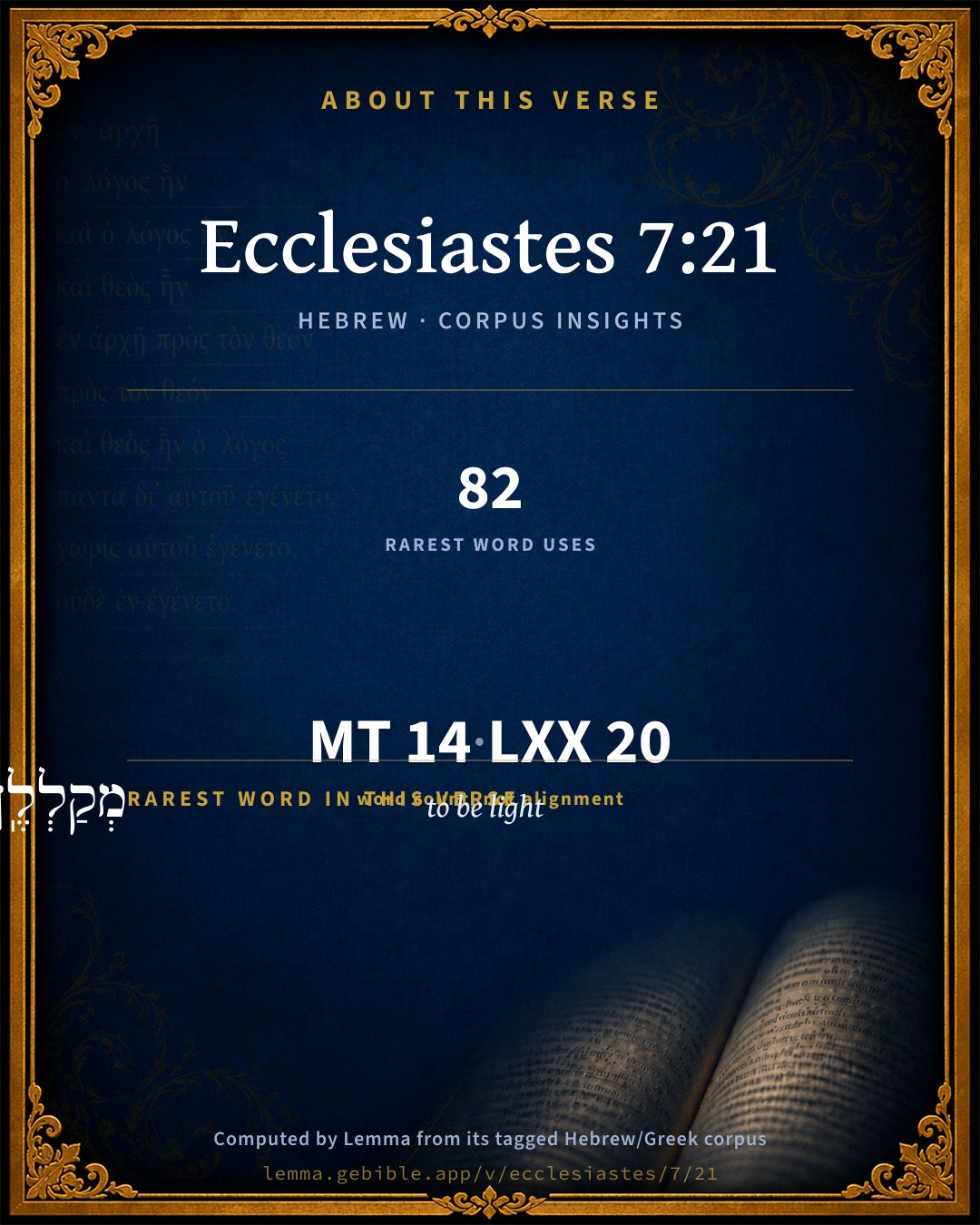
14
words
13
distinct lemmas
Wisdom
section

Grammatical profile

  • 4 verbs
  • 4 nouns
  • 6 particles

Verb forms

  • יְדַבֵּ֔רוּ Piel · Imperfect
  • תִּתֵּ֖ן Qal · Jussive
  • תִשְׁמַ֥ע Qal · Imperfect
  • מְקַלְלֶֽךָ Piel · Participle Active

Repetition

A word recurs within this verse — often emphatic in Hebrew:

  • אֲשֶׁ֣ר which H834 ×2

Hebrew & Septuagint length

In English translation the verse runs 17 words from the Hebrew and 17 from the Septuagint (LXX English) — the same length.

A rough comparison of the two English renderings, which tokenize alike — not a word-level alignment.

Word counts can differ between the Hebrew and the Greek without any difference in meaning — e.g. the Hebrew direct-object marker אֵת has no separate Greek word, and Greek often adds the article ὁ.

In the original languages it is 14 Hebrew tokens and 20 Greek tokens — but the two are counted differently (Hebrew bundles its prefixes and suffixes into one token; the Greek is in lemma form), so that isn’t a like-for-like length.

Cross-references

5

Topical passages linked to Ecclesiastes 7:21 in the Treasury of Scripture Knowledge — connected by theme and wording, ordered by reader-vote popularity; previews shown in the World English Bible.

  • Proverbs 30:10 "Don't slander a servant to his master, Lest he curse you, and you be held guilty.
  • Isaiah 29:21 that make a man an offender in [his] cause, and lay a snare for him who reproves in the gate, and turn aside the just with a thing of nothing.
  • 2 Samuel 16:10 The king said, What have I to do with you, you sons of Zeruiah? Because he curses, and because Yahweh has said to him, Curse David; who then shall say, Why have you done so?
  • 2 Samuel 19:19 He said to the king, Don't let my lord impute iniquity to me, neither do you remember that which your servant did perversely the day that my lord the king went out of Jerusalem, that the king should take it to his heart.
  • 1 Corinthians 13:5–7 doesn't behave itself inappropriately, doesn't seek its own way, is not provoked, takes no account of evil;

Cross-references courtesy of OpenBible.info (CC BY 4.0).

Hebrew and Greek witnesses Masoretic Hebrew ↔ Greek Septuagint

The same verse in the two great witnesses to the Old Testament, shown verse-for-verse.

These are two independent witnesses, not word-aligned to each other, and the Septuagint is shown in lemma (dictionary) form.

Hebrew Ecclesiastes 7:21 Masoretic · Westminster Leningrad Codex

גַּ֤ם לְכָל הַדְּבָרִים֙ אֲשֶׁ֣ר יְדַבֵּ֔רוּ אַל תִּתֵּ֖ן לִבֶּ֑ךָ אֲשֶׁ֥ר לֹֽא תִשְׁמַ֥ע אֶֽת עַבְדְּךָ֖ מְקַלְלֶֽךָ

Also don't take heed to all words that are spoken, lest you hear your servant curse you;

World English Bible · Public Domain

Greek LXX Ecclesiastes 7:21 Septuagint · lemma form

καί γέ εἰς πᾶς ὁ λόγος ὅς λαλέω μή τίθημι καρδία σύ ὅπως μή ἀκούω ὁ δοῦλος σύ καταῥάομαι σύ

For there is not a righteous man in the earth, who will do good, and not sin

LXX2012 (modern English Septuagint) · Public Domain

On this verse, John Gill's Exposition discusses the Septuagint’s reading. Read the note in Commentary ↓

Hebrew: Westminster Leningrad Codex (CC BY 4.0). Greek: Septuagint (public domain); English from LXX2012 (modern English Septuagint) (Public Domain). How the Septuagint differs from the Hebrew →

Commentary

Notes on Ecclesiastes 7:21 from classic Christian and Jewish commentators (each source and its license shown beneath its notes). The classic Christian expositions comment on the surrounding passage and are grouped to its opening verse, so a note may address several verses; the Jewish commentaries on the Tanakh (Rashi and others) are per-verse, so they appear only where the commentator wrote on this verse.

Lemma curates 59 commentaries, every one of them public domain or Creative Commons licensed, each selected and text-cleaned for this edition rather than reprinted as found. About our sources →

Trapp's Complete Commentary

John Trapp

Ecc 7:21 Also take no heed unto all words that are spoken; lest thou hear thy servant curse thee:

Ver. 21. Also take no heed.] But be "as a deaf man that heareth not, and as a dumb man, in whose mouth there is no reproof." {Psa 38:13} If thou answer anything, say as he in Tacitus did to one that railed at him, Tu linguae, ego vero aurium dominus, Thou mayest say what thou wilt, but I will hear as I wish; or as once a certain steward did to his passionate lord, when he called him knave, &c.: - ‘Your honour may speak as you please, but I believe not a word that you say, for I know myself an honest man.’ The language of reproachers must be read like Hebrew, backwards. Princes used to correct the indecencies of ambassadors by denying them audience. Certain it is, that he enjoys a brave composedness that sets himself above the flight of the injurious claw. Isaac’s apology to his brother Ishmael, viz., patience and silence is the best answer to words of scorn and petulance, said learned Hooker. I care not for man’s day, saith Paul. {1Co 4:3} Non cum vanum calumniatorem, I regard not a vain slanderer, saith Augustine. Wicelius and Cochleus gave out that we Lutherans betrayed the Rhodes to the Turk, saith Melanchthon. These impudent lies need no confutation, dicant ipsi talia quoad velint, let them tell such loud and lewd lies as many as they will. When a net is spread for a bird, saith Augustine, the manner is to throw stones at the hedge. These stones hurt not the bird, but she, hearing and fearing this vain sound, falls into the net. In like manner, saith he, men that fear and regard the vain sound of all ill words, what do they but fall into the devil’s net, who thereby carries them captive into much evil, many troubles and inconvenience?

Lest thou hear thy servant curse thee.] Who should in duty speak the best of thee, though frample and froward, cross and crooked. {1Pe 2:18} Or by "servant" understand base, inferior people, such as were Tobiah the servant, the Ammonite, and those "abjects" that "tare David’s name, and ceased not." {Psa 35:15}

John Trapp, A Commentary or Exposition upon All the Books of the Old and New Testament (1647–1656) — public domain. Text from a community e-Sword module.

The Biblical Illustrator

Joseph S. Exell

Ecc_7:21

Also take no heed unto all words that are spoken: lest thou hear thy servant curse thee.

Listeners hear no good of themselves

I. We should pay some attention to what others think and say about us. What a force public opinion is! We cannot see it, nor touch it; and yet it is a great factor in shaping the character and actions alike of men and nations. Public opinion may be utterly wrong; and then we must oppose it at any cost, even though we stand alone. And some of us might do well to pay a little more attention than we do to the tone of thought and feeling around us. If a man see that his acts and life are giving pain to others, that he is a stumblingblock to his neighbours, even though it only be to those whom he would consider weaker brethren; and if he go on his way recklessly, regardless of what men say or think, verily he will not be able to free himself from guilt. By such thoughtlessness we are apt to harden, to irritate, to mislead our fellows.

II. We should not be too curious to know what other people think of us. Some men are selfish or obstinate. They do what is pleasant; they follow the path which in their own eyes seems right. Am I my brothers keeper? they exclaim, in answer to every remonstrance. We are all one family, closely united, and at every point we are hurting or helping one another. There are thousands, however, who err on the opposite side. They allow the opinion of the world, the fashion of the day, to shape their life and character. There are many whose life is darkened for a whole day because some one has said a severe word about them and the report of it has reached their ears. It is foolish to make so much of the worlds opinion. For think how much idle gossip is floating about everywhere. Sharp words are often spoken in a passion, or under a misconception, and the speaker regrets them bitterly afterwards. He is a wise man who is not anxious to hear too much.

III. We should always be anxious to know Gods opinion of us, and to have his approval. Some one may say, I do not mind what men say of me; but, oh, that I knew Gods opinion of me I It is easy to know it. The Father Himself loveth you, because ye have loved Me. Do you love Christ? Then you are loved by God. He that believeth not the Son . . . the wrath of God abideth on him. Have you never trusted Christ as your Saviour? Then Gods wrath has its resting-place upon you. (W. Park, M. A.)

The Biblical Illustrator, edited by Joseph S. Exell (c. 1880s–1900s) — public domain. Text from a community e-Sword module.

Joseph Benson's Commentary

Ecc 7:21-22. Take no heed unto all words that are spoken — Namely, concerning thee, or against thee. Do not severely observe, or strictly search into them, or listen to hear them, as many persons out of curiosity, are wont to do. Under this one kind of offences which are most frequent, namely, those of the tongue, he seems to comprehend all injuries which we suffer from others, and advises that we should not too rigidly examine them, nor too deeply resent them, but rather neglect and forget them. Lest thou hear thy servant curse thee — Which would vex and grieve thee, and might, perhaps, provoke thee to treat him with severity, if not with vengeance and cruelty. For oftentimes also thine own heart — Thy mind or conscience, knoweth — Bears thee witness; that thou thyself likewise — Either upon some great provocation, and sudden passion, or possibly upon a mere mistake, or false report, hast cursed others — Hast censured them unjustly, and spoken ill of them, if not wished ill to them. If therefore thy servant, or any other, act thus toward thee, thou art only paid in thy own coin. Observe, reader, when any affront or injury is done us, it is seasonable to examine our consciences whether we have not done the same, or as bad, to others: and if, upon reflection, we find we have, we must take that occasion to renew our repentance for it, must justify God, and make use of it to qualify our own resentments. If we be truly displeased and grieved at ourselves for censuring and backbiting others, we shall be less angry at others for censuring and backbiting us. We must show all meekness toward all men, because we ourselves were formerly foolish, Tit 3:2.

Joseph Benson's Commentary on the Old and New Testaments (1811–1818) — public domain. Text from a community e-Sword module.

Jamieson, Fausset & Brown

Robert Jamieson, A. R. Fausset & David Brown

As therefore thou being far from perfectly "just" thyself, hast much to be forgiven by God, do not take too strict account, as the self-righteous do (Ecc 7:16; Luk 18:9, Luk 18:11), and thereby shorten their lives (Ecc 7:15-16), of words spoken against thee by others, for example, thy servant: Thou art their "fellow servant" before God (Mat 18:32-35).

Jamieson, Fausset & Brown — Commentary Critical and Explanatory on the Whole Bible (1871) — public domain (CC PDM 1.0). Text via the HelloAO Bible API.

Adam Clarke's Commentary

Verse 21. Also take no heed unto all words that are spoken] This is good advice, and much for every man's peace through life.

Thy servant curse thee] מקללך mekallelecha, make light of thee, speak evil of thee.

Adam Clarke's Commentary on the Bible (1810–1826) — public domain. Text from a community e-Sword/MySword module.

The Cambridge Bible for Schools and Colleges

gen. ed. J. J. S. Perowne

21. Also take no heed unto all words that are spoken] The train of thought leads on to another rule of conduct. The fact that all men sin is shewn by the words with which men talk of the faults and weaknesses of their neighbours. To such words, the idle gossip of rumour, the comments on words or acts, no wise man will give heed. For him, in St Paul’s language, it will be “a very small thing to be judged of man’s judgment” (1Co_4:3). An idle curiosity to know what other people say of us will for the most part bring with it the mortification of finding that they blame rather than praise. No man is a hero to his valet, and if he is anxious to know his servant’s estimate of him, he may discover, however wise and good he strives to be, that it may find utterance in a curse and not a blessing. So, in political life, men have been known (e.g. Pompeius in the case of Sertorius) to burn the papers of their fallen foes. So in literary life some of the wise of heart have laid it down as a rule not to read reviews of their own writings. The same feeling finds an epigrammatic expression in the proud motto of a Scotch family:

“They say: What say they? Let them say!”

The Cambridge Bible for Schools and Colleges (gen. ed. J. J. S. Perowne; Cambridge University Press, 1878–1918) — public domain. Text from a community e-Sword module.

John Gill's Exposition

Also take no heed unto all words that are spoken,.... Seeing so it is, that imperfection attends the best of men, no man is wise at all times, foolish words and unguarded expressions will sometimes drop from him, which it is better to take no notice of; they should not be strictly attended to, and closely examined, since they will not bear it. A man should not listen to everything that is said of himself or others; he should not curiously inquire what men say of him; and what he himself hears he should take no notice of; it is often best to let it pass, and not call it over again; to feign the hearing of a thing, or make as if you did not hear it; for oftentimes, by rehearsing a matter, or taking up words spoken, a deal of trouble and mischief follows; a man should not "give his heart" (f) to it, as it is in the Hebrew text; he should not give his mind to what is said of him, but be careless and indifferent about it; much less should he lay it up in his mind, and meditate revenge for it. The Targum, Septuagint, Syriac, and Arabic versions, restrain it to words spoken by wicked men, whose tongues are their own, and will say what they please; among these may be ranked, more especially, detractors, whisperers, backbiters, and talebearers, who should not be listened unto and encouraged; though there is no necessity of thus limiting the sense, which is more general, and may include what is said by any man, even good men, since they have their infirmities; it seems chiefly to have respect to defamatory words, by what follows;

lest thou hear thy servant curse thee; speak slightly, scoffingly, and reproachfully of thee, as Shimei of David; which must be very disagreeable and vexatious to hear from one so mean and abject, and who is dependent on him, earns his bread of him, and gets his livelihood in his service; and to whom, perhaps, he has been kind, and so is guilty of base ingratitude, which aggravates the more; or, if not, if what he says is just, to hear it must give great uneasiness.

(f) "ne des tuum cor", Montanus.

John Gill's Exposition of the Whole Bible (1746–1763) — public domain (CC PDM 1.0). Text via the HelloAO Bible API.

Albert Barnes' Notes on the Bible

Curse ... cursed - Rather, speak evil of ... spoken evil of.

Albert Barnes' Notes on the Bible (1834–1885) — public domain. Text from a community e-Sword/MySword module.

Haydock's Catholic Bible Commentary

Not. 1 John i. 8. Crates said it was "impossible to find one who falls not." (Laertius vi.) (Haydock) --- We must not flatter ourselves with impeccability, ver. 18. (Calmet) --- See Seneca. Clem. i. 6. Peccavimus omnes, &c., and de Ira. i. 28. (Menochius)

George Leo Haydock (1774–1849), Haydock's Catholic Family Bible and Commentary, 1859 edition — public domain. Excludes Psalms (Douay-Rheims chapter numbering differs from Protestant) and Deuterocanonical books (Catholic canon only).

Matthew Poole's English Annotations

Take no heed; do not severely observe nor strictly search into them, nor listen to hear them, as many persons out of curiosity use to do.

Unto all words that are spoken, to wit, concerning thee, or against thee. Under this one kind of offences of the tongue, which are most frequent, he seems to understand all injuries which we suffer from others, and adviseth us that we do not too rigidly examine them, nor too deeply resent them, but rather neglect and forget them.

Lest thou hear thy servant curse thee; which will vex and grieve thee, and may provoke thee to vengeance and cruelty against him.

Matthew Poole's English Annotations on the Holy Bible (1683–1685) — public domain. Text from a community e-Sword/MySword module.

Whedon's Commentary on the Bible

Daniel D. Whedon

21. Also — Should be therefore.

Take no heed unto all words — Seeing that great men are not always wise, do not be very inquisitive to know what is said even about yourself. Some ignorance of this may be some bliss. “No man is a hero to his valet-de-chambre,” and servants see the reverse side of their masters and may possibly tell it.

Daniel D. Whedon (gen. ed.), Commentary on the Old and New Testaments (1874–1909) — public domain. Text from a community e-Sword module.

The Pulpit Commentary

Also take no heed unto all words that are spoken; literally, give not thy heart, as Ecc_1:13, etc. Here is another matter in which.wisdom will lead to right conduct. You will not pay serious attention to evil reports either about yourself or others, nor regulate your views and actions according to such distortions of the truth. To be always hankering to know what people say of us is to set up a false standard, which will assuredly lead us astray; and, at the same time, we shall expose ourselves to the keen-eat mortification when we find, as we probably shall find, that they do not take us at our own valuation, but have thoroughly marked our weaknesses, and are ready enough to censure them. We have an instance of patience under unmerited reproof in the case of David when cursed by Shimei, (2Sa_16:11) as he, or one like minded, says, (Psa_38:13) "I, as a deaf man, hear not; and I am as a dumb man that openeth not his mouth. Yea, I am as a man that heareth not, and in whose mouth are no reproofs." Corn. a Lapide comments in words to which no translation would do justice, "Verbaenim non aunt verbera; aerem feriunt non hominem, nisi qui its attendit mordetur, sauciatur." Lest thou hear thy servant curse thee. The servant is introduced as an example of a gossip or calumniator, because he, if any one, would be acquainted with his master"s faults, and be most likely to disseminate his knowledge, and blame from such a quarter would be most intolerable. Commentators appositely quote Bacon"s remarks on this passage in his "Advancement of Learning," 8:2, where he notes the prudence of Pompey, who burned all the papers of Sertorius reread, containing, as they did, information which would fatally have compromised many leading men in Rome.

The Pulpit Commentary (1880–1919), ed. H.D.M. Spence-Jones & Joseph S. Exell — public domain. Text from a community e-Sword module.

John Wesley's Explanatory Notes

Also - Do not strictly search into them, nor listen to hear them.

John Wesley, Explanatory Notes Upon the Whole Bible (1754–1765) — public domain. Text via the GEBible commentary corpus.

Keil & Delitzsch

C. F. Keil & F. Delitzsch

"Also give not thy heart to all the words which one speaketh, lest thou shouldest hear thy servant curse thee. For thy heart knoweth in many cases that thou also hast cursed others." The talk of the people, who are the indef. subj. of ילבּרוּ (lxx, Targ., Syr. supply ἀσεβεῖς), is not about "thee who givest heed to the counsels just given" (Hitz., Zckl.), for the restrictive עליך is wanting; and why should a servant be zealous to utter imprecations on the conduct of his master, which rests on the best maxims? It is the babbling of the people in general that is meant. To this one ought not to turn his heart (ל ... נתן, as at Ecc 1:13, Ecc 1:17; Ecc 8:9, Ecc 8:16), i.e., gives wilful attention, ne (לא אשׁר = פּן, which does not occur in the Book of Koheleth) audias servum tuum tibi maledicere; the particip. expression of the pred. obj. follows the analogy of Gen 21:9, Ewald, 284b, and is not a Graecism; for since in this place hearing is meant, not immediately, but mediated through others, the expression would not in good Greek be with the lxx ... τοῦ δούλου σου καταρωμένου σε, but τὸν δοῦλόν σου καταρᾶσθαι σε. The warning has its motive in this, that by such roundabout hearing one generally hears most unpleasant things; and on hearsay no reliance can be placed. Such gossiping one should ignore, should not listen to it at all; and if, nevertheless, something so bad is reported as that our own servant has spoken words of imprecation against us, yet we ought to pass that by unheeded, well knowing that we ourselves have often spoken harsh words against others. The expression וגו ידע, "thou art conscious to thyself that," is like פּע ר, Kg1 2:44, not the obj. accus. dependent on ידע (Hitz.), "many cases where also thou ...," but the adv. accus. of time to קּלּלתּ; the words are inverted (Ewald, 336b), the style of Koheleth being fond of thus giving prominence to the chief conception (Ecc 7:20, Ecc 5:18; Ecc 3:13). The first gam, although it belongs to "thine, thy," as at Ecc 7:22 it is also connected with "thou,"

(Note: גּם־אתּ, on account of the half pause, accented on the penult. according to the Masora.)

stands at the beginning of the sentence, after such syntactical examples as Hos 6:11; Zac 9:11; and even with a two-membered sentence, Job 2:10.

Keil & Delitzsch — Biblical Commentary on the Old Testament (1861–1891) — public domain (CC PDM 1.0). Text via the HelloAO Bible API. (Old Testament only.)

unfoldingWord translationNotes

Door43 World Missions Community

every word that is spoken

This can be written in active form. AT: "everything that people say" (See: Active or Passive)

you know yourself

"you yourself know." Here "yourself" is used to emphasize the phrase "you know." (See: Reflexive Pronouns)

in your own heart

Here a person's thoughts are represented by their "heart." AT: "in your own thoughts" (See: Metonymy)

translationWords

word

servant

curse

heart

unfoldingWord translationNotes — © Distant Shores Media and the Door43 World Missions Community, licensed CC BY-SA 4.0. Source: git.door43.org/Door43/en_tn.

Rashi

Rabbi Shlomo Yitzchaki (Rashi)

Also take no heed of all the words, etc. Because he is speaking of Saul, who accepted slander about Nob the priestly city, and concerning him it was stated: “Be not overly wicked,” he says: “Also take no heed of all the words” that talebearers speak to you; do not take heed to accept them.

lest you hear your servant curse you It is not good that you bend your ear to hear your servant cursing you.

Another explanation: [19] more than ten rulers These are the ten things that condemn a person. His two eyes [which] show him sinful things, his two ears [which] enable him to hear idle talk, his two hands with which he robs and plunders, his two feet which lead him to sinful acts, and his mouth and his heart (Ecc. Zuta).

Another explanation: Wisdom affords strength to the wise This is Noah. more than ten rulers more than the ten generations that were before him (Ecc. Rabbah).

Another explanation: to the wise This is Abraham. more than ten rulers more than the ten generations that were before him (Ecc. Rabbah).

Another explanation: to the wise This is Joseph. more than ten rulers These are his brothers (Ecc. Zuta).

Another explanation: to the wise This is Moses. ten rulers the ten organs that minister to the body with food. From the mouth to the esophagus, from the esophagus to the stomach, etc., as appears in Midrash Koheleth (Ecc. Rabbah), but Moses’ wisdom stood him in good stead so that he did not require food for forty days and forty nights. All these interpretations appear in the Midrash, but I do not know how to reconcile them with the following verse: “For there is no righteous man on the earth.”

Rashi on the Tanakh — English translations: “The Judaica Press complete Tanach with Rashi, translated by A. J. Rosenberg” (CC BY 4.0); “Pentateuch with Rashi's commentary by M. Rosenbaum and A.M. Silbermann, 1929-1934” (public domain); “The Metsudah Tanach series, Lakewood, N.J” (CC BY 4.0); and “The Book of Joshua, Metsudah Publications, 1997” (CC BY 4.0). Text via Sefaria.

Lesson kit

Teaching starters — assembled from the data on this page, not authored interpretation. Every prompt links to the verse data it draws on. Edit before teaching.

Ecclesiastes, in the Wisdom, opens this verse with 14 words (13 distinct Hebrew lemmas). Its most distinctive word is qâlal (“to be light”). A historical commentator’s framing appears above. Read the whole chapter for the surrounding context.

Discussion questions

  1. The word qâlal carries the sense “to be light.” How does it shape the verse?
  2. Proverbs 30:10 shares this passage’s theme. How do the two illuminate each other?
  3. “which” occurs 2× in this one verse. What is the effect of the repetition?
  4. The translations on this page render this verse differently — a whole-verse word diff, not a word-by-word alignment. What might account for the different wordings?
  5. The verb «יְדַבֵּ֔רוּ» is Piel Imperfect. How does its form color the action?
  6. Reading how Trapp's Complete Commentary and The Biblical Illustrator read this verse, where do the two commentators agree and where do they part?

Things to notice

Reading settings

Reading text

Shown beneath each verse's original-language words.

Old Testament
Old Testament edition

Read the OT as the Masoretic Hebrew (MT) or the Greek Septuagint (LXX).

English shown for the Greek Septuagint (in the Hebrew ↔ Greek comparison).

Comparing translations? Open the Compare panel on any verse page to stack up to four side by side.