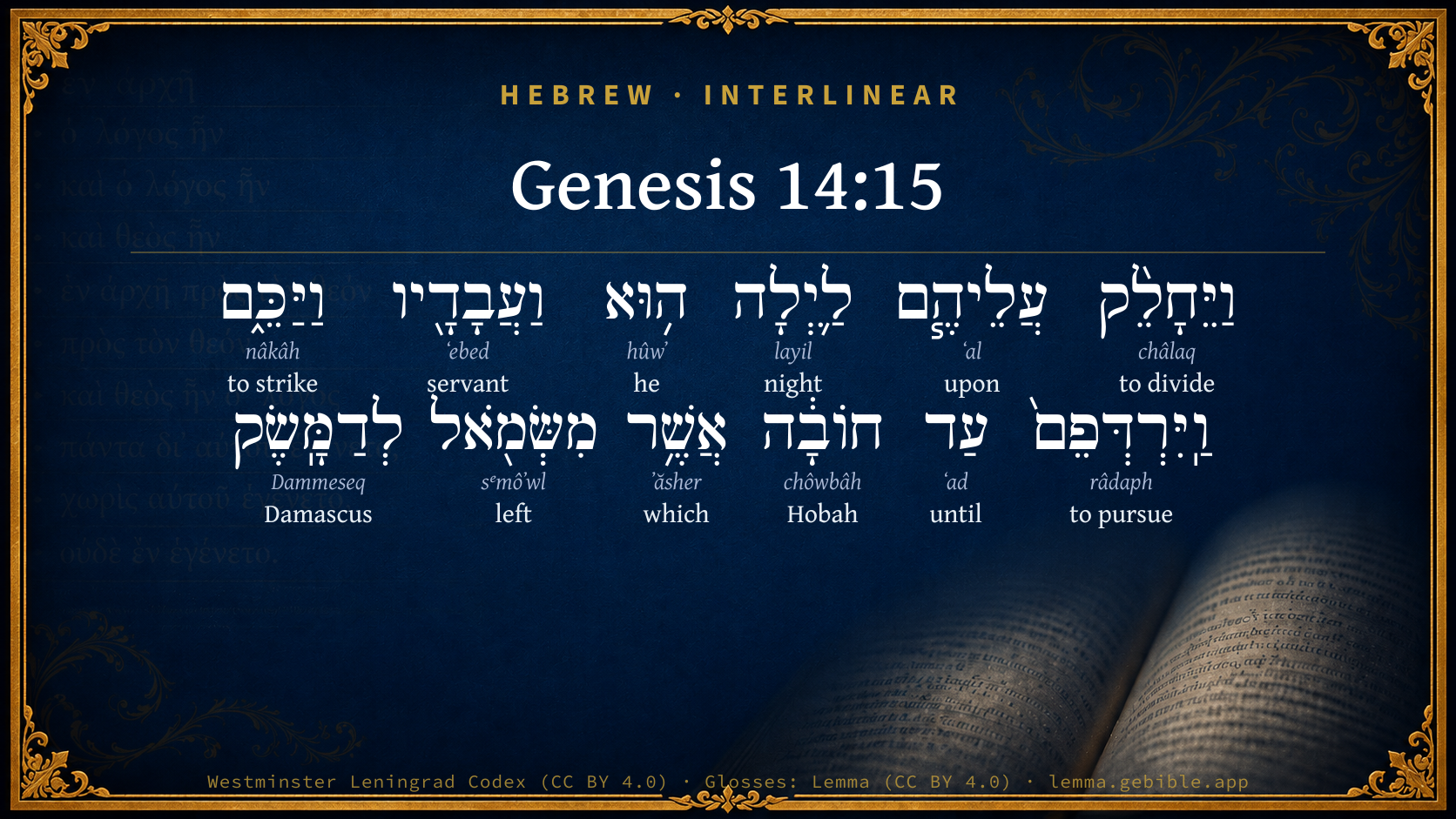
Genesis 14:15

Hebrew (Westminster Leningrad Codex) Genesis 14:15 appears in the Hebrew Old Testament. The text above is from the Westminster Leningrad Codex. Each word links to its Strong’s number, a concise gloss, and parsing drawn from the Open Scriptures Hebrew Bible morphology. Click any word for its full Brown-Driver-Briggs (BDB) entry.
Download image
Cite this verse

Genesis 14:15 (World English Bible). Public Domain. Lemma interlinear Bible study tool, https://lemma.gebible.app/v/genesis/14/15.

Show BibTeX & RIS
BibTeX
RIS
English Translation
He divided himself against them by night, he and his servants, and struck them, and pursued them to Hobah, which is on the left hand of Damascus.
World English Bible · Public Domain
Highlights
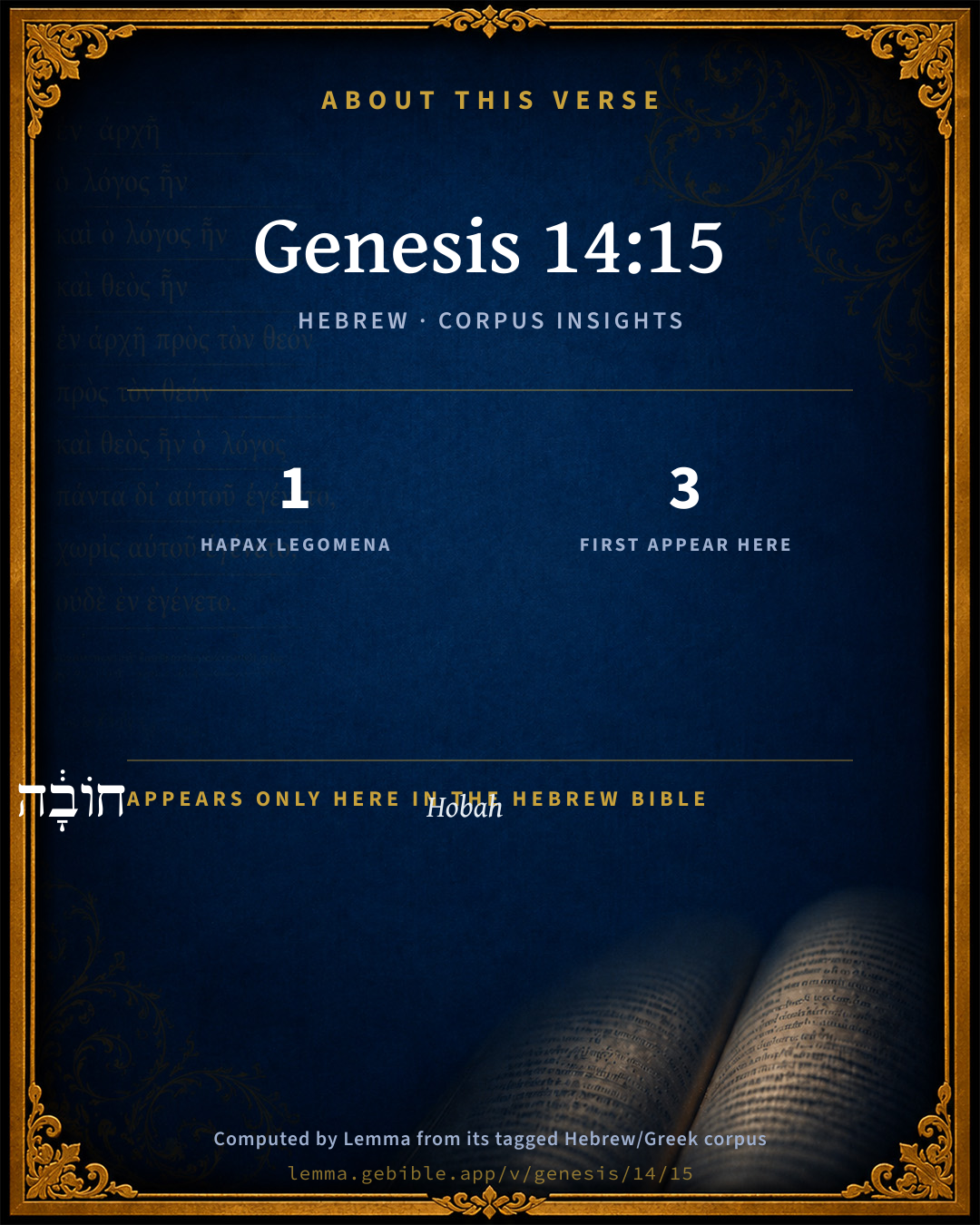
  • 1 hapax legomenon — only here in the Hebrew Bible
  • 3 first appearances in the Hebrew Bible
Full analysis ↓
Download a study sheet

One document with this verse’s original text, its word-by-word gloss line, the meaning frame, cross-references with their text, attributed commentary, and full source and license credits — printable, and it pastes into notes with its structure intact.

This verse Autodidact and up

Study sheet (.html) Plain text (.txt)

A passage Seminary Student

Up to 50 verses in one chapter. A passage sheet keeps up to 6 commentary sources and 12 cross-references per verse, in the order this page ranks them, and says so on the sheet whenever that leaves anything out. Ask for a single verse and you get the Autodidact verse sheet above.

Everything on this page stays free to read, with no account — the sheet is a download of what is already on screen, not access to it.

Want to remove ads? Support Godless Engineer
Compare translations 3

The same verse in 3 English versions, stacked beneath the original-language interlinear above. Click any original word for its lexicon entry.

Each is an independent rendering of the whole verse — the interlinear is not word-aligned to these translations.

Highlighted words mark where these versions differ — a whole-verse word diff, not a word-by-word alignment.

  • World English Bible Public Domain
    He divided himself against them by night, he and his servants, and struck them, and pursued them to Hobah, which is on the left hand of Damascus.
  • King James Version Public Domain
    And he divided himself against them, he and his servants, by night, and smote them, and pursued them unto Hobah, which is on the left hand of Damascus.
  • unfoldingWord Literal Text CC BY-SA 4.0
    Then he divided against them during the night, he and his servants, and struck them and pursued them to Hobah, which north of Damascus.

unfoldingWord Literal Text — © unfoldingWord, licensed CC BY-SA 4.0. Word-aligned USFM3 via Door43 (git.door43.org/unfoldingWord/en_ult).

Versions to compare (up to 4)

3 of 4 selected

Show all 18 translations

Every available English version of this verse, each an independent rendering of the whole verse.

  • World English Bible Public Domain
    He divided himself against them by night, he and his servants, and struck them, and pursued them to Hobah, which is on the left hand of Damascus.
  • Berean Standard Bible Public Domain
    During the night, Abram divided his forces and routed Chedorlaomer’s army, pursuing them as far as Hobah, north of Damascus.
  • Majority Standard Bible Public Domain
    During the night, Abram divided his forces and routed Chedorlaomer’s army, pursuing them as far as Hobah, north of Damascus.
  • King James Version Public Domain
    And he divided himself against them, he and his servants, by night, and smote them, and pursued them unto Hobah, which is on the left hand of Damascus.
  • American Standard Version (1901) Public Domain
    And he divided himself against them by night, he and his servants, and smote them, and pursued them unto Hobah, which is on the left hand of Damascus.
  • Revised Version (1885) Public Domain
    And he divided himself against them by night, he and his servants, and smote them, and pursued them unto Hobah, which is on the left hand of Damascus.
  • Geneva Bible (1599) Public Domain
    Then he, and his seruants deuided them selues against them by night, and smote them and pursued them vnto Hobah, which is on the left side of Damascus,
  • Douay-Rheims (1899) Public Domain
    And dividing his company, he rushed upon them in the night: and defeated them, and pursued them as far as Hoba, which is on the left hand of Damascus.
  • Young's Literal Translation Public Domain
    And he divideth himself against them by night, he and his servants, and smiteth them, and pursueth them unto Hobah, which `is' at the left of Damascus;
  • Literal Standard Version CC BY-SA 4.0
    And he divides himself against them by night, he and his servants, and strikes them, and pursues them to Hobah, which [is] at the left of Damascus;
  • Unlocked Literal Bible CC BY-SA 4.0
    He divided his men against them at night and attacked them, and pursued them as far as Hobah, which is north of Damascus.
  • unfoldingWord Literal Text CC BY-SA 4.0
    Then he divided against them during the night, he and his servants, and struck them and pursued them to Hobah, which north of Damascus.
  • Darby Bible Public Domain
    And he divided himself against them by night, he and his servants, and smote them, and pursued them as far as Hobah, which is to the left of Damascus.
  • World Messianic Bible Public Domain
    He divided himself against them by night, he and his servants, and struck them, and pursued them to Hobah, which is on the left hand of Damascus.
  • Webster's Bible Public Domain
    And he divided himself against them, he and his servants by night, and smote them, and pursued them to Hobah, which is on the left hand of Damascus.
  • Free Bible Version CC BY-SA 4.0
    There he divided his men into groups and attacked at night, defeating the enemy and chasing them as far as Hobah, north of Damascus.
  • Bible in Basic English Public Domain
    And separating his forces by night, he overcame them, putting them to flight and going after them as far as Hobah, which is on the north side of Damascus.
  • JPS Tanakh (1917) Public Domain
    And he divided himself against them by night, he and his servants, and smote them, and pursued them unto Hobah, which is on the left hand of Damascus.

Literal Standard Version (2020), Covenant Press — licensed CC BY-SA 4.0. Text via the HelloAO Bible API (eBible.org). Unlocked Literal Bible (unfoldingWord) — licensed CC BY-SA 4.0. Text via the HelloAO Bible API (eBible.org). unfoldingWord Literal Text — © unfoldingWord, licensed CC BY-SA 4.0. Word-aligned USFM3 via Door43 (git.door43.org/unfoldingWord/en_ult). Free Bible Version, Dr. Jonathan Gallagher — licensed CC BY-SA 4.0. Text via the HelloAO Bible API (eBible.org).

Word by word

More ways to search: Search by grammar → Find every occurrence → Compare this word →

Practice this passage: Drill this verse → Learn its vocabulary →

חוֹבָ֔ה
chôwbâh
H2327
“Hobah”
Noun, Proper
Part of Speech
Noun
Type
Proper
Full BDB Definition

Origin: fem. act. participle of H2247

TWOT: None

Hobah = "hiding place" - a city north of Damascus to which Abraham pursued the kings who had pillaged Sodom
  1. וַיֵּחָלֵ֨ק châlaq H2505 “and · to divide” Conjunction + Verb, Niphal, Sequential Imperfect, 3rd Person, Masculine, Singular
  2. עֲלֵיהֶ֧ם ʻal H5921 “upon · them” Preposition + Suffix, Personal, 3rd Person, Masculine, Plural
  3. לַ֛יְלָה layil H3915 “night” Noun, Common, Masculine, Singular, Absolute
  4. ה֥וּא hûwʼ H1931 “he” Pronoun, Personal, 3rd Person, Masculine, Singular
  5. וַעֲבָדָ֖יו ʻebed H5650 “and · servants · his” Conjunction + Noun, Common, Masculine, Plural, Construct + Suffix, Personal, 3rd Person, Masculine, Singular
  6. וַיַּכֵּ֑ם nâkâh H5221 “and · to strike · them” Conjunction + Verb, Hiphil, Sequential Imperfect, 3rd Person, Masculine, Singular + Suffix, Personal, 3rd Person, Masculine, Plural
  7. וַֽיִּרְדְּפֵם֙ râdaph H7291 “and · to pursue · them” Conjunction + Verb, Qal, Sequential Imperfect, 3rd Person, Masculine, Singular + Suffix, Personal, 3rd Person, Masculine, Plural
  8. עַד ʻad H5704 “until” Preposition
  9. אֲשֶׁ֥ר ʼăsher H834 “which” Particle, Relative
  10. מִשְּׂמֹ֖אל sᵉmôʼwl H8040 “from · left” Preposition + Noun, Common, Masculine, Singular, Absolute
  11. לְדַמָּֽשֶׂק Dammeseq H1834 “to/for · Damascus” Preposition + Noun, Proper

About this verse

These counts appear in no published source. They are computed here, from the morphology-tagged text and Lemma’s own curated glosses. What Lemma adds →

12
words
12
distinct lemmas
Pentateuch
section

Notable vocabulary

1 hapax legomenon — a word that appears only here in the entire Hebrew Bible:

  • חוֹבָ֔ה Hobah H2327

First appearance in Scripture

These words make their first canonical appearance in the Hebrew Bible here:

  • וַיֵּחָלֵ֨ק to divide H2505
  • חוֹבָ֔ה Hobah H2327
  • לְדַמָּֽשֶׂק Damascus H1834

Shared distinctive vocabulary

לְדַמָּֽשֶׂק Damascus H1834 occurs in 40 verses of the Hebrew Bible. Also found in:

Grammatical profile

  • 3 verbs
  • 5 nouns
  • 1 pronoun
  • 2 prepositions
  • 1 particle

Verb forms

  • וַיֵּחָלֵ֨ק Niphal · Sequential Imperfect
  • וַיַּכֵּ֑ם Hiphil · Sequential Imperfect
  • וַֽיִּרְדְּפֵם֙ Qal · Sequential Imperfect

Hebrew & Septuagint length

In English translation the verse runs 27 words from the Hebrew and 29 from the Septuagint (LXX English) — closely comparable.

A rough comparison of the two English renderings, which tokenize alike — not a word-level alignment.

Word counts can differ between the Hebrew and the Greek without any difference in meaning — e.g. the Hebrew direct-object marker אֵת has no separate Greek word, and Greek often adds the article ὁ.

Cross-references

5

Topical passages linked to Genesis 14:15 in the Treasury of Scripture Knowledge — connected by theme and wording, ordered by reader-vote popularity; previews shown in the World English Bible.

  • Acts 9:2 and asked for letters from him to the synagogues of Damascus, that if he found any who were of the Way, whether men or women, he might bring them bound to Jerusalem.
  • Deuteronomy 15:2 This is the manner of the release: every creditor shall release that which he has lent to his neighbor; he shall not exact it of his neighbor and his brother; because Yahweh's release has been proclaimed.
  • 1 Kings 15:18 Then Asa took all the silver and the gold that were left in the treasures of the house of Yahweh, and the treasures of the king's house, and delivered them into the hand of his servants; and king Asa sent them to Ben Hadad, the son of Tabrimmon, the son of Hezion, king of Syria, who lived at Damascus, saying,
  • Psalms 112:5 It is well with the man who deals graciously and lends. He will maintain his cause in judgment.
  • Isaiah 41:2–3 Who has raised up one from the east, whom he calls in righteousness to his foot? he gives nations before him, and makes him rule over kings; he gives them as the dust to his sword, as the driven stubble to his bow.

Cross-references courtesy of OpenBible.info (CC BY 4.0).

Hebrew and Greek witnesses Masoretic Hebrew ↔ Greek Septuagint

The same verse in the two great witnesses to the Old Testament, shown verse-for-verse.

These are two independent witnesses, not word-aligned to each other, and the Septuagint is shown in lemma (dictionary) form.

Hebrew Genesis 14:15 Masoretic · Westminster Leningrad Codex

וַיֵּחָלֵ֨ק עֲלֵיהֶ֧ם לַ֛יְלָה ה֥וּא וַעֲבָדָ֖יו וַיַּכֵּ֑ם וַֽיִּרְדְּפֵם֙ עַד חוֹבָ֔ה אֲשֶׁ֥ר מִשְּׂמֹ֖אל לְדַמָּֽשֶׂק

He divided himself against them by night, he and his servants, and struck them, and pursued them to Hobah, which is on the left hand of Damascus.

World English Bible · Public Domain

Greek LXX Genesis 14:15 Septuagint · lemma form

καί ἐπιπίπτω ἐπί αὐτός ὁ νύξ αὐτός καί ὁ παῖς αὐτός καί πατάσσω αὐτός καί διώκω αὐτός ἕως χωβα ὅς εἰμί ἐν ἀριστερός δαμασκός

And he came upon them by night, he and his servants, and he struck them and pursued them as far as Choba, which is on the left of Damascus.

LXX2012 (modern English Septuagint) · Public Domain

Hebrew: Westminster Leningrad Codex (CC BY 4.0). Greek: Septuagint (public domain); English from LXX2012 (modern English Septuagint) (Public Domain). How the Septuagint differs from the Hebrew →

Targum (Aramaic paraphrase)

2

The Targum is the ancient Jewish Aramaic paraphrase of the Hebrew Scriptures — an interpretive translation, not the Hebrew text itself. Onkelos (literal) and Pseudo-Jonathan (expansive) render the Torah, and Jonathan the Prophets. Coverage is partial: where no permissively-licensed English translation exists for a verse, only the Aramaic is shown. This is verse-level text, not a word-by-word alignment to the Hebrew.

  1. Targum Onkelos Torah (Genesis–Deuteronomy)
    וְאִתְפְּלֵג עֲלֵיהוֹן לֵילְיָא הוּא וְעַבְדוֹהִי וּמְחוֹנוּן וּרְדָפִנוּן עַד חוֹבָא דִי מִצִפּוּנָא לְדַמָשֶׂק

    And he divided against them by night, he and his servants, and smote them, and pursued them unto Hoba, which was northward of Damasek.

    Targum Onkelos — Aramaic: “Onkelos Genesis” (public domain); “Onkelos Exodus” (public domain); “Onkelos Leviticus” (public domain); “Onkelos Numbers” (public domain); “Onkelos Deuteronomy” (public domain). English: “Sefaria Community Translation” (CC0 1.0 (public-domain dedication)); “J.W. Etheridge. The Targums of Onkelos and Jonathan Ben Uzziel on the Pentateuch. London: Longmans, Green, 1862” (public domain). Text via Sefaria.

  2. Targum Pseudo-Jonathan Torah (Genesis–Deuteronomy)
    וְאִתְפְּלֵיג לְהוֹם לֵילְיָא בְּאָרְחָא פַלְגוּתָא אַגְחָן עִם מַלְכַיָא וּפַלְגוּתָא אַצְטִינְיָיא לְמִימְחֵי בּוּכְרַיָא בְּמִצְרַיִם וְקָם אִיהוּ וְעַבְדוֹי וּמְחִינוּן וּרְדָפִינוּן מַה דְאִשְׁתְּאַר מִנְהוֹן עַד דְאִידְכַּר חוֹבָא דְעָתִיד לְמֶהֱוֵי בְּדָן דְמִצִיפּוּנָא לְדַרְמָשֶק

    And he divided them at night in the way; a part were to engage with the kings, and a part were hidden to smite the firstborn of Egypt. And he arose, he and his servants, and smote them, and pursued them which remained of them unto (the place) of the memorial of sin which was to be in Dan, from the north of Darmesek.

    Targum Pseudo-Jonathan — Aramaic: “Targum Jonathan on Genesis” (public domain); “Targum Jonathan on Exodus” (public domain); “Targum Jonathan on Leviticus” (public domain); “Targum Jonathan on Numbers” (public domain); “Targum Jonathan on Deuteronomy” (public domain). English: “The Targum of Jonathan ben Uzziel, trans. J. W. Etheridge, London, 1862” (public domain). Text via Sefaria.

Commentary

Notes on Genesis 14:15 from classic Christian and Jewish commentators (each source and its license shown beneath its notes). The classic Christian expositions comment on the surrounding passage and are grouped to its opening verse, so a note may address several verses; the Jewish commentaries on the Tanakh (Rashi and others) are per-verse, so they appear only where the commentator wrote on this verse.

Lemma curates 59 commentaries, every one of them public domain or Creative Commons licensed, each selected and text-cleaned for this edition rather than reprinted as found. About our sources →

Trapp's Complete Commentary

John Trapp

Gen 14:15 And he divided himself against them, he and his servants, by night, and smote them, and pursued them unto Hobah, which [is] on the left hand of Damascus.

Ver. 15. Smote them, and pursued them.] Abram came upon them as they were, - secure, sleepy, and drunken, as Josephus writeth. So did David upon the Amalekites, {1Sa 30:16} and Ahab the Syrians. {1Ki 20:16} The division of his company, and taking benefit of the night, teacheth the use of godly policies and stratagems.

John Trapp, A Commentary or Exposition upon All the Books of the Old and New Testament (1647–1656) — public domain. Text from a community e-Sword module.

Tyndale Open Study Notes

Tyndale Open Resources

14:15 Damascus was 40 miles north of Dan. Hobah was about 60 miles north of Damascus.

Tyndale Open Study Notes — © Tyndale Open Resources, licensed CC BY-SA 4.0. Text via the HelloAO Bible API.

Geneva Bible (1599)

Geneva Bible translators

Hebrew, Dammesck.

Geneva Bible (1599) marginal notes — public domain. Text via Bolls.life.

Jamieson, Fausset & Brown

Robert Jamieson, A. R. Fausset & David Brown

he divided himself . . . by night--This war between the petty princes of ancient Canaan is exactly the same as the frays and skirmishes between Arab chiefs in the present day. When a defeated party resolves to pursue the enemy, they wait till they are fast asleep; then, as they have no idea of posting sentinels, they rush upon them from different directions, strike down the tent poles--if there is any fight at all, it is the fray of a tumultuous mob--a panic commonly ensues, and the whole contest is ended with little or no loss on either side.

Jamieson, Fausset & Brown — Commentary Critical and Explanatory on the Whole Bible (1871) — public domain (CC PDM 1.0). Text via the HelloAO Bible API.

Adam Clarke's Commentary

Verse 15. And he divided himself against them] It required both considerable courage and address in Abram to lead him to attack the victorious armies of these four kings with so small a number of troops, and on this occasion both his skill and his courage are exercised. His affection for Lot appears to have been his chief motive; he cheerfully risks his life for that nephew who had lately chosen the best part of the land, and left his uncle to live as he might, on what he did not think worthy his own acceptance. But it is the property of a great and generous mind, not only to forgive, but to forget offences; and at all times to repay evil with good.

Adam Clarke's Commentary on the Bible (1810–1826) — public domain. Text from a community e-Sword/MySword module.

John Calvin's Commentaries

15. And he divided himself against them. Some explain the words to mean that Abram alone, with his domestic troops, rushed upon the enemy. Others, that he and his three confederates divided their bands, in order to strike greater terror into the foe. A third class suppose the phrase to be a Hebraism, for making an irruption into the midst of the enemy. I rather embrace the second exposition; namely, that he invaded the enemy on different sides, and suddenly inspired them with terror. For the circumstance of time favors this view, because he attacked them by night. And although examples of similar bravery occur in profane history; yet it ought to be ascribed to the faith of Abram, that with a small band, he dared to assail a numerous army elated with victory. But that he came off conqueror with little trouble, and with intrepidity pursued those who far exceeded him in number, we must ascribe to the favor of God.

John Calvin's Commentaries (1540-1563) — public domain. Text from the Calvin Translation Society English edition (1840s-50s) via the Christian Classics Ethereal Library (ccel.org). Calvin's coverage is partial (roughly two-thirds of the Bible); uncommented books and verses are honest gaps, never fabricated. The 19th-century editor's footnotes and remarks are omitted so the notes are faithfully Calvin's own voice.

Ellicott's Commentary for English Readers

(15) Hobah . . . on the left hand of Damascus.—That is, to the north, as the Hebrews looked eastward in defining the quarters of the heaven. The victory had thus been followed up with great energy, the pursuit having lasted, according to Josephus, the whole of the next day and night after that on which the attack was made. At Hobah the mountains cease, and the great plain of Damascus begins, and further pursuit was therefore useless.

A Bible Commentary for English Readers, edited by Charles John Ellicott (1878–1897) — public domain. Text from a community e-Sword module.

The Cambridge Bible for Schools and Colleges

gen. ed. J. J. S. Perowne

15. divided himself against them by night] Abram divides his forces into three bands, and from three different quarters delivers a simultaneous night attack. The same manoeuvre was adopted by Gideon (Jdg_7:20-22), when a small force similarly routed a large army. Cf. 1Sa_11:11. The surprise was complete. Chedorlaomer’s panic-stricken troops are chased for over 100 miles, and all the prisoners and booty recovered.

There is no mention of Abram’s confederates (see Gen_14:13; Gen_14:24). The credit of the victories lies with Abram and his household force.

unto Hobah] Probably a place about 50 miles north of Damascus. Skinner rightly points out that “it is idle to pretend that Abram’s victory was merely a surprise attack on the rearguard, and the recovery of part of the booty. A pursuit carried so far implies the rout of the main body of the enemy” (p. 267).

which is on the left hand of Damascus] For “left hand,” R.V. marg. has north. An Israelite always spoke as if he were facing eastward; and the north is, therefore, on his left hand; cf. Gen_2:24.

Damascus, the capital of Syria (Heb. Damméseḳ = Assyr. Dimashḳi, = Dimashk esh-Shâm, i.e. “Damascus of Syria”), a famous city, mentioned in Egyptian inscriptions as early as the 16th century. On the fable of Abram’s capture of it, see note on Gen_12:5.

The Cambridge Bible for Schools and Colleges (gen. ed. J. J. S. Perowne; Cambridge University Press, 1878–1918) — public domain. Text from a community e-Sword module.

John Gill's Exposition

And he divided himself against them, he and his servants by night,.... Together with his confederates; and very probably their whole three was divided into four parts, under their four leaders; and this might be done in order to attack the four kings and their soldiers, who might be in four separate bodies; or to fall upon their camp in the four quarters of it, and to make a show of a greater army, thereby to intimidate the enemy: Abram seems to have understood the art of war, and the use of stratagems in it; and, as it might be night before he could come up to them, he took the advantage of that, and fell upon them unawares, when some were asleep in their beds, and others drunk, as Josephus (g) relates; and who also says, it was on the fifth night after Abram had knowledge of what had happened at Sodom:

and smote them, and pursued them unto Hoba, which is on the left hand of Damascus; a famous city in Syria; it was in later times the metropolis of that country, Isa 7:8; and was most delightfully situated in a vale; see Gill on Jer 49:25; according to Josephus (h) it was built by Uz, the son of Aram and grandson of Shem, and some say (i) by Shem himself, and that it is to this day called Sem in the Saracene language, and lay between Palestine and Coelesyria; on the left hand of this city, or on the north of it, as all the Targums paraphrase it, lay a place called Hoba, and is completed to be eighty miles from Dan, from whence he pursued them hither, after he had discomfited them there.

(g) Antiqu. l. 1. c. 10. sect. 1. (h) lbid. c. 6. sect. 4. (i) Baumgarten. Peregrinatio, l. 3. c. 4. p. 111.

John Gill's Exposition of the Whole Bible (1746–1763) — public domain (CC PDM 1.0). Text via the HelloAO Bible API.

Matthew Poole's English Annotations

He divided himself, i.e. his forces into several parties, that coming upon them from several quarters he might strike them with greater terror, whilst they thought his army far more numerous than it was.

Matthew Poole's English Annotations on the Holy Bible (1683–1685) — public domain. Text from a community e-Sword/MySword module.

Whedon's Commentary on the Bible

Daniel D. Whedon

15. Divided himself against them — Abram was the leader and commander in the war, and the forces of his confederates, as well as his own servants, were at his disposal. This dividing up into several squads and attacking the enemy from different quarters, and by night, explains how Abram’s company might, without any miraculous help from God, put to flight the combined armies of four Asiatic kings. Compare the similar strategy of Gideon. Jdg_7:15-23.

Hobah — Perhaps at the modern Burzeh, three miles north of Damascus, where there is a tomb called the “praying place of Abraham,” and marking, according to local tradition, the place where Abram gave thanks to God after this victory over the kings. It was on the left hand of Damascus, that is, to one facing the east.

Daniel D. Whedon (gen. ed.), Commentary on the Old and New Testaments (1874–1909) — public domain. Text from a community e-Sword module.

The Pulpit Commentary

And he divided himself (i.e. his forces) against them, he and his servants (along with the troops of his allies), by night, and (falling on them unexpectedly from different quarters) smote them, and pursued them unto Hobah. A place Choba is mentioned in RAPC Jdt 15:5 as that to which the Assyrians were pursued by the victorious Israelites. A village of the same name existed near Damascus in the time of Eusebius, and is "probably preserved in the village Hoba, mentioned by Troilo, a quarter of a mile to the north of Damascus" (Keil); or in that of Hobah, two miles outside the walls (Stanley, "Syria and Palestine," 414, k.), or in Burzeh, where there is a Moslem wady, or saint"s tomb, called the sanctuary of Abraham (Porter"s "Handbook," p. 492). Which is to the left of (i.e. to the north of, the spectator being supposed to look eastward) Damascus. The metropolis of Syria, on the river Chrysorrhoas, in a large and fertile plain at the foot of Antilibanus, the oldest existing city in the world, being possessed at the present day of 150, 000 inhabitants.

The Pulpit Commentary (1880–1919), ed. H.D.M. Spence-Jones & Joseph S. Exell — public domain. Text from a community e-Sword module.

unfoldingWord translationNotes

Door43 World Missions Community

He divided his men against them at night and attacked them

This probably refers to a battle strategy. "Abram divided the men into several groups, and they attacked their enemies from various directions"

all the possessions

This refers to the things that the enemies had stolen from the cities of Sodom and Gomorrah.

his goods

"Lot's property that the enemies had stolen from Lot"

as well as the women and the other people

"as well as the women and other people that the four kings had captured"

translationWords

Abraham

Damascus

Lot

unfoldingWord translationNotes — © Distant Shores Media and the Door43 World Missions Community, licensed CC BY-SA 4.0. Source: git.door43.org/Door43/en_tn.

Rashi

Rabbi Shlomo Yitzchaki (Rashi)

ויחלק עליהם AND HE DIVIDED HIMSELF AGAINST THEM — In accordance with its plain sense you must invert the order of the words of the verse: “And he divided himself, he and his servants, against them, at night”, as is the manner of those who pursue their enemies — they divide themselves up to follow after those of whom they are in pursuit when these flee in different directions.

לילה BY NIGHT, meaning, even after it became dark they did not give up pursuing them. According to the Midrashic explanation, it was the night that was divided): during its first half a miracle was wrought for him, and the second half was kept in reserve for the miracle of the midnight in Egypt (Genesis Rabbah 43:3).

עד חובה UNTO HOBAH — There is no place bearing the name Hobah, but the city Dan is called Hobah (guilty city) on account of the idolatry which would once be practised there (Midrash Tanchuma, Lech Lecha 13).

Rashi on the Tanakh — English translations: “The Judaica Press complete Tanach with Rashi, translated by A. J. Rosenberg” (CC BY 4.0); “Pentateuch with Rashi's commentary by M. Rosenbaum and A.M. Silbermann, 1929-1934” (public domain); “The Metsudah Tanach series, Lakewood, N.J” (CC BY 4.0); and “The Book of Joshua, Metsudah Publications, 1997” (CC BY 4.0). Text via Sefaria.

Ramban (Nachmanides)

Rabbi Moshe ben Nachman (Ramban / Nachmanides)

AND HE DIVIDED HIMSELF, BY NIGHT. Rashi wrote: “In accordance with the plain sense of the verse it means [that they divided into groups] as is the manner of those who pursue their enemies when they flee in different directions. By night means that even after it became dark, they did not cease pursuing them.”The correct interpretation is that he pursued the enemies to Dan during the daytime with his entire army. When it became dark and he was not able to see by which road they fled, he divided his people and servants into two or three groups, taking one part with him, and they pursued them on all roads, smiting them as far as Hobah, which is on the left hand of Damascus. Then he returned from pursuing them. The order of the words [in the verse are thus interpreted as follows]: “And he divided himself, he and his servants, by night.”

AND HE PURSUED THEM UNTO HOBAH, WHICH IS ON THE LEFT HAND OF DAMASCUS. It is known that there is a great distance from the oaks of Mamre in Hebron in the land of Judah, to Damascus, which is outside the Land. If so, he pursued them for many days until he forced them to leave the land for they were returning to Babylon, their country. Or possibly there occurred here a great miracle, just as our Rabbis expounded from the verse, The way with his foot he treadeth not.

Ramban (Nachmanides) on the Tanakh — English translation: “Commentary on the Torah by Ramban (Nachmanides). Translated and annotated by Charles B. Chavel. New York, Shilo Pub. House, 1971-1976” (CC BY 4.0). Text via Sefaria.

Radak

Rabbi David Kimhi (Radak)

ויחלק עליהם לילה, “when it was midnight, they attacked them. The word עליהם refers to the armies of the four kings, not as if it was midnight only for Avram and his men. As to the unusual expression עליהם, instead of the normative expression ויהי בחצי הלילה, “it was at midnight,” this tells us that until midnight on that night the four kings had felt absolutely safe and secure. Starting at that moment, they began to flee for their lives as soon as they found themselves under surprise attack by Avram and his men. He smote them as soon as he caught up with them, and those whom he did not catch continued fleeing all the way to Chovah, close to Damascus. The defeat was especially great, seeing that the fleeing armies left behind all their belongings, aiming only to save their lives. After having chased them such a great distance, Avram turned back and restored all the loot these kings had captured to their rightful owners.

Radak on the Tanakh — English translations: “Sefaria Community Translation” (CC0 1.0 (public-domain dedication)); “Eliyahu Munk, HaChut Hameshulash” (CC BY 4.0); “Rabbi Mike Feuer, Jerusalem Anthology” (CC BY 4.0); and “R. David Kimhi on the first book of Psalms, Translated by R.G. Finch, London, 1919” (public domain). Text via Sefaria.

Lesson kit

Teaching starters — assembled from the data on this page, not authored interpretation. Every prompt links to the verse data it draws on. Edit before teaching.

Genesis, in the Pentateuch, opens this verse with 12 words (12 distinct Hebrew lemmas). Its most distinctive word is chôwbâh (“Hobah”). A historical commentator’s framing appears above. Read the whole chapter for the surrounding context.

Discussion questions

  1. How does “Hobah” (chôwbâh) shape what this verse is saying?
  2. 1 word here appears nowhere else in the Hebrew Bible. Why might the author reach for such rare wording?
  3. 3 words make their first appearance in Scripture here. What does this debut establish?
  4. How does Genesis 15:2, which shares the word «Damascus», read alongside this verse?
  5. The translations on this page render this verse differently — a whole-verse word diff, not a word-by-word alignment. What might account for the different wordings?
  6. «וַיֵּחָלֵ֨ק» is a Niphal Sequential Imperfect verb. How does that grammatical form shape the action described?
  7. Compare how Trapp's Complete Commentary and Tyndale Open Study Notes read this verse. Where do they agree or differ?

Things to notice

  • 1 word in this verse appears nowhere else in the Hebrew Bible.
  • 3 words make their first canonical appearance in Scripture here.
  • These translations choose different wording for 7 words in this verse.
  • 12 distinct Hebrew lemmas span 12 words in this verse.

Reading settings

Reading text

Shown beneath each verse's original-language words.

Old Testament
Old Testament edition

Read the OT as the Masoretic Hebrew (MT) or the Greek Septuagint (LXX).

English shown for the Greek Septuagint (in the Hebrew ↔ Greek comparison).

Comparing translations? Open the Compare panel on any verse page to stack up to four side by side.