
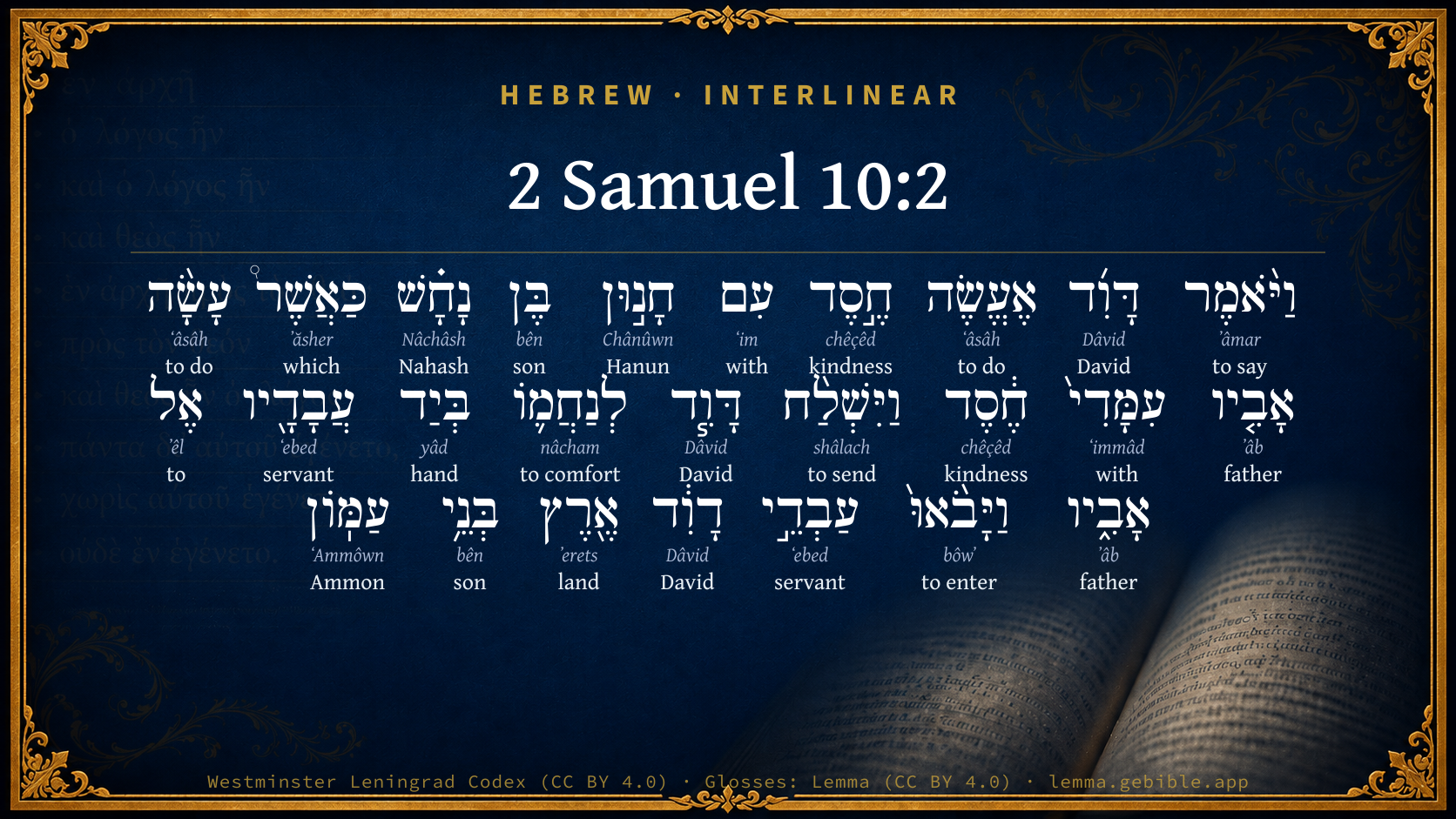
2 Samuel 10:2

Hebrew (Westminster Leningrad Codex) 2 Samuel 10:2 appears in the Hebrew Old Testament. The text above is from the Westminster Leningrad Codex. Each word links to its Strong’s number, a concise gloss, and parsing drawn from the Open Scriptures Hebrew Bible morphology. Click any word for its full Brown-Driver-Briggs (BDB) entry.
Download image
Cite this verse

2 Samuel 10:2 (World English Bible). Public Domain. Lemma interlinear Bible study tool, https://lemma.gebible.app/v/2-samuel/10/2.

Show BibTeX & RIS
BibTeX
RIS
English Translation
David said, I will show kindness to Hanun the son of Nahash, as his father shown kindness to me. So David sent by his servants to comfort him concerning his father. David's servants came into the land of the children of Ammon.
World English Bible · Public Domain
Download a study sheet

One document with this verse’s original text, its word-by-word gloss line, the meaning frame, cross-references with their text, attributed commentary, and full source and license credits — printable, and it pastes into notes with its structure intact.

This verse Autodidact and up

Study sheet (.html) Plain text (.txt)

A passage Seminary Student

Up to 50 verses in one chapter. A passage sheet keeps up to 6 commentary sources and 12 cross-references per verse, in the order this page ranks them, and says so on the sheet whenever that leaves anything out. Ask for a single verse and you get the Autodidact verse sheet above.

Everything on this page stays free to read, with no account — the sheet is a download of what is already on screen, not access to it.

Want to remove ads? Support Godless Engineer
Compare translations 3

The same verse in 3 English versions, stacked beneath the original-language interlinear above. Click any original word for its lexicon entry.

Each is an independent rendering of the whole verse — the interlinear is not word-aligned to these translations.

Highlighted words mark where these versions differ — a whole-verse word diff, not a word-by-word alignment.

  • World English Bible Public Domain
    David said, I will show kindness to Hanun the son of Nahash, as his father shown kindness to me. So David sent by his servants to comfort him concerning his father. David's servants came into the land of the children of Ammon.
  • King James Version Public Domain
    Then said David, I will show kindness unto Hanun the son of Nahash, as his father showed kindness unto me. And David sent to comfort him by the hand of his servants for his father. And David's servants came into the land of the children of Ammon.
  • unfoldingWord Literal Text CC BY-SA 4.0
    And David said, “I will do kindness with Hanun the son of Nahash, just as his father did kindness with me.” And David sent by the hand of his servants to console him concerning his father. And the servants of David entered the land of the sons of Ammon.

unfoldingWord Literal Text — © unfoldingWord, licensed CC BY-SA 4.0. Word-aligned USFM3 via Door43 (git.door43.org/unfoldingWord/en_ult).

Versions to compare (up to 4)

3 of 4 selected

Show all 18 translations

Every available English version of this verse, each an independent rendering of the whole verse.

  • World English Bible Public Domain
    David said, I will show kindness to Hanun the son of Nahash, as his father shown kindness to me. So David sent by his servants to comfort him concerning his father. David's servants came into the land of the children of Ammon.
  • Berean Standard Bible Public Domain
    And David said, “I will show kindness to Hanun son of Nahash, just as his father showed kindness to me.” So David sent some of his servants to console Hanun concerning his father. But when they arrived in the land of the Ammonites,
  • Majority Standard Bible Public Domain
    And David said, “I will show kindness to Hanun son of Nahash, just as his father showed kindness to me.” So David sent some of his servants to console Hanun concerning his father. But when they arrived in the land of the Ammonites,
  • King James Version Public Domain
    Then said David, I will show kindness unto Hanun the son of Nahash, as his father showed kindness unto me. And David sent to comfort him by the hand of his servants for his father. And David's servants came into the land of the children of Ammon.
  • American Standard Version (1901) Public Domain
    And David said, I will show kindness unto Hanun the son of Nahash, as his father showed kindness unto me. So David sent by his servants to comfort him concerning his father. And David's servants came into the land of the children of Ammon.
  • Revised Version (1885) Public Domain
    And David said, I will shew kindness unto Hanun the son of Nahash, as his father shewed kindness unto me. So David sent by the hand of his servants to comfort him concerning his father. And David’s servants came into the land of the children of Ammon.
  • Geneva Bible (1599) Public Domain
    Then sayde Dauid, I will shewe kindnesse vnto Hanun the sonne of Nahash, as his father shewed kindnesse vnto me. And Dauid sent his seruantes to comfort him for his father. So Dauids seruants came into the lande of the children of Ammon.
  • Douay-Rheims (1899) Public Domain
    And David said: I Will shew kindness to Hanon the son of Daas, as his father shewed kindness to me. So David sent his servants to comfort him for the death of his father. But when the servants of David were come into the land of the children of Ammon,
  • Young's Literal Translation Public Domain
    and David saith, `I do kindness with Hanun son of Nahash, as his father did with me kindness;' and David sendeth to comfort him by the hand of his servants concerning his father, and the servants of David come in to the land of the Bene-Ammon.
  • Literal Standard Version CC BY-SA 4.0
    and David says, “I do kindness with Hanun son of Nahash, as his father did kindness with me”; and David sends to comfort him by the hand of his servants concerning his father, and the servants of David come into the land of the sons of Ammon.
  • Unlocked Literal Bible CC BY-SA 4.0
    David said, “I will show kindness to Hanun son of Nahash, as his father showed kindness to me.” So David sent his servants to comfort Hanun concerning his father. His servants entered the land of the people of Ammon.
  • unfoldingWord Literal Text CC BY-SA 4.0
    And David said, “I will do kindness with Hanun the son of Nahash, just as his father did kindness with me.” And David sent by the hand of his servants to console him concerning his father. And the servants of David entered the land of the sons of Ammon.
  • Darby Bible Public Domain
    And David said, I will shew kindness to Hanun the son of Nahash, as his father shewed kindness to me. And David sent to comfort him by the hand of his servants for his father. And David's servants came into the land of the children of Ammon.
  • World Messianic Bible Public Domain
    David said, “I will show kindness to Hanun the son of Nahash, as his father showed kindness to me.” So David sent by his servants to comfort him concerning his father. David’s servants came into the land of the children of Ammon.
  • Webster's Bible Public Domain
    Then said David, I will show kindness to Hanun the son of Nahash, as his father showed kindness to me. And David sent to comfort him by the hand of his servants for his father. And David's servants came into the land of the children of Ammon.
  • Free Bible Version CC BY-SA 4.0
    David said, “I will be kind to Hanun, son of Nahash, just as his father was kind to me.” So David sent representatives to take his condolences to Hanun regarding his father. But when they arrived in the country of the Ammonites,
  • Bible in Basic English Public Domain
    And David said, I will be a friend to Hanun, the son of Nahash, as his father was a friend to me. So David sent his servants, to give him words of comfort on account of his father. And David's servants came into the land of the children of Ammon.
  • JPS Tanakh (1917) Public Domain
    And David said: 'I will show kindness unto Hanun the son of Nahash, as his father showed kindness unto me.' So David sent by the hand of his servants to comfort him concerning his father. And David's servants came into the land of the children of Ammon.

Literal Standard Version (2020), Covenant Press — licensed CC BY-SA 4.0. Text via the HelloAO Bible API (eBible.org). Unlocked Literal Bible (unfoldingWord) — licensed CC BY-SA 4.0. Text via the HelloAO Bible API (eBible.org). unfoldingWord Literal Text — © unfoldingWord, licensed CC BY-SA 4.0. Word-aligned USFM3 via Door43 (git.door43.org/unfoldingWord/en_ult). Free Bible Version, Dr. Jonathan Gallagher — licensed CC BY-SA 4.0. Text via the HelloAO Bible API (eBible.org).

Word by word

More ways to search: Search by grammar → Find every occurrence → Compare this word →

Practice this passage: Drill this verse → Learn its vocabulary →

נָחָ֗שׁ
Nâchâsh
H5176
“Nahash”
Noun, Proper
Part of Speech
Noun
Type
Proper
Full BDB Definition

Origin: the same as H5175

TWOT: None

Nahash = "serpent" - a king of the Ammonites during the time of king Saul - the father of Abigail, the mother of Amasa, the commander of Absalom's army
  1. וַיֹּ֨אמֶר ʼâmar H559 “and · to say” Conjunction + Verb, Qal, Sequential Imperfect, 3rd Person, Masculine, Singular
  2. דָּוִ֜ד Dâvid H1732 “David” Noun, Proper
  3. אֶעֱשֶׂה ʻâsâh H6213 “to do” Verb, Qal, Imperfect, 1st Person, Common, Singular
  4. חֶ֣סֶד chêçêd H2617 “kindness” Noun, Common, Masculine, Singular, Absolute
  5. עִם ʻim H5973 “with” Preposition
  6. חָנ֣וּן Chânûwn H2586 “Hanun” Noun, Proper
  7. בֶּן bên H1121 “son of” Noun, Common, Masculine, Singular, Construct
  8. כַּאֲשֶׁר֩ ʼăsher H834 “like/as · which” Preposition + Particle, Relative
  9. עָשָׂ֨ה ʻâsâh H6213 “to do” Verb, Qal, Perfect, 3rd Person, Masculine, Singular
  10. אָבִ֤יו ʼâb H1 “father · his” Noun, Common, Masculine, Singular, Construct + Suffix, Personal, 3rd Person, Masculine, Singular
  11. עִמָּדִי֙ ʻimmâd H5978 “with · me” Preposition + Suffix, Personal, 1st Person, Common, Singular
  12. חֶ֔סֶד chêçêd H2617 “kindness” Noun, Common, Masculine, Singular, Absolute
  13. וַיִּשְׁלַ֨ח shâlach H7971 “and · to send” Conjunction + Verb, Qal, Sequential Imperfect, 3rd Person, Masculine, Singular
  14. דָּוִ֧ד Dâvid H1732 “David” Noun, Proper
  15. לְנַחֲמ֛וֹ nâcham H5162 “to comfort · him” Preposition + Verb, Piel, Infinitive Construct + Suffix, Personal, 3rd Person, Masculine, Singular
  16. בְּיַד yâd H3027 “in/at · hand of” Preposition + Noun, Common, Both, Singular, Construct
  17. עֲבָדָ֖יו ʻebed H5650 “servants · his” Noun, Common, Masculine, Plural, Construct + Suffix, Personal, 3rd Person, Masculine, Singular
  18. אֶל ʼêl H413 “to” Preposition
  19. אָבִ֑יו ʼâb H1 “father · his” Noun, Common, Masculine, Singular, Construct + Suffix, Personal, 3rd Person, Masculine, Singular
  20. וַיָּבֹ֨אוּ֙ bôwʼ H935 “and · to enter” Conjunction + Verb, Qal, Sequential Imperfect, 3rd Person, Masculine, Plural
  21. עַבְדֵ֣י ʻebed H5650 “servants of” Noun, Common, Masculine, Plural, Construct
  22. דָוִ֔ד Dâvid H1732 “David” Noun, Proper
  23. אֶ֖רֶץ ʼerets H776 “land of” Noun, Common, Both, Singular, Construct
  24. בְּנֵ֥י bên H1121 “sons of” Noun, Common, Masculine, Plural, Construct
  25. עַמּֽוֹן ʻAmmôwn H5983 “Ammon” Noun, Proper

About this verse

These counts appear in no published source. They are computed here, from the morphology-tagged text and Lemma’s own curated glosses. What Lemma adds →

26
words
19
distinct lemmas
Historical
section

Notable vocabulary

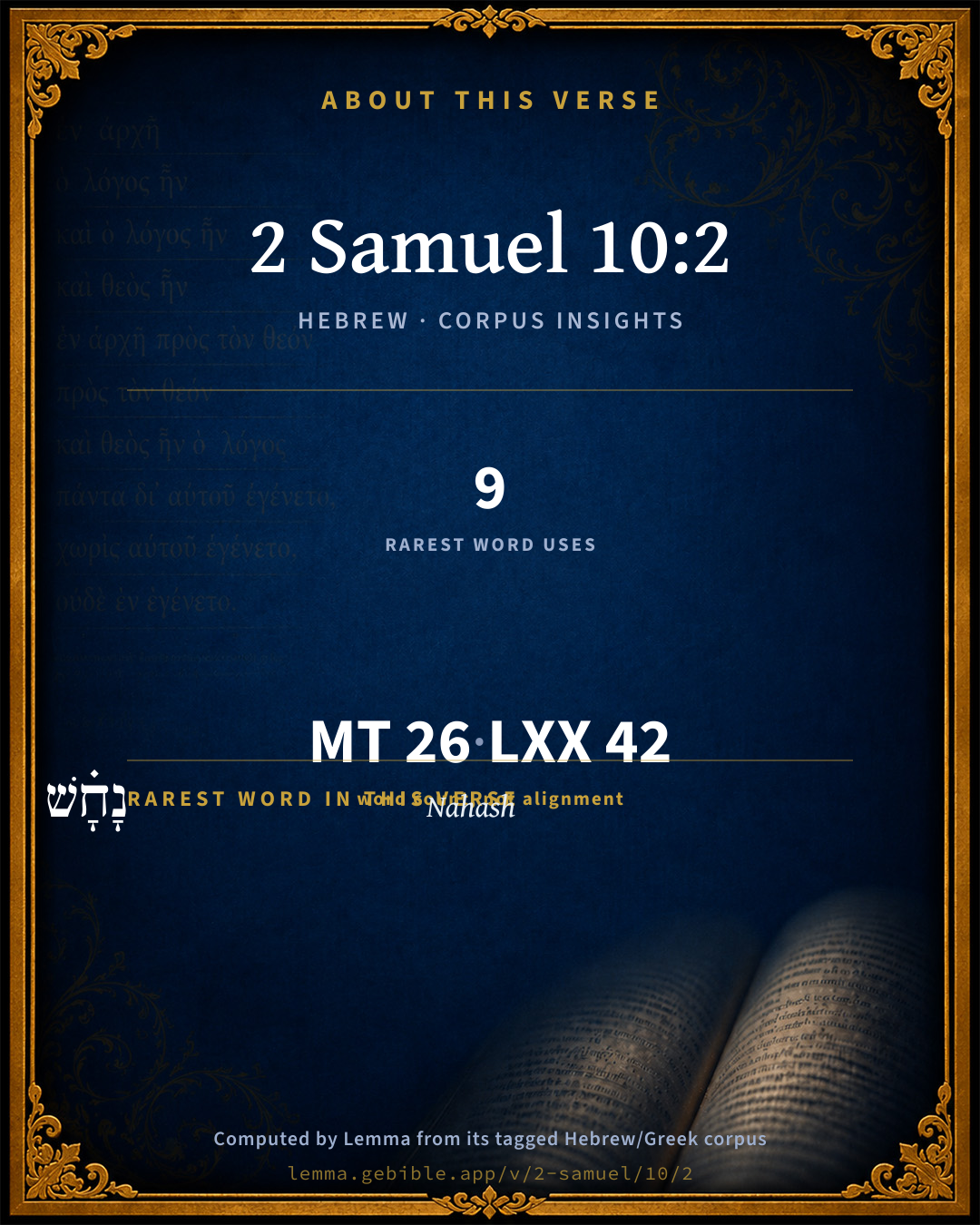
The rarest word here is נָחָ֗שׁ Nahash H5176 — appearing just 9 times in the whole Hebrew Bible.

Shared distinctive vocabulary

נָחָ֗שׁ Nahash H5176 occurs in 8 verses of the Hebrew Bible. Also found in:

Grammatical profile

  • 6 verbs
  • 16 nouns
  • 3 prepositions
  • 1 particle

Verb forms

  • וַיֹּ֨אמֶר Qal · Sequential Imperfect
  • אֶעֱשֶׂה Qal · Imperfect
  • עָשָׂ֨ה Qal · Perfect
  • וַיִּשְׁלַ֨ח Qal · Sequential Imperfect
  • לְנַחֲמ֛וֹ Piel · Infinitive Construct
  • וַיָּבֹ֨אוּ֙ Qal · Sequential Imperfect

Repetition

Words recur within this verse — often emphatic in Hebrew:

  • דָּוִ֜ד David H1732 ×3
  • אֶעֱשֶׂה to do H6213 ×2
  • חֶ֣סֶד kindness H2617 ×2
  • בֶּן son H1121 ×2
  • אָבִ֤יו father H1 ×2
  • עֲבָדָ֖יו servant H5650 ×2

Hebrew & Septuagint length

In English translation the verse runs 42 words from the Hebrew and 49 from the Septuagint (LXX English) — closely comparable.

A rough comparison of the two English renderings, which tokenize alike — not a word-level alignment.

Word counts can differ between the Hebrew and the Greek without any difference in meaning — e.g. the Hebrew direct-object marker אֵת has no separate Greek word, and Greek often adds the article ὁ.

In the original languages it is 26 Hebrew tokens and 42 Greek tokens — but the two are counted differently (Hebrew bundles its prefixes and suffixes into one token; the Greek is in lemma form), so that isn’t a like-for-like length.

Cross-references

5

Topical passages linked to 2 Samuel 10:2 in the Treasury of Scripture Knowledge — connected by theme and wording, ordered by reader-vote popularity; previews shown in the World English Bible.

  • 1 Samuel 11:1 Then Nahash the Ammonite came up, and encamped against Jabesh Gilead: and all the men of Jabesh said to Nahash, Make a covenant with us, and we will serve you.
  • Deuteronomy 23:3–6 An Ammonite or a Moabite shall not enter into the assembly of Yahweh; even to the tenth generation shall none belonging to them enter into the assembly of Yahweh forever:
  • Nehemiah 13:1–3 On that day they read in the book of Moses in the audience of the people; and therein was found written, that an Ammonite and a Moabite should not enter into the assembly of God forever,
  • 1 Samuel 22:3–4 David went there to Mizpeh of Moab: and he said to the king of Moab, Please let my father and my mother come forth, [and be] with you, until I know what God will do for me.
  • Nehemiah 4:3–7 Now Tobiah the Ammonite was by him, and he said, Even that which they are building, if a fox go up, he shall break down their stone wall.

Cross-references courtesy of OpenBible.info (CC BY 4.0).

Hebrew and Greek witnesses Masoretic Hebrew ↔ Greek Septuagint

The same verse in the two great witnesses to the Old Testament, shown verse-for-verse.

These are two independent witnesses, not word-aligned to each other, and the Septuagint is shown in lemma (dictionary) form.

Hebrew 2 Samuel 10:2 Masoretic · Westminster Leningrad Codex

וַיֹּ֨אמֶר דָּוִ֜ד אֶעֱשֶׂה חֶ֣סֶד עִם חָנ֣וּן בֶּן נָחָ֗שׁ כַּאֲשֶׁר֩ עָשָׂ֨ה אָבִ֤יו עִמָּדִי֙ חֶ֔סֶד וַיִּשְׁלַ֨ח דָּוִ֧ד לְנַחֲמ֛וֹ בְּיַד עֲבָדָ֖יו אֶל אָבִ֑יו וַיָּבֹ֨אוּ֙ עַבְדֵ֣י דָוִ֔ד אֶ֖רֶץ בְּנֵ֥י עַמּֽוֹן

David said, I will show kindness to Hanun the son of Nahash, as his father shown kindness to me. So David sent by his servants to comfort him concerning his father. David's servants came into the land of the children of Ammon.

World English Bible · Public Domain

Greek LXX 2 Samuel 10:2 Septuagint · lemma form

καί εἶπον δαυίδ ποιέω ἔλεος μετά αννων υἱός ναας ὅς τρόπος ποιέω ὁ πατήρ αὐτός μετά ἐγώ ἔλεος καί ἀποστέλλω δαυίδ παρακαλέω αὐτός ἐν χείρ ὁ δοῦλος αὐτός περί ὁ πατήρ αὐτός καί παραγίγνομαι ὁ παῖς δαυίδ εἰς ὁ γῆ υἱός αμμων

And David said, I will show mercy to Annon the son of Naas, as his father dealt mercifully with me. And David sent to comfort him concerning his father by the hand of his servants; and the servants of David came into the land of the children of Ammon.

LXX2012 (modern English Septuagint) · Public Domain

Hebrew: Westminster Leningrad Codex (CC BY 4.0). Greek: Septuagint (public domain); English from LXX2012 (modern English Septuagint) (Public Domain). How the Septuagint differs from the Hebrew →

Targum (Aramaic paraphrase)

1

The Targum is the ancient Jewish Aramaic paraphrase of the Hebrew Scriptures — an interpretive translation, not the Hebrew text itself. Onkelos (literal) and Pseudo-Jonathan (expansive) render the Torah, and Jonathan the Prophets. Coverage is partial: where no permissively-licensed English translation exists for a verse, only the Aramaic is shown. This is verse-level text, not a word-by-word alignment to the Hebrew.

  1. Targum Jonathan Prophets (Joshua–Malachi)
    וַאֲמַר דָוִד אַעְבֵיד טֵיבוּ עִם חָנוּן בַּר נָחָשׁ כְּמָא דַעֲבֵד אֲבוּהִי עִמִי טִיבוּ וּשְׁלַח דָוִד לְנַחֲמוּתֵיהּ בִּידָא דְעַבְדוֹהִי לְוַת אֲבוּהִי וַאֲתוֹ עַבְדֵי דָוִד לְאַרְעָא בְּנֵי עַמוֹן:

    (no public-domain English translation for this verse)

    Targum Jonathan — Aramaic: “Mikraot Gedolot” (public domain). English: “Sefaria Community Translation” (CC0 1.0 (public-domain dedication)); “London "Chaldee Paraphrase," 1871” (public domain). Text via Sefaria.

Commentary

Notes on 2 Samuel 10:2 from classic Christian and Jewish commentators (each source and its license shown beneath its notes). The classic Christian expositions comment on the surrounding passage and are grouped to its opening verse, so a note may address several verses; the Jewish commentaries on the Tanakh (Rashi and others) are per-verse, so they appear only where the commentator wrote on this verse.

Lemma curates 59 commentaries, every one of them public domain or Creative Commons licensed, each selected and text-cleaned for this edition rather than reprinted as found. About our sources →

Trapp's Complete Commentary

John Trapp

2Sa 10:2 Then said David, I will shew kindness unto Hanun the son of Nahash, as his father shewed kindness unto me. And David sent to comfort him by the hand of his servants for his father. And David’s servants came into the land of the children of Ammon.

Ver. 2. Then said David.] Let Hanun be as graceless as he will, David will show himself gracious by being grateful. The same Greek word χαρις signifieth both grace and gratitude. Neither doth the ill success he had argue that he did amiss, as Pellican will have it: for duty is to be done, however it speed or take with wicked persons. What if Hanun were a heathen king? might not his friendship be therefore sought? might not his father’s courtesy be requited? If a very dog fawn upon us, we stroke him on the head, and clap him on the side: much less is the common band of humanity untied by grace.

As his father showed kindness unto me.] What this kindness was in particular, the Scripture showeth not: the Hebrews say, that when the king of Moab had slain David’s parents and brethren - whom he left with him for safeguard from Saul - one of his brethren escaped and fled to Nahash, king of Ammon, who helped him. Abulensis, Lyra, Angelomus, and others say, that when David fled from Achish, king of Gath, he came to the king of Ammon, who showed him kindness, and out of his hatred to Saul, their common enemy, bestowed many favours upon him. This David now desireth to requite, but meeteth with coarse entertainment.

John Trapp, A Commentary or Exposition upon All the Books of the Old and New Testament (1647–1656) — public domain. Text from a community e-Sword module.

The Biblical Illustrator

Joseph S. Exell

2Sa_10:2-19

I will show kindness unto Hanun the son of Nahash, as his father showed kindness unto me.

David and Hanun

Powerful though David had proved himself in every direction in the art of war, his heart was inclined to peace. The position which he had gained as a warrior would naturally have made Hanun more afraid of David than David could be of Hanun. The king of Israel could not have failed to know this, and it might naturally occur to him that it would be a kindly act to the young king of Ammon to send him a message that showed that he might thoroughly rely on his friendly intentions. The message to Hanun was another emanation of a kindly heart. It is a happy thing for any country when its rulers and men of influence are ever on the watch for opportunities to strengthen the spirit of friendship. It is a happy thing in the Church when the leaders of different sections are more disposed to measures-that conciliate and heal than to measures that alienate and divide. In family life, and wherever men of different views and different tempers meet, this peace-loving spirit is of great price. Men that like fighting, and that are ever disposed to taunt, to irritate, to divide, are the nuisances of society. Between the Ammonites and the Israelites collisions had occurred on two former occasions, on both of which the Ammonites appear to have been the aggressors The former of these was in the days of Jephthah. The second was the collision at Jabesh-gilead at the beginning of the reign of Saul. When the men of Jabesh, brought to bay, begged terms of peace, the bitter answer was returned that it would be granted only on condition that every mans right eye should be put out. It was then that Saul showed such courage and promptitude. In the briefest space he was at Jabesh-gilead in defence of his people, and by his successful tactics inflicted on the Ammonites a terrible defeat, killing a great multitude and scattering the remainder, so that not any two of them were left together. After such a defeat, Nahash could not have very friendly feelings to Saul. And when Saul proclaimed David his enemy, Nahash would naturally incline to Davids side. It was long, long ago when it happened, but love has a long memory, and the remembrance was still pleasant to David. And now the king of Israel purposes to repay to the son the debt he had incurred to the father. Up to this point it is a pretty picture; and it is a great disappointment when we find the transaction miscarry, and a negotiation which began in all the warmth and sincerity of friendship terminate in the wild work of war. The fault of this miscarriage, however, was glaringly on the other side. Our difficulty is to understand how sane men could have acted in such a way. It is hardly necessary to say a word to bring out the outrageous character of their conduct.

(1) There was the repulse of Davids kindness. It was not even declined with civility; it was repelled with scorn. It is always a serious thing to reject overtures of kindness. Kindness is too rare a gem to be trampled under foot.

(2) But Hanun not only repelled Davids kindness, but charged him with meanness, and virtually flung in his face a challenge to war. To represent his apparent kindness as a mean cover of a hostile purpose was an act which Hanun might think little of, but which was fitted to wound David to the quick. Unscrupulous natures have a great advantage over others in the charge they may bring. In a street collision a man in dirty clothing is much more powerful for mischief than one in clean raiment. Rough, unscrupulous men are restrained by no delicacy from bringing atrocious charges against those to whom these charges are supremely odious. They have little sense of the din of them, and they toss them about without scruple. Such poisoned arrows inflict great pain, not because the charges are just, but because it is horrible to refined natures even to hear them.

(3) To these offences Hanun added yet another--scornful treatment of Davids ambassadors. In the eyes of all civilised nations the persons of ambassadors were held sacred, and any affront or injury to them was counted an odious crime. Very often men of eminent position, venerable age, and unblemished character were chosen for this function, and it is quite likely that Davids ambassadors to Hanun were of this class. When therefore these men were treated with contumely--half their beards, which were in a manner sacred, shorn away, their garments mutilated, and their persons exposed--no grosser insult could have been inflicted. It is a painful moment when true worth and nobility lie at the mercy of insolence and coarseness, and have to bear their bitter revilings. Such things may happen in public controversy in a country where the utmost liberty of speech is allowed, and when men of ruffian mould find contumely and insult their handiest weapons. In times of religious persecution the most frightful charges have been hurled at the heads of godly men and women, whose real crime is to have striven to the utmost to obey God.

3. The Ammonites did not wait for a formal declaration of war by David. Nor did they flatter themselves, when they came to their senses, that against one who had gained such renown as a warrior they could stand alone. Their insult to King David turned out a costly affair.

4. It requires but a very little consideration to see that the wars which are so briefly recorded in this chapter must have been most serious and perilous undertakings. The record of them is so short, so unimpassioned, so simple, that many readers are disposed to think very little of them. But when we pause to think what it was for the king of Israel to meet, on foreign soil, confederates so numerous, so powerful, and so familiar with warfare, we cannot but see that these were tremendous wars. They were fitted to try the faith as well as the courage of David and his people to the very utmost. (W. G. Blaikie, D. D.)

Ungenerous judgments

In thousands of men, the mind, if unveiled, would be found to be a star-chamber filled with false witnesses and cruel judgments. If you were to go back into the old star-chamber of England, and read the records made of testimony given and sentences passed by men of partial information, what a literature of hell those records would be I But worse than these are the cruel, rash, hateful judgments which men form of each other in the silence of the mind, simply because they follow their interests, their feelings, their prejudices, and not their conscience, in ascertaining facts and coming to conclusions. (H. W. Beecher.)

Two aspects of David

In chapters 10. and 11. we see king David at his best and also at his worst. The second verse of the tenth chapter opens almost in the same spirit as the first verse of the ninth. In both instances David is determined to show kindness. In the first instance he would show kindness to any survivor of the house of Saul, as we have just seen, and now he will show kindness unto Hanon the son of Nahash, because Hanuns father had shown kindness to David in the old times of distress. In both these historical instances David acts retrospectively, in the sense that he is not proposing to show kindness to living men for their own sakes but on account of some virtue or goodness on the part of their ancestors. A merely technical or literal nature would have been content with contemporary action--that is to say, would not have troubled about going back into yesterday in order to honour the memory of a dead man. But even in this generous retrospection David is faithful to his poetic nature and his religious enthusiasm. David is to be Credited with good retentions in this case, as he was in the case of proposing to build the temple and to do kindness to any survivor of the house of Saul Even good intentions hays a distinctive value of their own. Sweet waters do not rise from bitter fountains. To have one good wish, one unselfish desire, one generous impulse, is to have some degree of divine influence operating upon the heart, and so far is to show that the heart has not been given over to utter reprobation, This is a comforting thought for ourselves. Hanun responded to the counsels of his advisers in a manner which he supposed would increase his own popularity with his subjects. He took Davids servants, and shaved off the one half of their beards, and cut off their garments in the middle. it is little to the honour of human nature that there are not only insults which men can hurl at one another in moments of passion and defiance, but there are studied insults which are elaborated in cold blood and inflicted with a sense of enjoyment by the cruel men who have fashioned new modes of social humiliation. The insult inflicted upon Israel was not only personal, it was deeply religious. Not, only was David dishonoured, but God Himself was defied. In Lev_19:27, we see how stringent was the law regarding this matter of shaving the head. It, is not for us to enter into the value of any such ordinances; suffice it to say that they were the distinct ordinances of the people of Israel, and as such had religious value and significance. There is a cruelty in our own day which seeks to injure men- through the medium of their religious convictions. To-day men are kept out of pecuniary positions because of their religious faith. Social advancement is barred to not a few persons on account of their religious convictions. Were such men without conviction, light-headed, and light-hearted, ready to adopt any form or ceremony as they might adopt a change of garments, their course in life would be much smoother; but because they are earnest, even to agony, their convictions are made into so many stumbling-blocks by which their progress is hindered. The counsellors of Hanun the son of Nahash were too blinded by their own passion to foresee the results of their foolish policy. What was a practical jest to them was an occasion of just anger to the king whom they had insulted. It is well to take some account of the resources of the enemy before being too defiant or adopting a course of lofty superciliousness. But folly seldom sees both sides of a question. It is a notable characteristic of the genius of history that it is always faithful to its own time. As the action of David would now be out of place as between Christian nations, so any other course than that which he adopted would have been out of place in relation to his particular injury. Read history in its own light. It is essential to adopt this canon of interpretation in reading many portions of the Old Testament; otherwise the mind will be thrown often into a state of moral bewilderment, and be ready almost to cry out against the Spirit of God. (J. Parker, D. D.)

A fathers kindness repaid to his son

A good man of my acquaintance died very suddenly the other day, and when it came to settling up the account, it was found that, while with his presence and work he was able to get a living for his family out of his share in the business, with him gone there was nothing left. All the children were grown up and able to support themselves, with the exception of one young man who had two years yet to spend in the medical school before he would be able to take up his profession as a doctor. It seemed at first that he must drop out, and work his way for awhile saving up money to go on. But just then a man came forward, who said: Some years ago I was in a difficult place and needed a friend very much. Just at the critical time your father stepped into the breach, and in the gentlest, cheeriest way helped me out. I said then if ever I had a chance I would pay that kindness back. Now is my chance. You go back to the medical school and finish your course, and I will take care of the expenses. You can charge them up to your fathers kindness account. He who sows a kind deed may be sure that it is a long-lived, hardy crop, and certain to bring in its harvest by and by. (L. A. Banks, D. D.)

The Biblical Illustrator, edited by Joseph S. Exell (c. 1880s–1900s) — public domain. Text from a community e-Sword module.

Joseph Benson's Commentary

2Sa 10:2. As his father showed kindness unto me — All generous minds are full of gratitude and compassion. David here remembers the ancient benefits which he had received from Nahash, and pitied his son, who had lost such a father. What those benefits were is uncertain. It is probable, however, that, being an enemy to Saul, who had given him a great overthrow, he proved a friend to David when he was persecuted by him, sent him relief and assistance, and perhaps offered him his protection. David sent to comfort him — According to the present custom among princes, who send some of their courtiers to condole with those, under any loss or suffering, with whom they live in friendship. And as, it appears, there had hitherto been friendship between David and him, we must conclude that what is said of the spoils of the children of Ammon, 2Sa 8:12, is mentioned by way of anticipation, and is to be understood of the spoils taken after the victory spoken of in this chapter.

Joseph Benson's Commentary on the Old and New Testaments (1811–1818) — public domain. Text from a community e-Sword module.

Tyndale Open Study Notes

Tyndale Open Resources

10:2 In both chs 9 and 10, David wanted to show loyalty (khesed; also in 9:1, 3).

Tyndale Open Study Notes — © Tyndale Open Resources, licensed CC BY-SA 4.0. Text via the HelloAO Bible API.

Geneva Bible (1599)

Geneva Bible translators

The children of God are not unmindful of a benefit received.

Geneva Bible (1599) marginal notes — public domain. Text via Bolls.life.

Adam Clarke's Commentary

Verse 2. I will show kindness unto Hanun the son of Nahash] We do not know exactly the nature or extent of the obligation which David was under to the king of the Ammonites; but it is likely that the Nahash here mentioned was the same who had attacked Jabesh-gilead, and whom Saul defeated: as David had taken refuge with the Moabites, (1Sa 22:3), and this was contiguous to the king of the Ammonites, his hatred to Saul might induce him to show particular kindness to David.

Adam Clarke's Commentary on the Bible (1810–1826) — public domain. Text from a community e-Sword/MySword module.

The Cambridge Bible for Schools and Colleges

gen. ed. J. J. S. Perowne

2. as his father shewed kindness unto me] Possibly in the course of David’s wanderings: possibly by a congratulatory embassy on his accession (cp. 1Ki_5:1): according to a Jewish tradition by receiving one of his brothers, who escaped when his parents were murdered by the king of Moab.

The Cambridge Bible for Schools and Colleges (gen. ed. J. J. S. Perowne; Cambridge University Press, 1878–1918) — public domain. Text from a community e-Sword module.

John Gill's Exposition

Then said David, I will show kindness to Hanun the son of Nahash,.... Send him a friendly compliment of condolence on the death of his father:

as his father showed kindness unto me; when David was persecuted by Saul, he sent him aid, and invited him into his country for protection it may be, and some way or other showed respect unto him; though not out of real love and friendship to David, but in enmity to Saul, who had defeated him at Jabeshgilead, and had often wars with him: the Jews say (o) the particular kindness was, that when David left his father, mother, and brethren, with the king of Moab, he slew all but one, who fled to the king of the children of Ammon, and was by him saved alive:

and David sent to comfort him by the hand of his servants for his father; for the death of his father; to condole the loss of him, which was the custom of kings in friendship and alliance in former times, and still continues:

and David's servants came into the land of the children of Ammon; even to Rabbah, the metropolis of the nation, and the royal city, where the king kept his court.

(o) Tanchuma apud Jarchium in loc.

John Gill's Exposition of the Whole Bible (1746–1763) — public domain (CC PDM 1.0). Text via the HelloAO Bible API.

Albert Barnes' Notes on the Bible

The history does not record any instance of Nahash’s kindness to David, but the enmity of the house of Nahash against Saul may have disposed him favorably toward Saul’s enemy David, and if there was any family connection between David’s house and Nahash 2Sa 17:25 this may have increased the friendship.

Albert Barnes' Notes on the Bible (1834–1885) — public domain. Text from a community e-Sword/MySword module.

Haydock's Catholic Bible Commentary

Naas, whom Saul had defeated, and who on that account is supposed to have received his rival more willingly, (Calmet) when he had retreated into the country of Moab, 1 Kings xxii. 3. After receiving many presents from Naas, he retired to Odollam. (St. Jerome, Tradit.) (Menochius) --- Though the Israelites were not to seek the friendship of these nations, (Deuteronomy xxiii. 6,) they were not forbidden to make a return of gratitude. (Menochius)

George Leo Haydock (1774–1849), Haydock's Catholic Family Bible and Commentary, 1859 edition — public domain. Excludes Psalms (Douay-Rheims chapter numbering differs from Protestant) and Deuterocanonical books (Catholic canon only).

Matthew Poole's English Annotations

Therefore there had hitherto been peace and friendship between David and him; and therefore the spoils of the children of Ammon are mentioned 2Sa 8:12, by way of anticipation, and with respect to the story here following.

As his father showed kindness unto me; which he might do either by offering him his help, if he needed it; or by supplying him with military or other provisions upon occasion, or many other ways.

Matthew Poole's English Annotations on the Holy Bible (1683–1685) — public domain. Text from a community e-Sword/MySword module.

Whedon's Commentary on the Bible

Daniel D. Whedon

2. His father showed kindness unto me — When and how we are nowhere told, but it was probably during the time of his flight from Saul.

To comfort him — To sympathize with him in the time of his mourning for his father.

Daniel D. Whedon (gen. ed.), Commentary on the Old and New Testaments (1874–1909) — public domain. Text from a community e-Sword module.

The Pulpit Commentary

His father showed kindness unto me. This makes it probable that it was the same Nahash as Saul"s enemy. The smart of the defeat caused by Saul"s energy would make him regard with friendship any one who was a thorn in the side of the man who had so unexpectedly stopped him in his career, and hence his kindness to David.

HOMILIES BY G. WOOD Vers. 2-4.

Kindness misinterpreted and ill requited.

am for peace; but when I speak, they are for war". (Psa_120:7) It is not probable that these words were written by David, but they might have been with truth. It does not appear that he desired war with the neighbouring peoples; but for a time he was continually at war with one or other of them. Jealous of the growing greatness and power of Israel under his rule, they sought to humble them, but only to their own discomfiture and subjugation. And as the kingdom extended, more distant nations feared for themselves, and were ready to combine against what seemed the common foe. This is probably the real explanation of the transactions recorded in this chapter, including the most serious struggle which the rising kingdom had had to maintain. Nahash, "the king of the children of Ammon," having died, David, to whom Nahash had in some way shown kindness, sent ambassadors to Hanun, his son and successor, with a message of condolence. But the young king, induced by the princes to regard the ambassadors as spies, who had been sent to obtain such knowledge of the city as might facilitate its overthrow, treated them with the grossest contumely and indecency, and so dismissed them. Hence sprang a deadly war, in which the Ammonites were aided by other and more powerful peoples a war which taxed to the utmost the strength of Israel, and issued in the complete overthrow of their enemies. The first step in all this commotion and destruction was the false interpretation put upon the kind act of David; and, regarding it as an illustration of a too common evil, we take occasion to remark upon the evil itself misinterpretation of good deeds.

I THE CAUSES OF IT.

1. Knowledge of the world. There is so much evil in it, so much evil which conceals itself under the pretence of good; the actions which at first appear

2. good are so often, on closer acquaintance, discovered to be evil; that experience of the world tends to produce a suspicious spirit, which is slow to believe in the reality of goodness in any particular instance, quick to think the worst of the conduct of others, especially of strangers.

3. Evil in one"s self. Which may be conscious or unconscious. We are indisposed to believe others to be better than we know ourselves to be; and prone to suspect others of motives we are conscious of indulging ourselves. And, without distinct consciousness, we are influenced in our judgments of others by our own character; and may be so far under the influence of evil as to be blind to the good in others. The cold, selfish, illiberal, cannot credit others with the opposite virtues; but suspect the appearance of them to be only a semblance adopted for some unworthy purpose.

1. Enmity. If on any account we cherish ill will towards another, we are ever ready to think evil rather than good of him; and specially slow to think he can intend good to us. If another has failed to show as high an esteem for ourselves as we think we deserve, our mortified pride is apt to vent itself in depreciation of him. Prejudice is one kind of enmity, more or less virulent. It commonly exists in those of one party in religion or politics towards those of the opposite party, and predisposes them to misinterpret whatever they do.

2. Fear. Which was one of the motives that prompted Hanun and his advisers.

3. Conceit of sagacity. A cheap and easy way of appearing very wise, and of obtaining from some a reputation for wisdom, is to affect to discover unworthy motives in good actions.

4. Bad advisers. Such as those of Hanun. Those who might be otherwise disposed to a just estimate of good deeds will seldom want advisers to poison their minds, if they will listen to them.

II THE EVIL OF IT.

1. In itself. It is inherently base. It is contrary to:

(1) Charity, which "believeth all things, hopeth all \\ things", (1Co_13:7) whenever it is not manifestly impossible.

(2) Justice. Judgments which seem to be only charitable will often be simply just.

(3) Gratitude, in the case of actions kind to ourselves. Better to waste a little gratitude than indulge needless suspicion.

(4) The plain commands of our Lord. Such as "Judge not;" "Whatsoever ye would that men should do to you, do ye even so to them". (Mat_7:1, Mat_7:12) It involves, further, an assumption of knowledge such as men do not possess, and a usurpation of the office of him who alone searches the. (1Co_4:5) We are not, however, required to cherish a blind credulity, nor to trust men with important interests without positive knowledge of their moral worth, still less against plain evidence of the contrary. Prudence is a virtue as well as charity. The Ammonites might have rightly exercised such caution towards David"s messengers as would have prevented their obtaining so much knowledge of the city as would facilitate hostile measures against it, if these were really contemplated. They did wrong in concluding that the seeming kindness was covert hostility. To have returned civility for civility could have done them no harm, and would have prevented the severe retribution for their barbarity which followed.

2. In its effects.

(1) On those who are guilty of it. It deprives them of the happiness and other good which they would gain from kindness exercised towards them, were it duly appreciated and acknowledged; and of the benefit which it would impart in the way of example and influence. It strengthens the bad dispositions and habits from which it springs. It prompts to conduct (as in this case) which may work incalculable mischief.

(2) On those towards whom it is indulged. Inflicting pain, producing resentment, and perhaps active revenge, and discouraging them in the practice of virtues which are liable to be so maligned.

(3) On others. Infecting with unjust suspicions some who would not otherwise cherish them; encouraging disbelief in genuine goodness, and thus loosening the bonds of mutual confidence by which society is held together; disinclining also from good deeds, and so lessening the amount of goodness in the world.

III HOW IT SHOULD AFFECT US.

1. It should not surprise us. Considering what men are, we should regard it as quite possible that any good we may do will be misrepresented, or at

2. least fail to be duly appreciated and acknowledged even by those whose benefit we seek.

3. It should not deter us from doing good. The great motives for good deeds abide the same. They are quite independent of human appreciation. They should be our chief motives, the hope of approval or suitable return from men occupying a very subordinate position. Let us study and labour to be accepted of God, (2Co_5:9) and be content with his approval, let men think what they may.

4. If men misrepresent our conduct, let us exercise charity towards them, hoping, if we cannot confidently believe, that they have sinned through ignorance or inconsideration rather than ill will. If compelled to vindicate ourselves, let us do it with meekness. We should also reflect whether we have given any occasion in the manner of our conduct for misunderstanding of its real quality; and avoid the error in future. And, if we are really reproached for that which is good, without just occasion, let us be mindful that we are fellow sufferers with our Lord and many of the best men of all ages.

5. Let us be watchful against every temptation to depreciate and misrepresent the good which is practised by others. G.W.

The Pulpit Commentary (1880–1919), ed. H.D.M. Spence-Jones & Joseph S. Exell — public domain. Text from a community e-Sword module.

John Wesley's Explanatory Notes

David sent - There had hitherto been friendship between David and him: and therefore the spoils of the children of Ammon are mentioned, chap. viii, 12, by way of anticipation, and with respect to the story here following.

John Wesley, Explanatory Notes Upon the Whole Bible (1754–1765) — public domain. Text via the GEBible commentary corpus.

Rashi

Rabbi Shlomo Yitzchaki (Rashi)

As his father acted with kindness towards me. And what was the kindness? When Dovid was fleeing because of Shaul, his father, mother and brothers came to [join] him. "Dovid led them before the king of Moav" [Dovid] said to him, "Please, [let] my father and mother dwell with you." [The king of Moav] killed them [all] except for one of them [i.e., the brothers] who fled and escaped to the land of the people of Amon, to Nochosh. This is a Midrash Rebbe Tanchuma in [Parshas] Vayeiroh ailov.

Rashi on the Tanakh — English translations: “The Judaica Press complete Tanach with Rashi, translated by A. J. Rosenberg” (CC BY 4.0); “Pentateuch with Rashi's commentary by M. Rosenbaum and A.M. Silbermann, 1929-1934” (public domain); “The Metsudah Tanach series, Lakewood, N.J” (CC BY 4.0); and “The Book of Joshua, Metsudah Publications, 1997” (CC BY 4.0). Text via Sefaria.

Lesson kit

Teaching starters — assembled from the data on this page, not authored interpretation. Every prompt links to the verse data it draws on. Edit before teaching.

2 Samuel, in the Historical, opens this verse with 26 words (19 distinct Hebrew lemmas). Its most distinctive word is Nâchâsh (“Nahash”). A historical commentator’s framing appears above. Read the whole chapter for the surrounding context.

Discussion questions

  1. The word Nâchâsh carries the sense “Nahash.” How does it shape the verse?
  2. 1 Samuel 11:1 shares the word «Nahash» with this verse. How do the two illuminate each other?
  3. “David” occurs 3× in this one verse. What is the effect of the repetition?
  4. The translations on this page render this verse differently — a whole-verse word diff, not a word-by-word alignment. What might account for the different wordings?
  5. The verb «וַיֹּ֨אמֶר» is Qal Sequential Imperfect. How does its form color the action?
  6. Reading how Trapp's Complete Commentary and The Biblical Illustrator read this verse, where do the two commentators agree and where do they part?

Things to notice

Reading settings

Reading text

Shown beneath each verse's original-language words.

Old Testament
Old Testament edition

Read the OT as the Masoretic Hebrew (MT) or the Greek Septuagint (LXX).

English shown for the Greek Septuagint (in the Hebrew ↔ Greek comparison).

Comparing translations? Open the Compare panel on any verse page to stack up to four side by side.