
2 Samuel 9:2

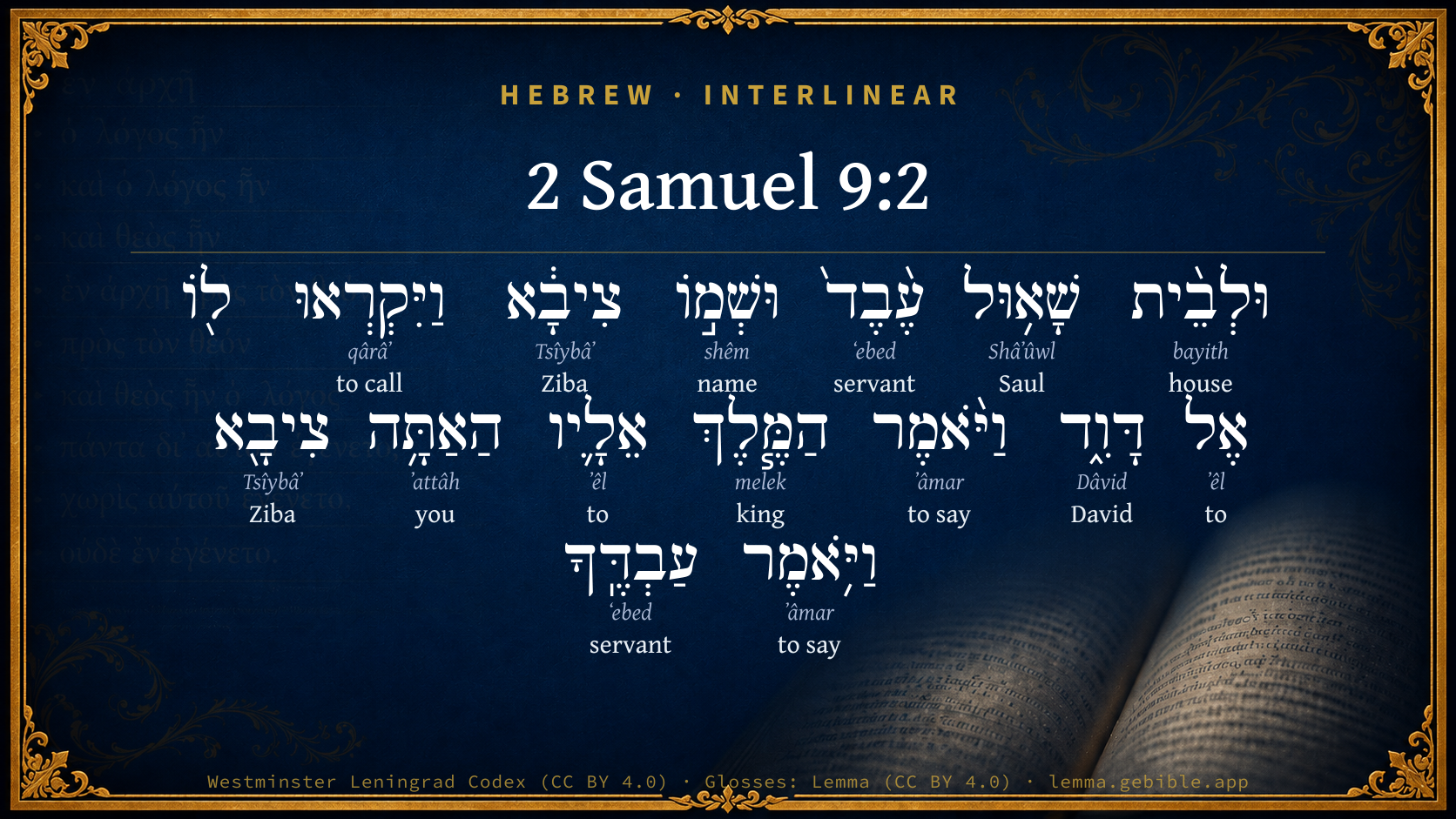
Hebrew (Westminster Leningrad Codex) 2 Samuel 9:2 appears in the Hebrew Old Testament. The text above is from the Westminster Leningrad Codex. Each word links to its Strong’s number, a concise gloss, and parsing drawn from the Open Scriptures Hebrew Bible morphology. Click any word for its full Brown-Driver-Briggs (BDB) entry.
Download image
Cite this verse

2 Samuel 9:2 (World English Bible). Public Domain. Lemma interlinear Bible study tool, https://lemma.gebible.app/v/2-samuel/9/2.

Show BibTeX & RIS
BibTeX
RIS
English Translation
There was of the house of Saul a servant whose name was Ziba, and they called him to David; and the king said to him, Are you Ziba? He said, Your servant is he.
World English Bible · Public Domain
Highlights
  • 1 first appearance in the Hebrew Bible
Full analysis ↓
Download a study sheet

One document with this verse’s original text, its word-by-word gloss line, the meaning frame, cross-references with their text, attributed commentary, and full source and license credits — printable, and it pastes into notes with its structure intact.

This verse Autodidact and up

Study sheet (.html) Plain text (.txt)

A passage Seminary Student

Up to 50 verses in one chapter. A passage sheet keeps up to 6 commentary sources and 12 cross-references per verse, in the order this page ranks them, and says so on the sheet whenever that leaves anything out. Ask for a single verse and you get the Autodidact verse sheet above.

Everything on this page stays free to read, with no account — the sheet is a download of what is already on screen, not access to it.

Want to remove ads? Support Godless Engineer
Compare translations 3

The same verse in 3 English versions, stacked beneath the original-language interlinear above. Click any original word for its lexicon entry.

Each is an independent rendering of the whole verse — the interlinear is not word-aligned to these translations.

Highlighted words mark where these versions differ — a whole-verse word diff, not a word-by-word alignment.

  • World English Bible Public Domain
    There was of the house of Saul a servant whose name was Ziba, and they called him to David; and the king said to him, Are you Ziba? He said, Your servant is he.
  • King James Version Public Domain
    And there was of the house of Saul a servant whose name was Ziba. And when they had called him unto David, the king said unto him, Art thou Ziba? And he said, Thy servant is he.
  • unfoldingWord Literal Text CC BY-SA 4.0
    Now to the house of Saul a servant, and his name Ziba. And they called him to David. And the king said to him, “ you Ziba?” And he said, “Your servant.”

unfoldingWord Literal Text — © unfoldingWord, licensed CC BY-SA 4.0. Word-aligned USFM3 via Door43 (git.door43.org/unfoldingWord/en_ult).

Versions to compare (up to 4)

3 of 4 selected

Show all 18 translations

Every available English version of this verse, each an independent rendering of the whole verse.

  • World English Bible Public Domain
    There was of the house of Saul a servant whose name was Ziba, and they called him to David; and the king said to him, Are you Ziba? He said, Your servant is he.
  • Berean Standard Bible Public Domain
    And there was a servant of Saul’s family named Ziba. They summoned him to David, and the king inquired, “Are you Ziba?” “I am your servant,” he replied.
  • Majority Standard Bible Public Domain
    And there was a servant of the house of Saul named Ziba. They summoned him to David, and the king inquired, “Are you Ziba?” “I am your servant,” he replied.
  • King James Version Public Domain
    And there was of the house of Saul a servant whose name was Ziba. And when they had called him unto David, the king said unto him, Art thou Ziba? And he said, Thy servant is he.
  • American Standard Version (1901) Public Domain
    And there was of the house of Saul a servant whose name was Ziba, and they called him unto David; and the king said unto him, Art thou Ziba? And he said, Thy servant is he.
  • Revised Version (1885) Public Domain
    And there was of the house of Saul a servant whose name was Ziba, and they called him unto David; and the king said unto him, Art thou Ziba? And he said, Thy servant is he.
  • Geneva Bible (1599) Public Domain
    And there was of the housholde of Saul a seruant whose name was Ziba, and when they had called him vnto Dauid, the King sayd vnto him, Art thou Ziba? And he sayd, I thy seruant am he.
  • Douay-Rheims (1899) Public Domain
    Now there was of the house of Saul, a servant named Siba: and when the king had called him to him, he said to him: Art thou Siba? And he answered: I am Siba thy servant.
  • Young's Literal Translation Public Domain
    And the house of Saul hath a servant, and his name `is' Ziba, and they call for him unto David; and the king saith unto him, `Art thou Ziba?' and he saith, `Thy servant.'
  • Literal Standard Version CC BY-SA 4.0
    And the house of Saul has a servant, and his name [is] Ziba, and they call for him to David; and the king says to him, “Are you Ziba?” And he says, “Your servant.”
  • Unlocked Literal Bible CC BY-SA 4.0
    There was in Saul's family a servant whose name was Ziba, and they called him to David. The king said to him, “Are you Ziba?” He replied, “Yes. I am your servant.”
  • unfoldingWord Literal Text CC BY-SA 4.0
    Now to the house of Saul a servant, and his name Ziba. And they called him to David. And the king said to him, “ you Ziba?” And he said, “Your servant.”
  • Darby Bible Public Domain
    And there was of the house of Saul a servant whose name was Ziba; and they called him to David. And the king said to him, Art thou Ziba? And he said, Thy servant!
  • World Messianic Bible Public Domain
    There was of Saul’s house a servant whose name was Ziba, and they called him to David; and the king said to him, “Are you Ziba?” He said, “I am your servant.”
  • Webster's Bible Public Domain
    And there was of the house of Saul a servant whose name was Ziba. And when they had called him to David, the king said to him, Art thou Ziba? And he said, Thy servant is he.
  • Free Bible Version CC BY-SA 4.0
    There was a man called Ziba who used to be a servant of Saul's family. They called for him to come to David, and the king asked him, “Are you Ziba?” “Yes, I am your servant,” he replied.
  • Bible in Basic English Public Domain
    Now there was of Saul's people a servant named Ziba, and they sent him to David; and the king said to him, Are you Ziba? And he said, I am.
  • JPS Tanakh (1917) Public Domain
    Now there was of the house of Saul a servant whose name was Ziba, and they called him unto David; and the king said unto him: 'Art thou Ziba?' And he said: 'Thy servant is he.'

Literal Standard Version (2020), Covenant Press — licensed CC BY-SA 4.0. Text via the HelloAO Bible API (eBible.org). Unlocked Literal Bible (unfoldingWord) — licensed CC BY-SA 4.0. Text via the HelloAO Bible API (eBible.org). unfoldingWord Literal Text — © unfoldingWord, licensed CC BY-SA 4.0. Word-aligned USFM3 via Door43 (git.door43.org/unfoldingWord/en_ult). Free Bible Version, Dr. Jonathan Gallagher — licensed CC BY-SA 4.0. Text via the HelloAO Bible API (eBible.org).

Word by word

More ways to search: Search by grammar → Find every occurrence → Compare this word →

Practice this passage: Drill this verse → Learn its vocabulary →

צִיבָ֔א
Tsîybâʼ
H6717
“Ziba”
Noun, Proper
Part of Speech
Noun
Type
Proper
Full BDB Definition

Origin: from the same as H6678

TWOT: None

Ziba = "statue" - a servant of Saul whom David made steward of Jonathan's son Mephibosheth
  1. וּלְבֵ֨ית bayith H1004 “and · to/for · house of” Conjunction + Preposition + Noun, Common, Masculine, Singular, Construct
  2. שָׁא֥וּל Shâʼûwl H7586 “Saul” Noun, Proper
  3. עֶ֨בֶד֙ ʻebed H5650 “servant” Noun, Common, Masculine, Singular, Absolute
  4. וּשְׁמ֣וֹ shêm H8034 “and · name · his” Conjunction + Noun, Common, Masculine, Singular, Construct + Suffix, Personal, 3rd Person, Masculine, Singular
  5. וַיִּקְרְאוּ qârâʼ H7121 “and · to call” Conjunction + Verb, Qal, Sequential Imperfect, 3rd Person, Masculine, Plural
  6. אֶל ʼêl H413 “to” Preposition
  7. דָּוִ֑ד Dâvid H1732 “David” Noun, Proper
  8. וַיֹּ֨אמֶר ʼâmar H559 “and · to say” Conjunction + Verb, Qal, Sequential Imperfect, 3rd Person, Masculine, Singular
  9. הַמֶּ֧לֶךְ melek H4428 “the · king” Particle, Definite Article + Noun, Common, Masculine, Singular, Absolute
  10. אֵלָ֛יו ʼêl H413 “to · him” Preposition + Suffix, Personal, 3rd Person, Masculine, Singular
  11. הַאַתָּ֥ה ʼattâh H859 “you” Particle, Interrogative + Pronoun, Personal, 2nd Person, Masculine, Singular
  12. צִיבָ֖א Tsîybâʼ H6717 “Ziba” Noun, Proper
  13. וַיֹּ֥אמֶר ʼâmar H559 “and · to say” Conjunction + Verb, Qal, Sequential Imperfect, 3rd Person, Masculine, Singular
  14. עַבְדֶּֽךָ ʻebed H5650 “servant · your” Noun, Common, Masculine, Singular, Construct + Suffix, Personal, 2nd Person, Masculine, Singular

About this verse

These counts appear in no published source. They are computed here, from the morphology-tagged text and Lemma’s own curated glosses. What Lemma adds →

16
words
11
distinct lemmas
Historical
section

Notable vocabulary

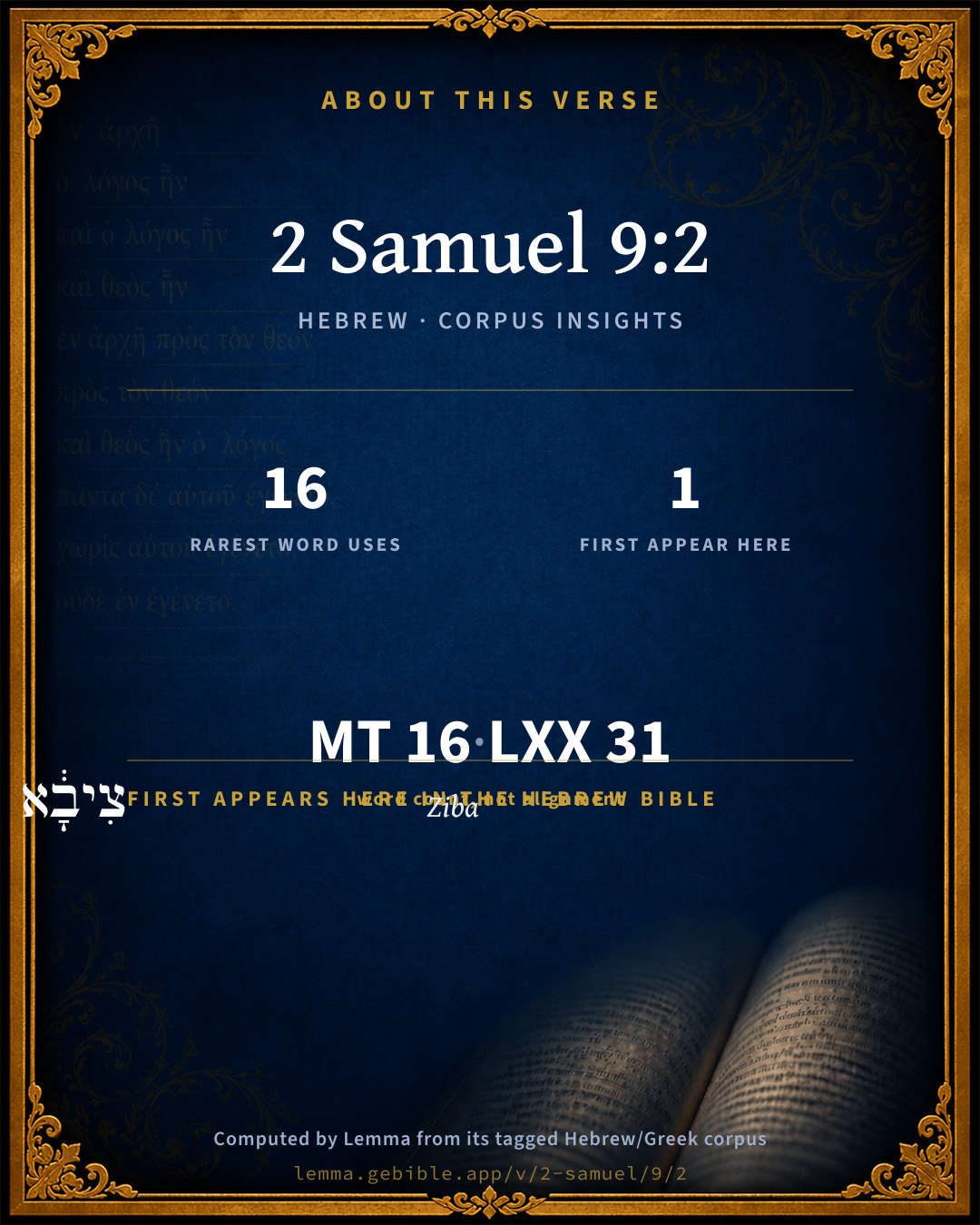
The rarest word here is צִיבָ֔א Ziba H6717 — appearing just 16 times in the whole Hebrew Bible.

First appearance in Scripture

This word makes its first canonical appearance in the Hebrew Bible here:

  • צִיבָ֔א Ziba H6717

Shared distinctive vocabulary

צִיבָ֔א Ziba H6717 occurs in 13 verses of the Hebrew Bible. Also found in:

Grammatical profile

  • 3 verbs
  • 9 nouns
  • 1 pronoun
  • 3 prepositions

Verb forms

  • וַיִּקְרְאוּ Qal · Sequential Imperfect
  • וַיֹּ֨אמֶר Qal · Sequential Imperfect
  • וַיֹּ֥אמֶר Qal · Sequential Imperfect

Repetition

Words recur within this verse — often emphatic in Hebrew:

  • עֶ֨בֶד֙ servant H5650 ×2
  • צִיבָ֔א Ziba H6717 ×2
  • וַיֹּ֨אמֶר to say H559 ×2
  • אֶל to H413 ×2

Hebrew & Septuagint length

In English translation the verse runs 34 words from the Hebrew and 37 from the Septuagint (LXX English) — closely comparable.

A rough comparison of the two English renderings, which tokenize alike — not a word-level alignment.

Word counts can differ between the Hebrew and the Greek without any difference in meaning — e.g. the Hebrew direct-object marker אֵת has no separate Greek word, and Greek often adds the article ὁ.

In the original languages it is 16 Hebrew tokens and 31 Greek tokens — but the two are counted differently (Hebrew bundles its prefixes and suffixes into one token; the Greek is in lemma form), so that isn’t a like-for-like length.

Cross-references

6

Topical passages linked to 2 Samuel 9:2 in the Treasury of Scripture Knowledge — connected by theme and wording, ordered by reader-vote popularity; previews shown in the World English Bible.

  • 2 Samuel 16:1–4 When David was a little past the top [of the ascent], behold, Ziba the servant of Mephibosheth met him, with a couple of donkeys saddled, and on them two hundred loaves of bread, and one hundred clusters of raisins, and one hundred summer fruits, and a bottle of wine.
  • 2 Samuel 19:17 There were a thousand men of Benjamin with him, and Ziba the servant of the house of Saul, and his fifteen sons and his twenty servants with him; and they went through the Jordan in the presence of the king.
  • Genesis 15:2–3 Abram said, "Lord Yahweh, what will you give me, seeing I go childless, and he who will inherit my estate is Eliezer of Damascus?"
  • Genesis 24:2 Abraham said to his servant, the elder of his house, who ruled over all that he had, "Please put your hand under my thigh.
  • Genesis 39:6 He left all that he had in Joseph's hand. He didn't concern himself with anything, except for the food which he ate. Joseph was well-built and handsome.
  • 2 Samuel 19:27–29 He has slandered your servant to my lord the king; but my lord the king is as an angel of God: do therefore what is good in your eyes.

Cross-references courtesy of OpenBible.info (CC BY 4.0).

Hebrew and Greek witnesses Masoretic Hebrew ↔ Greek Septuagint

The same verse in the two great witnesses to the Old Testament, shown verse-for-verse.

These are two independent witnesses, not word-aligned to each other, and the Septuagint is shown in lemma (dictionary) form.

Hebrew 2 Samuel 9:2 Masoretic · Westminster Leningrad Codex

וּלְבֵ֨ית שָׁא֥וּל עֶ֨בֶד֙ וּשְׁמ֣וֹ צִיבָ֔א וַיִּקְרְאוּ ל֖וֹ אֶל דָּוִ֑ד וַיֹּ֨אמֶר הַמֶּ֧לֶךְ אֵלָ֛יו הַאַתָּ֥ה צִיבָ֖א וַיֹּ֥אמֶר עַבְדֶּֽךָ

There was of the house of Saul a servant whose name was Ziba, and they called him to David; and the king said to him, Are you Ziba? He said, Your servant is he.

World English Bible · Public Domain

Greek LXX 2 Samuel 9:2 Septuagint · lemma form

καί ἐκ ὁ οἶκος σαούλ παῖς εἰμί καί ὄνομα αὐτός σιβα καί καλέω αὐτός πρός δαυίδ καί εἶπον πρός αὐτός ὁ βασιλεύς εἰ σύ εἰμί σιβα καί εἶπον ἐγώ δοῦλος σός

And there was a servant of the house of Saul, and his name was Siba: and they call him to David; and the king said to him, Are you Siba? and he said, I am your servant.

LXX2012 (modern English Septuagint) · Public Domain

Hebrew: Westminster Leningrad Codex (CC BY 4.0). Greek: Septuagint (public domain); English from LXX2012 (modern English Septuagint) (Public Domain). How the Septuagint differs from the Hebrew →

Targum (Aramaic paraphrase)

1

The Targum is the ancient Jewish Aramaic paraphrase of the Hebrew Scriptures — an interpretive translation, not the Hebrew text itself. Onkelos (literal) and Pseudo-Jonathan (expansive) render the Torah, and Jonathan the Prophets. Coverage is partial: where no permissively-licensed English translation exists for a verse, only the Aramaic is shown. This is verse-level text, not a word-by-word alignment to the Hebrew.

  1. Targum Jonathan Prophets (Joshua–Malachi)
    וּלְבֵית שָׁאוּל עַבְדָא וּשְׁמֵיהּ צִיבָא וּקְרוֹ לֵיהּ לְוַת דָוִד וַאֲמַר מַלְכָּא לֵיהּ הַאַתְּ צִיבָא וַאֲמַר עַבְדָךְ:

    (no public-domain English translation for this verse)

    Targum Jonathan — Aramaic: “Mikraot Gedolot” (public domain). English: “Sefaria Community Translation” (CC0 1.0 (public-domain dedication)); “London "Chaldee Paraphrase," 1871” (public domain). Text via Sefaria.

Commentary

Notes on 2 Samuel 9:2 from classic Christian and Jewish commentators (each source and its license shown beneath its notes). The classic Christian expositions comment on the surrounding passage and are grouped to its opening verse, so a note may address several verses; the Jewish commentaries on the Tanakh (Rashi and others) are per-verse, so they appear only where the commentator wrote on this verse.

Lemma curates 59 commentaries, every one of them public domain or Creative Commons licensed, each selected and text-cleaned for this edition rather than reprinted as found. About our sources →

Trapp's Complete Commentary

John Trapp

2Sa 9:2 And [there was] of the house of Saul a servant whose name [was] Ziba. And when they had called him unto David, the king said unto him, [Art] thou Ziba? And he said, Thy servant [is he].

Ver. 2. A servant whose name was Ziba.] An old flatter, such as Saul had many about him; Qualis herus, tolis servus.

John Trapp, A Commentary or Exposition upon All the Books of the Old and New Testament (1647–1656) — public domain. Text from a community e-Sword module.

John Gill's Exposition

And there was of the house of Saul a servant whose name was Ziba,.... Or there was a servant that belonged to Saul's family; not that any of Saul's family was a servant; and this servant the Jews commonly say was a Canaanitish servant, and who upon the death of his master was not made free, but became the inheritance and possession of his children after him, Lev 25:46; though Josephus (n) says he was made free by Saul:

and when they had called him unto David; who it seems was now at court, or in Jerusalem, on some account or another; or was in David's service, in some inferior post or another; however, having been a quondam servant of Saul, it was thought he could give the best intelligence of his family, and whether any were living, and therefore was sent for; and when he was come into the king's presence:

the king said unto him, art thou Ziba? for he had been told before by some of his courtiers what his name was:

and he said, thy servant is he; or my name is Ziba, and I am at thy command.

(n) Ut supra, (Antiqu. l. 7. c. 5.) sect. 5.

John Gill's Exposition of the Whole Bible (1746–1763) — public domain (CC PDM 1.0). Text via the HelloAO Bible API.

Haydock's Catholic Bible Commentary

Servant, of free man of Saul, and a convert. (Josephus) (Menochius) --- Yet he might very well be a Hebrew, who refused to accept his liberty, and continued as superintendent over the rest of his master’s house, (ver. 10,) like Eleazar, Joseph, (Genesis xxiv., and xxxix.) or the servant of whom our Saviour speaks, Luke xii. 42. (Calmet)

George Leo Haydock (1774–1849), Haydock's Catholic Family Bible and Commentary, 1859 edition — public domain. Excludes Psalms (Douay-Rheims chapter numbering differs from Protestant) and Deuterocanonical books (Catholic canon only).

Matthew Poole's English Annotations

A servant; one who had been a servant, and, as it may seem, a steward to Saul. See Poole "2Sa 9:10".

Matthew Poole's English Annotations on the Holy Bible (1683–1685) — public domain. Text from a community e-Sword/MySword module.

Whedon's Commentary on the Bible

Daniel D. Whedon

2. Ziba — This slave of Saul seems to have become a freedman at his master’s death, and so well did he improve all advantages that at this time he had himself become the head of a family of fifteen sons and twenty slaves. 2Sa_9:10.

Daniel D. Whedon (gen. ed.), Commentary on the Old and New Testaments (1874–1909) — public domain. Text from a community e-Sword module.

The Pulpit Commentary

A servant whose name was Ziba. It is evident from this that David was not certain that Jonathan had left behind him a son; but not because of the change of name from Meribbaal; (1Ch_8:34) for Baal retained its innocent meaning of "lord" until the time of Jezebel. It then became the title of the Phoenician sun god; and Jezebel"s shameless worship of this deity, and her cruelty to Jehovah"s prophets, made the people henceforth change the name Baal into Bosheth, "the shameful thing". (see note on 2Sa_2:8) Mephibosheth had not changed his name, but had lived in obscurity in the wild region beyond Mahanaim. Meanwhile Ziba had probably taken care of Saul"s property in the tribe of Benjamin. There is no reason to doubt that he had been steward there for Saul, and after his master"s death had continued in possession of the estate. David, we may feel sure, would not interfere with it, and Ziba would hold it for Saul"s heirs, who could not themselves take possession. To him David now sends, not because he expected to hear of a son of his dear friend Jonathan, but because he was ready to show kindness to any representative of the fallen monarch.

The Pulpit Commentary (1880–1919), ed. H.D.M. Spence-Jones & Joseph S. Exell — public domain. Text from a community e-Sword module.

Lesson kit

Teaching starters — assembled from the data on this page, not authored interpretation. Every prompt links to the verse data it draws on. Edit before teaching.

2 Samuel, in the Historical, opens this verse with 16 words (11 distinct Hebrew lemmas). Its most distinctive word is Tsîybâʼ (“Ziba”). A historical commentator’s framing appears above. Read the whole chapter for the surrounding context.

Discussion questions

  1. What does “Ziba” (Tsîybâʼ) contribute to the verse as a whole?
  2. The word “Ziba” first appears here in Scripture. What is being introduced at this debut?
  3. 2 Samuel 9:3 shares the word «Ziba» with this verse. How do the two illuminate each other?
  4. “servant” occurs 2× in this one verse. What is the effect of the repetition?
  5. These translations render this verse differently; the difference is in the English rendering, not the original. What questions does that raise?
  6. The verb «וַיִּקְרְאוּ» is Qal Sequential Imperfect. How does its form color the action?
  7. Reading how Trapp's Complete Commentary and John Gill's Exposition read this verse, where do the two commentators agree and where do they part?

Things to notice

Reading settings

Reading text

Shown beneath each verse's original-language words.

Old Testament
Old Testament edition

Read the OT as the Masoretic Hebrew (MT) or the Greek Septuagint (LXX).

English shown for the Greek Septuagint (in the Hebrew ↔ Greek comparison).

Comparing translations? Open the Compare panel on any verse page to stack up to four side by side.