2 Samuel 2:17

Hebrew (Westminster Leningrad Codex) 2 Samuel 2:17 appears in the Hebrew Old Testament. The text above is from the Westminster Leningrad Codex. Each word links to its Strong’s number, a concise gloss, and parsing drawn from the Open Scriptures Hebrew Bible morphology. Click any word for its full Brown-Driver-Briggs (BDB) entry.
Download image
Cite this verse

2 Samuel 2:17 (World English Bible). Public Domain. Lemma interlinear Bible study tool, https://lemma.gebible.app/v/2-samuel/2/17.

Show BibTeX & RIS
BibTeX
RIS
English Translation
The battle was very severe that day: and Abner was beaten, and the men of Israel, before the servants of David.
World English Bible · Public Domain
Download a study sheet

One document with this verse’s original text, its word-by-word gloss line, the meaning frame, cross-references with their text, attributed commentary, and full source and license credits — printable, and it pastes into notes with its structure intact.

This verse Autodidact and up

Study sheet (.html) Plain text (.txt)

A passage Seminary Student

Up to 50 verses in one chapter. A passage sheet keeps up to 6 commentary sources and 12 cross-references per verse, in the order this page ranks them, and says so on the sheet whenever that leaves anything out. Ask for a single verse and you get the Autodidact verse sheet above.

Everything on this page stays free to read, with no account — the sheet is a download of what is already on screen, not access to it.

Want to remove ads? Support Godless Engineer
Compare translations 3

The same verse in 3 English versions, stacked beneath the original-language interlinear above. Click any original word for its lexicon entry.

Each is an independent rendering of the whole verse — the interlinear is not word-aligned to these translations.

Highlighted words mark where these versions differ — a whole-verse word diff, not a word-by-word alignment.

  • World English Bible Public Domain
    The battle was very severe that day: and Abner was beaten, and the men of Israel, before the servants of David.
  • King James Version Public Domain
    And there was a very sore battle that day; and Abner was beaten, and the men of Israel, before the servants of David.
  • unfoldingWord Literal Text CC BY-SA 4.0
    And the battle was severe to extremity on that day. And Abner and the men of Israel were struck to the face of the servants of David.

unfoldingWord Literal Text — © unfoldingWord, licensed CC BY-SA 4.0. Word-aligned USFM3 via Door43 (git.door43.org/unfoldingWord/en_ult).

Versions to compare (up to 4)

3 of 4 selected

Show all 18 translations

Every available English version of this verse, each an independent rendering of the whole verse.

  • World English Bible Public Domain
    The battle was very severe that day: and Abner was beaten, and the men of Israel, before the servants of David.
  • Berean Standard Bible Public Domain
    The battle that day was intense, and Abner and the men of Israel were defeated by the servants of David.
  • Majority Standard Bible Public Domain
    The battle that day was intense, and Abner and the men of Israel were defeated by the servants of David.
  • King James Version Public Domain
    And there was a very sore battle that day; and Abner was beaten, and the men of Israel, before the servants of David.
  • American Standard Version (1901) Public Domain
    And the battle was very sore that day: and Abner was beaten, and the men of Israel, before the servants of David.
  • Revised Version (1885) Public Domain
    And the battle was very sore that day; and Abner was beaten, and the men of Israel, before the servants of David.
  • Geneva Bible (1599) Public Domain
    And the battel was exceeding sore that same day: for Abner and the men of Israel fell before the seruants of Dauid.
  • Douay-Rheims (1899) Public Domain
    And there was a very fierce battle that day: and Abner was put to flight, with the men of Israel, by the servants of David.
  • Young's Literal Translation Public Domain
    and the battle is very hard on that day, and Abner is smitten, and the men of Israel, before the servants of David.
  • Literal Standard Version CC BY-SA 4.0
    and the battle is very hard on that day, and Abner is struck, and the men of Israel, before the servants of David.
  • Unlocked Literal Bible CC BY-SA 4.0
    The battle was very severe that day and Abner and the men of Israel were defeated before the servants of David.
  • unfoldingWord Literal Text CC BY-SA 4.0
    And the battle was severe to extremity on that day. And Abner and the men of Israel were struck to the face of the servants of David.
  • Darby Bible Public Domain
    And the battle that day was very severe; and Abner and the men of Israel were routed before the servants of David.
  • World Messianic Bible Public Domain
    The battle was very severe that day; and Abner was beaten, and the men of Israel, before David’s servants.
  • Webster's Bible Public Domain
    And there was a very severe battle that day; and Abner was defeated, and the men of Israel, before the servants of David.
  • Free Bible Version CC BY-SA 4.0
    The battle that followed was hard-fought, but eventually Abner and his men were defeated by David's men.
  • Bible in Basic English Public Domain
    And there was hard fighting that day; and Abner and the men of Israel gave way before the servants of David.
  • JPS Tanakh (1917) Public Domain
    And the battle was very sore that day; and Abner was beaten, and the men of Israel, before the servants of David.

Literal Standard Version (2020), Covenant Press — licensed CC BY-SA 4.0. Text via the HelloAO Bible API (eBible.org). Unlocked Literal Bible (unfoldingWord) — licensed CC BY-SA 4.0. Text via the HelloAO Bible API (eBible.org). unfoldingWord Literal Text — © unfoldingWord, licensed CC BY-SA 4.0. Word-aligned USFM3 via Door43 (git.door43.org/unfoldingWord/en_ult). Free Bible Version, Dr. Jonathan Gallagher — licensed CC BY-SA 4.0. Text via the HelloAO Bible API (eBible.org).

Word by word

More ways to search: Search by grammar → Find every occurrence → Compare this word →

Practice this passage: Drill this verse → Learn its vocabulary →

קָשָׁ֥ה
qâsheh
H7186
“hard”
Adjective, Adjective, Feminine, Singular, Absolute
Part of Speech
Adjective
Type
Adjective
Gender
Feminine
Number
Singular
State
Absolute
Full BDB Definition

Origin: from H7185

TWOT: 2085a

hard, cruel, severe, obstinate - hard, difficult - severe - fierce, intense, vehement - stubborn, stiff of neck, stiff-necked - rigorous (of battle)
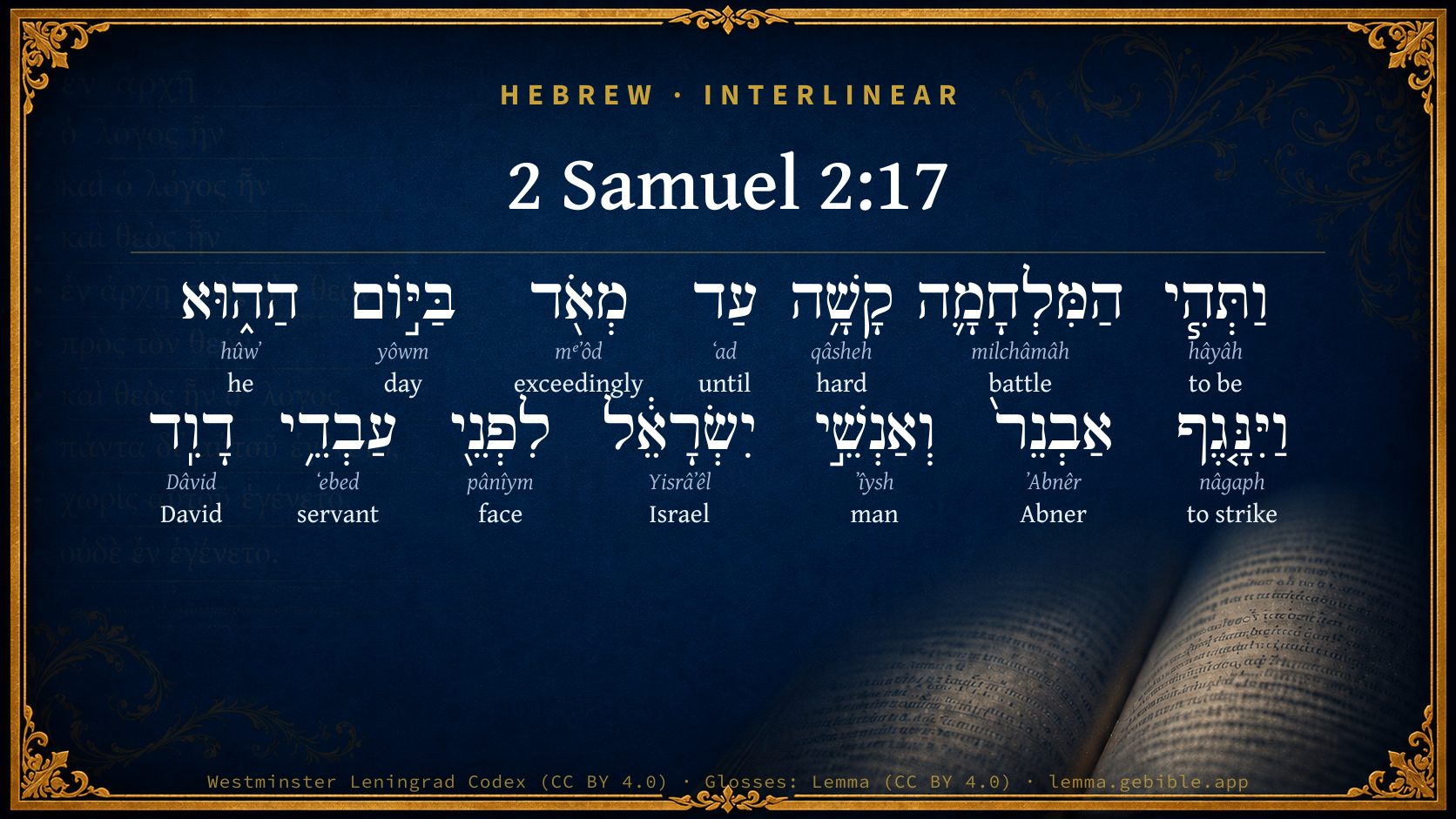
  1. וַתְּהִ֧י hâyâh H1961 “and · to be” Conjunction + Verb, Qal, Sequential Imperfect, 3rd Person, Feminine, Singular
  2. הַמִּלְחָמָ֛ה milchâmâh H4421 “the · battle” Particle, Definite Article + Noun, Common, Feminine, Singular, Absolute
  3. עַד ʻad H5704 “until” Preposition
  4. מְאֹ֖ד mᵉʼôd H3966 “exceedingly” Adverb
  5. בַּיּ֣וֹם yôwm H3117 “in/at the · day” Preposition, Determined + Noun, Common, Masculine, Singular, Absolute
  6. הַה֑וּא hûwʼ H1931 “the · he” Particle, Definite Article + Pronoun, Personal, 3rd Person, Masculine, Singular
  7. וַיִּנָּ֤גֶף nâgaph H5062 “and · to strike” Conjunction + Verb, Niphal, Sequential Imperfect, 3rd Person, Masculine, Singular
  8. אַבְנֵר֙ ʼAbnêr H74 “Abner” Noun, Proper
  9. וְאַנְשֵׁ֣י ʼîysh H376 “and · men of” Conjunction + Noun, Common, Masculine, Plural, Construct
  10. יִשְׂרָאֵ֔ל Yisrâʼêl H3478 “Israel” Noun, Proper
  11. לִפְנֵ֖י pânîym H6440 “to/for · face(s) of” Preposition + Noun, Common, Both, Plural, Construct
  12. עַבְדֵ֥י ʻebed H5650 “servants of” Noun, Common, Masculine, Plural, Construct
  13. דָוִֽד Dâvid H1732 “David” Noun, Proper

About this verse

These counts appear in no published source. They are computed here, from the morphology-tagged text and Lemma’s own curated glosses. What Lemma adds →

14
words
14
distinct lemmas
Historical
section

Shared distinctive vocabulary

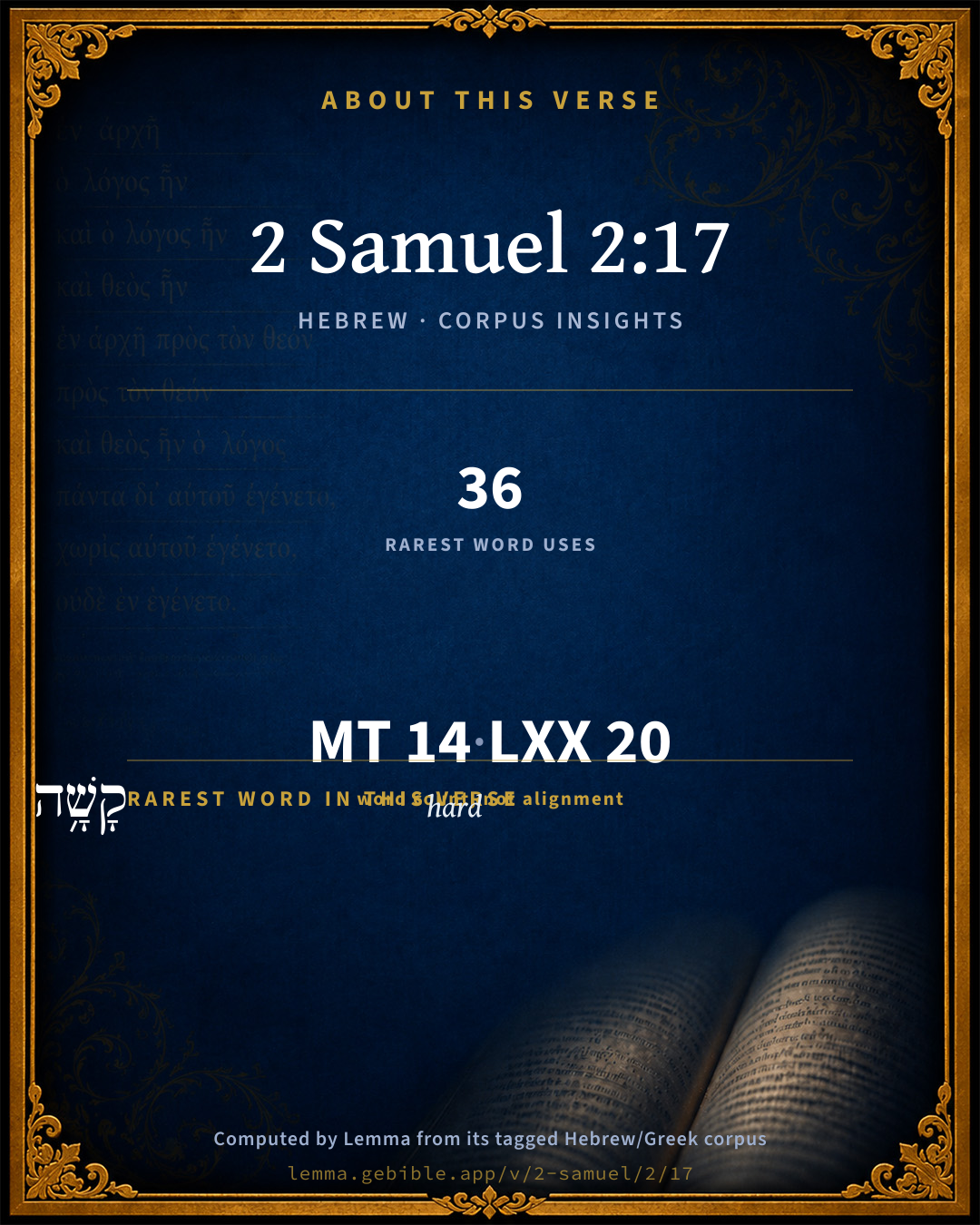
קָשָׁ֥ה hard H7186 occurs in 36 verses of the Hebrew Bible. Also found in:

Grammatical profile

  • 2 verbs
  • 8 nouns
  • 1 adjective
  • 1 pronoun
  • 1 preposition
  • 1 adverb

Verb forms

  • וַתְּהִ֧י Qal · Sequential Imperfect
  • וַיִּנָּ֤גֶף Niphal · Sequential Imperfect

Hebrew & Septuagint length

In English translation the verse runs 21 words from the Hebrew and 23 from the Septuagint (LXX English) — closely comparable.

A rough comparison of the two English renderings, which tokenize alike — not a word-level alignment.

Word counts can differ between the Hebrew and the Greek without any difference in meaning — e.g. the Hebrew direct-object marker אֵת has no separate Greek word, and Greek often adds the article ὁ.

In the original languages it is 14 Hebrew tokens and 20 Greek tokens — but the two are counted differently (Hebrew bundles its prefixes and suffixes into one token; the Greek is in lemma form), so that isn’t a like-for-like length.

Cross-references

1

Topical passages linked to 2 Samuel 2:17 in the Treasury of Scripture Knowledge — connected by theme and wording, ordered by reader-vote popularity; previews shown in the World English Bible.

  • 2 Samuel 3:1 Now there was long war between the house of Saul and the house of David: and David grew stronger and stronger, but the house of Saul grew weaker and weaker.

Cross-references courtesy of OpenBible.info (CC BY 4.0).

Hebrew and Greek witnesses Masoretic Hebrew ↔ Greek Septuagint

The same verse in the two great witnesses to the Old Testament, shown verse-for-verse.

These are two independent witnesses, not word-aligned to each other, and the Septuagint is shown in lemma (dictionary) form.

Hebrew 2 Samuel 2:17 Masoretic · Westminster Leningrad Codex

וַתְּהִ֧י הַמִּלְחָמָ֛ה קָשָׁ֥ה עַד מְאֹ֖ד בַּיּ֣וֹם הַה֑וּא וַיִּנָּ֤גֶף אַבְנֵר֙ וְאַנְשֵׁ֣י יִשְׂרָאֵ֔ל לִפְנֵ֖י עַבְדֵ֥י דָוִֽד

The battle was very severe that day: and Abner was beaten, and the men of Israel, before the servants of David.

World English Bible · Public Domain

Greek LXX 2 Samuel 2:17 Septuagint · lemma form

καί γίγνομαι ὁ πόλεμος σκληρός ὥστε λίαν ἐν ὁ ἡμέρα ἐκεῖνος καί πταίω αβεννηρ καί ἀνήρ ἰσραήλ ἐνώπιον παῖς δαυίδ

And the battle was very severe on that day; and Abenner and the men of Israel were worsted before the servants of David.

LXX2012 (modern English Septuagint) · Public Domain

Hebrew: Westminster Leningrad Codex (CC BY 4.0). Greek: Septuagint (public domain); English from LXX2012 (modern English Septuagint) (Public Domain). How the Septuagint differs from the Hebrew →

Targum (Aramaic paraphrase)

1

The Targum is the ancient Jewish Aramaic paraphrase of the Hebrew Scriptures — an interpretive translation, not the Hebrew text itself. Onkelos (literal) and Pseudo-Jonathan (expansive) render the Torah, and Jonathan the Prophets. Coverage is partial: where no permissively-licensed English translation exists for a verse, only the Aramaic is shown. This is verse-level text, not a word-by-word alignment to the Hebrew.

  1. Targum Jonathan Prophets (Joshua–Malachi)
    וַהֲוָה קְרָבָא תַּקִיף עַד לַחֲדָא בְּיוֹמָא הַהוּא וְאִתַּבַּר אַבְנֵר וֶאֱנָשֵׁי יִשְׂרָאֵל קֳדָם עַבְדֵי דָוִד:

    (no public-domain English translation for this verse)

    Targum Jonathan — Aramaic: “Mikraot Gedolot” (public domain). English: “Sefaria Community Translation” (CC0 1.0 (public-domain dedication)); “London "Chaldee Paraphrase," 1871” (public domain). Text via Sefaria.

Commentary

Notes on 2 Samuel 2:17 from classic Christian and Jewish commentators (each source and its license shown beneath its notes). The classic Christian expositions comment on the surrounding passage and are grouped to its opening verse, so a note may address several verses; the Jewish commentaries on the Tanakh (Rashi and others) are per-verse, so they appear only where the commentator wrote on this verse.

Lemma curates 59 commentaries, every one of them public domain or Creative Commons licensed, each selected and text-cleaned for this edition rather than reprinted as found. About our sources →

Trapp's Complete Commentary

John Trapp

2Sa 2:17 And there was a very sore battle that day; and Abner was beaten, and the men of Israel, before the servants of David.

Ver. 17. And there was a very sore battle.] Ecce hic duellum transit in acre bellum totale. "Behold, how great a matter a little fire kindleth!" {Jas 3:5} It is far easier to stir strife, than to stint it; to begin a war, than to end it.

John Trapp, A Commentary or Exposition upon All the Books of the Old and New Testament (1647–1656) — public domain. Text from a community e-Sword module.

Tyndale Open Study Notes

Tyndale Open Resources

2:17 The casualty count of this fierce battle is noted in 2:30-31.

Tyndale Open Study Notes — © Tyndale Open Resources, licensed CC BY-SA 4.0. Text via the HelloAO Bible API.

Geneva Bible (1599)

Geneva Bible translators

After that these four and twenty were slain.

Geneva Bible (1599) marginal notes — public domain. Text via Bolls.life.

Ellicott's Commentary for English Readers

(17) A very sore battle.—The combat of the twelve on each side having decided nothing, the two hosts joined battle. Abner and the Israelites were worsted. The numbers engaged were probably not large, as the whole number of the slain was nineteen on David’s side, and 360 on that of Israel (2Sa_2:30-31). It was, however, a turning-point in the struggle.

A Bible Commentary for English Readers, edited by Charles John Ellicott (1878–1897) — public domain. Text from a community e-Sword module.

The Cambridge Bible for Schools and Colleges

gen. ed. J. J. S. Perowne

17. And there was a very sore battle that day] The combat of champions having proved indecisive, a severe general engagement took place, ending in the defeat of Abner’s forces.

The Cambridge Bible for Schools and Colleges (gen. ed. J. J. S. Perowne; Cambridge University Press, 1878–1918) — public domain. Text from a community e-Sword module.

John Gill's Exposition

And there was a very sore battle that day,.... When the twenty four men fell together, and no decision could be made thereby, or any triumph on either side, both armies drew up in battle array, and fought very furiously:

and Abner was beaten, and the men of Israel, before the servants of David; the army under him had the worst of it, and were routed, and obliged to flee before the army of David under the command of Joab.

John Gill's Exposition of the Whole Bible (1746–1763) — public domain (CC PDM 1.0). Text via the HelloAO Bible API.

Albert Barnes' Notes on the Bible

Neither side had the advantage in the combat of twelve a side; hence, the quarrel was fought out with great fierceness by the two armies, and the victory was won by David.

Albert Barnes' Notes on the Bible (1834–1885) — public domain. Text from a community e-Sword/MySword module.

Whedon's Commentary on the Bible

Daniel D. Whedon

17. There was a very sore battle — The bloody combat just described brought on a general engagement between the two armies, in which David and his men were victorious.

Daniel D. Whedon (gen. ed.), Commentary on the Old and New Testaments (1874–1909) — public domain. Text from a community e-Sword module.

The Pulpit Commentary

A very sore battle. The purpose of Abner was thus gained. Excited by the spectacle of merciless slaughter, the armies manoeuvred no longer, but rushed fiercely to the attack, and fought with fury. But the mighty men of David were irresistible. Only nineteen of his warriors fell, while Abner lost three hundred and sixty, and was forced to flee.

The Pulpit Commentary (1880–1919), ed. H.D.M. Spence-Jones & Joseph S. Exell — public domain. Text from a community e-Sword module.

Keil & Delitzsch

C. F. Keil & F. Delitzsch

As this single combat decided nothing, there followed a general and very sore or fierce battle, in which Abner and his troops were put to flight by the soldiers of David. The only thing connected with this, of which we have any further account, is the slaughter of Asahel by Abner, which is mentioned here (Sa2 2:18-23) on account of the important results which followed. Of the three sons of Zeruiah, viz., Joab, Abishai, and Asahel, Asahel was peculiarly light of foot, like one of the gazelles; and he pursued Abner most eagerly, without turning aside to the right or to the left.

Keil & Delitzsch — Biblical Commentary on the Old Testament (1861–1891) — public domain (CC PDM 1.0). Text via the HelloAO Bible API. (Old Testament only.)

Lesson kit

Teaching starters — assembled from the data on this page, not authored interpretation. Every prompt links to the verse data it draws on. Edit before teaching.

2 Samuel, in the Historical, opens this verse with 14 words (14 distinct Hebrew lemmas). Its most distinctive word is qâsheh (“hard”). A historical commentator’s framing appears above. Read the whole chapter for the surrounding context.

Discussion questions

  1. How does “hard” (qâsheh) shape what this verse is saying?
  2. How does Genesis 42:7, which shares the word «hard», read alongside this verse?
  3. These translations render this verse differently. What is at stake in choosing one wording over another?
  4. «וַתְּהִ֧י» is a Qal Sequential Imperfect verb. How does that grammatical form shape the action described?
  5. Compare how Trapp's Complete Commentary and Tyndale Open Study Notes read this verse. Where do they agree or differ?

Things to notice

Reading settings

Reading text

Shown beneath each verse's original-language words.

Old Testament
Old Testament edition

Read the OT as the Masoretic Hebrew (MT) or the Greek Septuagint (LXX).

English shown for the Greek Septuagint (in the Hebrew ↔ Greek comparison).

Comparing translations? Open the Compare panel on any verse page to stack up to four side by side.