
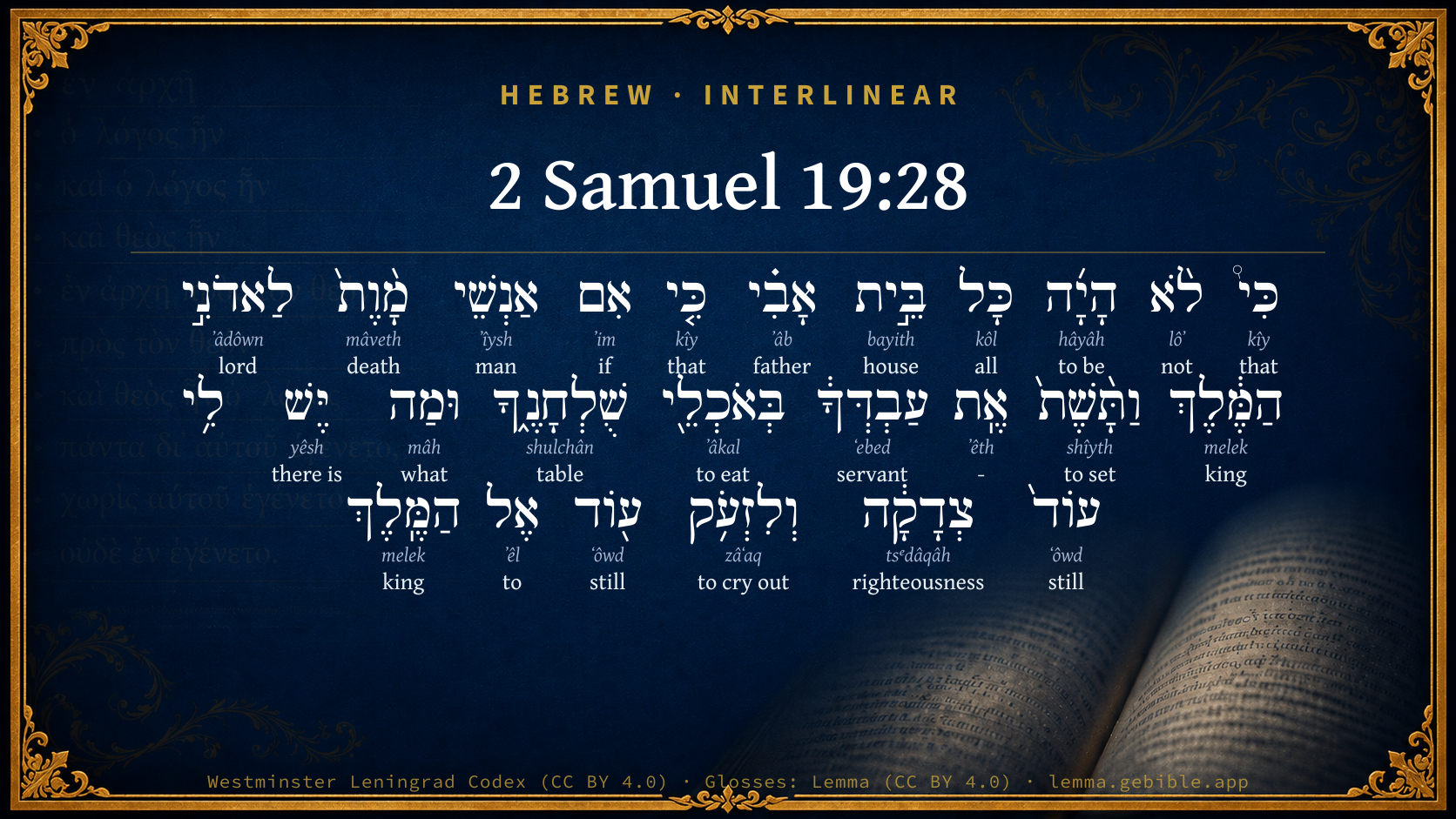
2 Samuel 19:28

Hebrew (Westminster Leningrad Codex) 2 Samuel 19:28 appears in the Hebrew Old Testament. The text above is from the Westminster Leningrad Codex. Each word links to its Strong’s number, a concise gloss, and parsing drawn from the Open Scriptures Hebrew Bible morphology. Click any word for its full Brown-Driver-Briggs (BDB) entry.
Download image
Cite this verse

2 Samuel 19:28 (World English Bible). Public Domain. Lemma interlinear Bible study tool, https://lemma.gebible.app/v/2-samuel/19/28.

Show BibTeX & RIS
BibTeX
RIS
English Translation
For all my father's house were but dead men before my lord the king; yet you set your servant among those who ate at your own table. What right therefore have I yet that I should cry any more to the king?
World English Bible · Public Domain
Download a study sheet

One document with this verse’s original text, its word-by-word gloss line, the meaning frame, cross-references with their text, attributed commentary, and full source and license credits — printable, and it pastes into notes with its structure intact.

This verse Autodidact and up

Study sheet (.html) Plain text (.txt)

A passage Seminary Student

Up to 50 verses in one chapter. A passage sheet keeps up to 6 commentary sources and 12 cross-references per verse, in the order this page ranks them, and says so on the sheet whenever that leaves anything out. Ask for a single verse and you get the Autodidact verse sheet above.

Everything on this page stays free to read, with no account — the sheet is a download of what is already on screen, not access to it.

Want to remove ads? Support Godless Engineer
Compare translations 3

The same verse in 3 English versions, stacked beneath the original-language interlinear above. Click any original word for its lexicon entry.

Each is an independent rendering of the whole verse — the interlinear is not word-aligned to these translations.

Highlighted words mark where these versions differ — a whole-verse word diff, not a word-by-word alignment.

  • World English Bible Public Domain
    For all my father's house were but dead men before my lord the king; yet you set your servant among those who ate at your own table. What right therefore have I yet that I should cry any more to the king?
  • King James Version Public Domain
    For all of my father's house were but dead men before my lord the king: yet didst thou set thy servant among them that did eat at thine own table. What right therefore have I yet to cry any more unto the king?
  • unfoldingWord Literal Text CC BY-SA 4.0
    For all of the house of my father was nothing except men of death to my lord the king, but you set your servant among the eaters at your table. So what right is there still for me to cry out more to the king?”

unfoldingWord Literal Text — © unfoldingWord, licensed CC BY-SA 4.0. Word-aligned USFM3 via Door43 (git.door43.org/unfoldingWord/en_ult).

Versions to compare (up to 4)

3 of 4 selected

Show all 18 translations

Every available English version of this verse, each an independent rendering of the whole verse.

  • World English Bible Public Domain
    For all my father's house were but dead men before my lord the king; yet you set your servant among those who ate at your own table. What right therefore have I yet that I should cry any more to the king?
  • Berean Standard Bible Public Domain
    For all the house of my grandfather deserves death from my lord the king, yet you have set your servant among those who eat at your table. What further right, then, do I have to keep appealing to the king?”
  • Majority Standard Bible Public Domain
    For all the house of my grandfather deserves death from my lord the king, yet you have set your servant among those who eat at your table. What further right, then, do I have to keep appealing to the king?”
  • King James Version Public Domain
    For all of my father's house were but dead men before my lord the king: yet didst thou set thy servant among them that did eat at thine own table. What right therefore have I yet to cry any more unto the king?
  • American Standard Version (1901) Public Domain
    For all my father's house were but dead men before my lord the king; yet didst thou set thy servant among them that did eat at thine own table. What right therefore have I yet that I should cry any more unto the king?
  • Revised Version (1885) Public Domain
    For all my father’s house were but dead men before my lord the king: yet didst thou set thy servant among them that did eat at thine own table. What right therefore have I yet that I should cry any more unto the king?
  • Geneva Bible (1599) Public Domain
    For all my fathers house were but dead men before my lord the king, yet diddest thou set thy seruant among them that did eate at thine owne table: what right therefore haue I yet to crye any more vnto the king?
  • Douay-Rheims (1899) Public Domain
    For all of my father's house were no better than worthy of death before my lord the king; and thou hast set me thy servant among the guests of thy table: what just complaint therefore have I? or what right to cry any more to the king?
  • Young's Literal Translation Public Domain
    for all the house of my father have been nothing except men of death before my lord the king, and thou dost set thy servant among those eating at thy table, and what right have I any more -- even to cry any more unto the king?'
  • Literal Standard Version CC BY-SA 4.0
    for all the house of my father have been nothing except men of death before my lord the king, and you set your servant among those eating at your table, and what right do I have anymore—even to cry anymore to the king?”
  • Unlocked Literal Bible CC BY-SA 4.0
    For all my father's house were dead men before my master the king, but you set your servant among those who ate at your own table. What right therefore have I that I should still cry any more to the king?”
  • unfoldingWord Literal Text CC BY-SA 4.0
    For all of the house of my father was nothing except men of death to my lord the king, but you set your servant among the eaters at your table. So what right is there still for me to cry out more to the king?”
  • Darby Bible Public Domain
    For all my father's house were but dead men before my lord the king; and thou didst set thy servant among them that eat at thine own table. What further right therefore have I? and for what should I cry any more to the king?
  • World Messianic Bible Public Domain
    For all my father’s house were but dead men before my lord the king; yet you set your servant among those who ate at your own table. What right therefore have I yet that I should appeal any more to the king?”
  • Webster's Bible Public Domain
    For all of my father's house were but dead men before my lord the king: yet didst thou set thy servant among them that ate at thy own table. What right therefore have I yet to cry any more to the king?
  • Free Bible Version CC BY-SA 4.0
    All my grandfather's family could only expect death from Your Majesty, but you included me, your servant, among those who eat at your table. So what right do I have to ask the king for anything more?”
  • Bible in Basic English Public Domain
    For all my father's family were only dead men before my lord the king: and still you put your servant among those whose place is at the king's table. What right then have I to say anything more to the king?
  • JPS Tanakh (1917) Public Domain
    (19-29) For all my father's house were deserving of death at the hand of my lord the king; yet didst thou set thy servant among them that did eat at thine own table. What right therefore have I yet? or why should I cry any more unto the king?'

Literal Standard Version (2020), Covenant Press — licensed CC BY-SA 4.0. Text via the HelloAO Bible API (eBible.org). Unlocked Literal Bible (unfoldingWord) — licensed CC BY-SA 4.0. Text via the HelloAO Bible API (eBible.org). unfoldingWord Literal Text — © unfoldingWord, licensed CC BY-SA 4.0. Word-aligned USFM3 via Door43 (git.door43.org/unfoldingWord/en_ult). Free Bible Version, Dr. Jonathan Gallagher — licensed CC BY-SA 4.0. Text via the HelloAO Bible API (eBible.org).

Word by word

More ways to search: Search by grammar → Find every occurrence → Compare this word →

Practice this passage: Drill this verse → Learn its vocabulary →

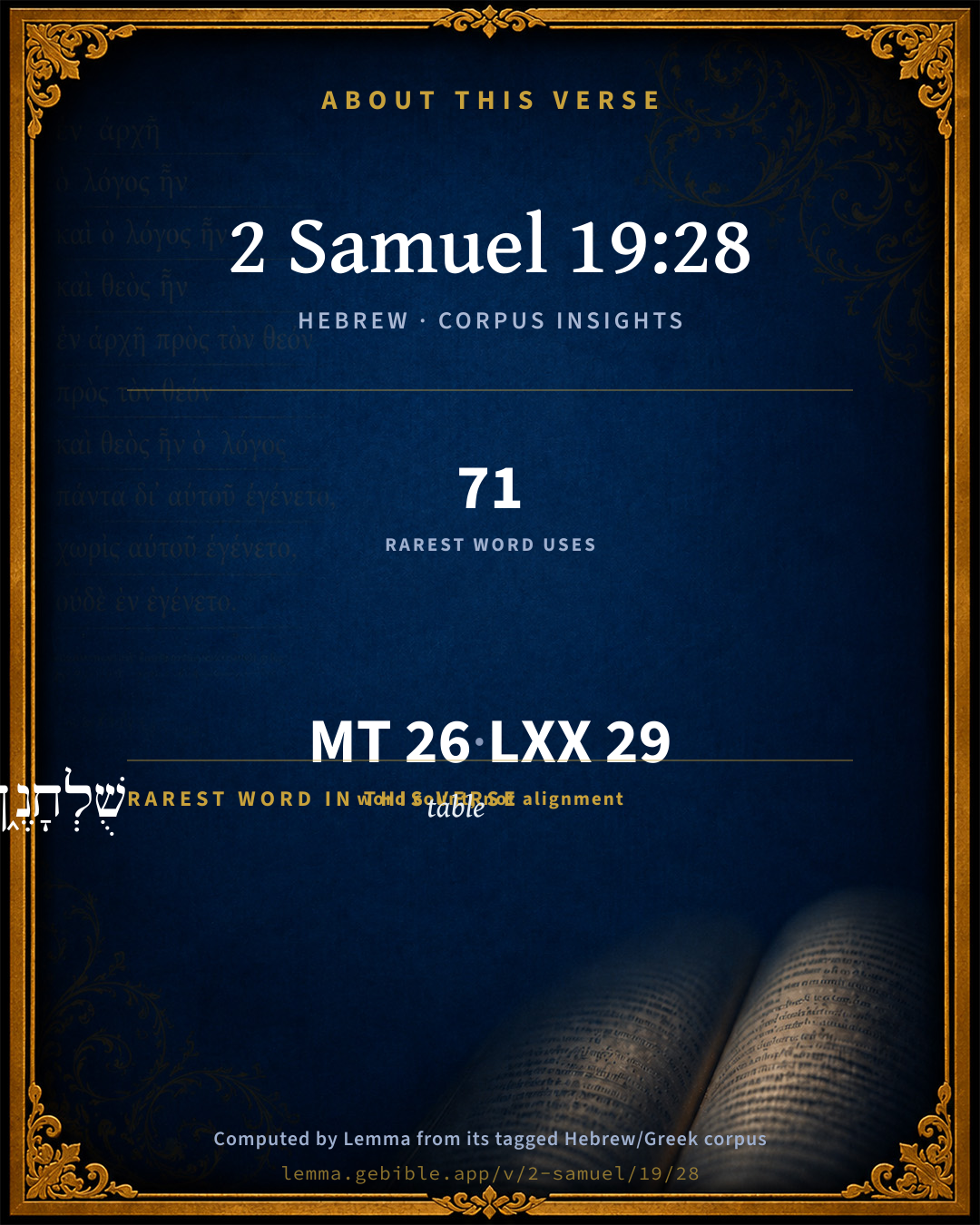
שֻׁלְחָנֶ֑ךָ
shulchân
H7979
“table · your”
Noun, Common, Masculine, Singular, Construct + Suffix, Personal, 2nd Person, Masculine, Singular
Part of Speech
Noun
Type
Common
Gender
Masculine
Number
Singular
State
Construct
Full BDB Definition

Origin: from H7971

TWOT: 2395a

table - table - of king's table, private use, sacred uses
  1. כִּי֩ kîy H3588 “that” Conjunction
  2. לֹ֨א lôʼ H3808 “not” Particle, Negative
  3. הָיָ֜ה hâyâh H1961 “to be” Verb, Qal, Perfect, 3rd Person, Masculine, Singular
  4. כָּל kôl H3605 “all of” Noun, Common, Masculine, Singular, Construct
  5. בֵּ֣ית bayith H1004 “house of” Noun, Common, Masculine, Singular, Construct
  6. אָבִ֗י ʼâb H1 “father · my” Noun, Common, Masculine, Singular, Construct + Suffix, Personal, 1st Person, Common, Singular
  7. כִּ֤י kîy H3588 “that” Conjunction
  8. אִם ʼim H518 “if” Conjunction
  9. אַנְשֵׁי ʼîysh H376 “men of” Noun, Common, Masculine, Plural, Construct
  10. מָ֨וֶת֙ mâveth H4194 “death” Noun, Common, Masculine, Singular, Absolute
  11. לַאדֹנִ֣י ʼâdôwn H113 “to/for · lord · my” Preposition + Noun, Common, Masculine, Singular, Construct + Suffix, Personal, 1st Person, Common, Singular
  12. הַמֶּ֔לֶךְ melek H4428 “the · king” Particle, Definite Article + Noun, Common, Masculine, Singular, Absolute
  13. וַתָּ֨שֶׁת֙ shîyth H7896 “and · to set” Conjunction + Verb, Qal, Sequential Imperfect, 2nd Person, Masculine, Singular
  14. אֶֽת ʼêth H853 “-” Particle, Direct Object
  15. עַבְדְּךָ֔ ʻebed H5650 “servant · your” Noun, Common, Masculine, Singular, Construct + Suffix, Personal, 2nd Person, Masculine, Singular
  16. בְּאֹכְלֵ֖י ʼâkal H398 “in/at · eating” Preposition + Verb, Qal, Participle Active, Masculine, Plural, Construct
  17. וּמַה mâh H4100 “and · what” Conjunction + Particle, Interrogative
  18. יֶּשׁ yêsh H3426 “there is” Particle, Demonstrative
  19. עוֹד֙ ʻôwd H5750 “still” Adverb
  20. צְדָקָ֔ה tsᵉdâqâh H6666 “righteousness” Noun, Common, Feminine, Singular, Absolute
  21. וְלִזְעֹ֥ק zâʻaq H2199 “and · to cry out” Conjunction + Preposition + Verb, Qal, Infinitive Construct
  22. ע֖וֹד ʻôwd H5750 “still” Adverb
  23. אֶל ʼêl H413 “to” Preposition
  24. הַמֶּֽלֶךְ melek H4428 “the · king” Particle, Definite Article + Noun, Common, Masculine, Singular, Absolute

About this verse

These counts appear in no published source. They are computed here, from the morphology-tagged text and Lemma’s own curated glosses. What Lemma adds →

26
words
22
distinct lemmas
Historical
section

Grammatical profile

  • 4 verbs
  • 11 nouns
  • 2 prepositions
  • 3 conjunctions
  • 2 adverbs
  • 4 particles

Verb forms

  • הָיָ֜ה Qal · Perfect
  • וַתָּ֨שֶׁת֙ Qal · Sequential Imperfect
  • בְּאֹכְלֵ֖י Qal · Participle Active
  • וְלִזְעֹ֥ק Qal · Infinitive Construct

Repetition

Words recur within this verse — often emphatic in Hebrew:

  • הַמֶּ֔לֶךְ king H4428 ×2
  • עוֹד֙ still H5750 ×2
  • כִּי֩ that H3588 ×2

Hebrew & Septuagint length

In English translation the verse runs 42 words from the Hebrew and 43 from the Septuagint (LXX English) — closely comparable.

A rough comparison of the two English renderings, which tokenize alike — not a word-level alignment.

Word counts can differ between the Hebrew and the Greek without any difference in meaning — e.g. the Hebrew direct-object marker אֵת has no separate Greek word, and Greek often adds the article ὁ.

In the original languages it is 26 Hebrew tokens and 29 Greek tokens — but the two are counted differently (Hebrew bundles its prefixes and suffixes into one token; the Greek is in lemma form), so that isn’t a like-for-like length.

Cross-references

7

Topical passages linked to 2 Samuel 19:28 in the Treasury of Scripture Knowledge — connected by theme and wording, ordered by reader-vote popularity; previews shown in the World English Bible.

  • 2 Samuel 9:13 So Mephibosheth lived in Jerusalem; for he ate continually at the king's table. He was lame in both his feet.
  • 2 Samuel 9:10 You shall till the land for him, you, and your sons, and your servants; and you shall bring in [the fruits], that your master's son may have bread to eat: but Mephibosheth your master's son shall eat bread always at my table." Now Ziba had fifteen sons and twenty servants.
  • Genesis 32:10 I am not worthy of the least of all the loving kindnesses, and of all the truth, which you have shown to your servant; for with just my staff I passed over this Jordan; and now I have become two companies.
  • 1 Samuel 26:16 This thing isn't good that you have done. As Yahweh lives, you are worthy to die, because you have not kept watch over your lord, Yahweh's anointed. Now see where the king's spear is, and the jar of water that was at his head.
  • 2 Samuel 9:7–8 David said to him, "Don't be afraid of him; for I will surely show you kindness for Jonathan your father's sake, and will restore you all the land of Saul your father; and you shall eat bread at my table continually."
  • 2 Samuel 21:6–9 let seven men of his sons be delivered to us, and we will hang them up to Yahweh in Gibeah of Saul, the chosen of Yahweh. The king said, I will give them.
  • 2 Kings 8:3 It happened at the seven years' end, that the woman returned out of the land of the Philistines: and she went forth to cry to the king for her house and for her land.

Cross-references courtesy of OpenBible.info (CC BY 4.0).

Hebrew and Greek witnesses Masoretic Hebrew ↔ Greek Septuagint

The same verse in the two great witnesses to the Old Testament, shown verse-for-verse.

These are two independent witnesses, not word-aligned to each other, and the Septuagint is shown in lemma (dictionary) form.

Hebrew 2 Samuel 19:28 Masoretic · Westminster Leningrad Codex

כִּי֩ לֹ֨א הָיָ֜ה כָּל בֵּ֣ית אָבִ֗י כִּ֤י אִם אַנְשֵׁי מָ֨וֶת֙ לַאדֹנִ֣י הַמֶּ֔לֶךְ וַתָּ֨שֶׁת֙ אֶֽת עַבְדְּךָ֔ בְּאֹכְלֵ֖י שֻׁלְחָנֶ֑ךָ וּמַה יֶּשׁ לִ֥י עוֹד֙ צְדָקָ֔ה וְלִזְעֹ֥ק ע֖וֹד אֶל הַמֶּֽלֶךְ

For all my father's house were but dead men before my lord the king; yet you set your servant among those who ate at your own table. What right therefore have I yet that I should cry any more to the king?

World English Bible · Public Domain

Greek LXX 2 Samuel 19:28 Septuagint · lemma form

καί μεταὁδεύω ἐν ὁ δοῦλος σύ πρός ὁ κύριος ἐγώ ὁ βασιλεύς καί ὁ κύριος ἐγώ ὁ βασιλεύς ὡς ἄγγελος ὁ θεός καί ποιέω ὁ ἀγαθός ἐν ὀφθαλμός σύ

For all the house of my father were but as dead men before my lord the king; yet you have set your servant among them that eat at your table: and what right have I any longer even to cry to the king?

LXX2012 (modern English Septuagint) · Public Domain

Hebrew: Westminster Leningrad Codex (CC BY 4.0). Greek: Septuagint (public domain); English from LXX2012 (modern English Septuagint) (Public Domain). How the Septuagint differs from the Hebrew →

Targum (Aramaic paraphrase)

1

The Targum is the ancient Jewish Aramaic paraphrase of the Hebrew Scriptures — an interpretive translation, not the Hebrew text itself. Onkelos (literal) and Pseudo-Jonathan (expansive) render the Torah, and Jonathan the Prophets. Coverage is partial: where no permissively-licensed English translation exists for a verse, only the Aramaic is shown. This is verse-level text, not a word-by-word alignment to the Hebrew.

  1. Targum Jonathan Prophets (Joshua–Malachi)
    וַאֲמַר עַל עַבְדָךְ מִילִין דְלָא כַשְׁרָן קֳדָם רִבּוֹנִי מַלְכָּא וְרִבּוֹנִי מַלְכָּא חַכִּים כְּמַלְאָכָא דַייָ וַעֲבֵיד דְתַקֵין בְּעֵינָךְ:

    (no public-domain English translation for this verse)

    Targum Jonathan — Aramaic: “Mikraot Gedolot” (public domain). English: “Sefaria Community Translation” (CC0 1.0 (public-domain dedication)); “London "Chaldee Paraphrase," 1871” (public domain). Text via Sefaria.

Commentary

Notes on 2 Samuel 19:28 from classic Christian and Jewish commentators (each source and its license shown beneath its notes). The classic Christian expositions comment on the surrounding passage and are grouped to its opening verse, so a note may address several verses; the Jewish commentaries on the Tanakh (Rashi and others) are per-verse, so they appear only where the commentator wrote on this verse.

Lemma curates 59 commentaries, every one of them public domain or Creative Commons licensed, each selected and text-cleaned for this edition rather than reprinted as found. About our sources →

Trapp's Complete Commentary

John Trapp

2Sa 19:28 For all [of] my father’s house were but dead men before my lord the king: yet didst thou set thy servant among them that did eat at thine own table. What right therefore have I yet to cry any more unto the king?

Ver. 28. For all of my father’s house were but dead men,] sc., For our siding with Ishbosheth.

What right therefore have I yet to cry? &c., ] i.e., To complain of my servant’s treachery, or mine own infelicity.

John Trapp, A Commentary or Exposition upon All the Books of the Old and New Testament (1647–1656) — public domain. Text from a community e-Sword module.

Joseph Benson's Commentary

2Sa 19:28. All my father’s house were but dead men before my lord — Before thy tribunal: we were all at thy mercy; not my estate only, but my life also was in thy power, if thou hadst dealt with rigour, and as earthly kings use to do with their predecessors’ and enemies’ children. What right have I yet to cry? — For the vindication of my honour, and the restitution of my estate.

Joseph Benson's Commentary on the Old and New Testaments (1811–1818) — public domain. Text from a community e-Sword module.

Geneva Bible (1599)

Geneva Bible translators

Worthy to die for Saul’s cruelty toward thee.

Geneva Bible (1599) marginal notes — public domain. Text via Bolls.life.

The Cambridge Bible for Schools and Colleges

gen. ed. J. J. S. Perowne

28. were but dead men] For David might have put them all to death. Possibly there is an allusion to the surrender of Saul’s sons to the Gibeonites (ch. 2Sa_21:6-9).

what right, &c.] Since all David’s favours to him were undeserved, he had no ground for making a complaint, and demanding the restoration of his property as a right.

The Cambridge Bible for Schools and Colleges (gen. ed. J. J. S. Perowne; Cambridge University Press, 1878–1918) — public domain. Text from a community e-Sword module.

John Gill's Exposition

For all of my, father's house were but dead men before my lord the king,.... Or "men of death" (m); worthy of death, not on account of Saul's persecution, for which his family did not deserve to suffer; rather for the attempt of Ishbosheth to get the kingdom from him, which might be deemed treason, and so the family was tainted for it; though the sense may be only this, that their lives lay at his mercy, and that if he had dealt with rigour and severity towards them, as was usual for princes to do towards the family of their predecessors, who had any claim to the kingdom, put them to death, this would have been their case:

yet didst thou set thy servant among them that eat at thine own table; which was showing him great kindness, and doing him great honour:

what right therefore have I yet to cry any more unto the king? to ask any favour of him, or make any complaint to him.

(m) "viris mortis", Montanus.

John Gill's Exposition of the Whole Bible (1746–1763) — public domain (CC PDM 1.0). Text via the HelloAO Bible API.

Haydock's Catholic Bible Commentary

Death, on account of Saul’s persecution, and his sons assuming the purple; so that all his adherents might have been justly slain. (Calmet) --- Cry, as if I had been wronged. (Menochius)

George Leo Haydock (1774–1849), Haydock's Catholic Family Bible and Commentary, 1859 edition — public domain. Excludes Psalms (Douay-Rheims chapter numbering differs from Protestant) and Deuterocanonical books (Catholic canon only).

Matthew Poole's English Annotations

Before my lord the king, i.e. before thy tribunal: we were all at thy mercy; not my estate only, (which thou hast now granted to Ziba,) but my life also was in thy power, if thou hadst dealt with rigour, and as earthly kings use to do with their predecessors’ and enemies’ children. For otherwise by the law of God Saul himself had not deserved to die by David’s hands, as David himself confessed; much less his children, who were not to die for their father’s sins, Deu 24:16. But Mephibosheth speaks like a courtier, and like an orator, aggravating matters against himself, that he might seem to justify the king’s sentence, and to submit to it; and so insinuate himself unto the king’s favour.

To cry any more unto the king, to wit, for the vindication of mine honour, and the restitution of my estate.

Matthew Poole's English Annotations on the Holy Bible (1683–1685) — public domain. Text from a community e-Sword/MySword module.

John Wesley's Explanatory Notes

Before - Before thy tribunal: we were all at thy mercy: not my estate only but my life also was in thy power, if thou hadst dealt with rigor, and as earthly kings use to do with their predecessor's and enemies children. To cry - For the vindication of mine honour, and the restitution of my estate.

John Wesley, Explanatory Notes Upon the Whole Bible (1754–1765) — public domain. Text via the GEBible commentary corpus.

Lesson kit

Teaching starters — assembled from the data on this page, not authored interpretation. Every prompt links to the verse data it draws on. Edit before teaching.

2 Samuel, in the Historical, opens this verse with 26 words (22 distinct Hebrew lemmas). Its most distinctive word is shulchân (“table”). A historical commentator’s framing appears above. Read the whole chapter for the surrounding context.

Discussion questions

  1. The word shulchân carries the sense “table.” How does it shape the verse?
  2. How does 2 Samuel 9:13, which shares this passage’s theme, read alongside this verse?
  3. What does the repetition of “king” (2× in this one verse) do in this verse?
  4. These translations render this verse differently. What is at stake in choosing one wording over another?
  5. «הָיָ֜ה» is a Qal Perfect verb. How does that grammatical form shape the action described?
  6. Compare how Trapp's Complete Commentary and Joseph Benson's Commentary read this verse. Where do they agree or differ?

Things to notice

Reading settings

Reading text

Shown beneath each verse's original-language words.

Old Testament
Old Testament edition

Read the OT as the Masoretic Hebrew (MT) or the Greek Septuagint (LXX).

English shown for the Greek Septuagint (in the Hebrew ↔ Greek comparison).

Comparing translations? Open the Compare panel on any verse page to stack up to four side by side.