
Leviticus 25:6

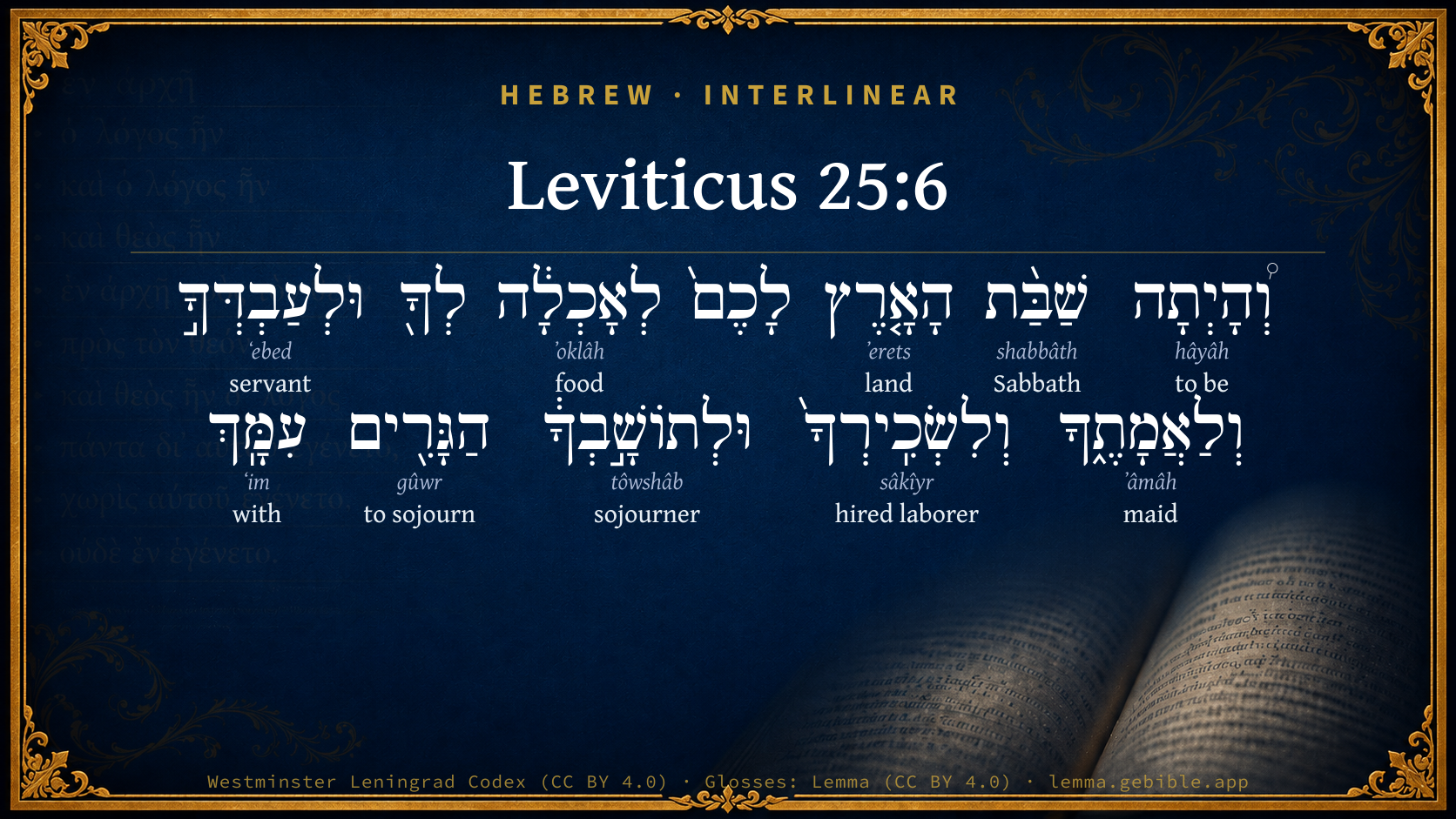
Hebrew (Westminster Leningrad Codex) Leviticus 25:6 appears in the Hebrew Old Testament. The text above is from the Westminster Leningrad Codex. Each word links to its Strong’s number, a concise gloss, and parsing drawn from the Open Scriptures Hebrew Bible morphology. Click any word for its full Brown-Driver-Briggs (BDB) entry.
Download image
Cite this verse

Leviticus 25:6 (World English Bible). Public Domain. Lemma interlinear Bible study tool, https://lemma.gebible.app/v/leviticus/25/6.

Show BibTeX & RIS
BibTeX
RIS
English Translation
The Sabbath of the land shall be for food for you; for yourself, for your servant, for your maid, for your hired servant, and for your stranger, who lives as a foreigner with you.
World English Bible · Public Domain
Download a study sheet

One document with this verse’s original text, its word-by-word gloss line, the meaning frame, cross-references with their text, attributed commentary, and full source and license credits — printable, and it pastes into notes with its structure intact.

This verse Autodidact and up

Study sheet (.html) Plain text (.txt)

A passage Seminary Student

Up to 50 verses in one chapter. A passage sheet keeps up to 6 commentary sources and 12 cross-references per verse, in the order this page ranks them, and says so on the sheet whenever that leaves anything out. Ask for a single verse and you get the Autodidact verse sheet above.

Everything on this page stays free to read, with no account — the sheet is a download of what is already on screen, not access to it.

Want to remove ads? Support Godless Engineer
Compare translations 3

The same verse in 3 English versions, stacked beneath the original-language interlinear above. Click any original word for its lexicon entry.

Each is an independent rendering of the whole verse — the interlinear is not word-aligned to these translations.

Highlighted words mark where these versions differ — a whole-verse word diff, not a word-by-word alignment.

  • World English Bible Public Domain
    The Sabbath of the land shall be for food for you; for yourself, for your servant, for your maid, for your hired servant, and for your stranger, who lives as a foreigner with you.
  • King James Version Public Domain
    And the sabbath of the land shall be meat for you; for thee, and for thy servant, and for thy maid, and for thy hired servant, and for thy stranger that sojourneth with thee.
  • unfoldingWord Literal Text CC BY-SA 4.0
    And the sabbath of the land shall be for food for you: for you, and for your male servant, and for your female servant, and for your hired worker, and for your temporary resident who sojourns with you,

unfoldingWord Literal Text — © unfoldingWord, licensed CC BY-SA 4.0. Word-aligned USFM3 via Door43 (git.door43.org/unfoldingWord/en_ult).

Versions to compare (up to 4)

3 of 4 selected

Show all 18 translations

Every available English version of this verse, each an independent rendering of the whole verse.

  • World English Bible Public Domain
    The Sabbath of the land shall be for food for you; for yourself, for your servant, for your maid, for your hired servant, and for your stranger, who lives as a foreigner with you.
  • Berean Standard Bible Public Domain
    Whatever the land yields during the Sabbath year shall be food for you—for yourself, your manservant and maidservant, the hired hand or foreigner who stays with you,
  • Majority Standard Bible Public Domain
    Whatever the land yields during the Sabbath year shall be food for you—for yourself, your manservant and maidservant, the hired hand or foreigner who stays with you,
  • King James Version Public Domain
    And the sabbath of the land shall be meat for you; for thee, and for thy servant, and for thy maid, and for thy hired servant, and for thy stranger that sojourneth with thee.
  • American Standard Version (1901) Public Domain
    And the sabbath of the land shall be for food for you; for thee, and for thy servant and for thy maid, and for thy hired servant and for thy stranger, who sojourn with thee.
  • Revised Version (1885) Public Domain
    And the sabbath of the land shall be for food for you; for thee, and for thy servant and for thy maid, and for thy hired servant and for thy stranger that sojourn with thee;
  • Geneva Bible (1599) Public Domain
    And the rest of the lande shall be meate for you, euen for thee, and for thy seruant, and for thy mayde, and for thy hired seruant, and for the stranger that soiourneth with thee:
  • Douay-Rheims (1899) Public Domain
    But they shall be unto you for meat, to thee and to thy manservant, to thy maidservant and thy hireling, and to the strangers that sojourn with thee:
  • Young's Literal Translation Public Domain
    `And the sabbath of the land hath been to you for food, to thee, and to thy man-servant, and to thy handmaid, and to thy hireling, and to thy settler, who are sojourning with thee;
  • Literal Standard Version CC BY-SA 4.0
    And the Sabbath [increase] of the land has been for you for food, to you, and to your manservant, and to your handmaid, and to your hired worker, and to your settler, who are sojourning with you;
  • Unlocked Literal Bible CC BY-SA 4.0
    Whatever the unworked land grows during the Sabbath year will be food for you. You, your male and female servants, your hired servants and the foreigners who live with you may gather food,
  • unfoldingWord Literal Text CC BY-SA 4.0
    And the sabbath of the land shall be for food for you: for you, and for your male servant, and for your female servant, and for your hired worker, and for your temporary resident who sojourns with you,
  • Darby Bible Public Domain
    And the sabbath of the land shall be for food for you, for thee, and for thy bondman, and for thy handmaid, and for thy hired servant, and for him that dwelleth as a sojourner with thee, and for thy cattle,
  • World Messianic Bible Public Domain
    The Sabbath of the land shall be for food for you; for yourself, for your servant, for your maid, for your hired servant, and for your stranger, who lives as a foreigner with you.
  • Webster's Bible Public Domain
    And the sabbath of the land shall be food for you; for thee, and for thy servant, and for thy maid, and for thy hired servant, and for thy stranger that sojourneth with thee,
  • Free Bible Version CC BY-SA 4.0
    You can eat whatever the land produces during the Sabbath year. This applies to yourself, your male and female slaves, paid workers and foreigners who live with you,
  • Bible in Basic English Public Domain
    And the Sabbath of the land will give food for you and your man-servant and your woman-servant and those working for payment, and for those of another country who are living among you;
  • JPS Tanakh (1917) Public Domain
    And the sabbath-produce of the land shall be for food for you: for thee, and for thy servant and for thy maid, and for thy hired servant and for the settler by thy side that sojourn with thee;

Literal Standard Version (2020), Covenant Press — licensed CC BY-SA 4.0. Text via the HelloAO Bible API (eBible.org). Unlocked Literal Bible (unfoldingWord) — licensed CC BY-SA 4.0. Text via the HelloAO Bible API (eBible.org). unfoldingWord Literal Text — © unfoldingWord, licensed CC BY-SA 4.0. Word-aligned USFM3 via Door43 (git.door43.org/unfoldingWord/en_ult). Free Bible Version, Dr. Jonathan Gallagher — licensed CC BY-SA 4.0. Text via the HelloAO Bible API (eBible.org).

Word by word

More ways to search: Search by grammar → Find every occurrence → Compare this word →

Practice this passage: Drill this verse → Learn its vocabulary →

וּלְתוֹשָׁ֣בְךָ֔
tôwshâb
H8453
“and · to/for · sojourner · your”
Conjunction + Preposition + Noun, Common, Masculine, Singular, Construct + Suffix, Personal, 2nd Person, Masculine, Singular
Part of Speech
Conjunction + Preposition + Noun
Type
Common
Gender
Masculine
Number
Singular
State
Construct
Full BDB Definition

Origin: from H3427

TWOT: 922d

sojourner, stranger
  1. וְ֠הָיְתָה hâyâh H1961 “and · to be” Conjunction + Verb, Qal, Sequential Perfect, 3rd Person, Feminine, Singular
  2. שַׁבַּ֨ת shabbâth H7676 “Sabbath of” Noun, Common, Both, Singular, Construct
  3. הָאָ֤רֶץ ʼerets H776 “the · land” Particle, Definite Article + Noun, Common, Both, Singular, Absolute
  4. לְאָכְלָ֔ה ʼoklâh H402 “to/for · food” Preposition + Noun, Common, Feminine, Singular, Absolute
  5. וּלְעַבְדְּךָ֣ ʻebed H5650 “and · to/for · servant · your” Conjunction + Preposition + Noun, Common, Masculine, Singular, Construct + Suffix, Personal, 2nd Person, Masculine, Singular
  6. וְלַאֲמָתֶ֑ךָ ʼâmâh H519 “and · to/for · maid · your” Conjunction + Preposition + Noun, Common, Feminine, Singular, Construct + Suffix, Personal, 2nd Person, Masculine, Singular
  7. וְלִשְׂכִֽירְךָ֙ sâkîyr H7916 “and · to/for · hired laborer · your” Conjunction + Preposition + Adjective, Adjective, Masculine, Singular, Construct + Suffix, Personal, 2nd Person, Masculine, Singular
  8. הַגָּרִ֖ים gûwr H1481 “the · sojourning” Particle, Definite Article + Verb, Qal, Participle Active, Masculine, Plural, Absolute
  9. עִמָּֽךְ ʻim H5973 “with · you” Preposition + Suffix, Personal, 2nd Person, Feminine, Singular

About this verse

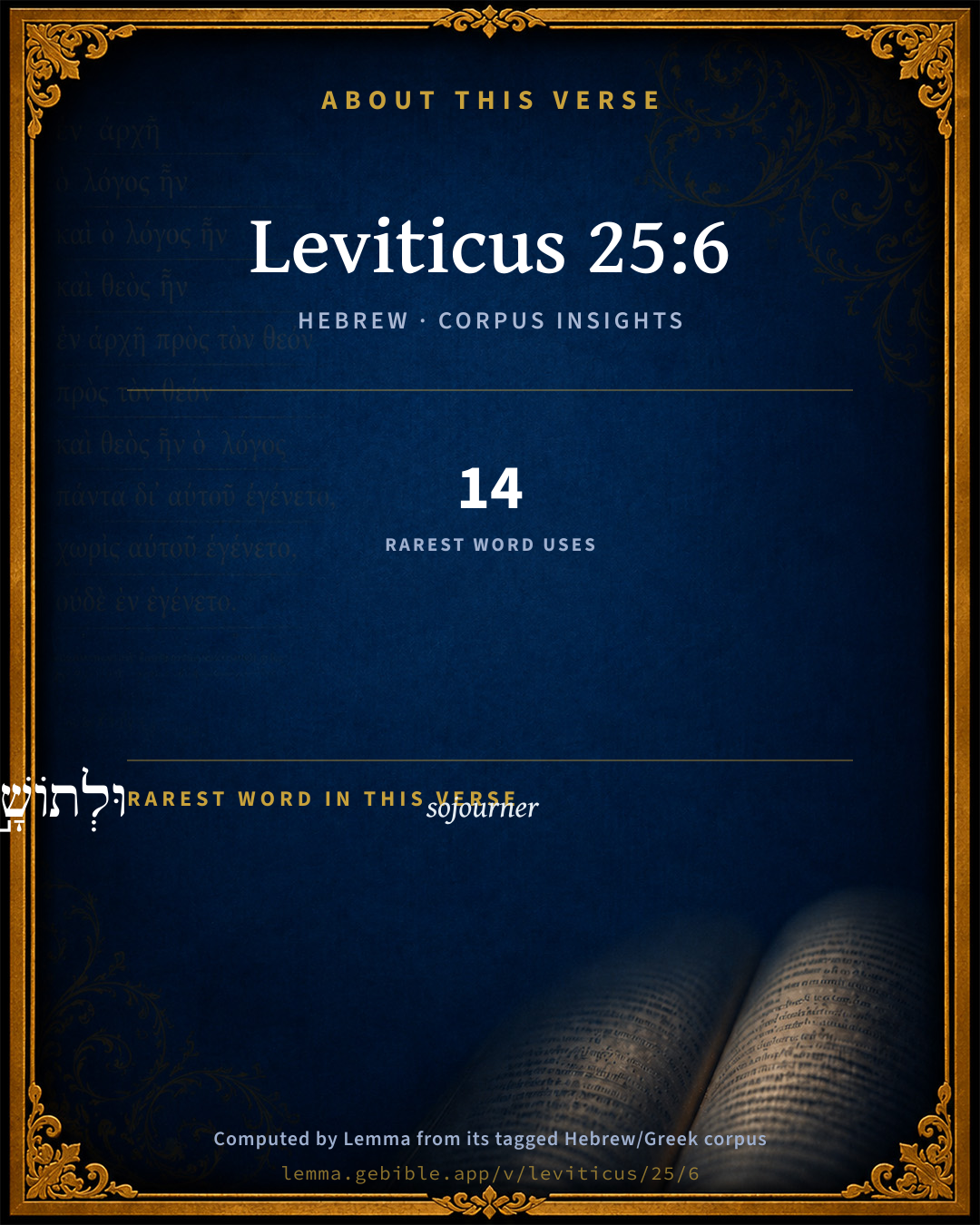
These counts appear in no published source. They are computed here, from the morphology-tagged text and Lemma’s own curated glosses. What Lemma adds →

12
words
10
distinct lemmas
Pentateuch
section

Notable vocabulary

The rarest word here is וּלְתוֹשָׁ֣בְךָ֔ sojourner H8453 — appearing just 14 times in the whole Hebrew Bible.

Shared distinctive vocabulary

וּלְתוֹשָׁ֣בְךָ֔ sojourner H8453 occurs in 13 verses of the Hebrew Bible. Also found in:

Grammatical profile

  • 2 verbs
  • 6 nouns
  • 1 adjective
  • 3 prepositions

Verb forms

  • וְ֠הָיְתָה Qal · Sequential Perfect
  • הַגָּרִ֖ים Qal · Participle Active

Hebrew & Septuagint length

In English translation the verse runs 34 words from the Hebrew and 29 from the Septuagint (LXX English) — closely comparable.

A rough comparison of the two English renderings, which tokenize alike — not a word-level alignment.

Word counts can differ between the Hebrew and the Greek without any difference in meaning — e.g. the Hebrew direct-object marker אֵת has no separate Greek word, and Greek often adds the article ὁ.

Cross-references

5

Topical passages linked to Leviticus 25:6 in the Treasury of Scripture Knowledge — connected by theme and wording, ordered by reader-vote popularity; previews shown in the World English Bible.

  • Exodus 23:11 but the seventh year you shall let it rest and lie fallow, that the poor of your people may eat; and what they leave the animal of the field shall eat. In like manner you shall deal with your vineyard and with your olive grove.
  • Leviticus 25:20 If you said, "What shall we eat the seventh year? Behold, we shall not sow, nor gather in our increase;"
  • Acts 2:44 All who believed were together, and had all things in common.
  • Acts 4:32 The multitude of those who believed were of one heart and soul. Not one of them claimed that anything of the things which he possessed was his own, but they had all things in common.
  • Acts 4:34–35 For neither was there among them any who lacked, for as many as were owners of lands or houses sold them, and brought the proceeds of the things that were sold,

Cross-references courtesy of OpenBible.info (CC BY 4.0).

Hebrew and Greek witnesses Masoretic Hebrew ↔ Greek Septuagint

The same verse in the two great witnesses to the Old Testament, shown verse-for-verse.

These are two independent witnesses, not word-aligned to each other, and the Septuagint is shown in lemma (dictionary) form.

Hebrew Leviticus 25:6 Masoretic · Westminster Leningrad Codex

וְ֠הָיְתָה שַׁבַּ֨ת הָאָ֤רֶץ לָכֶם֙ לְאָכְלָ֔ה לְךָ֖ וּלְעַבְדְּךָ֣ וְלַאֲמָתֶ֑ךָ וְלִשְׂכִֽירְךָ֙ וּלְתוֹשָׁ֣בְךָ֔ הַגָּרִ֖ים עִמָּֽךְ

The Sabbath of the land shall be for food for you; for yourself, for your servant, for your maid, for your hired servant, and for your stranger, who lives as a foreigner with you.

World English Bible · Public Domain

Greek LXX Leviticus 25:6 Septuagint · lemma form

καί εἰμί ὁ σάββατον ὁ γῆ βρῶμα σύ καί ὁ παῖς σύ καί ὁ παιδίσκη σύ καί ὁ μισθωτός σύ καί ὁ πάροικος ὁ προςκεῖμαι πρός σύ

And the sabbaths of the land shall be food for you, and for your man-servant, and for your maidservant, and your hireling, and the stranger that abides with you.

LXX2012 (modern English Septuagint) · Public Domain

On this verse, Haydock's Catholic Bible Commentary discusses the Septuagint’s reading. Read the note in Commentary ↓

Hebrew: Westminster Leningrad Codex (CC BY 4.0). Greek: Septuagint (public domain); English from LXX2012 (modern English Septuagint) (Public Domain). How the Septuagint differs from the Hebrew →

Targum (Aramaic paraphrase)

2

The Targum is the ancient Jewish Aramaic paraphrase of the Hebrew Scriptures — an interpretive translation, not the Hebrew text itself. Onkelos (literal) and Pseudo-Jonathan (expansive) render the Torah, and Jonathan the Prophets. Coverage is partial: where no permissively-licensed English translation exists for a verse, only the Aramaic is shown. This is verse-level text, not a word-by-word alignment to the Hebrew.

  1. Targum Onkelos Torah (Genesis–Deuteronomy)
    וּתְהֵי שְׁמִטַת אַרְעָא לְכוֹן לְמֵיכַל לָךְ וּלְעַבְדָךְ וּלְאַמְתָךְ וְלַאֲגִירָךְ וּלְתוֹתָבָךְ דְדָיְרִין עִמָךְ

    (no public-domain English translation for this verse)

    Targum Onkelos — Aramaic: “Onkelos Genesis” (public domain); “Onkelos Exodus” (public domain); “Onkelos Leviticus” (public domain); “Onkelos Numbers” (public domain); “Onkelos Deuteronomy” (public domain). English: “Sefaria Community Translation” (CC0 1.0 (public-domain dedication)); “J.W. Etheridge. The Targums of Onkelos and Jonathan Ben Uzziel on the Pentateuch. London: Longmans, Green, 1862” (public domain). Text via Sefaria.

  2. Targum Pseudo-Jonathan Torah (Genesis–Deuteronomy)
    וּתְהֵי שְׁמִיטַת אַרְעָא לְכוֹן לְמֵיכַל לָךְ וּלְעַבְדָךְ וּלְאַמְתָךְ וּלְאַגִירָךְ וּלְתוֹתָבָךְ דְדַיְירִין עִמָךְ

    but the remission of the ground shall be to you for food, to thee, to thy servant, and to thine handmaid, and to thy hireling, and to the stranger who dwelleth with thee;

    Targum Pseudo-Jonathan — Aramaic: “Targum Jonathan on Genesis” (public domain); “Targum Jonathan on Exodus” (public domain); “Targum Jonathan on Leviticus” (public domain); “Targum Jonathan on Numbers” (public domain); “Targum Jonathan on Deuteronomy” (public domain). English: “The Targum of Jonathan ben Uzziel, trans. J. W. Etheridge, London, 1862” (public domain). Text via Sefaria.

Commentary

Notes on Leviticus 25:6 from classic Christian and Jewish commentators (each source and its license shown beneath its notes). The classic Christian expositions comment on the surrounding passage and are grouped to its opening verse, so a note may address several verses; the Jewish commentaries on the Tanakh (Rashi and others) are per-verse, so they appear only where the commentator wrote on this verse.

Lemma curates 59 commentaries, every one of them public domain or Creative Commons licensed, each selected and text-cleaned for this edition rather than reprinted as found. About our sources →

Trapp's Complete Commentary

John Trapp

Lev 25:6 And the sabbath of the land shall be meat for you; for thee, and for thy servant, and for thy maid, and for thy hired servant, and for thy stranger that sojourneth with thee,

Ver. 6. Shall be meat for you.] Thus God taught and inured them to depend upon his providence, and to feed on faith, as some read that text. {Psa 37:3} For though the owner of the field might gather, even on that year, for the maintenance of himself and family, yet he was neither to sow his field, thereby to increase his harvest, nor to hedge his field, or lock up his vineyard, &c.

John Trapp, A Commentary or Exposition upon All the Books of the Old and New Testament (1647–1656) — public domain. Text from a community e-Sword module.

Joseph Benson's Commentary

Lev 25:6. The sabbath of the land — That is, the accidental crop that grew in the sabbatical year. Shall be meat for you — For all promiscuously, to take food from thence as you need. It is true the land would produce little corn without being tilled and sown, but the vines and other fruit-trees which abounded in the country, even without pruning, would yield a considerable increase, so that the poorer sort might thus enjoy many comforts, together with rest, of which they were destitute on other years.

Joseph Benson's Commentary on the Old and New Testaments (1811–1818) — public domain. Text from a community e-Sword module.

Geneva Bible (1599)

Geneva Bible translators

That which the land bringeth forth in her rest.

Geneva Bible (1599) marginal notes — public domain. Text via Bolls.life.

Ellicott's Commentary for English Readers

(6) And the sabbath of the land.—That is, the growth or produce during this sabbath of the land. For the figure of speech see Lev. 18:38.

Shall be meat for you.—That is, it shall serve as your food, but you must not trade with it, or store it up. Hence, during the second Temple the produce of the sabbatical year could only be used for direct consumption, and was not allowed to be converted first into other articles and then used. Thus, for instance, though wood of that year could be used as firewood, yet it was illegal to convert it first into coal and then use the coal thus obtained from the wood, nor was it legal to convert vegetables into medicines, or to give human food to animals.

For thee, and for thy servant . . . —The produce is to be left in the field for the free use of the poor, the servant, &c. (See also Exo_23:11.) Hence it was enacted during the second Temple that “whoso locks up his vineyard, or hedges in his field, or gathers all the fruit into his house in the sabbatical year breaks this law.” Everything is to be left common, and every man has a right to every thing in every place. Every man could only bring into his house a little at a time according to the manner of things that are in common.”

A Bible Commentary for English Readers, edited by Charles John Ellicott (1878–1897) — public domain. Text from a community e-Sword module.

The Cambridge Bible for Schools and Colleges

gen. ed. J. J. S. Perowne

6. the sabbath] i.e. the produce during the year of rest. Instead of storing it as in each of the six years, they were only to gather it from time to time when needed for food. Much of the grain in Palestine to-day sows itself, as it falls from the ripe ears.

The Cambridge Bible for Schools and Colleges (gen. ed. J. J. S. Perowne; Cambridge University Press, 1878–1918) — public domain. Text from a community e-Sword module.

John Gill's Exposition

And the sabbath of the land shall be meat for you,...., That is, that which grew up of itself but of the land, or on trees, vines, olives, &c. undressed, should be the meat or food on which they should live that year: and this comprehends everything that is fit for food, and also for drink, and for anointing, and even for the lighting of lamps, as in the Misnah (q):

for thee, and for thy servant, and for thy maid; the owner of the fields and vineyards, he and his family, wife, children, and servants, might eat of the fruits of them in common with others; for whereas it is elsewhere said, Exo 23:11, "that the poor of thy people may eat", this is observed here, lest anyone should think the rich are forbid eating them, as Jarchi remarks:

and for thy hired servant, and for the stranger that sojourneth with thee: which the same writer interprets of Gentiles; the food of this year was common to masters and servants, to rich and poor, to Israelites and Gentiles; all had an equal right unto, and share therein; which might be an emblem of the first times of the Gospel, in which all things were had in common, Act 4:32, and typical of the communion of saints in things spiritual; in salvation by Jesus Christ, common to Jews and Gentiles, high and low, bond and free; in the free and full forgiveness of sins by his blood; and in justification by his righteousness, which is unto all, and upon all them that believe, for there is no difference; in the participation of faith, and other graces, which are alike precious, and in the enjoyment of promises, privileges, and ordinances, and even of eternal life itself.

(q) Sheviith, c. 8. sect. 2.

John Gill's Exposition of the Whole Bible (1746–1763) — public domain (CC PDM 1.0). Text via the HelloAO Bible API.

Albert Barnes' Notes on the Bible

The sabbath of the land shall be meat for you - That is, the produce of the untilled land (its “increase,” Lev 25:7) shall be food for the whole of you in common, rich and poor without distinction Exo 23:11.

Albert Barnes' Notes on the Bible (1834–1885) — public domain. Text from a community e-Sword/MySword module.

Haydock's Catholic Bible Commentary

They. Hebrew and Septuagint, "The sabbath of the earth shall be meat for you" in common.

George Leo Haydock (1774–1849), Haydock's Catholic Family Bible and Commentary, 1859 edition — public domain. Excludes Psalms (Douay-Rheims chapter numbering differs from Protestant) and Deuterocanonical books (Catholic canon only).

Matthew Poole's English Annotations

The sabbath, i.e. the growth of the sabbath, or that fruit which groweth in the sabbatical year. See on Lev 23:38, where the word sabbath is taken in the like sense.

For thee, and for thy servant; for all promiscuously, to take food from thence as they need it.

Matthew Poole's English Annotations on the Holy Bible (1683–1685) — public domain. Text from a community e-Sword/MySword module.

Whedon's Commentary on the Bible

Daniel D. Whedon

6. The sabbath of the land — The spontaneous products of the soil during the sabbatical year shall be meat, or common food, for all classes indiscriminately, lords and servants, natives and foreigners, rich and poor, cattle and game. The assignment of the produce of this year to the poor in Exo_23:11, does not exclude the landowner from equal participation also. The quantity of this self-sown harvest is sometimes fiftyfold, according to Strabo, when the previous harvest was over ripe and there was not careful gleaning. This may have been the designed character of the sixth harvest.

Thy stranger — The thoshabh is one who lives permanently in the country, but without the rights of a citizen; different from a ger, who may live there for a time.

Daniel D. Whedon (gen. ed.), Commentary on the Old and New Testaments (1874–1909) — public domain. Text from a community e-Sword module.

John Wesley's Explanatory Notes

The sabbath of the land - That is, the growth of the sabbath, or that fruit which groweth in the sabbatical year. For thy servant - For all promiscuously, to take food from thence as they need it.

John Wesley, Explanatory Notes Upon the Whole Bible (1754–1765) — public domain. Text via the GEBible commentary corpus.

Keil & Delitzsch

C. F. Keil & F. Delitzsch

"And the Sabbath of the land (i.e., the produce of the sabbatical year or year of rest, whatever grew that year without cultivation) shall be to you for food, for thee and thy servant,...and for the beasts that are in thy land shall all its produce be for food." The meaning is, that what grew of itself was not to be reaped by the owner of the land, but that masters and servants, labourers and visitors, cattle and game, were to eat thereof away from the field (cf. Lev 25:12). The produce arising without tilling or sowing was to be a common good for man and beast. According to Exo 23:11, it was to belong to the poor and needy; but the owner was not forbidden to partake of it also, so that there can be no discrepancy discovered between this passage and the verse before us. The produce referred to would be by no means inconsiderable, particularly if there had not been a careful gleaning after the harvest, or the corn had become over-ripe. In the fertile portions of Palestine, especially in the plain of Jezreel and on the table-land of Galilee, as well as in other parts, large quantities of wheat and other cereals are still self-sown from the ripe ears, the over-flowing of which is not gathered by any of the inhabitants of the land. Strabo gives a similar account of Albania, viz., that in many parts a field once sown will bear fruit twice and even three times, the first yield being as much as fifty-fold. The intention of his law was not so much to secure the physical recreation of both the land and people, however useful and necessary this might be for men, animals, and land in this sublunary world; but the land was to keep Sabbath to the Lord in the seventh year. In the sabbatical year the land, which the Lord had given to His people, was to observe a period of holy rest and refreshment to its Lord and God, just as the congregation did on the Sabbath-day; and the hand of man was to be withheld from the fields and fruit-gardens from working them, that they might yield their produce for his use. The earth was to be saved from the hand of man exhausting its power for earthly purposes as his own property, and to enjoy the holy rest with which God had blessed the earth and all its productions after the creation. From this, Israel, as the nation of God, was to learn, on the one hand, that although the earth was created for man, it was not merely created for him to draw out its powers for his own use, but also to be holy to the Lord, and participate in His blessed rest; and on the other hand, that the great purpose for which the congregation of the Lord existed, did not consist in the uninterrupted tilling of the earth, connected with bitter labour in the sweat of his brow (Gen 3:17, Gen 3:19), but in the peaceful enjoyment of the fruits of the earth, which the Lord their God had given them, and would give them still without the labour of their hands, if they strove to keep His covenant and satisfy themselves with His grace. This intention of the sabbatical year comes out still more plainly in the year of jubilee, in which the idea of the sanctification of the whole land as the Lord's property is still more strongly expressed, and whose inward connection with the sabbatical year is indicated by the fact that the time for observing it was regulated by the sabbatical years (Lev 25:8).

Keil & Delitzsch — Biblical Commentary on the Old Testament (1861–1891) — public domain (CC PDM 1.0). Text via the HelloAO Bible API. (Old Testament only.)

Rashi

Rabbi Shlomo Yitzchaki (Rashi)

'והיתה שבת הארץ וגו‎‎‎‎ AND THE SABBATH OF THE LAND SHALL BE [FOOD FOR YOU] — Although I have forbidden them (the fruits of the sabbatical year) to you by stating “thou shalt not harvest etc.”, I do not mean to forbid them to you as food or to be used for any other beneficial purpose but what I meant was that you should not comport yourself in respect of them as the exclusive owner but all must be equal as regards it (the Sabbatical year’s produce) — you and your hired servant and your sojourner.

שבת הארץ לכם לאכלה THE שבת OF THE LAND [SHALL BE] FOR FOOD FOR YOU — Since Scripture does not state והיתה תבואת הארץ לכם לאכלה‏ but‎‎ והיתה שבת הארץ לכם לאכלה it intimates: Only that which has been treated according to the Sabbatical law (שבות) and been declared free to all may you eat, but not that which has been kept by you (Sifra, Behar, Chapter 1 5).

לך ולעבדך ולאמתך [AND THE SABBATH OF THE LAND SHALL BE FOOD FOR YOU]; FOR THEE, FOR THY SERVANT, AND FOR THY MAID SERVANT — Because it states (Exodus 23:11) “[but in the seventh year thou shalt let it rest and lie still]; that the needy of thy people may eat”, one might think that they (the fruits of the Sabbatical year) are forbidden as food for the rich (and thus also for the owner of the field and his household), Scripture therefore states here: “[it shall be for food for thee,] for thy servant, and for thy maid servant” — thus you have the mention of the owners (the rich) here as well as of the servants and the maid servants — the poor (Sifra, Behar, Chapter 1 6).

ולשכירך ולתושבך AND FOR THY HIRED SERVANT, AND FOR THY SOJOURNER — Even non-Jews (Sifra, Behar, Chapter 1 7).

Rashi on the Tanakh — English translations: “The Judaica Press complete Tanach with Rashi, translated by A. J. Rosenberg” (CC BY 4.0); “Pentateuch with Rashi's commentary by M. Rosenbaum and A.M. Silbermann, 1929-1934” (public domain); “The Metsudah Tanach series, Lakewood, N.J” (CC BY 4.0); and “The Book of Joshua, Metsudah Publications, 1997” (CC BY 4.0). Text via Sefaria.

Ramban (Nachmanides)

Rabbi Moshe ben Nachman (Ramban / Nachmanides)

AND ‘SHABBATH HA’ARETZ’ (THE SABBATH-PRODUCE OF THE LAND) SHALL BE FOR FOOD FOR YOU. Because He said it shall be a Sabbath of solemn rest for the Land, He states [here] that the rest mentioned shall be for food for you to maintain all of you — you and your servant, and the cattle and the beast — so that you should all support yourselves from that which the land will bring forth by itself whilst it is resting. Or [it may be that] the year itself is called shabbath ha’aretz, just as the [seventh] day is called “the Sabbath of the Eternal,”. or just “Sabbath;” and the reference thereof is to the produce of the Sabbath [year], for the Sabbath [year] itself is not something to be eaten.

Ramban (Nachmanides) on the Tanakh — English translation: “Commentary on the Torah by Ramban (Nachmanides). Translated and annotated by Charles B. Chavel. New York, Shilo Pub. House, 1971-1976” (CC BY 4.0). Text via Sefaria.

Lesson kit

Teaching starters — assembled from the data on this page, not authored interpretation. Every prompt links to the verse data it draws on. Edit before teaching.

Leviticus, in the Pentateuch, opens this verse with 12 words (10 distinct Hebrew lemmas). Its most distinctive word is tôwshâb (“sojourner”). A historical commentator’s framing appears above. Read the whole chapter for the surrounding context.

Discussion questions

  1. How does “sojourner” (tôwshâb) shape what this verse is saying?
  2. How does Genesis 23:4, which shares the word «sojourner», read alongside this verse?
  3. The translations on this page render this verse differently — a whole-verse word diff, not a word-by-word alignment. What might account for the different wordings?
  4. «וְ֠הָיְתָה» is a Qal Sequential Perfect verb. How does that grammatical form shape the action described?
  5. Compare how Trapp's Complete Commentary and Joseph Benson's Commentary read this verse. Where do they agree or differ?

Things to notice

Reading settings

Reading text

Shown beneath each verse's original-language words.

Old Testament
Old Testament edition

Read the OT as the Masoretic Hebrew (MT) or the Greek Septuagint (LXX).

English shown for the Greek Septuagint (in the Hebrew ↔ Greek comparison).

Comparing translations? Open the Compare panel on any verse page to stack up to four side by side.