
2 Samuel 15:8

Hebrew (Westminster Leningrad Codex) 2 Samuel 15:8 appears in the Hebrew Old Testament. The text above is from the Westminster Leningrad Codex. Each word links to its Strong’s number, a concise gloss, and parsing drawn from the Open Scriptures Hebrew Bible morphology. Click any word for its full Brown-Driver-Briggs (BDB) entry.
Download image
Cite this verse

2 Samuel 15:8 (World English Bible). Public Domain. Lemma interlinear Bible study tool, https://lemma.gebible.app/v/2-samuel/15/8.

Show BibTeX & RIS
BibTeX
RIS
English Translation
For your servant vowed a vow while I abode at Geshur in Syria, saying, If Yahweh shall indeed bring me again to Jerusalem, then I will serve Yahweh.
World English Bible · Public Domain
Download a study sheet

One document with this verse’s original text, its word-by-word gloss line, the meaning frame, cross-references with their text, attributed commentary, and full source and license credits — printable, and it pastes into notes with its structure intact.

This verse Autodidact and up

Study sheet (.html) Plain text (.txt)

A passage Seminary Student

Up to 50 verses in one chapter. A passage sheet keeps up to 6 commentary sources and 12 cross-references per verse, in the order this page ranks them, and says so on the sheet whenever that leaves anything out. Ask for a single verse and you get the Autodidact verse sheet above.

Everything on this page stays free to read, with no account — the sheet is a download of what is already on screen, not access to it.

Want to remove ads? Support Godless Engineer
Compare translations 3

The same verse in 3 English versions, stacked beneath the original-language interlinear above. Click any original word for its lexicon entry.

Each is an independent rendering of the whole verse — the interlinear is not word-aligned to these translations.

Highlighted words mark where these versions differ — a whole-verse word diff, not a word-by-word alignment.

  • World English Bible Public Domain
    For your servant vowed a vow while I abode at Geshur in Syria, saying, If Yahweh shall indeed bring me again to Jerusalem, then I will serve Yahweh.
  • King James Version Public Domain
    For thy servant vowed a vow while I abode at Geshur in Syria, saying, If the LORD shall bring me again indeed to Jerusalem, then I will serve the LORD.
  • unfoldingWord Literal Text CC BY-SA 4.0
    For your servant vowed a vow when I was living in Geshur in Aram, saying, ‘If bringing back, Yahweh brings me back Jerusalem, then I will serve Yahweh.’”

unfoldingWord Literal Text — © unfoldingWord, licensed CC BY-SA 4.0. Word-aligned USFM3 via Door43 (git.door43.org/unfoldingWord/en_ult).

Versions to compare (up to 4)

3 of 4 selected

Show all 18 translations

Every available English version of this verse, each an independent rendering of the whole verse.

  • World English Bible Public Domain
    For your servant vowed a vow while I abode at Geshur in Syria, saying, If Yahweh shall indeed bring me again to Jerusalem, then I will serve Yahweh.
  • Berean Standard Bible Public Domain
    For your servant made a vow while dwelling in Geshur of Aram, saying: ‘If indeed the LORD brings me back to Jerusalem, I will worship the LORD in Hebron.’”
  • Majority Standard Bible Public Domain
    For your servant made a vow while dwelling in Geshur of Aram, saying: ‘If indeed the LORD brings me back to Jerusalem, I will worship the LORD in Hebron.’”
  • King James Version Public Domain
    For thy servant vowed a vow while I abode at Geshur in Syria, saying, If the LORD shall bring me again indeed to Jerusalem, then I will serve the LORD.
  • American Standard Version (1901) Public Domain
    For thy servant vowed a vow while I abode at Geshur in Syria, saying, If Jehovah shall indeed bring me again to Jerusalem, then I will serve Jehovah.
  • Revised Version (1885) Public Domain
    For thy servant vowed a vow while I abode at Geshur in Syria, saying, If the LORD shall indeed bring me again to Jerusalem, then I will serve the LORD.
  • Geneva Bible (1599) Public Domain
    For thy seruant vowed a vowe when I remayned at Geshur, in Aram, saying, If the Lord shall bring me againe in deede to Ierusalem, I will serue the Lord.
  • Douay-Rheims (1899) Public Domain
    For thy servant made avow, when he was in Gessur of Syria, saying: If the Lord shall bring me again into Jerusalem I will offer sacrifice to the Lord.
  • Young's Literal Translation Public Domain
    for a vow hath thy servant vowed in my dwelling in Geshur, in Aram, saying, If Jehovah doth certainly bring me back to Jerusalem, then I have served Jehovah.'
  • Literal Standard Version CC BY-SA 4.0
    for your servant has vowed a vow in my dwelling in Geshur, in Aram, saying, If YHWH certainly brings me back to Jerusalem, then I have served YHWH.”
  • Unlocked Literal Bible CC BY-SA 4.0
    For your servant made a vow while I was living at Geshur in Aram, saying,' If Yahweh will indeed bring me again to Jerusalem, then I will worship Yahweh.'”
  • unfoldingWord Literal Text CC BY-SA 4.0
    For your servant vowed a vow when I was living in Geshur in Aram, saying, ‘If bringing back, Yahweh brings me back Jerusalem, then I will serve Yahweh.’”
  • Darby Bible Public Domain
    For thy servant vowed a vow while I abode in Geshur in Syria, saying, If Jehovah shall bring me again indeed to Jerusalem, then I will serve Jehovah.
  • World Messianic Bible Public Domain
    For your servant vowed a vow while I stayed at Geshur in Syria, saying, ‘If the LORD shall indeed bring me again to Jerusalem, then I will serve the LORD.’”
  • Webster's Bible Public Domain
    For thy servant vowed a vow while I abode at Geshur in Syria, saying, If the LORD shall bring me again indeed to Jerusalem, then I will serve the LORD.
  • Free Bible Version CC BY-SA 4.0
    For I, your servant, made this promise while living at Geshur in Aram, saying: ‘If the Lord does bring me back to Jerusalem, I will worship the Lord in Hebron.’”
  • Bible in Basic English Public Domain
    For while I was living in Geshur in Aram, your servant made an oath, saying, If ever the Lord lets me come back to Jerusalem, I will give him worship in Hebron.
  • JPS Tanakh (1917) Public Domain
    For thy servant vowed a vow while I abode at Geshur in Aram, saying: If the LORD shall indeed bring me back to Jerusalem, then I will serve the LORD.'

Literal Standard Version (2020), Covenant Press — licensed CC BY-SA 4.0. Text via the HelloAO Bible API (eBible.org). Unlocked Literal Bible (unfoldingWord) — licensed CC BY-SA 4.0. Text via the HelloAO Bible API (eBible.org). unfoldingWord Literal Text — © unfoldingWord, licensed CC BY-SA 4.0. Word-aligned USFM3 via Door43 (git.door43.org/unfoldingWord/en_ult). Free Bible Version, Dr. Jonathan Gallagher — licensed CC BY-SA 4.0. Text via the HelloAO Bible API (eBible.org).

Word by word

More ways to search: Search by grammar → Find every occurrence → Compare this word →

Practice this passage: Drill this verse → Learn its vocabulary →

בִגְשׁ֛וּר
Gᵉshûwr
H1650
“in/at · Geshur”
Preposition + Noun, Proper
Part of Speech
Preposition + Noun
Type
Proper
Full BDB Definition

Origin: from an unused root (meaning to join)

TWOT: None

Geshur or Geshurites = "proud beholder" - a people - a land in north Transjordania
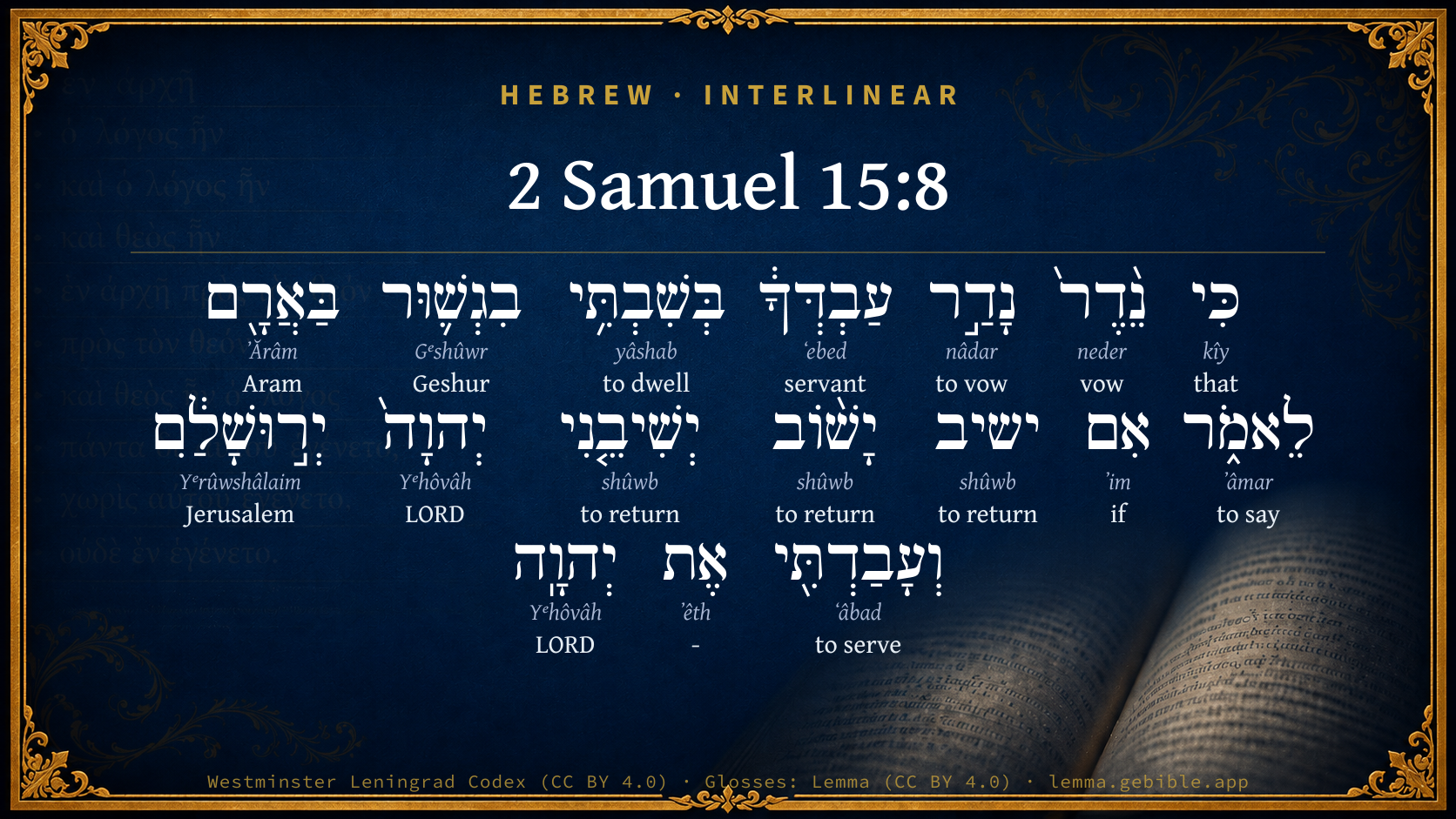
  1. כִּי kîy H3588 “that” Conjunction
  2. נֵ֨דֶר֙ neder H5088 “vow” Noun, Common, Masculine, Singular, Absolute
  3. נָדַ֣ר nâdar H5087 “to vow” Verb, Qal, Perfect, 3rd Person, Masculine, Singular
  4. עַבְדְּךָ֔ ʻebed H5650 “servant · your” Noun, Common, Masculine, Singular, Construct + Suffix, Personal, 2nd Person, Masculine, Singular
  5. בְּשִׁבְתִּ֥י yâshab H3427 “in/at · to dwell · me” Preposition + Verb, Qal, Infinitive Construct + Suffix, Personal, 1st Person, Common, Singular
  6. בַּאֲרָ֖ם ʼĂrâm H758 “in/at · Aram” Preposition + Noun, Proper
  7. לֵאמֹ֑ר ʼâmar H559 “to say” Preposition + Verb, Qal, Infinitive Construct
  8. אִם ʼim H518 “if” Conjunction
  9. ישיב shûwb H7725 “to return” Verb, Hiphil, Imperfect, 3rd Person, Masculine, Singular
  10. יָשׁ֨וֹב shûwb H7725 “to return” Verb, Qal, Infinitive Absolute
  11. יְשִׁיבֵ֤נִי shûwb H7725 “to return · me” Verb, Hiphil, Imperfect, 3rd Person, Masculine, Singular + Suffix, Personal, 1st Person, Common, Singular
  12. יְהוָה֙ Yᵉhôvâh H3068 “LORD” Noun, Proper
  13. יְר֣וּשָׁלִַ֔ם Yᵉrûwshâlaim H3389 “Jerusalem” Noun, Proper
  14. וְעָבַדְתִּ֖י ʻâbad H5647 “and · to serve” Conjunction + Verb, Qal, Perfect, 1st Person, Common, Singular
  15. אֶת ʼêth H853 “-” Particle, Direct Object
  16. יְהוָֽה Yᵉhôvâh H3068 “LORD” Noun, Proper

About this verse

These counts appear in no published source. They are computed here, from the morphology-tagged text and Lemma’s own curated glosses. What Lemma adds →

17
words
14
distinct lemmas
Historical
section

Notable vocabulary

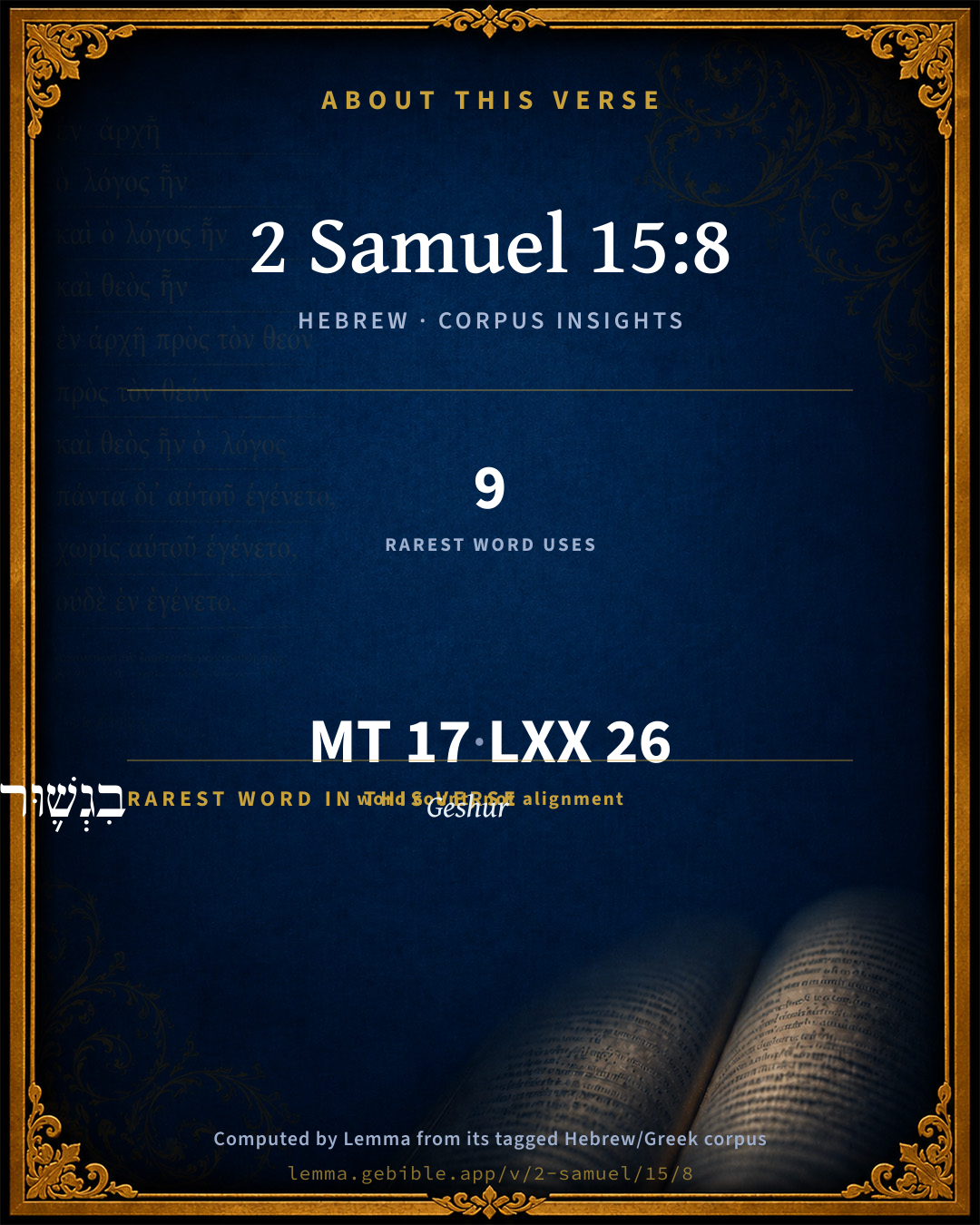
The rarest word here is בִגְשׁ֛וּר Geshur H1650 — appearing just 9 times in the whole Hebrew Bible.

Shared distinctive vocabulary

בִגְשׁ֛וּר Geshur H1650 occurs in 9 verses of the Hebrew Bible. Also found in:

Grammatical profile

  • 7 verbs
  • 7 nouns
  • 2 conjunctions
  • 1 particle

Verb forms

  • נָדַ֣ר Qal · Perfect
  • בְּשִׁבְתִּ֥י Qal · Infinitive Construct
  • לֵאמֹ֑ר Qal · Infinitive Construct
  • ישיב Hiphil · Imperfect
  • יָשׁ֨וֹב Qal · Infinitive Absolute
  • יְשִׁיבֵ֤נִי Hiphil · Imperfect
  • וְעָבַדְתִּ֖י Qal · Perfect

Repetition

Words recur within this verse — often emphatic in Hebrew:

  • ישיב to return H7725 ×3
  • יְהוָה֙ LORD H3068 ×2

Hebrew & Septuagint length

In English translation the verse runs 28 words from the Hebrew and 29 from the Septuagint (LXX English) — closely comparable.

A rough comparison of the two English renderings, which tokenize alike — not a word-level alignment.

Word counts can differ between the Hebrew and the Greek without any difference in meaning — e.g. the Hebrew direct-object marker אֵת has no separate Greek word, and Greek often adds the article ὁ.

In the original languages it is 17 Hebrew tokens and 26 Greek tokens — but the two are counted differently (Hebrew bundles its prefixes and suffixes into one token; the Greek is in lemma form), so that isn’t a like-for-like length.

Cross-references

12

Topical passages linked to 2 Samuel 15:8 in the Treasury of Scripture Knowledge — connected by theme and wording, ordered by reader-vote popularity; previews shown in the World English Bible.

  • Genesis 28:20–21 Jacob vowed a vow, saying, "If God will be with me, and will keep me in this way that I go, and will give me bread to eat, and clothing to put on,
  • 2 Samuel 13:37–38 But Absalom fled, and went to Talmai the son of Ammihur, king of Geshur. [David] mourned for his son every day.
  • 1 Samuel 1:11 She vowed a vow, and said, Yahweh of hosts, if you will indeed look on the affliction of your handmaid, and remember me, and not forget your handmaid, but will give to your handmaid a man-child, then I will give him to Yahweh all the days of his life, and there shall no razor come on his head.
  • Jeremiah 9:3–5 They bend their tongue, [as it were] their bow, for falsehood; and they are grown strong in the land, but not for truth: for they proceed from evil to evil, and they don't know me, says Yahweh.
  • Joshua 24:15 If it seem evil to you to serve Yahweh, choose you this day whom you will serve; whether the gods which your fathers served that were beyond the River, or the gods of the Amorites, in whose land you dwell: but as for me and my house, we will serve Yahweh.
  • 1 Samuel 16:2 Samuel said, How can I go? if Saul hear it, he will kill me. Yahweh said, Take a heifer with you, and say, I am come to sacrifice to Yahweh.
  • 2 Samuel 14:23 So Joab arose and went to Geshur, and brought Absalom to Jerusalem.
  • 2 Samuel 14:32 Absalom answered Joab, Behold, I sent to you, saying, Come here, that I may send you to the king, to say, Why am I come from Geshur? it were better for me to be there still. Now therefore let me see the king's face; and if there be iniquity in me, let him kill me.
  • Psalms 56:12 Your vows are on me, God. I will give thank offerings to you.
  • Ecclesiastes 5:4 When you vow a vow to God, don't defer to pay it; for he has no pleasure in fools. Pay that which you vow.
  • Isaiah 28:15 Because you have said, We have made a covenant with death, and with Sheol are we at agreement; when the overflowing scourge shall pass through, it shall not come to us; for we have made lies our refuge, and under falsehood have we hid ourselves:
  • Jeremiah 42:20 For you have dealt deceitfully against your own souls; for you sent me to Yahweh your God, saying, Pray for us to Yahweh our God; and according to all that Yahweh our God shall say, so declare to us, and we will do it:

Cross-references courtesy of OpenBible.info (CC BY 4.0).

Hebrew and Greek witnesses Masoretic Hebrew ↔ Greek Septuagint

The same verse in the two great witnesses to the Old Testament, shown verse-for-verse.

These are two independent witnesses, not word-aligned to each other, and the Septuagint is shown in lemma (dictionary) form.

Hebrew 2 Samuel 15:8 Masoretic · Westminster Leningrad Codex

כִּי נֵ֨דֶר֙ נָדַ֣ר עַבְדְּךָ֔ בְּשִׁבְתִּ֥י בִגְשׁ֛וּר בַּאֲרָ֖ם לֵאמֹ֑ר אִם ישיב יָשׁ֨וֹב יְשִׁיבֵ֤נִי יְהוָה֙ יְר֣וּשָׁלִַ֔ם וְעָבַדְתִּ֖י אֶת יְהוָֽה

For your servant vowed a vow while I abode at Geshur in Syria, saying, If Yahweh shall indeed bring me again to Jerusalem, then I will serve Yahweh.

World English Bible · Public Domain

Greek LXX 2 Samuel 15:8 Septuagint · lemma form

ὅτι εὐχή εὔχομαι ὁ δοῦλος σύ ἐν ὁ οἰκέω ἐγώ ἐν γεδσουρ ἐν συρία λέγω ἐάν ἐπιστρέφω ἐπιστρέφω ἐγώ κύριος εἰς ἰερουσαλήμ καί λατρεύω ὁ κύριος

For your servant vowed a vow when I lived at Gedsur in Syria, saying, If the Lord should indeed restore me to Jerusalem, then will I serve the Lord.

LXX2012 (modern English Septuagint) · Public Domain

Hebrew: Westminster Leningrad Codex (CC BY 4.0). Greek: Septuagint (public domain); English from LXX2012 (modern English Septuagint) (Public Domain). How the Septuagint differs from the Hebrew →

Targum (Aramaic paraphrase)

1

The Targum is the ancient Jewish Aramaic paraphrase of the Hebrew Scriptures — an interpretive translation, not the Hebrew text itself. Onkelos (literal) and Pseudo-Jonathan (expansive) render the Torah, and Jonathan the Prophets. Coverage is partial: where no permissively-licensed English translation exists for a verse, only the Aramaic is shown. This is verse-level text, not a word-by-word alignment to the Hebrew.

  1. Targum Jonathan Prophets (Joshua–Malachi)
    אֲרֵי נִדְרָא נְדַר עַבְדָךְ בְּמֵיתְבֵי בִּגְשׁוּר בַּאֲרָם לְמֵימָר אִם אֲתָבָא יְתִיבִינַנִי יְיָ לִירוּשְׁלֵם וְאֶפְלָח קֳדָם יְיָ:

    (no public-domain English translation for this verse)

    Targum Jonathan — Aramaic: “Mikraot Gedolot” (public domain). English: “Sefaria Community Translation” (CC0 1.0 (public-domain dedication)); “London "Chaldee Paraphrase," 1871” (public domain). Text via Sefaria.

Commentary

Notes on 2 Samuel 15:8 from classic Christian and Jewish commentators (each source and its license shown beneath its notes). The classic Christian expositions comment on the surrounding passage and are grouped to its opening verse, so a note may address several verses; the Jewish commentaries on the Tanakh (Rashi and others) are per-verse, so they appear only where the commentator wrote on this verse.

Lemma curates 59 commentaries, every one of them public domain or Creative Commons licensed, each selected and text-cleaned for this edition rather than reprinted as found. About our sources →

Trapp's Complete Commentary

John Trapp

2Sa 15:8 For thy servant vowed a vow while I abode at Geshur in Syria, saying, If the LORD shall bring me again indeed to Jerusalem, then I will serve the LORD.

Ver. 8. Then I will serve the Lord,] viz., With gratulatory oblations and peace offerings; when in truth his design was, not to serve the Lord, but to serve himself upon the Lord, by pretending his worship to his own wicked practices, and by drawing together as guests at that feast of his - usual at such sacrifices - as many as he thought meet to join with him in his intended conspiracy.

John Trapp, A Commentary or Exposition upon All the Books of the Old and New Testament (1647–1656) — public domain. Text from a community e-Sword module.

Joseph Benson's Commentary

2Sa 15:8-9. If the Lord shall bring me again to Jerusalem, &c. — This vow, we see, of Absalom is conceived exactly in the style of the patriarchal piety; and plainly implies, that however he was tempted by his grandfather to serve the gods of Geshur, yet he continued steady to the true religion, and determined against idolatry. This, we may be sure, David was highly delighted to hear, and therefore gave a ready consent to the performance of his vow, saying, Go in peace. So he arose and went to Hebron — This place he chose as being an eminent city, and next to Jerusalem, the chief city of the tribe of Judah. It was also the place of his birth, the place where his father had begun his kingdom, which he took for a good omen, and where the seat of government had been several years. Here, likewise, they were wont to sacrifice till the temple was built. It was at a convenient distance from Jerusalem, and, no doubt, he had here secured many friends. He therefore thought it the most commodious place for his purpose, next to Jerusalem.

Joseph Benson's Commentary on the Old and New Testaments (1811–1818) — public domain. Text from a community e-Sword module.

Tyndale Open Study Notes

Tyndale Open Resources

15:8 Geshur in Aram: After killing Amnon, Absalom had sought refuge in the homeland of his mother (also see study notes on 13:34-39, 37). • The perfect place for Absalom to turn his grassroots popularity into a full-fledged revolt against David was in Hebron, David’s first capital.

Tyndale Open Study Notes — © Tyndale Open Resources, licensed CC BY-SA 4.0. Text via the HelloAO Bible API.

Geneva Bible (1599)

Geneva Bible translators

By offering a peace offering, which was lawful to do in any place.

Geneva Bible (1599) marginal notes — public domain. Text via Bolls.life.

Adam Clarke's Commentary

Verse 8. While I abode at Geshur in Syria] Geshur, the country of Talmai, was certainly not in Syria, but lay on the south of Canaan, in or near Edom, as is evident from Jdg 1:10; 1Sa 27:8; 2Sa 13:37. Hence it is probable that ארם Aram, Syria, is a mistake for אדם Edom; ד daleth and ר resh being easily interchangeable. Edom is the reading both of the Syriac and Arabic.

I will serve the Lord.] Here he pretended to be a strict follower of Jehovah, even while he was in a heathen country; and now he desires liberty to go and perform a vow at Hebron, which he pretends to have made while he was resident at Geshur. And all this was the more perfectly to organize his system of rebellion against his venerable father.

Adam Clarke's Commentary on the Bible (1810–1826) — public domain. Text from a community e-Sword/MySword module.

The Cambridge Bible for Schools and Colleges

gen. ed. J. J. S. Perowne

8. then will I serve the Lord] By offering a sacrifice in accordance with his vow. Cp. Jacob’s similar vow (Gen_28:20-22).

The Cambridge Bible for Schools and Colleges (gen. ed. J. J. S. Perowne; Cambridge University Press, 1878–1918) — public domain. Text from a community e-Sword module.

John Gill's Exposition

For thy servant vowed a vow while I abode at Geshur in Syria,.... When at his grandfather's court there:

saying, if the Lord will bring me again indeed to Jerusalem; which he might be sincerely desirous of:

then I will serve the Lord; but it is a question whether he ever made a vow to this purpose, or concerned himself about serving the Lord; but it rather may be, this was a lie of his, now framed in order to get leave of the king to go to Hebron.

John Gill's Exposition of the Whole Bible (1746–1763) — public domain (CC PDM 1.0). Text via the HelloAO Bible API.

Haydock's Catholic Bible Commentary

Lord. The pretext seemed very bad, since he ought not to have delayed so long to perform his vow. Moreover, the usual places for sacrifice were Gabaon or Sion. But Absalom might plead a respect for the patriarchs, who were buried at Hebron. (St. Jerome, Trad.) (Menochius)

George Leo Haydock (1774–1849), Haydock's Catholic Family Bible and Commentary, 1859 edition — public domain. Excludes Psalms (Douay-Rheims chapter numbering differs from Protestant) and Deuterocanonical books (Catholic canon only).

Matthew Poole's English Annotations

i.e. Worship him by the offering of sacrifices of thanksgiving to God, for restoring me to the place of his presence and service, and to my father’s favour. But why should not this service have been performed at Zion, or at Gibeon? Here was some ground of suspicion; but God blinded David’s eyes, that he might bring upon David and upon Absalom the judgments which they deserved, and he designed.

Matthew Poole's English Annotations on the Holy Bible (1683–1685) — public domain. Text from a community e-Sword/MySword module.

Lesson kit

Teaching starters — assembled from the data on this page, not authored interpretation. Every prompt links to the verse data it draws on. Edit before teaching.

2 Samuel, in the Historical, opens this verse with 17 words (14 distinct Hebrew lemmas). Its most distinctive word is Gᵉshûwr (“Geshur”). A historical commentator’s framing appears above. Read the whole chapter for the surrounding context.

Discussion questions

  1. How does “Geshur” (Gᵉshûwr) shape what this verse is saying?
  2. How does Joshua 13:13, which shares the word «Geshur», read alongside this verse?
  3. What does the repetition of “to return” (3× in this one verse) do in this verse?
  4. These translations render this verse differently. What is at stake in choosing one wording over another?
  5. «נָדַ֣ר» is a Qal Perfect verb. How does that grammatical form shape the action described?
  6. Compare how Trapp's Complete Commentary and Joseph Benson's Commentary read this verse. Where do they agree or differ?

Things to notice

Reading settings

Reading text

Shown beneath each verse's original-language words.

Old Testament
Old Testament edition

Read the OT as the Masoretic Hebrew (MT) or the Greek Septuagint (LXX).

English shown for the Greek Septuagint (in the Hebrew ↔ Greek comparison).

Comparing translations? Open the Compare panel on any verse page to stack up to four side by side.