
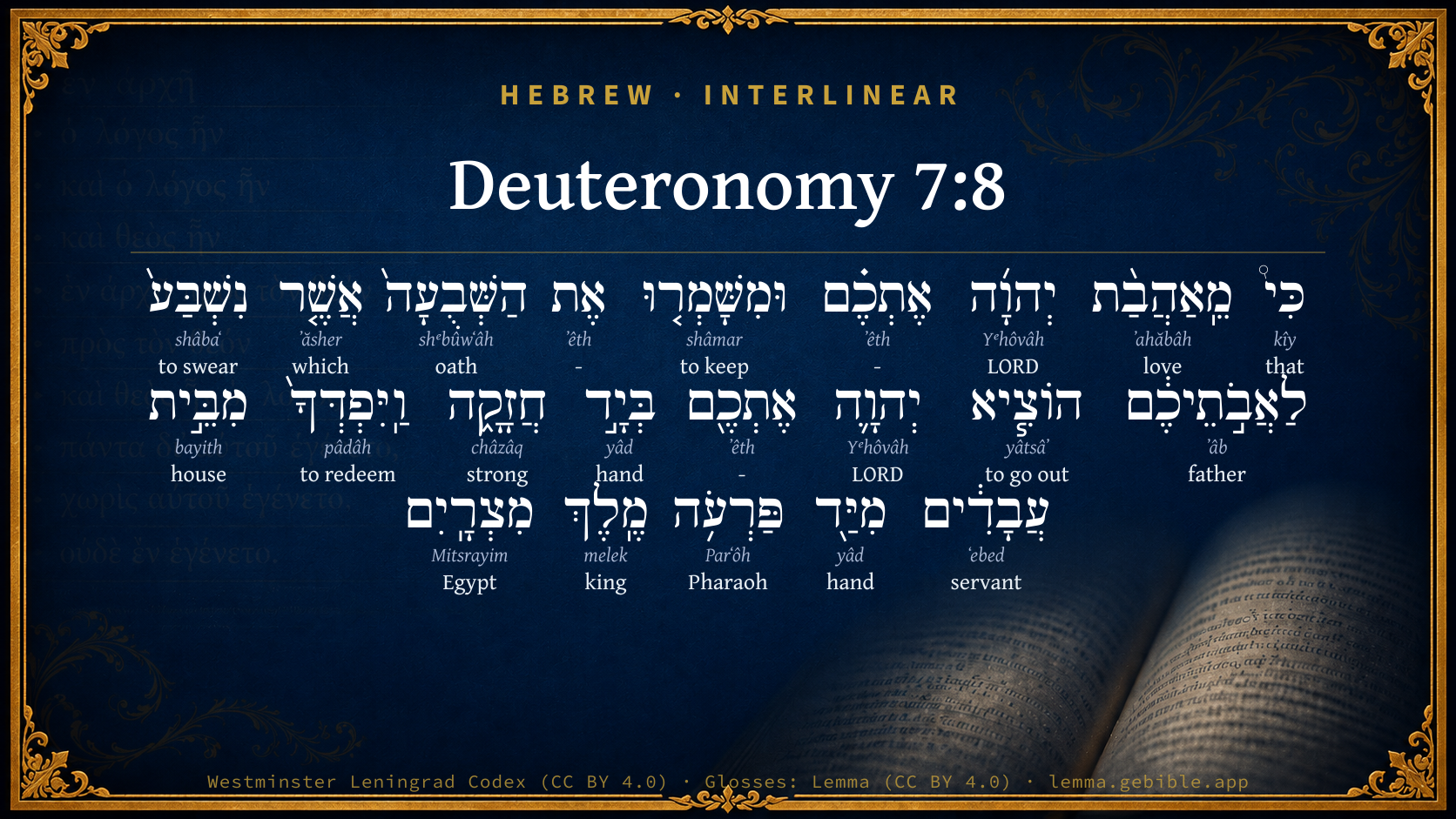
Deuteronomy 7:8

Hebrew (Westminster Leningrad Codex) Deuteronomy 7:8 appears in the Hebrew Old Testament. The text above is from the Westminster Leningrad Codex. Each word links to its Strong’s number, a concise gloss, and parsing drawn from the Open Scriptures Hebrew Bible morphology. Click any word for its full Brown-Driver-Briggs (BDB) entry.
Download image
Cite this verse

Deuteronomy 7:8 (World English Bible). Public Domain. Lemma interlinear Bible study tool, https://lemma.gebible.app/v/deuteronomy/7/8.

Show BibTeX & RIS
BibTeX
RIS
English Translation
but because Yahweh loves you, and because he would keep the oath which he swore to your fathers, has Yahweh brought you out with a mighty hand, and redeemed you out of the house of bondage, from the hand of Pharaoh king of Egypt.
World English Bible · Public Domain
Highlights
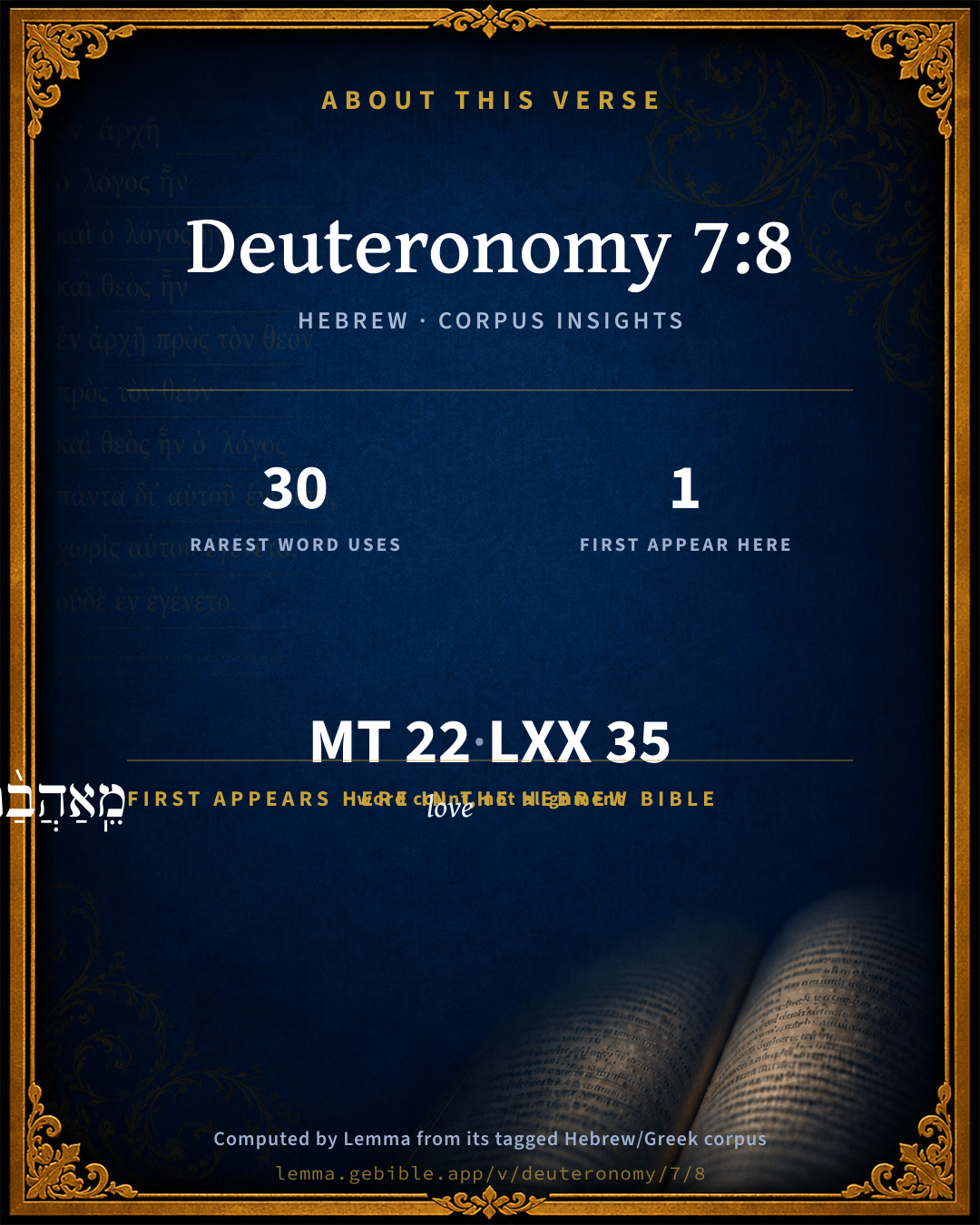
  • 1 first appearance in the Hebrew Bible
Full analysis ↓
Download a study sheet

One document with this verse’s original text, its word-by-word gloss line, the meaning frame, cross-references with their text, attributed commentary, and full source and license credits — printable, and it pastes into notes with its structure intact.

This verse Autodidact and up

Study sheet (.html) Plain text (.txt)

A passage Seminary Student

Up to 50 verses in one chapter. A passage sheet keeps up to 6 commentary sources and 12 cross-references per verse, in the order this page ranks them, and says so on the sheet whenever that leaves anything out. Ask for a single verse and you get the Autodidact verse sheet above.

Everything on this page stays free to read, with no account — the sheet is a download of what is already on screen, not access to it.

Want to remove ads? Support Godless Engineer
Compare translations 3

The same verse in 3 English versions, stacked beneath the original-language interlinear above. Click any original word for its lexicon entry.

Each is an independent rendering of the whole verse — the interlinear is not word-aligned to these translations.

Highlighted words mark where these versions differ — a whole-verse word diff, not a word-by-word alignment.

  • World English Bible Public Domain
    but because Yahweh loves you, and because he would keep the oath which he swore to your fathers, has Yahweh brought you out with a mighty hand, and redeemed you out of the house of bondage, from the hand of Pharaoh king of Egypt.
  • King James Version Public Domain
    But because the LORD loved you, and because he would keep the oath which he had sworn unto your fathers, hath the LORD brought you out with a mighty hand, and redeemed you out of the house of bondmen, from the hand of Pharaoh king of Egypt.
  • unfoldingWord Literal Text CC BY-SA 4.0
    but Yahweh loves you, and he kept the oath that he had sworn to your fathers. Yahweh has brought you out with a mighty hand and redeemed you from the house of slaves, from the hand of Pharaoh, king of Egypt.

unfoldingWord Literal Text — © unfoldingWord, licensed CC BY-SA 4.0. Word-aligned USFM3 via Door43 (git.door43.org/unfoldingWord/en_ult).

Versions to compare (up to 4)

3 of 4 selected

Show all 18 translations

Every available English version of this verse, each an independent rendering of the whole verse.

  • World English Bible Public Domain
    but because Yahweh loves you, and because he would keep the oath which he swore to your fathers, has Yahweh brought you out with a mighty hand, and redeemed you out of the house of bondage, from the hand of Pharaoh king of Egypt.
  • Berean Standard Bible Public Domain
    But because the LORD loved you and kept the oath He swore to your fathers, He brought you out with a mighty hand and redeemed you from the house of slavery, from the hand of Pharaoh king of Egypt.
  • Majority Standard Bible Public Domain
    But because the LORD loved you and kept the oath He swore to your fathers, He brought you out with a mighty hand and redeemed you from the house of slavery, from the hand of Pharaoh king of Egypt.
  • King James Version Public Domain
    But because the LORD loved you, and because he would keep the oath which he had sworn unto your fathers, hath the LORD brought you out with a mighty hand, and redeemed you out of the house of bondmen, from the hand of Pharaoh king of Egypt.
  • American Standard Version (1901) Public Domain
    but because Jehovah loveth you, and because he would keep the oath which he sware unto your fathers, hath Jehovah brought you out with a mighty hand, and redeemed you out of the house of bondage, from the hand of Pharaoh king of Egypt.
  • Revised Version (1885) Public Domain
    but because the LORD loveth you, and because he would keep the oath which he sware unto your fathers, hath the LORD brought you out with a mighty hand, and redeemed you out of the house of bondage, from the hand of Pharaoh king of Egypt.
  • Geneva Bible (1599) Public Domain
    But because the Lord loued you, and because hee would keepe the othe which hee had sworne vnto your fathers, the Lord hath brought you out by a mightie hand, and deliuered you out of the house of bondage from the hand of Pharaoh King of Egypt,
  • Douay-Rheims (1899) Public Domain
    But because the Lord hath loved you, and hath kept his oath, which he swore to your fathers: and hath brought you out with a strong hand, and redeemed you from the house of bondage, out of the hand of Pharao the king of Egypt.
  • Young's Literal Translation Public Domain
    but because of Jehovah's loving you, and because of His keeping the oath which He hath sworn to your fathers, hath Jehovah brought you out by a strong hand, and doth ransom you from a house of servants, from the hand of Pharaoh king of Egypt.
  • Literal Standard Version CC BY-SA 4.0
    but because of YHWH’s loving you, and because of His keeping the oath which He has sworn to your fathers; YHWH has brought you out by a strong hand, and ransoms you from a house of servants, from the hand of Pharaoh king of Egypt.
  • Unlocked Literal Bible CC BY-SA 4.0
    but because he loves you, and he wished to keep the oath that he had sworn to your fathers. This is why Yahweh has brought you out with a mighty hand and redeemed you out of the house of bondage, from the hand of Pharaoh, king of Egypt.
  • unfoldingWord Literal Text CC BY-SA 4.0
    but Yahweh loves you, and he kept the oath that he had sworn to your fathers. Yahweh has brought you out with a mighty hand and redeemed you from the house of slaves, from the hand of Pharaoh, king of Egypt.
  • Darby Bible Public Domain
    but because Jehovah loved you, and because he would keep the oath which he had sworn unto your fathers, hath Jehovah brought you out with a powerful hand, and redeemed you out of the house of bondage, from the hand of Pharaoh king of Egypt.
  • World Messianic Bible Public Domain
    but because the LORD loves you, and because he desires to keep the oath which he swore to your fathers, the LORD has brought you out with a mighty hand and redeemed you out of the house of bondage, from the hand of Pharaoh king of Egypt.
  • Webster's Bible Public Domain
    But because the LORD loved you, and because he would keep the oath which he had sworn to your fathers, hath the LORD brought you out with a mighty hand, and redeemed you from the house of bond-men, from the hand of Pharaoh king of Egypt.
  • Free Bible Version CC BY-SA 4.0
    However, because the Lord loved you and kept the promise he gave to your forefathers, He led you out by his power and rescued you from the prison-house of slavery, from the rule of Pharaoh, king of Egypt.
  • Bible in Basic English Public Domain
    But because of his love for you, and in order to keep his oath to your fathers, the Lord took you out with the strength of his hand, making you free from the prison-house and from the hand of Pharaoh, king of Egypt.
  • JPS Tanakh (1917) Public Domain
    but because the LORD loved you, and because He would keep the oath which He swore unto your fathers, hath the LORD brought you out with a mighty hand, and redeemed you out of the house of bondage, from the hand of Pharaoh king of Egypt.

Literal Standard Version (2020), Covenant Press — licensed CC BY-SA 4.0. Text via the HelloAO Bible API (eBible.org). Unlocked Literal Bible (unfoldingWord) — licensed CC BY-SA 4.0. Text via the HelloAO Bible API (eBible.org). unfoldingWord Literal Text — © unfoldingWord, licensed CC BY-SA 4.0. Word-aligned USFM3 via Door43 (git.door43.org/unfoldingWord/en_ult). Free Bible Version, Dr. Jonathan Gallagher — licensed CC BY-SA 4.0. Text via the HelloAO Bible API (eBible.org).

Word by word

More ways to search: Search by grammar → Find every occurrence → Compare this word →

Practice this passage: Drill this verse → Learn its vocabulary →

הַשְּׁבֻעָה֙
shᵉbûwʻâh
H7621
“the · oath”
Particle, Definite Article + Noun, Common, Feminine, Singular, Absolute
Part of Speech
Particle + Noun
Type
Common
Gender
Feminine
Number
Singular
State
Absolute
Full BDB Definition

Origin: pass part of H7650

TWOT: 2319a

oath, curse - oath - attesting of innocence - curse - oath (of Jehovah)
  1. כִּי֩ kîy H3588 “that” Conjunction
  2. מֵֽאַהֲבַ֨ת ʼahăbâh H160 “from · love” Preposition + Verb, Qal, Infinitive Construct
  3. יְהוָ֜ה Yᵉhôvâh H3068 “LORD” Noun, Proper
  4. אֶתְכֶ֗ם ʼêth H853 “- · you” Particle, Direct Object + Suffix, Personal, 2nd Person, Masculine, Plural
  5. וּמִשָּׁמְר֤וּ shâmar H8104 “and · from · to keep · him” Conjunction + Preposition + Verb, Qal, Infinitive Construct + Suffix, Personal, 3rd Person, Masculine, Singular
  6. אֶת ʼêth H853 “-” Particle, Direct Object
  7. אֲשֶׁ֤ר ʼăsher H834 “which” Particle, Relative
  8. נִשְׁבַּע֙ shâbaʻ H7650 “to swear” Verb, Niphal, Perfect, 3rd Person, Masculine, Singular
  9. לַאֲבֹ֣תֵיכֶ֔ם ʼâb H1 “to/for · fathers · your” Preposition + Noun, Common, Masculine, Plural, Construct + Suffix, Personal, 2nd Person, Masculine, Plural
  10. הוֹצִ֧יא yâtsâʼ H3318 “to go out” Verb, Hiphil, Perfect, 3rd Person, Masculine, Singular
  11. יְהוָ֛ה Yᵉhôvâh H3068 “LORD” Noun, Proper
  12. אֶתְכֶ֖ם ʼêth H853 “- · you” Particle, Direct Object + Suffix, Personal, 2nd Person, Masculine, Plural
  13. בְּיָ֣ד yâd H3027 “in/at · hand” Preposition + Noun, Common, Both, Singular, Absolute
  14. חֲזָקָ֑ה châzâq H2389 “strong” Adjective, Adjective, Feminine, Singular, Absolute
  15. וַֽיִּפְדְּךָ֙ pâdâh H6299 “and · to redeem · you” Conjunction + Verb, Qal, Sequential Imperfect, 3rd Person, Masculine, Singular + Suffix, Personal, 2nd Person, Masculine, Singular
  16. מִבֵּ֣ית bayith H1004 “from · house of” Preposition + Noun, Common, Masculine, Singular, Construct
  17. עֲבָדִ֔ים ʻebed H5650 “servants” Noun, Common, Masculine, Plural, Absolute
  18. מִיַּ֖ד yâd H3027 “from · hand of” Preposition + Noun, Common, Both, Singular, Construct
  19. פַּרְעֹ֥ה Parʻôh H6547 “Pharaoh” Noun, Proper
  20. מֶֽלֶךְ melek H4428 “king of” Noun, Common, Masculine, Singular, Construct
  21. מִצְרָֽיִם Mitsrayim H4714 “Egypt” Noun, Proper

About this verse

These counts appear in no published source. They are computed here, from the morphology-tagged text and Lemma’s own curated glosses. What Lemma adds →

22
words
18
distinct lemmas
Pentateuch
section

First appearance in Scripture

This word makes its first canonical appearance in the Hebrew Bible here:

  • מֵֽאַהֲבַ֨ת love H160

Shared distinctive vocabulary

הַשְּׁבֻעָה֙ oath H7621 occurs in 29 verses of the Hebrew Bible. Also found in:

Grammatical profile

  • 5 verbs
  • 11 nouns
  • 1 adjective
  • 1 conjunction
  • 4 particles

Verb forms

  • מֵֽאַהֲבַ֨ת Qal · Infinitive Construct
  • וּמִשָּׁמְר֤וּ Qal · Infinitive Construct
  • נִשְׁבַּע֙ Niphal · Perfect
  • הוֹצִ֧יא Hiphil · Perfect
  • וַֽיִּפְדְּךָ֙ Qal · Sequential Imperfect

Repetition

Words recur within this verse — often emphatic in Hebrew:

  • יְהוָ֜ה LORD H3068 ×2
  • בְּיָ֣ד hand H3027 ×2

Hebrew & Septuagint length

In English translation the verse runs 44 words from the Hebrew and 45 from the Septuagint (LXX English) — closely comparable.

A rough comparison of the two English renderings, which tokenize alike — not a word-level alignment.

Word counts can differ between the Hebrew and the Greek without any difference in meaning — e.g. the Hebrew direct-object marker אֵת has no separate Greek word, and Greek often adds the article ὁ.

In the original languages it is 22 Hebrew tokens and 35 Greek tokens — but the two are counted differently (Hebrew bundles its prefixes and suffixes into one token; the Greek is in lemma form), so that isn’t a like-for-like length.

Cross-references

27

Topical passages linked to Deuteronomy 7:8 in the Treasury of Scripture Knowledge — connected by theme and wording, ordered by reader-vote popularity; previews shown in the World English Bible.

  • Exodus 20:2 "I am Yahweh your God, who brought you out of the land of Egypt, out of the house of bondage.
  • Exodus 32:13 Remember Abraham, Isaac, and Israel, your servants, to whom you swore by your own self, and said to them, 'I will multiply your seed as the stars of the sky, and all this land that I have spoken of I will give to your seed, and they shall inherit it forever.'"
  • Jeremiah 31:3 Yahweh appeared of old to me, [saying], Yes, I have loved you with an everlasting love: therefore with loving kindness have I drawn you.
  • Ephesians 2:4–5 But God, being rich in mercy, for his great love with which he loved us,
  • Isaiah 43:4 Since you have been precious in my sight, [and] honorable, and I have loved you; therefore will I give men in your place, and peoples instead of your life.
  • Deuteronomy 10:15 Only Yahweh had a delight in your fathers to love them, and he chose their seed after them, even you above all peoples, as at this day.
  • Exodus 13:14 It shall be, when your son asks you in time to come, saying, 'What is this?' that you shall tell him, 'By strength of hand Yahweh brought us out from Egypt, from the house of bondage;
  • Exodus 13:3 Moses said to the people, "Remember this day, in which you came out from Egypt, out of the house of bondage; for by strength of hand Yahweh brought you out from this place. No leavened bread shall be eaten.
  • Luke 1:72–73 To show mercy towards our fathers, To remember his holy covenant,
  • Hebrews 6:13–17 For when God made a promise to Abraham, since he could swear by none greater, he swore by himself,
  • Genesis 22:16–18 and said, "I have sworn by myself, says Yahweh, because you have done this thing, and have not withheld your son, your only son,
  • Exodus 12:41–42 It happened at the end of four hundred thirty years, even the same day it happened, that all the hosts of Yahweh went out from the land of Egypt.
  • Deuteronomy 4:20 But Yahweh has taken you, and brought you forth out of the iron furnace, out of Egypt, to be to him a people of inheritance, as at this day.
  • Deuteronomy 4:34 Or has God tried to go and take him a nation from the midst of [another] nation, by trials, by signs, and by wonders, and by war, and by a mighty hand, and by an outstretched arm, and by great terrors, according to all that Yahweh your God did for you in Egypt before your eyes?
  • Deuteronomy 4:37 Because he loved your fathers, therefore he chose their seed after them, and brought you out with his presence, with his great power, out of Egypt;
  • Deuteronomy 9:4–5 Don't speak in your heart, after that Yahweh your God has thrust them out from before you, saying, For my righteousness Yahweh has brought me in to possess this land; whereas for the wickedness of these nations Yahweh does drive them out from before you.
  • 1 Samuel 12:22 For Yahweh will not forsake his people for his great name's sake, because it has pleased Yahweh to make you a people to himself.
  • 2 Samuel 22:20 He brought me forth also into a large place; He delivered me, because he delighted in me.
  • Psalms 44:3 For they didn't get the land in possession by their own sword, Neither did their own arm save them; But your right hand, and your arm, and the light of your face, Because you were favorable to them.
  • Psalms 105:8–10 He has remembered his covenant forever, The word which he commanded to a thousand generations,
  • Psalms 105:42 For he remembered his holy word, And Abraham, his servant.
  • Zephaniah 3:17 Yahweh, your God, is in the midst of you, a mighty one who will save. He will rejoice over you with joy. He will rest in his love. He will rejoice over you with singing.
  • Matthew 11:26 Yes, Father, for so it was well-pleasing in your sight.
  • Luke 1:55 As he spoke to our fathers, To Abraham and his seed forever."
  • 2 Thessalonians 2:13–14 But we are bound to always give thanks to God for you, brothers loved by the Lord, because God chose you from the beginning for salvation through sanctification of the Spirit and belief in the truth;
  • Titus 3:3–7 For we were also once foolish, disobedient, deceived, serving various lusts and pleasures, living in malice and envy, hateful, and hating one another.
  • 1 John 4:19 We love Him, because he first loved us.

Cross-references courtesy of OpenBible.info (CC BY 4.0).

Hebrew and Greek witnesses Masoretic Hebrew ↔ Greek Septuagint

The same verse in the two great witnesses to the Old Testament, shown verse-for-verse.

These are two independent witnesses, not word-aligned to each other, and the Septuagint is shown in lemma (dictionary) form.

Hebrew Deuteronomy 7:8 Masoretic · Westminster Leningrad Codex

כִּי֩ מֵֽאַהֲבַ֨ת יְהוָ֜ה אֶתְכֶ֗ם וּמִשָּׁמְר֤וּ אֶת הַשְּׁבֻעָה֙ אֲשֶׁ֤ר נִשְׁבַּע֙ לַאֲבֹ֣תֵיכֶ֔ם הוֹצִ֧יא יְהוָ֛ה אֶתְכֶ֖ם בְּיָ֣ד חֲזָקָ֑ה וַֽיִּפְדְּךָ֙ מִבֵּ֣ית עֲבָדִ֔ים מִיַּ֖ד פַּרְעֹ֥ה מֶֽלֶךְ מִצְרָֽיִם

but because Yahweh loves you, and because he would keep the oath which he swore to your fathers, has Yahweh brought you out with a mighty hand, and redeemed you out of the house of bondage, from the hand of Pharaoh king of Egypt.

World English Bible · Public Domain

Greek LXX Deuteronomy 7:8 Septuagint · lemma form

ἀλλά παρά ὁ ἀγαπάω κύριος σύ καί διατηρέω ὁ ὅρκος ὅς ὄμνυμι ὁ πατήρ σύ ἐκἄγω κύριος σύ ἐν χείρ κραταιός καί ἐν βραχίων ὑψηλός καί λυτρόω ἐκ οἶκος δουλεία ἐκ χείρ φαραώ βασιλεύς αἴγυπτος

But because the Lord loved you, and as keeping the oath which he swore to your fathers, the Lord brought you out with a strong hand, and the Lord redeemed you from the house of bondage, out of the hand of Pharao king of Egypt.

LXX2012 (modern English Septuagint) · Public Domain

On this verse, The Cambridge Bible for Schools and Colleges discusses the Septuagint’s reading. Read the note in Commentary ↓

Hebrew: Westminster Leningrad Codex (CC BY 4.0). Greek: Septuagint (public domain); English from LXX2012 (modern English Septuagint) (Public Domain). How the Septuagint differs from the Hebrew →

Targum (Aramaic paraphrase)

2

The Targum is the ancient Jewish Aramaic paraphrase of the Hebrew Scriptures — an interpretive translation, not the Hebrew text itself. Onkelos (literal) and Pseudo-Jonathan (expansive) render the Torah, and Jonathan the Prophets. Coverage is partial: where no permissively-licensed English translation exists for a verse, only the Aramaic is shown. This is verse-level text, not a word-by-word alignment to the Hebrew.

  1. Targum Onkelos Torah (Genesis–Deuteronomy)
    אֲרֵי מִדְרַחַם יְיָ יָתְכוֹן וּמִדִנְטַר יָת קְיָמָא דִי קַיִים לַאֲבָהָתְכוֹן אַפֵּיק יְיָ יָתְכוֹן בִּידָא תַקִיפָא וּפָרְקָךְ מִבֵּית עַבְדוּתָא מִידָא דְפַרְעֹה מַלְכָּא דְמִצְרָיִם

    (no public-domain English translation for this verse)

    Targum Onkelos — Aramaic: “Onkelos Genesis” (public domain); “Onkelos Exodus” (public domain); “Onkelos Leviticus” (public domain); “Onkelos Numbers” (public domain); “Onkelos Deuteronomy” (public domain). English: “Sefaria Community Translation” (CC0 1.0 (public-domain dedication)); “J.W. Etheridge. The Targums of Onkelos and Jonathan Ben Uzziel on the Pentateuch. London: Longmans, Green, 1862” (public domain). Text via Sefaria.

  2. Targum Pseudo-Jonathan Torah (Genesis–Deuteronomy)
    אֲרוּם מִן בִּגְלַל דְּרָחִים יְיָ יַתְכוֹן וּמִן דְּנָטִיר יַת קְיָימָא דְקַיֵּים לְאַבְהַתְכוֹן אַפֵּיק יַתְכוֹן פְּרִיקִין בִּידָא תַּקִּיפְתָּא וּפְרִקְכוֹן מִבֵּית שִׁעֲבּוּד עַבְדַיָא מִן יְדָא דְפַרְעה מַלְכָּא דְמִצְרָיִם

    Therefore, because the Lord had mercy on you, and would keep the covenant He had sworn with your fathers, He led you out free with a mighty hand, and redeemed you from the house of the affliction of slaves, from the hand of Pharoh king of Mizraim.

    Targum Pseudo-Jonathan — Aramaic: “Targum Jonathan on Genesis” (public domain); “Targum Jonathan on Exodus” (public domain); “Targum Jonathan on Leviticus” (public domain); “Targum Jonathan on Numbers” (public domain); “Targum Jonathan on Deuteronomy” (public domain). English: “The Targum of Jonathan ben Uzziel, trans. J. W. Etheridge, London, 1862” (public domain). Text via Sefaria.

Commentary

Notes on Deuteronomy 7:8 from classic Christian and Jewish commentators (each source and its license shown beneath its notes). The classic Christian expositions comment on the surrounding passage and are grouped to its opening verse, so a note may address several verses; the Jewish commentaries on the Tanakh (Rashi and others) are per-verse, so they appear only where the commentator wrote on this verse.

Lemma curates 59 commentaries, every one of them public domain or Creative Commons licensed, each selected and text-cleaned for this edition rather than reprinted as found. About our sources →

The Cambridge Bible for Schools and Colleges

gen. ed. J. J. S. Perowne

8. loveth you] With Israel’s love to God (see on Deu_6:5) God’s love to Israel is equally characteristic of D and not found elsewhere in Hexateuch; first expressed and very fully in Hosea 1-3 and Hos_11:1-4. In Deut. of God’s love to the fathers of the nation, Deu_4:37, Deu_10:15, both Sg.; to the nation, Deu_7:8 Pl. (editorial), Deu_7:13, Deu_23:5 Sg.; to the stranger, Deu_10:18 Sg.

the oath which he sware] See Deu_9:5.

mighty hand] See on Deu_3:24.

redeemed you] Heb. thee, and the Sg. is confirmed by Sam. and most MSS of LXX. This Sg. clause follows, not only conveniently upon Deu_7:6, the last clause in Sg., but very appropriately because of its redeemed and the peculiar people of that clause.

redeemed] The ordinary term for ransoming beast or man from slavery or death (see on Exo_13:13), is used of the redemption of Israel from Egypt in D here, Deu_13:5, Deu_15:15, Deu_21:8, Deu_24:8, all with the Sg., and in Deu_9:26 in a Pl. context; and so nowhere else in the Hexateuch.

The Cambridge Bible for Schools and Colleges (gen. ed. J. J. S. Perowne; Cambridge University Press, 1878–1918) — public domain. Text from a community e-Sword module.

Trapp's Complete Commentary

John Trapp

Deu 7:8 But because the LORD loved you, and because he would keep the oath which he had sworn unto your fathers, hath the LORD brought you out with a mighty hand, and redeemed you out of the house of bondmen, from the hand of Pharaoh king of Egypt.

Ver. 8. But because he loved you.] Lo, he loved you, because he loved you. This may seem idem per idem, a woman’s reason. But it excellently shows the ground of God’s love to be wholly in himself.

John Trapp, A Commentary or Exposition upon All the Books of the Old and New Testament (1647–1656) — public domain. Text from a community e-Sword module.

Geneva Bible (1599)

Geneva Bible translators

Freely, finding no cause in you more than in others so to do.

Geneva Bible (1599) marginal notes — public domain. Text via Bolls.life.

Adam Clarke's Commentary

Verse 8. But because the Lord loved you] It was no good in them that induced God to choose them at this time to be his peculiar people: he had his reasons, but these sprang from his infinite goodness. He intended to make a full discovery of his goodness to the world, and this must have a commencement in some particular place, and among some people. He chose that time, and he chose the Jewish people; but not because of their goodness or holiness.

Adam Clarke's Commentary on the Bible (1810–1826) — public domain. Text from a community e-Sword/MySword module.

Ellicott's Commentary for English Readers

(8) But because the Lord loved you.—And this, again, was not due to themselves, as he points out fully in Deu_9:4, &c.

A Bible Commentary for English Readers, edited by Charles John Ellicott (1878–1897) — public domain. Text from a community e-Sword module.

John Gill's Exposition

But because the Lord loved you,.... With an unmerited love; he loved them, because he loved them; that is, because he would love them; his love was not owing to any goodness in them, or done by them, or any love in them to him, but to his own good will and pleasure:

and because he would keep the oath which he had sworn unto your fathers; the promise he had made, confirmed by an oath:

hath the Lord brought you out with a mighty hand; out of the land of Egypt:

and redeemed you out of the house of bondmen; where they were bondmen to the Egyptians:

from the hand of Pharaoh king of Egypt; who detained them, and refused to let them go.

John Gill's Exposition of the Whole Bible (1746–1763) — public domain (CC PDM 1.0). Text via the HelloAO Bible API.

Matthew Poole's English Annotations

Because the Lord loved you, i.e. because it pleased him to love you; it was his free choice, without any cause or motive on your part. Compare Deu 10:15; 1Sa 12:22; Psa 44:3.

Matthew Poole's English Annotations on the Holy Bible (1683–1685) — public domain. Text from a community e-Sword/MySword module.

Whedon's Commentary on the Bible

Daniel D. Whedon

8. He would keep the oath — Not for any merit on their part did Jehovah deliver them from the oppressions of Egypt. Moses seeks to impress upon them that it was God’s good pleasure to select them for a peculiar people.

Daniel D. Whedon (gen. ed.), Commentary on the Old and New Testaments (1874–1909) — public domain. Text from a community e-Sword module.

The Pulpit Commentary

Because the Lord loved you. Targum Onkelos, "Because he had complacency in you;" Vulgate, quia vobis junctus est. "Instead of saying, He hath chosen you out of love to your fathers, as in Deu_4:37, Moses brings out in this place love to the people of Israel as the Divine motive, not for choosing Israel, but for leading it out and delivering it from the slave-house of Egypt, by which God had practically carried out the election of the people, that he might thereby allure the Israelites to a reciprocity of love". (Keil)

The Pulpit Commentary (1880–1919), ed. H.D.M. Spence-Jones & Joseph S. Exell — public domain. Text from a community e-Sword module.

John Wesley's Explanatory Notes

The Lord loved you - It was his free choice without any cause or motive on your part.

John Wesley, Explanatory Notes Upon the Whole Bible (1754–1765) — public domain. Text via the GEBible commentary corpus.

Scofield Reference Notes

C. I. Scofield

redeemed

(See Scofield "Exo 14:30").

The Scofield Reference Bible (1917 edition), notes by C. I. Scofield — public domain. Text from a community e-Sword module.

Rashi

Rabbi Shlomo Yitzchaki (Rashi)

כי מאהבת — Here, however, you have the word כי used in the sense of “but": NOT ON ACCOUNT THAT YE WERE MORE NUMEROUS … DID GOD DELIGHT IN YOU … BUT ON ACCOUNT OF THE LORD'S LOVE TO YOU.

ומשמרו את השבועה means, on account of His keeping the oath.

Rashi on the Tanakh — English translations: “The Judaica Press complete Tanach with Rashi, translated by A. J. Rosenberg” (CC BY 4.0); “Pentateuch with Rashi's commentary by M. Rosenbaum and A.M. Silbermann, 1929-1934” (public domain); “The Metsudah Tanach series, Lakewood, N.J” (CC BY 4.0); and “The Book of Joshua, Metsudah Publications, 1997” (CC BY 4.0). Text via Sefaria.

Lesson kit

Teaching starters — assembled from the data on this page, not authored interpretation. Every prompt links to the verse data it draws on. Edit before teaching.

Deuteronomy, in the Pentateuch, opens this verse with 22 words (18 distinct Hebrew lemmas). Its most distinctive word is shᵉbûwʻâh (“oath”). A historical commentator’s framing appears above. Read the whole chapter for the surrounding context.

Discussion questions

  1. What does “oath” (shᵉbûwʻâh) contribute to the verse as a whole?
  2. The word “love” first appears here in Scripture. What is being introduced at this debut?
  3. Genesis 24:8 shares the word «oath» with this verse. How do the two illuminate each other?
  4. “LORD” occurs 2× in this one verse. What is the effect of the repetition?
  5. These translations render this verse differently. What is at stake in choosing one wording over another?
  6. The verb «מֵֽאַהֲבַ֨ת» is Qal Infinitive Construct. How does its form color the action?
  7. Reading how The Cambridge Bible for Schools and Colleges and Trapp's Complete Commentary read this verse, where do the two commentators agree and where do they part?

Things to notice

Reading settings

Reading text

Shown beneath each verse's original-language words.

Old Testament
Old Testament edition

Read the OT as the Masoretic Hebrew (MT) or the Greek Septuagint (LXX).

English shown for the Greek Septuagint (in the Hebrew ↔ Greek comparison).

Comparing translations? Open the Compare panel on any verse page to stack up to four side by side.