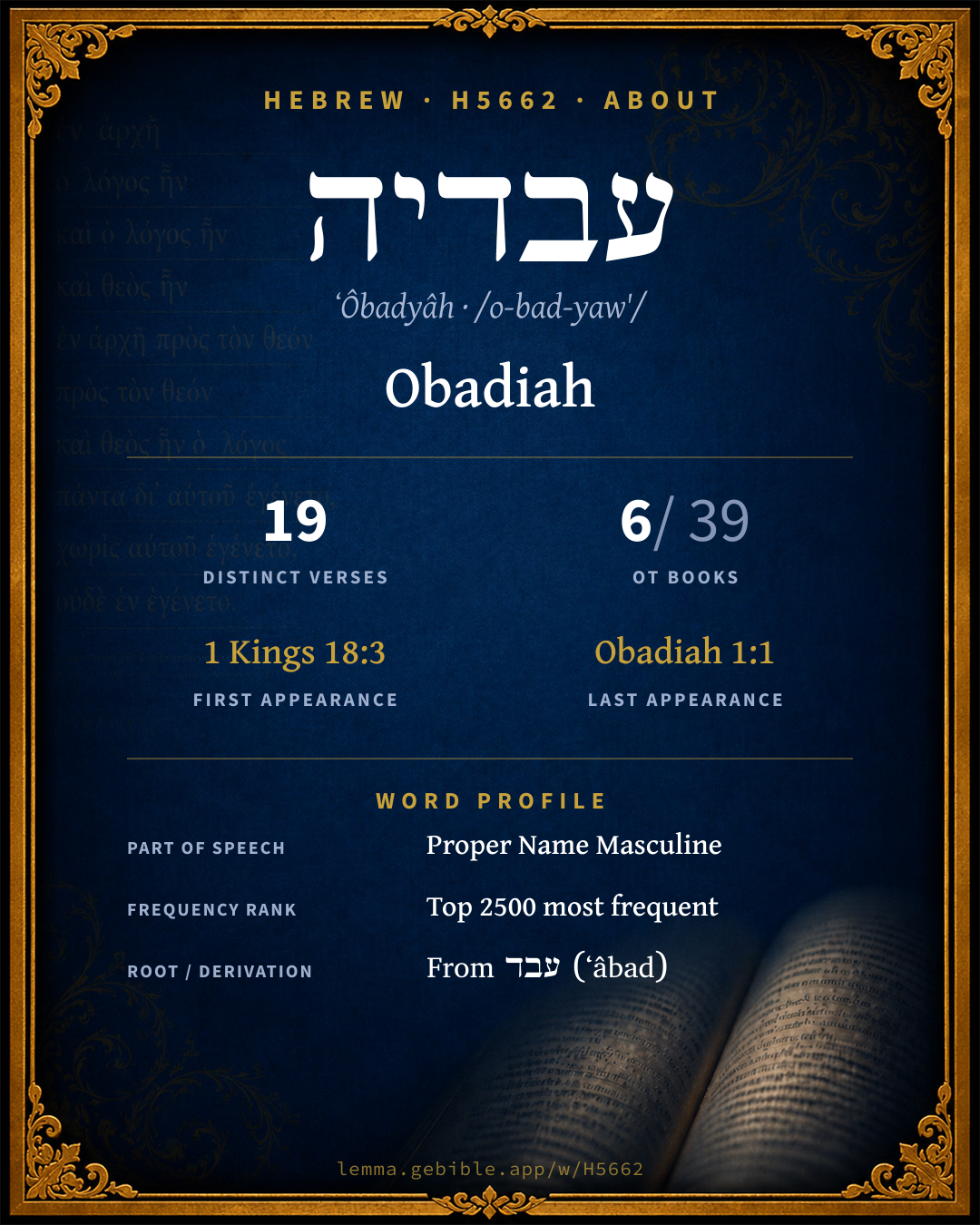
עֹבַדְיָ֫הוּ
Obadiah
BDB lists 10 entries for ‘Obadiah’ fuller range ↓
Full lexicon entry — Brown-Driver-Briggs (BDB)
From Brown-Driver-Briggs (BDB)
Where this word appears
Grammar key — what these labels mean
Part of speech
- Noun
- A naming word — a person, place, thing, or idea.
Noun type
- Proper
- A name of a specific person, place, or people (e.g. Abraham, Zion, Israel).
Every verse where H5662 appears — 19 distinct verses across 6 books. Click any verse to open its interlinear word-by-word view. Verse text shown in the World English Bible for context — . Each verse’s Hebrew form is shown with its reference; the English is not keyword-highlighted, since the data carries no word-level English alignment. Use “Compare translations” on any verse to read it across multiple English versions. This concordance covers the Hebrew Bible; Septuagint (Greek Old Testament) occurrences are not indexed here.
1 Kings 6 verses
- 1 Kings 18:3 עֹבַדְיָ֖הוּ וְ/עֹבַדְיָ֗הוּ n Proper conj + n Proper Ahab called Obadiah, who was over the household. (Now Obadiah feared Yahweh greatly:
- 1 Kings 18:4 עֹבַדְיָ֜הוּ n Proper for it was so, when Jezebel cut off the prophets of Yahweh, that Obadiah took one hundred prophets, and hid them by fifty in a cave, and fed them with bread and water.)
- 1 Kings 18:5 עֹ֣בַדְיָ֔הוּ n Proper Ahab said to Obadiah, Go through the land, to all the springs of water, and to all the brooks: peradventure we may find grass and save the horses and mules alive, that we not lose all the animals.
- 1 Kings 18:6 וְ/עֹֽבַדְיָ֛הוּ conj + n Proper So they divided the land between them to pass throughout it: Ahab went one way by himself, and Obadiah went another way by himself.
- 1 Kings 18:7 עֹבַדְיָ֨הוּ֙ n Proper As Obadiah was in the way, behold, Elijah met him: and he knew him, and fell on his face, and said, Is it you, my lord Elijah?
- 1 Kings 18:16 עֹבַדְיָ֛הוּ n Proper So Obadiah went to meet Ahab, and told him; and Ahab went to meet Elijah.
1 Chronicles 7 verses
- 1 Chronicles 3:21 עֹבַדְיָ֖ה n Proper The sons of Hananiah: Pelatiah, and Jeshaiah; the sons of Rephaiah, the sons of Arnan, the sons of Obadiah, the sons of Shecaniah.
- 1 Chronicles 7:3 וְ֠/עֹבַדְיָה conj + n Proper The sons of Uzzi: Izrahiah. The sons of Izrahiah: Michael, and Obadiah, and Joel, Isshiah, five; all of them chief men.
- 1 Chronicles 8:38 וְ/עֹבַדְיָ֖ה conj + n Proper Azel had six sons, whose names are these: Azrikam, Bocheru, and Ishmael, and Sheariah, and Obadiah, and Hanan. All these were the sons of Azel.
- 1 Chronicles 9:16 וְ/עֹבַדְיָה֙ conj + n Proper and Obadiah the son of Shemaiah, the son of Galal, the son of Jeduthun, and Berechiah the son of Asa, the son of Elkanah, who lived in the villages of the Netophathites.
- 1 Chronicles 9:44 וְ/עֹבַדְיָ֖ה conj + n Proper Azel had six sons, whose names are these: Azrikam, Bocheru, and Ishmael, and Sheariah, and Obadiah, and Hanan: these were the sons of Azel.
- 1 Chronicles 12:9 עֹבַדְיָה֙ n Proper Ezer the chief, Obadiah the second, Eliab the third,
- 1 Chronicles 27:19 עֹבַדְיָ֑הוּ n Proper of Zebulun, Ishmaiah the son of Obadiah: of Naphtali, Jeremoth the son of Azriel:
2 Chronicles 2 verses
- 2 Chronicles 17:7 וּ/לְ/עֹבַדְיָ֣ה conj + prep + n Proper Also in the third year of his reign he sent his princes, even Ben Hail, and Obadiah, and Zechariah, and Nethanel, and Micaiah, to teach in the cities of Judah;
- 2 Chronicles 34:12 וְ/עֹבַדְיָ֤הוּ conj + n Proper The men did the work faithfully: and the overseers of them were Jahath and Obadiah, the Levites, of the sons of Merari; and Zechariah and Meshullam, of the sons of the Kohathites, to set it forward; and [others of] the Levites, all who were skillful with instruments of music.
Ezra 1 verse
Nehemiah 2 verses
Obadiah 1 verse
About this entry
At a glance — auto-summarized from this page’s data, not written by a person. Every figure links to its source below. This summary describes the numbers; it doesn’t interpret them.
עבדיה — transliterated ʻÔbadyâh — is a Hebrew name carrying the sense “Obadiah.” Debuting at 1 Kings 18:3, it then recurs through the corpus. With 19 verses in 6 books, it is an uncommon word in the Hebrew Bible. Its uses concentrate in 1 Chronicles (37% of all occurrences). See 19-verse concordance and the renderings breakdown below.
Gloss history
Strong's 1890 vs modern scholarship
About this word
Strong's H5662 catalogs a Hebrew word from the Hebrew Old Testament.
These counts are not copied from any lexicon or concordance. They are computed here, from the morphology-tagged Hebrew Old Testament. What Lemma adds →
- 19
- distinct verses
- The word appears in 19 distinct verses.
- 6 / 39
- OT books
- The word appears in 6 of 39 Old Testament books.
- #1,513
- by frequency
- Top 2500 most frequent Hebrew words (rank 1,513 of 8,640 Hebrew words by occurrence).
View all 19 occurrences in the concordance →
Most concentrated in
- 1 Chronicles 7 verses 37%
- 1 Kings 6 verses 32%
- 2 Chronicles 2 verses 11%
By section of the Old Testament
By traditional corpus
Conventional, traditional groupings — biblical authorship is debated, so this is a traditional corpus grouping, not an authorship claim. Each share is this word’s portion of its verses in that division of the Hebrew canon. Each figure is a share of the word’s 19 distinct verses.
- Writings (Ketuvim) 12 verses · 63%
- Prophets (Nevi'im) 7 verses · 37%
How translations render this word
Counts come from each version’s own published word-to-Strong’s tagging or interlinear alignment — an approximate guide to how each version renders this word, not a word-level alignment the data otherwise carries. Because each total is that version’s own tagged count, the per-version totals vary from one another and need not match the appearance or distinct-verse counts above. These counts may also differ from a printed concordance because Lemma counts each distinctly tagged rendering and does not collapse phrase taggings into a single head-word total. This is a fixed set of word-tagged versions (KJV, ASV, BSB, ULT) and does not change with the reading translation you choose elsewhere. Each version’s license is shown beside its name below (and on Sources).
- King James Version: Obadiah 18×
- American Standard Version: Obadiah 18×
- Berean Standard Bible: Obadiah 18×
- unfoldingWord Literal Text: Obadiah 19×
King James Version Public Domain
Renders H5662 across 20 tagged occurrences — most commonly:
Plus 2 renderings that appear only once — usually multi-word phrases or single function words the recovered tagging swept in, not distinct renderings.
American Standard Version Public Domain
Renders H5662 across 20 tagged occurrences — most commonly:
Plus 2 renderings that appear only once — usually multi-word phrases or single function words the recovered tagging swept in, not distinct renderings.
Berean Standard Bible Public Domain
Renders H5662 across 20 tagged occurrences — most commonly:
Plus 2 renderings that appear only once — usually multi-word phrases or single function words the recovered tagging swept in, not distinct renderings.
unfoldingWord Literal Text CC BY-SA 4.0
Renders H5662 across 20 tagged occurrences — most commonly:
Plus 1 rendering that appears only once — usually multi-word phrases or single function words the recovered tagging swept in, not distinct renderings.
14 senses and sub-senses in the full BDB
What do BDB’s symbols mean?
BDB uses these scholarly abbreviations:
| Symbol | Meaning |
|---|---|
| 𝔊 | the Septuagint (the ancient Greek translation, LXX) |
| 𝔙 | the Vulgate (the Latin translation) |
| 𝔖 | the Syriac version (the Peshitta) |
| 𝔗 | the Targum (the Aramaic translation) |
| ψ | the Psalms |
| √ | root (the underlying root or stem) |
| ‖ | parallel passage (a synonymous or contrasted parallel) |
| † | the dagger: every passage where the word occurs is cited |
The 14 senses and sub-senses the full Brown-Driver-Briggs lexicon distinguishes for this word, in lexicon order (not ranked by frequency), with BDB’s own verbatim wording and sub-sense lettering. Shown in Hebrew script with BDB’s own scholarly abbreviations. The condensed entry is in the Lexicon Entry tab. See also the Forms in the corpus table below.
- I. עֹבַדְיָ֫הוּ:
- 1. chief of Ahab’s household 1 K 18:3(×2), 4, 5, 6, 7, 16, 𝔊 Αβδ(ε)ιου. e.g. 1 Kings 18:3
- 2. father of one of the chiefs of Zebulun 1 Ch 27:19, 𝔊 Αβδ(ε)ιου (genit.). e.g. 1 Chronicles 27:19
- 3. a Levite overseer in time of Josiah 2 Ch 34:12, 𝔊 Αβδ(ε)ια, A 𝔊L Αβδιας. e.g. 2 Chronicles 34:12
- II. עֹבַדְיָה:
- 1. the prophet Ob 1, 𝔊 Οβδ(ε)ιου (genit.), Αβδ(ε)ιου. e.g. Obadiah 1:1
- 2. a descendant of David 1 Ch 3:21, 𝔊 Αβδεια, 𝔊L Οβδιας. e.g. 1 Chronicles 3:21
- 3. chief of tribe of Issachar 1 Ch 7:3, 𝔊 Μειβδεια, A Οβδια, 𝔊L Αβδια. e.g. 1 Chronicles 7:3
- 4. a Benjamite 1 Ch 8:38; 9:44, 𝔊 Αβδ(ε)ια. e.g. 1 Chronicles 8:28
- 5. a Levite 1 Ch 9:16 (‖ עַבְדָּא Ne 11:17), 𝔊 Αβδεια, A Οβδια, 𝔊L Αβια. e.g. 1 Chronicles 9:16
- 6. a Gadite chief 1 Ch 12:9, 𝔊 Αβδ(ε)ια. e.g. 1 Chronicles 12:9
- 7. a prince in time of Jehoshaphat 2 Ch 17:7, 𝔊 Αβ(δ)ιαν. e.g. 2 Chronicles 17:7
- 8. priestly companion of Ezra Ezr 8:9 Ne 10:6, 𝔊 Αδεια, Αβ(α)δ(ε)ια, 𝔊L Αβδιου, Αβιας. e.g. Ezra 8:9
- 9. a doorkeeper Ne 12:25, א Οβδιας, 𝔊L Αβδιας. e.g. Nehemiah 12:25
Senses from the full Brown-Driver-Briggs lexicon (Brown, Driver, Briggs; Oxford 1906 — public domain), digitized via Sefaria, supplemented by the OpenScriptures HebrewLexicon (CC BY 4.0). Full attribution on Sources.
Word origin
n.pr.m. (servant of Yah, cf. GrayProp. N. 295, No. 90; also Ph. עבדבעל, Palm. עבדבל, Old Aramaic עבדההד Lzb333, OHeb. עבדיהו id.334);—
— Brown-Driver-Briggs (Oxford 1906, public domain), digitized via Sefaria, supplemented by the OpenScriptures HebrewLexicon (CC BY 4.0). See Sources.
Derived from עבד (ʻâbad) (H5647) — to serve.
Forms in the corpus
The 18 distinct written forms H5662 takes in the Hebrew Bible, most frequent first — each parse links to that state’s occurrences in the concordance. Hebrew forms include their vowel points and cantillation, so a single lemma takes many written forms.
| Form | Parsing | Example | Uses |
|---|---|---|---|
| וְ/עֹבַדְיָ֖ה | Noun, Proper | 1 Chronicles 8:38 | 2 |
| עֹבַדְיָ֖ה | Noun, Proper | Ezra 8:9 | 2 |
| וְ/עֹֽבַדְיָ֛הוּ | Noun, Proper | 1 Kings 18:6 | 1 |
| וְ/עֹבַדְיָ֗הוּ | Noun, Proper | 1 Kings 18:3 | 1 |
| וְ/עֹבַדְיָ֤הוּ | Noun, Proper | 2 Chronicles 34:12 | 1 |
| וְ/עֹבַדְיָה֙ | Noun, Proper | 1 Chronicles 9:16 | 1 |
| וְ֠/עֹבַדְיָה | Noun, Proper | 1 Chronicles 7:3 | 1 |
| וּ/לְ/עֹבַדְיָ֣ה | Noun, Proper | 2 Chronicles 17:7 | 1 |
| עֹ֣בַדְיָ֔הוּ | Noun, Proper | 1 Kings 18:5 | 1 |
| עֹֽבַדְיָ֑ה | Noun, Proper | Obadiah 1:1 | 1 |
| עֹֽבַדְיָֽה | Noun, Proper | Nehemiah 10:5 | 1 |
| עֹבַדְיָ֑הוּ | Noun, Proper | 1 Chronicles 27:19 | 1 |
| עֹבַדְיָ֖הוּ | Noun, Proper | 1 Kings 18:3 | 1 |
| עֹבַדְיָ֛הוּ | Noun, Proper | 1 Kings 18:16 | 1 |
| עֹבַדְיָ֜הוּ | Noun, Proper | 1 Kings 18:4 | 1 |
| עֹבַדְיָ֥ה | Noun, Proper | Nehemiah 12:25 | 1 |
| עֹבַדְיָ֨הוּ֙ | Noun, Proper | 1 Kings 18:7 | 1 |
| עֹבַדְיָה֙ | Noun, Proper | 1 Chronicles 12:9 | 1 |
Same root — word family
Other BDB entries built from the same root as H5662, grouped by Strong’s listed origin. These share a root / origin per the lexicon — not necessarily a shared meaning. Each links to that word’s own entry.
Derives from
Shares the same root
- מעבד maʻbâd H4566 work
- עבד ʻăbad H5648 to make
- עבד ʻebed H5650 servant
- עבד ʻăbâd H5652 work
- עבדה ʻăbôdâh H5656 service
- עבדה ʻăbuddâh H5657 service
- עבדות ʻabdûwth H5659 bondage
Proper names from this root
People and places named from this root — a name, not an additional meaning of the word.
- עבדא ʻAbdâʼ H5653 Abda
- עבד אדום ʻÔbêd ʼĔdôwm H5654 Obed-edom
- עבדאל ʻAbdᵉʼêl H5655 Abdeel
- עבדון ʻAbdôwn H5658 Abdon
- עבדי ʻAbdîy H5660 Abdi
- עובד ʻÔwbêd H5744 Obed
- בדיה Bêdᵉyâh H912 Bedeiah
Compare all same-root words → Showing 4 of 16 — not the complete family. 7 of the same-root words are proper names (people or places). They share a root, not necessarily a meaning.
Bible dictionary
Public-domain dictionary articles matched to this entry by name (Obadiah). A biblical name can be shared by more than one person or place, so an article may treat several.
Easton's Bible Dictionary · M. G. Easton, 1897
Servant of the Lord. (1.) An Israelite who was chief in the household of King Ahab (1 Kings 18:3). Amid great spiritual degeneracy he maintained his fidelity to God, and interposed to protect The Lord's prophets, an hundred of whom he hid at great personal risk in a cave (4, 13). Ahab seems to have held Obadiah in great honour, although he had no sympathy with his piety (5, 6, 7). The last notice of him is his bringing back tidings to Ahab that Elijah, whom he had so long sought for, was at hand (9-16). "Go," said Elijah to him, when he met him in the way, "go tell thy lord, Behold, Elijah is here."
(2.) A chief of the tribe of Issachar (1 Chr. 7:3).
(3.) A descendant of Saul (1 Chr. 8:38).
(4.) A Levite, after the Captivity (1 Chr. 9:16).
(5.) A Gadite who joined David at Ziklag (1 Chr. 12:9).
(6.) A prince of Zebulun in the time of David (1 Chr. 27:19).
(7.) One of the princes sent by Jehoshaphat to instruct the people in the law (2 Chr. 17:7).
(8.) A Levite who superintended the repairs of the temple under Josiah (2 Chr. 34:12).
(9.) One who accompanied Ezra on the return from Babylon (Ezra 8:9).
(10.) A prophet, fourth of the minor prophets in the Hebrew canon, and fifth in the LXX. He was probably contemporary with Jeremiah and Ezekiel. Of his personal history nothing is known.
Smith's Bible Dictionary · William Smith, 1863
(servant of the Lord),
+ A man whose sons are enumerated in the genealogy of the tribe of Judah. (1 Chronicles 3:21) (B.C. 470.) + A descendant of Issachar and a chief man of his tribe. (1 Chronicles 7:3) (B.C. 1014.) + One of the six sons of Azel, a descendant of Saul. (1 Chronicles 8:33; 9:44) (B.C. 720.) + A Levite, son of Shemaiah, and descended from Jeduthun. (1 Chronicles 9:16; Nehemiah 12:25) + The second of the lion-faced Gadites who joined David at Ziklag. (1 Chronicles 12:9) (B.C. 1054.) + One of the Princes of Judah in the reign of Jehoshaphat. (2 Chronicles 17:7) (B.C. 909.) + The son of Jehiel, of the sons of Joab, who came up in the second caravan with Ezra. (Ezra 8:9) + A priest, or family of priests, who settled the covenant with Nehemiah. (Nehemiah 10:5) + The fourth of the twelve minor prophets. We know nothing of him except what we can gather from the short book which bears his name. The question of his date must depend upon the interpretation of the 11th verse of his prophecy. He there speaks of the conquest of Jerusalem and the captivity of Jacob as having occurred, He probably refers to the captivity by Nebuchadnezzar, B.C. 688. It must have been uttered at some time in the five years which intervened between B.C. 588 and 583. The book of Obadiah is a sustained denunciation of the Edomites, melting into a vision of the future glories of Zion when the arm of the Lord should have wrought her deliverance and have repaid double upon her enemies. + An officer of high rank in the court of Ahab. (1 Kings 18:3) He was a devout worshipper of Jehovah, and at the peril of his life concealed over a hundred prophets during the persecution by Jezebel; (1 Kings 18:3-16) (B.C. 904.) + The father of Ishmaiah who was chief of the tribe of Zebulun in David's reign. (1 Chronicles 27:19) (B.C. before 1014.) + A Merarite Levite in the reign of Josiah, and one of the overseers of the workmen in the restoration of the temple. (2 Chronicles 34:12) (B.C.623.)
Hitchcock's Bible Names Dictionary · Roswell D. Hitchcock, 1869
servant of the Lord
Classic public-domain reference works; full attribution on Sources.
Septuagint verse parallels
This word appears in 17 verses that also exist in the Greek Old Testament (Septuagint), out of the 19 Hebrew verses it occurs in. You can read those verses in Greek by switching the Old Testament edition to the Septuagint.
Read these verses in the Septuagint
This is a verse-level parallel only — the same verses exist in both the Hebrew and Greek Old Testaments. No word-level Hebrew↔Greek correspondence is claimed: the data carries no such alignment, so no Greek word is shown as this Hebrew word’s translation. Coverage is not total — the Septuagint omits the deuterocanon and renumbers the Psalms, so some Hebrew verses have no direct Greek parallel.