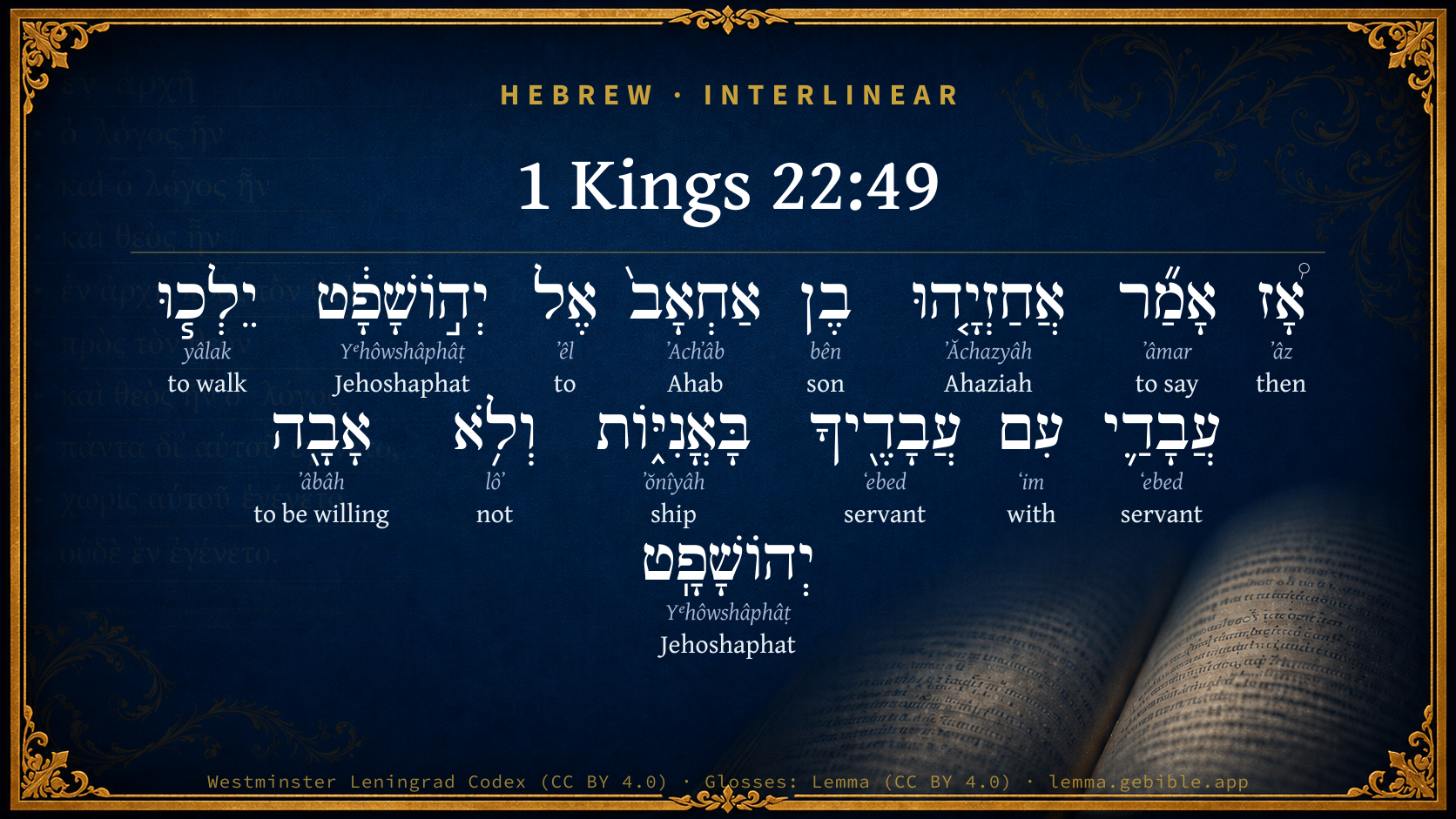
1 Kings 22:49

Hebrew (Westminster Leningrad Codex) 1 Kings 22:49 appears in the Hebrew Old Testament. The text above is from the Westminster Leningrad Codex. Each word links to its Strong’s number, a concise gloss, and parsing drawn from the Open Scriptures Hebrew Bible morphology. Click any word for its full Brown-Driver-Briggs (BDB) entry.
Download image
Cite this verse

1 Kings 22:49 (World English Bible). Public Domain. Lemma interlinear Bible study tool, https://lemma.gebible.app/v/1-kings/22/49.

Show BibTeX & RIS
BibTeX
RIS
English Translation
Then said Ahaziah the son of Ahab to Jehoshaphat, Let my servants go with your servants in the ships. But Jehoshaphat would not.
World English Bible · Public Domain
Download a study sheet

One document with this verse’s original text, its word-by-word gloss line, the meaning frame, cross-references with their text, attributed commentary, and full source and license credits — printable, and it pastes into notes with its structure intact.

This verse Autodidact and up

Study sheet (.html) Plain text (.txt)

A passage Seminary Student

Up to 50 verses in one chapter. A passage sheet keeps up to 6 commentary sources and 12 cross-references per verse, in the order this page ranks them, and says so on the sheet whenever that leaves anything out. Ask for a single verse and you get the Autodidact verse sheet above.

Everything on this page stays free to read, with no account — the sheet is a download of what is already on screen, not access to it.

Want to remove ads? Support Godless Engineer
Compare translations 3

The same verse in 3 English versions, stacked beneath the original-language interlinear above. Click any original word for its lexicon entry.

Each is an independent rendering of the whole verse — the interlinear is not word-aligned to these translations.

Highlighted words mark where these versions differ — a whole-verse word diff, not a word-by-word alignment.

  • World English Bible Public Domain
    Then said Ahaziah the son of Ahab to Jehoshaphat, Let my servants go with your servants in the ships. But Jehoshaphat would not.
  • King James Version Public Domain
    Then said Ahaziah the son of Ahab unto Jehoshaphat, Let my servants go with thy servants in the ships. But Jehoshaphat would not.
  • unfoldingWord Literal Text CC BY-SA 4.0
    Then Ahaziah, the son of Ahab, said to Jehoshaphat, “Let my servants go with your servants in the ships.” But Jehoshaphat was not willing.

unfoldingWord Literal Text — © unfoldingWord, licensed CC BY-SA 4.0. Word-aligned USFM3 via Door43 (git.door43.org/unfoldingWord/en_ult).

Versions to compare (up to 4)

3 of 4 selected

Show all 18 translations

Every available English version of this verse, each an independent rendering of the whole verse.

  • World English Bible Public Domain
    Then said Ahaziah the son of Ahab to Jehoshaphat, Let my servants go with your servants in the ships. But Jehoshaphat would not.
  • Berean Standard Bible Public Domain
    At that time Ahaziah son of Ahab said to Jehoshaphat, “Let my servants sail with your servants,” but Jehoshaphat refused.
  • Majority Standard Bible Public Domain
    At that time Ahaziah son of Ahab said to Jehoshaphat, “Let my servants sail with your servants,” but Jehoshaphat refused.
  • King James Version Public Domain
    Then said Ahaziah the son of Ahab unto Jehoshaphat, Let my servants go with thy servants in the ships. But Jehoshaphat would not.
  • American Standard Version (1901) Public Domain
    Then said Ahaziah the son of Ahab unto Jehoshaphat, Let my servants go with thy servants in the ships. But Jehoshaphat would not.
  • Revised Version (1885) Public Domain
    Then said Ahaziah the son of Ahab unto Jehoshaphat, Let my servants go with thy servants in the ships. But Jehoshaphat would not.
  • Geneva Bible (1599) Public Domain
    Then sayde Ahaziah the sonne of Ahab vnto Iehoshaphat, Let my seruants goe with thy seruants in the ships, But Iehoshaphat would not.
  • Douay-Rheims (1899) Public Domain
    But king Josaphat made navies on the sea, to sail into Ophir for gold: but they could not go, for the ships were broken in Asiongaber.
  • Young's Literal Translation Public Domain
    Then said Ahaziah son of Ahab unto Jehoshaphat, `Let my servants go with thy servants in the ships;' and Jehoshaphat was not willing.
  • Literal Standard Version CC BY-SA 4.0
    Then Ahaziah son of Ahab said to Jehoshaphat, “Let my servants go with your servants in the ships”; and Jehoshaphat was not willing.
  • Unlocked Literal Bible CC BY-SA 4.0
    Then Ahaziah son of Ahab said to Jehoshaphat, “Let my servants sail with your servants in the ships.” But Jehoshaphat would not allow it.
  • unfoldingWord Literal Text CC BY-SA 4.0
    Then Ahaziah, the son of Ahab, said to Jehoshaphat, “Let my servants go with your servants in the ships.” But Jehoshaphat was not willing.
  • Darby Bible Public Domain
    Then said Ahaziah the son of Ahab to Jehoshaphat, Let my servants go with thy servants in the ships. But Jehoshaphat would not.
  • World Messianic Bible Public Domain
    Then Ahaziah the son of Ahab said to Jehoshaphat, “Let my servants go with your servants in the ships.” But Jehoshaphat would not.
  • Webster's Bible Public Domain
    \\22:48\\Jehoshaphat made ships of Tharshish to go to Ophir for gold: but they went not; for the ships were broken at Ezion-geber.
  • Free Bible Version CC BY-SA 4.0
    During that time Ahaziah, son of Ahab, asked Jehoshaphat, “Let my men sail with your men,” but Jehoshaphat refused.
  • Bible in Basic English Public Domain
    Then Ahaziah, the son of Ahab, said to Jehoshaphat, Let my men go with yours in the ships. But Jehoshaphat would not let them.
  • JPS Tanakh (1917) Public Domain
    (22-50) Then said Ahaziah the son of Ahab unto Jehoshaphat: 'Let my servants go with thy servants in the ships.' But Jehoshaphat would not.

Literal Standard Version (2020), Covenant Press — licensed CC BY-SA 4.0. Text via the HelloAO Bible API (eBible.org). Unlocked Literal Bible (unfoldingWord) — licensed CC BY-SA 4.0. Text via the HelloAO Bible API (eBible.org). unfoldingWord Literal Text — © unfoldingWord, licensed CC BY-SA 4.0. Word-aligned USFM3 via Door43 (git.door43.org/unfoldingWord/en_ult). Free Bible Version, Dr. Jonathan Gallagher — licensed CC BY-SA 4.0. Text via the HelloAO Bible API (eBible.org).

Word by word

More ways to search: Search by grammar → Find every occurrence → Compare this word →

Practice this passage: Drill this verse → Learn its vocabulary →

בָּאֳנִיּ֑וֹת
ʼŏnîyâh
H591
“in/at · ships”
Preposition + Noun, Common, Feminine, Plural, Absolute
Part of Speech
Preposition + Noun
Type
Common
Gender
Feminine
Number
Plural
State
Absolute
Full BDB Definition

Origin: from H590

TWOT: 125b

ship - men of ships, seamen
  1. אָ֠ז ʼâz H227 “then” Adverb
  2. אָמַ֞ר ʼâmar H559 “to say” Verb, Qal, Perfect, 3rd Person, Masculine, Singular
  3. אֲחַזְיָ֤הוּ ʼĂchazyâh H274 “Ahaziah” Noun, Proper
  4. בֶן bên H1121 “son of” Noun, Common, Masculine, Singular, Construct
  5. אַחְאָב֙ ʼAchʼâb H256 “Ahab” Noun, Proper
  6. אֶל ʼêl H413 “to” Preposition
  7. יְה֣וֹשָׁפָ֔ט Yᵉhôwshâphâṭ H3092 “Jehoshaphat” Noun, Proper
  8. יֵלְכ֧וּ yâlak H3212 “to walk” Verb, Qal, Jussive, 3rd Person, Masculine, Plural
  9. עֲבָדַ֛י ʻebed H5650 “servants · my” Noun, Common, Masculine, Plural, Construct + Suffix, Personal, 1st Person, Common, Singular
  10. עִם ʻim H5973 “with” Preposition
  11. עֲבָדֶ֖יךָ ʻebed H5650 “servants · your” Noun, Common, Masculine, Plural, Construct + Suffix, Personal, 2nd Person, Masculine, Singular
  12. וְלֹ֥א lôʼ H3808 “and · not” Conjunction + Particle, Negative
  13. אָבָ֖ה ʼâbâh H14 “to be willing” Verb, Qal, Perfect, 3rd Person, Masculine, Singular
  14. יְהוֹשָׁפָֽט Yᵉhôwshâphâṭ H3092 “Jehoshaphat” Noun, Proper

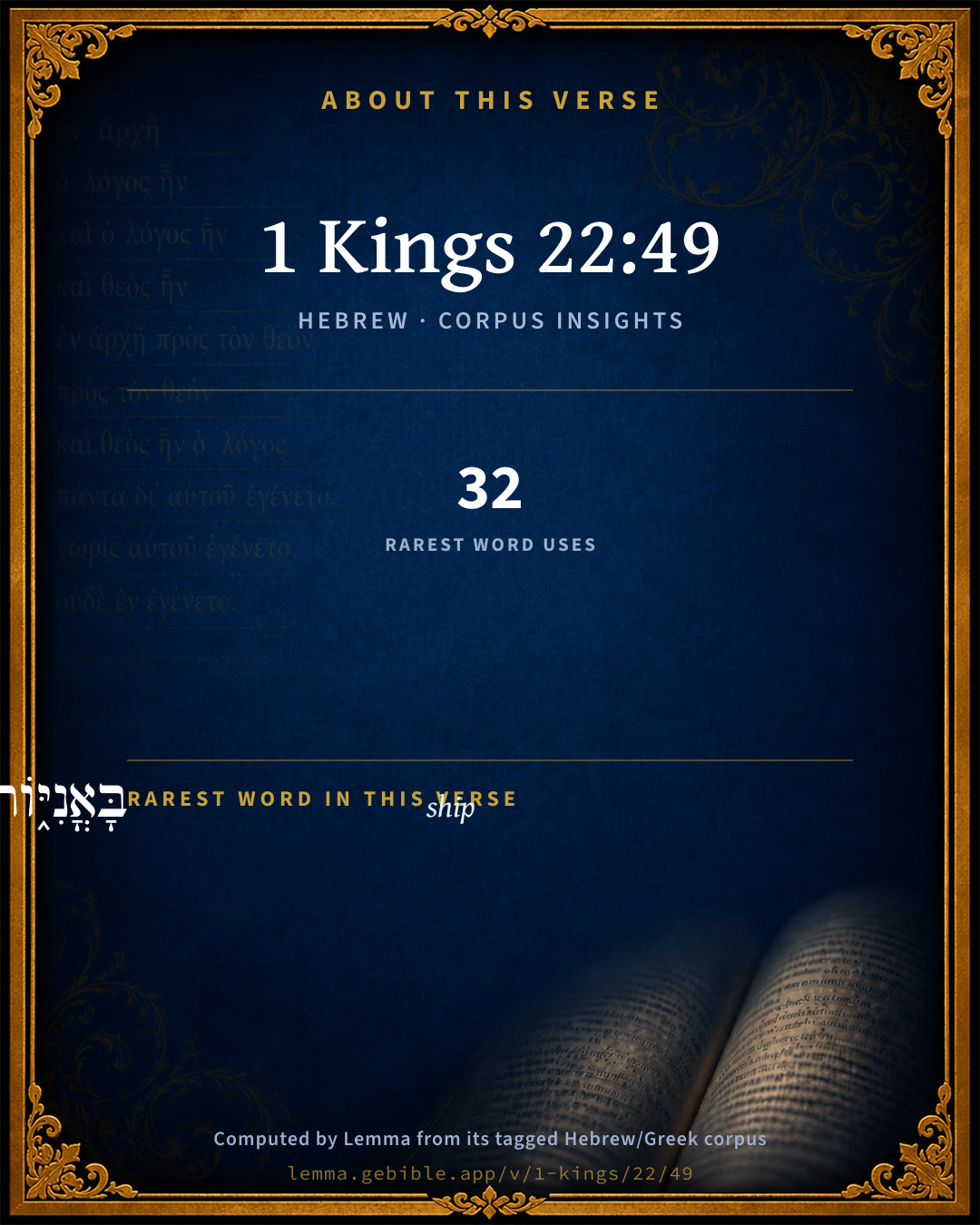
About this verse

These counts appear in no published source. They are computed here, from the morphology-tagged text and Lemma’s own curated glosses. What Lemma adds →

15
words
13
distinct lemmas
Historical
section

Shared distinctive vocabulary

בָּאֳנִיּ֑וֹת ship H591 occurs in 28 verses of the Hebrew Bible. Also found in:

Grammatical profile

  • 3 verbs
  • 8 nouns
  • 2 prepositions
  • 1 adverb
  • 1 particle

Verb forms

  • אָמַ֞ר Qal · Perfect
  • יֵלְכ֧וּ Qal · Jussive
  • אָבָ֖ה Qal · Perfect

Repetition

Words recur within this verse — often emphatic in Hebrew:

  • יְה֣וֹשָׁפָ֔ט Jehoshaphat H3092 ×2
  • עֲבָדַ֛י servant H5650 ×2
Hebrew and Greek witnesses Masoretic Hebrew ↔ Greek Septuagint

The same verse in the two great witnesses to the Old Testament, shown verse-for-verse.

These are two independent witnesses, not word-aligned to each other, and the Septuagint is shown in lemma (dictionary) form.

Hebrew 1 Kings 22:49 Masoretic · Westminster Leningrad Codex

אָ֠ז אָמַ֞ר אֲחַזְיָ֤הוּ בֶן אַחְאָב֙ אֶל יְה֣וֹשָׁפָ֔ט יֵלְכ֧וּ עֲבָדַ֛י עִם עֲבָדֶ֖יךָ בָּאֳנִיּ֑וֹת וְלֹ֥א אָבָ֖ה יְהוֹשָׁפָֽט

Then said Ahaziah the son of Ahab to Jehoshaphat, Let my servants go with your servants in the ships. But Jehoshaphat would not.

World English Bible · Public Domain

Hebrew: Westminster Leningrad Codex (CC BY 4.0). Greek: Septuagint (public domain); English from a public-domain English Septuagint. How the Septuagint differs from the Hebrew →

Targum (Aramaic paraphrase)

1

The Targum is the ancient Jewish Aramaic paraphrase of the Hebrew Scriptures — an interpretive translation, not the Hebrew text itself. Onkelos (literal) and Pseudo-Jonathan (expansive) render the Torah, and Jonathan the Prophets. Coverage is partial: where no permissively-licensed English translation exists for a verse, only the Aramaic is shown. This is verse-level text, not a word-by-word alignment to the Hebrew.

  1. Targum Jonathan Prophets (Joshua–Malachi)
    יְהוֹשָׁפָט עֲבַד סְפִינַת אַפְרִיקָא לְמֵיזַל לְאוֹפִיר לְאַיְתָאָה דַהֲבָא וְלָא אֲזַל אַרֵי אִתְבָרוּ סְפִינְתָא בְעֶצְיוֹן גָבֶר:

    (no public-domain English translation for this verse)

    Targum Jonathan — Aramaic: “Mikraot Gedolot” (public domain). English: “Sefaria Community Translation” (CC0 1.0 (public-domain dedication)); “London "Chaldee Paraphrase," 1871” (public domain). Text via Sefaria.

Commentary

Notes on 1 Kings 22:49 from classic Christian and Jewish commentators (each source and its license shown beneath its notes). The classic Christian expositions comment on the surrounding passage and are grouped to its opening verse, so a note may address several verses; the Jewish commentaries on the Tanakh (Rashi and others) are per-verse, so they appear only where the commentator wrote on this verse.

Lemma curates 59 commentaries, every one of them public domain or Creative Commons licensed, each selected and text-cleaned for this edition rather than reprinted as found. About our sources →

Trapp's Complete Commentary

John Trapp

1Ki 22:49 Then said Ahaziah the son of Ahab unto Jehoshaphat, Let my servants go with thy servants in the ships. But Jehoshaphat would not.

Ver. 49. But Jehoshaphat would not.] At first he would not, but afterwards he yielded. {2Ch 20:35-37} Or, at first he did, and miscarried; and therefore would not hearken to a second motion. Vexatio dat intellectum.

John Trapp, A Commentary or Exposition upon All the Books of the Old and New Testament (1647–1656) — public domain. Text from a community e-Sword module.

Joseph Benson's Commentary

1Ki 22:49. Jehoshaphat would not — He had contracted an amity with this king, and engaged himself so far, as to permit him to join with him in this navy, 2Ch 20:35. But, being chastised, and better instructed by his ill success, and the breaking of the ships, and being reproved for his sin in joining with him, by a prophet, he would not be persuaded to repeat it, or to continue this league with him.

Joseph Benson's Commentary on the Old and New Testaments (1811–1818) — public domain. Text from a community e-Sword module.

Adam Clarke's Commentary

Verse 49. But Jehoshaphat would not.] It appears from the above cited place in Chronicles that Jehoshaphat did join in making and sending ships to Tharshish, and it is possible that what is here said is spoken of a second expedition, in which Jehoshaphat would not join Ahaziah. But instead of ולא אבה velo abah, "he would not," perhaps we should read ולו אבה velo abah, "he consented to him;" two words pronounced exactly in the same way, and differing but in one letter, viz., an א aleph for a ו vau. This reading, however, is not supported by any MS. or version; but the emendation seems just; for there are several places in these historical books in which there are mistakes of transcribers which nothing but violent criticism can restore, and to this it is dangerous to resort, but in cases of the last necessity. Critics have recommended the 48th and 49th verses to be read thus: "Jehoshaphat had built ships of burden at Ezion-geber, to go to Ophir for gold. 49. And Ahaziah, the son of Ahab, had said to Jehoshaphat, Let my servants, I pray thee, go with thy servants in the ships: to which Jehoshaphat consented. But the ships went not thither; for the ships were broken at Ezion-geber." This is Houbigant's translation, who contends that "the words of the 48th verse, but they went not, should be placed at the end of the 49th verse, for who can believe that the sacred writer should first relate that the ships were broken, and then that Ahaziah requested of Jehoshaphat that his servants might embark with the servants of Jehoshaphat?" This bold critic, who understood the Hebrew language better than any man in Europe, has, by happy conjectures, since verified by the testimony of MSS., removed the blots of many careless transcribers from the sacred volume.

Adam Clarke's Commentary on the Bible (1810–1826) — public domain. Text from a community e-Sword/MySword module.

The Cambridge Bible for Schools and Colleges

gen. ed. J. J. S. Perowne

49. Let my servants go with thy servants] This appears to have been an attempt to engage Jehoshaphat in a second expedition. If there were two expeditions contemplated, one may have been to Ophir, and the other to Tarshish. This would account for what is noticed in the previous verse, that the Chronicler mentions Tarshish as the destination, while here Ophir is spoken of.

The Cambridge Bible for Schools and Colleges (gen. ed. J. J. S. Perowne; Cambridge University Press, 1878–1918) — public domain. Text from a community e-Sword module.

Albert Barnes' Notes on the Bible

2Ch 20:35-36, explains that the two kings conjointly built the fleet with which the Ophir trade (1Ki 9:28 note) was to be re-opened. Ahaziah had thus an interest in the ships; and when they were wrecked, attributing, as it would seem, the calamity to the unskillfulness of his ally’s mariners, he proposed that the fleet should be manned in part by Israelite sailors - men probably accustomed to the sea, perhaps trained at Tyre. This proposal Jehoshaphat refused, either offended at the reflection on his subjects’ skill, or accepting the wreck of the ships, which Eliezer had prophesied, as a proof that God was against the entire undertaking.

Albert Barnes' Notes on the Bible (1834–1885) — public domain. Text from a community e-Sword/MySword module.

Haydock's Catholic Bible Commentary

Made. Hebrew incorrectly reads hasar, "ten," instead of hasa, "made;" (Calmet) which the Protestants follow, "made ships of Tharshish, to go to Ophir." (Haydock) See chap. iv. 26., and 28.

George Leo Haydock (1774–1849), Haydock's Catholic Family Bible and Commentary, 1859 edition — public domain. Excludes Psalms (Douay-Rheims chapter numbering differs from Protestant) and Deuterocanonical books (Catholic canon only).

Matthew Poole's English Annotations

Object. It is said that he did join with Ahaziah herein, 2Ch 20:35,36.

Answ. That was before this time, and before the ships were broken; for the breaking of the ships, mentioned here, 1Ki 22:48, is noted to be the effect of his sin, in joining with Ahaziah, and of the prophecy consequent upon it, 2Ch 20:37. And good Jehoshaphat being warned and chastised by God for this sin, would not be persuaded to repeat it; whereby he showed the sincerity of his repentance.

Matthew Poole's English Annotations on the Holy Bible (1683–1685) — public domain. Text from a community e-Sword/MySword module.

Whedon's Commentary on the Bible

Daniel D. Whedon

49. Jehoshaphat would not — From 2Ch_20:36-37, we learn that Ahaziah did join himself with Jehoshaphat in building ships at Ezion-geber; and for allowing this, Jehoshaphat was reproved by the prophet Eliezer, and the ships were wrecked as a Divine judgment for the offence. Accordingly we naturally infer that Jehoshaphat’s attempt to form for himself a navy, as described in the preceding verse, was subsequent to the one spoken of in 2Ch_20:36; and when Ahaziah wished again to join himself with Jehoshaphat in this second attempt, the latter refused. But nevertheless his ship-building proved a failure.

Daniel D. Whedon (gen. ed.), Commentary on the Old and New Testaments (1874–1909) — public domain. Text from a community e-Sword module.

The Pulpit Commentary

Then said Ahaziah the son of Ahab unto Jehoshaphat, Let my servants go with thy servants In the ships. But Jehoshaphat would not. But we are told in. 2Ch_20:37 that the ships were broken, according to a prophecy of Eliezer, the son of Dodavah, because Jehoshaphat had joined himself with Ahaziah. The explanation is that the fleet had been built by the two kings conjointly, and manned by the subjects of Jehoshaphat exclusively; and that, after the disaster, Ahaziah proposed either to repair the injured vessels, or to construct a second fleet, which should then be partly manned by sailors of the northern kingdom, "men probably accustomed to the sea, perhaps trained at Tyre" (Rawlinson) This proposal was declined by the king of Judah, not so much on account of the "reflection on his subjects" skill contained in it," as because of the prophecy of Eliezer, and the evidently judicial disaster which had befallen the fleet already built.

The Pulpit Commentary (1880–1919), ed. H.D.M. Spence-Jones & Joseph S. Exell — public domain. Text from a community e-Sword module.

John Wesley's Explanatory Notes

Would not - He did join with Ahaziah before this time, and before the ships were broken: for the breaking of the ships mentioned here, is noted to be the effect of his sin, in joining with Ahaziah, 2 Chron. xx, 37. And Jehoshaphat being warned and chastised by God for this sin, would not be persuaded to repeat it.

John Wesley, Explanatory Notes Upon the Whole Bible (1754–1765) — public domain. Text via the GEBible commentary corpus.

Rashi

Rabbi Shlomo Yitzchaki (Rashi)

For they [the ships] were broken. Since he joined Achazyahu in this [undertaking], therefore, they were broken. And so did the prophet say to him in Divrei Hayomim, “Because you have allied yourself with a Achazyahu, Adonoy has wrecked your undertakings.”

Rashi on the Tanakh — English translations: “The Judaica Press complete Tanach with Rashi, translated by A. J. Rosenberg” (CC BY 4.0); “Pentateuch with Rashi's commentary by M. Rosenbaum and A.M. Silbermann, 1929-1934” (public domain); “The Metsudah Tanach series, Lakewood, N.J” (CC BY 4.0); and “The Book of Joshua, Metsudah Publications, 1997” (CC BY 4.0). Text via Sefaria.

Lesson kit

Teaching starters — assembled from the data on this page, not authored interpretation. Every prompt links to the verse data it draws on. Edit before teaching.

1 Kings, in the Historical, opens this verse with 15 words (13 distinct Hebrew lemmas). Its most distinctive word is ʼŏnîyâh (“ship”). A historical commentator’s framing appears above. Read the whole chapter for the surrounding context.

Discussion questions

  1. How does “ship” (ʼŏnîyâh) shape what this verse is saying?
  2. Genesis 49:13 shares the word «ship» with this verse. How do the two illuminate each other?
  3. “Jehoshaphat” occurs 2× in this one verse. What is the effect of the repetition?
  4. These translations render this verse differently; the difference is in the English rendering, not the original. What questions does that raise?
  5. The verb «אָמַ֞ר» is Qal Perfect. How does its form color the action?
  6. Reading how Trapp's Complete Commentary and Joseph Benson's Commentary read this verse, where do the two commentators agree and where do they part?

Things to notice

  • These translations choose different wording for 2 words in this verse.
  • “Jehoshaphat” occurs 2× in this single verse.
  • 13 distinct Hebrew lemmas span 15 words in this verse.

Reading settings

Reading text

Shown beneath each verse's original-language words.

Old Testament
Old Testament edition

Read the OT as the Masoretic Hebrew (MT) or the Greek Septuagint (LXX).

English shown for the Greek Septuagint (in the Hebrew ↔ Greek comparison).

Comparing translations? Open the Compare panel on any verse page to stack up to four side by side.