
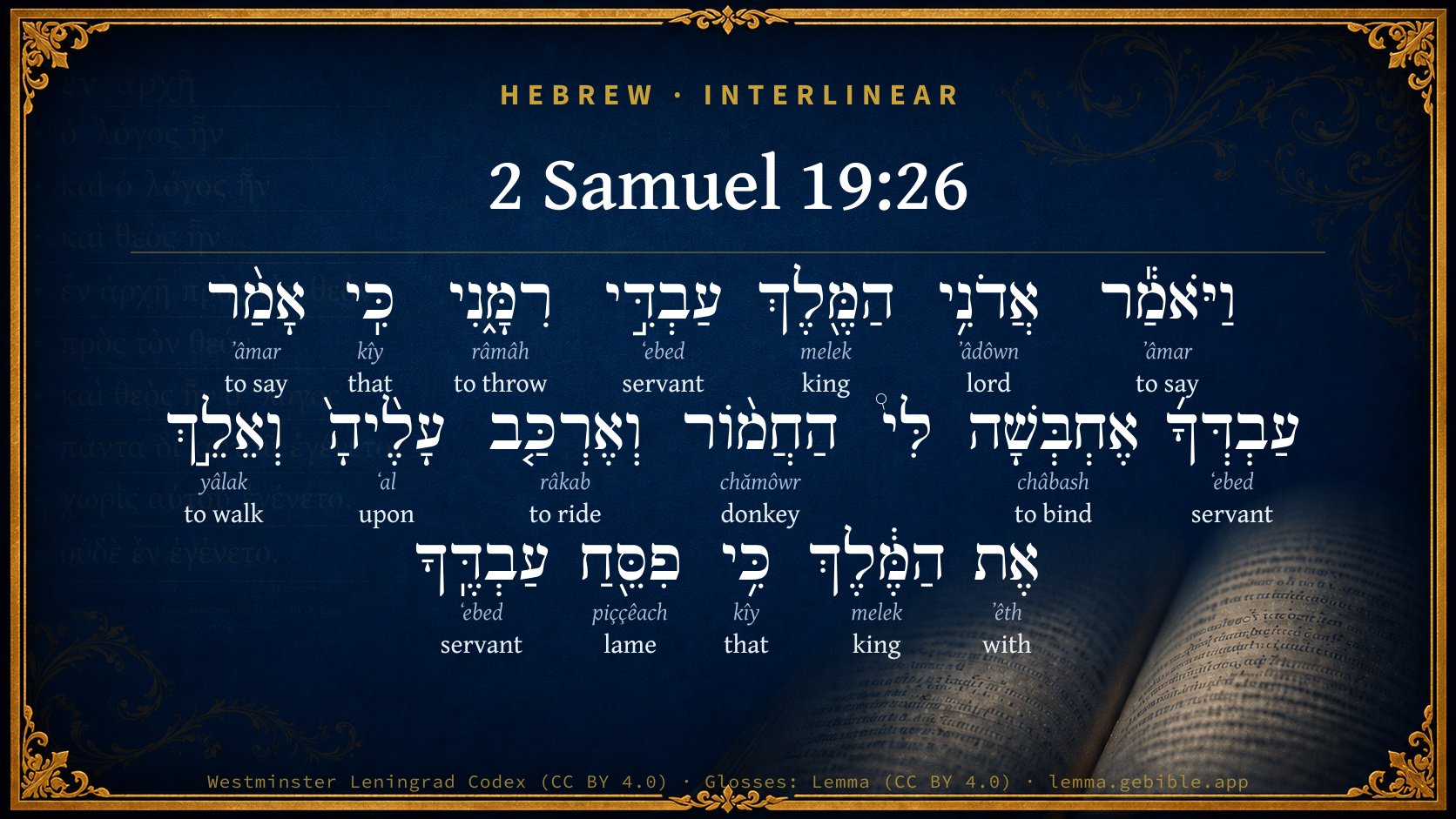
2 Samuel 19:26

Hebrew (Westminster Leningrad Codex) 2 Samuel 19:26 appears in the Hebrew Old Testament. The text above is from the Westminster Leningrad Codex. Each word links to its Strong’s number, a concise gloss, and parsing drawn from the Open Scriptures Hebrew Bible morphology. Click any word for its full Brown-Driver-Briggs (BDB) entry.
Download image
Cite this verse

2 Samuel 19:26 (World English Bible). Public Domain. Lemma interlinear Bible study tool, https://lemma.gebible.app/v/2-samuel/19/26.

Show BibTeX & RIS
BibTeX
RIS
English Translation
He answered, My lord, O king, my servant deceived me: for your servant said, I will saddle me a donkey, that I may ride thereon, and go with the king; because your servant is lame.
World English Bible · Public Domain
Download a study sheet

One document with this verse’s original text, its word-by-word gloss line, the meaning frame, cross-references with their text, attributed commentary, and full source and license credits — printable, and it pastes into notes with its structure intact.

This verse Autodidact and up

Study sheet (.html) Plain text (.txt)

A passage Seminary Student

Up to 50 verses in one chapter. A passage sheet keeps up to 6 commentary sources and 12 cross-references per verse, in the order this page ranks them, and says so on the sheet whenever that leaves anything out. Ask for a single verse and you get the Autodidact verse sheet above.

Everything on this page stays free to read, with no account — the sheet is a download of what is already on screen, not access to it.

Want to remove ads? Support Godless Engineer
Compare translations 3

The same verse in 3 English versions, stacked beneath the original-language interlinear above. Click any original word for its lexicon entry.

Each is an independent rendering of the whole verse — the interlinear is not word-aligned to these translations.

Highlighted words mark where these versions differ — a whole-verse word diff, not a word-by-word alignment.

  • World English Bible Public Domain
    He answered, My lord, O king, my servant deceived me: for your servant said, I will saddle me a donkey, that I may ride thereon, and go with the king; because your servant is lame.
  • King James Version Public Domain
    And he answered, My lord, O king, my servant deceived me: for thy servant said, I will saddle me an ass, that I may ride thereon, and go to the king; because thy servant is lame.
  • unfoldingWord Literal Text CC BY-SA 4.0
    And he said, “My lord the king, my servant deceived me, for your servant said, ‘Let me saddle a donkey for myself, and let me ride on it, and let me go with the king.’ For your servant lame.

unfoldingWord Literal Text — © unfoldingWord, licensed CC BY-SA 4.0. Word-aligned USFM3 via Door43 (git.door43.org/unfoldingWord/en_ult).

Versions to compare (up to 4)

3 of 4 selected

Show all 18 translations

Every available English version of this verse, each an independent rendering of the whole verse.

  • World English Bible Public Domain
    He answered, My lord, O king, my servant deceived me: for your servant said, I will saddle me a donkey, that I may ride thereon, and go with the king; because your servant is lame.
  • Berean Standard Bible Public Domain
    “My lord the king,” he replied, “because I am lame, I said, ‘I will have my donkey saddled so that I may ride on it and go with the king.’ But my servant Ziba deceived me,
  • Majority Standard Bible Public Domain
    “My lord the king,” he replied, “because I am lame, I said, ‘I will have my donkey saddled so that I may ride on it and go with the king.’ But my servant Ziba deceived me,
  • King James Version Public Domain
    And he answered, My lord, O king, my servant deceived me: for thy servant said, I will saddle me an ass, that I may ride thereon, and go to the king; because thy servant is lame.
  • American Standard Version (1901) Public Domain
    And he answered, My lord, O king, my servant deceived me: for thy servant said, I will saddle me an ass, that I may ride thereon, and go with the king; because thy servant is lame.
  • Revised Version (1885) Public Domain
    And he answered, My lord, O king, my servant deceived me: for thy servant said, I will saddle me an ass, that I may ride thereon, and go with the king; because thy servant is lame.
  • Geneva Bible (1599) Public Domain
    And he answered, My lorde the king, my seruant deceiued me: for thy seruant said, I would haue mine asse sadled to ride thereon, for to goe with the king, because thy seruant is lame.
  • Douay-Rheims (1899) Public Domain
    And he answering, said: My lord, O king, my servant despised me: for I thy servant spoke to him to saddle me an ass, that I might get on and go with the king: for I thy servant am lame.
  • Young's Literal Translation Public Domain
    And he saith, `My lord, O king, my servant deceived me, for thy servant said, I saddle for me the ass, and ride on it, and go with the king, for thy servant `is' lame;
  • Literal Standard Version CC BY-SA 4.0
    And he says, “My lord, O king, my servant deceived me, for your servant said, I saddle the donkey for myself, and ride on it, and go with the king, for your servant [is] lame;
  • Unlocked Literal Bible CC BY-SA 4.0
    He answered, “My master the king, my servant deceived me, for I said, 'I will saddle a donkey so I may ride on it and go with the king, because your servant is lame.'
  • unfoldingWord Literal Text CC BY-SA 4.0
    And he said, “My lord the king, my servant deceived me, for your servant said, ‘Let me saddle a donkey for myself, and let me ride on it, and let me go with the king.’ For your servant lame.
  • Darby Bible Public Domain
    And he said, My lord, O king, my servant deceived me; for thy servant said, I will saddle me the ass, and ride thereon, and go with the king; for thy servant is lame.
  • World Messianic Bible Public Domain
    He answered, “My lord, O king, my servant deceived me. For your servant said, ‘I will saddle a donkey for myself, that I may ride on it and go with the king,’ because your servant is lame.
  • Webster's Bible Public Domain
    And he answered, My lord, O king, my servant deceived me: for thy servant said, I will saddle me an ass, that I may ride on it, and go to the king; because thy servant is lame.
  • Free Bible Version CC BY-SA 4.0
    Mephibosheth answered, “Your Majesty, my servant Ziba tricked me. I told him, ‘Saddle up my donkey so I can ride her and leave with the king,’ because you know that I'm lame.
  • Bible in Basic English Public Domain
    And he said in answer, Because of the deceit of my servant, my lord king: for I, your servant, said to him, You are to make ready an ass and on it I will go with the king, for your servant has not the use of his feet.
  • JPS Tanakh (1917) Public Domain
    (19-27) And he answered: 'My lord, O king, my servant deceived me; for thy servant said: I will saddle me an ass, that I may ride thereon, and go with the king; because thy servant is lame.

Literal Standard Version (2020), Covenant Press — licensed CC BY-SA 4.0. Text via the HelloAO Bible API (eBible.org). Unlocked Literal Bible (unfoldingWord) — licensed CC BY-SA 4.0. Text via the HelloAO Bible API (eBible.org). unfoldingWord Literal Text — © unfoldingWord, licensed CC BY-SA 4.0. Word-aligned USFM3 via Door43 (git.door43.org/unfoldingWord/en_ult). Free Bible Version, Dr. Jonathan Gallagher — licensed CC BY-SA 4.0. Text via the HelloAO Bible API (eBible.org).

Word by word

More ways to search: Search by grammar → Find every occurrence → Compare this word →

Practice this passage: Drill this verse → Learn its vocabulary →

רִמָּ֑נִי
râmâh
H7411
“to throw · me”
Verb, Piel, Perfect, 3rd Person, Masculine, Singular + Suffix, Personal, 1st Person, Common, Singular
Part of Speech
Verb
Stem
Piel
Form
Perfect
Person
3rd Person
Gender
Masculine
Number
Singular
Full BDB Definition

Origin: a primitive root

TWOT: 2168 , 2169

to cast, shoot, hurl - (Qal) - to throw - bow-shooters, bowmen (participle) - (Piel) to throw down - to beguile, deceive, mislead, deal treacherously - (Piel) - to beguile, deceive, mislead, trick - to deal treacherously with, betray
  1. וַיֹּאמַ֕ר ʼâmar H559 “and · to say” Conjunction + Verb, Qal, Sequential Imperfect, 3rd Person, Masculine, Singular
  2. אֲדֹנִ֥י ʼâdôwn H113 “lord · my” Noun, Common, Masculine, Singular, Construct + Suffix, Personal, 1st Person, Common, Singular
  3. הַמֶּ֖לֶךְ melek H4428 “the · king” Particle, Definite Article + Noun, Common, Masculine, Singular, Absolute
  4. עַבְדִּ֣י ʻebed H5650 “servant · my” Noun, Common, Masculine, Singular, Construct + Suffix, Personal, 1st Person, Common, Singular
  5. כִּֽי kîy H3588 “that” Conjunction
  6. אָמַ֨ר ʼâmar H559 “to say” Verb, Qal, Perfect, 3rd Person, Masculine, Singular
  7. עַבְדְּךָ֜ ʻebed H5650 “servant · your” Noun, Common, Masculine, Singular, Construct + Suffix, Personal, 2nd Person, Masculine, Singular
  8. אֶחְבְּשָׁה châbash H2280 “to bind” Verb, Qal, Imperfect, 1st Person, Common, Singular
  9. הַחֲמ֨וֹר chămôwr H2543 “the · donkey” Particle, Definite Article + Noun, Common, Both, Singular, Absolute
  10. וְאֶרְכַּ֤ב râkab H7392 “and · to ride” Conjunction + Verb, Qal, Imperfect, 1st Person, Common, Singular
  11. עָלֶ֨יהָ֙ ʻal H5921 “upon · her” Preposition + Suffix, Personal, 3rd Person, Feminine, Singular
  12. וְאֵלֵ֣ךְ yâlak H3212 “and · to walk” Conjunction + Verb, Qal, Imperfect, 1st Person, Common, Singular
  13. אֶת ʼêth H854 “with” Preposition
  14. הַמֶּ֔לֶךְ melek H4428 “the · king” Particle, Definite Article + Noun, Common, Masculine, Singular, Absolute
  15. כִּ֥י kîy H3588 “that” Conjunction
  16. פִסֵּ֖חַ piççêach H6455 “lame” Adjective, Adjective, Masculine, Singular, Absolute
  17. עַבְדֶּֽךָ ʻebed H5650 “servant · your” Noun, Common, Masculine, Singular, Construct + Suffix, Personal, 2nd Person, Masculine, Singular

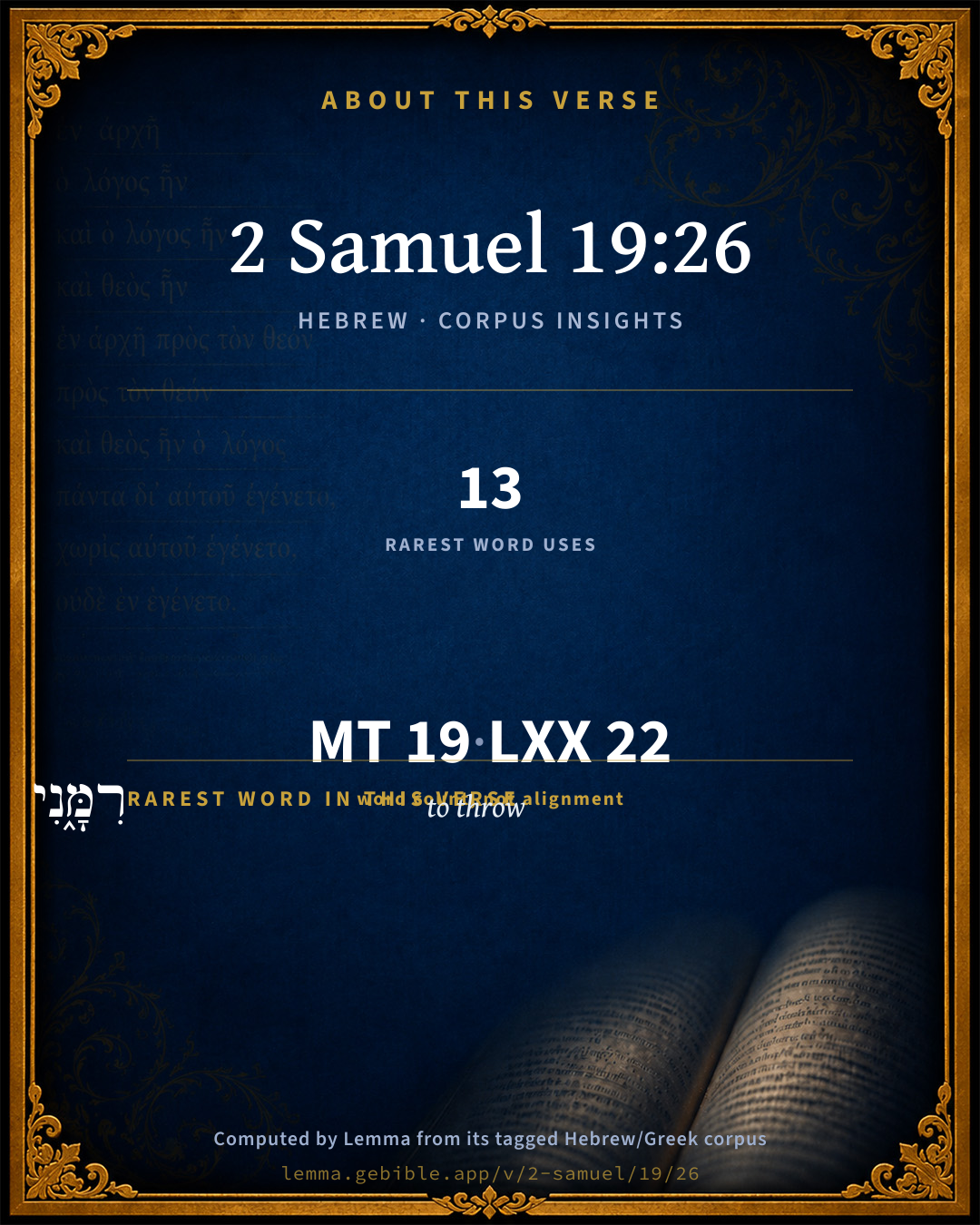
About this verse

These counts appear in no published source. They are computed here, from the morphology-tagged text and Lemma’s own curated glosses. What Lemma adds →

19
words
13
distinct lemmas
Historical
section

Notable vocabulary

The rarest word here is רִמָּ֑נִי to throw H7411 — appearing just 13 times in the whole Hebrew Bible.

Shared distinctive vocabulary

רִמָּ֑נִי to throw H7411 occurs in 13 verses of the Hebrew Bible. Also found in:

Grammatical profile

  • 6 verbs
  • 7 nouns
  • 1 adjective
  • 3 prepositions
  • 2 conjunctions

Verb forms

  • וַיֹּאמַ֕ר Qal · Sequential Imperfect
  • רִמָּ֑נִי Piel · Perfect
  • אָמַ֨ר Qal · Perfect
  • אֶחְבְּשָׁה Qal · Imperfect
  • וְאֶרְכַּ֤ב Qal · Imperfect
  • וְאֵלֵ֣ךְ Qal · Imperfect

Repetition

Words recur within this verse — often emphatic in Hebrew:

  • עַבְדִּ֣י servant H5650 ×3
  • וַיֹּאמַ֕ר to say H559 ×2
  • הַמֶּ֖לֶךְ king H4428 ×2
  • כִּֽי that H3588 ×2

Hebrew & Septuagint length

In English translation the verse runs 35 words from the Hebrew and 39 from the Septuagint (LXX English) — closely comparable.

A rough comparison of the two English renderings, which tokenize alike — not a word-level alignment.

Word counts can differ between the Hebrew and the Greek without any difference in meaning — e.g. the Hebrew direct-object marker אֵת has no separate Greek word, and Greek often adds the article ὁ.

In the original languages it is 19 Hebrew tokens and 22 Greek tokens — but the two are counted differently (Hebrew bundles its prefixes and suffixes into one token; the Greek is in lemma form), so that isn’t a like-for-like length.

Cross-references

3

Topical passages linked to 2 Samuel 19:26 in the Treasury of Scripture Knowledge — connected by theme and wording, ordered by reader-vote popularity; previews shown in the World English Bible.

  • 2 Samuel 4:4 Now Jonathan, Saul's son, had a son who was lame of his feet. He was five years old when the news came of Saul and Jonathan out of Jezreel; and his nurse took him up, and fled: and it happened, as she made haste to flee, that he fell, and became lame. His name was Mephibosheth.
  • 2 Samuel 9:3 The king said, Is there not yet any of the house of Saul, that I may show the kindness of God to him? Ziba said to the king, Jonathan has yet a son, who is lame of his feet.
  • 2 Samuel 16:2–3 The king said to Ziba, What do you mean by these? Ziba said, The donkeys are for the king's household to ride on; and the bread and summer fruit for the young men to eat; and the wine, that such as are faint in the wilderness may drink.

Cross-references courtesy of OpenBible.info (CC BY 4.0).

Hebrew and Greek witnesses Masoretic Hebrew ↔ Greek Septuagint

The same verse in the two great witnesses to the Old Testament, shown verse-for-verse.

These are two independent witnesses, not word-aligned to each other, and the Septuagint is shown in lemma (dictionary) form.

Hebrew 2 Samuel 19:26 Masoretic · Westminster Leningrad Codex

וַיֹּאמַ֕ר אֲדֹנִ֥י הַמֶּ֖לֶךְ עַבְדִּ֣י רִמָּ֑נִי כִּֽי אָמַ֨ר עַבְדְּךָ֜ אֶחְבְּשָׁה לִּי֩ הַחֲמ֨וֹר וְאֶרְכַּ֤ב עָלֶ֨יהָ֙ וְאֵלֵ֣ךְ אֶת הַמֶּ֔לֶךְ כִּ֥י פִסֵּ֖חַ עַבְדֶּֽךָ

He answered, My lord, O king, my servant deceived me: for your servant said, I will saddle me a donkey, that I may ride thereon, and go with the king; because your servant is lame.

World English Bible · Public Domain

Greek LXX 2 Samuel 19:26 Septuagint · lemma form

καί γίγνομαι ὅτε εἰςἔρχομαι εἰς ἰερουσαλήμ εἰς ἀπάντησις ὁ βασιλεύς καί εἶπον αὐτός ὁ βασιλεύς τίς ὅτι οὐ πορεύομαι μετά ἐγώ μεμφιβοσθε

And Memphibosthe said to him, My lord, O king, my servant deceived me; for your servant said to him, Saddle me the ass, and I will ride upon it, and go with the king; for your servant is lame.

LXX2012 (modern English Septuagint) · Public Domain

Hebrew: Westminster Leningrad Codex (CC BY 4.0). Greek: Septuagint (public domain); English from LXX2012 (modern English Septuagint) (Public Domain). How the Septuagint differs from the Hebrew →

Targum (Aramaic paraphrase)

1

The Targum is the ancient Jewish Aramaic paraphrase of the Hebrew Scriptures — an interpretive translation, not the Hebrew text itself. Onkelos (literal) and Pseudo-Jonathan (expansive) render the Torah, and Jonathan the Prophets. Coverage is partial: where no permissively-licensed English translation exists for a verse, only the Aramaic is shown. This is verse-level text, not a word-by-word alignment to the Hebrew.

  1. Targum Jonathan Prophets (Joshua–Malachi)
    וַהֲוָה כַּד אָתָא לִירוּשְׁלֵם לָקֳדָמוּת מַלְכָּא וַאֲמַר לֵיהּ מַלְכָּא לְמָא לָא אָזַלְתָּא עִמִי מְפִיבֹשֶׁת:

    (no public-domain English translation for this verse)

    Targum Jonathan — Aramaic: “Mikraot Gedolot” (public domain). English: “Sefaria Community Translation” (CC0 1.0 (public-domain dedication)); “London "Chaldee Paraphrase," 1871” (public domain). Text via Sefaria.

Commentary

Notes on 2 Samuel 19:26 from classic Christian and Jewish commentators (each source and its license shown beneath its notes). The classic Christian expositions comment on the surrounding passage and are grouped to its opening verse, so a note may address several verses; the Jewish commentaries on the Tanakh (Rashi and others) are per-verse, so they appear only where the commentator wrote on this verse.

Lemma curates 59 commentaries, every one of them public domain or Creative Commons licensed, each selected and text-cleaned for this edition rather than reprinted as found. About our sources →

Trapp's Complete Commentary

John Trapp

2Sa 19:26 And he answered, My lord, O king, my servant deceived me: for thy servant said, I will saddle me an ass, that I may ride thereon, and go to the king; because thy servant [is] lame.

Ver. 26. My servant deceived me.] He doth not say, My servant hath by false informations and unjust accusations got my land from me: this troubled Mephibosheth nothing so much as the loss of his good name, and that good esteem that David formerly had of him. He said,

“ Ego si bonam famam servasso, sat dives ero.” - Plaut.

His comfort was that God, howsoever, would be his character witness at the resurrection.

John Trapp, A Commentary or Exposition upon All the Books of the Old and New Testament (1647–1656) — public domain. Text from a community e-Sword module.

Ellicott's Commentary for English Readers

(26) My servant deceived me.—It now appears that the two asses laden with provisions which Ziba had brought to David in his flight (2Sa_16:1-2) were those which he had been ordered to prepare for his master. When Ziba had stolen away with these, Mephibosheth was left helpless in his lameness. Most of the ancient versions read “said to him, Saddle,” &c., but the sense is plain enough as the text stands.

A Bible Commentary for English Readers, edited by Charles John Ellicott (1878–1897) — public domain. Text from a community e-Sword module.

The Cambridge Bible for Schools and Colleges

gen. ed. J. J. S. Perowne

26. said, I will saddle me an ass] Meaning of course, I will have my ass saddled. The Sept. however reads, said unto him, Saddle me the ass, which certainly suits the context better. Apparently Ziba, after receiving the order, saddled the asses, loaded them with provisions, and went to meet David with his fictitious story (ch. 2Sa_16:1), leaving Mephibosheth in the lurch.

The Cambridge Bible for Schools and Colleges (gen. ed. J. J. S. Perowne; Cambridge University Press, 1878–1918) — public domain. Text from a community e-Sword module.

John Gill's Exposition

And he answered, my lord, O king, my servant deceived me,.... His servant Ziba, who, instead of saddling an ass for him by his order, went off with that and another himself, Sa2 16:1; for thy servant

said, I will saddle me an ass; he not only determined this in his own mind, but gave orders to his servant to saddle one for him:

that I may ride thereon, and go to the king, because thy servant is lame; and could not walk afoot, being lame of both his feet, Sa2 4:4.

John Gill's Exposition of the Whole Bible (1746–1763) — public domain (CC PDM 1.0). Text via the HelloAO Bible API.

Albert Barnes' Notes on the Bible

What appears to have happened is, that when Mephibosheth ordered Ziba to saddle the donkeys and ride with him to join David, Ziba left him under pretence of obeying, but instead laded the donkeys with provisions, and went off alone with them, thus making it impossible for Mephibosheth to follow.

Albert Barnes' Notes on the Bible (1834–1885) — public domain. Text from a community e-Sword/MySword module.

Haydock's Catholic Bible Commentary

Despised. Hebrew and Chaldean, "acted treacherously against me." (Menochius)

George Leo Haydock (1774–1849), Haydock's Catholic Family Bible and Commentary, 1859 edition — public domain. Excludes Psalms (Douay-Rheims chapter numbering differs from Protestant) and Deuterocanonical books (Catholic canon only).

Matthew Poole's English Annotations

My servant deceived me, by carrying away the ass which I bid him saddle for me.

Matthew Poole's English Annotations on the Holy Bible (1683–1685) — public domain. Text from a community e-Sword/MySword module.

The Pulpit Commentary

Thy servant said, I will saddle me an ass. This would mean, "Thy servant purposed, said within himself, that he would saddle an ass, not by his own hands, but by those of his servants." All the versions, however, except the Chaldee, read, "Thy servant said to him, Saddle me an ass." With this agrees the narrative in 2Sa_16:1. Mephibosheth ordered Ziba to saddle for him an ass, and one for an attendant, and to put hastily together a supply of food for the journey. And Ziba does so; but when everything is ready, he leaves his master in the lurch, and carries all away to David, to whom he falsely represents Mephibosheth as a traitor. In the words that follow, he unreservedly submits himself to David, on the ground that, though innocent in this affair, yet that, as a member of a dethroned dynasty, his life was forfeit, (comp. 2Sa_21:7) and that, in permitting him to live, and placing him among his friends, the king had done him an act of grace.

The Pulpit Commentary (1880–1919), ed. H.D.M. Spence-Jones & Joseph S. Exell — public domain. Text from a community e-Sword module.

John Wesley's Explanatory Notes

Deceived me - By carrying away the ass which I bid him saddle for me.

John Wesley, Explanatory Notes Upon the Whole Bible (1754–1765) — public domain. Text via the GEBible commentary corpus.

unfoldingWord translationNotes

Door43 World Missions Community

Ziba

See how you translated this man's name in 2 Samuel 9:2. (See: How to Translate Names)

my master the king is like an angel of God

Here David's wisdom is compared to the wisdom of an angel. AT: "my master the king is as wise as an angel of God" (See: Simile)

do what is good in your eyes

This means to do what you think is right. AT: "do what you believe to be the right thing to do" (See: Idiom)

all my father's house were dead men before my master the king

Mephibosheth speaks of how his relatives had deserved to be executed as if they had already been executed and were dead. AT: "all my father's house deserved for my master the king to order them to be executed" (See: Metaphor)

my father's house

This refers to his father's relatives. AT: "my father's relatives" (See: Metonymy)

What right therefore have I that I should still cry any more to the king?

Mephibosheth uses this rhetorical question to emphasize that he has no right to request anything from the king. This can be written as a statement. AT: "Therefore, I have no right to ask the king to do anything else for me." (See: Rhetorical Question)

translationWords

deceive

donkey

angel

God

good

unfoldingWord translationNotes — © Distant Shores Media and the Door43 World Missions Community, licensed CC BY-SA 4.0. Source: git.door43.org/Door43/en_tn.

Rashi

Rabbi Shlomo Yitzchaki (Rashi)

Why did you not you go with me? To leave Yerusholoyim when I left.

Rashi on the Tanakh — English translations: “The Judaica Press complete Tanach with Rashi, translated by A. J. Rosenberg” (CC BY 4.0); “Pentateuch with Rashi's commentary by M. Rosenbaum and A.M. Silbermann, 1929-1934” (public domain); “The Metsudah Tanach series, Lakewood, N.J” (CC BY 4.0); and “The Book of Joshua, Metsudah Publications, 1997” (CC BY 4.0). Text via Sefaria.

Lesson kit

Teaching starters — assembled from the data on this page, not authored interpretation. Every prompt links to the verse data it draws on. Edit before teaching.

2 Samuel, in the Historical, opens this verse with 19 words (13 distinct Hebrew lemmas). Its most distinctive word is râmâh (“to throw”). A historical commentator’s framing appears above. Read the whole chapter for the surrounding context.

Discussion questions

  1. The word râmâh carries the sense “to throw.” How does it shape the verse?
  2. How does Genesis 29:25, which shares the word «to throw», read alongside this verse?
  3. What does the repetition of “servant” (3× in this one verse) do in this verse?
  4. These translations render this verse differently. What is at stake in choosing one wording over another?
  5. «וַיֹּאמַ֕ר» is a Qal Sequential Imperfect verb. How does that grammatical form shape the action described?
  6. Compare how Trapp's Complete Commentary and Ellicott's Commentary for English Readers read this verse. Where do they agree or differ?

Things to notice

Reading settings

Reading text

Shown beneath each verse's original-language words.

Old Testament
Old Testament edition

Read the OT as the Masoretic Hebrew (MT) or the Greek Septuagint (LXX).

English shown for the Greek Septuagint (in the Hebrew ↔ Greek comparison).

Comparing translations? Open the Compare panel on any verse page to stack up to four side by side.