2 Samuel 7:25

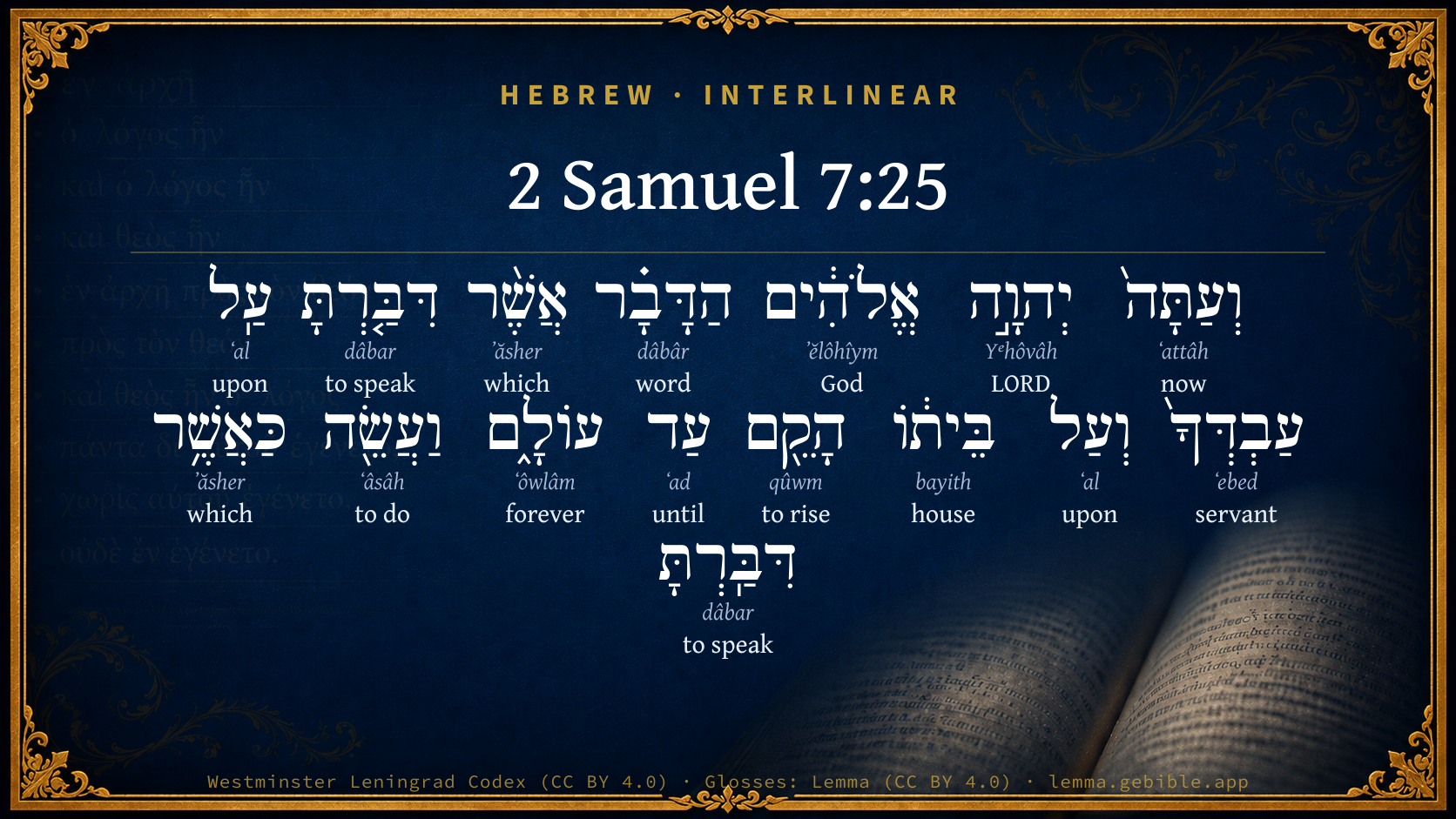
Hebrew (Westminster Leningrad Codex) 2 Samuel 7:25 appears in the Hebrew Old Testament. The text above is from the Westminster Leningrad Codex. Each word links to its Strong’s number, a concise gloss, and parsing drawn from the Open Scriptures Hebrew Bible morphology. Click any word for its full Brown-Driver-Briggs (BDB) entry.
Download image
Cite this verse

2 Samuel 7:25 (World English Bible). Public Domain. Lemma interlinear Bible study tool, https://lemma.gebible.app/v/2-samuel/7/25.

Show BibTeX & RIS
BibTeX
RIS
English Translation
Now, Yahweh God, the word that you have spoken concerning your servant, and concerning his house, confirm you it forever, and do as you have spoken.
World English Bible · Public Domain
Download a study sheet

One document with this verse’s original text, its word-by-word gloss line, the meaning frame, cross-references with their text, attributed commentary, and full source and license credits — printable, and it pastes into notes with its structure intact.

This verse Autodidact and up

Study sheet (.html) Plain text (.txt)

A passage Seminary Student

Up to 50 verses in one chapter. A passage sheet keeps up to 6 commentary sources and 12 cross-references per verse, in the order this page ranks them, and says so on the sheet whenever that leaves anything out. Ask for a single verse and you get the Autodidact verse sheet above.

Everything on this page stays free to read, with no account — the sheet is a download of what is already on screen, not access to it.

Want to remove ads? Support Godless Engineer
Compare translations 3

The same verse in 3 English versions, stacked beneath the original-language interlinear above. Click any original word for its lexicon entry.

Each is an independent rendering of the whole verse — the interlinear is not word-aligned to these translations.

Highlighted words mark where these versions differ — a whole-verse word diff, not a word-by-word alignment.

  • World English Bible Public Domain
    Now, Yahweh God, the word that you have spoken concerning your servant, and concerning his house, confirm you it forever, and do as you have spoken.
  • King James Version Public Domain
    And now, O LORD God, the word that thou hast spoken concerning thy servant, and concerning his house, establish it for ever, and do as thou hast said.
  • unfoldingWord Literal Text CC BY-SA 4.0
    And now, Yahweh God, the word that you have spoken concerning your servant and concerning his house, raise up to forever, and do just as you have spoken.

unfoldingWord Literal Text — © unfoldingWord, licensed CC BY-SA 4.0. Word-aligned USFM3 via Door43 (git.door43.org/unfoldingWord/en_ult).

Versions to compare (up to 4)

3 of 4 selected

Show all 18 translations

Every available English version of this verse, each an independent rendering of the whole verse.

  • World English Bible Public Domain
    Now, Yahweh God, the word that you have spoken concerning your servant, and concerning his house, confirm you it forever, and do as you have spoken.
  • Berean Standard Bible Public Domain
    And now, O LORD God, confirm forever the word You have spoken concerning Your servant and his house. Do as You have promised,
  • Majority Standard Bible Public Domain
    And now, O LORD God, confirm forever the word You have spoken concerning Your servant and his house. Do as You have promised,
  • King James Version Public Domain
    And now, O LORD God, the word that thou hast spoken concerning thy servant, and concerning his house, establish it for ever, and do as thou hast said.
  • American Standard Version (1901) Public Domain
    And now, O Jehovah God, the word that thou hast spoken concerning thy servant, and concerning his house, confirm thou it for ever, and do as thou hast spoken.
  • Revised Version (1885) Public Domain
    And now, O LORD God, the word that thou hast spoken concerning thy servant, and concerning his house, confirm thou it for ever, and do as thou hast spoken.
  • Geneva Bible (1599) Public Domain
    Nowe therefore, O Lord God, confirme for euer the word that thou hast spoken concerning thy seruant and his house, and doe as thou hast sayde.
  • Douay-Rheims (1899) Public Domain
    And now, O Lord God, raise up for ever the word that thou hast spoken, concerning thy servant and concerning his house: and do as thou hast spoken,
  • Young's Literal Translation Public Domain
    `And now, Jehovah God, the word which Thou hast spoken concerning Thy servant, and concerning his house, establish unto the age, and do as Thou hast spoken;
  • Literal Standard Version CC BY-SA 4.0
    And now, YHWH God, the word which You have spoken concerning Your servant, and concerning his house, establish for all time, and do as You have spoken.
  • Unlocked Literal Bible CC BY-SA 4.0
    So now, Yahweh God, may the promise that you made concerning your servant and his family be established forever. Do as you have spoken.
  • unfoldingWord Literal Text CC BY-SA 4.0
    And now, Yahweh God, the word that you have spoken concerning your servant and concerning his house, raise up to forever, and do just as you have spoken.
  • Darby Bible Public Domain
    And now, Jehovah Elohim, the word that thou hast spoken concerning thy servant and concerning his house, fulfil it for ever, and do as thou hast said.
  • World Messianic Bible Public Domain
    “Now, LORD God, the word that you have spoken concerning your servant, and concerning his house, confirm it forever, and do as you have spoken.
  • Webster's Bible Public Domain
    And now, O LORD God, the word that thou hast spoken concerning thy servant, and concerning his house, establish it for ever, and do as thou hast said.
  • Free Bible Version CC BY-SA 4.0
    So now, Lord God, please ensure that what you have said about me and my house happens, and is confirmed forever. Please do as you have promised,
  • Bible in Basic English Public Domain
    And now, O Lord God, may the word which you have said about your servant and about his family, be made certain for ever, and may you do as you have said!
  • JPS Tanakh (1917) Public Domain
    And now, O LORD God, the word that Thou hast spoken concerning Thy servant, and concerning his house, confirm Thou it for ever, and do as Thou hast spoken.

Literal Standard Version (2020), Covenant Press — licensed CC BY-SA 4.0. Text via the HelloAO Bible API (eBible.org). Unlocked Literal Bible (unfoldingWord) — licensed CC BY-SA 4.0. Text via the HelloAO Bible API (eBible.org). unfoldingWord Literal Text — © unfoldingWord, licensed CC BY-SA 4.0. Word-aligned USFM3 via Door43 (git.door43.org/unfoldingWord/en_ult). Free Bible Version, Dr. Jonathan Gallagher — licensed CC BY-SA 4.0. Text via the HelloAO Bible API (eBible.org).

Word by word

More ways to search: Search by grammar → Find every occurrence → Compare this word →

Practice this passage: Drill this verse → Learn its vocabulary →

וְעַתָּה֙
ʻattâh
H6258
“and · now”
Conjunction + Adverb
Part of Speech
Conjunction + Adverb
Full BDB Definition

Origin: from H6256

TWOT: 1650c

now - now - in phrases
  1. יְהוָ֣ה Yᵉhôvâh H3068 “LORD” Noun, Proper
  2. אֱלֹהִ֔ים ʼĕlôhîym H430 “God(s)” Noun, Common, Masculine, Plural, Absolute
  3. הַדָּבָ֗ר dâbâr H1697 “the · word” Particle, Definite Article + Noun, Common, Masculine, Singular, Absolute
  4. אֲשֶׁ֨ר ʼăsher H834 “which” Particle, Relative
  5. דִּבַּ֤רְתָּ dâbar H1696 “to speak” Verb, Piel, Perfect, 2nd Person, Masculine, Singular
  6. עַֽל ʻal H5921 “upon” Preposition
  7. עַבְדְּךָ֙ ʻebed H5650 “servant · your” Noun, Common, Masculine, Singular, Construct + Suffix, Personal, 2nd Person, Masculine, Singular
  8. וְעַל ʻal H5921 “and · upon” Conjunction + Preposition
  9. בֵּית֔וֹ bayith H1004 “house · his” Noun, Common, Masculine, Singular, Construct + Suffix, Personal, 3rd Person, Masculine, Singular
  10. הָקֵ֖ם qûwm H6965 “rise” Verb, Hiphil, Imperative, 2nd Person, Masculine, Singular
  11. עַד ʻad H5704 “until” Preposition
  12. עוֹלָ֑ם ʻôwlâm H5769 “forever” Noun, Common, Masculine, Singular, Absolute
  13. וַעֲשֵׂ֖ה ʻâsâh H6213 “and · do” Conjunction + Verb, Qal, Imperative, 2nd Person, Masculine, Singular
  14. כַּאֲשֶׁ֥ר ʼăsher H834 “like/as · which” Preposition + Particle, Relative
  15. דִּבַּֽרְתָּ dâbar H1696 “to speak” Verb, Piel, Perfect, 2nd Person, Masculine, Singular

About this verse

These counts appear in no published source. They are computed here, from the morphology-tagged text and Lemma’s own curated glosses. What Lemma adds →

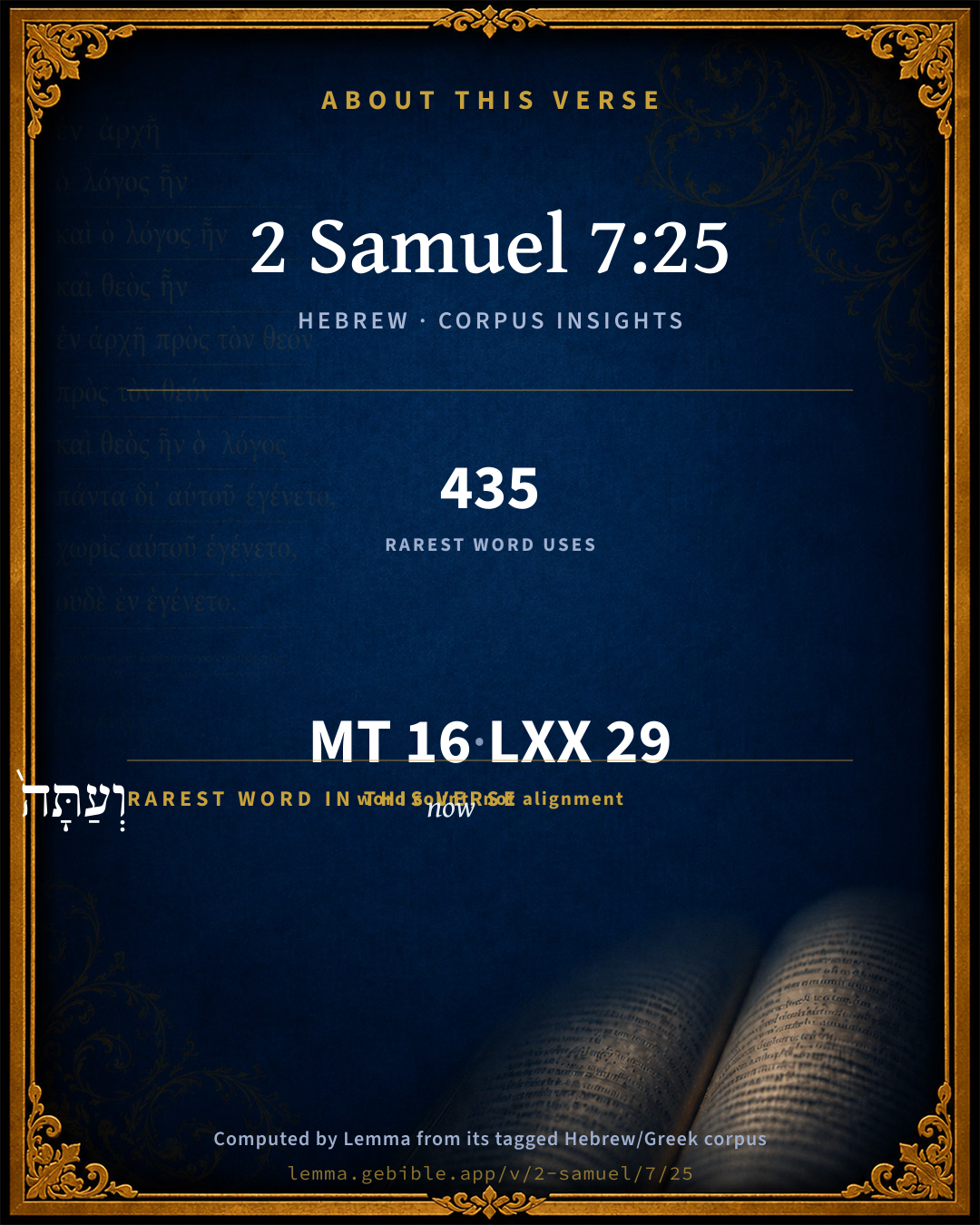
16
words
13
distinct lemmas
Historical
section

Grammatical profile

  • 4 verbs
  • 6 nouns
  • 3 prepositions
  • 1 adverb
  • 2 particles

Verb forms

  • דִּבַּ֤רְתָּ Piel · Perfect
  • הָקֵ֖ם Hiphil · Imperative
  • וַעֲשֵׂ֖ה Qal · Imperative
  • דִּבַּֽרְתָּ Piel · Perfect

Repetition

Words recur within this verse — often emphatic in Hebrew:

  • דִּבַּ֤רְתָּ to speak H1696 ×2
  • עַֽל upon H5921 ×2
  • אֲשֶׁ֨ר which H834 ×2

Hebrew & Septuagint length

In English translation the verse runs 26 words from the Hebrew and 32 from the Septuagint (LXX English) — closely comparable.

A rough comparison of the two English renderings, which tokenize alike — not a word-level alignment.

Word counts can differ between the Hebrew and the Greek without any difference in meaning — e.g. the Hebrew direct-object marker אֵת has no separate Greek word, and Greek often adds the article ὁ.

In the original languages it is 16 Hebrew tokens and 29 Greek tokens — but the two are counted differently (Hebrew bundles its prefixes and suffixes into one token; the Greek is in lemma form), so that isn’t a like-for-like length.

Cross-references

4

Topical passages linked to 2 Samuel 7:25 in the Treasury of Scripture Knowledge — connected by theme and wording, ordered by reader-vote popularity; previews shown in the World English Bible.

  • Psalms 119:49 Remember your word to your servant, Because you gave me hope.
  • Ezekiel 36:37 Thus says the Lord Yahweh: For this, moreover, will I be inquired of by the house of Israel, to do it for them: I will increase them with men like a flock.
  • Genesis 32:12 You said, 'I will surely do you good, and make your seed as the sand of the sea, which can't be numbered because there are so many.'"
  • Jeremiah 11:4–5 which I commanded your fathers in the day that I brought them forth out of the land of Egypt, out of the iron furnace, saying, Obey my voice, and do them, according to all which I command you: so shall you be my people, and I will be your God;

Cross-references courtesy of OpenBible.info (CC BY 4.0).

Hebrew and Greek witnesses Masoretic Hebrew ↔ Greek Septuagint

The same verse in the two great witnesses to the Old Testament, shown verse-for-verse.

These are two independent witnesses, not word-aligned to each other, and the Septuagint is shown in lemma (dictionary) form.

Hebrew 2 Samuel 7:25 Masoretic · Westminster Leningrad Codex

וְעַתָּה֙ יְהוָ֣ה אֱלֹהִ֔ים הַדָּבָ֗ר אֲשֶׁ֨ר דִּבַּ֤רְתָּ עַֽל עַבְדְּךָ֙ וְעַל בֵּית֔וֹ הָקֵ֖ם עַד עוֹלָ֑ם וַעֲשֵׂ֖ה כַּאֲשֶׁ֥ר דִּבַּֽרְתָּ

Now, Yahweh God, the word that you have spoken concerning your servant, and concerning his house, confirm you it forever, and do as you have spoken.

World English Bible · Public Domain

Greek LXX 2 Samuel 7:25 Septuagint · lemma form

καί νῦν κύριος ἐγώ κύριος ὁ ῥῆμα ὅς λαλέω περί ὁ δοῦλος σύ καί ὁ οἶκος αὐτός πιστόω ἕως αἰών κύριος παντοκράτωρ θεός ὁ ἰσραήλ καί νῦν καθώς λαλέω

And now, O my Lord, the Almighty Lord God of Israel, confirm the word for ever which you have spoken concerning your servant and his house: and now as you have said,

LXX2012 (modern English Septuagint) · Public Domain

Hebrew: Westminster Leningrad Codex (CC BY 4.0). Greek: Septuagint (public domain); English from LXX2012 (modern English Septuagint) (Public Domain). How the Septuagint differs from the Hebrew →

Targum (Aramaic paraphrase)

1

The Targum is the ancient Jewish Aramaic paraphrase of the Hebrew Scriptures — an interpretive translation, not the Hebrew text itself. Onkelos (literal) and Pseudo-Jonathan (expansive) render the Torah, and Jonathan the Prophets. Coverage is partial: where no permissively-licensed English translation exists for a verse, only the Aramaic is shown. This is verse-level text, not a word-by-word alignment to the Hebrew.

  1. Targum Jonathan Prophets (Joshua–Malachi)
    וּכְעַן יְיָ אֱלֹהִים פִּתְגָמָא דִי מַלֵלְתָּא עַל עַבְדָךְ וְעַל אֱנַשׁ בֵּיתֵיהּ אָקִים עַד עָלְמָא וֶעֱבֵיד כְּמָא דִי מַלֵלְתָּא:

    (no public-domain English translation for this verse)

    Targum Jonathan — Aramaic: “Mikraot Gedolot” (public domain). English: “Sefaria Community Translation” (CC0 1.0 (public-domain dedication)); “London "Chaldee Paraphrase," 1871” (public domain). Text via Sefaria.

Commentary

Notes on 2 Samuel 7:25 from classic Christian and Jewish commentators (each source and its license shown beneath its notes). The classic Christian expositions comment on the surrounding passage and are grouped to its opening verse, so a note may address several verses; the Jewish commentaries on the Tanakh (Rashi and others) are per-verse, so they appear only where the commentator wrote on this verse.

Lemma curates 59 commentaries, every one of them public domain or Creative Commons licensed, each selected and text-cleaned for this edition rather than reprinted as found. About our sources →

Trapp's Complete Commentary

John Trapp

2Sa 7:25 And now, O LORD God, the word that thou hast spoken concerning thy servant, and concerning his house, establish [it] for ever, and do as thou hast said.

Ver. 25. Do as thou hast said.] David knew well that God’s promises must be put into suit, must be prayed over. Eliah went forth to pray for rain, after He had promised it. David elsewhere saith, "Remember the word unto thy servant, upon which thou hast caused me to hope." {Psa 119:49} "Lord, do as thou hast said," is a speeding argument; like Jonathan’s bow, that never returned empty.

John Trapp, A Commentary or Exposition upon All the Books of the Old and New Testament (1647–1656) — public domain. Text from a community e-Sword module.

Tyndale Open Study Notes

Tyndale Open Resources

7:25 Confirm it: David was not asking God for a sign (as Gideon had done, Judg 6:17). Rather, David was saying, “God, may it be so.”

Tyndale Open Study Notes — © Tyndale Open Resources, licensed CC BY-SA 4.0. Text via the HelloAO Bible API.

Adam Clarke's Commentary

Verse 25. And do as thou hast said.] David well knew that all the promises made to himself and family were conditional; and therefore he prays that they may be fulfilled. His posterity did not walk with God, and therefore they were driven from the throne. It was taken from them by the neighbouring nations, and it is now in the hands of the Mohammedans; all the promises have failed to David and his natural posterity, and to Christ and his spiritual seed alone are they fulfilled. Had David's posterity been faithful, they would, according to the promises of God, have been sitting on the Israelitish throne at this day.

IT is worthy of remark how seldom God employs a soldier in any spiritual work, just for the same reason as that given to David; and yet there have been several eminently pious men in the army, who have laboured for the conversion of sinners. I knew a remarkable instance of this; I was acquainted with Mr. John Haime, a well known preacher among the people called Methodists. He was a soldier in the queen's eighth regiment of dragoons, in Flanders, in the years 1739-46. He had his horse shot under him at the battle of Fontenoy, May 11, 1745; and was in the hottest fire of the enemy for above seven hours; he preached among his fellow soldiers frequently, and under the immediate patronage of his royal highness the Duke of Cumberland, commander-in-chief; and was the means of reforming and converting many hundreds of the soldiers. He was a man of amazing courage and resolution, and of inflexible loyalty. One having expressed a wonder "how he could reconcile killing men with preaching the Gospel of the grace and peace of Christ," he answered, "I never killed a man." "How can you tell that? were you not in several battles?" "Yes, but I am confident I never killed nor wounded a man." "How was this? did you not do your duty?" "Yes, with all my might; but when in battle, either my horse jumped aside or was wounded, or was killed, or my carbine missed fire, and I could never draw the blood of the enemy." "And would you have done it if you could?" "Yes, I would have slain the whole French army, had it been in my power; I fought in a good cause, for a good king, and for my country; and though I struck in order to cut, and hack, and hew, on every side, I could kill no man." This is the substance of his answers to the above questions, and we see from it a remarkable interfering Providence; God had appointed this man to build a spiritual house in the British army, in Flanders, and would not permit him to shed the blood of his fellow creatures.

"This chapter is one of the most important in the Old Testament, and yet some of its most interesting verses are very improperly rendered in our translation; it therefore demands our most careful consideration. And as in the course of these remarks I propose to consider, and hope to explain, some of the prophecies descriptive of THE MESSIAH, which were fulfilled in JESUS CHRIST, among which prophecies that contained in this chapter is worthy of particular attention, I shall introduce it with a general state of this great argument.

"It having pleased God that, between the time of a Messiah being promised and the time of his coming, there should be delivered by the prophets a variety of marks by which the Messiah was to be known, and distinguished from every other man; it was impossible for any one to prove himself the Messiah, whose character did not answer to these marks; and of course it was necessary that all these criteria, thus Divinely foretold, should be fulfilled in the character of Jesus Christ. That these prophetic descriptions of the Messiah were numerous, appears from Christ and his apostles, (Lu 24:27; Lu 24:44; Ac 17:2; Ac 17:3; Ac 28:23, c.,) who referred the Jews to the Old Testament as containing abundant evidence of his being THE MESSIAH, because he fulfilled all the prophecies descriptive of that singular character. The chief of these prophecies related to his being miraculously born of a virgin the time and place of his birth; the tribe and family from which he was to descend; the miracles he was to perform; the manner of his preaching; his humility and mean appearance; the perfect innocence of his life; the greatness of his sufferings; the treachery of his betrayer; the circumstances of his trial; the nature of his death and burial; and his miraculous resurrection. Now amongst all the circumstances which form this chain of prophecy, the first reference made in the New Testament relates to his descent; for the New Testament begins with asserting that JESUS CHRIST was the son of David, the son of Abraham. As to the descent of Christ from ABRAHAM, every one knows that Christ was born a Jew, and consequently descended from Jacob, the grandson of Abraham. And we all know that the promise given to Abraham concerning the Messiah is recorded in the history of Abraham's life, in Ge 22:18. Christ being also to descend from DAVID, there can be no doubt that this promise, as made to David, was recorded likewise in the history of David. It is remarkable that David's life is given more at large than that of any other person in the Old Testament; and can it be supposed that the historian omitted to record that promise which was more honourable to David than any other circumstance? The record of this promise, if written at all, must have been written in this chapter; in the message from God by Nathan to David, which is here inserted. Here, I am fully persuaded, the promise was, and still is, recorded; and the chief reason why our divines have so frequently missed it, or been so much perplexed about it, is owing to our very improper translation of the 10th and 14th verses. 2Sa 7:10; 2Sa 7:14

"This wrong translation in a part of Scripture so very interesting, has been artfully laid hold of, and expatiated upon splendidly, by the deistical author of The Ground and Reasons of the Christian Religion; who pretends to demonstrate that the promise of a Messiah could not be here recorded. His reasons, hitherto I believe unanswered, are three:

1. Because, in 2Sa 7:10, the prophet speaks of the future prosperity of the Jews, as to be afterwards fixed, and no more afflicted; which circumstances are totally repugnant to the fate of the Jews, as connected with the birth and death of Christ.

2. Because the son here promised was (2Sa 7:13) to build a house; which house, it is pretended, must mean the temple of Solomon; and of course Solomon must be the son here promised. And,

3. Because 2Sa 7:14 supposes that this son might commit iniquity, which could not be supposed of the Messiah.

The first of these objections is founded on our wrong translation of 2Sa 7:10, where the words should be expressed as relating to the time past or present. For the prophet is there declaring what great things God had already done for David and his people; that he had raised David from the sheepfold to the throne; and that he had planted the Israelites in a place of safety, at rest from all those enemies who had so often before afflicted them. That the verbs ושמתי vesamti, and ונטעתי unetati, may be rendered in the time past or present, is allowed by our own translators; who here (2Sa 7:11) render והניחתי vahanichothi, and have caused thee to rest, and also render והגיד vehiggid, and telleth; which construction, made necessary here by the context, might be confirmed by other proofs almost innumerable. The translation, therefore, should run thus: I took thee from the sheepcote; and have made thee a great name; and I HAVE APPOINTED a place for my people Israel; and HAVE PLANTED them, that they may dwell in a place of their own, and move no more. Neither DO the children of wickedness afflict them any more; as before-time, and as since the time that I commanded judges to be over Israel: and I HAVE CAUSED thee to rest from all thine enemies.

"Objection the second is founded on a mistake in the sense. David indeed had proposed to build a house for God, which God did not permit. Yet, approving the piety of David's intention, God was pleased to reward it by promising that he would make a house for DAVID; which house, to be thus erected by God, was certainly not material, or made of stones, but a spiritual house, or family, to be raised up for the honour of God, and the salvation of mankind. And this house, which God would make, was to be built by David's SEED; and this seed was to be raised up AFTER David slept with his fathers; which words clearly exclude Solomon, who was set up and placed upon the throne BEFORE David was dead. This building promised by God, was to be erected by one of David's descendants, who was also to be an everlasting king; and indeed the house and the kingdom were both of them to be established forever. Now that this house or spiritual building was to be set up, together with a kingdom, by the Messiah, is clear from Zechariah; who very emphatically says, (Zec 6:12-13), Behold the man whose name is The Branch; HE SHALL BUILD THE TEMPLE of the Lord. Even HE SHALL BUILD THE TEMPLE of the Lord; and he shall bear the glory, and shall sit and rule upon his THRONE, c. Observe also the language of the New Testament. In 1Co 3:9-17, St. Paul says, Ye are God's BUILDING - Know ye not that YE are the temple of God - the temple of God is holy, which temple YE are. And the author of the Epistle to the Hebrews seems to have his eye upon this very promise in Samuel concerning a son to David, and of the house which he should build when he says, (Heb 3:6), CHRIST, AS A SON OVER HIS OWN HOUSE, WHOSE HOUSE ARE WE.

"As to the third and greatest difficulty, that also may be removed by a more just translation of 2Sa 7:14; for the Hebrew words do not properly signify what they are now made to speak. It is certain that the principal word, בהעותו behaavotho, is not the active infinitive of kal, which wouid be בעותו, but העות from עיה is in niphal, as הגלות from גלה. It is also certain that a verb, which in the active voice signifies to commit iniquity, may, in the passive signify to suffer for iniquity; and hence it is that nouns from such verbs sometimes signify iniquity, sometimes punishment. See Lowth's Isaiah, p, 187, with many other authorities which shall be produced hereafter. The way being thus made clear, we are now prepared for abolishing our translation, if he commit iniquity; and also for adopting the true one, even in his suffering for iniquity. The Messiah, who is thus the person possibly here spoken of, will be made still more manifest from the whole verse thus translated: I will be his father, and he shall be my son: EVEN IN HIS SUFFERING FOR INIQUITY, I shall chasten him with the rod of men, (with the rod due to men,) and with the stripes (due to) the children of ADAM. And this construction is well supported by Isa 53:4-5: He hath carried OUR SORROWS, (i.e., the sorrows due to us, and which we must otherwise have suffered,) he was wounded for our transgressions, he was bruised for our iniquities: the chastisement of our peace was upon him; and with his stripes we are healed. See note, p. 479, in Hallet, on Heb 11:26. Thus, then, God declares himself the Father of the Son here meant; (see also Heb 1:5); and promises that, even amidst the sufferings of this Son, (as they would be for the sins of others, not for his own,) his mercy should still attend him: nor should his favour be ever removed from this king, as it had been from Saul. And thus (as it follows) thine house (O David) and thy kingdom shall, in Messiah, be established for ever before ME: (before GOD:) thy throne shall be established for ever. Thus the angel, delivering his message to the virgin mother, Lu 1:32-33, speaks as if he was quoting from this very prophecy: The Lord God shall give unto him the throne of his father David, and he shall reign over the house of Jacob FOR EVER: and of his kingdom there shall be no end. In 2Sa 7:16, לפניך lephaneycha, is rendered as לפני lephanai, on the authority of three Hebrew MSS., with the Greek and Syriac versions; and, indeed, nothing could be established for ever in the presence of David, but in the presence of God only.

"Having thus shown that the words fairly admit here the promise made to David, that from his seed should arise Messiah, the everlasting King; it may be necessary to add that, if the Messiah be the person here meant, as suffering innocently for the sins of others, Solomon cannot be; nor can this be a prophecy admitting such double sense, or be applied properly to two such opposite characters. Of whom speaketh the prophet this? of HIMSELF, or of SOME OTHER man? This was a question properly put by the Ethiopian treasurer, (Ac 8:34), who never dreamed that such a description as he was reading could relate to different persons; and Philip shows him that the person was Jesus only. So here it may be asked, Of whom speaketh the prophet this? of Solomon, or of Christ? It must be answered, Of Christ: one reason is, because the description does not agree to Solomon; and therefore Solomon being necessarily excluded in a single sense, must also be excluded in a double. Lastly, if it would be universally held absurd to consider the promise of Messiah made to Abraham as relating to any other person besides MESSIAH; why is there not an equal absurdity in giving a double sense to the promise of Messiah thus made to DAVID?

"Next to our present very improper translation, the cause of the common confusion here has been - not distinguishing the promise here made as to Messiah alone, from another made as to Solomon alone: the first brought by Nathan, the second by Gad; the first near the beginning of David's reign, the second near the end of it; the first relating to Messiah's spiritual kingdom, everlasting without conditions, the second relating to the fate of the temporal kingdom of Solomon, and his heirs, depending entirely on their obedience or rebellion, 1Ch 22:8-13; 1Ch 28:7. Let the first message be compared with this second in 1Ch 22:8-13, which the Syriac version (at 1Ch 22:8) tells us was delivered by a prophet, and the Arabian says by the prophet GAD. This second message was after David's many wars, when he had shed much blood; and it was this second message that, out of all David's sons, appointed Solomon to be his successor. At the time of the first message Solomon was not born; it being delivered soon after David became king at Jerusalem: but Solomon was born at the time of this second message. For though our translation very wrongly says, (1Ch 22:9), a son SHALL BE born to thee - and his name shall be Solomon; yet the Hebrew text expressly speaks of him as then born - Behold a son, (נולד, natus est), IS BORN to thee: and therefore the words following must be rendered, Solomon IS his name, and I will give peace in his days: he shall build a house for my name, c.

"From David's address to God, after receiving the message by Nathan, it is plain that David understood the Son promised to be THE MESSIAH: in whom his house was to be established for ever. But the words which seem most expressive of this are in this verse now rendered very unintelligibly: And is this the manner of man? Whereas the words וזאת תורת האדם vezoth torath haadam literally signify, and this is (or must be) the law of the man, or of the Adam i.e., this promise must relate to the law or ordinance made by God to Adam, concerning the seed of the woman; the man, or the second ADAM; as the Messiah is expressly called by St. Paul, 1Co 15:45; 1Co 15:47. This meaning will be yet more evident from the parallel place, 1Ch 17:17, where the words of David are now miserably rendered thus: And thou hast regarded me according to the estate of a man of high degree; whereas the words וראיתני כתור האדם המעלה ureithani kethor haadam hammaalah literally signify, and thou hast regarded me according to the order of the ADAM THAT IS FUTURE, or THE MAN THAT IS FROM ABOVE: (for the word המעלה hammaalah very remarkably signifies hereafter as to time, and from above as to place:) and thus St. Paul, including both senses - THE SECOND MAN is THE LORD FROM HEAVEN - and Adam is the figure of him that was to come, or the future, Ro 5:14. - See the Preface of the late learned Mr. Peters on Job, referred to and confirmed as to this interesting point in a note subjoined to my Sermon on A VIRGIN SHALL CONCEIVE, c., P. 46-52, 8VO. 1765. A part of that note here follows: 'The speech of David (2Sa 7:18-29) is such as one might naturally expect from a person overwhelmed with the greatness of the promised blessing: for it is abrupt, full of wonder, and fraught with repetitions. And now what can David say unto thee? What, indeed! For thou, LORD GOD knowest thy servant - thou knowest the hearts of all men, and seest how full my own heart is. For thy word's sake - for the sake of former prophecies, and according to thine own heart - from the mere motive of thy wisdom and goodness, hast thou done all these great things, to make thy servant know them. I now perceive the reason of those miraculous providences which have attended me from my youth up taken from following the sheep, and conducted through all difficulties to be ruler of thy people; and shall I distrust the promise now made me? Thy words be true. If the preceding remarks on this whole passage be just and well grounded, then may we see clearly the chief foundation of what St. Peter tells us (Ac 2:30) concerning DAVID: that being a prophet, and KNOWING that God had sworn with an oath to him, that of the fruit of his loins, according to the flesh, he would raise up CHRIST to sit on his throne; he, seeing this before, spake of the resurrection of Christ, &c.'"

Adam Clarke's Commentary on the Bible (1810–1826) — public domain. Text from a community e-Sword/MySword module.

John Gill's Exposition

And now, O Lord God,.... From confessions of unworthiness, and of the goodness of God, and a recital of favours conferred on him and the people of Israel, David proceeds to petitions:

the word that thou hast spoken concerning thy servant, and concerning his house, establish it for ever: he prays for the sure performance of the promise of God respecting himself and his family, and the stability and perpetual continuance of the kingdom in it, and has, no doubt, a special regard to the Messiah, the promised seed that should spring from him:

and do as thou hast said: for though God had purposed and promised to do those several things, and would do them, yet it was expected by him, and it was right in David to pray for the performance of them; see Eze 36:37.

John Gill's Exposition of the Whole Bible (1746–1763) — public domain (CC PDM 1.0). Text via the HelloAO Bible API.

Haydock's Catholic Bible Commentary

Raise up. As long as the promises were not fulfilled, they seemed to be dormant. (Menochius)

George Leo Haydock (1774–1849), Haydock's Catholic Family Bible and Commentary, 1859 edition — public domain. Excludes Psalms (Douay-Rheims chapter numbering differs from Protestant) and Deuterocanonical books (Catholic canon only).

The Pulpit Commentary

Vers. 25, 26. And now, O Lord God; Hebrew, Jehovah God. Similarly, in ver. 26 the Hebrew is "Let thy Name be magnified forever, saying, Jehovah Sabaoth is God over Israel." The special relation of Jehovah to Israel is throughout kept constantly in view; for Jehovah is the Name of Deity in covenant with his people, and it is in the confirmation and permanence of the covenant that David sees the true value of the lasting continuance of his own house.

Vers. 25-29 (ZION.) (1Ch_17:23-27)

Promise and prayer.

"Do as thou hast said" (ver. 25).

1. God has spoken to men. "His greatness is unsearchable" (ver. 22; (Psa_145:3) nevertheless, he has surely spoken to them in his Word (ver. 4; Heb_1:1)

2. He has spoken in the way of promise (ver. 28). A large portion of Divine revelation consists of promises, "exceeding great and precious", (2Pe_1:4) pertaining to the life that now is, and that which is to come.

3. And as God has spoken to men in the way of promise, so they shouldspeak to him in the way of prayer. (1Sa_1:9 1Sa_8:6 1Sa_14:16, 1Sa_14:36)

A breath that fleets beyond this iron world, And touches him who made it. (Tennyson.)

I PROMISE SUPERSEDES NOT THE NECESSITY OF PRAYER; inasmuch as the latter is commonly the expressed or implied condition of its fulfilment. As a bank note must be presented that we may obtain the gold which it represents, so the Divine promise must be sought in prayer that we may receive the good of which it gives assurance. A child does not refrain from asking his father for what he wants because it has been promised, but rather asks him all the more. David prayed for what he had been promised. "I will yet for this be inquired of," etc.. (Eze_36:37)

and it shall be given you" (Mat_7:7; Psa_50:15; Zec_10:1) "The prayer that prevails is a reflected promise.

II PROMISE CONFIRMS THE DUTY OF PRAYER; by indicating the will of God concerning us. To neglect the condition of receiving the blessing, or to refuse to comply with it, is to despise the blessing itself. Why such a condition?

1. To give to God the honour which is his due.

2. To teach a spirit of dependence.

3. To promote personal and direct intercourse with God.

4. To call into exercise the noblest principles of our nature.

5. To incite cooperation towards the attainment of what ispromised.

6. To make its bestowment more beneficial to the recipient.

Some things may be beneficial in connection with prayer that would not be so without it.

III PROMISE AUTHORIZES THE PRIVILEGE OF PRAYER. What greater privilege can there be than that of "making known our requests unto God"? But who, without his promise, could venture to believe that these requests would be heard; especially when made for the "great things" contained in it? Even now, how doubtful and timid are we in claiming the privilege! The promise gives encouragement and confidence; and should, therefore, be pondered in the heart, as it was by David; who was thereby emboldened (Authorized Version, "found in his heart ")" to pray this prayer" (ver. 27). "Thy words are truth" (ver. 28). "When thou saidst, Seek ye my face; my heart said unto thee, Thy face, O Lord, will I seek" (Psa_27:8 Psa_119:49; Gen_32:12)

IV PROMISE TEACHES THE MATTER OF PRAYER. "We know not what we should pray for as we ought," and are apt, in this respect, to "ask amiss." But the promises constitute an invaluable, directory of prayer," teaching us:

1. The things for which we ought to ask, both temporal andspiritual.

2. Their relative importance.

3. Their application to others as well as to ourselves (vers. 25, 29).

4. Their chief design (ver. 26).

ye abide in me, and my words abide in you," etc. (Joh_15:7; Rev_22:20) "Pause over each promise, and let your faith in it blossom into a prayer for it. This will be the true, responsive reading of the sacred Scriptures, wherein there shall be not simply the answering of voice to voice as among men, but the responding of your heart to God. Happy are they in whose souls there is thus a continual recurring "Amen" to the benedictions of the Lord" (W.M. Taylor).

V PROMISE INCITES THE SPIRIT OF PRAYER.

1. A reverent regard for God.

2. A lowly estimate of ourselves.

3. Fervent desire for the blessing of God.

4. Childlike confidence in his Word.

5. Unreserved submission to his will.

6. Patience and perseverance.

on the Lord," etc. (Psa_27:14; Luk_11:1-13 Luk_18:1) "Prayer is nothing else but the language of faith, love, and hope: of faith, a believing of God"s being and bounty, that he is willing and able to succour us; of love, which directeth us to the prime Fountain of all the good we have and would have, and to the end and glory of God, and regulateth all our choices by it, and to those means which conduce to the enjoying of God; and of hope, which is a desirous expectation of the promised blessing" (T. Manton, "Works," 18:72).

VI PROMISE ENSURES THE ANSWER OF PRAYER; not always in the immediate and conscious experience of the petitioner, but always at the proper time, (Dan_10:12) the delay being needful and beneficial; not always in the literal terms of the promise, but often in a more spiritual and glorious manner; and never wholly withheld. (1Jn_5:14, 1Jn_5:15) "He is faithful that promised". (Heb_10:23) "The promises of God are the free expressions of his goodness and beneficence; but then their meaning has in it something of that Divine attribute. Nothing that he says can be in the mere narrow proportions of man. The words are necessarily those used by man, but the meaning is that of God; and we may be confident that what will be given in fulfilment of them will be according to the magnitude of the Divine goodness; as far, at least, as the faculties of the recipients will admit, and these can be enlarged. The Divine goodness being transcendently above all other goodness, the gifts of it will be according to its own manner, and not limited to the human import of the words, as if merely preserving the bare truth of the words. So that he will surprise his servants, as they find the earthly terms of his promises translated as it were into celestial language, when they arrive in his presence and have those promises acknowledged" (John Foster, "Literary Remains"). D.

God"s promises and our prayers.

as thou hast said." The words are used by David of the promises given to him respecting himself and his house. They are applicable to all the promises.

I THEY FURNISH A GUIDE TO OUR PRAYERS. What God has said shows us what we should ask. His promises indicate:

1. The kind of blessings which we should most earnestly seek. The promises of God those given us in Christ especially assure us of temporal good so far as is needful; but relate chiefly to spiritual and eternal blessings. The "good things" of Mat_7:11 are interpreted for us by Luk_11:13 to be mainly "the Holy Spirit," which comprehends all good for our spirits, all the best things for time and eternity. While, therefore, we may pray for things temporal with moderated and submissive desire, we should most earnestly and constantly pray for things spiritual. In praying according to what God "has said," we are guided by infinite wisdom and love; we are asking "according to his will". (1Jn_5:14) To permit ourselves to be prompted in prayer by our own worldly, carnal inclinations, is to turn our worship into sin, and to ask for evil instead of good.

2. The degree of these blessings which we should seek. The promises of God encourage us to open our mouths wide for him to fill. (Psa_81:10) They are without limit in extent and duration of blessing. Let us not limit ourselves in our desires, nor limit in our thoughts the bounty or power of God. (Psa_78:41) What he "has said" includes all we can need, but no more than we need for our highest blessedness; let us not be content with less. Let us study the promises, stretch our minds to grasp them, and then turn them into prayer; and, certain that our thoughts have not attained to the full extent of their meaning, let us yield ourselves to the influences of the Holy Spirit, that he may intercede within and "for us with groanings which cannot be uttered," but which "he that searcheth the hearts" can interpret and respond to. (Rom_8:26, Rom_8:27)

II THEY FURNISH AN ALL-POWERFUL PLEA IN OUR PRAYERS. "Do as thou hast said" is an appeal to the faithfulness and kindness of him to whom we pray. "Thou canst not break thy word ("Thy words be true," ver. 28); thou art too kind to trifle with those who confide in it. For thy Name"s sake, therefore, fulfil thy promises.

III THEY ASSURE US OF A FAVOURABLE ANSWER TO OUR PRAYERS. When our prayers are according to the Divine promises, we should be absolutely certain of their success. For:

1. God is able to do as he has said.

1. He is most willing. His promises spring from his love to us, and expresswhat he is most desirous of conferring upon us, and which only our

2. indifference, unwillingness, unbelief, and consequent unfitness prevent our receiving.

3. His word binds him. "God is not a man, that he should lie; neither theson of man, that he should repent: hath he said, and shall he not do it? or bath he spoken, and shall he not make it good?". (Num_23:19)

4. He has given confirmations of his promises and pledges for theirfulfilment, especially in the gift of his Son (2Co_1:20; Rom_8:32) Therefore "let us ask in faith, nothing doubting". (Jam_1:6, Revised Version) Were it not for what he has said, we might reasonably hesitate to ask for such great things as we are taught to pray for; but, having his word, there is no room for hesitation (ver. 27). However conscious of sinfulness and unworthiness, we may and should "come boldly unto the throne of grace". (Heb_4:16; also 10:19, 22)

Let us, then:

1. Familiarize ourselves with the promises of God, that we may pray with understanding and largeness of heart, and with confidence, importunity, and perseverance.

2. Use the promises when we pray, whether for ourselves, our families,our country, the Church, or the world.

3. Abandon whatever would turn the words, "Do as thou hast said," into afearful imprecation. For think of what God has said as to what he will do with the impenitent, the unbelieving, the disobedient, the unforgiving, etc., even if they offer prayers to him (see e.g.. Mat_6:12, Mat_6:14, Mat_6:15)

G.W.

The Pulpit Commentary (1880–1919), ed. H.D.M. Spence-Jones & Joseph S. Exell — public domain. Text from a community e-Sword module.

Lesson kit

Teaching starters — assembled from the data on this page, not authored interpretation. Every prompt links to the verse data it draws on. Edit before teaching.

2 Samuel, in the Historical, opens this verse with 16 words (13 distinct Hebrew lemmas). Its most distinctive word is ʻattâh (“now”). A historical commentator’s framing appears above. Read the whole chapter for the surrounding context.

Discussion questions

  1. What does “now” (ʻattâh) contribute to the verse as a whole?
  2. How does Psalms 119:49, which shares this passage’s theme, read alongside this verse?
  3. What does the repetition of “to speak” (2× in this one verse) do in this verse?
  4. These translations render this verse differently. What is at stake in choosing one wording over another?
  5. «דִּבַּ֤רְתָּ» is a Piel Perfect verb. How does that grammatical form shape the action described?
  6. Compare how Trapp's Complete Commentary and Tyndale Open Study Notes read this verse. Where do they agree or differ?

Things to notice

Reading settings

Reading text

Shown beneath each verse's original-language words.

Old Testament
Old Testament edition

Read the OT as the Masoretic Hebrew (MT) or the Greek Septuagint (LXX).

English shown for the Greek Septuagint (in the Hebrew ↔ Greek comparison).

Comparing translations? Open the Compare panel on any verse page to stack up to four side by side.