
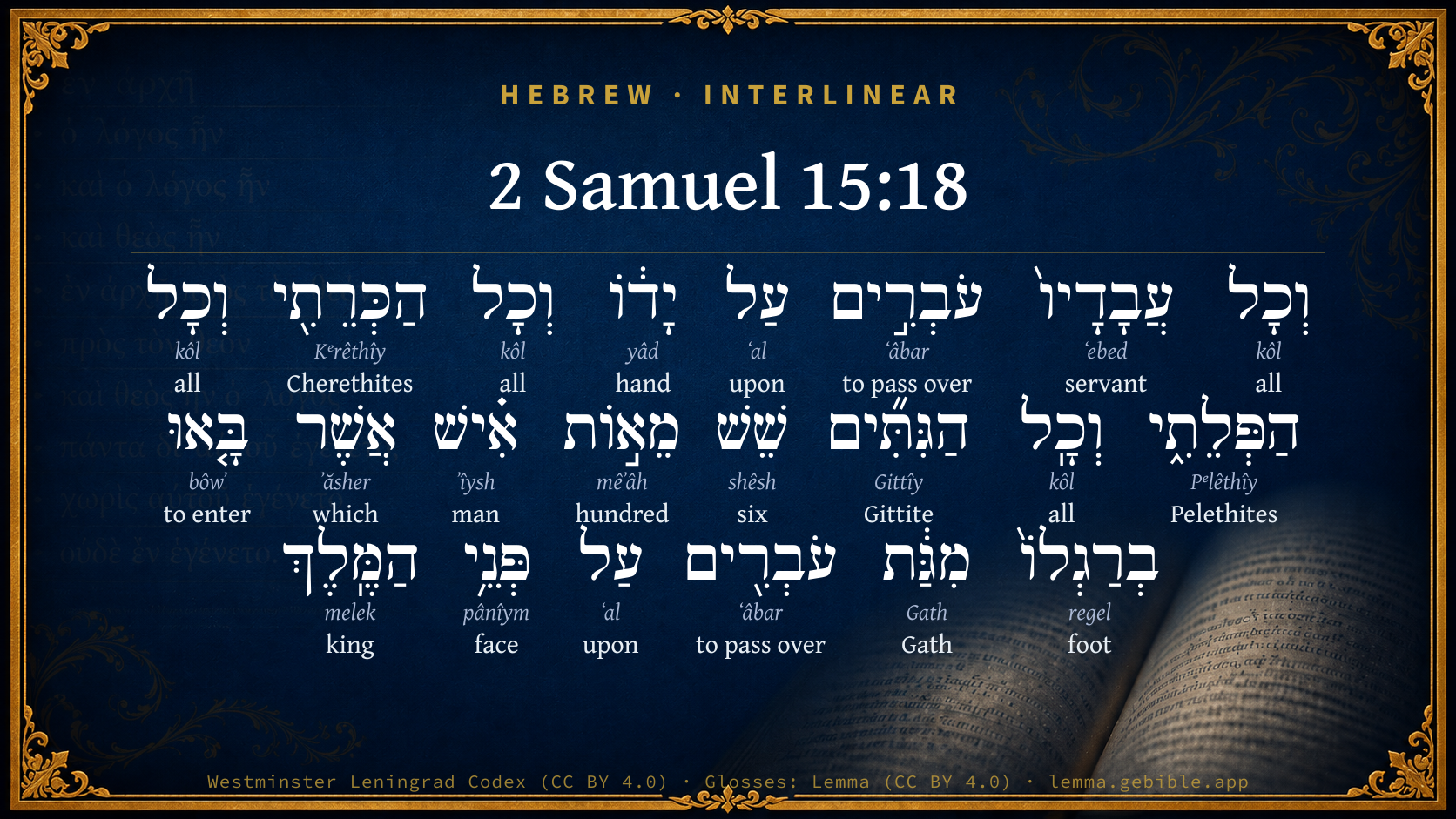
2 Samuel 15:18

Hebrew (Westminster Leningrad Codex) 2 Samuel 15:18 appears in the Hebrew Old Testament. The text above is from the Westminster Leningrad Codex. Each word links to its Strong’s number, a concise gloss, and parsing drawn from the Open Scriptures Hebrew Bible morphology. Click any word for its full Brown-Driver-Briggs (BDB) entry.
Download image
Cite this verse

2 Samuel 15:18 (World English Bible). Public Domain. Lemma interlinear Bible study tool, https://lemma.gebible.app/v/2-samuel/15/18.

Show BibTeX & RIS
BibTeX
RIS
English Translation
All his servants passed on beside him; and all the Cherethites, and all the Pelethites, and all the Gittites, six hundred men who came after him from Gath, passed on before the king.
World English Bible · Public Domain
Download a study sheet

One document with this verse’s original text, its word-by-word gloss line, the meaning frame, cross-references with their text, attributed commentary, and full source and license credits — printable, and it pastes into notes with its structure intact.

This verse Autodidact and up

Study sheet (.html) Plain text (.txt)

A passage Seminary Student

Up to 50 verses in one chapter. A passage sheet keeps up to 6 commentary sources and 12 cross-references per verse, in the order this page ranks them, and says so on the sheet whenever that leaves anything out. Ask for a single verse and you get the Autodidact verse sheet above.

Everything on this page stays free to read, with no account — the sheet is a download of what is already on screen, not access to it.

Want to remove ads? Support Godless Engineer
Compare translations 3

The same verse in 3 English versions, stacked beneath the original-language interlinear above. Click any original word for its lexicon entry.

Each is an independent rendering of the whole verse — the interlinear is not word-aligned to these translations.

Highlighted words mark where these versions differ — a whole-verse word diff, not a word-by-word alignment.

  • World English Bible Public Domain
    All his servants passed on beside him; and all the Cherethites, and all the Pelethites, and all the Gittites, six hundred men who came after him from Gath, passed on before the king.
  • King James Version Public Domain
    And all his servants passed on beside him; and all the Cherethites, and all the Pelethites, and all the Gittites, six hundred men which came after him from Gath, passed on before the king.
  • unfoldingWord Literal Text CC BY-SA 4.0
    And all of his servants were passing by at his hand. And all of the Cherethites and all of the Pelethites and all of the Gittites, the 600 men who had come at his foot from Gath, were passing by to the face of the king.

unfoldingWord Literal Text — © unfoldingWord, licensed CC BY-SA 4.0. Word-aligned USFM3 via Door43 (git.door43.org/unfoldingWord/en_ult).

Versions to compare (up to 4)

3 of 4 selected

Show all 18 translations

Every available English version of this verse, each an independent rendering of the whole verse.

  • World English Bible Public Domain
    All his servants passed on beside him; and all the Cherethites, and all the Pelethites, and all the Gittites, six hundred men who came after him from Gath, passed on before the king.
  • Berean Standard Bible Public Domain
    and all his servants marched past him—all the Cherethites and Pelethites, and six hundred Gittites who had followed him from Gath.
  • Majority Standard Bible Public Domain
    and all his servants marched past him—all the Cherethites and Pelethites, and six hundred Gittites who had followed him from Gath.
  • King James Version Public Domain
    And all his servants passed on beside him; and all the Cherethites, and all the Pelethites, and all the Gittites, six hundred men which came after him from Gath, passed on before the king.
  • American Standard Version (1901) Public Domain
    And all his servants passed on beside him; and all the Cherethites, and all the Pelethites, and all the Gittites, six hundred men that came after him from Gath, passed on before the king.
  • Revised Version (1885) Public Domain
    And all his servants passed on beside him; and all the Cherethites, and all the Pelethites, and all the Gittites, six hundred men which came after him from Gath, passed on before the king.
  • Geneva Bible (1599) Public Domain
    And all his seruants went about him, and all the Cherethites and all the Pelethites and all the Gittites, euen sixe hudreth men which were come after him from Gath, went before the King.
  • Douay-Rheims (1899) Public Domain
    And all his servants walked by him, and the bands of the Cerethi, and the Phelethi, and all the Gethites, valiant warriors, six hundred men who had followed him from Geth on foot, went before the king.
  • Young's Literal Translation Public Domain
    And all his servants are passing on at his side, and all the Cherethite, and all the Pelethite, and all the Gittites, six hundred men who came at his feet from Gath, are passing on at the front of the king.
  • Literal Standard Version CC BY-SA 4.0
    And all his servants are passing on at his side, and all the Cherethite, and all the Pelethite, and all the Gittites, six hundred men who came at his feet from Gath, are passing on at the front of the king.
  • Unlocked Literal Bible CC BY-SA 4.0
    All his army marched with him, and before him went all the Kerethites, and all the Pelethites, and all the Gittites—six hundred men who had followed him from Gath.
  • unfoldingWord Literal Text CC BY-SA 4.0
    And all of his servants were passing by at his hand. And all of the Cherethites and all of the Pelethites and all of the Gittites, the 600 men who had come at his foot from Gath, were passing by to the face of the king.
  • Darby Bible Public Domain
    And all his servants passed on beside him; and all the Cherethites, and all the Pelethites, and all the Gittites, six hundred men that came after him from Gath, passed over before the king.
  • World Messianic Bible Public Domain
    All his servants passed on beside him; and all the Cherethites, and all the Pelethites, and all the Gittites, six hundred men who came after him from Gath, passed on before the king.
  • Webster's Bible Public Domain
    And all his servants passed on by his side; and all the Cherethites, and all the Pelethites, and all the Gittites, six hundred men who came after him from Gath, passed on before the king.
  • Free Bible Version CC BY-SA 4.0
    and all his men marched past him, including all the Cherethites and Pelethites, and six hundred Gittites who had come with him from Gath.
  • Bible in Basic English Public Domain
    And all the people went on by his side; and all the Cherethites and all the Pelethites and all the men of Ittai of Gath, six hundred men who came after him from Gath, went on before the king.
  • JPS Tanakh (1917) Public Domain
    And all his servants passed on beside him; and all the Cherethites, and all the Pelethites, and all the Gittites, six hundred men that came after him from Gath, passed on before the king.

Literal Standard Version (2020), Covenant Press — licensed CC BY-SA 4.0. Text via the HelloAO Bible API (eBible.org). Unlocked Literal Bible (unfoldingWord) — licensed CC BY-SA 4.0. Text via the HelloAO Bible API (eBible.org). unfoldingWord Literal Text — © unfoldingWord, licensed CC BY-SA 4.0. Word-aligned USFM3 via Door43 (git.door43.org/unfoldingWord/en_ult). Free Bible Version, Dr. Jonathan Gallagher — licensed CC BY-SA 4.0. Text via the HelloAO Bible API (eBible.org).

Word by word

More ways to search: Search by grammar → Find every occurrence → Compare this word →

Practice this passage: Drill this verse → Learn its vocabulary →

הַפְּלֵתִ֑י
Pᵉlêthîy
H6432
“the · Pelethites”
Particle, Definite Article + Noun, Gentilic, Masculine, Singular, Absolute
Part of Speech
Particle + Noun
Type
Gentilic
Gender
Masculine
Number
Singular
State
Absolute
Full BDB Definition

Origin: from the same form as H6431

TWOT: None

Pelethites = "couriers" - a collective name for the guardsmen of David - probably descendants of an unknown person, perhaps Philistine mercenaries
  1. וְכָל kôl H3605 “and · all of” Conjunction + Noun, Common, Masculine, Singular, Construct
  2. עֲבָדָיו֙ ʻebed H5650 “servants · his” Noun, Common, Masculine, Plural, Construct + Suffix, Personal, 3rd Person, Masculine, Singular
  3. עֹבְרִ֣ים ʻâbar H5674 “passing over” Verb, Qal, Participle Active, Masculine, Plural, Absolute
  4. עַל ʻal H5921 “upon” Preposition
  5. יָד֔וֹ yâd H3027 “hand · his” Noun, Common, Both, Singular, Construct + Suffix, Personal, 3rd Person, Masculine, Singular
  6. וְכָל kôl H3605 “and · all of” Conjunction + Noun, Common, Masculine, Singular, Construct
  7. הַכְּרֵתִ֖י Kᵉrêthîy H3774 “the · Cherethites” Particle, Definite Article + Noun, Gentilic, Masculine, Singular, Absolute
  8. וְכָל kôl H3605 “and · all of” Conjunction + Noun, Common, Masculine, Singular, Construct
  9. וְכָֽל kôl H3605 “and · all of” Conjunction + Noun, Common, Masculine, Singular, Construct
  10. הַגִּתִּ֞ים Gittîy H1663 “the the · Gittite” Preposition, Determined + Noun, Gentilic, Masculine, Singular, Absolute
  11. שֵׁשׁ shêsh H8337 “six” Adjective, Cardinal number, Feminine, Singular, Absolute
  12. מֵא֣וֹת mêʼâh H3967 “hundred” Adjective, Cardinal number, Both, Plural, Absolute
  13. אִ֗ישׁ ʼîysh H376 “man” Noun, Common, Masculine, Singular, Absolute
  14. אֲשֶׁר ʼăsher H834 “which” Particle, Relative
  15. בָּ֤אוּ bôwʼ H935 “to enter” Verb, Qal, Perfect, 3rd Person, Common, Plural
  16. בְרַגְלוֹ֙ regel H7272 “in/at · foot · his” Preposition + Noun, Common, Feminine, Singular, Construct + Suffix, Personal, 3rd Person, Masculine, Singular
  17. מִגַּ֔ת Gath H1661 “from · Gath” Preposition + Noun, Proper
  18. עֹבְרִ֖ים ʻâbar H5674 “passing over” Verb, Qal, Participle Active, Masculine, Plural, Absolute
  19. עַל ʻal H5921 “upon” Preposition
  20. פְּנֵ֥י pânîym H6440 “face(s) of” Noun, Common, Both, Plural, Construct
  21. הַמֶּֽלֶךְ melek H4428 “the · king” Particle, Definite Article + Noun, Common, Masculine, Singular, Absolute

About this verse

These counts appear in no published source. They are computed here, from the morphology-tagged text and Lemma’s own curated glosses. What Lemma adds →

22
words
17
distinct lemmas
Historical
section

Notable vocabulary

The rarest word here is הַפְּלֵתִ֑י Pelethites H6432 — appearing just 7 times in the whole Hebrew Bible.

Shared distinctive vocabulary

הַפְּלֵתִ֑י Pelethites H6432 occurs in 7 verses of the Hebrew Bible. Also found in:

Grammatical profile

  • 3 verbs
  • 14 nouns
  • 2 adjectives
  • 2 prepositions
  • 1 particle

Verb forms

  • עֹבְרִ֣ים Qal · Participle Active
  • בָּ֤אוּ Qal · Perfect
  • עֹבְרִ֖ים Qal · Participle Active

Repetition

Words recur within this verse — often emphatic in Hebrew:

  • וְכָל all H3605 ×4
  • עֹבְרִ֣ים to pass over H5674 ×2
  • עַל upon H5921 ×2

Hebrew & Septuagint length

In English translation the verse runs 33 words from the Hebrew and 83 from the Septuagint (LXX English) — the Septuagint runs noticeably longer here. See the side-by-side →

A rough comparison of the two English renderings, which tokenize alike — not a word-level alignment.

Word counts can differ between the Hebrew and the Greek without any difference in meaning — e.g. the Hebrew direct-object marker אֵת has no separate Greek word, and Greek often adds the article ὁ.

Cross-references

10

Topical passages linked to 2 Samuel 15:18 in the Treasury of Scripture Knowledge — connected by theme and wording, ordered by reader-vote popularity; previews shown in the World English Bible.

  • 2 Samuel 8:18 and Benaiah the son of Jehoiada [was over] the Cherethites and the Pelethites; and David's sons were chief ministers.
  • 1 Samuel 30:14 We made a raid on the South of the Cherethites, and on that which belongs to Judah, and on the South of Caleb; and we burned Ziklag with fire.
  • 2 Samuel 20:7 There went out after him Joab's men, and the Cherethites and the Pelethites, and all the mighty men; and they went out of Jerusalem, to pursue after Sheba the son of Bichri.
  • 2 Samuel 20:23 Now Joab was over all the host of Israel; and Benaiah the son of Jehoiada was over the Cherethites and over the Pelethites;
  • 1 Kings 1:38 So Zadok the priest, and Nathan the prophet, and Benaiah the son of Jehoiada, and the Cherethites and the Pelethites, went down, and caused Solomon to ride on king David's mule, and brought him to Gihon.
  • 1 Chronicles 18:17 and Benaiah the son of Jehoiada was over the Cherethites and the Pelethites; and the sons of David were chief about the king.
  • 1 Samuel 27:3 David lived with Achish at Gath, he and his men, every man with his household, even David with his two wives, Ahinoam the Jezreelitess, and Abigail the Carmelitess, Nabal's wife.
  • 2 Samuel 6:10 So David would not remove the ark of Yahweh to him into the city of David; but David carried it aside into the house of Obed-edom the Gittite.
  • 2 Samuel 15:19–22 Then said the king to Ittai the Gittite, Why go you also with us? return, and abide with the king: for you are a foreigner, and also an exile; [return] to your own place.
  • 2 Samuel 18:2 David sent forth the people, a third part under the hand of Joab, and a third part under the hand of Abishai the son of Zeruiah, Joab's brother, and a third part under the hand of Ittai the Gittite. The king said to the people, I will surely go forth with you myself also.

Cross-references courtesy of OpenBible.info (CC BY 4.0).

Hebrew and Greek witnesses Masoretic Hebrew ↔ Greek Septuagint

The same verse in the two great witnesses to the Old Testament, shown verse-for-verse.

Here the Septuagint runs noticeably longer than the Hebrew — LXX2012 (modern English Septuagint) 83 words vs World English Bible 33. A rough length comparison of the two English translations, not a word-level alignment — read both below.

These are two independent witnesses, not word-aligned to each other, and the Septuagint is shown in lemma (dictionary) form.

Hebrew 2 Samuel 15:18 Masoretic · Westminster Leningrad Codex

וְכָל עֲבָדָיו֙ עֹבְרִ֣ים עַל יָד֔וֹ וְכָל הַכְּרֵתִ֖י וְכָל הַפְּלֵתִ֑י וְכָֽל הַגִּתִּ֞ים שֵׁשׁ מֵא֣וֹת אִ֗ישׁ אֲשֶׁר בָּ֤אוּ בְרַגְלוֹ֙ מִגַּ֔ת עֹבְרִ֖ים עַל פְּנֵ֥י הַמֶּֽלֶךְ

All his servants passed on beside him; and all the Cherethites, and all the Pelethites, and all the Gittites, six hundred men who came after him from Gath, passed on before the king.

World English Bible · Public Domain

Greek LXX 2 Samuel 15:18 Septuagint · lemma form

καί πᾶς ὁ παῖς αὐτός ἀνά χείρ αὐτός παραἄγω καί πᾶς ὁ χεττι καί πᾶς ὁ φελετθι καί ἵστημι ἐπί ὁ ἐλαία ἐν ὁ ἐρῆμος καί πᾶς ὁ λαός παραπορεύομαι ἔχω αὐτός καί πᾶς ὁ περί αὐτός καί πᾶς ὁ ἁδρός καί πᾶς ὁ μαχητής ἑξακόσιοι ἀνήρ καί παραεἰμί ἐπί χείρ αὐτός καί πᾶς ὁ χερεθθι καί πᾶς ὁ φελεθθι καί πᾶς ὁ γεθθαῖος ἑξακόσιοι ἀνήρ ὁ ἔρχομαι ὁ πούς αὐτός ἐκ γεθ πορεύομαι ἐπί πρόσωπον ὁ βασιλεύς

And all his servants passed on by his side, and every Chelethite, and every Phelethite, and they stood by the olive tree in the wilderness: and all the people marched near him, and all his court, and all the men of might, and all the men of war, six hundred: and they were present at his side: and every Chelethite, and every Phelethite, and all the six hundred Gittites that came on foot out of Geth, and they went on before the king.

LXX2012 (modern English Septuagint) · Public Domain

On this verse, The Cambridge Bible for Schools and Colleges discusses the Septuagint’s reading. Read the note in Commentary ↓

Hebrew: Westminster Leningrad Codex (CC BY 4.0). Greek: Septuagint (public domain); English from LXX2012 (modern English Septuagint) (Public Domain). How the Septuagint differs from the Hebrew →

Targum (Aramaic paraphrase)

1

The Targum is the ancient Jewish Aramaic paraphrase of the Hebrew Scriptures — an interpretive translation, not the Hebrew text itself. Onkelos (literal) and Pseudo-Jonathan (expansive) render the Torah, and Jonathan the Prophets. Coverage is partial: where no permissively-licensed English translation exists for a verse, only the Aramaic is shown. This is verse-level text, not a word-by-word alignment to the Hebrew.

  1. Targum Jonathan Prophets (Joshua–Malachi)
    וְכָל עַבְדוֹהִי עָבְרִין עַל יְדוֹהִי וְכָל קַשָׁתַיָא וְכָל קַלְעַיָא וְכָל גִתָּאֵי שִׁית מְאָה גַבְרָא דְאָתָן עִמֵיהּ מִגַת עָבְרִין קֳדָם מַלְכָּא:

    (no public-domain English translation for this verse)

    Targum Jonathan — Aramaic: “Mikraot Gedolot” (public domain). English: “Sefaria Community Translation” (CC0 1.0 (public-domain dedication)); “London "Chaldee Paraphrase," 1871” (public domain). Text via Sefaria.

Commentary

Notes on 2 Samuel 15:18 from classic Christian and Jewish commentators (each source and its license shown beneath its notes). The classic Christian expositions comment on the surrounding passage and are grouped to its opening verse, so a note may address several verses; the Jewish commentaries on the Tanakh (Rashi and others) are per-verse, so they appear only where the commentator wrote on this verse.

Lemma curates 59 commentaries, every one of them public domain or Creative Commons licensed, each selected and text-cleaned for this edition rather than reprinted as found. About our sources →

The Cambridge Bible for Schools and Colleges

gen. ed. J. J. S. Perowne

18. all the Gittites] If the text is sound, we must infer that David had brought with him a body of Philistine followers from Gath, a supposition which is in accordance with the view that the Cherethites and Pelethites were Philistines. See note on ch. 2Sa_8:18. But it is possible that we should follow the LXX. in reading Gibbôrîm in place of Gittites. During his wanderings David formed a corps of six hundred picked men, who were particularly distinguished as “David’s men.” They appear first at Keilah (1Sa_23:13, cp. 1Sa_22:2), were with him in the wilderness of Paran (1Sa_25:13), followed him to Gath (1Sa_27:2-3) and Ziklag (1Sa_27:8, 1Sa_29:1, 1Sa_30:1; 1Sa_30:9), came up with him to Hebron (1Sa_2:3), and finally to Jerusalem (2Sa_15:6). This corps seems to have been afterwards maintained as a guard with the title of “the Gibbôrîm,” that is, “the Heroes” or “the Mighty Men” (cp. ch. 2Sa_10:7, 2Sa_16:6, 2Sa_20:7; 1Ki_1:8), and it is natural to identify the six hundred here mentioned with that body. Some critics think that without altering the reading, we should identify the Gittites with the Gibbôrîm, and suppose that they were called Gittites either because they had followed David ever since his residence in Gath; or because the corps had at this time been largely recruited from the natives of Gath.

The Sept. text of 2Sa_15:18 is as follows: “And all his servants passed on beside him, and all the Cherethites and all the Pelethites, and halted at the olive tree in the wilderness. And all the people marched by close to him, and all his attendants, and all the mighty men, and all the warriors, six hundred men, and were present by his side; and all the Cherethites and all the Pelethites, and all the Gittites, the six hundred men who came after him from Gath, marched on before the king.” This appears to be the rendering of a text differing somewhat from the present Hebrew, to which has been added a rendering of the present Hebrew text, with some further glosses or alternative renderings. “The olive tree in the wilderness,” which marked the scene of the second halt, (if the reading is genuine and not a mere mistranslation), was probably beyond the Mount of Olives on the road to the Jordan.

The Cambridge Bible for Schools and Colleges (gen. ed. J. J. S. Perowne; Cambridge University Press, 1878–1918) — public domain. Text from a community e-Sword module.

Trapp's Complete Commentary

John Trapp

2Sa 15:18 And all his servants passed on beside him; and all the Cherethites, and all the Pelethites, and all the Gittites, six hundred men which came after him from Gath, passed on before the king.

Ver. 18. Six hundred men which came after him from Gath.] That had stuck to him in all his afflictions; then when he was at Gath, and now also that Absalom was up in arms against him. As any of these six hundred died, others of like fidelity were succenturiated, and set in their room; and these were to David as that Sacra cohors was to the Thebans, who esteemed them the prime of all their strength in battle, {a} God likewise setteth a high price on such as keep close to him in evil times. See Zep 3:18 Luk 22:28-29.

{a} Athenaeus, lib. iii.

John Trapp, A Commentary or Exposition upon All the Books of the Old and New Testament (1647–1656) — public domain. Text from a community e-Sword module.

Tyndale Open Study Notes

Tyndale Open Resources

15:18 600 men from Gath: This alliance went back to David’s relationship with the Philistines in Saul’s day (1 Sam 21:10-15; 27:1-12; 29:1-11). • the king’s bodyguard: See study note on 2 Sam 8:18.

Tyndale Open Study Notes — © Tyndale Open Resources, licensed CC BY-SA 4.0. Text via the HelloAO Bible API.

Geneva Bible (1599)

Geneva Bible translators

These were as the king’s guard, or as some write, his counselors.

Geneva Bible (1599) marginal notes — public domain. Text via Bolls.life.

Jamieson, Fausset & Brown

Robert Jamieson, A. R. Fausset & David Brown

all the Gittites, six hundred men--These were a body of foreign guards, natives of Gath, whom David, when in the country of the Philistines, had enlisted in his service, and kept around his person. Addressing their commander, Ittai, he made a searching trial of their fidelity in bidding them (Sa2 15:19) abide with the new king.

Jamieson, Fausset & Brown — Commentary Critical and Explanatory on the Whole Bible (1871) — public domain (CC PDM 1.0). Text via the HelloAO Bible API.

Ellicott's Commentary for English Readers

(18) Cherethites . . . Pelethites.—See Note on 2Sa_8:18.

Gittites.—This word in its form would naturally mean men of Gath, and it has therefore been understood by some commentators of a body of Philistines in David’s service. But the term is distinctly explained here as meaning the “six hundred men which came after him from Gath,” and called “Gittites” for that reason, a body of men with whom the previous history of David has made us very familiar. They had gathered to him during his outlawry (1Sa_22:1-2), had been with him at Keilah (1Sa_23:13), in the wilderness of Paran (1Sa_25:13), and at Gath (1Sa_27:3), “came after him from Gath” to Ziklag, and shared with him in his life and exploits there (1Sa_27:8; 1Sa_29:2; 1Sa_30:1-9), and went up with him to Hebron (2 Samuel 23), and thence to Jerusalem (2Sa_5:6). They are generally supposed to have afterwards constituted the body of “heroes” or “mighty men,” to whom frequent reference is made (2Sa_10:7; 2Sa_16:6; 2Sa_20:7; 1Ki_1:8). The Vatican LXX. here, as often, adds considerably to the text.

A Bible Commentary for English Readers, edited by Charles John Ellicott (1878–1897) — public domain. Text from a community e-Sword module.

John Gill's Exposition

And all his servants passed on beside him,.... Or at his hand or side; his household servants walking perhaps some on one side of him, and some on the other, see Sa2 16:6,

and all the Cherethites, and all the Pelethites; which were his bodyguards, see Sa2 8:18,

and all the Gittites, six hundred men which came after him from Gath; which either came with him from Gath, when he conquered that city, and took it out of the hands of the Philistines, Sa2 8:1; compared with Ch1 18:1; and who might become proselytes, and be incorporated into the commonwealth of Israel, and into David's army, a troop of men, of which Ittai, after mentioned, was captain, Sa2 15:22; or else these were Israelites, so called, because with David they sojourned in Gath a while, when he fled from Saul; and so Josephus (l) says, they were companions of him in his first flight, when Saul was living; and this number is just the number of the men that were with him at Gath, Sa1 27:2; and it may be David kept a troop of men always of the same number, to whom he gave this name in memory of them, having been a set of trusty and faithful men to him: these, with the Cherethites and Pelethites:

passed on before the king: in this form and manner David and his men marched in their flight.

(l) Ut supra, (Antiqu. l. 7. c. 9.) sect. 2.

John Gill's Exposition of the Whole Bible (1746–1763) — public domain (CC PDM 1.0). Text via the HelloAO Bible API.

Albert Barnes' Notes on the Bible

Passed on - Rather, “crossed” the Brook Kidron, as in 2Sa 15:22-23.

Gittites - During David’s residence in the country of the Philistines he attached such a band to himself; and after the settlement of his kingdom, and the subjugation of the Philistines, the band received recruits from Gath, perhaps with the king of Gath’s consent. They were now under the command of Ittai the Gittite, a foreigner 2Sa 15:19, and “his brethren” 2Sa 15:20. The number 600 probably indicates that this band or regiment of Gittites had its origin in David’s band of 600 1Sa 23:13; 1Sa 27:2. They were at first, it is likely, all Israelites, then Gittites mixed with Israelites, and at last all Gittites.

Albert Barnes' Notes on the Bible (1834–1885) — public domain. Text from a community e-Sword/MySword module.

Haydock's Catholic Bible Commentary

Phelethi, the king’s foreign guards, of Philistine extraction, chap. viii. 18. --- Gethites, who had been probably induced to enter his service by Ethai, ver. 19. (Calmet) --- Men. This number David kept up, in honour of those valiant companions who had defended him at Odollam, &c. (Salien) --- It is observable, that David is attended only by his own family, and by strangers; representing Jesus Christ, who rejects the Synagogue and its sacrifices, while he makes choice of the Gentiles. (Calmet)

George Leo Haydock (1774–1849), Haydock's Catholic Family Bible and Commentary, 1859 edition — public domain. Excludes Psalms (Douay-Rheims chapter numbering differs from Protestant) and Deuterocanonical books (Catholic canon only).

Matthew Poole's English Annotations

Of the Cherethites and the Pelethites See Poole on "2Sa 8:18". The Gittites were either, first, Israelites by birth, called Gittites because they went with him to Gath, and abode with him in that country. Or rather, secondly, Strangers, as Ittai their head is called, 2Sa 15:19, and they are called his brethren, 2Sa 15:20; and probably they were Philistines by birth born in the city or territory of Gath, as the following words imply, who by David’s counsel, and example, and the success of his arms, were won to embrace and profess the true religion, and had given good proof of their military skill, and valour, and fidelity to the king.

Matthew Poole's English Annotations on the Holy Bible (1683–1685) — public domain. Text from a community e-Sword/MySword module.

Whedon's Commentary on the Bible

Daniel D. Whedon

18. Cherethites — See note on 2Sa_8:18.

The Gittites, six hundred men — That old, tried, and faithful band whom he had gathered around him principally when he enjoyed the protection of the king of Gath, (1Sa_27:2,) and from that land of their refuge ever after bore the name of Gittites. We need not suppose that these Gittites were all Philistines from Gath, and all foreigners who had become proselytes to the Jewish religion. But it is very likely that most of these six hundred were of foreign birth. As one after another of the old warriors died, the king, perhaps to perpetuate old associations, filled up their places with men from Gath. See note on 2Sa_8:18.

Daniel D. Whedon (gen. ed.), Commentary on the Old and New Testaments (1874–1909) — public domain. Text from a community e-Sword module.

The Pulpit Commentary

All the Gittites, air hundred men which came after him from Gath. The Septuagint reads "Gibborim," and without doubt these are the persons meant; but while they were styled Gibborim, the "mighties," for honour"s sake, because of their prowess, they probably were popularly called David"s Gittites, because they were the six hundred men who had formed his little army when he sought refuge with Achish, King of Gath. (1Sa_27:2 1Sa_30:9) They were not Philistines, but Israelites of desperate fortune; (1Sa_22:2) and it is a proof of David"s great ability, and of the moral influence of his character, that he was successful, not only in controlling them and maintaining discipline, but also in forming them into as noble a set of heroes as ever existed, and who were faithful to him in all his fortunes. To their number belonged the thirty-seven champions endmerated in ch. 23., and possibly the title "Gibborim" strictly belonged to them only. As they are still called "the six hundred," it is probable that the corps was maintained at this number by new appointments, and that they had special privileges which made their position very desirable. Certainly David would never forget men who had shared all his fortunes, and been so true and so useful to him; and it is evident, from Hushai"s counsel, (2Sa_17:8) that Absalom feared their resolute valour, and hesitated to attack without overwhelming numbers. Thenius compares these veterans to Napoleon"s Old Guard.

The Pulpit Commentary (1880–1919), ed. H.D.M. Spence-Jones & Joseph S. Exell — public domain. Text from a community e-Sword module.

John Wesley's Explanatory Notes

Gittites - Or rather strangers, as Ittai their head is called, ver. 19, and they are called his brethren, ver. 20. Probably they were Philistines by birth, born in the city or territory of Gath, as the following words imply, who by David's counsel, and example, were won to embrace the true religion, and had given good proof of their military skill, and valour, and fidelity to the king.

John Wesley, Explanatory Notes Upon the Whole Bible (1754–1765) — public domain. Text via the GEBible commentary corpus.

Keil & Delitzsch

C. F. Keil & F. Delitzsch

And all his servants, i.e., his state officers and attendants, went along by his side, and the whole body-guard (the Crethi and Plethi: see at Sa2 8:18); and all the Gathites, namely the six hundred men who had come in his train from Gath, went along in front of the king. David directed the fugitives to all into rank, the servants going by his side, and the body-guard and the six hundred old companions in arms, who probably also formed a kind of body-guard, marching in front. The verb עבר (passed on) cannot be understood as signifying to file past on account of its connection with על־ידו (beside him, or by his side). The expression Gittim is strange, as we cannot possibly think of actual Gathites or Philistines from Gath. The apposition (the six hundred men, etc.) shows clearly enough that the six hundred old companions in arms are intended, the men who gathered round David on his flight from Saul and emigrated with him to Gath (Sa1 27:2-3), who afterwards lived with him in Ziklag (Sa1 27:8; Sa1 29:2; Sa1 30:1, Sa1 30:9), and eventually followed him to Hebron and Jerusalem (Sa2 2:3; Sa2 5:6). In all probability they formed a separate company of well-tried veterans or a kind of body-guard in Jerusalem, and were commonly known as Gathites.

(Note: The Septuagint also has πάντες οἱ Γεθαῖοι, and has generally rendered the Masoretic text correctly. But כּל־עבדיו has been translated incorrectly, or at all events in a manner likely to mislead, viz., πάντες οἱ παῖδες αὐτοῦ. But in the Septuagint text, as it has come down to us, another paraphrase has been interpolated into the literal translation, which Thenius would adopt as an emendation of the Hebrew text, notwithstanding the fact that the critical corruptness of the Alexandrian text must be obvious to every one.)

Keil & Delitzsch — Biblical Commentary on the Old Testament (1861–1891) — public domain (CC PDM 1.0). Text via the HelloAO Bible API. (Old Testament only.)

Rashi

Rabbi Shlomo Yitzchaki (Rashi)

By him. Near him, He stood in place and they passed by.

Rashi on the Tanakh — English translations: “The Judaica Press complete Tanach with Rashi, translated by A. J. Rosenberg” (CC BY 4.0); “Pentateuch with Rashi's commentary by M. Rosenbaum and A.M. Silbermann, 1929-1934” (public domain); “The Metsudah Tanach series, Lakewood, N.J” (CC BY 4.0); and “The Book of Joshua, Metsudah Publications, 1997” (CC BY 4.0). Text via Sefaria.

Lesson kit

Teaching starters — assembled from the data on this page, not authored interpretation. Every prompt links to the verse data it draws on. Edit before teaching.

2 Samuel, in the Historical, opens this verse with 22 words (17 distinct Hebrew lemmas). Its most distinctive word is Pᵉlêthîy (“Pelethites”). The Greek Septuagint runs longer here. A historical commentator’s framing appears above. Read the whole chapter for the surrounding context.

Discussion questions

  1. The word Pᵉlêthîy carries the sense “Pelethites.” How does it shape the verse?
  2. 2 Samuel 8:18 shares the word «Pelethites» with this verse. How do the two illuminate each other?
  3. “all” occurs 4× in this one verse. What is the effect of the repetition?
  4. Compared with the Hebrew, the Septuagint runs longer here. What questions does that raise?
  5. These translations render this verse differently. What is at stake in choosing one wording over another?
  6. The verb «עֹבְרִ֣ים» is Qal Participle Active. How does its form color the action?
  7. Reading how The Cambridge Bible for Schools and Colleges and Trapp's Complete Commentary read this verse, where do the two commentators agree and where do they part?

Things to notice

Reading settings

Reading text

Shown beneath each verse's original-language words.

Old Testament
Old Testament edition

Read the OT as the Masoretic Hebrew (MT) or the Greek Septuagint (LXX).

English shown for the Greek Septuagint (in the Hebrew ↔ Greek comparison).

Comparing translations? Open the Compare panel on any verse page to stack up to four side by side.