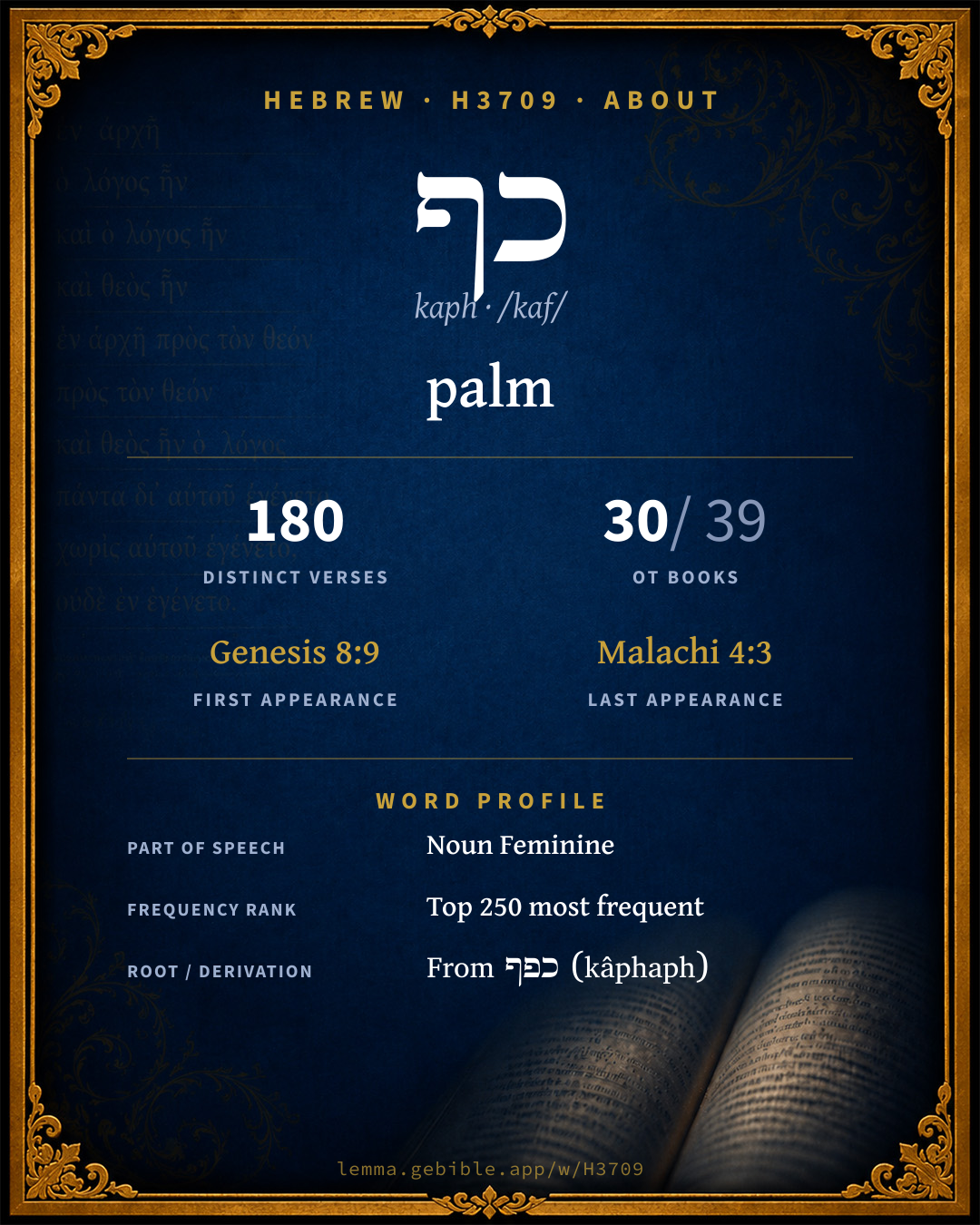
כַּף
palm
also: hand, sole fuller range ↓
Full lexicon entry — Brown-Driver-Briggs (BDB)
From Brown-Driver-Briggs (BDB)
Where this word appears
See every Construct-state word in the Hebrew Bible →
Grammar key — what these labels mean
Part of speech
- Noun
- A naming word — a person, place, thing, or idea.
Noun type
- Common
- A common noun — a general class of person, place, or thing (“king,” “city,” “water”), not a specific name.
State
- Construct
- A noun bound to a following noun in a possessive / “of” relationship (the construct chain).
- Absolute
- The independent form of a noun, not bound to a following word.
Gender
- Feminine
- Grammatically feminine.
Number
- Singular
- One.
- Dual
- Exactly two — for natural pairs and some measures of time.
- Plural
- More than one (in Hebrew, generally three or more).
Grammatical forms
- Noun, Common, Feminine, Singular, Construct 95 times (49%)
- Noun, Common, Feminine, Dual, Construct 55 times (28%)
- Noun, Common, Feminine, Plural, Construct 15 times (8%)
- Noun, Common, Feminine, Singular, Absolute 14 times (7%)
- Noun, Common, Feminine, Dual, Absolute 8 times (4%)
- Noun, Common, Feminine, Plural, Absolute 8 times (4%)
Parsed forms decoded from the imported morphology (morphhb / Westminster Leningrad Codex — WLC text public domain, morphhb tagging CC BY 4.0), counted across 195 parsed occurrences — not distinct verses.
Every verse where H3709 appears — 180 distinct verses across 30 books. Click any verse to open its interlinear word-by-word view. Verse text shown in the World English Bible for context — . Each verse’s Hebrew form is shown with its reference; the English is not keyword-highlighted, since the data carries no word-level English alignment. Use “Compare translations” on any verse to read it across multiple English versions. This concordance covers the Hebrew Bible; Septuagint (Greek Old Testament) occurrences are not indexed here.
Genesis 7 verses
- Genesis 8:9 לְ/כַף prep + n c fs cs but the dove found no place to rest her foot, and she returned to him into the ark; for the waters were on the surface of the whole earth. He put forth his hand, and took her, and brought her to him into the ark.
- Genesis 20:5 כַּפַּ֖/י n c fd cs + sfx pers 1cs Didn't he tell me, 'She is my sister?' She, even she herself said, 'He is my brother.' In the integrity of my heart and the innocence of my hands have I done this."
- Genesis 31:42 כַּפַּ֛/י n c fd cs + sfx pers 1cp Unless the God of my father, the God of Abraham, and the fear of Isaac, had been with me, surely now you would have sent me away empty. God has seen my affliction and the labor of my hands, and rebuked you last night."
- Genesis 32:25 בְּ/כַף כַּף prep + n c fs cs n c fs cs When he saw that he didn't prevail against him, he touched the hollow of his thigh, and the hollow of Jacob's thigh was strained, as he wrestled.
- Genesis 32:32 כַּ֣ף בְּ/כַף n c fs cs prep + n c fs cs Therefore the children of Israel don't eat the sinew of the hip, which is on the hollow of the thigh, to this day, because he touched the hollow of Jacob's thigh in the sinew of the hip.
- Genesis 40:11 כַּ֥ף n c fs cs Pharaoh's cup was in my hand; and I took the grapes, and pressed them into Pharaoh's cup, and I gave the cup into Pharaoh's hand."
- Genesis 40:21 כַּ֥ף n c fs cs He restored the chief cupbearer to his position again, and he gave the cup into Pharaoh's hand;
Exodus 8 verses
- Exodus 4:4 בְּ/כַפּֽ/וֹ prep + n c fs cs + sfx pers 3ms Yahweh said to Moses, "Put forth your hand, and take it by the tail." He put forth his hand, and laid hold of it, and it became a rod in his hand.
- Exodus 9:29 כַּפַּ֖/י n c fd cs + sfx pers 1cs Moses said to him, "As soon as I have gone out of the city, I will spread abroad my hands to Yahweh. The thunders shall cease, neither shall there be any more hail; that you may know that the earth is Yahweh's.
- Exodus 9:33 כַּפָּ֖י/ו n c fd cs + sfx pers 3ms Moses went out of the city from Pharaoh, and spread abroad his hands to Yahweh; and the thunders and hail ceased, and the rain was not poured on the earth.
- Exodus 25:29 וְ/כַפֹּתָ֗י/ו conj + n c fp cs + sfx pers 3ms You shall make its dishes, its spoons, its ladles, and its bowls to pour out offerings with. Of pure gold shall you make them.
- Exodus 29:24 כַּפֵּ֣י כַּפֵּ֣י n c fd cs n c fd cs You shall put all of this in Aaron's hands, and in his sons' hands, and shall wave them for a wave-offering before Yahweh.
- Exodus 33:22 כַפִּ֛/י n c fs cs + sfx pers 1cs It will happen, while my glory passes by, that I will put you in a cleft of the rock, and will cover you with my hand until I have passed by;
- Exodus 33:23 כַּפִּ֔/י n c fs cs + sfx pers 1cs then I will take away my hand, and you will see my back; but my face shall not be seen."
- Exodus 37:16 כַּפֹּתָי/ו֙ n c fp cs + sfx pers 3ms He made the vessels which were on the table, its dishes, its spoons, its bowls, and its pitchers with which to pour out, of pure gold.
Leviticus 13 verses
- Leviticus 8:27 כַּפֵּ֣י כַּפֵּ֣י n c fd cs n c fd cs He put all these in Aaron's hands and in his sons' hands, and waved them for a wave offering before Yahweh.
- Leviticus 8:28 כַּפֵּי/הֶ֔ם n c fd cs + sfx pers 3mp Moses took them from their hands, and burned them on the altar on the burnt offering. They were a consecration for a sweet savor. It was an offering made by fire to Yahweh.
- Leviticus 9:17 כַפּ/וֹ֙ n c fs cs + sfx pers 3ms He presented the meal offering, and filled his hand from there, and burned it upon the altar, besides the burnt offering of the morning.
- Leviticus 11:27 כַּפָּ֗י/ו n c fd cs + sfx pers 3ms Whatever goes on its paws, among all animals that go on all fours, they are unclean to you. Whoever touches their carcass shall be unclean until the evening.
- Leviticus 14:15 כַּ֥ף n c fs cs The priest shall take some of the log of oil, and pour it into the palm of his own left hand.
- Leviticus 14:16 כַּפּ֖/וֹ n c fs cs + sfx pers 3ms The priest shall dip his right finger in the oil that is in his left hand, and shall sprinkle some of the oil with his finger seven times before Yahweh.
- Leviticus 14:17 כַּפּ֗/וֹ n c fs cs + sfx pers 3ms The priest shall put some of the rest of the oil that is in his hand on the tip of the right ear of him who is to be cleansed, and on the thumb of his right hand, and on the big toe of his right foot, upon the blood of the trespass offering.
- Leviticus 14:18 כַּ֣ף n c fs cs The rest of the oil that is in the priest's hand he shall put on the head of him who is to be cleansed, and the priest shall make atonement for him before Yahweh.
- Leviticus 14:26 כַּ֥ף n c fs cs The priest shall pour some of the oil into the palm of his own left hand;
- Leviticus 14:27 כַּפּ֖/וֹ n c fs cs + sfx pers 3ms and the priest shall sprinkle with his right finger some of the oil that is in his left hand seven times before Yahweh.
- Leviticus 14:28 כַּפּ֗/וֹ n c fs cs + sfx pers 3ms Then the priest shall put some of the oil that is in his hand on the tip of the right ear of him who is to be cleansed, and on the thumb of his right hand, and on the big toe of his right foot, on the place of the blood of the trespass offering.
- Leviticus 14:29 כַּ֣ף n c fs cs The rest of the oil that is in the priest's hand he shall put on the head of him who is to be cleansed, to make atonement for him before Yahweh.
- Leviticus 23:40 כַּפֹּ֣ת n c fp cs You shall take on the first day the fruit of goodly trees, branches of palm trees, and boughs of thick trees, and willows of the brook; and you shall rejoice before Yahweh your God seven days.
Numbers 18 verses
- Numbers 4:7 הַ/כַּפֹּת֙ ptcl def.art + n c fp On the table of show bread they shall spread a blue cloth, and put on it the dishes, the spoons, the bowls, and the cups with which to pour out; and the continual bread shall be on it.
- Numbers 5:18 כַּפֶּ֗י/הָ n c fd cs + sfx pers 3fs The priest shall set the woman before Yahweh, and let the hair of the woman's head go loose, and put the meal offering of memorial in her hands, which is the meal offering of jealousy. The priest shall have in his hand the water of bitterness that brings a curse.
- Numbers 6:19 כַּפֵּ֣י n c fd cs The priest shall take the boiled shoulder of the ram, and one unleavened cake out of the basket, and one unleavened wafer, and shall put them on the hands of the Nazirite, after he has shaved the head of his separation;
- Numbers 7:14 כַּ֥ף n c fs cs one golden ladle of ten shekels, full of incense;
- Numbers 7:20 כַּ֥ף n c fs cs one golden ladle of ten shekels, full of incense;
- Numbers 7:26 כַּ֥ף n c fs cs one golden ladle of ten shekels, full of incense;
- Numbers 7:32 כַּ֥ף n c fs cs one golden ladle of ten shekels, full of incense;
- Numbers 7:38 כַּ֥ף n c fs cs one golden ladle of ten shekels, full of incense;
- Numbers 7:44 כַּ֥ף n c fs cs one golden ladle of ten shekels, full of incense;
- Numbers 7:50 כַּ֥ף n c fs cs one golden ladle of ten shekels, full of incense;
- Numbers 7:56 כַּ֥ף n c fs cs one golden ladle of ten shekels, full of incense;
- Numbers 7:62 כַּ֥ף n c fs cs one golden ladle of ten shekels, full of incense;
- Numbers 7:68 כַּ֥ף n c fs cs one golden ladle of ten shekels, full of incense;
- Numbers 7:74 כַּ֥ף n c fs cs one golden ladle of ten shekels, full of incense;
- Numbers 7:80 כַּ֥ף n c fs cs one golden spoon of ten shekels, full of incense;
- Numbers 7:84 כַּפּ֥וֹת n c fp cs This was the dedication of the altar, on the day when it was anointed, by the princes of Israel: twelve silver platters, twelve silver bowls, twelve golden ladles;
- Numbers 7:86 כַּפּ֨וֹת הַ/כַּ֖ף הַ/כַּפּ֖וֹת n c fp cs ptcl def.art + n c fs ptcl def.art + n c fp the twelve golden ladles, full of incense, weighing ten shekels apiece, after the shekel of the sanctuary; all the gold of the ladles weighed one hundred twenty shekels;
- Numbers 24:10 כַּפָּ֑י/ו n c fd cs + sfx pers 3ms Balak's anger was kindled against Balaam, and he struck his hands together; and Balak said to Balaam, I called you to curse my enemies, and, behold, you have altogether blessed them these three times.
Deuteronomy 6 verses
- Deuteronomy 2:5 כַּף n c fs cs don't contend with them; for I will not give you of their land, no, not so much as for the sole of the foot to tread on; because I have given Mount Seir to Esau for a possession.
- Deuteronomy 11:24 כַּֽף n c fs cs Every place whereon the sole of your foot shall tread shall be yours: from the wilderness, and Lebanon, from the river, the river Euphrates, even to the hinder sea shall be your border.
- Deuteronomy 25:12 כַּפָּ֑/הּ n c fs cs + sfx pers 3fs then you shall cut off her hand, your eye shall have no pity.
- Deuteronomy 28:35 מִ/כַּ֥ף prep + n c fs cs Yahweh will strike you in the knees, and in the legs, with a sore boil, of which you can not be healed, from the sole of your foot to the crown of your head.
- Deuteronomy 28:56 כַף n c fs cs The tender and delicate woman among you, who would not adventure to set the sole of her foot on the ground for delicateness and tenderness, her eye shall be evil toward the husband of her bosom, and toward her son, and toward her daughter,
- Deuteronomy 28:65 לְ/כַף prep + n c fs cs Among these nations shall you find no ease, and there shall be no rest for the sole of your foot: but Yahweh will give you there a trembling heart, and failing of eyes, and pining of soul;
Joshua 3 verses
- Joshua 1:3 כַּֽף n c fs cs Every place that the sole of your foot shall tread on, to you have I given it, as I spoke to Moses.
- Joshua 3:13 כַּפּ֣וֹת n c fp cs It shall come to pass, when the soles of the feet of the priests who bear the ark of Yahweh, the Lord of all the earth, shall rest in the waters of the Jordan, that the waters of the Jordan shall be cut off, even the waters that come down from above; and they shall stand in one heap.
- Joshua 4:18 כַּפּוֹת֙ n c fp cs It happened, when the priests who bore the ark of the covenant of Yahweh were come up out of the midst of the Jordan, and the soles of the priests' feet were lifted up to the dry ground, that the waters of the Jordan returned to their place, and went over all its banks, as before.
Judges 6 verses
- Judges 6:13 בְּ/כַף prep + n c fs cs Gideon said to him, Oh, my lord, if Yahweh is with us, why then has all this happened to us? and where are all his wondrous works which our fathers told us of, saying, Did not Yahweh bring us up from Egypt? but now Yahweh has cast us off, and delivered us into the hand of Midian.
- Judges 6:14 מִ/כַּ֣ף prep + n c fs cs Yahweh looked at him, and said, Go in this your might, and save Israel from the hand of Midian: have not I sent you?
- Judges 8:6 הֲ֠/כַף ptcl inter + n c fs cs The princes of Succoth said, Are the hands of Zebah and Zalmunna now in your hand, that we should give bread to your army?
- Judges 8:15 הֲ֠/כַף ptcl inter + n c fs cs He came to the men of Succoth, and said, See Zebah and Zalmunna, concerning whom you did taunt me, saying, Are the hands of Zebah and Zalmunna now in your hand, that we should give bread to your men who are weary?
- Judges 12:3 בְ/כַפִּ/י֙ prep + n c fs cs + sfx pers 1cs When I saw that you didn't save me, I put my life in my hand, and passed over against the children of Ammon, and Yahweh delivered them into my hand: why then are you come up to me this day, to fight against me?
- Judges 14:9 כַּפָּ֗י/ו n c fd cs + sfx pers 3ms He took it into his hands, and went on, eating as he went; and he came to his father and mother, and gave to them, and they ate: but he didn't tell them that he had taken the honey out of the body of the lion.
1 Samuel 5 verses
- 1 Samuel 4:3 מִ/כַּ֥ף prep + n c fs cs When the people were come into the camp, the elders of Israel said, Why has Yahweh struck us today before the Philistines? Let us get the ark of the covenant of Yahweh out of Shiloh to us, that it may come among us, and save us out of the hand of our enemies.
- 1 Samuel 5:4 כַּפּ֣וֹת n c fp cs When they arose early on the next day morning, behold, Dagon was fallen on his face to the ground before the ark of Yahweh; and the head of Dagon and both the palms of his hands [lay] cut off on the threshold; only [the stump of] Dagon was left to him.
- 1 Samuel 19:5 בְ/כַפּ֜/וֹ prep + n c fs cs + sfx pers 3ms for he put his life in his hand, and struck the Philistine, and Yahweh worked a great victory for all Israel: you saw it, and did rejoice; why then will you sin against innocent blood, to kill David without a cause?
- 1 Samuel 25:29 כַּ֥ף n c fs cs Though men be risen up to pursue you, and to seek your soul, yet the soul of my lord shall be bound in the bundle of life with Yahweh your God; and the souls of your enemies, them shall he sling out, as from the hollow of a sling.
- 1 Samuel 28:21 בְּ/כַפִּ֔/י prep + n c fs cs + sfx pers 1cs The woman came to Saul, and saw that he was sore troubled, and said to him, Behold, your handmaid has listened to your voice, and I have put my life in my hand, and have listened to your words which you spoke to me.
2 Samuel 6 verses
- 2 Samuel 14:16 מִ/כַּ֣ף prep + n c fs cs For the king will hear, to deliver his servant out of the hand of the man who would destroy me and my son together out of the inheritance of God.
- 2 Samuel 14:25 מִ/כַּ֤ף prep + n c fs cs Now in all Israel there was none to be so much praised as Absalom for his beauty: from the sole of his foot even to the crown of his head there was no blemish in him.
- 2 Samuel 18:12 כַּפַּ/י֙ n c fd cs + sfx pers 1cs The man said to Joab, Though I should receive a thousand [pieces of] silver in my hand, I still wouldn't put forth my hand against the king's son; for in our hearing the king charged you and Abishai and Ittai, saying, Beware that none touch the young man Absalom.
- 2 Samuel 18:14 בְּ/כַפּ֗/וֹ prep + n c fs cs + sfx pers 3ms Then said Joab, I may not wait thus with you. He took three darts in his hand, and thrust them through the heart of Absalom, while he was yet alive in the midst of the oak.
- 2 Samuel 19:9 מִ/כַּ֣ף מִ/כַּ֣ף prep + n c fs cs prep + n c fs cs All the people were at strife throughout all the tribes of Israel, saying, The king delivered us out of the hand of our enemies, and he saved us out of the hand of the Philistines; and now he is fled out of the land from Absalom.
- 2 Samuel 22:1 מִ/כַּ֥ף וּ/מִ/כַּ֥ף prep + n c fs cs conj + prep + n c fs cs David spoke to Yahweh the words of this song in the day that Yahweh delivered him out of the hand of all his enemies, and out of the hand of Saul:
1 Kings 7 verses
- 1 Kings 5:3 כַּפּ֥וֹת n c fp cs You know how that David my father could not build a house for the name of Yahweh his God for the wars which were about him on every side, until Yahweh put them under the soles of his feet.
- 1 Kings 7:50 וְ/הַ/כַּפּ֥וֹת conj + ptcl def.art + n c fp and the cups, and the snuffers, and the basins, and the spoons, and the fire pans, of pure gold; and the hinges, both for the doors of the inner house, the most holy place, and for the doors of the house, [to wit], of the temple, of gold.
- 1 Kings 8:22 כַּפָּ֖י/ו n c fd cs + sfx pers 3ms Solomon stood before the altar of Yahweh in the presence of all the assembly of Israel, and spread forth his hands toward heaven;
- 1 Kings 8:38 כַּפָּ֖י/ו n c fd cs + sfx pers 3ms whatever prayer and supplication be made by any man, [or] by all your people Israel, who shall know every man the plague of his own heart, and spread forth his hands toward this house:
- 1 Kings 8:54 וְ/כַפָּ֖י/ו conj + n c fd cs + sfx pers 3ms It was so, that when Solomon had made an end of praying all this prayer and supplication to Yahweh, he arose from before the altar of Yahweh, from kneeling on his knees with his hands spread forth toward heaven.
- 1 Kings 17:12 כַף n c fs cs She said, As Yahweh your God lives, I don't have a cake, but a handful of meal in the jar, and a little oil in the jar: and, behold, I am gathering two sticks, that I may go in and bake it for me and my son, that we may eat it, and die.
- 1 Kings 18:44 כְּ/כַף prep + n c fs cs It happened at the seventh time, that he said, "Behold, a small cloud, like a man's hand, is rising out of the sea." He said, Go up, tell Ahab, Make ready [your chariot], and get you down, that the rain not stop you.
2 Kings 8 verses
- 2 Kings 4:34 וְ/כַפָּ֣י/ו כפ/ו כַּפָּ֔י/ו conj + n c fd cs + sfx pers 3ms n c fd cs + sfx pers 3ms n c fd cs + sfx pers 3ms He went up, and lay on the child, and put his mouth on his mouth, and his eyes on his eyes, and his hands on his hands: and he stretched himself on him; and the flesh of the child grew warm.
- 2 Kings 9:35 וְ/כַפּ֥וֹת conj + n c fp cs They went to bury her; but they found no more of her than the skull, and the feet, and the palms of her hands.
- 2 Kings 11:12 כָ֔ף n c fs Then he brought out the king's son, and put the crown on him, and [gave him] the testimony; and they made him king, and anointed him; and they clapped their hands, and said, [Long] live the king.
- 2 Kings 16:7 מִ/כַּ֣ף וּ/מִ/כַּף֙ prep + n c fs cs conj + prep + n c fs cs So Ahaz sent messengers to Tiglath Pileser king of Assyria, saying, I am your servant and your son: come up, and save me out of the hand of the king of Syria, and out of the hand of the king of Israel, who rise up against me.
- 2 Kings 18:21 בְ/כַפּ֖/וֹ prep + n c fs cs + sfx pers 3ms Now, behold, you trust on the staff of this bruised reed, even on Egypt; whereon if a man lean, it will go into his hand, and pierce it: so is Pharaoh king of Egypt to all who trust on him.
- 2 Kings 19:24 בְּ/כַף prep + n c fs cs I have dug and drunk strange waters, and with the sole of my feet will I dry up all the rivers of Egypt.
- 2 Kings 20:6 וּ/מִ/כַּ֤ף conj + prep + n c fs cs I will add to your days fifteen years; and I will deliver you and this city out of the hand of the king of Assyria; and I will defend this city for my own sake, and for my servant David's sake.
- 2 Kings 25:14 הַ/כַּפּ֗וֹת ptcl def.art + n c fp The pots, and the shovels, and the snuffers, and the spoons, and all the vessels of brass with which they ministered, took they away.
1 Chronicles 1 verse
2 Chronicles 7 verses
- 2 Chronicles 4:22 וְ/הַ/כַּפּ֥וֹת conj + ptcl def.art + n c fp and the snuffers, and the basins, and the spoons, and the fire pans, of pure gold: and as for the entry of the house, the inner doors of it for the most holy place, and the doors of the house, [to wit], of the temple, were of gold.
- 2 Chronicles 6:12 כַּפָּֽי/ו n c fd cs + sfx pers 3ms He stood before the altar of Yahweh in the presence of all the assembly of Israel, and spread forth his hands
- 2 Chronicles 6:13 כַּפָּ֖י/ו n c fd cs + sfx pers 3ms (for Solomon had made a brazen scaffold, five cubits long, and five cubits broad, and three cubits high, and had set it in the midst of the court; and on it he stood, and kneeled down on his knees before all the assembly of Israel, and spread forth his hands toward heaven;)
- 2 Chronicles 6:29 כַּפָּ֖י/ו n c fd cs + sfx pers 3ms whatever prayer and supplication be made by any man, or by all your people Israel, who shall know every man his own plague and his own sorrow, and shall spread forth his hands toward this house:
- 2 Chronicles 24:14 וְ/כַפּ֔וֹת conj + n c fp When they had made an end, they brought the rest of the money before the king and Jehoiada, of which were made vessels for the house of Yahweh, even vessels with which to minister and to offer, and spoons, and vessels of gold and silver. They offered burnt offerings in the house of Yahweh continually all the days of Jehoiada.
- 2 Chronicles 30:6 מִ/כַּ֖ף prep + n c fs cs So the posts went with the letters from the king and his princes throughout all Israel and Judah, and according to the commandment of the king, saying, You children of Israel, turn again to Yahweh, the God of Abraham, Isaac, and Israel, that he may return to the remnant that have escaped of you out of the hand of the kings of Assyria.
- 2 Chronicles 32:11 מִ/כַּ֖ף prep + n c fs cs Does not Hezekiah persuade you, to give you over to die by famine and by thirst, saying, Yahweh our God will deliver us out of the hand of the king of Assyria?
Ezra 2 verses
- Ezra 8:31 מִ/כַּ֥ף prep + n c fs cs Then we departed from the river Ahava on the twelfth [day] of the first month, to go to Jerusalem: and the hand of our God was on us, and he delivered us from the hand of the enemy and the bandit by the way.
- Ezra 9:5 כַפַּ֖/י n c fd cs + sfx pers 1cs At the evening offering I arose up from my humiliation, even with my garment and my robe torn; and I fell on my knees, and spread out my hands to Yahweh my God;
Job 13 verses
- Job 2:7 מִ/כַּ֥ף prep + n c fs cs So Satan went forth from the presence of Yahweh, and struck Job with painful sores from the sole of his foot to his head.
- Job 9:30 כַּפָּֽ/י n c fd cs + sfx pers 1cs If I wash myself with snow, And cleanse my hands with lye,
- Job 10:3 כַּפֶּ֑י/ךָ n c fd cs + sfx pers 2ms Is it good to you that you should oppress, That you should despise the work of your hands, And smile on the counsel of the wicked?
- Job 11:13 כַּפֶּֽ/ךָ n c fs cs + sfx pers 2ms "If you set your heart aright, Stretch out your hands toward him.
- Job 13:14 בְּ/כַפִּֽ/י prep + n c fs cs + sfx pers 1cs Why should I take my flesh in my teeth, And put my life in my hand?
- Job 13:21 כַּ֭פְּ/ךָ n c fs cs + sfx pers 2ms Withdraw your hand far from me; And don't let your terror make me afraid.
- Job 16:17 בְּ/כַפָּ֑/י prep + n c fd cs + sfx pers 1cs Although there is no violence in my hands, And my prayer is pure.
- Job 22:30 כַּפֶּֽי/ךָ n c fd cs + sfx pers 2ms He will even deliver him who is not innocent; Yes, he shall be delivered through the cleanness of your hands."
- Job 27:23 כַפֵּ֑י/מוֹ n c fd cs + sfx pers 3ms Men shall clap their hands at him, And shall hiss him out of his place.
- Job 29:9 וְ֝/כַ֗ף conj + n c fs The princes refrained from talking, And laid their hand on their mouth;
- Job 31:7 וּ֝/בְ/כַפַּ֗/י conj + prep + n c fd cs + sfx pers 1cs If my step has turned out of the way, If my heart walked after my eyes, If any defilement has stuck to my hands,
- Job 36:32 כַּפַּ֥יִם n c fd He covers his hands with the lightning, And commands it to strike the mark.
- Job 41:8 כַּפֶּ֑/ךָ n c fs cs + sfx pers 2ms Lay your hand on him. Remember the battle, and do so no more.
Psalms 21 verses
- Psalms 7:3 בְּ/כַפָּֽ/י prep + n c fd cs + sfx pers 1cs Yahweh, my God, if I have done this, If there is iniquity in my hands,
- Psalms 9:16 כַּ֭פָּי/ו n c fd cs + sfx pers 3ms Yahweh has made himself known. He has executed judgment. The wicked is snared by the work of his own hands. Meditation. Selah.
- Psalms 18:1 מִ/כַּ֥ף prep + n c fs cs I love you, Yahweh, my strength.
- Psalms 24:4 כַפַּ֗יִם n c fd He who has clean hands and a pure heart; Who has not lifted up his soul to falsehood, And has not sworn deceitfully.
- Psalms 26:6 כַּפָּ֑/י n c fd cs + sfx pers 1cs I will wash my hands in innocence, So I will go about your altar, Yahweh;
- Psalms 44:20 כַּ֝פֵּ֗י/נוּ n c fd cs + sfx pers 1cp If we have forgotten the name of our God, Or spread forth our hands to a strange god;
- Psalms 47:1 כָ֑ף n c fs Oh clap your hands, all you nations. Shout to God with the voice of triumph!
- Psalms 63:4 כַפָּֽ/י n c fd cs + sfx pers 1cs So I will bless you while I live. I will lift up my hands in your name.
- Psalms 71:4 מִ/כַּ֖ף prep + n c fs cs Rescue me, my God, from the hand of the wicked, From the hand of the unrighteous and cruel man.
- Psalms 73:13 כַּפָּֽ/י n c fd cs + sfx pers 1cs Surely in vain I have cleansed my heart, And washed my hands in innocence,
- Psalms 78:72 כַּפָּ֣י/ו n c fd cs + sfx pers 3ms So he was their shepherd according to the integrity of his heart, And guided them by the skillfulness of his hands.
- Psalms 81:6 כַּ֝פָּ֗י/ו n c fd cs + sfx pers 3ms "I removed his shoulder from the burden. His hands were freed from the basket.
- Psalms 88:9 כַפָּֽ/י n c fd cs + sfx pers 1cs My eyes are dim from grief. I have called on you daily, Yahweh. I have spread out my hands to you.
- Psalms 91:12 כַּפַּ֥יִם n c fd They will bear you up in their hands, So that you won't dash your foot against a stone.
- Psalms 98:8 כָ֑ף n c fs Let the rivers clap their hands. Let the mountains sing for joy together.
- Psalms 119:48 כַפַּ֗/י n c fd cs + sfx pers 1cs I reach out my hands for your commandments, which I love. I will meditate on your statutes.
- Psalms 119:109 בְ/כַפִּ֣/י prep + n c fs cs + sfx pers 1cs My soul is continually in my hand, Yet I won't forget your law.
- Psalms 128:2 כַּ֭פֶּי/ךָ n c fd cs + sfx pers 2ms For you will eat the labor of your hands. You will be happy, and it will be well with you.
- Psalms 129:7 כַפּ֥/וֹ n c fs cs + sfx pers 3ms With which the reaper doesn't fill his hand, Nor he who binds sheaves, his bosom.
- Psalms 139:5 כַּפֶּֽ/כָה n c fs cs + sfx pers 2ms You hem me in behind and before. You laid your hand on me.
- Psalms 141:2 כַּ֝פַּ֗/י n c fd cs + sfx pers 1cs Let my prayer be set before you like incense; The lifting up of my hands like the evening sacrifice.
Proverbs 9 verses
- Proverbs 6:1 כַּפֶּֽי/ךָ n c fd cs + sfx pers 2ms My son, if you have become collateral for your neighbor, If you have struck your hands in pledge for a stranger;
- Proverbs 6:3 בְ/כַף prep + n c fs cs Do this now, my son, and deliver yourself, Seeing you have come into the hand of your neighbor. Go, humble yourself. Press your plea with your neighbor.
- Proverbs 10:4 כַף n c fs cs He becomes poor who works with a lazy hand, But the hand of the diligent brings wealth.
- Proverbs 17:18 כָּ֑ף n c fs A man void of understanding strikes hands, And becomes collateral in the presence of his neighbor.
- Proverbs 22:26 כָ֑ף n c fs Don't you be one of those who strike hands, Of those who are collateral for debts.
- Proverbs 31:13 כַּפֶּֽי/הָ n c fd cs + sfx pers 3fs She seeks wool and flax, And works eagerly with her hands.
- Proverbs 31:16 כַ֝פֶּ֗י/הָ n c fd cs + sfx pers 3fs She considers a field, and buys it. With the fruit of her hands, she plants a vineyard.
- Proverbs 31:19 וְ֝/כַפֶּ֗י/הָ conj + n c fd cs + sfx pers 3fs She lays her hands to the distaff, And her hands hold the spindle.
- Proverbs 31:20 כַּ֭פָּ/הּ n c fs cs + sfx pers 3fs She opens her arms to the poor; Yes, she extends her hands to the needy.
Ecclesiastes 1 verse
Song of Solomon 1 verse
Isaiah 13 verses
- Isaiah 1:6 מִ/כַּף prep + n c fs cs From the sole of the foot even to the head there is no soundness in it: Wounds, welts, and open sores. They haven't been closed, neither bandaged, neither soothed with oil.
- Isaiah 1:15 כַּפֵּי/כֶ֗ם n c fd cs + sfx pers 2mp When you spread forth your hands, I will hide my eyes from you; Yes, when you make many prayers, I will not hear. Your hands are full of blood.
- Isaiah 28:4 בְּ/כַפּ֖/וֹ prep + n c fs cs + sfx pers 3ms and the fading flower of his glorious beauty, which is on the head of the fat valley, shall be as the first-ripe fig before the summer; which when he who looks on it sees, while it is yet in his hand he eats it up.
- Isaiah 33:15 כַּפָּי/ו֙ n c fd cs + sfx pers 3ms He who walks righteously, and speaks blamelessly; he who despises the gain of oppressions, who shakes his hands from taking a bribe, who stops his ears from hearing of blood, and shuts his eyes from looking on evil:
- Isaiah 36:6 בְ/כַפּ֖/וֹ prep + n c fs cs + sfx pers 3ms Behold, you trust on the staff of this bruised reed, even on Egypt, whereon if a man lean, it will go into his hand, and pierce it: so is Pharaoh king of Egypt to all who trust on him.
- Isaiah 37:25 בְּ/כַף prep + n c fs cs I have dug and drunk water, and with the sole of my feet will I dry up all the rivers of Egypt.
- Isaiah 38:6 וּ/מִ/כַּ֤ף conj + prep + n c fs cs I will deliver you and this city out of the hand of the king of Assyria; and I will defend this city.
- Isaiah 49:16 כַּפַּ֖יִם n c fd Behold, I have engraved you on the palms of my hands; your walls are continually before me.
- Isaiah 55:12 כָֽף n c fs For you shall go out with joy, and be led forth with peace: the mountains and the hills shall break forth before you into singing; and all the trees of the fields shall clap their hands.
- Isaiah 59:3 כַפֵּי/כֶם֙ n c fd cs + sfx pers 2mp For your hands are defiled with blood, and your fingers with iniquity; your lips have spoken lies, your tongue mutters wickedness.
- Isaiah 59:6 בְּ/כַפֵּי/הֶֽם prep + n c fd cs + sfx pers 3mp Their webs shall not become garments, neither shall they cover themselves with their works: their works are works of iniquity, and the act of violence is in their hands.
- Isaiah 60:14 כַּפּ֥וֹת n c fp cs The sons of those who afflicted you shall come bending to you; and all those who despised you shall bow themselves down at the soles of your feet; and they shall call you The city of Yahweh, The Zion of the Holy One of Israel.
- Isaiah 62:3 בְּ/כַף prep + n c fs cs You shall also be a crown of beauty in the hand of Yahweh, and a royal diadem in the hand of your God.
Jeremiah 5 verses
- Jeremiah 4:31 כַּפֶּ֑י/הָ n c fd cs + sfx pers 3fs For I have heard a voice as of a woman in travail, the anguish as of her who brings forth her first child, the voice of the daughter of Zion, who gasps for breath, who spreads her hands, [saying], Woe is me now! for my soul faints before the murderers.
- Jeremiah 12:7 בְּ/כַ֥ף prep + n c fs cs I have forsaken my house, I have cast off my heritage; I have given the dearly beloved of my soul into the hand of her enemies.
- Jeremiah 15:21 מִ/כַּ֥ף prep + n c fs cs I will deliver you out of the hand of the wicked, and I will redeem you out of the hand of the terrible.
- Jeremiah 52:18 הַ/כַּפּ֗וֹת ptcl def.art + n c fp The pots also, and the shovels, and the snuffers, and the basins, and the spoons, and all the vessels of brass with which they ministered, took they away.
- Jeremiah 52:19 הַ/כַּפּוֹת֙ ptcl def.art + n c fp The cups, and the fire pans, and the basins, and the pots, and the lampstands, and the spoons, and the bowls-that which was of gold, in gold, and that which was of silver, in silver,-the captain of the guard took away.
Lamentations 3 verses
- Lamentations 2:15 כַּפַּ֨יִם֙ n c fd All that pass by clap their hands at you; They hiss and wag their head at the daughter of Jerusalem, [saying], Is this the city that men called The perfection of beauty, The joy of the whole earth?
- Lamentations 2:19 כַּפַּ֗יִ/ךְ n c fd cs + sfx pers 2fs Arise, cry out in the night, at the beginning of the watches; Pour out your heart like water before the face of the Lord: Lift up your hands toward him for the life of your young children, that faint for hunger at the head of every street.
- Lamentations 3:41 כַּפָּ֔יִם n c fd Let us lift up our heart with our hands to God in the heavens.
Ezekiel 9 verses
- Ezekiel 1:7 וְ/כַ֣ף כְּ/כַף֙ conj + n c fs cs prep + n c fs cs Their feet were straight feet; and the sole of their feet was like the sole of a calf's foot; and they sparkled like burnished brass.
- Ezekiel 6:11 בְ/כַפְּ/ךָ֜ prep + n c fs cs + sfx pers 2ms Thus says the Lord Yahweh: Smite with your hand, and stamp with your foot, and say, Alas! because of all the evil abominations of the house of Israel; for they shall fall by the sword, by the famine, and by the pestilence.
- Ezekiel 21:11 בַּ/כָּ֑ף prep det + n c fs It is given to be furbished, that it may be handled: the sword, it is sharpened, yes, it is furbished, to give it into the hand of the killer.
- Ezekiel 21:14 כַּ֣ף כָּ֑ף n c fs n c fs You therefore, son of man, prophesy, and strike your hands together; and let the sword be doubled the third time, the sword of the deadly wounded: it is the sword of the great one who is deadly wounded, which enters into their chambers.
- Ezekiel 21:17 כַפִּ/י֙ כַּפִּ֔/י n c fs cs + sfx pers 1cs n c fs cs + sfx pers 1cs I will also strike my hands together, and I will cause my wrath to rest: I, Yahweh, have spoken it.
- Ezekiel 21:24 בַּ/כַּ֖ף prep det + n c fs Therefore thus says the Lord Yahweh: Because you have made your iniquity to be remembered, in that your transgressions are uncovered, so that in all your doings your sins do appear; because you have come to memory, you shall be taken with the hand.
- Ezekiel 22:13 כַפִּ֔/י n c fs cs + sfx pers 1cs Behold, therefore, I have struck my hand at your dishonest gain which you have made, and at your blood which has been in the midst of you.
- Ezekiel 29:7 ב/כפ/ך בַ/כַּף֙ prep + n c fs cs + sfx pers 2ms prep det + n c fs When they took hold of you by your hand, you did break, and did tear all their shoulders; and when they leaned on you, you broke, and mad all their loins to be at a stand.
- Ezekiel 43:7 כַּפּ֣וֹת n c fp cs He said to me, Son of man, [this is] the place of my throne, and the place of the soles of my feet, where I will dwell in the midst of the children of Israel forever. The house of Israel shall no more defile my holy name, neither they, nor their kings, by their prostitution, and by the dead bodies of their kings [in] their high places;
Daniel 1 verse
Jonah 1 verse
Micah 2 verses
- Micah 4:10 מִ/כַּ֖ף prep + n c fs cs Be in pain, and labor to bring forth, daughter of Zion, Like a woman in travail; For now you will go forth out of the city, And will dwell in the field, And will come even to Babylon. There you will be rescued. There Yahweh will redeem you from the hand of your enemies.
- Micah 7:3 כַּפַּ֨יִם֙ n c fd Their hands are on that which is evil to do it diligently. The ruler and judge ask for a bribe; And the powerful man dictates the evil desire of his soul. Thus they conspire together.
Nahum 1 verse
Habakkuk 1 verse
Haggai 1 verse
Malachi 1 verse
About this entry
At a glance — auto-summarized from this page’s data, not written by a person. Every figure links to its source below. This summary describes the numbers; it doesn’t interpret them.
כף (kaph) is a Hebrew noun most often rendered “palm.” Its English rendering has broadened — “hands” classically, “palms” (unfoldingWord Literal Text) in modern versions; see the renderings breakdown. Spanning 180 verses in 30 books, it ranks among the common words of the Hebrew Bible. It first appears in Genesis 8:9. It also covers “hand” and “sole”, alongside “palm” — see its full sense range. For the data behind this summary, explore the sense tree and the renderings breakdown below.
Gloss history
Strong's 1890 vs modern scholarship

About this word
Strong's H3709 catalogs a Hebrew word from the Hebrew Old Testament.
These counts are not copied from any lexicon or concordance. They are computed here, from the morphology-tagged Hebrew Old Testament. What Lemma adds →
- 180
- distinct verses
- The word appears in 180 distinct verses.
- 30 / 39
- OT books
- The word appears in 30 of 39 Old Testament books.
- #241
- by frequency
- Top 250 most frequent Hebrew words (rank 241 of 8,640 Hebrew words by occurrence).
View all 180 occurrences in the concordance →
By section of the Old Testament
By traditional corpus
Conventional, traditional groupings — biblical authorship is debated, so this is a traditional corpus grouping, not an authorship claim. Each share is this word’s portion of its verses in that division of the Hebrew canon. Each figure is a share of the word’s 180 distinct verses.
- Prophets (Nevi'im) 69 verses · 38%
- Writings (Ketuvim) 59 verses · 33%
- Torah (Pentateuch) 52 verses · 29%
How translations render this word
Counts come from each version’s own published word-to-Strong’s tagging or interlinear alignment — an approximate guide to how each version renders this word, not a word-level alignment the data otherwise carries. Because each total is that version’s own tagged count, the per-version totals vary from one another and need not match the appearance or distinct-verse counts above. These counts may also differ from a printed concordance because Lemma counts each distinctly tagged rendering and does not collapse phrase taggings into a single head-word total. This is a fixed set of word-tagged versions (KJV, ASV, BSB, ULT) and does not change with the reading translation you choose elsewhere. Each version’s license is shown beside its name below (and on Sources).
BDB lists this Strong’s number as 2 distinct words (homographs). Each count above pools all of them and is not split by sense — see the Senses section below. A low-frequency rendering may belong to a different one of those words, not the primary meaning.
- King James Version†: Hands 61×, Hand 47×, Spoon 12×
- American Standard Version†: Hands 54×, Hand 36×, Spoon 12×
- Berean Standard Bible†: Hands 68×, Hand 32×, Dish 12×
- unfoldingWord Literal Text†: Palms 31×, Hands 28×, Palm 25×
King James Version Public Domain
Renders H3709 across 188† tagged occurrences — most commonly:
Plus other, less common renderings. Plus 30 renderings that appear only once — usually multi-word phrases or single function words the recovered tagging swept in, not distinct renderings. Not rendered by a distinct English word in 4 further occurrences.
American Standard Version Public Domain
Renders H3709 across 185† tagged occurrences — most commonly:
Plus other, less common renderings. Plus 39 renderings that appear only once — usually multi-word phrases or single function words the recovered tagging swept in, not distinct renderings.
Berean Standard Bible Public Domain
Renders H3709 across 176† tagged occurrences — most commonly:
Plus 20 renderings that appear only once — usually multi-word phrases or single function words the recovered tagging swept in, not distinct renderings. Not rendered by a distinct English word in 17 further occurrences.
unfoldingWord Literal Text CC BY-SA 4.0
Renders H3709 across 204† tagged occurrences — most commonly:
Plus other, less common renderings. Plus 16 renderings that appear only once — usually multi-word phrases or single function words the recovered tagging swept in, not distinct renderings.
12 senses and sub-senses in the full BDB
What do BDB’s symbols mean?
BDB uses these scholarly abbreviations:
| Symbol | Meaning |
|---|---|
| 𝔊 | the Septuagint (the ancient Greek translation, LXX) |
| 𝔙 | the Vulgate (the Latin translation) |
| 𝔖 | the Syriac version (the Peshitta) |
| 𝔗 | the Targum (the Aramaic translation) |
| ψ | the Psalms |
| √ | root (the underlying root or stem) |
| ‖ | parallel passage (a synonymous or contrasted parallel) |
| † | the dagger: every passage where the word occurs is cited |
The 12 senses and sub-senses the full Brown-Driver-Briggs lexicon distinguishes for this word, in lexicon order (not ranked by frequency), with BDB’s own verbatim wording and sub-sense lettering. Shown in Hebrew script with BDB’s own scholarly abbreviations. The condensed entry is in the Lexicon Entry tab. See also the Forms in the corpus table below.
- 1.
- a. of human beings, hollow or flat of hand, palm, (c. 116 times) 2 K 4:34(×2); נָתַן אֵת הַכּום עַל־כַּף פ׳ Gn 40:11, 21 (E), set the cup upon the palm of Pharaoh (cf. v 11a וְכוֹס פַּרְעֹה בְּיָדִי), similarly Lv 8:27(×2) (P) +; הַשֶּׁמֶן אֲשֶׁר עַל־כַּפּוֹ Lv 14:16, 17, 18, 27, 28; as disting. from wrist and arm, Dt 25:12; rarely c. ידים (always כַּכּוֹת), שְׁתֵּי כַּפּוֹת ידיו 1 S 5:4 (of Dagon), כ׳ הַיָּדַיִם 2 K 9:35, cf. Dn 10:10; כַּף הַשְּׂמָאלִית Lv 14:15, 26; note especially מְלֹא כ׳ קֶמַח 1 K 17:12 a handful of meal (lit. palmful), cf. Ec 4:6 (where disting. from מלא חָפְנַיִם a double fistful; in both these passages of a very small quantity); cf. וַיְמַלֵּא כַּפּוֹ מִן Lv 9:17 (ref. to מְלֹא קֻמְצוֹ 2:2; 5:12 cf. 6:8). In Ex 4:4 (JE), Pr 31:19 Ez 21:16 ψ 129:7, etc., the thought is that of grasping. e.g. 2 Kings 4:34
- b. anthropomorph. of י׳, covering Moses over with his palm, וְשַׂכֹּתִי כַפִּי עָלֶיךָ Ex 33:22 (J), and so fig. (c. שׁית) ψ 139:5; withdrawing (הֵסִיר) his hand Ex 33:23 (J); removing (הִרְחִיק) his afflicting hand Jb 13:21; עַל־כַּפַּיִם כִּסָּה אוֹר Jb 36:22, i.e. he (God) hath filled his palms with light. e.g. Exodus 33:22
- c. once of animals, הוֹלֵךְ עַל־כַּפָּיו Lv 11:27 going upon their palms, i.e. paws (cats, dogs, etc.). e.g. Leviticus 11:27
- d. phrases are:—†(1) הִכָּה כַּף = clap the hands, in applause 2 K 11:12 so תָּקַע כ׳ ψ 47:2, מָחָא כ׳ Is 55:12 (fig. of trees), ψ 98:8 (fig. of rivers); but especially in scorn, contempt, etc., סָפַק אֶת־כַּפָּיו Nu 24:10 (J), יִשְׂפֹּק עָלֵימוֹ כַפֵּ֑ימוֹ Jb 27:23; so תָּקַע כַּף על־ Na 3:19, הִכָּה כַפִּי אֶל־ Ez 22:13 (of י׳); abs., הִכָּה בְכַפְּךָ Ez 6:11 (as מחא יד 25:6), הִכָּה כַּף אֶל־כַּף 21:19, אַכֶּה כַפִּי אֶל־כַּפִּי v 22 (of י׳). †(2) תָּפַשׂ בַּכַּף grasp, seize with the hand Ez 29:7 cf. v 7 (on text v. supr.) †(3) of hand-grasp as pledge, תָּקַעְתָּ לַזָּר כַּפֶּיךָ Pr 6:1 (if) thou hast smitten thy palms (given a double hand-grassp), for another (so De; ‖ עָרַבְתָּ לְרֵעֶ֑ךָ); so abs. תקע כף 17:18; 22:26 (cf. תקע ליד Jb 17:3). (4) often of hand spread out in prayer, as sign of longing to receive, c. פָּרַשׂ אֶל־ Ex 9:29, 33 (J), 1 K 8:38 = 2 Ch 6:29, etc. (v. יר ψ 143:6 La 1:17 and יָר 1 d, supr. p. 389; also פרשׂ, נשׂא, שׁטח). †(5) שׂים כַּף לְפֶה, in respectful silence, Jb 29:9. †(6) fig. וָאָשִׂימָה נַפְשִׁי בְכַפִּי Ju 12:3 = I have taken my life in my hand (i.e. hazard ed it), so 1 S 19:5; 28:21; Jb 13:14 and (without vb.) ψ 119:109. †(7) נִקְיֹן כ׳ Gn 20:5 cleanness of palms is fig. for purity of act, cf. ψ 26:6, also Jb 9:30; 22:30; ψ 24:4; 73:13; conversely, (לֹא)חָמָם בְּכַפָּ֑י Jb 16:17; 1 Ch 12:18; Is 59:6; Jon 3:8, cf. Is 59:3 (so ידים 1:15), Jb 31:7 ψ 7:4.—In many cases כַּף is not to be distinguished from יָד; so in phr. †יְגִיעַ כ׳ toil of the hands Gn 31:42; Hg 1:11; Jb 10:3; ψ 128:2; פֹּעַל כ׳ ψ 9:17, חֵפֶץ כ׳ Pr 31:13; תְּבוּנוֹת כ׳ ψ 78:72, פְּרִי כ׳ Pr 31:16 †; cf. Mi 7:3. e.g. 2 Kings 11:12
- 2. = power (i.e. grasp) of any one, נתן בכף Ju 6:13 = deliver into the power of, so Je 12:7, cf. בּוֹא בכף Pr 6:3; usually הוֹשִׁיעַ, פָּדָה, הִצִּיל etc., c. מִכַּף = out of the power of Ju 6:14 1 S 4:3 2 S 14:16; 19:10(×2); 22:1(×2) = 18:1 (title), 2 K 16:7(×2); 20:6 = Is 38:6, Mi 4:10 Je 15:21 2 Ch 30:6; 32:11 Ezr 8:31 ψ 71:4 (cf. יָד 5 g, p. 391 supr.) e.g. Judges 6:13
- 3. כַּף רַגְלָהּ, etc., = sole of foot, Gn 8:9 (J), Jos 3:13; 4:18 (both JE), 1 K 5:17 2 K 19:24 = Is 37:25, Dt 11:24; 28:56, 65 Jos 1:3 (D), Ez 43:7 Mal 3:21; מִכַּף רַגְלוֹ וְעַד קָדְקֳדוֹ 2 S 14:25 Jb 2:7, cf. Is 1:6 (fig.); מִדְרַךְ כ׳ ר׳ Dt 2:5 treading-place for the sole of a foot; of the cherubim Ez 1:7, of a calf, (in sim.) v 7, (according to MT; cf. however Co). e.g. Genesis 8:9
- 4. of various hollow, bending or bend objects:—
- a. hollow (i.e. socket), of the thigh-joint, כ׳ יָרֵךְ Gn 32:26(×2), 33(×2) (J). e.g. Genesis 32:26
- b. pan, vessel (as hollow), used in ritual, Ex 25:29; 37:16 Nu 4:7; 7:14 + 15 times Nu 7; 1 K 7:50 = 2 Ch 4:22, 2 K 25:14 = Je 52:18, Je 52:19, 2 Ch 24:14. e.g. Exodus 25:29
- c. hollow of sling, 1 S 25:29. e.g. 1 Samuel 25:29
- d. כַּפּוֹת תְּמָרִים Lv 23:40 = of huge hand-shaped branches (or fronds) of palm-trees. e.g. Leviticus 23:40
- e. כַּפּוֹת הַמַּנְעוּל Ct 5:5 the (bent) handles of the bolt. e.g. Song of Solomon 5:5
Senses from the full Brown-Driver-Briggs lexicon (Brown, Driver, Briggs; Oxford 1906 — public domain), digitized via Sefaria, supplemented by the OpenScriptures HebrewLexicon (CC BY 4.0). Full attribution on Sources.
Word origin
n.f. 1 K 8:54 hollow, or flat of the hand, palm, sole of foot, pan (NH id.; Aramaic id., ܟܰܦܳܐ; Assyrian kappu, hand, pan, kippatu, hollow; Arabic كَفٌّ palm, hand)—abs. כ׳ Jb 29:9 +, so read prob. also Ez 29:7b for MT כָּתֵף (𝔊 𝔖 Sm Co, cf. v a); כָּ֑ף 2 K 11:12 +; more often cstr. כַּף Gn 40:11 +; sf. כַּפִּי Ju 12:3, כַּפְּךָ Jb 13:21, etc.; in Ez 29:7 read כַּף Qr for כפך Kt (so Ew Hi Sm Co Da); du. כַּפַּיִם Is 49:16 +; cstr. כַּפֵּי Ex 29:24(×2) + 3 times; sf. כַּפַּי Gn 20:5 +, כַּפָּיו Nu 24:10 +, כַּפֵּיהֶם Is 59:6 + 2 times, כַּפֵּימוֹ Jb 27:23, etc.; pl. כַּפּוֹת (especially of soles, and in metaph. senses) abs. Nu 4:7 +; cstr. 2 K 9:35 +, sf. כַּפֹתָיו Ex 25:29; 37:16;—
— Brown-Driver-Briggs (Oxford 1906, public domain), digitized via Sefaria, supplemented by the OpenScriptures HebrewLexicon (CC BY 4.0). See Sources.
Derived from כפף (kâphaph) (H3721) — to bow down.
Jastrow Dictionary
A second Hebrew/Aramaic lexicon for comparison, covering Aramaic and post-biblical (Talmudic, Targumic, Midrashic) usage that the biblical-Hebrew BDB does not. Matched by lemma rather than by Strong’s number, so a lemma may carry more than one Jastrow headword (shown separately below), and the entries cover usage well beyond the Bible.
כָּף
- , v. כָּפַף, כְּפַף.
כֵּף
- , v. כֵּיף
כַּף
- c. (b. h.; [something arched, hollow,]
- 1. palm of the hand, hand.—Du. כַּפַּיִם. Y. Ber. I, 3ᶜ bot., v. חָטַף. Naz. 46ᵇ, v. כָּנָף; a. fr.—נשא כ׳ to raise the hands, to pronounce the priestly benediction. Ber. V, 4 לא ישא את כַּפָּיו must not pronounce &c.; a. fr.
- 2. sole of the foot. Du. as ab. Ḥull. 70ᵇ מהלכי כ׳ animals walking on soles (having no split hoofs, Lev. XI, 27).—Trnsf. glove; sole of the shoe. Kel. XXVI, 3 כף לוקטי(ם) קוצים (R. S. כפלוקטי) the thorn-pickers’ glove. Tosef. Kel. B. Bath. IV, 5 רוב כף אחת, the larger portion of one sole; כל כף אחת the whole of &c. e.g. Leviticus 11:27
- 3. the crest (fleshy elevation) over the genitals. Tosef. Nidd. VI, 4, sq. עד שתפשט את הכף (Var. משתתפשט) when the crest (of the girl) begins to flatten; Y. Yeb. I, 2ᵈ bot. עד שתתפשט הכף; Y. Snh. VIII, beg. 26ᵃ משתתפשט הכ׳ (of a male); Nidd. 47ᵃ, sq. נתמעך הכ׳ the crest grows lower. Ib. 52ᵇ אחת על הכ׳ one hair on the crest; a. e.
- 4. pan, censer. Tam. V, 4 (containing the בָּזָךְ). Ib. VII, 2 כף וכסויה the censer and its lid; a. fr.—Pl. כַּפּוֹת. Num. R. s. 14; a. e.
- 5. spoon, mason’s trowel &c. Kel. XIII, 2; 4; a. fr. Sabb. VIII, 5 כ׳ סיד, expl. ib. 80ᵇ כ׳ של סיידין the plasterers’ trowel.—Pl. כַּפִּים, כַּפִּין. Midd. III, 4 כפין של ברזל Ar. (ed. כפיס, Var. כפים) iron trowels.
- 6. (with, or without מאזנים) scale of the balance. Ab. II, 8. Pesik. Aḥăré, p. 167ᵃ כ׳ עוונות וכ׳ the scale of sins on the one side, and that of merits on the other; והקב"ה מטה לכ׳ זכות and the Lord bends (the balance) towards the scale of merits. Ab. I, 6, v. זְכוּת; a. fr.—Du. כַּפַּיִים, כַּפַּיִין. Tosef. Kel. B. Mets. II, 5 (ed. Zuck. כיפין, read: כפיין).
- 7. shore, banks (v. כֵּיפָא). Num. R. s. 13, v. חָף.—Pl. כַּפִּים, constr. כַּפֵּי. Lam. R. introd. (R. Ḥăn. 3) (transl. גיא המלח, II Chr. XXV, 11) כ׳ המלח the salt shores. e.g. 2 Chronicles 25:11
כַּף ²
- 1. palm, hand. Targ. Y. Gen. III, 19.—Pl. כַּפַּיָּא. Targ. Ps. XCVIII, 8 (v., however, Num. R. s. 13, s. v. חָף).
- 2. border, shore, v. כֵּיפָא.
- 3. bundle, sheaf. Snh. 26ᵇ bot. חד גנב כ׳ Ar. (v. Rabb. D. S. a. l. note 6, Var. in Ar. הזמת כ׳, v. הזמת; ed. קבא דשערי) one stole a sheaf.—Pl. (כֵּיפֵי) כַּפִּין. Y. Sabb. III, 5ᵈ bot. מיתן תלתא כ׳ וכ׳ to bring three bunches (of twigs) and put dishes upon them. Gitt. 86ᵇ דביני כיפי, v. דִּידְבָא. Pes. 40ᵃ, v. הֲפַךְ. Ned. 48ᵇ top כי׳ דכיתנא flax bunches, v. שְׁמַט; a. e.—Ib. bot. דשדיא בכיפי, v. כְּפֵילָא.
- 4. top branch of palm trees (v. כִּיפָּה).—Pl. כַּפֵּי. Succ. 32ᵃ ואימא תרתי כ׳ דתמרי perhaps kappoth (Lev. XXIII, 40) means two tops of palm trees? e.g. Leviticus 23:40
- 5. pan, spoon &c. Pes. 28ᵃ, v. חֲטַט I. Sabb. 142ᵇ מנח כ׳ אכיפי (Ms. M. כיפא) placed a ladle on a pile of sheaves. Ḥull. 54ᵃ מאי כ׳ what kappa do yon mean?—כ׳ דידא pan of the fore foot (shoulder), כ׳ דמוחא scull
- 6. shoulder(also of human beings). B. Bath. 96ᵇ top אכ׳ Ms. M. a. Ar. (ed. אכתפא); Sot. 34ᵃ bot. בכ׳ Ar. (ed. לכתפיה); Taan. 23ᵇ אחד כַּפֵּיה Ar. (ed. כתפיה), v. כַּתְּפָא.—Sot. 6ᵇ … אטו בכַפָּהּ תלי לה Ar. (ed. בכיפה) do the young priests (that guard the woman) suspend her by her shoulder (Rashi: by her cap), i.e. can they watch all her movements?
A Dictionary of the Targumim, the Talmud Babli and Yerushalmi, and the Midrashic Literature (Marcus Jastrow; London, Luzac, 1903) — Public Domain. Digitized via Sefaria. Digitized via Sefaria. Full attribution on Sources.
Forms in the corpus
The 118 distinct written forms H3709 takes in the Hebrew Bible, most frequent first — each parse links to that state’s occurrences in the concordance. Hebrew forms include their vowel points and cantillation, so a single lemma takes many written forms.
The 60 most common forms are shown; 58 rarer forms follow in the full concordance.
Same root — word family
Other BDB entries built from the same root as H3709, grouped by Strong’s listed origin. These share a root / origin per the lexicon — not necessarily a shared meaning. Each links to that word’s own entry.
Derives from
Shares the same root
Derived from this word
Compare all same-root words → They share a root, not necessarily a meaning.
Septuagint verse parallels
This word appears in 175 verses that also exist in the Greek Old Testament (Septuagint), out of the 180 Hebrew verses it occurs in. You can read those verses in Greek by switching the Old Testament edition to the Septuagint.
Read these verses in the Septuagint
- Genesis 8:9
- Exodus 4:4
- Leviticus 8:27
- Numbers 4:7
- Deuteronomy 2:5
- Joshua 1:3
- Judges 6:13
- 1 Samuel 4:3
- 2 Samuel 14:16
- 1 Kings 5:3
- 2 Kings 4:34
- 1 Chronicles 12:17
This is a verse-level parallel only — the same verses exist in both the Hebrew and Greek Old Testaments. No word-level Hebrew↔Greek correspondence is claimed: the data carries no such alignment, so no Greek word is shown as this Hebrew word’s translation. Coverage is not total — the Septuagint omits the deuterocanon and renumbers the Psalms, so some Hebrew verses have no direct Greek parallel.